New Semester
Started
Get
50% OFF
Study Help!
--h --m --s
Claim Now
Question Answers
Textbooks
Find textbooks, questions and answers
Oops, something went wrong!
Change your search query and then try again
S
Books
FREE
Study Help
Expert Questions
Accounting
General Management
Mathematics
Finance
Organizational Behaviour
Law
Physics
Operating System
Management Leadership
Sociology
Programming
Marketing
Database
Computer Network
Economics
Textbooks Solutions
Accounting
Managerial Accounting
Management Leadership
Cost Accounting
Statistics
Business Law
Corporate Finance
Finance
Economics
Auditing
Tutors
Online Tutors
Find a Tutor
Hire a Tutor
Become a Tutor
AI Tutor
AI Study Planner
NEW
Sell Books
Search
Search
Sign In
Register
study help
mathematics
precalculus 1st
Calculus For Scientists And Engineers Early Transcendentals 1st Edition William L Briggs, Bernard Gillett, Bill L Briggs, Lyle Cochran - Solutions
If possible, write iterated integrals in spherical coordinates for the following regions in the specified orders. Sketch the region of integration. Assume that f is continuous on the region. 2π π/4 4 sec 4 III, dp do do and do dp do f(p, q,0) p² sin o dp do do in the orders
If possible, write iterated integrals in spherical coordinates for the following regions in the specified orders. Sketch the region of integration. Assume that f is continuous on the region. 2πT •π/2 2 f(p, q, 0) p² sin o dp do do in the orders π/6 csc o dp do do and do dp do
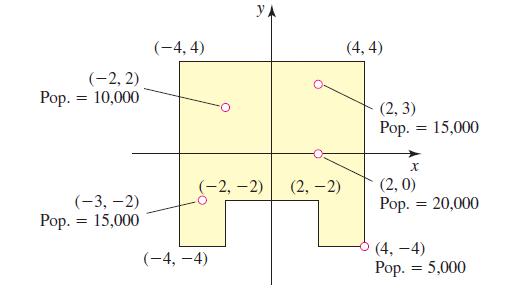
Geographers measure the geographical center of a country (which is the centroid) and the population center of a country (which is the center of mass computed with the population density). A hypothetical country is shown in the figure with the location and population of five towns. Assuming no one
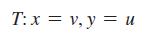
Let S = {(u, v): 0 ≤ u ≤ 1, 0 ≤ v ≤ 1} be a unit square in the uv-plane. Find the image of S in the xy-plane under the following transformations. T:x= v₁y = u
Use spherical coordinates to find the volume of the following regions.A ball of radius a > 0
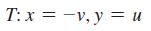
Let S = {(u, v): 0 ≤ u ≤ 1, 0 ≤ v ≤ 1} be a unit square in the uv-plane. Find the image of S in the xy-plane under the following transformations. T: x=-v, y = u
Consider the following two-and three-dimensional regions. Specify the surfaces and curves that bound the region, choose a convenient coordinate system, and compute the center of mass assuming constant density. All parameters are positive real numbers.A solid cone has a base with a radius of a and a
Consider the following two-and three-dimensional regions. Specify the surfaces and curves that bound the region, choose a convenient coordinate system, and compute the center of mass assuming constant density. All parameters are positive real numbers.A solid is enclosed by a hemisphere of radius a.
Consider the following two-and three-dimensional regions. Specify the surfaces and curves that bound the region, choose a convenient coordinate system, and compute the center of mass assuming constant density. All parameters are positive real numbers.A region is enclosed by an isosceles triangle
Compute the Jacobian J(u, v) of the following transformations. T: x = u + v, y = u - v
Consider the following two-and three-dimensional regions. Specify the surfaces and curves that bound the region, choose a convenient coordinate system, and compute the center of mass assuming constant density. All parameters are positive real numbers.A tetrahedron is bounded by the coordinate
Let S = {(u, v): 0 ≤ u ≤ 1, 0 ≤ v ≤ 1} be a unit square in the uv-plane. Find the image of S in the xy-plane under the following transformations. T:x= (u + v)/2, y = (u - v)/2
Consider the following two-and three-dimensional regions. Specify the surfaces and curves that bound the region, choose a convenient coordinate system, and compute the center of mass assuming constant density. All parameters are positive real numbers.A solid is enclosed by the upper half of an
Let S = {(u, v): 0 ≤ u ≤ 1, 0 ≤ v ≤ 1} be a unit square in the uv-plane. Find the image of S in the xy-plane under the following transformations. T:xu, y = 2v + 2
Compute the Jacobian J(u, v) of the following transformations. T:x=u²v², y = 2uv
Compute the Jacobian J(u, v) of the following transformations. T: x = 4uv, y = -2u + 3v
If possible, write iterated integrals in cylindrical coordinates for the following regions in the specified orders. Sketch the region of integration.The region above the cone z = r and below the sphere ρ = 2, for z ≥ 0, in the orders dz dr dθ, dr dz dθ, and dθ dz dr
Compute the Jacobian J(u, v) of the following transformations. T: x= 3u, y = 2v + 2
Choose the best coordinate system and find the volume of the following solid regions. Surfaces are specified using the coordinates that give the simplest description, but the simplest integration may be with respect to different variables.The region inside the sphere ρ = 1 and below the cone φ =
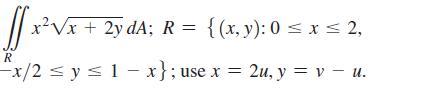
To evaluate the following integrals carry out the following steps.a. Sketch the original region of integration R and the new region S using the given change of variables.b. Find the limits of integration for the new integral with respect to u and v.c. Compute the Jacobian.d. Change variables and
Choose the best coordinate system and find the volume of the following solid regions. Surfaces are specified using the coordinates that give the simplest description, but the simplest integration may be with respect to different variables.That part of the solid cylinder r ≤ 2 that lies between
To evaluate the following integrals carry out the following steps.a. Sketch the original region of integration R and the new region S using the given change of variables.b. Find the limits of integration for the new integral with respect to u and v.c. Compute the Jacobian.d. Change variables and
Evaluate the following integrals using a change of variables of your choice. Sketch the original and new regions of integration, R and S. JI y4 dA; R is the region bounded by the hyperbolas xy = 1 and R xy = 4 and the lines y/x = 1 and y/x = 3.
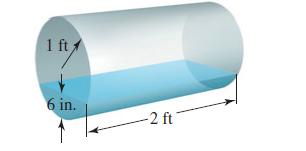
Before a gasoline-powered engine is started, water must be drained from the bottom of the fuel tank. Suppose the tank is a right circular cylinder on its side with a length of 2 ft and a radius of 1 ft. If the water level is 6 in above the lowest part of the tank, determine how much water must be
Evaluate the following integrals using a change of variables of your choice. Sketch the original and new regions of integration, R and S. JS (y² + xy - 2x²) dA; R is the region bounded by the lines R y = x, y = x - 3, y = -2x + 3, and y = -2x - 3.
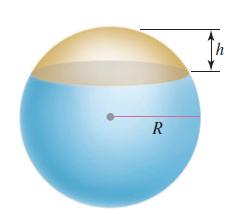
Use integration to find the volume of the following solids. In each case, choose a convenient coordinate system, find equations for the bounding surfaces, set up a triple integral, and evaluate the integral. Assume that a, b, c, r, R, and h are positive constants.Find the volume of the cap of a
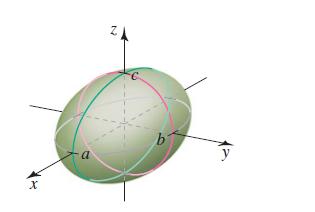
Use integration to find the volume of the following solids. In each case, choose a convenient coordinate system, find equations for the bounding surfaces, set up a triple integral, and evaluate the integral. Assume that a, b, c, r, R, and h are positive constants.Find the volume of a solid
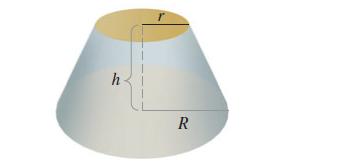
Use integration to find the volume of the following solids. In each case, choose a convenient coordinate system, find equations for the bounding surfaces, set up a triple integral, and evaluate the integral. Assume that a, b, c, r, R, and h are positive constants.Find the volume of a truncated
Use a change of variables to evaluate the following integrals. III yz dV; D is bounded by the planes x + 2y = 1, x + 2y = 2, D x -z = 0, x-z = 2, 2yz = 0, and 2y -z = 3.
Find the average value of the following functions on the given curves. f(x, y) = xe on the unit circle centered at the origin
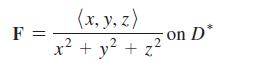
Determine whether the following vector fields are conservative on the specified region. If so, determine a potential function. Let R* and D* be open regions of R2 and R3, respectively, that do not include the origin. F || (x, y, z) x² + y² + z² on D*
Use a change of variables to evaluate the following integrals. x dV; D is bounded by the planes y - 2x = 0, y 2x = 1, D z - 3y = 0, z - 3y = 1,2 - 4x = 0, and z 4x = 3.
Consider the following regions R and vector fields F.a. Compute the two-dimensional divergence of the vector field.b. Evaluate both integrals in Green’s Theorem and check for consistency.c. State whether the vector field is source free. F = (x, y); R = {(x, y): x² + y² ≤ 4}
Use integration to find the volume of the following solids. In each case, choose a convenient coordinate system, find equations for the bounding surfaces, set up a triple integral, and evaluate the integral. Assume that a, b, c, r, R, and h are positive constants.Find the volume of a solid right
Find the average value of the following functions on the given curves. f(x, y) = √4 + 9y²/3 on the curve y = x³/2, for 0 ≤ x ≤ 5
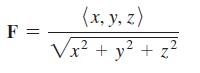
Sketch a few representative vectors of the following vector fields. F = (x, y, z) √x² + y² + 2²
Determine whether the following vector fields are conservative on the specified region. If so, determine a potential function. Let R* and D* be open regions of R2 and R3, respectively, that do not include the origin. F = (y + 2, x + 2, x + y) on R³
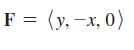
Sketch a few representative vectors of the following vector fields. F = (y, -x, 0)
Find the average value of the following functions on the given curves. f(x, y) = x² + 4y² on the circle of radius 9 centered at the origin
Find the average value of the following functions on the given curves. f(x, y) = x + 2y on the line segment from (1, 1) to (2,5)
Use a line integral on the boundary to find the area of the following regions.The region bounded by the curve r(t) = (t(11²), 1-²), for -1 ≤ t ≤ 1
Explain with pictures what is meant by a simple curve and a closed curve.
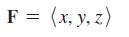
Sketch a few representative vectors of the following vector fields. F = (x, y, z)
Determine whether the following vector fields are conservative on the specified region. If so, determine a potential function. Let R* and D* be open regions of R2 and R3, respectively, that do not include the origin. F = (yz, xz, xy) on R³
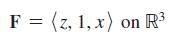
Determine whether the following vector fields are conservative on the specified region. If so, determine a potential function. Let R* and D* be open regions of R2 and R3, respectively, that do not include the origin. F = (z, 1, x) on R³
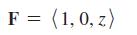
Sketch a few representative vectors of the following vector fields. F = (1, 0, z)
Use a line integral on the boundary to find the area of the following regions.The region bounded by the parabolas r(t) = (t, 21²) and r(t) = (t, 12 - 1²), for-2≤ t ≤2
a. Find a parametric description for C in the form r(t) = (x(t), y(t)), if it is not given.b. Evaluate |r'(t)|.c. Convert the line integral to an ordinary integral with respect to the parameter and evaluate it. [ (2x - 3y) ds; C is the line segment from (-1,0) to (0, 1) followed by the line segment
Use a line integral on the boundary to find the area of the following regions. {(x, y): x²/25 + y²/9 ≤ 1}
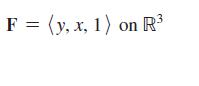
Determine whether the following vector fields are conservative on the specified region. If so, determine a potential function. Let R* and D* be open regions of R2 and R3, respectively, that do not include the origin. F = (y, x, 1) on R³
a. Find a parametric description for C in the form r(t) = (x(t), y(t)), if it is not given.b. Evaluate |r'(t)|.c. Convert the line integral to an ordinary integral with respect to the parameter and evaluate it. [₁ quadrant, oriented counterclockwise. xy ds; C is the portion of the
Use a line integral on the boundary to find the area of the following regions. {(x, y): x² + y² ≤ 16}
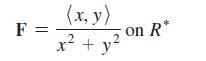
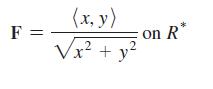
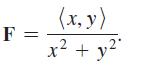
Determine whether the following vector fields are conservative on the specified region. If so, determine a potential function. Let R* and D* be open regions of R2 and R3, respectively, that do not include the origin. F = (x, y) x² + y² 2 on R*
Determine whether the following vector fields are conservative on the specified region. If so, determine a potential function. Let R* and D* be open regions of R2 and R3, respectively, that do not include the origin. F = (x, y) √x² + y² on R*
a. Find a parametric description for C in the form r(t) = (x(t), y(t)), if it is not given.b. Evaluate |r'(t)|.c. Convert the line integral to an ordinary integral with respect to the parameter and evaluate it. [x² + y2 ds; ds; C is the line segment from (1, 1) to (10, 10).
a. Find a parametric description for C in the form r(t) = (x(t), y(t)), if it is not given.b. Evaluate |r'(t)|.c. Convert the line integral to an ordinary integral with respect to the parameter and evaluate it. (xy)¹/³ ds; C is the curve y = x², for 0 ≤ x ≤ 1.
Determine whether the following vector fields are conservative on the specified region. If so, determine a potential function. Let R* and D* be open regions of R2 and R3, respectively, that do not include the origin. F = (x² - xy + y) on R² r2 2
Use a line integral on the boundary to find the area of the following regions.A region bounded by an ellipse with semimajor and semiminor axes of length 6 and 4, respectively.
Use a line integral on the boundary to find the area of the following regions.A disk of radius 5
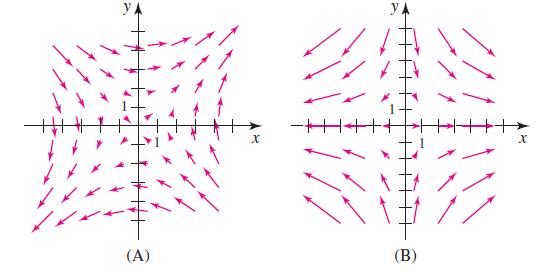
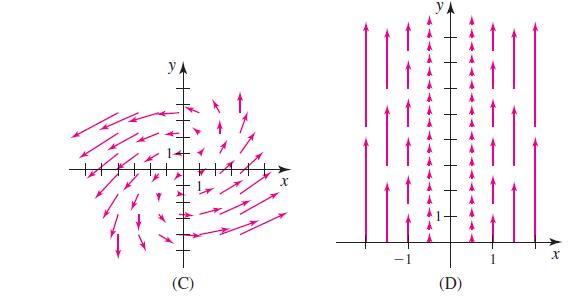
Match vector fields a–d with graphs A–D. a. F = c. F = (0, x²) (2x, -y) b. F= (xy, x) d. F = (y,x)
Consider the following regions R and vector fields F.a. Compute the two-dimensional curl of the vector field.b. Evaluate both integrals in Green’s Theorem and check for consistency.c. State whether the vector field is conservative. F = (0, x² + y²); R = {(x, y): x² + y² ≤ 1}
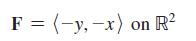
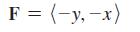
Determine whether the following vector fields are conservative on the specified region. If so, determine a potential function. Let R* and D* be open regions of R2 and R3, respectively, that do not include the origin. F = (-y, -x) on R²
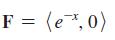
Sketch the following vector fields. F = (e ³, 0)
a. Find a parametric description for C in the form r(t) = (x(t), y(t)), if it is not given.b. Evaluate |r'(t)|.c. Convert the line integral to an ordinary integral with respect to the parameter and evaluate it. [ (x2 + y2) ds; C is the line segment from (0, 0) to (5,5).
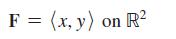
Determine whether the following vector fields are conservative on the specified region. If so, determine a potential function. Let R* and D* be open regions of R2 and R3, respectively, that do not include the origin. F = (x, y) on R²
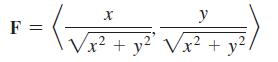
Sketch the following vector fields. F = X y 2 x +y Vx? +y? Vx
a. Find a parametric description for C in the form r(t) = (x(t), y(t)), if it is not given.b. Evaluate |r'(t)|.c. Convert the line integral to an ordinary integral with respect to the parameter and evaluate it. Jo (x² + y2) ds; C is the circle of radius 4 centered at (0, 0).
Evaluate the following line integrals. [.x² x²y ds; C is the line r(s) = (s/V2, 1-s/√2), for 0 ≤S≤ 4.
Consider the following regions R and vector fields F.a. Compute the two-dimensional curl of the vector field.b. Evaluate both integrals in Green’s Theorem and check for consistency. c. State whether the vector field is conservative. F = (2xy, x² - y2); R is the region bounded by y = x(2 -
Determine whether the following vector fields are conservative on R2. F = (2x³ + xy², 2y³ + x²y)
Consider the following regions R and vector fields F.a. Compute the two-dimensional curl of the vector field.b. Evaluate both integrals in Green’s Theorem and check for consistency.c. State whether the vector field is conservative. F = (-3y, 3x); R is the triangle with vertices (0, 0), (1, 0),
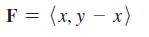
Sketch the following vector fields. F = (x, y - x)
Evaluate the following line integrals. √(x²- (x²2y2) ds; C is the line r(s) = (s/√2, s/√2), for 0 ≤S≤ 4.
Consider the following regions R and vector fields F.a. Compute the two-dimensional curl of the vector field.b. Evaluate both integrals in Green’s Theorem and check for consistency.c. State whether the vector field is conservative. F = (2y, -2x); R is the region bounded by y = sin x and y = 0,
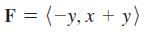
Determine whether the following vector fields are conservative on R2. F = (-y, x + y)
Determine whether the following vector fields are conservative on R2. F = (e cos y, e* sin y)
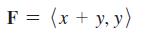
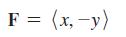
Sketch the following vector fields. F = (x + y, y)
Evaluate the following line integrals. xy ds; C is the unit circle r(s) = (cos s, sin s), for с 0 ≤S≤ 2TT.
Consider the following regions R and vector fields F.a. Compute the two-dimensional curl of the vector field.b. Evaluate both integrals in Green’s Theorem and check for consistency.c. State whether the vector field is conservative. F = (y,x); R is the square with vertices (0, 0), (1, 0), (1,
Consider the following regions R and vector fields F.a. Compute the two-dimensional curl of the vector field.b. Evaluate both integrals in Green’s Theorem and check for consistency.c. State whether the vector field is conservative. F = (x,y); R = {(x, y): x² + y² ≤ 2}
Determine whether the following vector fields are conservative on R2. F = (-y, -x)
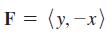
Sketch the following vector fields. F = (y₂-x)
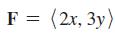
Sketch the following vector fields. F = (2x, 3y)
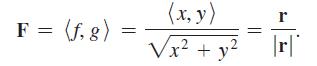
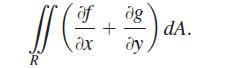
Consider the radial fielda. Explain why the conditions of Green’s Theorem do not apply to F on a region that includes the origin.b. Let R be the unit disk centered at the origin and computec. Evaluate the line integral in the flux form of Green’s Theorem on the boundary of R.d. Do the results
Determine whether the following vector fields are conservative on R2. F = (x, y)
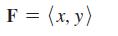
Sketch the following vector fields. F = (x, y)
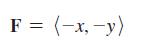
Sketch the following vector fields. F = (-x, -y)
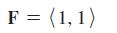
Determine whether the following vector fields are conservative on R2. F = (1, 1)
Consider the radial fielda. Verify that the divergence of F is zero, which suggests that the double integral in the flux form of Green’s Theorem is zero.b. Use a line integral to verify that the outward flux across the unit circle of the vector field is 2π.c. Explain why the results of parts (a)
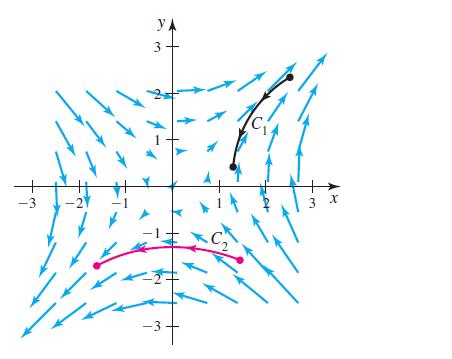
Determine whether ∫C F • dr along the paths C1 and C2 shown in the following vector fields is positive or negative. Explain your reasoning. to // // YA 3 14 4-2 3+ -3 C₂ 3 X
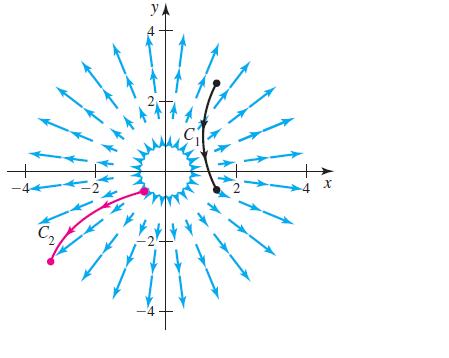
Determine whether ∫C F • dr along the paths C1 and C2 shown in the following vector fields is positive or negative. Explain your reasoning. -4 YA 2 X
Sketch the oriented quarter circle from (1, 0) to (0, 1) and supply a parameterization for the curve. Draw the unit normal vector (as defined in the text) at several points on the curve.
Discuss one of the parallels between a conservative vector field and a source free vector field.
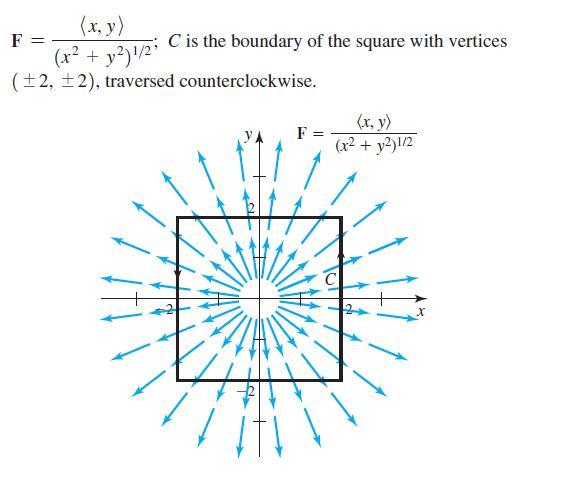
Consider the following vector fields F and closed oriented curves C in the plane (see figures).a. Based on the picture, make a conjecture about whether the circulation of F on C is positive, negative, or zero.b. Compute the circulation and interpret the result. (x, y) (x² + y²)¹/2³ (±2, ±2),
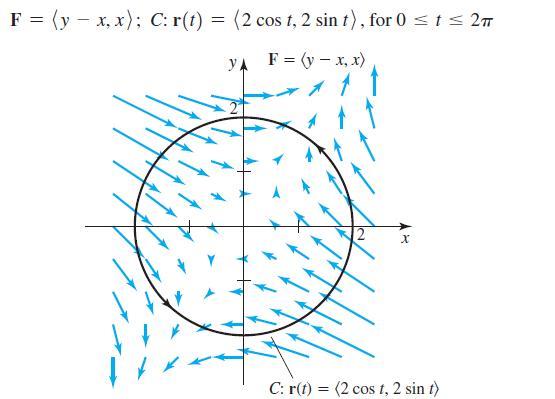
Consider the following vector fields F and closed oriented curves C in the plane (see figures).a. Based on the picture, make a conjecture about whether the circulation of F on C is positive, negative, or zero.b. Compute the circulation and interpret the result. F = (yx,x); C: r(t) = (2 cos t, 2 sin
How do you calculate the flux of a two-dimensional vector field across a smooth oriented curve C?
R3 Given the force field F, find the work required to move an object on the given oriented curve. F = (x, y, z) (x² + y² + z²)3/2 (10, 10, 10) on the line segment from (1, 1, 1) to
Sketch a two-dimensional vector field that has zero divergence everywhere in the plane.
Given a two-dimensional vector field F and a smooth oriented curve C, what is the meaning of the flux of F across C?
Sketch a two-dimensional vector field that has zero curl everywhere in the plane.
Showing 200 - 300
of 8578
1
2
3
4
5
6
7
8
9
10
11
12
13
14
15
Last
Step by Step Answers

 Get 50% OFF
Claim Now
Get 50% OFF
Claim Now