New Semester
Started
Get
50% OFF
Study Help!
--h --m --s
Claim Now
Question Answers
Textbooks
Find textbooks, questions and answers
Oops, something went wrong!
Change your search query and then try again
S
Books
FREE
Study Help
Expert Questions
Accounting
General Management
Mathematics
Finance
Organizational Behaviour
Law
Physics
Operating System
Management Leadership
Sociology
Programming
Marketing
Database
Computer Network
Economics
Textbooks Solutions
Accounting
Managerial Accounting
Management Leadership
Cost Accounting
Statistics
Business Law
Corporate Finance
Finance
Economics
Auditing
Tutors
Online Tutors
Find a Tutor
Hire a Tutor
Become a Tutor
AI Tutor
AI Study Planner
NEW
Sell Books
Search
Search
Sign In
Register
study help
mathematics
precalculus 1st
Calculus For Scientists And Engineers Early Transcendentals 1st Edition William L Briggs, Bernard Gillett, Bill L Briggs, Lyle Cochran - Solutions
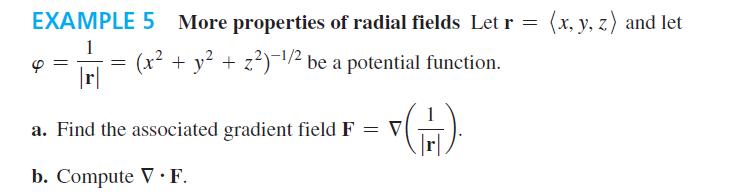
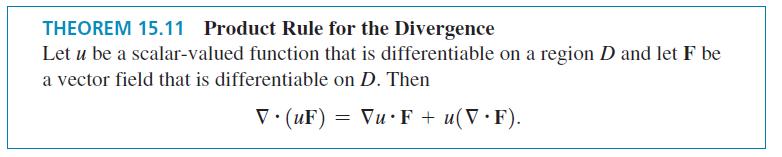
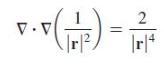
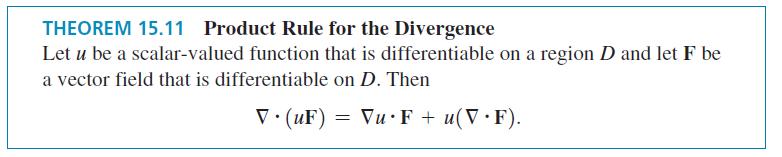
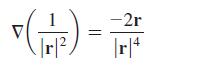
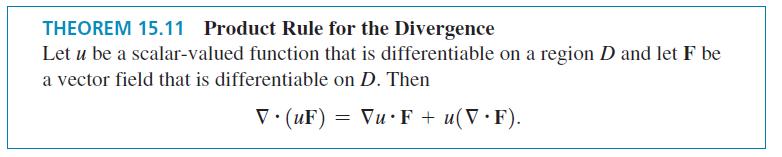
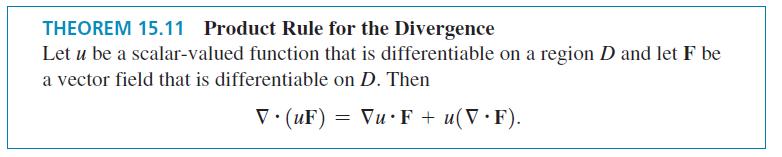
Prove the following identities. Use Theorem 15.11 (Product Rule) whenever possible.Data from in Example 5Data from in Theorem 15.11 (+) = -3r 15 |r|5 (used in Example 5)
Find the area of the following surfaces using an explicit description of the surface. The cone z² = 4(x² + y2), for 0 ≤ z≤ 4
Use either form of Green’s Theorem to evaluate the following line integrals. $ 3x³0 3x³ dy - 3y³ dx; C is the circle of radius 4 centered at the origin with clockwise orientation.
Find the area of the following surfaces using an explicit description of the surface. The trough z = x², for-2 ≤ x ≤ 2,0 ≤ y ≤ 4
Compute the curl of the following vector fields. F = (3xz³e², 2xz³e², 3xz²er²)
Compute the curl of the following vector fields. F (x, y, z) (x² + y² + z²)¹/2 r
Find the area of the following surfaces using an explicit description of the surface. The part of the hyperbolic paraboloid z = x² - y² above the sec- tor R = {(r, 0): 0 ≤ r ≤ 4,-π/4 ≤ 0 ≤ π/4}
Find the area of the following surfaces using an explicit description of the surface. The paraboloid z = 2(x² + y2), for 0 ≤z≤ 8
Consider the following vector fields.a. Compute the circulation on the boundary of the region R (with counterclockwise orientation).b. Compute the outward flux across the boundary of R. F = r/r], where r = (x, y) and R is the half-annulus ≤ 0 ≤ T } {(r, 0): 1 ≤ r ≤ 3,0
Compute the curl of the following vector fields. F = (z² sin y, xz² cos y, 2xz sin y)
Prove the following identities. Use Theorem 15.11 (Product Rule) whenever possible.Data from in Theorem 15.11 ♥ * ♥ ੧ (72) = 2
Prove the following identities. Use Theorem 15.11 (Product Rule) whenever possible.Data from in Theorem 15.11 = (半)△ -2r 바
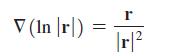
Prove the following identities. Use Theorem 15.11 (Product Rule) whenever possible.Data from in Theorem 15.11 V(In |rl) = r | 2
Using an explicit description Evaluate the surface integral ∫∫s f(x, y, z) dS using an explicit representation of the surface. f(x, y, z) = 25x² - y²; S is the hemisphere centered at the origin with radius 5, for z ≥ 0.
Using an explicit description Evaluate the surface integral ∫∫s f(x, y, z) dS using an explicit representation of the surface. f(x, y, z) = xy; S is the plane z = 2 - x - y in the first octant.
Consider the following vector fields.a. Compute the circulation on the boundary of the region R (with counterclockwise orientation).b. Compute the outward flux across the boundary of R. F = (-sin y, x cos y), where R is the square {(x, y): 0 ≤ x ≤ π/2,0 ≤ y ≤ π/2}
Using an explicit description Evaluate the surface integral ∫∫s f(x, y, z) dS using an explicit representation of the surface. f(x, y, z) = x² + y²; S is the paraboloid z = x² + y², for 0 ≤z≤ 4.
Using an explicit description Evaluate the surface integral ∫∫s f(x, y, z) dS using an explicit representation of the surface. f(x, y, z)= e; S is the plane z = 8 - x - 2y in the first octant.
Compute the divergence and curl of the following vector fields. State whether the field is source free or irrotational. 2 F = rr = (x, y, z) √x² + y² + z²
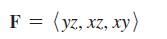
Compute the divergence and curl of the following vector fields. State whether the field is source free or irrotational. F = (yz, xz, xy)
Compute the divergence and curl of the following vector fields. State whether the field is source free or irrotational. F = (sin xy, cos yz, sin xz)
Consider the following vector fields, where r = (x, y, z).a. Compute the curl of the field and verify that it has the same direction as the axis of rotation.b. Compute the magnitude of the curl of the field. F = (1, -2, -3) X r
Compute the divergence and curl of the following vector fields. State whether the field is source free or irrotational. F = (2xy + z4, x², 4xz³)
Find the flux of the following vector fields across the given surface with the specified orientation. You may use either an explicit or parametric description of the surface. F = (x, y, z) across the slanted face of the tetrahedron z = 10 2x - 5y in the first octant; normal vectors point in
Find the flux of the following vector fields across the given surface with the specified orientation. You may use either an explicit or parametric description of the surface. F = (0, 0, -1) across the slanted face of the tetrahedron z = 4 - x - y in the first octant; normal vectors point in
Find the flux of the following vector fields across the given surface with the specified orientation. You may use either an explicit or parametric description of the surface. F = (e, 2z, xy) across the curved sides of the surface S = {(x, y, z): z = cos y, y ≤ 7,0 ≤ x ≤ 4}, where
Find the flux of the following vector fields across the given surface with the specified orientation. You may use either an explicit or parametric description of the surface. F = (x, y, z) across the slanted surface of the cone z² = x² + y², for 0 ≤ z ≤ 1; normal vectors point in
Find the flux of the following vector fields across the given surface with the specified orientation. You may use either an explicit or parametric description of the surface. F = r/r³ across the sphere of radius a centered at the origin, where r = (x, y, z); the normal vectors point outward.
Find the flux of the following vector fields across the given surface with the specified orientation. You may use either an explicit or parametric description of the surface. F = (-y, x, 1) across the cylinder y = x², for 0 ≤ x ≤ 1, 0 ≤ z ≤ 4; normal vectors point in the positive
Evaluate the following integrals using the method of your choice. Assume normal vectors point either outward or in the positive z-direction. V In|rn ds, where S is the hemisphere x² + y² + z² = a², for z ≥ 0, and where r = (x, y, z)
Evaluate the following surface integrals. (1+yz) dS; S is the plane x + y + z = 2 in the first octant.
Evaluate the following surface integrals. (0, y, z) n dS; S is the curved surface of the cylinder y² + z² = a², [x] ≤ 8 with outward normal vectors.
Find the flux of the following vector fields across the given surface. Assume the vectors normal to the surface point outward. F = (x, y, z) across the curved surface of the cylinder x² + y² = 1, for |z| ≤ 8
Evaluate the following surface integrals. ff (x - y (x - y + z) dS; S is the entire surface including the base of the hemisphere x² + y² + z² = 4, for z ≥ 0.
Evaluate the following integrals using the method of your choice. Assume normal vectors point either outward or in the positive z-direction. srds, where S is the cylinder x² + y² = 4, for 0 ≤ z ≤ 8, and where r = (x, y, z)
Find the flux of the following vector fields across the given surface. Assume the vectors normal to the surface point outward. F = r/|r| across the sphere of radius a centered at the origin, where r = (x, y, z)
Evaluate the following integrals using the method of your choice. Assume normal vectors point either outward or in the positive z-direction. xyz ds, where S is that part of the plane z = 6 − y that lies in the cylinder x² + y² = 4
Evaluate the following integrals using the method of your choice. Assume normal vectors point either outward or in the positive z-direction. (x, 0, z) √x² + z² lyl ≤2 ndS, where S is the cylinder x² + z² = a²,
Use Stokes’ Theorem to evaluate the surface integral ∫∫s (∇× F) • n ds. Assume that n is the outward normal. F = (-2, x, y), where S is the hyperboloid z = 10 V1 + x² + y², for ≥ 0 -
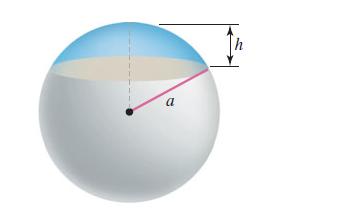
A sphere of radius a is sliced parallel to the equatorial plane at a distance a - h from the equatorial plane (see figure). Find the general formula for the surface area of the resulting spherical cap (excluding the base) with thickness h. D
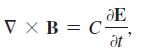
One of Maxwell’s equations for electromagnetic waves (also called Ampere’s Law) iswhere E is the electric field, B is the magnetic field, and C is a constant.a. Show that the fieldssatisfy the equation for constants A, k, and ω, provided ω = k/C.b. Make a rough sketch showing the directions
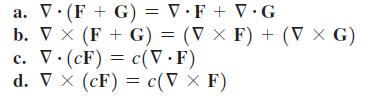
Prove the following properties of the divergence and curl. Assume F and G are differentiable vector fields and c is a real number. a. V. (F+G) = V.F + V.G b. VX (FG) = (VX F) + (V x G) c. V. (CF) = c(V.F) d. VX (CF) = c(VX F)
Prove the following identities. Assume that φ is a differentiable scalar-valued function and F and G are differentiable vector fields, all defined on a region of R3. V. (F) = Vo F V F (Product Rule)
Prove the following identities. Assume that φ is a differentiable scalar-valued function and F and G are differentiable vector fields, all defined on a region of R3. V. (FX G) = G (VXF) - F. (V x G)
Prove the following identities. Assume that φ is a differentiable scalar-valued function and F and G are differentiable vector fields, all defined on a region of R3. VX (OF) = (Vox F) + (V x F) (Product Rule)
Prove the following identities. Assume that φ is a differentiable scalar-valued function and F and G are differentiable vector fields, all defined on a region of R3. VX (FX G) = (G.V)FG(V.F) (F.V)G+ F(V.G)
Prove the following identities. Assume that φ is a differentiable scalar-valued function and F and G are differentiable vector fields, all defined on a region of R3. V(F G) (GV)F+ (FV)G + GX (VX F) + = FX (V x G)
Use Stokes’ Theorem to evaluate the surface integral ∫∫s (∇× F) • n ds. Assume that n is the outward normal. F = (x²z², y², xz), where S is the hemisphere x² + y² + z² = 4, for y ≥ 0 2 2
Prove that for a real number p, with r = (x, y, z), V. (x, y, z) |r|p 3- P |r|P
Prove that for a real number p, with r = (x, y, z), V. V (P) = P(p-1) |r|p+2
Prove that for a real number p, with r = (x, y, z). V (P) = -pr r/P+2°
Prove the following identities. Assume that φ is a differentiable scalar-valued function and F and G are differentiable vector fields, all defined on a region of R3. VX (VXF) = V(V.F) (VV)F -
Write the interval (- ∞, 2) in set notation and draw it on a number line.
Give the definition of |x|.
Write an equation of the set of all points that are a distance 5 units from the point (2, 3).
What are the possible solution sets of the equation x² + y² + Cx + Dy + E = 0?
Give an equation of the upper half of the circle centered at the origin with radius 6?
Explain how to find the distance between two points whose coordinates are known.
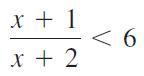
Solve the following inequalities and draw the solution on a number line. x + 1 x + 2 < 6
Simplify or evaluate the following expressions without a calculator. (1/8)-2/3
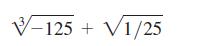
Simplify or evaluate the following expressions without a calculator. V-125+ V1/25
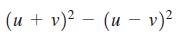
Simplify or evaluate the following expressions without a calculator. (u + v)² – (u - v)²
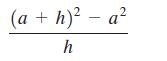
Simplify or evaluate the following expressions without a calculator. (a+h)² - a² h
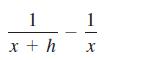
Simplify or evaluate the following expressions without a calculator. 1 x + h 1 X
Give an equation of the line with slope m that passes through the point (4, -2).
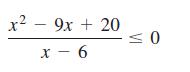
Solve the following inequalities and draw the solution on a number line. 42 - 9x + 20 x-6 ≤0
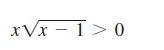
Solve the following inequalities and draw the solution on a number line. xVx - 1 > 0
Give an equation of the line with slope m and y-intercept (0, 6).
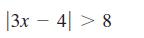
Solve the following inequalities. Then draw the solution on a number line and express it using interval notation. |3x4> 8
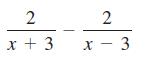
Simplify or evaluate the following expressions without a calculator. 2 x + 3 2 x - 3
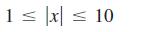
Solve the following inequalities. Then draw the solution on a number line and express it using interval notation. 1 ≤ x ≤ 10
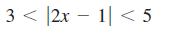
Solve the following inequalities. Then draw the solution on a number line and express it using interval notation. 3 < 2x1 < 5
What is the relationship between the slopes of two parallel lines?
What is the relationship between the slopes of two perpendicular lines?
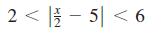
Solve the following inequalities. Then draw the solution on a number line and express it using interval notation. 2 < 5 < 6
Determine f(x) lim - if f(x)→ 100,000 and g(x) - x→x g(x) →∞as x→ ∞0.
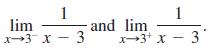
Evaluate lim x3x3 1 x-3¹ x 3 and lim
Evaluate lim e*, lim e*, and lim ex. x →∞ X→ X-18
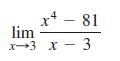
Evaluate the following limits analytically. x4 -81 lim x3 x3
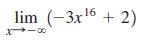
Determine the following limits. Determine the following limits. lim (-3x¹6 + 2) 1110
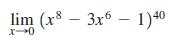
Evaluate the following limits and justify your answer. lim (x83x6-1) 4⁰ 40 x-0
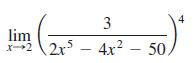
Evaluate the following limits and justify your answer. lim 3 22x³4x² - 50, 4
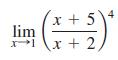
Evaluate the following limits and justify your answer. lim *1 x + 5 x + 2 4
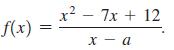
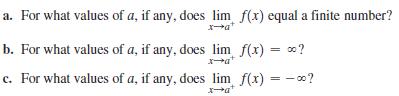
Let f(x) = x² - 7x + 12 x - a
To evaluate the following integrals carry out the following steps.a. Sketch the original region of integration R and the new region S using the given change of variables.b. Find the limits of integration for the new integral with respect to u and v.c. Compute the Jacobian.d. Change variables and
To evaluate the following integrals carry out the following steps.a. Sketch the original region of integration R and the new region S using the given change of variables.b. Find the limits of integration for the new integral with respect to u and v.c. Compute the Jacobian.d. Change variables and
Evaluate the following line integrals. (x + y) ds; C is the circle of radius 1 centered at (0, 0).
R3 Given the force field F, find the work required to move an object on the given oriented curve. F || (x, y, z) on the line segment from (1, 1, 1) to (8,4, 2) x² + y² + z²
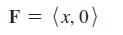
Sketch the following vector fields. F = (x, 0)
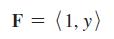
Sketch the following vector fields. F = (1, y)
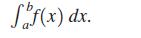
Explain how a line integral differs from the single-variable integral Sof(x) dx.
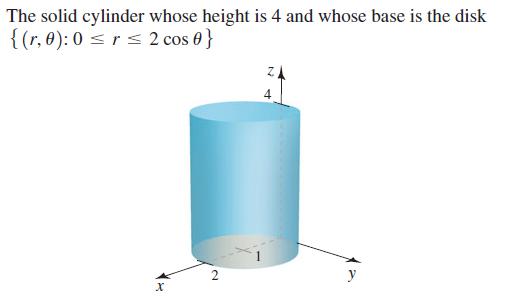
Use integration in cylindrical coordinates to find the volume of the following regions. The solid cylinder whose height is 4 and whose base is the disk {(r, 0): 0 ≤ r ≤ 2 cos 0} X 2 y
Give three equivalent properties of conservative vector fields.
Explain how to calculate the circulation of a vector field on a closed smooth oriented curve.
Why does a two-dimensional vector field with zero divergence on a region have zero outward flux across a closed curve that bounds the region?
Given a vector field F and a closed smooth oriented curve C, what is the meaning of the circulation of F on C?
Why does a two-dimensional vector field with zero curl on a region have zero circulation on a closed curve that bounds the region?
How do you use a line integral to compute the area of a plane region?
Explain with pictures what is meant by a connected region and a simply connected region.
Evaluate the following integrals in spherical coordinates. 0 2π π/2 p2 cos p 0 0 p² sin o dp do de
Showing 100 - 200
of 8578
1
2
3
4
5
6
7
8
9
10
11
12
13
14
15
Last
Step by Step Answers

 Get 50% OFF
Claim Now
Get 50% OFF
Claim Now