New Semester
Started
Get
50% OFF
Study Help!
--h --m --s
Claim Now
Question Answers
Textbooks
Find textbooks, questions and answers
Oops, something went wrong!
Change your search query and then try again
S
Books
FREE
Study Help
Expert Questions
Accounting
General Management
Mathematics
Finance
Organizational Behaviour
Law
Physics
Operating System
Management Leadership
Sociology
Programming
Marketing
Database
Computer Network
Economics
Textbooks Solutions
Accounting
Managerial Accounting
Management Leadership
Cost Accounting
Statistics
Business Law
Corporate Finance
Finance
Economics
Auditing
Tutors
Online Tutors
Find a Tutor
Hire a Tutor
Become a Tutor
AI Tutor
AI Study Planner
NEW
Sell Books
Search
Search
Sign In
Register
study help
mathematics
precalculus
Calculus Of A Single Variable 11th Edition Ron Larson, Bruce H. Edwards - Solutions
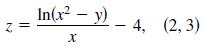
In Exercises 15–20, find the gradient of the function at the given point. Z= In(x²-y)-4, (2,3) X
In Exercises 15–18, find z f(x, y) and use the total differential to approximate the quantity. (4.03)² + (3.1)² - (3.1)²-√4² +3²
In Exercises 9–24, find all relative extrema and saddle points of the function. Use the Second Partials Test where applicable.f(x, y) = 1/2 xy
In Exercises 23–26, differentiate implicitly to find dy/dx. In√√x² + y² + x + y = 4
In Exercises 7–16, find an equation of the tangent plane to the surface at the given point.x2 + y2 - 5z2 = 15, (-4, -2, 1)
In Exercises 9–24, find all relative extrema and saddle points of the function. Use the Second Partials Test where applicable.f(x, y) = 7x2 + 2y2 - 7x + 16y - 13
In Exercises 9–24, find all relative extrema and saddle points of the function. Use the Second Partials Test where applicable.f(x, y) = x5 + y5
In Exercises 15–20, find the gradient of the function at the given point.z = cos(x2 + y2), (3, -4)
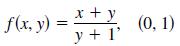
In Exercises 29–38, find the gradient of the function and the maximum value of the directional derivative at the given point. f(x, y) = x + y y + l' 1 (0, 1)
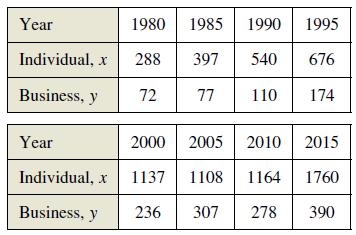
The table shows the gross income tax collections (in billions of dollars) by the Internal Revenue Service for individuals x and businesses y for selected years.(a) Use the regression capabilities of a graphing utility to find the least squares regression line for the data.(b) Use the model to
In Exercises 15–20, find the gradient of the function at the given point.w = 6xy - y2 + 2xyz3, (-1, 5, -1)
If fx and fy are each continuous in an open region R, is f(x, y) continuous in R? Explain.
In Exercises 25–28, find the least squares regression line for the points. Use the regression capabilities of a graphing utility to verify your results. Use the graphing utility to plot the points and graph the regression line.(0, 0), (1, 1), (3, 6), (4, 8), (5, 9)
In Exercises 17–26,(a) Find an equation of the tangent plane to the surface at the given point and(b) Find a set of symmetric equations for the normal line to the surface at the given point.x2 + 2y2 + z2 = 7, (1, -1, 2)
In Exercises 9–24, find all relative extrema and saddle points of the function. Use the Second Partials Test where applicable.f(x, y) = -4(x2 + y2 + 81)1/4
In Exercises 9–24, find all relative extrema and saddle points of the function. Use the Second Partials Test where applicable.h(x, y) = (x2 + y2)1/3 + 2
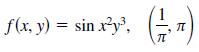
In Exercises 29–38, find the gradient of the function and the maximum value of the directional derivative at the given point. (17/₁7) *Axis = (¹x) f
In Exercises 29–38, find the gradient of the function and the maximum value of the directional derivative at the given point. f(x, y, z)=√√√x² + y² + z², (1,4,2)
In Exercises 17–26,(a) Find an equation of the tangent plane to the surface at the given point and(b) Find a set of symmetric equations for the normal line to the surface at the given point.6xy = z, (-1, 1, -6)
In Exercises 25–28, use a computer algebra system to graph the surface and locate any relative extrema and saddle points.z = cos x + sin y, -π/2 < x < π/2, -π < y < π
In Exercises 29–38, find the gradient of the function and the maximum value of the directional derivative at the given point. W 1 Л1 - x2 — y² — z² (0, 0, 0)
In Exercises 25–28, find the least squares regression line for the points. Use the regression capabilities of a graphing utility to verify your results. Use the graphing utility to plot the points and graph the regression line.(0, 4), (4, 1), (7, -3)
In Exercises 29–38, find the gradient of the function and the maximum value of the directional derivative at the given point.f(x, y) = y2 - x√y, (0, 3)
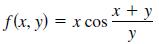
A function f is homogeneous of degree n when f(tx, ty) = tnf(x, y). In Exercises 39– 42,(a) Show that the function is homogeneous and determine n, and(b) Show that xfx(x, y) + yfy(x, y) = nf(x, y). x+y y f(x, y) = x cos -
In Exercises 35–38,(a) Find the critical points,(b) Test for relative extrema,(c) List the critical points for which the Second Partials Test fails, and(d) Use a computer algebra system to graph the function, labeling any extrema and saddle points.f(x, y) = x3 + y3
In Exercises 29 and 30, use Lagrange multipliers to find the highest point on the curve of intersection of the surfaces.Cone: x2 + y2 - z2 = 0Plane: x + 2z = 4
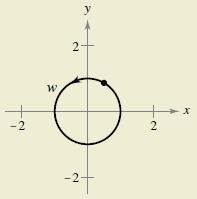
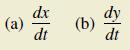
The path of an object represented by w = f(x, y) is shown, where x and y are functions of t. The point on the graph represents the position of the object.Determine whether each of the following is positive, negative, or zero. -2 W 2 y -2. 2 X
In Exercises 27–34, differentiate implicitly to find the first partial derivatives of z.tan(x + y) + cos z = 2
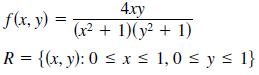
In Exercises 39–46, find the absolute extrema of the function over the region R. (In each case, R contains the boundaries.) Use a computer algebra system to confirm your results. 4xy (x² + 1)(y² + 1) R = {(x, y): 0 ≤ x ≤ 1,0 ≤ y ≤ 1} f(x, y) =
In Exercises 35–38, differentiate implicitly to find the first partial derivatives of w.7xy + yz2 - 4wz + w2z + w2x - 6 = 0
Let F(u, v) be a function of two variables. Find a formula for f'(x) when(a) f(x) = F(4x, 4) and (b) f(x) = F(-2x, x2).
Consider the function(a) Analytically verify that the level curve of f(x, y) at the level c = 2 is a circle.(b) At the point (√3, 2) on the level curve for which c = 2, sketch the vector showing the direction of the greatest rate of increase of the function. To print a graph of the level curve,
In Exercises 29–38, find the gradient of the function and the maximum value of the directional derivative at the given point.w = xy2z2, (2, 1, 1)
In Exercises 29–38, find the gradient of the function and the maximum value of the directional derivative at the given point.f(x, y, z) = xeyz, (2, 0, -4)
A function f is homogeneous of degree n when f(tx, ty) = tnf(x, y). In Exercises 39– 42,(a) Show that the function is homogeneous and determine n, and(b) Show that xfx(x, y) + yfy(x, y) = nf(x, y).f(x, y) = 2x2 - 5xy
In Exercises 39–46, find the absolute extrema of the function over the region R. (In each case, R contains the boundaries.) Use a computer algebra system to confirm your results.f(x, y) = x2 - 4xy + 5R = {(x, y): 1 ≤ x ≤ 4, 0 ≤ y ≤ 2}
Draw the level curves for f(x, y) = x2 + y2 = c for c = 1, 2, 3, and 4, and sketch the constraint x + y = 2. Explain analytically how you know that the extremum of f(x, y) = x2 + y2 at (1, 1) is a minimum instead of a maximum.
Find a point on the ellipsoid 3x2 + y2 + 3z2 = 1 where the tangent line is parallel to the plane -12x + 2y + 6z = 0.
Find a point on the ellipsoid x2 + 4y2 + z2 = 9 where the tangent plane is perpendicular to the line with parametric equations x = 2 - 4t, y = 1 + 8t, and z = 3 - 2t.
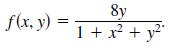
In Exercises 21–32, find the domain and range of the function. = 2 x + y xy
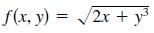
In Exercises 11–40, find both first partial derivatives. f(x, y) = √2x + y³
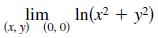
In Exercises 25–36, find the limit (if it exists). If the limit does not exist, explain why. lim (x, y) (0,0) In(x² + y²)
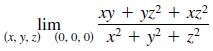
In Exercises 25–36, find the limit (if it exists). If the limit does not exist, explain why. xy + yz² + xz² lim (x, y, z) (0,0,0) x² + y² + z²
In Exercises 21–32, find the domain and range of the function.f(x, y) = √9 - 6x2 + y2
In Exercises 21–32, find the domain and range of the function.f(x, y) = ln(5 - x - y)
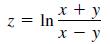
In Exercises 11–40, find both first partial derivatives. z = Z = In x + y x - y
In Exercises 21–32, find the domain and range of the function.f(x, y) = √4 - x2 - y2
In Exercises 11–40, find both first partial derivatives. g(x, y) = In√√x² + y²
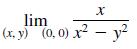
In Exercises 25–36, find the limit (if it exists). If the limit does not exist, explain why. x lim (x, y) (0,0) x² - y²
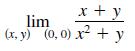
In Exercises 25–36, find the limit (if it exists). If the limit does not exist, explain why. x + y lim (x, y) (0,0) x² + y
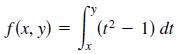
In Exercises 11–40, find both first partial derivatives. f(x, y) x (t²-1)dt
In Exercises 11–40, find both first partial derivatives. f(x, y) = f'(2₁ (2t + 1) dt + +fo 1x (2t - 1) dt
In Exercises 35–42, describe and sketch the surface given by the function. f(x, y) = Jxy, 0, x ≥ 0, y ≥ 0 x
In Exercises 35–42, describe and sketch the surface given by the function.z = -x2 - y2
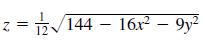
In Exercises 43–46, use a computer algebra system to graph the function. Z = z/144 - 16x² - 9y-
In Exercises 45–52, find fx and fy, and evaluate each at the given point.f(x, y) = exy2, (ln 3, 2)
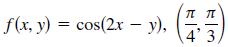
In Exercises 45–52, find fx and fy, and evaluate each at the given point. f(x, y) = cos(2x - y), EM П П 4' 3,
In Exercises 45–52, find fx and fy, and evaluate each at the given point.f(x, y) = x3 ln 5y, (1, 1)
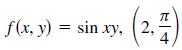
In Exercises 45–52, find fx and fy, and evaluate each at the given point. f(x, y) = sin xy, (2, (2,4)
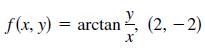
In Exercises 45–52, find fx and fy, and evaluate each at the given point. f(x, y) = arctan = arctan Ỵ, (2, −2) X
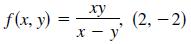
In Exercises 45–52, find fx and fy, and evaluate each at the given point. f(x, y) = xy x - y (2,-2)
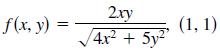
In Exercises 45–52, find fx and fy, and evaluate each at the given point. f(x, y) 2xy 4x² + 5y²² (1, 1)
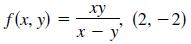
In Exercises 45–52, find fx and fy, and evaluate each at the given point. f(x, y) = xy x - y (2,-2)
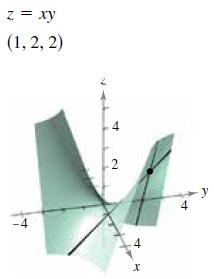
In Exercises 53–56, find the slopes of the surface in the x- and y directions at the given point. z = xy (1, 2, 2) -4 4 2 X
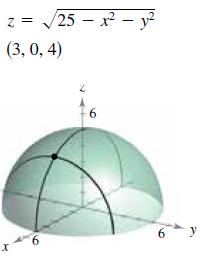
In Exercises 53–56, find the slopes of the surface in the x- and y directions at the given point. z = √√√25-1²-2 (3, 0, 4) X 6 6 6 y
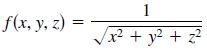
In Exercises 61–66, discuss the continuity of the function. f(x, y, z) = 1 -2 √x² + y² + 2²
In Exercises 63–68, find fx, fy, and fz, and evaluate each at the given point.f(x, y, z) = x3yz2, (1, 1, 1)
In Exercises 61–66, discuss the continuity of the function.f(x, y, z) = xy sin z
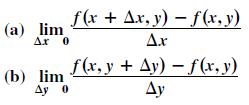
In Exercises 71–76, find each limit.f(x, y) = √y(y + 1) (a) lim Δε 0 (b) lim Δy Ο f(x + Δx, y) - f(x,y) Δι f(x,y + Δy) - f(x,y) Δν
In Exercises 81 and 82, use the Cobb-Douglas production function to find the production level when x = 600 units of labor and y = 350 units of capital.f(x, y) = 100x0.65y0.35
In Exercises 77–86, find the four second partial derivatives. Observe that the second mixed partials are equal.z = x4 - 3x2y2 + y4
In Exercises 63–68, find fx, fy, and fz, and evaluate each at the given point. f(x, y, z) In x yz (1,-1,-1)
In Exercises 69–76, find all values of x and y such that fx(x, y) = 0 and fy(x, y) = 0 simultaneously.f(x, y) = ex2 + xy + y2
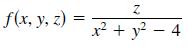
In Exercises 61–66, discuss the continuity of the function. f(x, y, z) = Z x² + y² - 4
Describe the order in which the differentiation of f (x, y, z) occurs for(a) fyxz and(b) ∂2f/∂x∂z.
In Exercises 11–40, find both first partial derivatives.z = 6x - x2y + 8y2
In Exercises 11–40, find both first partial derivatives.f(x, y) = 4x3y-2
In Exercises 11–40, find both first partial derivatives.z = x√y
In Exercises 11–40, find both first partial derivatives.z = x2e2y
In Exercises 11–40, find both first partial derivatives.z = 7yey/x
In Exercises 11–40, find both first partial derivatives.z = ln x/y
In Exercises 11–40, find both first partial derivatives. Z ху x2 +y2
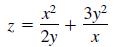
In Exercises 11–40, find both first partial derivatives. Z || 2y 3y² X
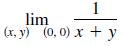
In Exercises 25–36, find the limit (if it exists). If the limit does not exist, explain why. 1 lim (x, y) (0,0) x + y
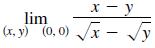
In Exercises 25–36, find the limit (if it exists). If the limit does not exist, explain why. x-y lim (x, y) (0,0)√√x /y
In Exercises 21–32, find the domain and range of the function. Z = 2 AX x + y
In Exercises 11–40, find both first partial derivatives.z = ln√xy
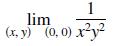
In Exercises 25–36, find the limit (if it exists). If the limit does not exist, explain why. 1 lim (x, y) (0,0) x²y² 2
In Exercises 11–40, find both first partial derivatives. ?x2 +y/ܢ = (f(xy
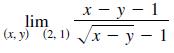
In Exercises 25–36, find the limit (if it exists). If the limit does not exist, explain why. lim (x, y) (2, x-y-1 1)√√x-y-1
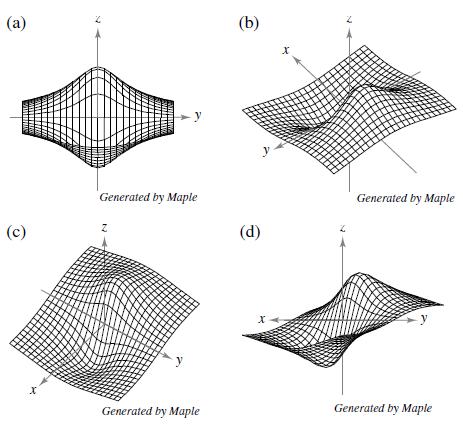
The graphs labeled (a), (b), (c), and (d) are graphs of the function f(x, y) = -4x/(x2 + y2 + 1). Match each of the four graphs with the point in space from which the surface is viewed. The four points are (20, 15, 25), (-15, 10, 20), (20, 20, 0), and (20, 0, 0). (a) (c) -y Generated by
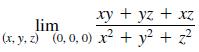
In Exercises 25–36, find the limit (if it exists). If the limit does not exist, explain why. xy + yz + xz lim (x, y, z) (0,0,0) x² + y² + z²
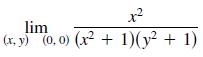
In Exercises 25–36, find the limit (if it exists). If the limit does not exist, explain why. x² lim (x, y) (0,0) (x² + 1)(y² + 1)
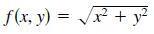
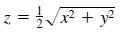
In Exercises 35–42, describe and sketch the surface given by the function. z = ²√√√√x² + y²
In Exercises 43–46, use a computer algebra system to graph the function.z = y2 - x2 + 1
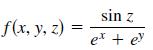
In Exercises 61–66, discuss the continuity of the function. f(x, y, z) = sin z ex + ey
In Exercises 63–68, find fx, fy, and fz, and evaluate each at the given point. f(x, y, z) = xy x + y + z (3, 1, 1)
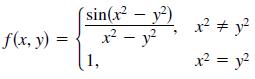
In Exercises 61–66, discuss the continuity of the function. f(x, y) = (sin(x² - y²) x² - y² x² = y² x² = y²
In Exercises 63–68, find fx, fy, and fz, and evaluate each at the given point. f(x, y, z) = z sin(x + 6y), (0, (0.11.
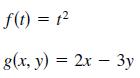
In Exercises 67–70, discuss the continuity of the composite function f ° g. f(t) = 12 g(x, y) =2x-3y
Showing 5700 - 5800
of 29454
First
51
52
53
54
55
56
57
58
59
60
61
62
63
64
65
Last
Step by Step Answers

 Get 50% OFF
Claim Now
Get 50% OFF
Claim Now