New Semester
Started
Get
50% OFF
Study Help!
--h --m --s
Claim Now
Question Answers
Textbooks
Find textbooks, questions and answers
Oops, something went wrong!
Change your search query and then try again
S
Books
FREE
Study Help
Expert Questions
Accounting
General Management
Mathematics
Finance
Organizational Behaviour
Law
Physics
Operating System
Management Leadership
Sociology
Programming
Marketing
Database
Computer Network
Economics
Textbooks Solutions
Accounting
Managerial Accounting
Management Leadership
Cost Accounting
Statistics
Business Law
Corporate Finance
Finance
Economics
Auditing
Tutors
Online Tutors
Find a Tutor
Hire a Tutor
Become a Tutor
AI Tutor
AI Study Planner
NEW
Sell Books
Search
Search
Sign In
Register
study help
mathematics
precalculus
Calculus Of A Single Variable 11th Edition Ron Larson, Bruce H. Edwards - Solutions
Find the standard form of the equation of the ellipse with the given characteristics.Foci: (0, ±7)Major axis length: 20
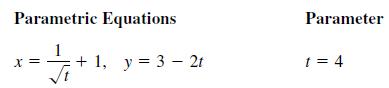
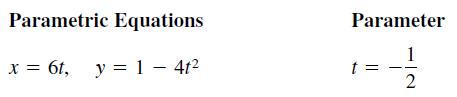
Find dy/dx and d2y/dx2, and find the slope and concavity (if possible) at the given value of the parameter. Parametric Equations 1 Vi +1, y = 32t Parameter 1 = 4
Find the standard form of the equation of the hyperbola with the given characteristics.Vertices: (0, ±8)Asymptotes: y = ±2x
Find the area of the surface generated by revolving the curve about(a) The x-axis(b) The y-axis. x = 2 cos 0, y = 2 sin 0,000 스플 2
The polar coordinates of a point are given. Plot the point and find the corresponding rectangular coordinates for the point. Зл 5, | a
Find the standard form of the equation of the hyperbola with the given characteristics.Vertices: (±2,0)Asymptotes: y = ±32x
Find the standard form of the equation of the hyperbola with the given characteristics.Vertices: (±7,-1)Foci: (±9,-1)
Find the arc length of the curve on the given interval. Parametric Equations x = 7 cos 0, y = 7 sin 0 Interval 0 ≤0 ≤ π
The polar coordinates of a point are given. Plot the point and find the corresponding rectangular coordinates for the point. (-6, 5π 6
Find the standard form of the equation of the hyperbola with the given characteristics.Center: (0, 0)Vertex: (0, 3)Focus: (0, 6)
Sketch the curve represented by the parametric equations (indicate the orientation of the curve), and write the corresponding rectangular equation by eliminating the parameter.x = t - 2, y = t2 - 1
Find two different sets of parametric equations for the rectangular equation.y = x2 - 3
Consider the parametric equations x = 2 cot θ and y = 4 sin θ cos θ, 0 < θ < π.(a) Use a graphing utility to graph the curve.(b) Eliminate the parameter to show that the rectangular equation of the serpentine curve is (4 + x2)y = 8x.
The polar coordinates of a point are given. Plot the point and find the corresponding rectangular coordinates for the point.(√7, 3.25)
Find the area of the surface generated by revolving the curve about(a) The x-axis(b) The y-axis.x = 4t, y = 3t + 1, 0 ≤ t ≤ 1
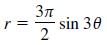
Use a graphing utility to graph the polar equation. Find an interval for θ over which the graph is traced only once. r= Зл Fla 2 sin 30
The rectangular coordinates of a point are given. Plot the point and find two sets of polar coordinates for the point for 0 = θ < 2π.(-1, 3)
The polar coordinates of a point are given. Plot the point and find the corresponding rectangular coordinates for the point.(-2, -2.45)
Convert the rectangular equation to polar form and sketch its graph.x2 + y2 = 25
The rectangular coordinates of a point are given. Plot the point and find two sets of polar coordinates for the point for 0 = θ < 2π.(0, -7)
Convert the rectangular equation to polar form and sketch its graph.y = 9
Convert the rectangular equation to polar form and sketch its graph.-x + 4y - 3 = 0
The rectangular coordinates of a point are given. Plot the point and find two sets of polar coordinates for the point for 0 = θ < 2π.(-√3, -√3)
Convert the polar equation to rectangular form and sketch its graph.r = 6 cos θ
Convert the rectangular equation to polar form and sketch its graph.x2 - y2 = 4
Convert the rectangular equation to polar form and sketch its graph.x = 6
Sketch a graph of the polar equation. 6 = 7. 10
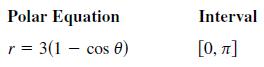
Find the length of the curve over the given interval. Polar Equation r = 3(1 - cos 0) Interval [0, π]
Convert the polar equation to rectangular form and sketch its graph.r = -4 sec θ
Convert the rectangular equation to polar form and sketch its graph.x2 = 4y
Use a graphing utility to graph the polar equation. Find an interval for θ over which the graph is traced only once.r = 4 cos 2θ sec θ
Convert the polar equation to rectangular form and sketch its graph.r = 10
Sketch a graph of the polar equation.r = 6
Use a graphing utility to graph the polar equation. Find an interval for θ over which the graph is traced only once.r = 2 sin θ cos2 θ
Sketch a graph of the polar equation.r = 4θ
Use a graphing utility to graph the polar equation. Find an interval for θ over which the graph is traced only once.r = 4(sec θ - cos θ)
Sketch a graph of the polar equation.r = 3 + 2 sin θ
Use a graphing utility to graph the polar equation. Find the area of the given region analytically.Between the loops of r = 4 + 8 sin θ
Find the area of the surface formed by revolving the polar equation over the given interval about the given line. Polar Equation r = 2 sin 0 Interval 0 ≤ 0 ≤ π Axis of Revolution Polar axis
Find a polar equation for the conic with its focus at the pole and the given eccentricity and directrix. Conic Parabola Eccentricity e = 1 Directrix x = 5
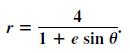
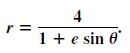
Consider the polar equationUse a graphing utility to graph the equation for e = 0.1,e = 0.25, e = 0.5, e = 0.75, and e = 0.9. Identify the conic and discuss the change in its shape as e = 1- and e = 0+. r= 4 1+ e sin 0
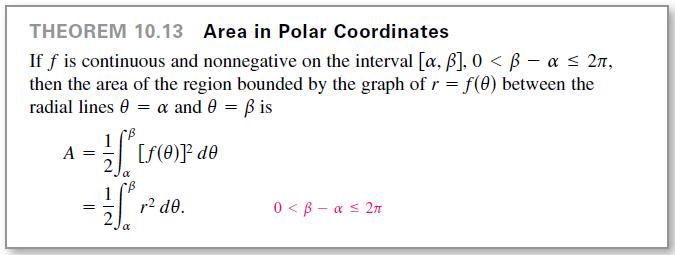
What should you check before applying Theorem 10.13 to find the area of the region bounded by the graph of r = f (θ)? THEOREM 10.13 Area in Polar Coordinates If f is continuous and nonnegative on the interval [a, b], 0
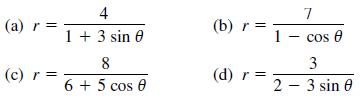
Identify each conic using eccentricity. (a) r = (c) r = 4 1 + 3 sin 0 8 6 + 5 cos 0 (b) r = (d) r = 7 1 - cos 0 3 2 - 3 sin 0
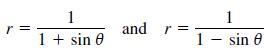
Without graphing, how are the graphs of the following conics different? Explain. r = 1 1 + sin 0 and r 1 1 - sin 0
Consider the polar equationUse a graphing utility to graph the equation for e = 1.1, e = 1.5, and e = 2. Identify the conic and discuss the change in its shape as e = 1+ and e = ∞. r= 4 1+ e sin 0
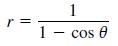
Find the eccentricity and the distance from the pole to the directrix of the conic. Then identify the conic and sketch its graph. Use a graphing utility to confirm your results. 1 1- cos 0
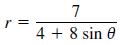
Find the eccentricity and the distance from the pole to the directrix of the conic. Then identify the conic and sketch its graph. Use a graphing utility to confirm your results. r 7 4 + 8 sin 8.
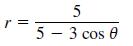
Find the eccentricity and the distance from the pole to the directrix of the conic. Then identify the conic and sketch its graph. Use a graphing utility to confirm your results. 5 r 5- 3 cos 0
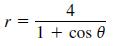
Find the eccentricity and the distance from the pole to the directrix of the conic. Then identify the conic and sketch its graph. Use a graphing utility to confirm your results. r = 4 1 + cos 0
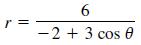
Find the eccentricity and the distance from the pole to the directrix of the conic. Then identify the conic and sketch its graph. Use a graphing utility to confirm your results. r 6 -2 +3 cos 0
Find the area of the region.Interior of r = 6 sin θ
Find the area of the region.One petal of r = 2 cos 3θ
Find the area of the region.Two petals of r = 4 sin 3θ
Find the area of the region.Two petals of r = sin 8θ
Find the area of the region.Three petals of r = cos 5θ
Find the area of the region.Interior of r = 6 + 5 sin θ (below the polar axis)
Find the area of the region.Interior of r = 9 - sin θ (above the polar axis)
Find the area of the region.Interior of r = 4 + sin θ
Find the area of the region.Interior of r = 1 - cos θ
Find the area of the region.Interior of r2 = 4 cos 2θ
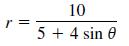
Find the eccentricity and the distance from the pole to the directrix of the conic. Then identify the conic and sketch its graph. Use a graphing utility to confirm your results. 10 5 + 4 sin 0
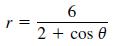
Find the eccentricity and the distance from the pole to the directrix of the conic. Then identify the conic and sketch its graph. Use a graphing utility to confirm your results. r = 6 2 + cos 0
Find the area of the region.Interior of r2 = 6 sin 2θ
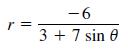
Find the eccentricity and the distance from the pole to the directrix of the conic. Then identify the conic and sketch its graph. Use a graphing utility to confirm your results. -6 3 + 7 sin 0
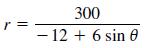
Find the eccentricity and the distance from the pole to the directrix of the conic. Then identify the conic and sketch its graph. Use a graphing utility to confirm your results. r = 300 - 12 + 6 sin 8
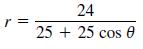
Find the eccentricity and the distance from the pole to the directrix of the conic. Then identify the conic and sketch its graph. Use a graphing utility to confirm your results. r T = 24 25 + 25 cos 0
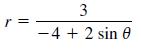
Use a graphing utility to graph the polar equation. Identify the graph and find its eccentricity. r = 3 - 4 + 2 sin e
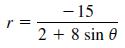
Use a graphing utility to graph the polar equation. Identify the graph and find its eccentricity. r = - 15 2 + 8 sin 8
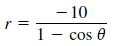
Use a graphing utility to graph the polar equation. Identify the graph and find its eccentricity. r = - 10 1- cos e
Find a polar equation for the conic with its focus at the pole and the given eccentricity and directrix. Conic Parabola Eccentricity e = 1 Directrix x = -3
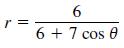
Use a graphing utility to graph the polar equation. Identify the graph and find its eccentricity. r 6 6 + 7 cos 0
Find a polar equation for the conic with its focus at the pole and the given eccentricity and directrix. Conic Ellipse Eccentricity e = // Directrix y = 1
Find a polar equation for the conic with its focus at the pole and the given eccentricity and directrix. Conic Hyperbola Eccentricity e 3 Directrix x = 2
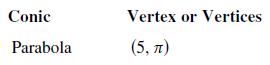
Find a polar equation for the conic with its focus at the pole and the given vertex or vertices. Conic Parabola Vertex or Vertices (5, π)
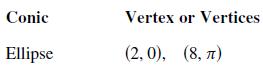
Find a polar equation for the conic with its focus at the pole and the given vertex or vertices. Conic Ellipse Vertex (2.0), or Vertices (8, 7)
Consider two ellipses, where the foci of the first ellipse are farther apart than the foci of the second ellipse. Is the eccentricity of the first ellipse always greater than the eccentricity of the second ellipse? Explain.
Find a polar equation for the ellipse with the following characteristics.Focus: (0, 0)Eccentricity: e = 1/2Directrix: r = 4 sec θ
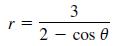
Use the integration capabilities of a graphing utility to approximate the area of the region bounded by the graph of the polar equation. r = 3 2 - cos 0
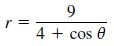
Use the integration capabilities of a graphing utility to approximate the area of the region bounded by the graph of the polar equation. r 9 4 + cos e
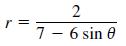
Use the integration capabilities of a graphing utility to approximate the area of the region bounded by the graph of the polar equation. 2 7- 6 sin 0
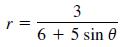
Use the integration capabilities of a graphing utility to approximate the area of the region bounded by the graph of the polar equation. r = 3 6 + 5 sin 0
The comet Hale-Bopp has an elliptical orbit with the sun at one focus and has an eccentricity of e ≈ 0.995. The length of the major axis of the orbit is approximately 500 astronomical units.(a) Find the length of its minor axis.(b) Find a polar equation for the orbit.(c) Find the perihelion and
Use the integration capabilities of a graphing utility to approximate the area of the surface formed by revolving the polar equation over the given interval about the polar axis.r = θ, [0, π]
Let f (θ) > 0 for all θ and let g(θ) < 0 for all θ. Find polar equations r = f (θ) and r = g(θ) such that their graphs intersect.
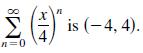
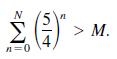
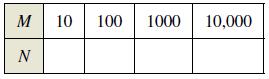
The interval of convergence of the series(a) Find the sum of the series when x = 1/6. Use a graphing utility to graph the first six terms of the sequence of partial sums and the horizontal line representing the sum of the series.(b) Repeat part (a) for x = -1/6.(c) Write a short paragraph comparing
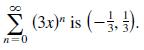
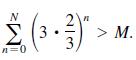
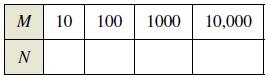
The interval of convergence of the geometric series(a) Find the sum of the series when x = 5/2. Use a graphing utility to graph the first six terms of the sequence of partial sums and the horizontal line representing the sum of the series.(b) Repeat part (a) for x = -5/2.(c) Write a short paragraph
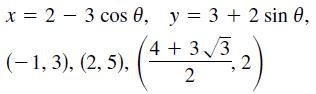
Find an equation of the tangent line to the curve at each given point. x = 2 - 3 cos 0, y = 3 + 2 sin 0, 4+3 3 (-1, 3), (2, 5), 2 2
The rectangular coordinates of a point are given. Plot the point and find two sets of polar coordinates for the point for 0 = θ < 2π.(1, 8)
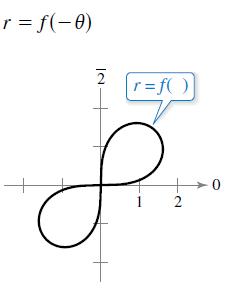
Use the graph of r = f(θ) to sketch a graph of the transformation. r = f(-0) T 2 r=f() Р. o 1 2 0
Determine whether the statement is true or false. If it is false, explain why or give an example that shows it is false. If x = f(t) and y = g(t), then d²y_g"(t) dx² f"(t)
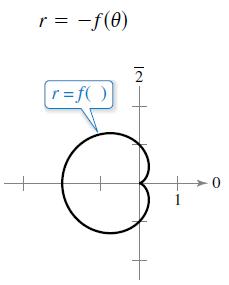
Use the graph of r = f(θ) to sketch a graph of the transformation. T r = -f(0) [r=f()] +NI 2 1 0
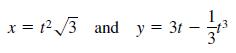
Use the parametric equationsto answer the following.(a) Use a graphing utility to graph the curve on the interval -3 ≤ t ≤ 3.(b) Find dy/dx and d2y/dx2.(c) Find the equation of the tangent line at the point (√3, 8/3).(d) Find the length of the curve on the interval -3 ≤ t ≤ 3.(e) Find the
Write an integral that represents the area of the surface generated by revolving the curve about the x-axis. Use a graphing utility to approximate the integral. Parametric Equations x = 1³, y = 1 + 2 Interval 0 ≤t≤2
Use the parametric equations x = a(θ - sinθ) and y = a(1 - cos θ), a > 0 to answer the following.(a) Find dy/dx and d2y/dx2.(b) Find the equation of the tangent line at the point where θ = π/6.(c) Find all points of horizontal tangency.(d) Determine where the curve is concave upward or
Describe how to test whether a polar graph is symmetric about(a) The x-axis(b) The y-axis.
Determine whether the statement is true or false. If it is false, explain why or give an example that shows it is false.The curve given by x = x1 + t(x2 - x1) and y = y1 + t( y2 - y1), y1 ≠ y2, has at least one horizontal asymptote.
Sketch a graph of the polar equation.r = 3θ
(a) Use a graphing utility to graph the curve represented by the parametric equations,(b) Use a graphing utility to find dx/dt, dy/dt, and dy/dx at the given value of the parameter,(c) Find an equation of the tangent line to the curve at the given value of the parameter,(d) Use a graphing utility
Sketch a graph of the polar equation.r = -7 csc θ
Sketch a graph of the polar equation and find the tangent line(s) at the pole (if any).r = 4(1 - sin θ)
Showing 6100 - 6200
of 29454
First
55
56
57
58
59
60
61
62
63
64
65
66
67
68
69
Last
Step by Step Answers

 Get 50% OFF
Claim Now
Get 50% OFF
Claim Now