New Semester
Started
Get
50% OFF
Study Help!
--h --m --s
Claim Now
Question Answers
Textbooks
Find textbooks, questions and answers
Oops, something went wrong!
Change your search query and then try again
S
Books
FREE
Study Help
Expert Questions
Accounting
General Management
Mathematics
Finance
Organizational Behaviour
Law
Physics
Operating System
Management Leadership
Sociology
Programming
Marketing
Database
Computer Network
Economics
Textbooks Solutions
Accounting
Managerial Accounting
Management Leadership
Cost Accounting
Statistics
Business Law
Corporate Finance
Finance
Economics
Auditing
Tutors
Online Tutors
Find a Tutor
Hire a Tutor
Become a Tutor
AI Tutor
AI Study Planner
NEW
Sell Books
Search
Search
Sign In
Register
study help
mathematics
precalculus
Precalculus Concepts Through Functions A Unit Circle Approach To Trigonometry 5th Edition Michael Sullivan - Solutions
(a) Graph f (x) = x − 3 − 3 using transformations.(b) Find the area of the region that is bounded by f and the x-axis and lies below the x-axis.
(a) Graph f (x) = −2 x − 4 + 4 using transformations.(b) Find the area of the region that is bounded by f and the x-axis and lies above the x-axis.
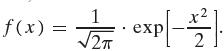
In statistics, the standard normal density function is given byThis function can be transformed to describe any general normal distribution with mean, μ , and standard deviation,σ. A general normal density function is given byDescribe the transformations needed to get from the graph of the
If a function f is increasing on the intervals [−3, 3] and [11, 19] and decreasing on the interval [3, 11] , determine the interval(s) on which g(x) = −3f (2x − 5) is increasing.
Explain how the range of the function f (x) = x2 compares to the range of g(x) = f (x) + k.
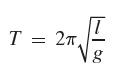
The period T (in seconds) of a simple pendulum is a function of its length l (in feet) defined by the equationwhere g ≈ 32.2 feet per second per second is the acceleration due to gravity.(a) Use a graphing utility to graph the function T = T(l).(b) Now graph the functions T = T( l + 1), T = T( l
Explain how the domain of g (x) =√x compares to the domain of g(x − k), where k ≥ 0.
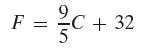
The relationship between the Celsius (°C) and Fahrenheit (°F) scales for measuring temperature is given by the equationThe relationship between the Celsius (°C) and Kelvin (K) scales is K = C + 273. Graph the equation F = 9/5C = + 32 using degrees Fahrenheit on the y-axis and degrees Celsius on
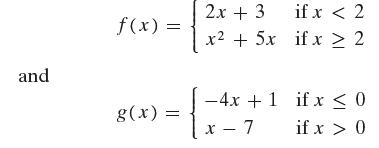
Find the sum function (f + g)(x) if and f(x) = g(x) = 2x + 3 x2 + 5x -4x+1 x - 7 if x < 2 if x ≥ 2 if x ≤ 0 if x > 0
Suppose that the function y = f ( x) is decreasing on the interval [−2, 7 ].(a) Over what interval is the graph of y = f (x + 2) decreasing?(b) Over what interval is the graph of y = f (x − 5) decreasing?(c) Is the graph of y = −f ( x) increasing, decreasing, or neither on the interval [−2,
Suppose that the function y = f ( x) is increasing on the interval [−1, 5 ].(a) Over what interval is the graph of y = f (x + 2) increasing?(b) Over what interval is the graph of y = f (x − 5) increasing?(c) Is the graph of y = −f (x) increasing, decreasing, or neither on the interval [−1,
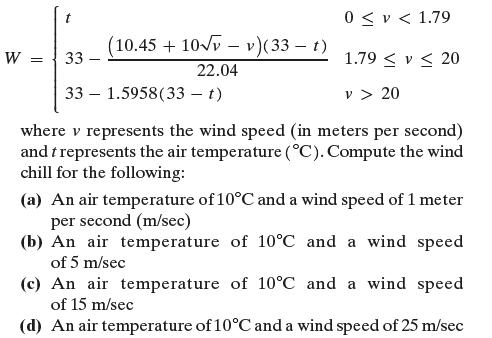
Wind Chill Redo Problem 61(a)–(d) for an air temperature of − 10°C.Data from in problem 61(a)–(d)The wind chill factor represents the air temperature at a standard wind speed that would produce the same heat loss as the given temperature and wind speed. One formula for computing the
In 2022 the U.S. Postal Service charged $1.16 postage for certain First-Class mail retail flats (such as an 8 .5''by 11''envelope) weighing up to 1 ounce, plus $0.20 for each additional ounce up to 13 ounces. First-Class rates do not apply to flats weighing more than 13 ounces. Develop a model that
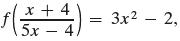
If find f (1). x + 4 (+4) 5x – 4) 3x2 - 2. 2,
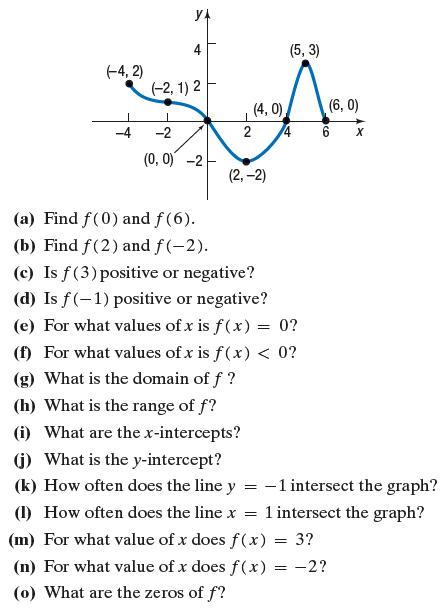
Use the given graph of the function f to answer parts (a)–(o). (-4,2) 4 (-2, 1) 2 1 -2 (0,0) -2 (4,0) 2 (2,-2) (5, 3) (6, 0) 4 6 (a) Find f(0) and ƒ (6). (b) Find f(2) and f(-2). (c) Is f(3) positive or negative? (d) Is f(-1) positive or negative? (e) For what values of x is f(x) = 0? (f) For
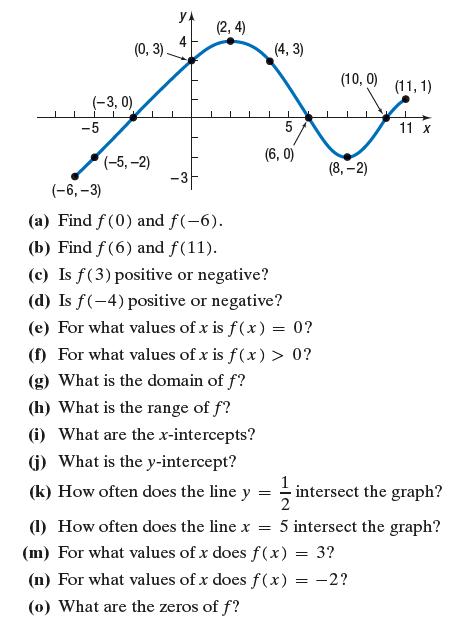
Use the given graph of the function f to answer parts (a)–(o). L (-3,0) -5 (0, 3) (-5,-2) YA I (2,4) 1 (4,3) I 5 (6, 0) (-6,-3) (a) Find f (0) and f(-6). (b) Find f (6) and f(11). (c) Is f(3) positive or negative? (d) Is f(-4) positive or negative? сл (10,0) (8,-2) (11, 1) 11 x (e) For what
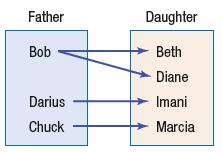
In Problems 19–30, find the domain and range of each relation. Then determine whether the relation represents a function. Father Bob Darius Chuck Daughter Beth Diane Imani Marcia
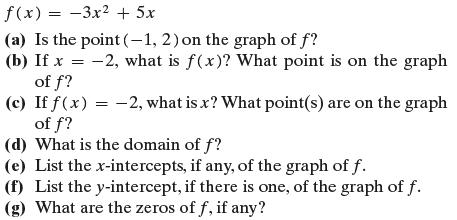
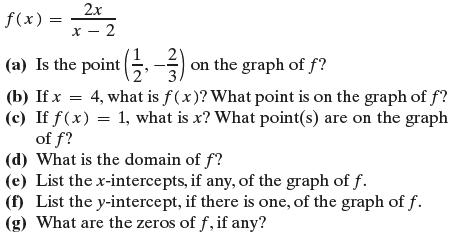
In Problems 25–30, answer the questions about each function. f(x) = -3x2 + 5x (a) Is the point (-1, 2) on the graph of f? (b) If x = -2, what is f(x)? What point is on the graph of f? (c) If f(x) = -2, what is x? What point(s) are on the graph of f? (d) What is the domain of f? (e) List the
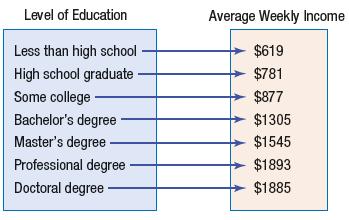
In Problems 19–30, find the domain and range of each relation. Then determine whether the relation represents a function. Level of Education Less than high school High school graduate- Some college Bachelor's degree Master's degree. Professional degree Doctoral degree Average Weekly
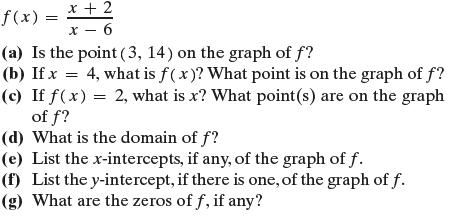
In Problems 25–30, answer the questions about each function. f(x) = = x + 2 x - 6 (a) Is the point (3, 14) on the graph of f? (b) If x 4, what is f(x)? What point is on the graph of f? (c) If f(x) = 2, what is x? What point (s) are on the graph of f? (d) What is the domain of f? (e) List the
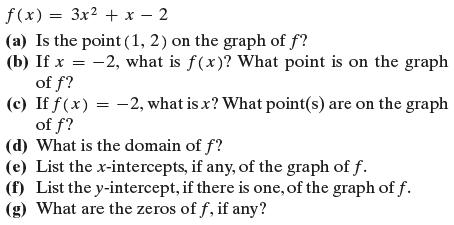
In Problems 25–30, answer the questions about each function. f(x) = 3x² + x - 2 (a) Is the point (1, 2) on the graph of f? (b) If x = -2, what is f(x)? What point is on the graph of f? (c) If f(x) = -2, what is x? What point(s) are on the graph of f? (d) What is the domain of f? (e) List the
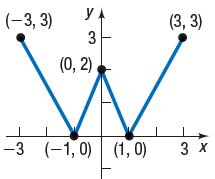
In Problems 25–32, the graph of a function is given. Use the graph to find:(a) The intercepts, if any(b) The domain and range(c) The intervals on which the function is increasing, decreasing, or constant(d) Whether the function is even, odd, or neither (-3, 3) у 3 (0, 2) -3 (-1,0) (1, 0) (3,
True or False The point (−2, −6) is on the graph of the equation x = 2y − 2.
A function f is on an interval I if, for any choice of x1 and x2 in I, with x1 < x2, then f (x1) < f (x2).
The set of all images of the elements in the domain of a function is called the .(a) Range(b) Domain(c) Solution set(d) Function
True or False A function f is decreasing on an interval I if, for any choice of x1 and x2 in I, with x1 < x2, then f (x1) > f (x2).
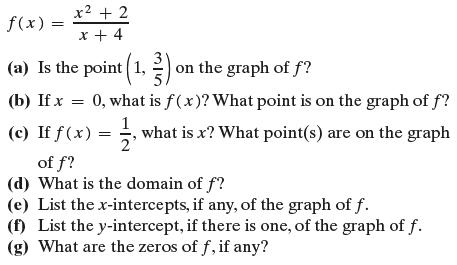
In Problems 25–30, answer the questions about each function. f(x) = x² + 2 x + 4 (a) Is the point (1, 2) on the graph of f? (b) If x (c) If f(x) of f? (d) What is the domain of f? (e) List the x-intercepts, if any, of the graph of f. (f) List the y-intercept, if there is one, of the graph of
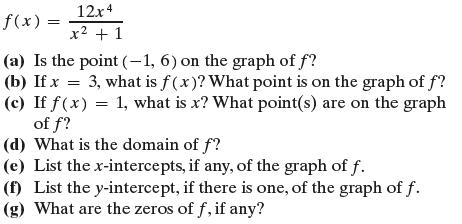
In Problems 25–30, answer the questions about each function. f(x)= 12x4 x² + 1 (a) Is the point (-1, 6) on the graph of f? (b) If x= = = 3, what is f(x)? What point is on the graph of f? (c) If f(x) = 1, what is x? What point(s) are on the graph of f? (d) What is the domain of f? (e) List the
An odd function is symmetric with respect to ________.(a) The x -axis(b) The y -axis(c) The origin (d) t he line y = x
In Problems 25–30, answer the questions about each function. f(x) = ²x2 - (a) Is the point (1,-) on the graph of f? 3. (b) If x 4, what is f(x)? What point is on the graph of f? (c) If f(x) = 1, what is x? What point(s) are on the graph of f? = (d) What is the domain of f? (e) List the
A function that is continuous on the interval________ is guaranteed to have both an absolute maximum and an absolute minimum.(a) (a, b)(b) (a, b](c) [a, b)(d) [a, b]
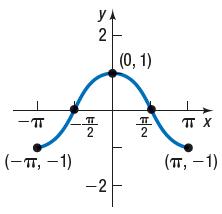
In Problems 25–32, the graph of a function is given. Use the graph to find:(a) The intercepts, if any(b) The domain and range(c) The intervals on which the function is increasing, decreasing, or constant(d) Whether the function is even, odd, or neither -ㅠ (-TT, -1) YA 2 ㅠ 2 -2 (0, 1) ㅍ 2 TT
In Problems 31–42, determine whether the equation defines y as a function of x. y = √√x
In Problems 19–30, find the domain and range of each relation. Then determine whether the relation represents a function.{(−2, 5), (−1, 3), (3, 7), (4, 12)}
In Problems 19–30, find the domain and range of each relation. Then determine whether the relation represents a function.{(0, −2), (1, 3), (2, 3), (3, 7)}
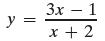
In Problems 31–42, determine whether the equation defines y as a function of x. у 3x - 1 x + 2 X
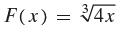
In Problems 37–48, determine algebraically whether each function is even, odd, or neither. F(x) = 3√4x
In Problems 31–42, determine whether the equation defines y as a function of x.y = x/1
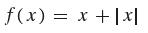
In Problems 37–48, determine algebraically whether each function is even, odd, or neither. f(x) = x + |x|
In Problems 31–42, determine whether the equation defines y as a function of x.y = |x|
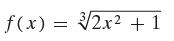
In Problems 37–48, determine algebraically whether each function is even, odd, or neither. f(x) = 3√2x² + 1
In Problems 31–42, determine whether the equation defines y as a function of x.x = y2
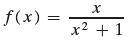
In Problems 43–50, find the following for each function:(a) f (0)(b) f (1)(c) f (−1)(d) f (−x)(e) −f (x)(f) f (x + 1)(g) f (2x)(h) f (x + h) f(x) = X x² + 1
In Problems 31–42, determine whether the equation defines y as a function of x.x + y2 = 1
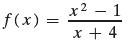
In Problems 43–50, find the following for each function:(a) f (0)(b) f (1)(c) f (−1)(d) f (−x)(e) −f (x)(f) f (x + 1)(g) f (2x)(h) f (x + h) f(x) = x² - 1 x + 4
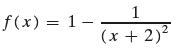
In Problems 43–50, find the following for each function:(a) f (0)(b) f (1)(c) f (−1)(d) f (−x)(e) −f (x)(f) f (x + 1)(g) f (2x)(h) f (x + h) f(x) = 1- 1 (x + 2)²
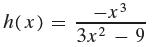
In Problems 37–48, determine algebraically whether each function is even, odd, or neither. h(x) = 3x² - 9
Suppose f (x) = x2 − 4x + c and g(x) = −f(x)/3 4. Find f (3) if g(−2) = 5.
In Problems 37–48, determine algebraically whether each function is even, odd, or neither.h(x) = 3x3 + 5
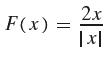
In Problems 37–48, determine algebraically whether each function is even, odd, or neither. F(x) = 2x |x|
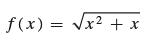
In Problems 43–50, find the following for each function:(a) f (0)(b) f (1)(c) f (−1)(d) f (−x)(e) −f (x)(f) f (x + 1)(g) f (2x)(h) f (x + h) f(x) = √√√x² + x
Suppose f (x) =√x + 2 and g(x) = x2 + n. If f (g(5)) = 4, what is the value of g(n)?
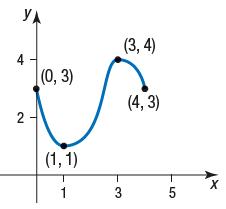
In Problems 49–56, for each graph of a function y = f (x), find the absolute maximum and the absolute minimum, if they exist. Identify any local maximum values or local minimum values. У 4 2 (0, 3) (1, 1) 1 (3, 4) 3 (4,3) 5 X
In Problems 31–42, determine whether the equation defines y as a function of x.x2 − 4y2 = 1
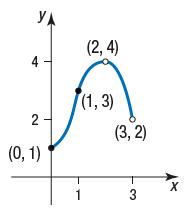
In Problems 49–56, for each graph of a function y = f (x), find the absolute maximum and the absolute minimum, if they exist. Identify any local maximum values or local minimum values. y УА 4 2 (0, 1) (2,4) (1,3) 1 (3, 2) 3 X
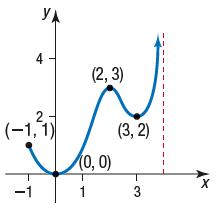
In Problems 49–56, for each graph of a function y = f (x), find the absolute maximum and the absolute minimum, if they exist. Identify any local maximum values or local minimum values. y -1 4 2 (-1,1) (2,3) (0, 0) 1 (3, 2) 3 X
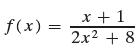
In Problems 51–70, find the domain of each function. f(x) = = x + 1 2x² + 8
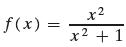
In Problems 51–70, find the domain of each function. f(x) = = x2 2 x² + 1
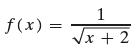
In Problems 43–50, find the following for each function:(a) f (0)(b) f (1)(c) f (−1)(d) f (−x)(e) −f (x)(f) f (x + 1)(g) f (2x)(h) f (x + h)f (x) = x + 4
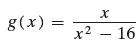
In Problems 51–70, find the domain of each function. g(x) = X x2 x² - 16
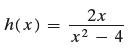
In Problems 51–70, find the domain of each function. h(x) = 2x x² - 4
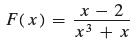
In Problems 51–70, find the domain of each function. F(x) = x-2 x³ + x
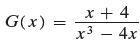
In Problems 51–70, find the domain of each function. G(x) = x + 4 x3 x³ - 4x
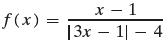
In Problems 51–70, find the domain of each function. f(x) = = x-1 |3x - 11 - 4
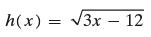
In Problems 51–70, find the domain of each function. h(x) = √3x - 12
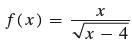
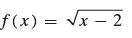
In Problems 51–70, find the domain of each function. f(x) = √x - 4
In Problems 51–70, find the domain of each function.f (x) = −5x + 4
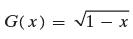
In Problems 51–70, find the domain of each function. - x G(x)=√1-
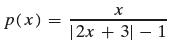
In Problems 51–70, find the domain of each function. p(x) = X |2x + 3 1
Explain why the vertical-line test works.
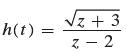
In Problems 51–70, find the domain of each function. h(t) = √z + 3 z 2
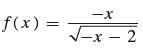
In Problems 51–70, find the domain of each function. f(x) = -X √√-x-2
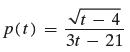
In Problems 51–70, find the domain of each function. p(t) = √t 4 - 3t - 21
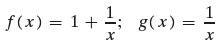
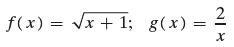
In Problems 71–80, for the given functions f and g, find the following. For parts (a)–(d), also find the domain. (a) (f + g)(x) (e) (f + g)(3) (b) (f- g)(x) (f) (f - g)(4) (c) (f.g)(x) (g) (f.g)(2) (d) (x) (h) (2) (1)
In Problems 71–80, for the given functions f and g, find the following. For parts (a)–(d), also find the domain. (a) (f + g)(x) (e) (f + g)(3) (b) (f- g)(x) (f) (f - g)(4) (c) (f.g)(x) (g) (f.g)(2) (d) (x) (h) (2) (1)
In Problems 71–80, for the given functions f and g, find the following. For parts (a)–(d), also find the domain.f (x) = √x; g( x) = 3x − 5 (a) (f + g)(x) (e) (f + g)(3) (b) (f- g)(x) (f) (f - g)(4) (c) (f.g)(x) (g) (f.g)(2) (d) (x) (h) (2) (1)
In Problems 71–80, for the given functions f and g, find the following. For parts (a)–(d), also find the domain.f (x) = |x| ; g(x) = x (a) (f + g)(x) (e) (f + g)(3) (b) (f- g)(x) (f) (f - g)(4) (c) (f.g)(x) (g) (f.g)(2) (d) (x) (h) (2) (1)
In Problems 71–80, for the given functions f and g, find the following. For parts (a)–(d), also find the domain. (a) (f + g)(x) (e) (f + g)(3) (b) (f- g)(x) (f) (f - g)(4) (c) (f.g)(x) (g) (f.g)(2) (d) (x) (h) (2) (1)
In Problems 71–80, for the given functions f and g, find the following. For parts (a)–(d), also find the domain. (a) (f + g)(x) (e) (f + g)(3) (b) (f- g)(x) (f) (f - g)(4) (c) (f.g)(x) (g) (f.g)(2) (d) (x) (h) (2) (1)
Open the “Secant” interactive figure, which is available in the Video & Resource Library of MyLab Math (under Interactive Figures) or at bit.ly/3raFUGB.(a) The polynomial function shown in blue has a local maximum of 3 at x = −1. Move Point B to (−1, 3). Move Point A so that the
Find the average rate of change of f (x) = −2x2 + 4:(a) From 0 to 2(b) From 1 to 3(c) From 1 to 4
Find the average rate of change of f (x) = −x3 + 1:(a) From 0 to 2(b) From 1 to 3(c) From −1 to 1
Givenfind the function g. f(x) = ¹(²)(x) = 1 and X x + 1 x²x²
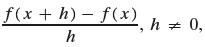
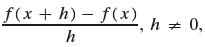
In Problems 83–98, find the difference quotient f; that is, findfor each function. Be sure to simplify.f (x) = 4x + 3 f(x + h) = f(x) h h = 0,
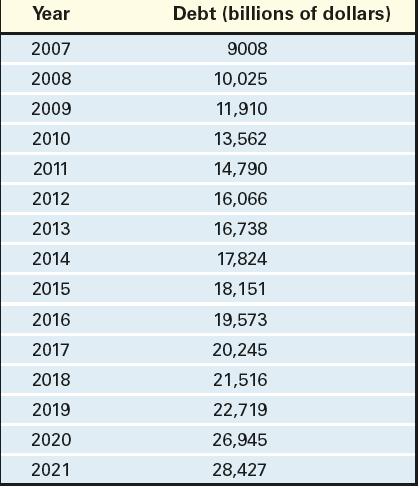
The size of the total debt owed by the United States federal government continues to grow. In fact, according to the Department of the Treasury, the debt per person living in the United States is approximately $90,575. The data on the next page represent the U.S. debt for the years 2007–2021.
Open the “Secant” interactive figure, which is available in the Video & Resource Library of MyLab Math (under Interactive Figures) or at bit.ly/3raFUGB.(a) Move Point A to (−2, −1) and Point B to (−1, 3). What is the slope of the secant line?(b) Grab Point B and move it toward Point
Given f (x) = 3x + 1 and (f + g) (x) = 6 - 1/2x, find the function g.
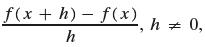
In Problems 83–98, find the difference quotient f; that is, findfor each function. Be sure to simplify.f (x) = −3x + 1 f(x + h) = f(x) h h = 0,
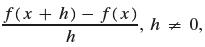
In Problems 83–98, find the difference quotient f; that is, findfor each function. Be sure to simplify.(x) = 3x2 + 2 f(x + h) = f(x) h h = 0,
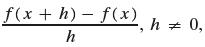
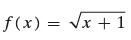
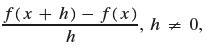
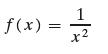
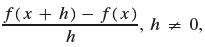
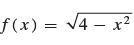
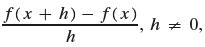
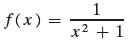
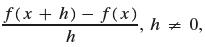
In Problems 83–98, find the difference quotient f; that is, findfor each function. Be sure to simplify. f(x + h) = f(x) h h = 0,
In Problems 83–98, find the difference quotient f; that is, findfor each function. Be sure to simplify.f (x) = x2 − x + 4 f(x + h) = f(x) h h = 0,
In Problems 83–98, find the difference quotient f; that is, findfor each function. Be sure to simplify.f (x) = 3x2 − 2x + 6 f(x + h) = f(x) h h = 0,
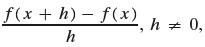
In Problems 83–98, find the difference quotient f; that is, findfor each function. Be sure to simplify. f(x + h) = f(x) h h = 0,
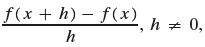
In Problems 83–98, find the difference quotient f; that is, findfor each function. Be sure to simplify. f(x + h) = f(x) h h = 0,
In Problems 83–98, find the difference quotient f; that is, find for each function. Be sure to simplify. f(x + h) = f(x) h h = 0,
In Problems 83–98, find the difference quotient f; that is, find for each function. Be sure to simplify. f(x + h) = f(x) h h = 0,
In Problems 83–98, find the difference quotient f; that is, find for each function. Be sure to simplify. f(x + h) = f(x) h h = 0,
If what is the value of A? f(x) = = 3x + 8 2x A and f(0) = 2,
If what is the value of B? f(x) = 2x B 3x + 4 and f(2) HIN 2
Suppose f (x) = x3 + 2x2 − x + 6. From calculus, the Mean Value Theorem guarantees that there is at least one number in the open interval ( −1, 2) at which the value of the derivative of f, given by f'(x) = 3x2 + 4x − 1, is equal to the average rate of change of f on the interval. Find all
Showing 5200 - 5300
of 29454
First
46
47
48
49
50
51
52
53
54
55
56
57
58
59
60
Last
Step by Step Answers

 Get 50% OFF
Claim Now
Get 50% OFF
Claim Now