New Semester
Started
Get
50% OFF
Study Help!
--h --m --s
Claim Now
Question Answers
Textbooks
Find textbooks, questions and answers
Oops, something went wrong!
Change your search query and then try again
S
Books
FREE
Study Help
Expert Questions
Accounting
General Management
Mathematics
Finance
Organizational Behaviour
Law
Physics
Operating System
Management Leadership
Sociology
Programming
Marketing
Database
Computer Network
Economics
Textbooks Solutions
Accounting
Managerial Accounting
Management Leadership
Cost Accounting
Statistics
Business Law
Corporate Finance
Finance
Economics
Auditing
Tutors
Online Tutors
Find a Tutor
Hire a Tutor
Become a Tutor
AI Tutor
AI Study Planner
NEW
Sell Books
Search
Search
Sign In
Register
study help
mathematics
precalculus
Calculus Of A Single Variable 11th Edition Ron Larson, Bruce H. Edwards - Solutions
In Exercises 17–26, find a vector-valued function whose graph is the indicated surface.The plane z = 3y
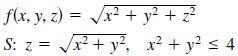
In Exercises 19–24, evaluate ∫S∫ f(x, y, z) dS. f(x, y, z)=√√x² + y² + z² S: z = √√x² + y², x² + y² ≤ 4 2
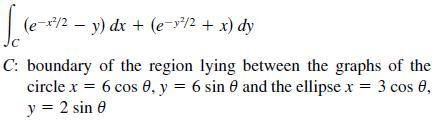
In Exercises 15–24, use Green’s Theorem to evaluate the line integral. [(e-²/² - y) dx + (e-3²/²2 + x) dy C: boundary of the region lying between the graphs of the circle x = 6 cos 0, y = 6 sin 0 and the ellipse x = 3 cos 0, y = 2 sin 0
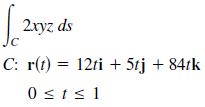
In Exercises 19–22, evaluate the line integral along the given path. Sa C: r(t) = 12ti + 5tj + 84tk 0 ≤t≤ 1 2xyz ds
In Exercises 19–24, evaluate ∫S∫ f(x, y, z) dS. f(x, y, z)=√√√x² + y² + z² S: z = √√√√x² + y², (x - 1)² + y² ≤1
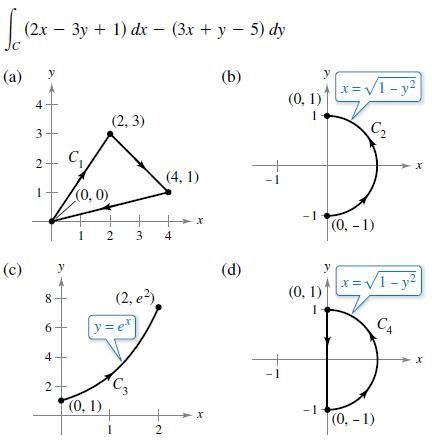
In Exercises 23–32, evaluate ∫c F · dr along each path. √ (2x (2x - 3y + 1) dx - (3x + y - 5) dy (a) y 4 (c) 3 2- C₁. 1 دیا 00 8 6 4 2 (0, 0) 1 (2,3) (0, 1) 2 3 4 |y=e* (2, e²) C3 I (4,1) 2 X (b) (d) (0, 1) -1 (0, 1) -1 X x=√/1-y² C₂ (0, -1) x=V √1-y² C₁ X (0, -1) X
In Exercises 19–28, find the conservative vector field for the potential function by finding its gradient.f(x, y) = x3 - 2xy
In Exercises 19–24, evaluate ∫S∫ f(x, y, z) dS. f(x, y, z) = x² + y² + z² S: x² + y² = 9, 0≤x≤ 3, 0≤ y ≤ 3, 0≤z ≤ 9
In Exercises 19–24, evaluate ∫S∫ f(x, y, z) dS. f(x, y, z) = x² + y² + z² S: x² + y² = 9, 0≤x≤ 3, 0≤ z ≤ x
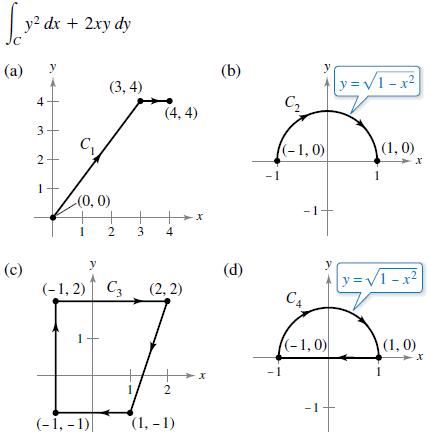
In Exercises 23–32, evaluate ∫c F · dr along each path. [y² dx + 2xy dy (a) (c) 4 3 2 C₁ -(0, 0) 1 (3, 4) (-1,-1) (4,4) + 2 3 4 (-1,2) C3 (2, 2) 1 2 (1, -1) X (b) (d) C₂ (-1,0) -1 C4 -1. y (-1,0) -1 y = √/1-x² (1,0) 1 X y=√1-x² (1, 0) -X
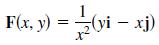
In Exercises 29–36, determine whether the vector field is conservative. F(x, y) = (vi-xj)
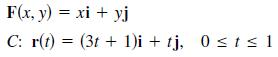
In Exercises 29–34, evaluate ∫c F · dr. F(x, y) = xi + yj C: r(t) = (3t+1)i + tj, 0≤ t ≤ 1
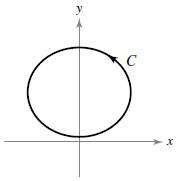
ConsiderSketch an open connected region around the smooth curve C shown in the figure such that you can use Theorem 15.7 to evaluate ∫c F · dr. Explain how you created your sketch. F(x, y) = y x² + y² X x² + y2.j.
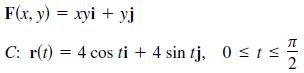
In Exercises 29–34, evaluate ∫c F · dr. F(x, y) = xyi + yj C: r(t) = 4 cos ti + 4 sin tj, 0 ≤ t ≤ EIN
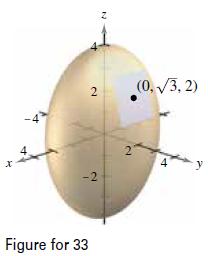
In Exercises 33– 36, find an equation of the tangent plane to the surface represented by the vector-valued function at the given point.r(u, v) = 3 cos v cos ui + 2 cos v sin uj + 4 sin vk, (0, √3, 2) X 2 -2 Figure for 33 2 (0,√3, 2) y
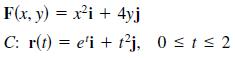
In Exercises 29–34, evaluate ∫c F · dr. F(x, y) = x²i+ 4yj C: r(t) = e'i + t²j, 0≤ t ≤ 2
In Exercises 17–26, find a vector-valued function whose graph is the indicated surface.The paraboloid x = y2 + z2 + 7
In Exercises 29–34, evaluate ∫c F · dr. F(x, y, z) = x²i + y²j + z²k C: r(t) = 2 sin ti + 2 cos tj + t²k, 0≤t≤n
In Exercises 29–34, evaluate ∫c F · dr. F(x, y) = 3xi + 4yj C: r(t) = ti+√√4-1²j, -2 ≤t≤ 2
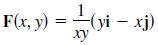
In Exercises 29–36, determine whether the vector field is conservative. F(x, y) = = xy (yi - xj)
In Exercises 19–28, find the conservative vector field for the potential function by finding its gradient.f(x, y, z) = √x2y + z2
In Exercises 35 and 36, use a computer algebra system to evaluate ∫c F · dr. F(x, y, z) = x²zi + 6yj + yz²k C: r(t) = ti + t²j + In tk, 1 ≤ t ≤ 3
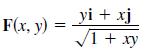
In Exercises 29–36, determine whether the vector field is conservative. F(x, y) = = yi + xj √√√1 + xy
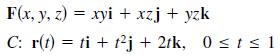
In Exercises 29–34, evaluate ∫c F · dr. F(x, y, z) = xyi + xzj + yzk C: r(t) = ti + t²j+ 2tk, 0≤ t ≤1
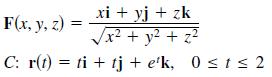
In Exercises 35 and 36, use a computer algebra system to evaluate ∫c F · dr. F(x, y, z) = xi + yj + zk √x² + y² + z² 2 C: r(t) = ti + tj + e¹k, 0≤ t ≤ 2
In Exercises 25–30, find the flux of F across S, ∫S∫ F · N dS where N is the upward unit normal vector to S.F(x, y, z) = xi + 2yj; S: z = 6 - 3x - 2y, first octant
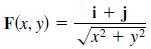
In Exercises 29–36, determine whether the vector field is conservative. F(x, y) = i+j √x² + y²
In Exercises 29–32, use a line integral to find the area of the region R.R: region bounded by the graph of x2 + y2 = 4
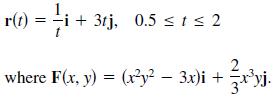
Use two different methods to evaluate ∫c F · dr along the path r(t) = i + 3tj, 0.5 ≤t≤ 2 where F(x, y) = (x²y² – 3x)i + 3x³yj.
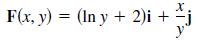
In Exercises 37– 44, determine whether the vector field is conservative. If it is, find a potential function for the vector field. x F(x, y) = (In y + 2)i + yº
In Exercises 43–46, determine whether the statement is true or false. If it is false, explain why or give an example that shows it is false. If F = Mi + Nj and ам ax ƏN dy' then F is conservative.
In Exercises 43–46, determine whether the statement is true or false. If it is false, explain why or give an example that shows it is false. If C₁, C₂, and C3 have the same initial and terminal points and Sc₂Fdr₁ = Sc₂F • dr₂, then fc, F. dr₁ = Sc₂F • drz.
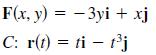
In Exercises 49–52, demonstrate the property that ∫c F · dr = 0 regardless of the initial and terminal points of C, where the tangent vector r'(t) is orthogonal to the force field F. F(x, y) = -3yi + xj C: r(t) = tit³j
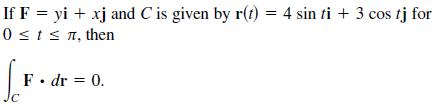
In Exercises 43–46, determine whether the statement is true or false. If it is false, explain why or give an example that shows it is false. If F = yi + xj and C is given by r(t) = 4 sin ti + 3 cos tj for 0 ≤ t ≤ 7, then S JC F. dr = 0.
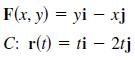
In Exercises 49–52, demonstrate the property that ∫c F · dr = 0 regardless of the initial and terminal points of C, where the tangent vector r'(t) is orthogonal to the force field F. F(x, y) = yi-xj C: r(t) = ti 2tj
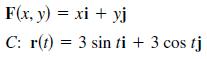
In Exercises 49–52, demonstrate the property that ∫c F · dr = 0 regardless of the initial and terminal points of C, where the tangent vector r'(t) is orthogonal to the force field F. F(x, y) = xi + yj C: r(t) = 3 sin ti + 3 cos tj
In Exercises 37– 44, determine whether the vector field is conservative. If it is, find a potential function for the vector field.F(x, y) = (3y - x2)i + (3x + y)j
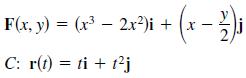
In Exercises 49–52, demonstrate the property that ∫c F · dr = 0 regardless of the initial and terminal points of C, where the tangent vector r'(t) is orthogonal to the force field F. F(x, y) = (x³ − 2x¹³)i + (x − 2)i C: r(t) = ti + 1²j
In Exercises 37– 44, determine whether the vector field is conservative. If it is, find a potential function for the vector field.F(x, y) = (x3 + ey)i + (xey - 6)j
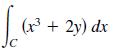
In Exercises 53–56, evaluate the line integral along the path C given by x = 2t, y = 4t, where 0 ≤ t ≤ 1. La (x³ + 2y) dx
In Exercises 37– 44, determine whether the vector field is conservative. If it is, find a potential function for the vector field.F(x, y) = sin yi + x cos yj
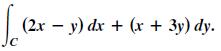
In Exercises 57–64, evaluateC: x-axis from x = 0 to x = 5 [ (2x − y) dx + (x + 3y) dy.
In Exercises 51–56, determine whether the vector field is conservative. If it is, find a potential function for the vector field. XZ F(x, y, z) = ³i – 5j + (5 − 1)k - y
In Exercises 51–56, determine whether the vector field is conservative. If it is, find a potential function for the vector field. F(x, y, z) = X x2 + y2 + y ? + ypi x2 + x- 5j + k
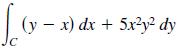
In Exercises 53–56, evaluate the line integral along the path C given by x = 2t, y = 4t, where 0 ≤ t ≤ 1. Lo (y - x) dx + 5x²y² dy
In Exercises 51–56, determine whether the vector field is conservative. If it is, find a potential function for the vector field.F(x, y, z) = (3x2 + yz)i + (3y2 + xz)j + (3z2 + xy)k
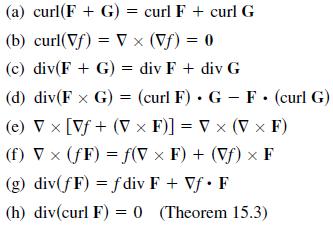
In parts (a)–(h), prove the property for vector fields F and G and scalar function f. (Assume that the required partial derivatives are continuous.) (a) curl(F + G) = curl F + curl G (b) curl(vf) = V × (Vf) = 0 (c) div(F + G) = div F + div G (d) div(F x G) = (curl F) G - F. (curl G) (e) ▼ x
In Exercises 51–56, determine whether the vector field is conservative. If it is, find a potential function for the vector field.F(x, y, z) = y2z3i + 2xyz3j + 3xy2z2k
In Exercises 51–56, determine whether the vector field is conservative. If it is, find a potential function for the vector field.F(x, y, z) = yezi + zexj + xeyk
In Exercises 57–60, find the divergence of the vector field.F(x, y) = x2i + 2y2j
In Exercises 85 and 86, determine whether the statement is true or false. If it is false, explain why or give an example that shows it is false. = If C₂-C₁, then f(x, y) ds + C₁ [ f(x, y) ds = 0. C₂
In Exercises 57–60, find the divergence of the vector field.F(x, y) = xexi - x2y2j
In Exercises 57–60, find the divergence of the vector field.F(x, y, z) = sin2 xi + z cos zj + z3k
The top outer edge of a solid with vertical sides that is resting on the xy-plane is modeled by r(t) = 3 cos ti + 3 sin tj + (1 + sin2 2t)k, where all measurements are in centimeters. The intersection of the plane y = b, where -3 < b < 3, with the top of the solid is a horizontal
In Exercises 61–64, find the divergence of the vector field at the given point.F(x, y, z) = xyzi + xz2j + 3yz2k; (2, 4, 1)
In Exercises 65–67, consider a scalar function ƒ and a vector field F in space. Determine whether the expression is a vector field, a scalar function, or neither. Explain.curl(∇ƒ)
In Exercises 65–67, consider a scalar function ƒ and a vector field F in space. Determine whether the expression is a vector field, a scalar function, or neither. Explain.div[curl(∇ƒ)]
In Exercises 65–67, consider a scalar function ƒ and a vector field F in space. Determine whether the expression is a vector field, a scalar function, or neither. Explain.curl(div F)
In Exercises 1 and 2, evaluate the integral. y X y + 1 -dx
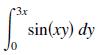
In Exercises 1 and 2, evaluate the integral. (3x sin(xy) dy
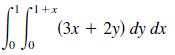
In Exercises 3–6, evaluate the iterated integral. cl cl+x 7 Jo Jo (3x + 2y) dy dx
In Exercises 11–14, sketch the region R whose area is given by the iterated integral. Then change the order of integration and show that both orders yield the same area. JJ dy dx
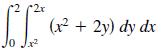
In Exercises 3–6, evaluate the iterated integral. 2x T (x2 + 2y) dy dx 10
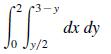
In Exercises 11–14, sketch the region R whose area is given by the iterated integral. Then change the order of integration and show that both orders yield the same area. 3-y 10 Jy/2 dx dy
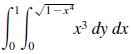
In Exercises 3–6, evaluate the iterated integral. S.S. Jo Jo T- 27 x³ dy dx
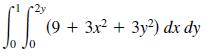
In Exercises 3–6, evaluate the iterated integral. *2y [fe (9 + 3x² + 3y²) dx dy
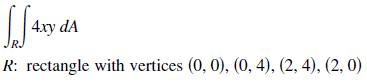
In Exercises 15 and 16, set up integrals for both orders of integration. Use the more convenient order to evaluate the integral over the plane region R. S.SA R: rectangle with vertices (0, 0), (0, 4), (2, 4), (2, 0) 4xy dA
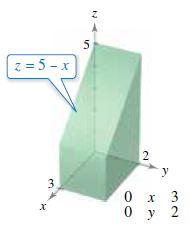
In Exercises 17–20, use a double integral to find the volume of the indicated solid. z = 5 - x 3 5 2 0 x 0 У У y 3 2
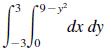
In Exercises 11–14, sketch the region R whose area is given by the iterated integral. Then change the order of integration and show that both orders yield the same area. 3 —3.0 9-² dx dy
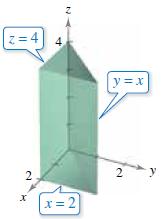
In Exercises 17–20, use a double integral to find the volume of the indicated solid. Z=4 2 X x=2] y = x 2 y
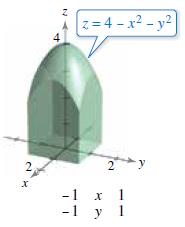
In Exercises 17–20, use a double integral to find the volume of the indicated solid. 2 x 2 |z=4-x² - y²| - 1 -1 2 x 1 y 1
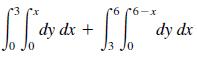
In Exercises 11–14, sketch the region R whose area is given by the iterated integral. Then change the order of integration and show that both orders yield the same area. x-9J 9J ff dy dx + ff* J3 J0 dy dx
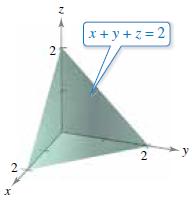
In Exercises 17–20, use a double integral to find the volume of the indicated solid. 2 X Z 2 x+y+z=2 2 y
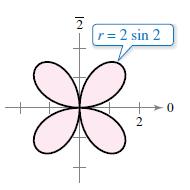
In Exercises 29 and 30, use a double integral to find the area of the shaded region. IN+ 2 r=2 sin 2 8 2 -0
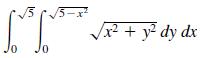
In Exercises 25 and 26, evaluate the iterated integral by converting to polar coordinates. •√√5√√√5-x² JO √√x² + y² dy dx
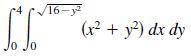
In Exercises 25 and 26, evaluate the iterated integral by converting to polar coordinates. JJ Jo Jo 16-y² (x² + y²) dx dy
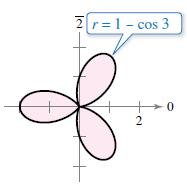
In Exercises 29 and 30, use a double integral to find the area of the shaded region. 2r=1- cos 3 2 -0
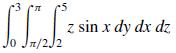
In Exercises 49–52, evaluate the triple iterated integral. Jo Jn/2J2 z sin x dy dx dz
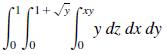
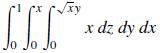
In Exercises 49–52, evaluate the triple iterated integral. [ 1+ √y pxy. y dz dx dy
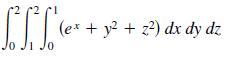
In Exercises 49–52, evaluate the triple iterated integral. S²S (ex + y² + 2²) dx dy dz ST 0 0
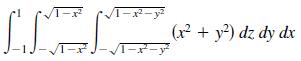
In Exercises 53 and 54, use a computer algebra system to evaluate the triple iterated integral. JENT 1-x²-y² -- (x² + y²) dz dy dx
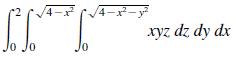
In Exercises 53 and 54, use a computer algebra system to evaluate the triple iterated integral. 1. T Jo 4-r 4-x²-y² xyz dz dy dx
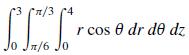
In Exercises 61–64, evaluate the triple iterated integral. (3 (π/3 (4 LIS Jo Jл/6 Jo r cos 0 dr do dz
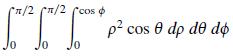
In Exercises 65 and 66, use a computer algebra system to evaluate the triple iterated integral. 1/2 n/2 cos Jo p² cos 0 dp de do
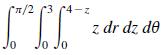
In Exercises 61–64, evaluate the triple iterated integral. π/2 /23 (4-z 0 z dr dz de
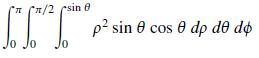
In Exercises 61–64, evaluate the triple iterated integral. C C/2 (sin 8 B p² sin 0 cos 0 dp de do 10
In Exercises 43–46, find the area of the surface given by z = f(x, y) that lies above the region R.f(x, y) = 25 - x2 - y2R = {(x, y): x2 + y2 ≤ 25}
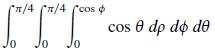
In Exercises 61–64, evaluate the triple iterated integral. n/4 (π/4 cos Jo Jo cos 0 dp do de
In Exercises 43–46, find the area of the surface given by z = f(x, y) that lies above the region R.f(x, y) = 8 + 4x - 5yR = {(x, y): x2 + y2 ≤ 1}
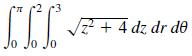
In Exercises 65 and 66, use a computer algebra system to evaluate the triple iterated integral. -3 √z² + 4 dz dr de
In Exercises 43–46, find the area of the surface given by z = f(x, y) that lies above the region R.f(x, y) = 4 - x2R: triangle with vertices (-2, 2), (0, 0), (2, 2)
In Exercises 67 and 68, use cylindrical coordinates to find the volume of the solid.Solid bounded above by 3x2 + 3y2 + z2 = 45 and below by the xy-plane
In Exercises 69 and 70, use spherical coordinates to find the volume of the solid.Solid bounded above by x2 + y2 + z2 = 4 and below by z2 = 3x2 + 3y2
In Exercises 71–74, find the Jacobian ∂(x, y)/∂(u, v) for the indicated change of variables.x = 3uv, y = 2(u - v)
What is the differential of volume, dV, for(a) Cylindrical coordinates and(b) Spherical coordinates? Choose one order of integration for each system.
Why is it beneficial to be able to change the order of integration for a triple integral? Explain.
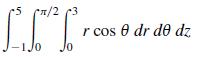
In Exercises 3–8, evaluate the triple iterated integral. Cπ/2 1/2 (3 LSI -1/0 Jo r cos 0 dr de dz
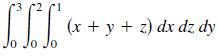
In Exercises 3–10, evaluate the triple iterated integral. JJJ Jo Jo Jo (x+y+z) dx dz dy
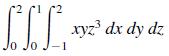
In Exercises 3–10, evaluate the triple iterated integral. (2 fff²³, xyz² dx dy dz -1
In Exercises 3–10, evaluate the triple iterated integral. xp Ap zp x of of
Showing 5400 - 5500
of 29454
First
48
49
50
51
52
53
54
55
56
57
58
59
60
61
62
Last
Step by Step Answers

 Get 50% OFF
Claim Now
Get 50% OFF
Claim Now