New Semester
Started
Get
50% OFF
Study Help!
--h --m --s
Claim Now
Question Answers
Textbooks
Find textbooks, questions and answers
Oops, something went wrong!
Change your search query and then try again
S
Books
FREE
Study Help
Expert Questions
Accounting
General Management
Mathematics
Finance
Organizational Behaviour
Law
Physics
Operating System
Management Leadership
Sociology
Programming
Marketing
Database
Computer Network
Economics
Textbooks Solutions
Accounting
Managerial Accounting
Management Leadership
Cost Accounting
Statistics
Business Law
Corporate Finance
Finance
Economics
Auditing
Tutors
Online Tutors
Find a Tutor
Hire a Tutor
Become a Tutor
AI Tutor
AI Study Planner
NEW
Sell Books
Search
Search
Sign In
Register
study help
mathematics
precalculus
Calculus Of A Single Variable 11th Edition Ron Larson, Bruce H. Edwards - Solutions
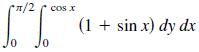
In Exercises 11–28, evaluate the iterated integral. (π/2 cos x (1 + sin x) dy dx
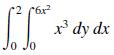
In Exercises 11–28, evaluate the iterated integral. 6x² o Jo x³ dy dx
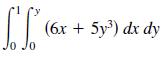
In Exercises 11–28, evaluate the iterated integral. S.S. Jo Jo (6x + 5y³) dx dy
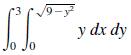
In Exercises 17–26, evaluate the iterated integral by converting to polar coordinates. /9-² ST Jo Jo y dx dy
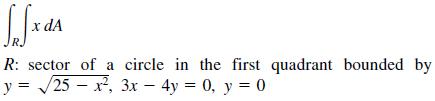
In Exercises 13–20, set up integrals for both orders of integration. Use the more convenient order to evaluate the integral over the plane region R. x dA R. R: sector of a circle in the first quadrant bounded by y = √25x², 3x - 4y = 0, y = 0
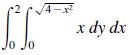
In Exercises 17–26, evaluate the iterated integral by converting to polar coordinates. 4-x² ST Jo Jo x dy dx
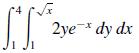
In Exercises 11–28, evaluate the iterated integral. SS JI 2ye* dy dx
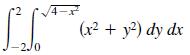
In Exercises 17–26, evaluate the iterated integral by converting to polar coordinates. -2/0 4-x (x² + y²) dy dx
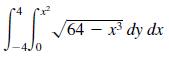
In Exercises 11–28, evaluate the iterated integral. -4/0 √64 - x³ dy dx
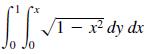
In Exercises 11–28, evaluate the iterated integral. SL 0 Jo √1-x² dy dx
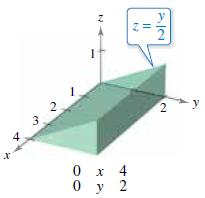
In Exercises 21–26, use a double integral to find the volume of the indicated solid. X 4 3 2 1 N 0 х 0 у 42 N Z= y 2
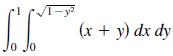
In Exercises 11–28, evaluate the iterated integral. ST 0 Jo (x + y) dx dy
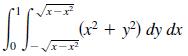
In Exercises 17–26, evaluate the iterated integral by converting to polar coordinates. 1-√√√x-x² (x² + y²) dy dx
In Exercises 13–24, find the mass and center of mass of the lamina bounded by the graphs of the equations for the given density. y = sin TX , y = 0, x=0, x= 3, p = k 3'
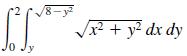
In Exercises 17–26, evaluate the iterated integral by converting to polar coordinates. 10 Jy /8- √x² + y² dx dy
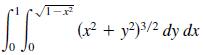
In Exercises 17–26, evaluate the iterated integral by converting to polar coordinates. 1-r SC lo Jo (x² + y²)³/² dy dx
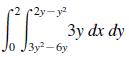
In Exercises 11–28, evaluate the iterated integral. 2у-ма Jo J3y²-6y 3y dx dy
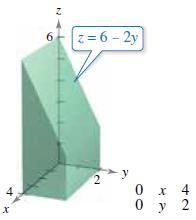
In Exercises 21–26, use a double integral to find the volume of the indicated solid. 4 6 |z=6-2y 2 0 0 х у 4 2
In Exercises 13–24, find the mass and center of mass of the lamina bounded by the graphs of the equations for the given density. y = √√36 - x², 0 ≤ y ≤ x₂ p = k
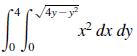
In Exercises 17–26, evaluate the iterated integral by converting to polar coordinates. 4√√4y-y² If 10 Jo x dx dy
In Exercises 13–24, find the mass and center of mass of the lamina bounded by the graphs of the equations for the given density. y = cos TX 8 y = 0, x = 0, x = 4, p = ky
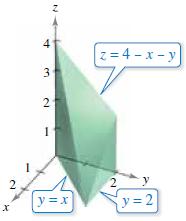
In Exercises 21–26, use a double integral to find the volume of the indicated solid. 2 X 4 نیا 3 2 1 y=x z=4-x-y 2 y y=2
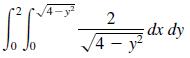
In Exercises 11–28, evaluate the iterated integral. 4-2 2 0 Jo √4 - y² 2 dx dy
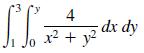
In Exercises 11–28, evaluate the iterated integral. ff: 4 x² + y² dx dy
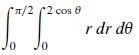
In Exercises 11–28, evaluate the iterated integral. *π/2 (2 cos 8 r dr de
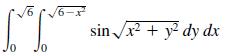
In Exercises 17–26, evaluate the iterated integral by converting to polar coordinates. √6 6-1 freque 10 Jo sin √√x² + y² dy dx
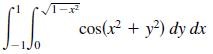
In Exercises 17–26, evaluate the iterated integral by converting to polar coordinates. -1/0 1-x²2² cos(x² + y²) dy dx
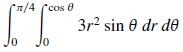
In Exercises 11–28, evaluate the iterated integral. n/4 cos 0 10 10 3r² sin 0 dr de
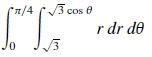
In Exercises 11–28, evaluate the iterated integral. (π/4 √√3 cos 0 [*] انی r dr de
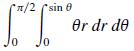
In Exercises 11–28, evaluate the iterated integral. (π/2 (sin 8 Jo Or dr de
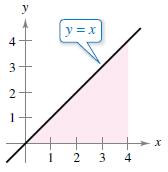
In Exercises 33–36, use an iterated integral to find the area of the region. 4 3 2 y y = x 12 23 4 x
In Exercises 51–60, sketch the region R whose area is given by the iterated integral. Then change the order of integration and show that both orders yield the same area. . J 2 dy dx
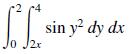
In Exercises 45–50, sketch the region of integration. Then evaluate the iterated integral, changing the order of integration if necessary. 10 J2x sin y² dy dx
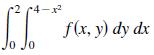
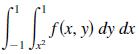
In Exercises 43–50, sketch the region R of integration and change the order of integration. 24-1² SS 0 Jo f(x, y) dy dx
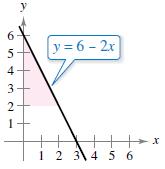
In Exercises 33–36, use an iterated integral to find the area of the region. ه انا حلو ليا يا 6 5 4 3 2 1 y y=6-2x 1 2 3 4 5 6
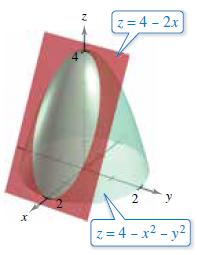
In Exercises 35–40, set up a double integral to find the volume of the solid region bounded by the graphs of the equations. Do not evaluate the integral. X |z=4-2x 2 y |z=4-x² - y²
In Exercises 13–24, find the mass and center of mass of the lamina bounded by the graphs of the equations for the given density.x2 + y2 = 16, x ≥ 0, y ≥ 0, ρ = k(x2 + y2)
In Exercises 43–50, sketch the region R of integration and change the order of integration. fra -1/2² f(x, y) dy dx
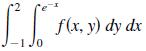
In Exercises 43–50, sketch the region R of integration and change the order of integration. [ -1 J0 f(x, y) dy dx
In Exercises 51–60, sketch the region R whose area is given by the iterated integral. Then change the order of integration and show that both orders yield the same area. 2 (4 SS. 2 dx dy
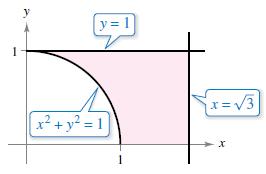
Express the area of the region in the figure using the sum of two double polar integrals. Then find the area of the region without using integrals. y=1 x² + y² = 1 1 { x= √3] X
In Exercises 51–60, sketch the region R whose area is given by the iterated integral. Then change the order of integration and show that both orders yield the same area. 1 2 If 10 J2y dx dy
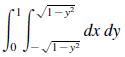
In Exercises 51–60, sketch the region R whose area is given by the iterated integral. Then change the order of integration and show that both orders yield the same area. 0 √1-y² -√1-y² dx dy
In Exercises 29–32, use polar coordinates to set up and evaluate the double integral ∫R∫ f (x, y) dA.f(x, y) = x + yR: x2 + y2 ≤ 36, x ≥ 0, y ≥ 0
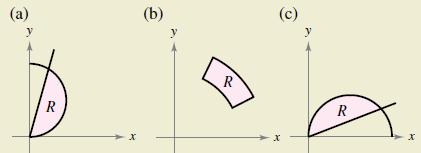
Each figure shows a region of integration for the double integral ∫R∫ f(x, y) dA. For each region, state whether horizontal representative elements, vertical representative elements, or polar sectors would yield the easiest method for obtaining the limits of integration. Explain your reasoning.
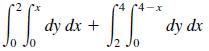
In Exercises 51–60, sketch the region R whose area is given by the iterated integral. Then change the order of integration and show that both orders yield the same area. f²f 0 Jo dy dx + 4 (4-x J2 12 JO dy dx
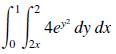
In Exercises 61–66, sketch the region of integration. Then evaluate the iterated integral. 2 [T 0 №2x 4e dy dx
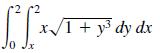
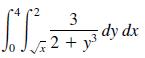
In Exercises 61–66, sketch the region of integration. Then evaluate the iterated integral. (2 SfAVT+ X- 0 x√1 + y³ dy dx
In Exercises 37– 42, use an iterated integral to find the area of the region bounded by the graphs of the equations.y = 9 - x2, y = 0
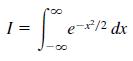
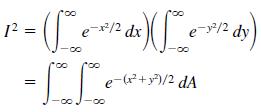
The value of the integralis required in the development of the normal probability density function.(a) Use polar coordinates to evaluate the improper integral.(b) Use the result of part (a) to determine I. roo = Sohbe 00 I e-²/2 dx
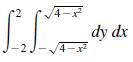
In Exercises 51–60, sketch the region R whose area is given by the iterated integral. Then change the order of integration and show that both orders yield the same area. L -√√4-1²2² dy dx
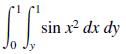
In Exercises 61–66, sketch the region of integration. Then evaluate the iterated integral. CS sin x² dx dy
In Exercises 61–66, sketch the region of integration. Then evaluate the iterated integral. 4 Sa 3 √√√x2 + y²³² dy dx
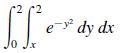
In Exercises 61–66, sketch the region of integration. Then evaluate the iterated integral. 2/2 [T e-² dy dx 10 x
In Exercises 51–56, find the average value of f(x, y) over the plane region R. f(x, y) = 2xy R: rectangle with vertices (0, 1), (1, 1), (1, 6), (0, 6)
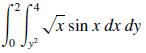
In Exercises 61–66, sketch the region of integration. Then evaluate the iterated integral. (4 f √x sin x dx dy R
In Exercises 79 and 80, determine whether the statement is true or false. If it is false, explain why or give an example that shows it is false. b (d Cd fb. ["[^f(x, y) dy dx = ["[*r(x, f(x, y) dx dy
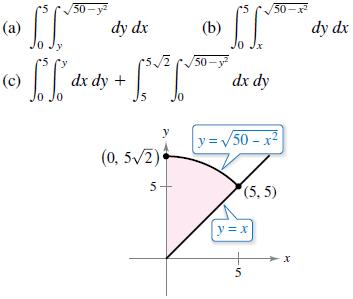
Determine whether each expression represents the area of the shaded region (see figure). 50-y² (a) dy dx 0 Jy (c) • [f de dy + [v³ from dx 5 Jo (0, 5√2) (b) 52 50-² 5+ fr Jo Jx dx dy 50-x² y=√50-x² (5,5) y=x 5 X dy dx
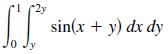
In Exercises 71–76, use a computer algebra system to evaluate the iterated integral. 2y y sin(x + y) dx dy
In Exercises 61 and 62, determine whether the statement is true or false. If it is false, explain why or give an example that shows it is false.If ∫R∫ f (r, θ) dA > 0, then f (r, θ) > 0 for all (r, θ) in R.
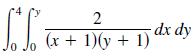
In Exercises 71–76, use a computer algebra system to evaluate the iterated integral. S 0 2 Jo (x + 1)(y + 1) dx dy
Express the area of the region bounded by x = √4 - 4y2, y = 1, and x = 2 in at least two different ways, one of which is an iterated integral. Do not find the area of the region.
In Exercises 79 and 80, determine whether the statement is true or false. If it is false, explain why or give an example that shows it is false. 0 Jo ax = LCry = 0 JO f(x, y) dy dx f(x, y) dx dy
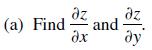
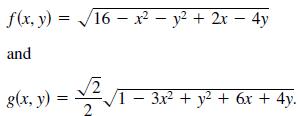
Consider the functions(a) Find a set of parametric equations of the tangent line to the curve of intersection of the surfaces at the point (1, 2, 4) and find the angle between the gradients of f and g.(b) Use a computer algebra system to graph the surfaces and the tangent line found in part (a).
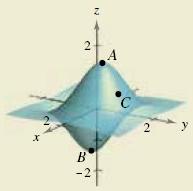
Determine whether each labeled point is an absolute maximum, an absolute minimum, or neither. X Z 2 А B -2 C 2
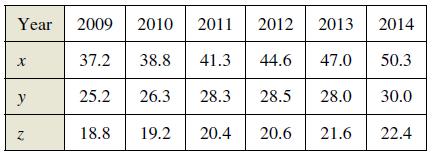
Personal consumption expenditures (in billions of dollars) for several types of recreation from 2009 through 2014 are shown in the table, where x is the expenditures on amusement parks and campgrounds, y is the expenditures on live entertainment (excluding sports), and z is the expenditures on
Consider the functions(a) Use a computer algebra system to graph the first octantportion of the surfaces represented by f and g.(b) Find one first-octant point on the curve of intersection and show that the surfaces are orthogonal at this point.(c) These surfaces are orthogonal along the curve of
Consider v = 3u. Is the directional derivative of a differentiable function f (x, y) in the direction of v at the point (x0, y0) three times the directional derivative of f in the direction of u at the point (x0, y0)? Explain.
In Exercises 55–58, determine whether the statement is true or false. If it is false, explain why or give an example that shows it is false.If f has a relative maximum at (x0, y0, z0), thenfx(x0, y0) = fy(x0, y0) = 0.
In Exercises 55–58, determine whether the statement is true or false. If it is false, explain why or give an example that shows it is false.If fx(x0, y0) = fy(x0, y0) = 0, then f has a relative extremum at (x0, y0, z0).
The temperature at the point (x, y) on a metal plate is T(x, y) = 400e-(x2+y)/2, x ≥ 0, y ≥ 0.(a) Use a computer algebra system to graph the temperature distribution function.(b) Find the directions of no change in heat on the plate from the point (3, 5).(c) Find the direction of greatest
In Exercises 61–64, determine whether the statement is true or false. If it is false, explain why or give an example that shows it is false.If f (x, y) = √1 - x2 - y2, then Du f (0, 0) = 0 for any unit vector u.
Let f : R2 R be a function such thatf(x, y) + f(y, z) + f (z, x) = 0for all real numbers x, y, and z. Prove that there exists a function g: R R such thatf(x, y) = g(x) - g(y)for all real numbers x and y
Consider w = f (x, y), where x = g(s, t) and y = h(s, t). Describe two ways of finding the partial derivatives ∂w/∂s and ∂w/∂t.
Consider a point (x0, y0, z0) on a surface given by F(x, y, z) = 0. What is the relationship between ∇F(x0, y0, z0) and any tangent vector v at (x0, y0, z0)? How do you represent this relationship mathematically?
For a function f(x, y), when does the directional derivative at the point (x0, y0) equal the partial derivative with respect to x at the point (x0, y0)? What does this mean graphically?
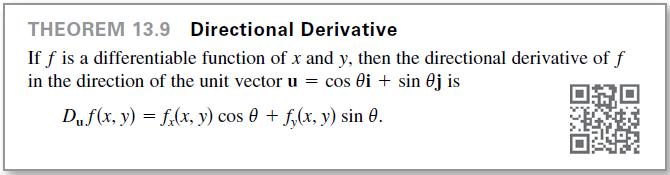
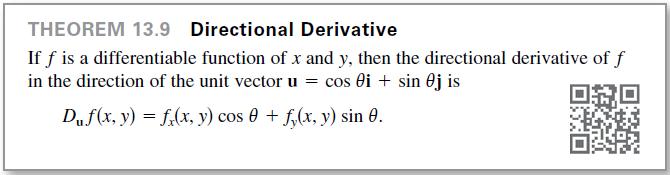
In Exercises 7–10, use Theorem 13.9 to find the directional derivative of the function at P in the direction of v. THEOREM 13.9 Directional Derivative If f is a differentiable function of x and y, then the directional derivative of f in the direction of the unit vector u = cos i + sin ej
Why is using the Chain Rule to determine the derivative of the equation F(x, y) = 0 implicitly easier than using the method you learned in Section 2.5?
Under what condition does the Second Partials Test fail?
What is the meaning of the gradient of a function f at a point (x, y)?
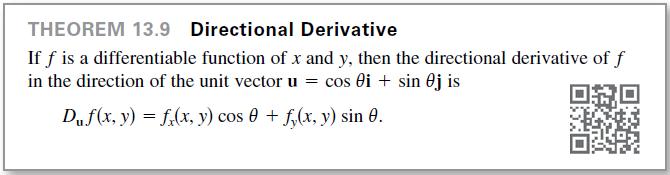
In Exercises 7–10, use Theorem 13.9 to find the directional derivative of the function at P in the direction of v. THEOREM 13.9 Directional Derivative If f is a differentiable function of x and y, then the directional derivative of f in the direction of the unit vector u = cos i + sin ej
In Exercises 3–8, find the total differential.z = 5x3y2
In Exercises 3–10, use Lagrange multipliers to find the indicated extrema, assuming that x and y are positive.Maximize f(x, y) = xyConstraint: x + y = 10
In Exercises 7–10, use Theorem 13.9 to find the directional derivative of the function at P in the direction of v.h(x, y) = e-(x2+y2), P(0, 0), v = i + j THEOREM 13.9 Directional Derivative If f is a differentiable function of x and y, then the directional derivative of f in the direction of the
In Exercises 3–8, find the total differential.z = 2x3y - 8xy4
In Exercises 3 and 4, find the minimum distance from the point to the plane x - y + z = 3.(4, 0, 6)
In Exercises 3–8, identify any extrema of the function by recognizing its given form or its form after completing the square. Verify your results by using the partial derivatives to locate any critical points and test for relative extrema.g(x, y) = 5 - (x - 6)2 - (y + 2)2
In Exercises 3–6, describe the level surface F(x, y, z) = 0.F(x, y, z) = 36 - x2 - y2 - z2
In Exercises 3–8, find the total differential.z = 1/2 (ex2+y2 - e-x2-y2)
In Exercises 3–8, find the total differential.z = e-x tan y
In Exercises 3–8, identify any extrema of the function by recognizing its given form or its form after completing the square. Verify your results by using the partial derivatives to locate any critical points and test for relative extrema.f(x, y) = √49 - (x - 2)2 - y2
In Exercises 7–12, find dw/dt(a) By using the appropriate Chain Rule and(b) By converting w to a function of t before differentiating.w = x - 1/y, x = e2t, y = t3
In Exercises 3–8, find the total differential.w = (x + y)/(z - 3y)
In Exercises 3–10, use Lagrange multipliers to find the indicated extrema, assuming that x and y are positive.Minimize f(x, y) = 3x + y + 10Constraint: x2y = 6
In Exercises 9–14,(a) Find f(2, 1) and f(2.1, 1.05) and calculate Δz, and(b) Use the total differential dz to approximate Δz.f(x, y) = 2x - 3y
In Exercises 9–24, find all relative extrema and saddle points of the function. Use the Second Partials Test where applicable.f(x, y) = x2 + y2 + 8x - 12y - 3
In Exercises 9–14,(a) Find f(2, 1) and f(2.1, 1.05) and calculate Δz, and(b) Use the total differential dz to approximate Δz.f(x, y) = x2 + y2
In Exercises 11–14, use Lagrange multipliers to find the indicated extrema, assuming that x, y, and z are positive.Minimize f(x, y, z) = x2 + y2 + z2Constraint: x + y + z - 9 = 0
In Exercises 9–24, find all relative extrema and saddle points of the function. Use the Second Partials Test where applicable.f(x, y) = -2x4y4
In Exercises 7–16, find an equation of the tangent plane to the surface at the given point. f(x, y) = sin x cos y. л л 3 3'6'4,
Showing 5600 - 5700
of 29454
First
50
51
52
53
54
55
56
57
58
59
60
61
62
63
64
Last
Step by Step Answers

 Get 50% OFF
Claim Now
Get 50% OFF
Claim Now