New Semester
Started
Get
50% OFF
Study Help!
--h --m --s
Claim Now
Question Answers
Textbooks
Find textbooks, questions and answers
Oops, something went wrong!
Change your search query and then try again
S
Books
FREE
Study Help
Expert Questions
Accounting
General Management
Mathematics
Finance
Organizational Behaviour
Law
Physics
Operating System
Management Leadership
Sociology
Programming
Marketing
Database
Computer Network
Economics
Textbooks Solutions
Accounting
Managerial Accounting
Management Leadership
Cost Accounting
Statistics
Business Law
Corporate Finance
Finance
Economics
Auditing
Tutors
Online Tutors
Find a Tutor
Hire a Tutor
Become a Tutor
AI Tutor
AI Study Planner
NEW
Sell Books
Search
Search
Sign In
Register
study help
mathematics
precalculus
Calculus Of A Single Variable 11th Edition Ron Larson, Bruce H. Edwards - Solutions
In Exercises 25–30, find the tangential and normal components of acceleration at the given time t for the plane curve r(t).r(t) = ti + 1/tj, t = 1
In Exercises 23–26, find (a) r'(t), (b) r''(t), (c) r'(t) · r''(t), and (d) r'(t) x r''(t).r(t) = 〈e-t, t2, tan t〉
In Exercises 25–30, find the tangential and normal components of acceleration at the given time t for the plane curve r(t).r(t) = t2i + 2tj, t = 1
In Exercises 23–28, find the curvature of the plane curve at the given value of the parameter.r(t) = ti + 1/9 t3j, t = 2
Sketch the plane curve represented by the vector-valued function and give the orientation of the curve.r(t) = (t2 + t)i + (t2 - t)j
In Exercises 25–30, find the tangential and normal components of acceleration at the given time t for the plane curve r(t).r(t) = eti + e-2tj, t = 0
Sketch the space curve represented by the vector-valued function and give the orientation of the curve.r(t) = 〈t, t2, 2/3 t3〉
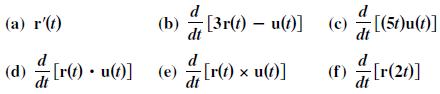
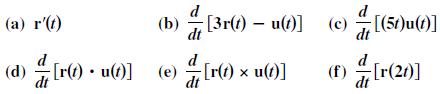
In Exercises 35 and 36, Use the properties of the derivative to find the following.r(t) = ti + 3tj + t2k, u(t) = 4ti + t2j + t3k (a) r'(t) [3r(t) - u(t)] (d) [r(t) u(t)] (e) [r(t) = u(t)] dt x dt (b) (c) [(5t)u(t)] dt (f) [r(20)] dt
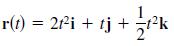
In Exercises 29–36, find the curvature of the curve. r(t) = 2i + tj + 1 12k
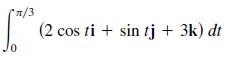
In Exercises 31–34, evaluate the definite integral. Sö¹³ (2 cos ti + sin tj + 3k) dt
In Exercises 35 and 36, Use the properties of the derivative to find the following.r(t) = 〈t, 2 sin t, 2 cos t〉, u(t) = 〈1/t, 2 sin t, 2 cos t〉 (a) r'(t) [3r(t) - u(t)] (d) [r(t) u(t)] (e) [r(t) = u(t)] dt x dt (b) (c) [(5t)u(t)] dt (f) [r(20)] dt
In Exercises 35–40, find the tangential and normal components of acceleration at the given time t for the space curve (r)t. r(t) cos ti+ sin tj + 2tk, t E|M π
In Exercises 35–40, find the tangential and normal components of acceleration at the given time t for the space curve (r)t.r(t) = ti + 2tj - 3tk, t = 1
Sketch the space curve represented by the vector-valued function and give the orientation of the curve.r(t) = t2i + 2tj + 3/2 tk
In Exercises 35–40, find the tangential and normal components of acceleration at the given time t for the space curve (r)t. r(t) = ti + Aj + 2/2k, -k. t = 1
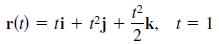
In Exercises 37–40, find the curvature of the curve at the point P. r(t) = ti + 1²j + —k, P(2, 4, 2)
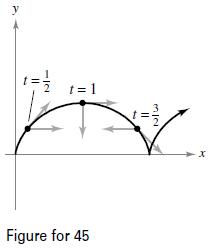
The figure shows the path of a particle modeled by the vector-valued function r(t) = (πt - sin πt, 1 - cos πt).The figure also shows the vectors v(t)/∥v(t)∥ and a(t)/∥a(t)∥ at the indicated values of t.(a) Find aT and aN at t = 1/2, t = 1, and t = 3/2.(b) Determine whether the speed of
In Exercises 37–40, find the curvature of the curve at the point P.r(t) = 3ti + 2t2j, P(-3, 2)
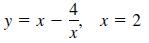
In Exercises 41–48, find the curvature and radius of curvature of the plane curve at the given value of x. y = x--, X x = 2
Sketch the space curve represented by the vector-valued function and give the orientation of the curve.r(t) = 〈cos t + t sin t, sin t - t cos t, t〉
In Exercises 35–40, find the tangential and normal components of acceleration at the given time t for the space curve (r)t.r(t) = (2t - 1)i + t2j - 4tk, t = 2
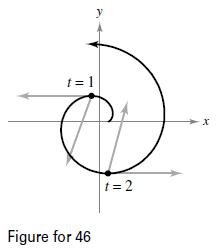
The figure shows a particle moving along a path modeled byr(t) = 〈cos πt + πt sin πt, sin πt - πt cos πt〉.The figure also shows the vectors v(t) and a(t) for t = 1 and t = 2.(a) Find aT and aN at t = 1 and t = 2.(b) Determine whether the speed of the particle is increasing or decreasing
In Exercises 53 and 54, find the tangential and normal components of acceleration at the given time t for the space curve r(t). r(t) = sin ti 3tj + cos tk, - t = π 6
In Exercises 35–40, find the tangential and normal components of acceleration at the given time t for the space curve (r)t.r(t) = et sin ti + et cos tj + etk, t = 0
In Exercises 35–40, find the tangential and normal components of acceleration at the given time t for the space curve (r)t.r(t) = eti + 2tj + e-tk, t = 0
In Exercises 53 and 54, find the tangential and normal components of acceleration at the given time t for the space curve r(t). ) = —i − 6tj + f²k, t = 2 3 r(t)
In Exercises 41–48, find the curvature and radius of curvature of the plane curve at the given value of x.y = 6x, x = 3
In Exercises 43 and 44, find the unit tangent vector to the curve at the specified value of the parameter.r(t) = 6ti - t2j, t = 2
In Exercises 41–48, find the curvature and radius of curvature of the plane curve at the given value of x.y = 5x2 + 7, x = -1
In Exercises 53 – 58, find r(t) that satisfies the initial condition(s). r'(1) 1 hr + 2 + r(1) = 2i
In Exercises 41–48, find the curvature and radius of curvature of the plane curve at the given value of x.y = 2√9 - x2, x = 0
Consider the vector-valued function r(t) = 3t2i + (t -1)j + tk. Write a vector-valued function u(t) that is the specified transformation of r.The y-value increases by a factor of two
In Exercises 61–68, prove the property. In each case, assume r, u, and v are differentiable vector-valued functions of t in space, w is a differentiable real-valued function of t, and c is a scalar. (1)n × (1),.¹ + (1),n × (1).¹ = [(1)n × (1)-¹]. 01/7/2
In Exercises 45 and 46, find the unit tangent vector T(t) and a set of parametric equations for the tangent line to the space curve at point P.r(t) = e2ti + cos tj - sin 3tk, P(1, 1, 0)
In Exercises 41–48, find the curvature and radius of curvature of the plane curve at the given value of x.y = sin 2x, x = π/4
Consider the vector-valued function r(t) = 3t2i + (t -1)j + tk. Write a vector-valued function u(t) that is the specified transformation of r.The z-value increases by a factor of three
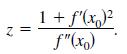
Let C be a curve given by y = f (x). Let K be the curvature (K ≠ 0) at the point P(x0, y0) and letShow that the coordinates (α, β) of the center of curvature at P are (α, β) = (x0 - f'(x0)z, y0 + z). z = Z 1 + f'(x)²
In Exercises 41–48, find the curvature and radius of curvature of the plane curve at the given value of x.y = e-x/4, x = 8
In Exercises 61–68, prove the property. In each case, assume r, u, and v are differentiable vector-valued functions of t in space, w is a differentiable real-valued function of t, and c is a scalar. (1),M((1)M), I = [((1)M).¹]- ¹p P
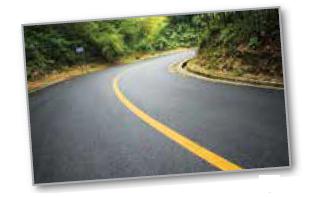
The smaller the curvature of a bend in a road, the faster a car can travel. Assume that the maximum speed around a turn is inversely proportional to the square root of the curvature. A car moving on the path y = 1/3x3, where x and y are measured in miles, can safely go 30 miles per hour at (1,
In Exercises 53 – 58, find r(t) that satisfies the initial condition(s).r'(t) = 4e2ti + 3etj, r(0) = 2i
In Exercises 55–58, find all points on the graph of the function such that the curvature is zero.y = 1 - x4
In Exercises 67 and 68, find the curvature of the curve at the point P. r(t) = ½ t²i + tj + ¾t³k, P(1, 1, 3)
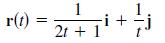
Determine the interval(s) on which the vector-valued function is continuous. r(t) 1 21 + 1 i + | |
In Exercises 55–58, find all points on the graph of the function such that the curvature is zero.y = (x - 2)6 + 3x
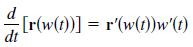
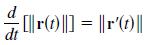
In Exercises 73–76, determine whether the statement is true or false. If it is false, explain why or give an example that shows it is false. d dt [r]=r'()|
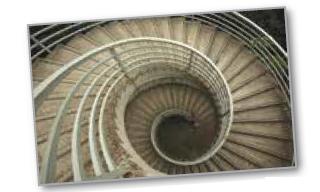
The outer bottom edge of a staircase is in the shape of a helix of radius 1 meter. The staircase has a height of 4 meters and makes two complete revolutions from top to bottom. Find a vector- valued function for the staircase. Use a computer algebra system to graph your function.
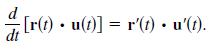
In Exercises 73–76, determine whether the statement is true or false. If it is false, explain why or give an example that shows it is false.If r and u are differentiable vector-valued functions of t, then d dt [r). [r(t) u(t)] = r'(t). u'(t).
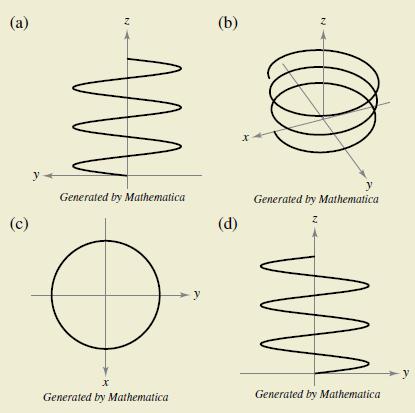
The four figures below are graphs of the vector-valued function r(t) = 4 cos ti + 4 sin tj + t/4 k.Match each of the four graphs with the point in space from which the helix is viewed.(i) (0, 0, 20)(ii) (20, 0, 0)(iii) (-20, 0, 0)(iv) (10, 20, 10) (a) y z A Generated by Mathematica X Generated by
Which of the following vector-valued functions represent the same graph?(a) r(t) = (-3 cos t + 1)i + (5 sin t + 2)j + 4k(b) r(t) = 4i + (-3 cos t + 1)j + (5 sin t + 2)k(c) r(t) = (3 cos t - 1)i + (-5 sin t - 2)j + 4k(d) r(t) = (-3 cos 2t + 1)i + (5 sin 2t + 2)j + 4k
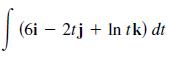
In Exercises 27–30, find the indefinite integral. [ − (6i 2tj + In tk) dt
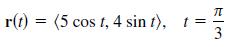
In Exercises 23–28, find the curvature of the plane curve at the given value of the parameter. r(t) = (5 cos t, 4 sin t), t = W3
In Exercises 27–34, find the open interval(s) on which the curve given by the vector-valued function is smooth.r(t) = 5t5i - t4j
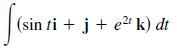
In Exercises 27–30, find the indefinite integral. (sin ti + j + e²¹ k) dt
In Exercises 25–30, find the tangential and normal components of acceleration at the given time t for the plane curve r(t).r(t) = eti + e-tj, t = 0
Sketch the plane curve represented by the vector-valued function and give the orientation of the curve.r(θ) = 3 sec θi + 2 tan θj
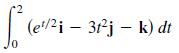
In Exercises 31–34, evaluate the definite integral. 2 (e/2i 3t2jk) dt -
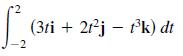
In Exercises 31–34, evaluate the definite integral. Le -2 (3ti + 2t²j - t³k) dt
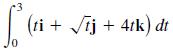
In Exercises 31–34, evaluate the definite integral. Jo (ti + √tj + 4tk) dt
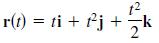
In Exercises 29–36, find the curvature of the curve. r(t) = ti + ²j + — k 2
In Exercises 29–36, find the curvature of the curve.r(t) = 4 cos 2πti + 4 sin 2πtj
Sketch the space curve represented by the vector-valued function and give the orientation of the curve.r(t) = ti + (2t - 5) j + 3tk
Sketch the space curve represented by the vector-valued function and give the orientation of the curve.r(t) = ti + 3 cos tj + 3 sin tk
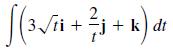
In Exercises 27–30, find the indefinite integral. 2 [ (3√ii + ¾ j + k) dt
Sketch the plane curve represented by the vector-valued function and give the orientation of the curve.r(t) = 2 cos3 ti + 2 sin3 tj
Find u · (v x w).u = 〈2, 0, 1〉v = 〈0, 3, 0〉w = 〈0, 0, 1〉
Determine whether each point lies in the plane.x + 2y − 4z − 1 = 0(a) (−7, 2, −1)(b) (5, 2, 2)(c) (−6, 1, −1)
Convert the point from rectangular coordinates to spherical coordinates.(-5, -5, √2)
Find u · (v x w).u = 〈2, 0, 0〉v = 〈1, 1, 1〉w = 〈0, 2, 2〉
Determine whether each point lies in the plane.2x + y + 3z − 6 = 0(a) (3, 6, −2)(b) (−1, 5, −1)(c) (2, 1, 0)
(a) Find the projection of u onto v(b) Find the vector component of u orthogonal to v.u = 〈9, 7〉, v = 〈1,3〉
Find an equation of a generating curve given the equation of its surface of revolution.8x2 + y2 + z2 = 5
Find an equation of a generating curve given the equation of its surface of revolution.6x2 + 2y2 + 2z2 = 1
(a) Find the projection of u onto v(b) Find the vector component of u orthogonal to v.u = -9i - 2j - 4k, v = 4j + 4k
(a) Find the projection of u onto v(b) Find the vector component of u orthogonal to v.u = 5i - j - k, v = -i + 5j + 8k
Find an equation in rectangular coordinates for the surface represented by the spherical equation, and sketch its graph.ρ = 1
Sketch a graph of the plane and label any intercepts.y = −2
A pallet truck is pulled by exerting a force of 400 newtons on a handle that makes a 60° angle with the horizontal. Find the work done in pulling the truck 40 meters.
Consider a regular tetrahedron with vertices (0, 0, 0), (k, k, 0), (k, 0, k), and (0, k, k), where k is a positive real number.(a) Sketch the graph of the tetrahedron.(b) Find the length of each edge.(c) Find the angle between any two edges.(d) Find the angle between the line segments from the
Sketch a graph of the plane and label any intercepts.z = 1
Convert the rectangular equation to an equation in(a) Cylindrical coordinates(b) Spherical coordinates.x2 + y2 = 4y
Explain what u x v represents geometrically.
What can you say about the relative position of two nonzero vectors if their dot product is zero?
Describe the position of the point (2, 0°, 30°) given in spherical coordinates.
The equation of a plane in space is 2(x − 1) + 4(y − 3) − (z + 5) = 0. What is the normal vector to this plane?
Find(a) u · v,(b) u · u,(c) ∥v∥2,(d) (u · v) v, (e) u · (3v).u = 〈3, 4〉, v = 〈-1, 5〉
Find(a) u · v,(b) u · u,(c) ∥v∥2,(d) (u · v) v, (e) u · (3v).u = 〈4, 10〉, v = 〈-2, 3〉
Find(a) u · v,(b) u · u,(c) ∥v∥2,(d) (u · v) v, (e) u · (3v).u = 〈6, -4〉, v = 〈-3, 2〉
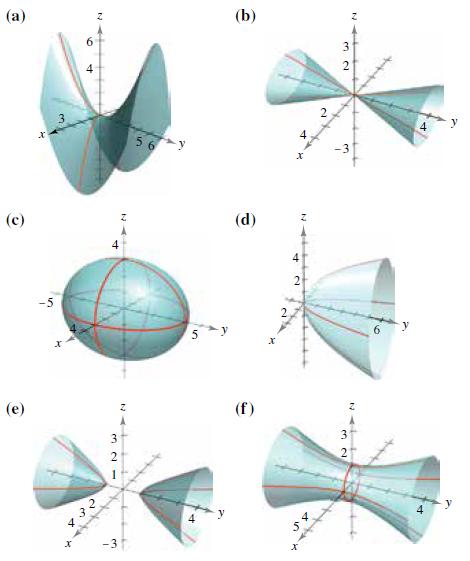
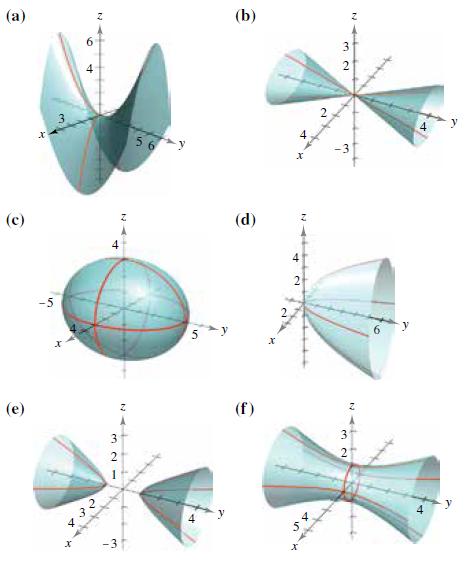
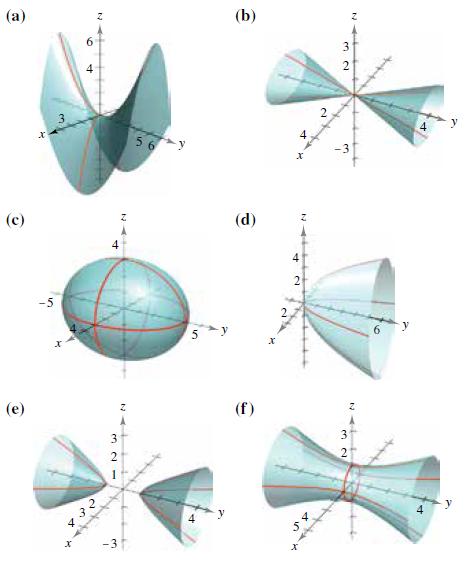
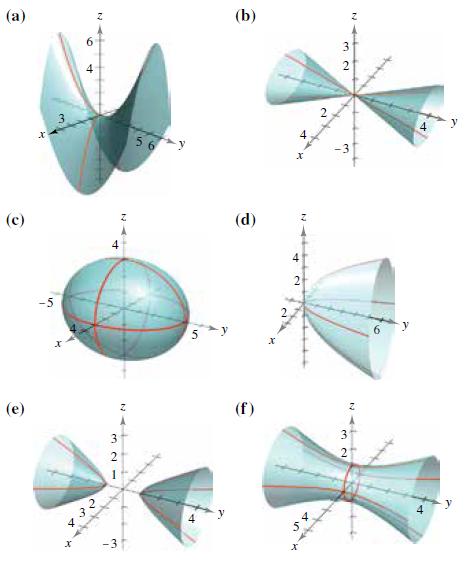
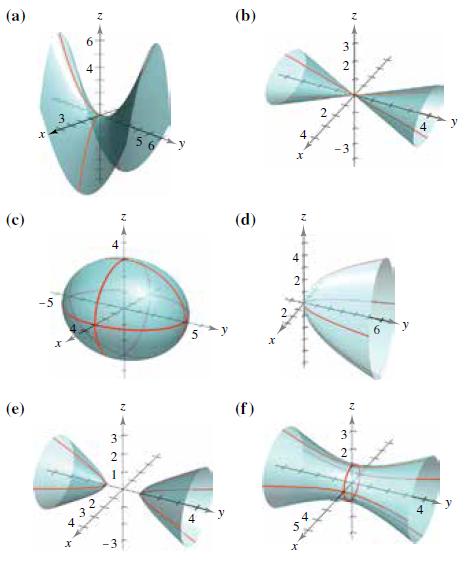
Match the equation with its graph. [The graphs are labeled (a), (b), (c), (d), (e), and (f).]15x2 - 4y2 + 15z2 = -4 (a) (c) (e) -5 6 st CEA 321 NA ++++ -3 5 (b) (d) (f) 4 NA TYYN 42 2 3 2 N 4312 32 Fot
Find(a) u · v,(b) u · u,(c) ∥v∥2,(d) (u · v) v, (e) u · (3v).u = 〈-7, -1〉, v = 〈-4, -1〉
Match the equation with its graph. [The graphs are labeled (a), (b), (c), (d), (e), and (f).]4x2 - y2 + 4z2 = 4 (a) (c) (e) -5 6 st CEA 321 NA ++++ -3 5 (b) (d) (f) 4 NA TYYN 42 2 3 2 N 4312 32 Fot
Find(a) u · v,(b) u · u,(c) ∥v∥2,(d) (u · v) v, (e) u · (3v).u = 〈2, -3, 4〉, v = 〈0, 6, 5〉
Match the equation with its graph. [The graphs are labeled (a), (b), (c), (d), (e), and (f).]y2 = 4x2 + 9z2 (a) (c) (e) -5 6 st CEA 321 NA ++++ -3 5 (b) (d) (f) 4 NA TYYN 42 2 3 2 N 4312 32 Fot
Match the equation with its graph. [The graphs are labeled (a), (b), (c), (d), (e), and (f).]4x2 - 4y + z2 = 0 (a) (c) (e) -5 6 st CEA 321 NA ++++ -3 5 (b) (d) (f) 4 NA TYYN 42 2 3 2 N 4312 32 Fot
Find(a) u · v,(b) u · u,(c) ∥v∥2,(d) (u · v) v, (e) u · (3v).u = 〈-5, 0, 5〉, v = 〈-1, 2, 1〉
Find(a) u x v,(b) v x u,(c) v x v.u = 3i + 5k v = 2i + 3j - 2k
Match the equation with its graph. [The graphs are labeled (a), (b), (c), (d), (e), and (f).]4x2 - y2 + 4z = 0 (a) (c) (e) -5 6 st CEA 321 NA ++++ -3 5 (b) (d) (f) 4 NA TYYN 42 2 3 2 N 4312 32 Fot
Find(a) u · v,(b) u · u,(c) ∥v∥2,(d) (u · v) v, (e) u · (3v).u = 2i - j + kv = i - k
Find(a) u x v,(b) v x u,(c) v x v.u = 〈7, 3, 2〉v = 〈1, -1, 5〉
Find(a) u · v,(b) u · u,(c) ∥v∥2,(d) (u · v) v, (e) u · (3v).u = 2i + j - 2kv = i - 3j + 2k
Showing 5900 - 6000
of 29454
First
53
54
55
56
57
58
59
60
61
62
63
64
65
66
67
Last
Step by Step Answers

 Get 50% OFF
Claim Now
Get 50% OFF
Claim Now