New Semester
Started
Get
50% OFF
Study Help!
--h --m --s
Claim Now
Question Answers
Textbooks
Find textbooks, questions and answers
Oops, something went wrong!
Change your search query and then try again
S
Books
FREE
Study Help
Expert Questions
Accounting
General Management
Mathematics
Finance
Organizational Behaviour
Law
Physics
Operating System
Management Leadership
Sociology
Programming
Marketing
Database
Computer Network
Economics
Textbooks Solutions
Accounting
Managerial Accounting
Management Leadership
Cost Accounting
Statistics
Business Law
Corporate Finance
Finance
Economics
Auditing
Tutors
Online Tutors
Find a Tutor
Hire a Tutor
Become a Tutor
AI Tutor
AI Study Planner
NEW
Sell Books
Search
Search
Sign In
Register
study help
mathematics
precalculus
Precalculus Concepts Through Functions A Unit Circle Approach To Trigonometry 5th Edition Michael Sullivan - Solutions
In Problems 89–94,(a) Graph each function using transformations,(b) Find the real zeros of each function,(c) Label the x-intercepts on the graph of the function.f (x) = −2(x + 1)2 + 12
In Problems 95–100, solve f (x) = g(x). What are the points of intersection of the graphs of the two functions?f (x) = 5x(x − 1)g(x) = −7x2 + 2
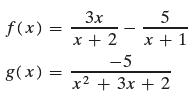
In Problems 95–100, solve f (x) = g(x). What are the points of intersection of the graphs of the two functions? f(x) = g(x) = 3x x + 2 5 x + 1 -5 x² + 3x + 2
In Problems 95–100, solve f (x) = g(x). What are the points of intersection of the graphs of the two functions?f (x) = 10x(x + 2)g(x) = −3x + 5
In Problems 95–100, solve f (x) = g(x). What are the points of intersection of the graphs of the two functions?f (x) = 3( x2 − 4)g(x) = 3x2 + 2x + 4
In Problems 95–100, solve f (x) = g(x). What are the points of intersection of the graphs of the two functions?f (x) = 4(x2 + 1)g(x) = 4x2 − 3x − 8
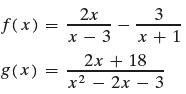
In Problems 95–100, solve f (x) = g(x). What are the points of intersection of the graphs of the two functions? f(x) = = g(x) = 2x x - 3 1 3 x + 1 2x + 18 x² - 2x - 3 2
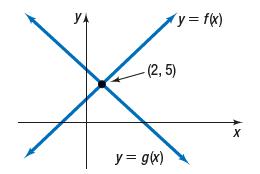
In parts (a) and (b), use the figure below.(a) Solve the equation: f (x) = g(x).(b) Solve the inequality: f (x) ≤ g(x). YA (y = f(x) (2,5) y = g(x) X
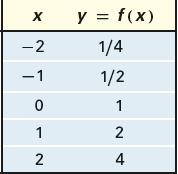
In Problems 27–34, determine whether each function is linear or nonlinear. If it is linear, determine the slope. X -2 -1 0 1 2 y = f(x) 1/4 1/2 1 2 4
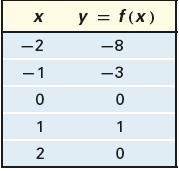
In Problems 27–34, determine whether each function is linear or nonlinear. If it is linear, determine the slope. X -2 -1 0 1 2 y = f(x) -8 -3 0 1 0
In Problems 21 – 26,(a) Find the zero of each linear function(b) Graph each function using the zero and y -intercept.f (x) = −6x + 12
In Problems 21 – 26,(a) Find the zero of each linear function(b) Graph each function using the zero and y -intercept.H( x) = −1/2x + 4
In Problems 21 – 26,(a) Find the zero of each linear function(b) Graph each function using the zero and y -intercept.G (x) = 1/3 x − 4
Find the average rate of change of f (x) = −4x + 3, from 2 to 4.
Graph y = 3x − 1.
If f (x) = 7.5x + 15, find f (−2).
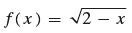
In Problems 9 – 14, find the domain of each function. f(x) √2 - x
In Problems 5 – 16 , write a general formula to describe each variation. A varies directly with x2; A = 4π when x = 2
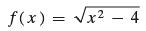
In Problems 6 – 8, find the following for each function:(a) f (2)(b) f (−2)(c) f (−x)(d) − f (x)(e) f (x − 2)(f) f (2x) f(x) = √√x² √x²4
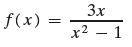
In Problems 6 – 8, find the following for each function:(a) f (2)(b) f (−2)(c) f (−x)(d) − f (x)(e) f (x − 2)(f) f (2x) f(x) = 3x x2 - 1
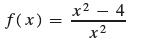
In Problems 6 – 8, find the following for each function:(a) f (2)(b) f (−2)(c) f (−x)(d) − f (x)(e) f (x − 2)(f) f (2x) f(x) = x² - 4 x2
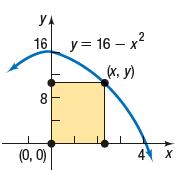
A rectangle has one corner in quadrant I on the graph of y = 16 − x2, another at the origin, a third on the positive y-axis, and the fourth on the positive x-axis. See the figure.(a) Express the area A of the rectangle as a function of x.(b) What is the domain of A ?(c) Graph A = A(x). For what
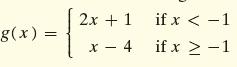
Consider the function(a) Graph the function.(b) List the intercepts.(c) Find g(−5).(d) Find g(2). g(x) = { 2x + 1 x - 4 if x if x < -1 if x > -1
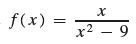
In Problems 9 – 14, find the domain of each function. f(x) = x x² - 9
In Problems 2 – 5 , find the domain and range of each relation. Then determine whether the relation represents a function.{(−1, 0), (2, 3), (4, 0)}
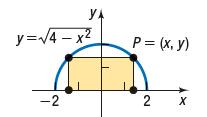
A rectangle is inscribed in a semicircle of radius 2. See the figure. Let P = (x, y) be the point in quadrant I that is a vertex of the rectangle and is on the circle.(a) Express the area A of the rectangle as a function of x.(b) Express the perimeter p of the rectangle as a function of x.(c) Graph
In Problems 2 – 5, find the domain and range of each relation. Then determine whether the relation represents a function.{ (4, −1), (2, 1), (4, 2)}
Open the “Vertical Compressions and Stretches” interactive figure, which is available in the Video & Resource Library of MyLab Math (under Interactive Figures) or at bit.ly/3raFUGB.(a) Use the drop-down menu to select the absolute value (|x|) function. The basic function f (x) = |x| is
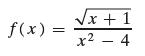
In Problems 9 – 14, find the domain of each function. f(x) = √x + 1 x² 2-4
Open the “Horizontal Compressions and Stretches” interactive figure, which is available in the Video & Resource Library of MyLab Math (under Interactive Figures) or at bit.ly/3raFUGB.(a) Use the drop-down menu to select the square root (√x) function. The basic function f (x) = √x is
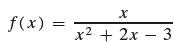
In Problems 9 – 14, find the domain of each function. f(x): X x² + 2x + 2x - 3 2
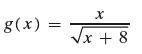
In Problems 9 – 14, find the domain of each function. g(x) = X √x + 8
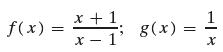
In Problems 15 – 17, find f + g, f − g, f º g, and f/g for each pair of functions. State the domain of each of these functions. f(x) = 4 x - 1' x + 1 g(x)= 1 X
For the function f (x) = 3x2 − 3x + 4,(a) Find the average rate of change of f from 3 to 4.(b) Find an equation of the secant line from 3 to 4.
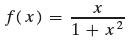
In Problems 21–24, determine (algebraically) whether the given function is even, odd, or neither. f(x) = X 1 + x² 2
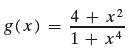
In Problems 21–24, determine (algebraically) whether the given function is even, odd, or neither. g(x) = 4+x² 1 + x4
For the functions f (x) = 2x2 + 1 and g( x) = 3x − 2, find the following and simplify.(a) (f − g )( x)(b) (f ° g )( x)(c) f (x + h) − f ( x)
In Problems 5 – 16 , write a general formula to describe each variation.z varies directly with the sum of the squares of x and y ; z = 5 when x = 3 and y = 4
In Problems 5 – 16 , write a general formula to describe each variation.z varies directly with the sum of the cube of x and the square of y ; z = 1 when x = 2 and y = 3
Find the difference quotient of f ( x) = −2x2 + x + 1 ; that is, find f(x + h) - f(x)/h, h ≠ 0
In Problems 17–22, write an equation that relates the quantities.The period of a pendulum is the time required for one oscillation; the pendulum is usually referred to as simple when the angle made to the vertical is less than 5°. The period T of a simple pendulum (in seconds) varies directly
The monthly payment p on a mortgage varies directly with the amount borrowed B. If the monthly payment on a 30-year mortgage is $6.49 for every $1000 borrowed, find a linear equation that relates the monthly payment p to the amount borrowed B for a mortgage with the same terms. Then find the
Find the average rate of change of f ( x) = 8x2 − x:(a) From 1 to 2(b) From 0 to 1(c) From 2 to 4
A retailer buys 600 USB Flash Drives per year from a distributor. The retailer wants to determine how many drives to order, x , per shipment so that her inventory is exhausted just as the next shipment arrives. The processing fee is $15 per shipment, the yearly storage cost is $1.60 x , and each
At the corner Shell station, the revenue R varies directly with the number g of gallons of gasoline sold. If the revenue is $47.40 when the number of gallons sold is 12, find a linear equation that relates revenue R to the number g of gallons of gasoline. Then find the revenue R when the number of
If f (x) = 3x − 4x2, find an equation of the secant line of f from 2 to 3.
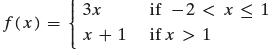
In Problems 41 and 42:(a) Find the domain of each function.(b) Locate any intercepts.(c) Graph each function.(d) Based on the graph, find the range. f(x) if -2 < x 1
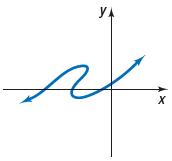
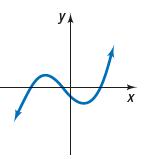
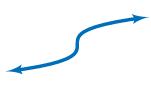
In Problems 31 and 32, is the graph shown that of a function? У
In Problems 31 and 32, is the graph shown that of a function? У X
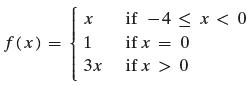
In Problems 41 and 42:(a) Find the domain of each function.(b) Locate any intercepts.(c) Graph each function.(d) Based on the graph, find the range. f(x) X 1 3x if -4 < x < 0 if x = 0 if x > 0
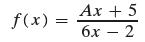
A function f is defined byIf f (1) = 4, find A. f(x) = Ax + 5 6x - 2
The horsepower (hp) that a shaft can safely transmit varies jointly with its speed (in revolutions per minute, rpm) and the cube of its diameter. If a shaft of a certain material 2 inches in diameter can transmit 36 hp at 75 rpm, what diameter must the shaft have in order to transmit 45 hp at 125
The volume V of an ideal gas varies directly with the temperature T and inversely with the pressure P. Write an equation relating V, T, and P using k as the constant of proportionality. If a cylinder contains oxygen at a temperature of 300 K and a pressure of 15 atmospheres in a volume of 100
The electrical resistance of a wire varies directly with the length of the wire and inversely with the square of the diameter of the wire. If a wire 432 feet long and 4 millimeters in diameter has a resistance of 1.24 ohms, find the length of a wire of the same material whose resistance is 1.44
The kinetic energy K of a moving object varies jointly with its mass m and the square of its velocity v. If an object weighing 25 kilograms and moving with a velocity of 10 meters per second has a kinetic energy of 1250 joules, find its kinetic energy when the velocity is 15 meters per second.
Using a situation that has not been discussed in the text, write a real-world problem that you think involves two variables that vary directly. Exchange your problem with another student’s to solve and critique.
Using a situation that has not been discussed in the text, write a real-world problem that you think involves three variables that vary jointly. Exchange your problem with another student’s to solve and critique.
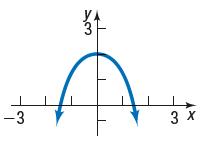
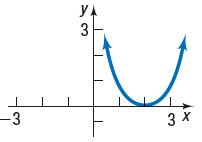
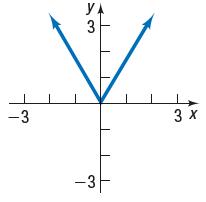
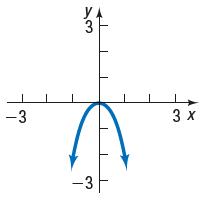
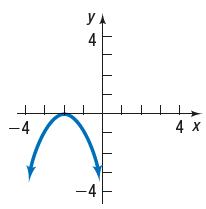
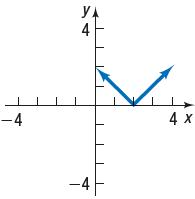
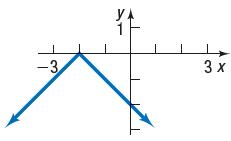
In Problems 11–22, match each graph to one of the following functions: A. y = x² + 2 B. y = C. y = x² + 2 x + 2 D. y = x + 2 E. y = (x - 2)² F y = (x + 2)² G. y = |x - 21 H. y = x + 21 1. y = 2x² J. y = -2x² K. y = 21x| L. y = -2|x|
In Problems 11–22, match each graph to one of the following functions: A. y = x² + 2 B. y = C. y = x² + 2 x + 2 D. y = x + 2 E. y = (x - 2)² F y = (x + 2)² G. y = |x - 21 H. y = x + 21 1. y = 2x² J. y = -2x² K. y = 21x| L. y = -2|x|
True or False The graph of y = 1/3g(x) is the graph of y = g(x) vertically stretched by a factor of 3.
True or False The graph of y = −f (x) is the reflection about the x-axis of the graph of y = f (x).
True or False The domain and the range of the reciprocal function are the set of all real numbers.
In Problems 11–22, match each graph to one of the following functions: A. y = x + 2 B. y = C. y = x + 2 x + 2 D. y = x + 2 E. y = (x - 2) F y = (x + 2) G. y = |x - 21 H. y = x + 21 1. y = 2x J. y = -2x K. y = 21x| L. y = -2|x|
If(a) f (−2)(b) f (0)(c) f (1)(d) f (3) f(x) = 2x + 4 x³ - 1 if -3 ≤ x ≤ 1 if 1 < x < 5 find:
In Problems 11–22, match each graph to one of the following functions: A. y = x² + 2 B. y = C. y = x² + 2 x + 2 D. y = x + 2 E. y = (x - 2)² F y = (x + 2)² G. y = |x - 21 H. y = x + 21 1. y = 2x² J. y = -2x² K. y = 21x| L. y = -2|x|
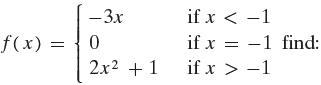
If(a) f (−2)(b) f (−1)(c) f (0) f(x) = - 3x 0 2x² + 1 if x < -1 if x = -1 find: if x > -1
In Problems 11–22, match each graph to one of the following functions: A. y = x² + 2 B. y = C. y = x² + 2 x + 2 D. y = x + 2 E. y = (x - 2)² F y = (x + 2)² G. y = |x - 21 H. y = x + 21 1. y = 2x² J. y = -2x² K. y = 21x| L. y = -2|x|
In Problems 11–22, match each graph to one of the following functions: A. y = x² + 2 B. y = C. y = x² + 2 x + 2 D. y = x + 2 E. y = (x - 2)² F y = (x + 2)² G. y = |x - 21 H. y = x + 21 1. y = 2x² J. y = -2x² K. y = 21x| L. y = -2|x|
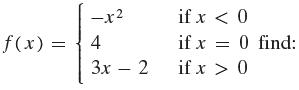
If(a) f (−3)(b) f (0)(c) f (3) f(x) = -x 4 3x - 2 if x < 0 if x = 0 find: if x > 0
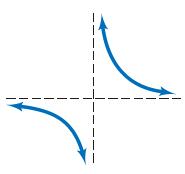
In Problems 11–18, match each graph to its function.A. Constant functionB. Identity functionC. Square functionD. Cube functionE. Square root functionF. Reciprocal functionG. Absolute value functionH. Cube root function
In Problems 11–18, match each graph to its function.A. Constant functionB. Identity functionC. Square functionD. Cube functionE. Square root functionF. Reciprocal functionG. Absolute value functionH. Cube root function I
In Problems 23–32, write the function whose graph is the graph of y = x3 but is:Vertically stretched by a factor of 5
In Problems 23–32, write the function whose graph is the graph of y = x3 but is:Reflected about the x-axis
In Problems 23–32, write the function whose graph is the graph of y = x3 but is: Reflected about the y-axis
In Problems 11–22, match each graph to one of the following functions: A. y = x² + 2 B. y = C. y = x² + 2 x + 2 D. y = x + 2 E. y = (x - 2)² F y = (x + 2)² G. y = |x - 21 H. y = x + 21 1. y = 2x² J. y = -2x² K. y = 21x| L. y = -2|x|
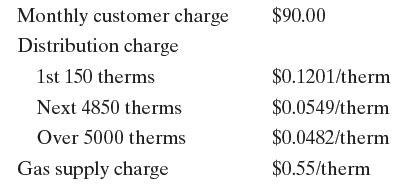
In February 2022, Nicor Gas had the following rate schedule for natural gas usage in small businesses.(a) What is the charge for using 1000 therms in a month?(b) What is the charge for using 6000 therms in a month?(c) Develop a function that models the monthly charge C for x therms of gas.(d) Graph
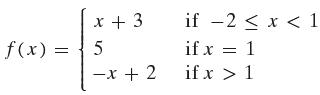
In Problems 31–42:(a) Find the domain of each function.(b) Locate any intercepts.(c) Graph each function.(d) Based on the graph, find the range. f(x) = x + 3 5 -x+ 2 if -2 < x < 1 if x = 1 if x > 1
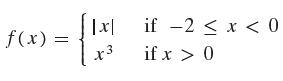
In Problems 31–42:(a) Find the domain of each function.(b) Locate any intercepts.(c) Graph each function.(d) Based on the graph, find the range. f(x) = |x| x if -2 < x < 0 if x > 0
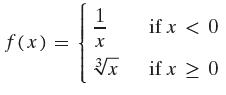
In Problems 31–42:(a) Find the domain of each function.(b) Locate any intercepts.(c) Graph each function.(d) Based on the graph, find the range. f(x)= = x 3√x if x < 0 if x ≥ 0
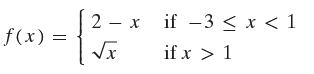
In Problems 31–42:(a) Find the domain of each function.(b) Locate any intercepts.(c) Graph each function.(d) Based on the graph, find the range. f(x) = 2x √√x if -3 < x < 1 if x > 1
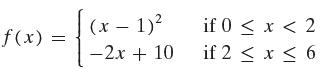
(a) Graph(b) Find the domain of f .(c) Find the absolute maximum and the absolute minimum, if they exist. f(x) = (x - 1)² -2x + 10 if 0 < x < 2 if 2 < x < 6
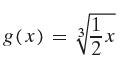
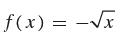
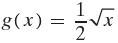
In Problems 41–64, graph each function using the techniques of shifting, compressing, stretching, and/or reflecting. Start with the graph of the basic function (for example, y = x2) and show all the steps. Be sure to show at least three key points. Find the domain and the range of each function.
In Problems 41–64, graph each function using the techniques of shifting, compressing, stretching, and/or reflecting. Start with the graph of the basic function (for example, y = x2) and show all the steps. Be sure to show at least three key points. Find the domain and the range of each function.
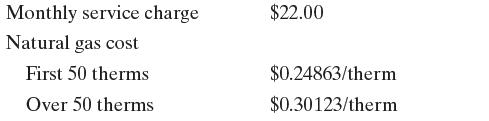
In October 2021, Spire, Inc. had the following rate schedule for natural gas usage in single-family residences.(a) What is the charge for using 20 therms in a month?(b) What is the charge for using 100 therms in a month?(c) Develop a function that models the monthly charge C for x therms of gas.(d)
In Problems 41–64, graph each function using the techniques of shifting, compressing, stretching, and/or reflecting. Start with the graph of the basic function (for example, y = x2) and show all the steps. Be sure to show at least three key points. Find the domain and the range of each function.
In Problems 41–64, graph each function using the techniques of shifting, compressing, stretching, and/or reflecting. Start with the graph of the basic function (for example, y = x2) and show all the steps. Be sure to show at least three key points. Find the domain and the range of each function.
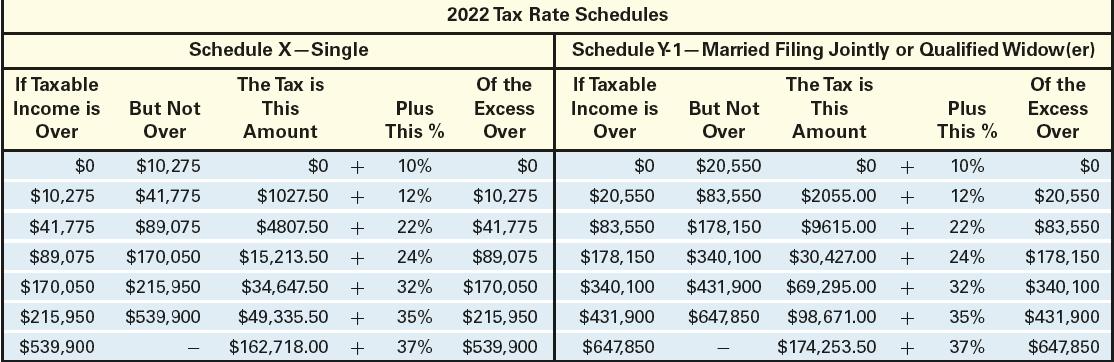
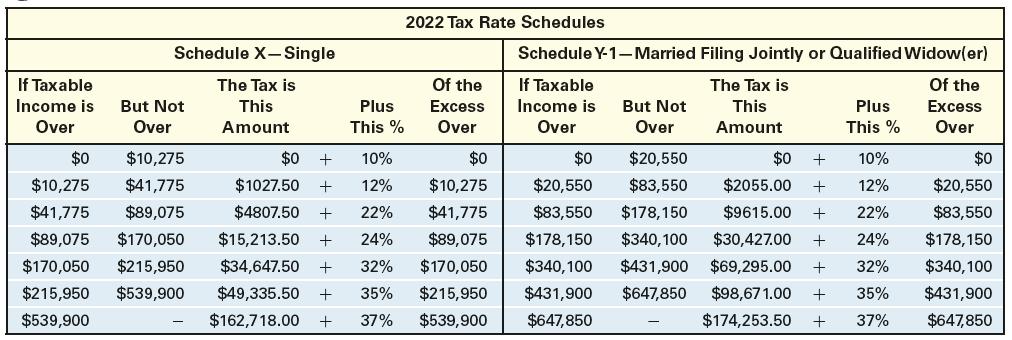
Two 2022 Tax Rate Schedules are given in the accompanying table. If x equals taxable income and y equals the tax due, construct a function y = f ( x) for Schedule X. Schedule X-Single The Tax is This Amount If Taxable Income is But Not Over Over $10,275 $0 $10,275 $41,775 $41,775 $89,075 $89,075
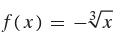
In Problems 41–64, graph each function using the techniques of shifting, compressing, stretching, and/or reflecting. Start with the graph of the basic function (for example, y = x2) and show all the steps. Be sure to show at least three key points. Find the domain and the range of each
Tax Refer to the 2022 tax rate schedules. If x equals taxable income and y equals the tax due, construct a function y = f ( x) for Schedule Y-1. Schedule X-Single The Tax is This Amount If Taxable Income is But Not Over Over $10,275 $0 $10,275 $41,775 $41,775 $89,075 $89,075 $170,050 $170,050
In Problems 41–64, graph each function using the techniques of shifting, compressing, stretching, and/or reflecting. Start with the graph of the basic function (for example, y = x2) and show all the steps. Be sure to show at least three key points. Find the domain and the range of each
In Problems 41–64, graph each function using the techniques of shifting, compressing, stretching, and/or reflecting. Start with the graph of the basic function (for example, y = x2) and show all the steps. Be sure to show at least three key points. Find the domain and the range of each function.
In Problems 41–64, graph each function using the techniques of shifting, compressing, stretching, and/or reflecting. Start with the graph of the basic function (for example, y = x2) and show all the steps. Be sure to show at least three key points. Find the domain and the range of each function.f
In Problems 41–64, graph each function using the techniques of shifting, compressing, stretching, and/or reflecting. Start with the graph of the basic function (for example, y = x2) and show all the steps. Be sure to show at least three key points. Find the domain and the range of each
In Problems 41–64, graph each function using the techniques of shifting, compressing, stretching, and/or reflecting. Start with the graph of the basic function (for example, y = x2) and show all the steps. Be sure to show at least three key points. Find the domain and the range of each function.f
In Problems 41–64, graph each function using the techniques of shifting, compressing, stretching, and/or reflecting. Start with the graph of the basic function (for example, y = x2) and show all the steps. Be sure to show at least three key points. Find the domain and the range of each function.f
In Problems 41–64, graph each function using the techniques of shifting, compressing, stretching, and/or reflecting. Start with the graph of the basic function (for example, y = x2) and show all the steps. Be sure to show at least three key points. Find the domain and the range of each function.f
In Problems 41–64, graph each function using the techniques of shifting, compressing, stretching, and/or reflecting. Start with the graph of the basic function (for example, y = x2) and show all the steps. Be sure to show at least three key points. Find the domain and the range of each
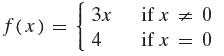
In Problems 31–42:(a) Find the domain of each function.(b) Locate any intercepts.(c) Graph each function.(d) Based on the graph, find the range. f(x): = 3x 4 if x if x = 0 = 0
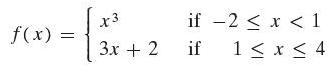
Iffind:(a) f (−1) (b) f (0) (c) f (1) (d) f (3) f(x) = x3 3x + 2 if -2 < x < 1 if 1 ≤ x ≤ 4
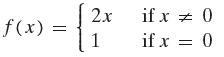
In Problems 31–42:(a) Find the domain of each function.(b) Locate any intercepts.(c) Graph each function.(d) Based on the graph, find the range. f(x) = 2x 1 if x = 0 if x = 0
Showing 5100 - 5200
of 29454
First
45
46
47
48
49
50
51
52
53
54
55
56
57
58
59
Last
Step by Step Answers

 Get 50% OFF
Claim Now
Get 50% OFF
Claim Now