New Semester
Started
Get
50% OFF
Study Help!
--h --m --s
Claim Now
Question Answers
Textbooks
Find textbooks, questions and answers
Oops, something went wrong!
Change your search query and then try again
S
Books
FREE
Study Help
Expert Questions
Accounting
General Management
Mathematics
Finance
Organizational Behaviour
Law
Physics
Operating System
Management Leadership
Sociology
Programming
Marketing
Database
Computer Network
Economics
Textbooks Solutions
Accounting
Managerial Accounting
Management Leadership
Cost Accounting
Statistics
Business Law
Corporate Finance
Finance
Economics
Auditing
Tutors
Online Tutors
Find a Tutor
Hire a Tutor
Become a Tutor
AI Tutor
AI Study Planner
NEW
Sell Books
Search
Search
Sign In
Register
study help
mathematics
precalculus
Precalculus Concepts Through Functions A Unit Circle Approach To Trigonometry 5th Edition Michael Sullivan - Solutions
In Problems 13 – 26, find the zeros of each quadratic function by factoring. What are the x-intercepts of the graph of the function?H (x) = 2x2 − 50
In Problems 21 – 26,(a) Find the zero of each linear function(b) Graph each function using the zero and y-intercept.f (x) = −5x + 10
In Problems 13 – 26, find the zeros of each quadratic function by factoring. What are the x-intercepts of the graph of the function?g (x) = x(x + 8) + 12
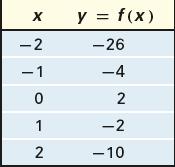
In Problems 27–34, determine whether each function is linear or nonlinear. If it is linear, determine the slope. X -2 -1 0 1 2 y = f(x) -26 -4 2 -2 -10
In Problems 13 – 26, find the zeros of each quadratic function by factoring. What are the x-intercepts of the graph of the function?f (x) = x( x − 4) − 12
In Problems 13 – 26, find the zeros of each quadratic function by factoring. What are the x-intercepts of the graph of the function?G (x) = 4x2 + 9 − 12x
In Problems 13 – 26, find the zeros of each quadratic function by factoring. What are the x-intercepts of the graph of the function?F(x) = 25x2 + 16 − 40x
In Problems 27 – 32, find the zeros of each quadratic function using the Square Root Method. What are the x-intercepts of the graph of the function?f (x) = x2 − 8
In Problems 27 – 32, find the zeros of each quadratic function using the Square Root Method. What are the x-intercepts of the graph of the function?g (x) = x2 − 18
In Problems 27 – 32, find the zeros of each quadratic function using the Square Root Method. What are the x-intercepts of the graph of the function?g (x) = (x − 1)2 − 4
Problems 29 – 38 are based on previously learned material. The purpose of these problems is to keep the material fresh in your mind so that you are better prepared for later sections, a final exam, or subsequent courses such as calculusFind an equation for the line containing the points (−1, 5)
In Problems 27 – 32, find the zeros of each quadratic function using the Square Root Method. What are the x-intercepts of the graph of the function?G (x) = (x + 2)2 − 1
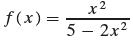
Problems 29 – 38 are based on previously learned material. The purpose of these problems is to keep the material fresh in your mind so that you are better prepared for later sections, a final exam, or subsequent courses such as calculus.Determine algebraically whether the functionis even, odd, or
Problems 29 – 38 are based on previously learned material. The purpose of these problems is to keep the material fresh in your mind so that you are better prepared for later sections, a final exam, or subsequent courses such as calculusUse a graphing utility to:(a) Graph f (x) = −2(x − 4)2 +
In Problems 27 – 32, find the zeros of each quadratic function using the Square Root Method. What are the x-intercepts of the graph of the function?F (x) = (2x + 3)2 − 32
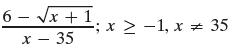
Problems 29 – 38 are based on previously learned material. The purpose of these problems is to keep the material fresh in your mind so that you are better prepared for later sections, a final exam, or subsequent courses such as calculus.Rationalize the numerator: 6-√√√x + 1 x - 35 x-1, x
Problems 29 – 38 are based on previously learned material. The purpose of these problems is to keep the material fresh in your mind so that you are better prepared for later sections, a final exam, or subsequent courses such as calculus.For f (x) = 5x − 8 and g (x) = x2 − 3x + 4, find (g −
In Problems 27 – 32, find the zeros of each quadratic function using the Square Root Method. What are the x-intercepts of the graph of the function?g (x) = (3x − 2)2 − 75
Problems 29 – 38 are based on previously learned material. The purpose of these problems is to keep the material fresh in your mind so that you are better prepared for later sections, a final exam, or subsequent courses such as calculus.Writeas a single quotient in which only positive exponents
Problems 29 – 38 are based on previously learned material. The purpose of these problems is to keep the material fresh in your mind so that you are better prepared for later sections, a final exam, or subsequent courses such as calculus.Find a function whose graph is the graph of y = x2, but
In Problems 33 – 38, find the zeros of each quadratic function by completing the square. What are the x-intercepts of the graph of the function?f (x) = x2 + 4x − 8
Problems 29 – 38 are based on previously learned material. The purpose of these problems is to keep the material fresh in your mind so that you are better prepared for later sections, a final exam, or subsequent courses such as calculus.Solve: x2 − 4x = 3
In Problems 33 – 38, find the zeros of each quadratic function by completing the square. What are the x-intercepts of the graph of the function?f (x) = x2 − 6x − 9
In Problems 33 – 38, find the zeros of each quadratic function by completing the square. What are the x-intercepts of the graph of the function?g (x) = x2 − 1/2 x − 3/16
In Problems 33 – 38, find the zeros of each quadratic function by completing the square. What are the x-intercepts of the graph of the function?g(x) = x2 + 2/3 x − 1/3
Problems 29 – 38 are based on previously learned material. The purpose of these problems is to keep the material fresh in your mind so that you are better prepared for later sections, a final exam, or subsequent courses such as calculus.Find the x -intercept(s) and y -intercept(s) of the graph of
In Problems 33 – 38, find the zeros of each quadratic function by completing the square. What are the x-intercepts of the graph of the function?F(x) = 3x2 + x − 1/2
In Problems 33 – 38, find the zeros of each quadratic function by completing the square. What are the x-intercepts of the graph of the function?G (x) = 2x2 − 3x − 1
In Problems 39 – 52, find the real zeros, if any, of each quadratic function using the quadratic formula. What are the x-intercepts, if any, of the graph of the function?f (x) = x2 − 4x + 2
In Problems 39 – 52, find the real zeros, if any, of each quadratic function using the quadratic formula. What are the x-intercepts, if any, of the graph of the function?f (x) = x2 + 4x + 2
In Problems 39 – 52, find the real zeros, if any, of each quadratic function using the quadratic formula. What are the x-intercepts, if any, of the graph of the function?g (x) = x2 − 4x − 1
In Problems 39 – 52, find the real zeros, if any, of each quadratic function using the quadratic formula. What are the x-intercepts, if any, of the graph of the function?g (x) = x2 + 6x + 1
In Problems 39 – 52, find the real zeros, if any, of each quadratic function using the quadratic formula. What are the x-intercepts, if any, of the graph of the function?F (x) = 2x2 − 5x + 3
In Problems 39 – 52, find the real zeros, if any, of each quadratic function using the quadratic formula. What are the x-intercepts, if any, of the graph of the function?g(x) = 2x2 + 5x + 3
In Problems 39 – 52, find the real zeros, if any, of each quadratic function using the quadratic formula. What are the x-intercepts, if any, of the graph of the function?P(x) = 4x2 − x + 2
In Problems 39 – 52, find the real zeros, if any, of each quadratic function using the quadratic formula. What are the x-intercepts, if any, of the graph of the function?H (x) = 4x2 + x + 1
In Problems 39 – 52, find the real zeros, if any, of each quadratic function using the quadratic formula. What are the x-intercepts, if any, of the graph of the function?f (x) = 4x2 − 1 + 2x
In Problems 39 – 52, find the real zeros, if any, of each quadratic function using the quadratic formula. What are the x-intercepts, if any, of the graph of the function?f (x) = 2x2 − 1 + 2x
Taxes The function T(x) = 0.12(x − 10,275) + 1027.50 represents the tax bill T of a single person whose adjusted gross income is x dollars for income over $10,275 but not over $41,775, in 2022.(a) What is the domain of this linear function?(b) What is a single filer’s tax bill if adjusted gross
In Problems 39 – 52 , find the real zeros, if any, of each quadratic function using the quadratic formula. What are the x-intercepts, if any, of the graph of the function?G (x) = 2x( x + 2) − 3
Teams in the National Basketball Association that exceed a given payroll threshold must pay a luxury tax on the amount above the threshold. For a team that exceeds the payroll threshold by an amount of at least $10 million but less than $15 million for the first time, the linear function T(x) =
In Problems 39 – 52, find the real zeros, if any, of each quadratic function using the quadratic formula. What are the x-intercepts, if any, of the graph of the function?F(x) = 3x( x + 2) − 1
The distance d between the bottom of a suspended spring and a countertop is a linear function of the weight w attached to the bottom of the spring. The bottom of the spring is 9 inches from the countertop when the attached weight is 1.5 pounds and 5 inches from the countertop when the attached
In Problems 53–58, solve f (x) = g(x). What are the points of intersection of the graphs of the two functions?f (x) = x2 − x + 1g(x) = 2x2 − 3x − 14
In Problems 53–58, solve f (x) = g(x). What are the points of intersection of the graphs of the two functions?f (x) = 3x2 − 7g(x) = 10x + 1
In Problems 53–58, solve f (x) = g(x). What are the points of intersection of the graphs of the two functions?f(x) = −2x2 + 1g(x) = 3x + 2
In Problems 53–58, solve f (x) = g(x). What are the points of intersection of the graphs of the two functions?f (x) = x2 − 4x + 3g(x) = 3
In Problems 53–58, solve f (x) = g(x). What are the points of intersection of the graphs of the two functions?f (x) = x2 + 6x + 3g(x) = 3
In Problems 39 – 52, find the real zeros, if any, of each quadratic function using the quadratic formula. What are the x-intercepts, if any, of the graph of the function?g (x) = 4x2 + 20x + 25
In Problems 39 – 52, find the real zeros, if any, of each quadratic function using the quadratic formula. What are the x-intercepts, if any, of the graph of the function?P(x) = 9x2 − 6x + 1
In Problems 59–76, find the real zeros of each function. What are the x-intercepts of the graph of the function?g(x) = x6 − 7x3 − 8
In Problems 59–76, find the real zeros of each function. What are the x-intercepts of the graph of the function?g(x) = x6 + 7x3 − 8
Problems 65 – 74 are based on previously learned material. The purpose of these problems is to keep the material fresh in your mind so that you are better prepared for later sections, a final exam, or subsequent courses such as calculus.Graph x2 − 4x + y2 + 10y − 7 = 0.
In Problems 59–76, find the real zeros of each function. What are the x-intercepts of the graph of the function?F(x) = 2x4 − 5x2 − 12
In Problems 59–76, find the real zeros of each function. What are the x-intercepts of the graph of the function?G(x) = 3x4 − 2x2 − 1
In Problems 59–76, find the real zeros of each function. What are the x-intercepts of the graph of the function?f (x) = x4 − 10x2 + 24
In Problems 59–76, find the real zeros of each function. What are the x-intercepts of the graph of the function?f (x) = x4 − 5x2 + 4
In Problems 59–76, find the real zeros of each function. What are the x-intercepts of the graph of the function?H(x) = x4 − 3x2 − 4
The linear function F(C) = 9/5C + 32 converts degrees Celsius to degrees Fahrenheit, and the linear function R(F) = F + 459.67 converts degrees Fahrenheit to degrees Rankine. Find a linear function that converts degrees Rankine to degrees Celsius.
In Problems 53–58, solve f (x) = g(x). What are the points of intersection of the graphs of the two functions?f (x) = x2 + 5x − 3g(x) = 2x2 + 7x − 27
In Problems 59–76, find the real zeros of each function. What are the x-intercepts of the graph of the function?P(x) = x4 − 6x2 − 16
In Problems 59–76, find the real zeros of each function. What are the x-intercepts of the graph of the function?H(x) = (2 − x)2 + (2 − x) − 20
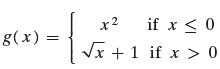
Problems 65 – 74 are based on previously learned material. The purpose of these problems is to keep the material fresh in your mind so that you are better prepared for later sections, a final exam, or subsequent courses such as calculus.Graph g(x) = { if x ≤ 0 √x + 1 if x > 0 x2
In Problems 59–76, find the real zeros of each function. What are the x-intercepts of the graph of the function?G(x) = (x + 2)2 + 7(x + 2) + 12
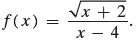
Problems 65 – 74 are based on previously learned material. The purpose of these problems is to keep the material fresh in your mind so that you are better prepared for later sections, a final exam, or subsequent courses such as calculus.Find the domain of f(x) = √x + 2 x - 4
In Problems 59–76, find the real zeros of each function. What are the x-intercepts of the graph of the function?f (x) = (2x + 5)2 − (2x + 5) − 6
Problems 65 – 74 are based on previously learned material. The purpose of these problems is to keep the material fresh in your mind so that you are better prepared for later sections, a final exam, or subsequent courses such as calculus.In Problems 69 – 70, complete the square for each
In Problems 59–76, find the real zeros of each function. What are the x-intercepts of the graph of the function?f (x) = (3x + 4)2 − 6(3x + 4) + 9
Problems 65 – 74 are based on previously learned material. The purpose of these problems is to keep the material fresh in your mind so that you are better prepared for later sections, a final exam, or subsequent courses such as calculus.In Problems 69 – 70, complete the square for each
Problems 65 – 74 are based on previously learned material. The purpose of these problems is to keep the material fresh in your mind so that you are better prepared for later sections, a final exam, or subsequent courses such as calculus.Find the x-intercept(s) and y -intercepts(s) of the graph of
In Problems 59–76, find the real zeros of each function. What are the x-intercepts of the graph of the function?P(x) = 2(x + 1)2 − 5(x + 1) − 3
In Problems 59–76, find the real zeros of each function. What are the x-intercepts of the graph of the function?H(x) = 3(1 − x)2 + 5(1 − x) + 2
Problems 65 – 74 are based on previously learned material. The purpose of these problems is to keep the material fresh in your mind so that you are better prepared for later sections, a final exam, or subsequent courses such as calculus.Suppose f (x) = x2 − 3x + 7. Find an equation of the
In Problems 59–76, find the real zeros of each function. What are the x-intercepts of the graph of the function?G(x) = x − 4 √x
Problems 65 – 74 are based on previously learned material. The purpose of these problems is to keep the material fresh in your mind so that you are better prepared for later sections, a final exam, or subsequent courses such as calculus.Graph f (x) = x3 − 8x2 + 13x − 2 over the interval
In Problems 59–76, find the real zeros of each function. What are the x-intercepts of the graph of the function?f (x) = x + 8 √x
In Problems 59–76, find the real zeros of each function. What are the x-intercepts of the graph of the function?g(x) = x + √x − 20
In Problems 59–76, find the real zeros of each function. What are the x-intercepts of the graph of the function?f (x) = x + √x − 2
In Problems 77–88, find the real zeros of each quadratic function using any method you wish. What are the x-intercepts, if any, of the graph of the function?f (x) = x2 − 50
In Problems 77–88, find the real zeros of each quadratic function using any method you wish. What are the x-intercepts, if any, of the graph of the function?f (x) = x2 − 20
In Problems 77–88, find the real zeros of each quadratic function using any method you wish. What are the x-intercepts, if any, of the graph of the function?g(x) = 16x2 − 8x + 1
In Problems 77–88, find the real zeros of each quadratic function using any method you wish. What are the x-intercepts, if any, of the graph of the function?F(x) = 4x2 − 12x + 9
In Problems 77–88, find the real zeros of each quadratic function using any method you wish. What are the x-intercepts, if any, of the graph of the function?G(x) = 10x2 − 19x − 15
In Problems 77–88, find the real zeros of each quadratic function using any method you wish. What are the x-intercepts, if any, of the graph of the function?f (x) = 6x2 + 7x − 20
In Problems 77–88, find the real zeros of each quadratic function using any method you wish. What are the x-intercepts, if any, of the graph of the function?P(x) = 6x2 − x − 2
In Problems 77–88, find the real zeros of each quadratic function using any method you wish. What are the x-intercepts, if any, of the graph of the function?H(x) = 6x2 + x − 2
In Problems 77–88, find the real zeros of each quadratic function using any method you wish. What are the x-intercepts, if any, of the graph of the function?G(x) = x2 + √2x − 1/2
In Problems 77–88, find the real zeros of each quadratic function using any method you wish. What are the x-intercepts, if any, of the graph of the function?F(x) = 1/2 x2 − √2x − 1
In Problems 77–88, find the real zeros of each quadratic function using any method you wish. What are the x-intercepts, if any, of the graph of the function?f (x) = x2 + x − 4
In Problems 77–88, find the real zeros of each quadratic function using any method you wish. What are the x-intercepts, if any, of the graph of the function?g(x) = x2 + x − 1
In Problems 89–94,(a) Graph each function using transformations,(b) Find the real zeros of each function,(c) Label the x-intercepts on the graph of the function.g(x) = (x − 1)2 − 4
In Problems 89–94,(a) Graph each function using transformations,(b) Find the real zeros of each function,(c) Label the x-intercepts on the graph of the function.F(x) = (x + 3)2 − 9
How many times can the graphs of two different quadratic functions intersect?
Problems 127–130 are based on previously learned material. The purpose of these problems is to keep the material fresh in your mind so that you are better prepared for later sections, a final exam, or subsequent courses such as calculus.Use transformations to graph f (x) = −|x| + 4.
Problems 127–130 are based on previously learned material. The purpose of these problems is to keep the material fresh in your mind so that you are better prepared for later sections, a final exam, or subsequent courses such as calculus.State the domain and range of the relation that follows, and
Problems 127–130 are based on previously learned material. The purpose of these problems is to keep the material fresh in your mind so that you are better prepared for later sections, a final exam, or subsequent courses such as calculus.Find the midpoint of the line segment joining the points P1
Problems 127–130 are based on previously learned material. The purpose of these problems is to keep the material fresh in your mind so that you are better prepared for later sections, a final exam, or subsequent courses such as calculus.If a graph is symmetric with respect to the y-axis, and if
In Problems 89–94,(a) Graph each function using transformations,(b) Find the real zeros of each function,(c) Label the x-intercepts on the graph of the function.f (x) = 2( x + 4)2 − 8
In Problems 89–94,(a) Graph each function using transformations,(b) Find the real zeros of each function,(c) Label the x-intercepts on the graph of the function.h(x) = 3( x − 2)2 − 12
In Problems 89–94,(a) Graph each function using transformations,(b) Find the real zeros of each function,(c) Label the x-intercepts on the graph of the function.H(x) = −3(x − 3)2 + 6
Showing 5000 - 5100
of 29454
First
44
45
46
47
48
49
50
51
52
53
54
55
56
57
58
Last
Step by Step Answers

 Get 50% OFF
Claim Now
Get 50% OFF
Claim Now