New Semester
Started
Get
50% OFF
Study Help!
--h --m --s
Claim Now
Question Answers
Textbooks
Find textbooks, questions and answers
Oops, something went wrong!
Change your search query and then try again
S
Books
FREE
Study Help
Expert Questions
Accounting
General Management
Mathematics
Finance
Organizational Behaviour
Law
Physics
Operating System
Management Leadership
Sociology
Programming
Marketing
Database
Computer Network
Economics
Textbooks Solutions
Accounting
Managerial Accounting
Management Leadership
Cost Accounting
Statistics
Business Law
Corporate Finance
Finance
Economics
Auditing
Tutors
Online Tutors
Find a Tutor
Hire a Tutor
Become a Tutor
AI Tutor
AI Study Planner
NEW
Sell Books
Search
Search
Sign In
Register
study help
physics
college physics 2nd
College Physics 2nd Edition OpenStax - Solutions
What is the ratio of the average distances that oxygen will diffuse in a given time in air and water? Why is this distance less in water (equivalently, why is D less in water)?
A rock with a mass of 540 g in air is found to have an apparent mass of 342 g when submerged in water. (a) What mass of water is displaced? (b) What is the volume of the rock?(c) What is its average density? Is this consistent with the value for granite?
Oxygen reaches the veinless cornea of the eye by diffusing through its tear layer, which is 0.500-mm thick. How long does it take the average oxygen molecule to do this?
(a) Find the average time required for an oxygen molecule to diffuse through a 0.200-mm-thick tear layer on the cornea. (b) How much time is required to diffuse 0.500 cm3 of oxygen to the cornea if its surface area is 1.00 cm2?
Draw a free body diagram to show how a diver gains angular momentum when leaving the diving board.
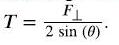
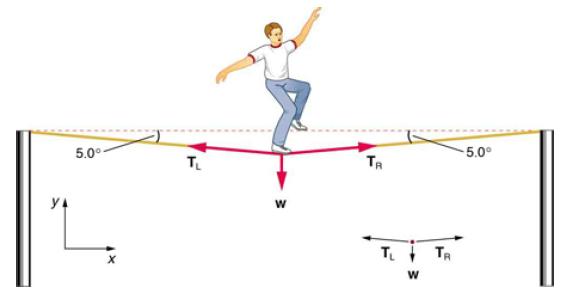
Show that, as stated in the text, a force Fexerted on a flexible medium at its center and perpendicular to its length (such as on the tightrope wire in Figure 4.16) gives rise to a FL tension of magnitude Data given in Figure 4.16
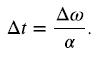
Suppose a teenager puts her bicycle on its back and starts the rear wheel spinning from rest to a final angular velocity of 250 rpm in 5.00 s. (a) Calculate the angular acceleration in rad/s2.(b) If she now slams on the brakes, causing an angular acceleration of -87.3 rad/s2, how long does it take
When serving a tennis ball, a player hits the ball when its velocity is zero (at the highest point of a vertical toss). The racquet exerts a force of 540 N on the ball for 5.00 ms, giving it a final velocity of 45.0 m/s. Using these data, find the mass of the ball.
Angular acceleration is a vector, having both magnitude and direction. How do we denote its magnitude and direction? Illustrate with an example.
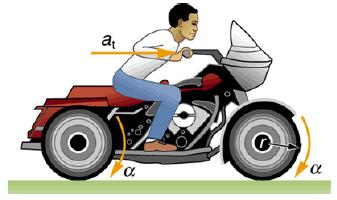
A powerful motorcycle can accelerate from 0 to 30.0 m/s (about 108 km/h) in 4.20 s. What is the angular acceleration of its 0.320-m-radius wheels? (See Figure 10.6.)StrategyWe are given information about the linear velocities of the motorcycle. Thus, we can find its linear acceleration at. Then,
Analogies exist between rotational and translational physical quantities. Identify the rotational term analogous to each of the following: acceleration, force, mass, work, translational kinetic energy, linear momentum, impulse.
Rotational kinematics has many useful relationships, often expressed in equation form. Are these relationships laws of physics or are they simply descriptive? (Hint: the same question applies to linear kinematics.)
An ultracentrifuge accelerates from rest to 100,000 rpm in 2.00 min. (a) What is its angular acceleration in rad/s2?(b) What is the tangential acceleration of a point 9.50 cm from the axis of rotation?(c) What is the radial acceleration in m/s2 and multiples of g of this point at full rpm?
Explain why centripetal acceleration changes the direction of velocity in circular motion but not its magnitude.
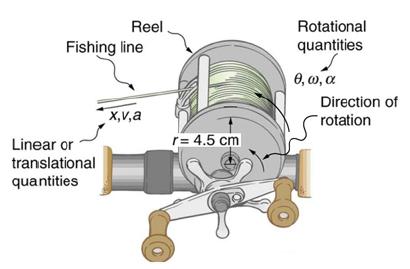
A deep-sea fisherman hooks a big fish that swims away from the boat pulling the fishing line from his fishing reel. The whole system is initially at rest and the fishing line unwinds from the reel at a radius of 4.50 cm from its axis of rotation. The reel is given an angular acceleration of 110
Torque is the analog of force and moment of inertia is the analog of mass. Force and mass are physical quantities that depend on only one factor. For example, mass is related solely to the numbers of atoms of various types in an object. Are torque and moment of inertia similarly simple?
In circular motion, a tangential acceleration can change the magnitude of the velocity but not its direction. Explain your answer.
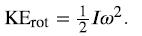
Analogy of Rotational and Translational Kinetic Energy Is rotational kinetic energy completely analogous totranslational kinetic energy? What, if any, are their differences? Give an example of each type of kinetic energy.
You are told that a basketball player spins the ball with an angular acceleration of 100rad/s2.(a) What is the ball’s final angular velocity if the ball starts from rest and the acceleration lasts 2.00 s? (b) What is unreasonable about the result?(c) Which premises are unreasonable or
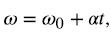
Now let us consider what happens if the fisherman applies a brake to the spinning reel, achieving an angular acceleration of - 300 rad/s2. How long does it take the reel to come to a stop?StrategyWe are asked to find the time t for the reel to come to a stop. The initial and final conditions are
Is angular momentum completely analogous to linear momentum? What, if any, are their differences?
With the aid of a string, a gyroscope is accelerated from rest to 32 rad/s in 0.40 s.(a) What is its angular acceleration in rad/s2?(b) How many revolutions does it go through in the process?
Suppose a piece of food is on the edge of a rotating microwave oven plate. Does it experience nonzero tangential acceleration, centripetal acceleration, or both when: (a) The plate starts to spin?(b) The plate rotates at constant angular velocity?(c) The plate slows to a halt?
Large freight trains accelerate very slowly. Suppose one such train accelerates from rest, giving its 0.350-m-radius wheels an angular acceleration of 0.250 rad/s2. After the wheels have made 200 revolutions (assume no slippage):(a) How far has the train moved down the track?(b) What are the final
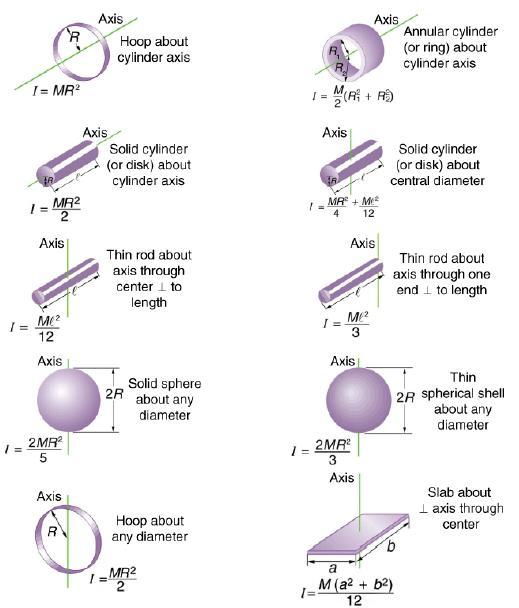
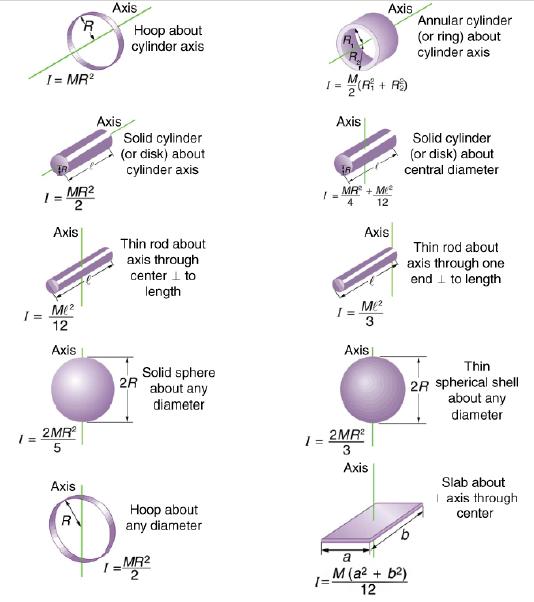
The moment of inertia of a long rod spun around an axis through one end perpendicular to its length is ML2/3. Why is this moment of inertia greater than it would be if you spun a point mass M at the location of the center of mass of the rod (at L/2)? (That would be ML2/4.)
Is rotational kinetic energy a vector? Justify your answer.
A person decides to use a microwave oven to reheat some lunch. In the process, a fly accidentally flies into the microwave and lands on the outer edge of the rotating plate and remains there. If the plate has a radius of 0.15 m and rotates at 6.0 rpm, calculate the total distance traveled by the
Suppose a piece of dust finds itself on a CD. If the spin rate of the CD is 500 rpm, and the piece of dust is 4.3 cm from the center, what is the total distance traveled by the dust in 3 minutes? (Ignore accelerations due to getting the CD rotating.)
Why is the moment of inertia of a hoop that has a mass M and a radius R greater than the moment of inertia of a disk that has the same mass and radius? Why is the moment of inertia of a spherical shell that has a mass M and a radius R greater than that of a solid sphere that has the same mass and
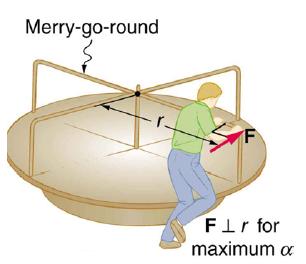
Consider the father pushing a playground merry-go-round in Figure 10.12. He exerts a force of 250 N at the edge of the 50.0-kg merry-go-round, which has a 1.50 m radius. Calculate the angular acceleration produced(a) When no one is on the merry-go-round and(b) When an 18.0-kg child sits 1.25 m away
Rotational kinetic energy is associated with angular momentum? Does that mean that rotational kinetic energy is a vector?
A gyroscope slows from an initial rate of 32.0 rad/s at a rate of 0.700rad/s2.(a) How long does it take to come to rest?(b) How many revolutions does it make before stopping?
Give an example in which a small force exerts a large torque. Give another example in which a large force exerts a small torque.
During a very quick stop, a car decelerates at 7.00 m/s2.(a) What is the angular acceleration of its 0.280-m- radius tires, assuming they do not slip on the pavement? (b) How many revolutions do the tires make before coming to rest, given their initial angular velocity is 95.0 rad/s?(c) How long
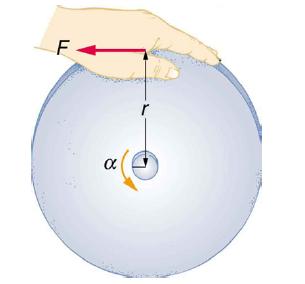
Consider a person who spins a large grindstone by placing her hand on its edge and exerting a force through part of a revolution as shown in Figure 10.16. In this example, we verify that the work done by the torque she exerts equals the change in rotational energy. (a) How much work is done if she
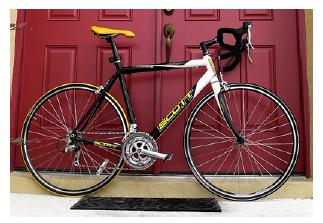
While reducing the mass of a racing bike, the greatest benefit is realized from reducing the mass of the tires and wheel rims. Why does this allow a racer to achieve greater accelerations than would an identical reduction in the mass of the bicycle’s frame?
Everyday application: Suppose a yo-yo has a center shaft that has a 0.250 cm radius and that its string is being pulled.(a) If the string is stationary and the yo-yo accelerates away from it at a rate of 1.50m/s2, what is the angular acceleration of the yo-yo?(b) What is the angular velocity after
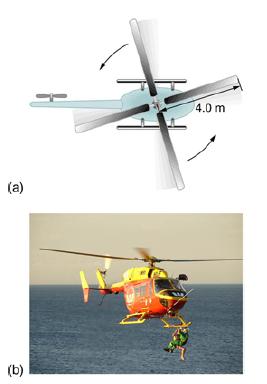
A typical small rescue helicopter, similar to the one in Figure 10.17, has four blades, each is 4.00 m long and has a mass of 50.0 kg. The blades can be approximated as thin rods that rotate about one end of an axis perpendicular to their length. The helicopter has a total loaded mass of 1000
A ball slides up a frictionless ramp. It is then rolled without slipping and with the same initial velocity up another frictionless ramp (with the same slope angle). In which case does it reach a greater height, and why?
Calculate the final speed of a solid cylinder that rolls down a 2.00-m-high incline. The cylinder starts from rest, has a mass of 0.750 kg, and has a radius of 4.00 cm.StrategyWe can solve for the final velocity using conservation of energy, but we must first express rotational quantities in terms
No information is given in the statement of the problem; so we must look up pertinent data before we can calculate L = Iω. First, according to Figure 10.11. the formula for the moment of inertia of a sphere isEarth's mass M is 5.979 x 1024 kg and its radius R is 6.376 x 10⁶ m. The Earth's angular
Describe the energy transformations involved when a yo-yo is thrown downward and then climbs back up its string to be caught in the user’s hand.
Calculate the moment of inertia of a skater given the following information. (a) The 60.0-kg skater is approximated as a cylinder that has a 0.110-m radius. (b) The skater with arms extended is approximately a cylinder that is 52.5 kg, has a 0.110-m radius, and has two 0.900-m-long arms which are
What energy transformations are involved when a dragster engine is revved, its clutch let out rapidly, its tires spun, and it starts to accelerate forward? Describe the source and transformation of energy at each step.
The Earth has more rotational kinetic energy now than did the cloud of gas and dust from which it formed. Where did this energy come from?
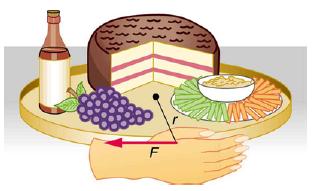
Figure 10.19 shows a rotating food tray, often called a lazy Susan, being turned by a person in quest of sustenance. Suppose the person exerts a 2.50 N force perpendicular to the lazy Susan’s 0.260-m radius for 0.150 s. (a) What is the final angular momentum of the lazy Susan if it starts from
The triceps muscle in the back of the upper arm extends the forearm. This muscle in a professional boxer exerts a force of 2.00 ×10³ N with an effective perpendicular lever arm of 3.00 cm, producing an angular acceleration of the forearm of 120rad/s2. What is the moment of inertia of the
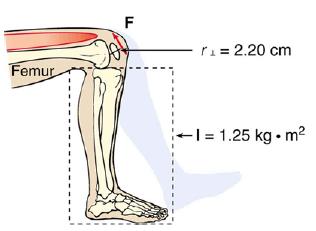
The person whose leg is shown in Figure 10.20 kicks his leg by exerting a 2000-N force with his upper leg muscle. The effective perpendicular lever arm is 2.20 cm. Given the moment of inertia of the lower leg is 1.25 kg m2,(a) Find the angular acceleration of the leg. (b) Neglecting the
A soccer player extends her lower leg in a kicking motion by exerting a force with the muscle above the knee in the front of her leg. She produces an angular acceleration of 30.00 rad/s2 and her lower leg has a moment of inertia of 0.750 kg- m2. What is the force exerted by the muscle if its
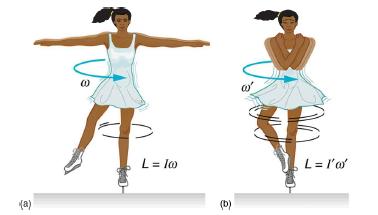
Suppose an ice skater, such as the one in Figure 10.21, is spinning at 0.800 rev/s with her arms extended. She has a moment of inertia of 2.34 kg - m2 with her arms extended and of 0.363 kg - m2 with her arms close to her body. (These moments of inertia are based on reasonable assumptions about a
When you start the engine of your car with the transmission in neutral, you notice that the car rocks in the opposite sense of the engine’s rotation. Explain in terms of conservation of angular momentum. Is the angular momentum of the car conserved for long (for more than a few seconds)?
Suppose you exert a force of 180 N tangential to a 0.280-m-radius 75.0-kg grindstone (a solid disk).(a)What torque is exerted?(b) What is the angular acceleration assuming negligible opposing friction?(c) What is the angular acceleration if there is an opposing frictional force of 20.0 N exerted
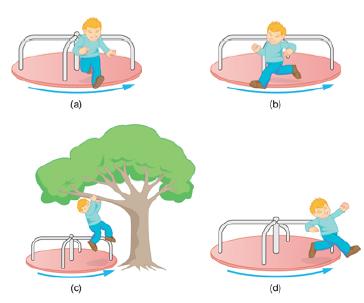
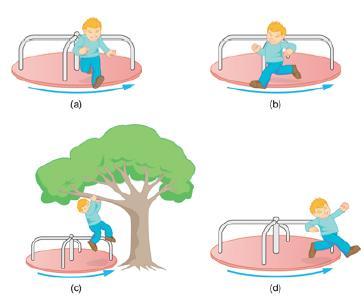
Suppose a child walks from the outer edge of a rotating merry-go-round to the inside. Does the angular velocity of the merry-go-round increase, decrease, or remain the same? Explain your answer. (a) (c) (b) (d)
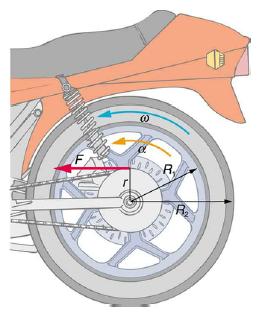
Consider the 12.0 kg motorcycle wheel shown in Figure 10.36. Assume it to be approximately an annular ring with an inner radius of 0.280 m and an outer radius of 0.330 m. The motorcycle is on its center stand, so that the wheel can spin freely.(a) If the drive chain exerts a force of 2200 N at a
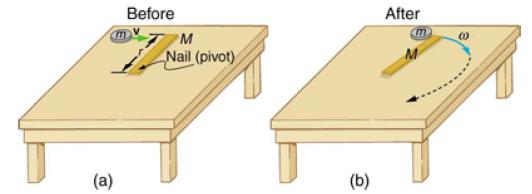
Suppose the disk in Figure 10.24 has a mass of 50.0 g and an initial velocity of 30.0 m/s when it strikes the stick that is 1.20 m long and 2.00 kg.(a) What is the angular velocity of the two after the collision?(b) What is the kinetic energy before and after the collision?(c) What is the total
Suppose a child gets off a rotating merry-go round. Does the angular velocity of the merry-go-round increase, decrease, or remain the same if:(a) He jumps off radially? (b) He jumps backward to land motionless?(c) He jumps straight up and hangs onto an overhead tree branch?(d) He jumps off
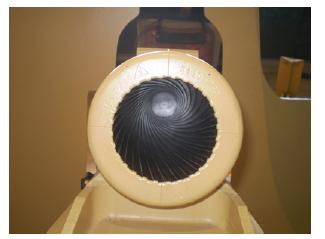
Helicopters have a small propeller on their tail to keep them from rotating in the opposite direction of their main lifting blades. Explain in terms of Newton’s third law why the helicopter body rotates in the opposite direction to the blades.
Starting with the formula for the moment of inertia of a rod rotated around an axis through one end perpendicular to its length (I = Ml2/3), prove that the moment of inertia of a rod rotated about an axis through its center perpendicular to its length is I = Ml2/12. You will find the graphics in
An automobile engine can produce 200 N • m of torque. Calculate the angular acceleration produced if 95.0% of this torque is applied to the drive shaft, axle, and rear wheels of a car, given the following information. The car is suspended so that the wheels can turn freely. Each wheel acts like a
Whenever a helicopter has two sets of lifting blades, they rotate in opposite directions (and there will be no tail propeller). Explain why it is best to have the blades rotate in opposite directions.
Describe how work is done by a skater pulling in her arms during a spin. In particular, identify the force she exerts on each arm to pull it in and the distance each moves, noting that a component of the force is in the direction moved. Why is angular momentum not increased by this action?
A gymnast doing a forward flip lands on the mat and exerts a 500-N • m torque to slow their angular velocity to zero. Their initial angular velocity is 10.0 rad/s, and their moment of inertia is 0.050kg . m2.(a) What time is required for the gymnast to exactly stop their spin?(b) What is
When there is a global heating trend on Earth, the atmosphere expands and the length of the day increases very slightly. Explain why the length of a day increases.
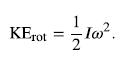
This problem considers energy and work aspects of Example 10.7—use data from that example as needed. (a) Calculate the rotational kinetic energy in the merry-go-round plus child when they have an angular velocity of 20.0 rpm. (b) Using energy considerations, find the number of revolutions the
An advertisement claims that an 800-kg car is aided by its 20.0-kg flywheel, which can accelerate the car from rest to a speed of 30.0 m/ s. The flywheel is a disk with a 0.150-m radius.(a) Calculate the angular velocity the flywheel must have if 95.0% of its rotational energy is used to get the
Nearly all conventional piston engines have flywheels on them to smooth out engine vibrations caused by the thrust of individual piston firings. Why does the flywheel have this effect?
Jet turbines spin rapidly. They are designed to fly apart if something makes them seize suddenly, rather than transfer angular momentum to the plane’s wing, possibly tearing it off. Explain how flying apart conserves angular momentum without transferring it to the wing.
What is the final velocity of a hoop that rolls without slipping down a 5.00-m-high hill, starting from rest?
An astronaut tightens a bolt on a satellite in orbit. He rotates in a direction opposite to that of the bolt, and the satellite rotates in the same direction as the bolt. Explain why. If a handhold is available on the satellite, can this counter-rotation be prevented? Explain your answer.
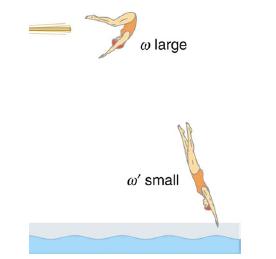
Competitive divers pull their limbs in and curl up their bodies when they do flips. Just before entering the water, they fully extend their limbs to enter straight down. Explain the effect of both actions on their angular velocities. Also explain the effect on their angular momenta. 7. w large w'
(a) Calculate the rotational kinetic energy of Earth on its axis. (b) What is the rotational kinetic energy of Earth in its orbit around the Sun?
A baseball pitcher throws the ball in a motion where there is rotation of the forearm about the elbow joint as well as other movements. If the linear velocity of the ball relative to the elbow joint is 20.0 m/s at a distance of 0.480 m from the joint and the moment of inertia of the forearm is
In terms of angular momentum, what is the advantage of giving a football or a rifle bullet a spin when throwing or releasing it?
While punting a football, a kicker rotates her leg about the hip joint. The moment of inertia of the leg is 3.75kg . m2 and its rotational kinetic energy is 175 J.(a) What is the angular velocity of the leg?(b) What is the velocity of tip of the punter’s shoe if it is 1.05 m from the hip
Describe two different collisions—one in which angular momentum is conserved, and the other in which it is not. Which condition determines whether or not angular momentum is conserved in a collision?
A bus contains a 1500 kg flywheel (a disk that has a 0.600 m radius) and has a total mass of 10,000 kg.(a) Calculate the angular velocity the flywheel must have to contain enough energy to take the bus from rest to a speed of 20.0 m/s, assuming 90.0% of the rotational kinetic energy can be
Suppose an ice hockey puck strikes a hockey stick that lies flat on the ice and is free to move in any direction. Which quantities are likely to be conserved: angular momentum, linear momentum, or kinetic energy (assuming the puck and stick are very resilient)?
A ball with an initial velocity of 8.00 m/s rolls up a hill without slipping. Treating the ball as a spherical shell, calculate the vertical height it reaches. (b) Repeat the calculation for the same ball if it slides up the hill without rolling.
While driving his motorcycle at highway speed, a physics student notices that pulling back lightly on the right handlebar tips the cycle to the left and produces a left turn. Explain why this happens.
While exercising in a fitness center, a man lies face down on a bench and lifts a weight with one lower leg by contacting the muscles in the back of the upper leg.(a) Find the angular acceleration produced given the mass lifted is 10.0 kg at a distance of 28.0 cm from the knee joint, the moment of
While driving his motorcycle at highway speed, a physics student notices that pulling back lightly on the right handlebar tips the cycle to the left and produces a left turn. Explain why this happens.
Gyroscopes used in guidance systems to indicate directions in space must have an angular momentum that does not change in direction. Yet they are often subjected to large forces and accelerations. How can the direction of their angular momentum be constant when they are accelerated?
Consider two cylinders that start down identical inclines from rest except that one is frictionless.Thus one cylinder rolls without slipping, while the other slides frictionlessly without rolling. They both travel a short distance at the bottom and then start up another incline. (a) Show that they
What is the moment of inertia of an object that rolls without slipping down a 2.00-m-high incline starting from rest, and has a final velocity of 6.00 m/s? Express the moment of inertia as a multiple of MR2, where M is the mass of the object and R is its radius.
Suppose a 200-kg motorcycle has two wheels like, the one described in Problem 10.15 and is heading toward a hill at a speed of 30.0 m/s.(a) How high can it coast up the hill, if you neglect friction? (b) How much energy is lost to friction if the motorcycle only gains an altitude of 35.0 m before
In softball, the pitcher throws with the arm fully extended (straight at the elbow). In a fast pitch the ball leaves the hand with a speed of 139 km/h.(a) Find the rotational kinetic energy of the pitcher’s arm and ball together given that the arm's moment of inertia is 0.720 kg .m2 and the ball
Consider the work done by a spinning skater pulling his arms in to increase his rate of spin. Construct a problem in which you calculate the work done with a “force multiplied by distance” calculation and compare it to the skater’s increase in kinetic energy.
(a) What is the angular momentum of the Moon in its orbit around Earth?(b) How does this angular momentum compare with the angular momentum of the Moon on its axis? Remember that the Moon keeps one side toward Earth at all times.(c) Discuss whether the values found in parts (a) and (b) seem
Suppose you start an antique car by exerting a force of 300 N on its crank for 0.250 s. What angular momentum is given to the engine if the handle of the crank is 0.300 m from the pivot and the force is exerted to create maximum torque the entire time?
A playground merry-go-round has a mass of 120 kg and a radius of 1.80 m and it is rotating with an angular velocity of 0.500 rev/s. What is its angular velocity after a 22.0-kg child gets onto it by grabbing its outer edge? The child is initially at rest.
Three children are riding on the edge of a merry-go-round that is 100 kg, has a 1.60-m radius, and is spinning at 20.0 rpm. The children have masses of 22.0, 28.0, and 33.0 kg. If the child who has a mass of 28.0 kg moves to the center of the merry-go- round, what is the new angular velocity in rpm?
(a) Calculate the angular momentum of an ice skater spinning at 6.00 rev/s given his moment of inertia is 0.400 kg. m2.(b) He reduces his rate of spin (his angular velocity) by extending his arms and increasing his moment of inertia. Find the value of his moment of inertia if his angular velocity
Consider the Earth-Moon system. Construct a problem in which you calculate the total angular momentum of the system including the spins of the Earth and the Moon on their axes and the orbital angular momentum of the Earth-Moon system in its nearly monthly rotation. Calculate what happens to the
Repeat Example 10.15 in which the disk originally spins clockwise at 1000 rpm and has a radius of 1.50 cm.Data given in Example 10.15Suppose the disk in Figure 10.24 has a mass of 50.0 g and an initial velocity of 30.0 m/s when it strikes the stick that is 1.20 m long and 2.00 kg.(a) What is the
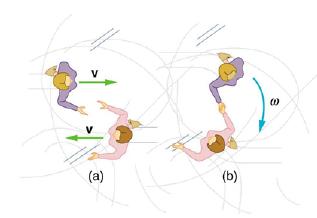
Twin skaters approach one another as shown in Figure 10.37 and lock hands.(a) Calculate their final angular velocity, given each had an initial speed of 2.50 m/s relative to the ice. Each has a mass of 70.0 kg, and each has a center of mass located 0.800 m from their locked hands. You may
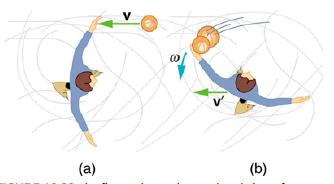
Suppose a 0.250-kg ball is thrown at 15.0 m/s to a motionless person standing on ice who catches it with an outstretched arm as shown in Figure 10.38.(a) Calculate the final linear velocity of the person, given his mass is 70.0 kg.(b) What is his angular velocity if each arm is 5.00 kg? You may
Repeat Example 10.15 in which the stick is free to have translational motion as well as rotational motion.Data given in Example 10.15Suppose the disk in Figure 10.24 has a mass of 50.0 g and an initial velocity of 30.0 m/s when it strikes the stick that is 1.20 m long and 2.00 kg.(a) What is the
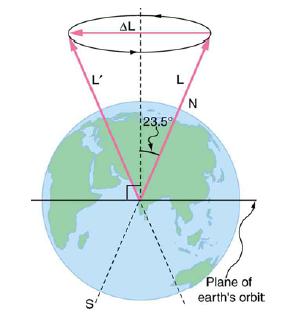
The axis of Earth makes a 23.5° angle with a direction perpendicular to the plane of Earth’s orbit. As shown in Figure 10.39, this axis precesses, making one complete rotation in 25,780 y.(a) Calculate the change in angular momentum in half this time.(b) What is the average torque producing this
A car moving at 10.0 m/s crashes into a tree and stops in 0.26 s. Calculate the force the seat belt exerts on a passenger in the car to bring him to a halt. The mass of the passenger is 70.0 kg.
Two teams of nine members each engage in a tug of war. Each of the first team’s members has an average mass of 68 kg and exerts an average force of 1350 N horizontally. Each of the second team’s members has an average mass of 73 kg and exerts an average force of 1365 N horizontally.(a) What is
Showing 2800 - 2900
of 3651
First
22
23
24
25
26
27
28
29
30
31
32
33
34
35
36
Last
Step by Step Answers

 Get 50% OFF
Claim Now
Get 50% OFF
Claim Now