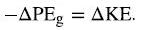
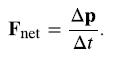
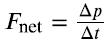
New Semester
Started
Get
50% OFF
Study Help!
--h --m --s
Claim Now
Question Answers
Textbooks
Find textbooks, questions and answers
Oops, something went wrong!
Change your search query and then try again
S
Books
FREE
Study Help
Expert Questions
Accounting
General Management
Mathematics
Finance
Organizational Behaviour
Law
Physics
Operating System
Management Leadership
Sociology
Programming
Marketing
Database
Computer Network
Economics
Textbooks Solutions
Accounting
Managerial Accounting
Management Leadership
Cost Accounting
Statistics
Business Law
Corporate Finance
Finance
Economics
Auditing
Tutors
Online Tutors
Find a Tutor
Hire a Tutor
Become a Tutor
AI Tutor
AI Study Planner
NEW
Sell Books
Search
Search
Sign In
Register
study help
physics
college physics 2nd
College Physics 2nd Edition OpenStax - Solutions
Does the work you do on a book when you lift it onto a shelf depend on the path taken? On the time taken? On the height of the shelf? On the mass of the book?
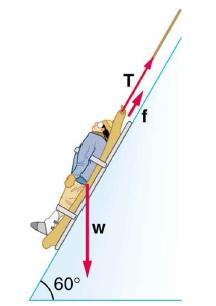
Suppose the ski patrol lowers a rescue sled and victim, having a total mass of 90.0 kg, down a slope at constant speed, as shown in Figure 7.34. The coefficient of friction between the sled and the snow is 0.100.(a) How much work is done by friction as the sled moves 30.0 m along the hill?(b) How
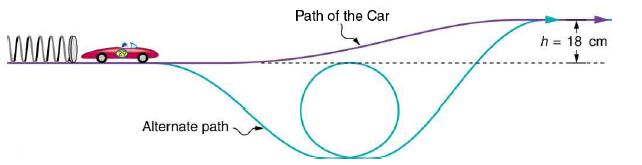
Using Conservation of Mechanical Energy to Calculate the Speed of a Toy Car A 0.100-kg toy car is propelled by a compressed spring, as shown in Figure 7.12. The car follows a track that rises 0.180 m above the starting point. The spring is compressed 4.00 cm and has a force constant of 250.0
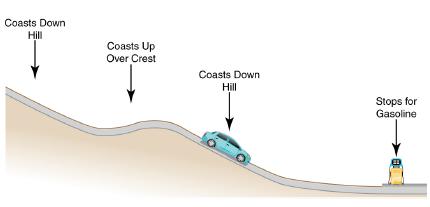
Consider the following scenario. A car for which friction is not negligible accelerates from rest down a hill, running out of gasoline after a short distance. The driver lets the car coast farther down the hill, then up and over a small crest. He then coasts down that hill into a gas station, where
Using energy considerations, calculate the average force a 60.0-kg sprinter exerts backward on the track to accelerate from 2.00 to 8.00 m/s in a distance of 25.0 m, if he encounters a headwind that exerts an average force of 30.0 N against him.
Do devices with efficiencies of less than one violate the law of conservation of energy? Explain.
A car’s bumper is designed to withstand a 4.0-km/h (1.12-m/s) collision with an immovable object without damage to the body of the car. The bumper cushions the shock by absorbing the force over a distance. Calculate the magnitude of the average force on a bumper that collapses 0.200 m while
If a person who normally requires an average of 12,000 kJ (3000 kcal) of food energy per day consumes 13,000 kJ per day, they will steadily add body fat. How much bicycling per day is required to work off this extra 1000 kJ?
Describe the energy transfers and transformations for a javelin, starting from the point at which an athlete picks up the javelin and ending when the javelin is stuck into the ground after being thrown.
Boxing gloves are padded to lessen the force of a blow.(a) Calculate the force exerted by a boxing glove on an opponent’s face, if the glove and face compress 7.50 cm during a blow in which the 7.00-kg arm and glove are brought to rest from an initial speed of 10.0 m/s.(b) Calculate the force
List four different forms or types of energy. Give one example of a conversion from each of these forms to another form.
(a) How much gravitational potential energy (relative to the ground on which it is built) is stored in the Great Pyramid of Cheops, given that its mass is about 7 x 10⁹ kg and its center of mass is 36.5 m above the surrounding ground?(b) How does this energy compare with the daily food intake of a
List the energy conversions that occur when riding a bicycle.
Suppose a 350-g kookaburra (a large kingfisher bird) picks up a 75-g snake and raises it 2.5 m from the ground to a branch.(a) How much work did the bird do on the snake? (b) How much work did it do to raise its own center of mass to the branch?
Most electrical appliances are rated in watts. Does this rating depend on how long the appliance is on? (When off, it is a zero-watt device.) Explain in terms of the definition of power.
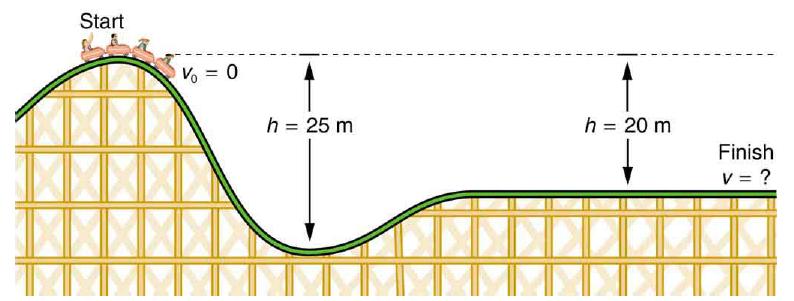
In Example 7.7, we found that the speed of a roller coaster that had descended 20.0 m was only slightly greater when it had an initial speed of 5.00 m/s than when it started from rest. This implies that ΔPE >> KEi. Confirm this statement by taking the ratio of ΔPE to KEi. (Note that mass
Explain, in terms of the definition of power, why energy consumption is sometimes listed in kilowatt-hours rather than joules. What is the relationship between these two energy units?
A 100-g toy car is propelled by a compressed spring that starts it moving. The car follows the curved track in Figure 7.36. Show that the final speed of the toy car is 0.687 m/s if its initial speed is 2.00 m/s and it coasts up the frictionless slope, gaining 0.180 m in altitude. LAGE KARARINER
Explain why it is easier to climb a mountain on a zigzag path rather than one straight up the side. Is your increase in gravitational potential energy the same in both cases? Is your energy consumption the same in both?
In a downhill ski race, surprisingly, little advantage is gained by getting a running start. (This is because the initial kinetic energy is small compared with the gain in gravitational potential energy on even small hills.) To demonstrate this, find the final speed and the time taken for a skier
Do you do work on the outside world when you rub your hands together to warm them? What is the efficiency of this activity?
An object that has a small mass and an object that has a large mass have the same momentum. Which object has the largest kinetic energy?
(a) Calculate the momentum of a 110-kg football player running at 8.00 m/s.(b) Compare the player’s momentum with the momentum of a hard-thrown 0.410-kg football that has a speed of 25.0 m/s.StrategyNo information is given regarding direction, and so we can calculate only the magnitude of the
An object that has a small mass and an object that has a large mass have the same kinetic energy. Which mass has the largest momentum?
(a) What is the mass of a large ship that has a momentum of 1.60 ×10⁹ kg-m/s, when the ship is moving at a speed of 48.0 km/h?(b) Compare the ship's momentum to the momentum of a 1100-kg artillery shell fired at a speed of 1200 m/s.
During the 2007 French Open, Venus Williams hit the fastest recorded serve in a premier women’s match, reaching a speed of 58 m/s (209 km/h). What is the average force exerted on the 0.057-kg tennis ball by Venus Williams’ racquet, assuming that the ball’s speed just after impact is 58 m/s,
Two identical billiard balls strike a rigid wall with the same speed, and are reflected without any change of speed. The first ball strikes perpendicular to the wall. The second ball strikes the wall at an angle of 30° from the perpendicular, and bounces off at an angle of 30° from perpendicular
Football coaches advise players to block, hit, and tackle with their feet on the ground rather than by leaping through the air. Using the concepts of momentum, work, and energy, explain how a football player can be more effective with his feet on the ground.
(a) At what speed would a 2.00 x 10⁴-kg airplane have to fly to have a momentum of 1.60 x 10⁹ kg m/s (the same as the ship's momentum in the problem above)? (b) What is the plane's momentum when it is taking off at a speed of 60.0 m/s? (c) If the ship is an aircraft carrier that launches these
How can a small force impart the same momentum to an object as a large force?
(a) What is the momentum of a garbage truck that is 1.20 x 10⁴ kg and is moving at 30.0 m/s?(b) At what speed would an 8.00-kg trash can have the same momentum as the truck?
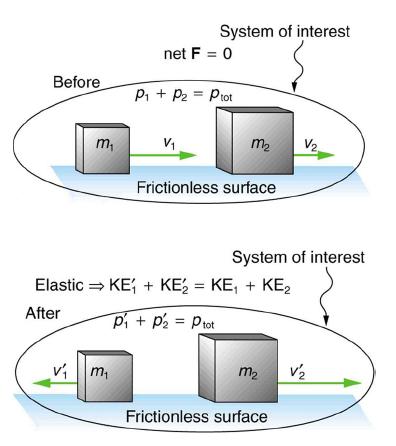
Calculate the velocities of two objects following an elastic collision, given thatStrategy and ConceptFirst, visualize what the initial conditions mean—a small object strikes a larger object that is initially at rest. This situation is slightly simpler than the situation shown in Figure 8.6 where
A runaway train car that has a mass of 15,000 kg travels at a speed of 5.4 m/s down a track. Compute the time required for a force of 1500 N to bring the car to rest.
A 500-kg dragster accelerates from rest to a final speed of 110 m/s in 400 m (about a quarter of a mile) and encounters an average frictional force of 1200 N. What is its average power output in watts and horsepower if this takes 7.30 s?
(a) How long will it take an 850-kg car with a useful power output of 40.0 hp (1 hp = 746 W) to reach a speed of 15.0 m/s, neglecting friction?(b) How long will this acceleration take if the car also climbs a 3.00-m-high hill in the process?
(a) Find the useful power output of an elevator motor that lifts a 2500-kg load a height of 35.0 m in 12.0 s, if it also increases the speed from rest to 4.00 m/s. Note that the total mass of the counterbalanced system is 10,000 kg-so that only 2500 kg is raised in height, but the full 10,000 kg is
(a) What is the available energy content, in joules, of a battery that operates a 2.00-W electric clock for 18 months?(b) How long can a battery that can supply 8.00 × 10⁴ J run a pocket calculator that consumes energy at the rate of 1.00 × 10⁻³ W?
(a) How long would it take a 1.50 x 10⁵-kg airplane with engines that produce 100 MW of power to reach a speed of 250 m/s and an altitude of 12.0 km if air resistance were negligible?(b) If it actually takes 900 s, what is the power?(c) Given this power, what is the average force of air resistance
(a) Calculate the power per square meter reaching Earth's upper atmosphere from the Sun. (Take the power output of the Sun to be 4.00 x 1026 W.)(b) Part of this is absorbed and reflected by the atmosphere, so that a maximum of 1.30 kW/m reaches Earth's surface. Calculate the area in km of solar
(a) How long can you rapidly climb stairs (116/min) on the 93.0 kcal of energy in a 10.0-g pat of butter?(b) How many flights is this if each flight has 16 stairs?
(a) What is the power output in watts and horsepower of a 70.0-kg sprinter who accelerates from rest to 10.0 m/s in 3.00 s?(b) Considering the amount of power generated, do you think a well-trained athlete could do this repetitively for long periods of time?
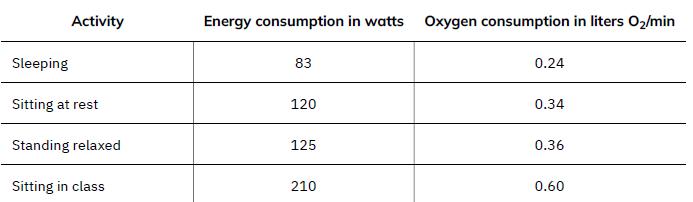
Energy that is not utilized for work or heat transfer is converted to the chemical energy of body fat containing about 39 kJ/g. How many grams of fat will you gain if you eat 10,000 kJ (about 2500 kcal) one day and do nothing but sit relaxed for 16.0 h and sleep for the other 8.00 h? Use data from
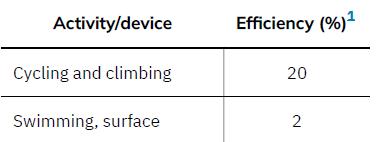
(a) What is the efficiency of an out-of-condition person who does 2.10 × 10⁵ J of useful work while metabolizing 500 kcal of food energy?(b) How many food calories would a well-conditioned athlete metabolize in doing the same work with an efficiency of 20%?
Using data from Table 7.5, calculate the daily energy needs of a person who sleeps for 7.00 h, walks for 2.00 h, attends classes for 4.00 h, cycles for 2.00 h, sits relaxed for 3.00 h, and studies for 6.00 h. (Studying consumes energy at the same rate as sitting in class.)Data given in Table 7.5
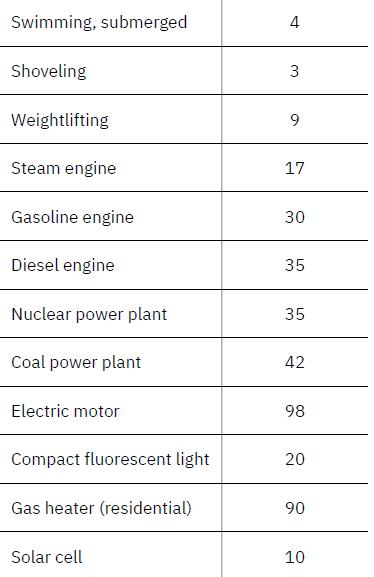
What is the efficiency of a subject on a treadmill who puts out work at the rate of 100 W while consuming oxygen at the rate of 2.00 L/min? (Hint: See Table 7.5.)Data given in Table 7.5 Activity Sleeping Sitting at rest Standing relaxed Sitting in class Energy consumption in watts Oxygen
Shoveling snow can be extremely taxing because the arms have such a low efficiency in this activity. Suppose a person shoveling a footpath metabolizes food at the rate of 800 W.(a) What is her useful power output?(b) How long will it take her to lift 3000 kg of snow 1.20 m? (This could be the
Jogging on hard surfaces with insufficiently padded shoes produces large forces in the feet and legs.(a) Calculate the magnitude of the force needed to stop the downward motion of a jogger’s leg, if his leg has a mass of 13.0 kg, a speed of 6.00 m/s, and stops in a distance of 1.50 cm. (Be
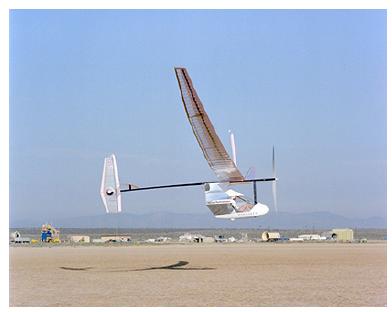
Kanellos Kanellopoulos flew 119 km from Crete to Santorini, Greece, on April 23, 1988, in the Daedalus 88, an aircraft powered by a bicycletype drive mechanism (see Figure 7.40). His useful power output for the 234-min trip was about 350 W. Using the efficiency for cycling from Table 7.2, calculate
(a) Calculate the energy in kJ used by a 55.0-kg person who does 50 deep knee bends in which their center of mass is lowered and raised 0.400 m. (They do work in both directions.) You may assume their efficiency is 20%.(b) What is the average power consumption rate in watts if they do this in 3.00
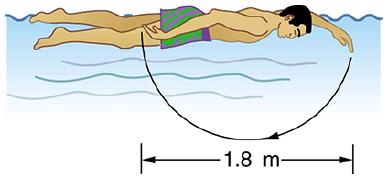
The swimmer shown in Figure 7.41 exerts an average horizontal backward force of 80.0 N with his arm during each 1.80 m long stroke.(a) What is his work output in each stroke?(b) Calculate the power output of his arms if he does 120 strokes per minute. -1.8 m-
Mountain climbers carry bottled oxygen when at very high altitudes.(a) Assuming that a mountain climber uses oxygen at twice the rate for climbing 116 stairs per minute (because of low air temperature and winds), calculate how many liters of oxygen a climber would need for 10.0 h of climbing.
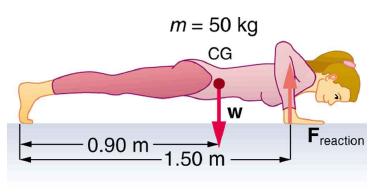
(a) Calculate the force the woman in Figure 7.43 exerts to do a push-up at constant speed, taking all data to be known to three digits.(b) How much work does she do if her center of mass rises 0.240 m? (c) What is her useful power output if she does 25 push-ups in 1 min? (Should work done lowering
(a) How long can you play tennis on the 800 kJ (about 200 kcal) of energy in a candy bar?(b) Does this seem like a long time? Discuss why exercise is necessary but may not be sufficient to cause a person to lose weight.
A 75.0-kg cross-country skier is climbing a 3.0° slope at a constant speed of 2.00 m/s and encounters air resistance of 25.0 N. Find his power output for work done against the gravitational force and air resistance.(b) What average force does he exert backward on the snow to accomplish this?(c) If
The 70.0-kg swimmer in Figure 7.41 starts a race with an initial velocity of 1.25 m/s and exerts an average force of 80.0 N backward with his arms during each 1.80 m long stroke.(a) What is his initial acceleration if water resistance is 45.0 N?(b) What is the subsequent average resistance force
A toy gun uses a spring with a force constant of 300 N/m to propel a 10.0-g steel ball. If the spring is compressed 7.00 cm and friction is negligible:(a) How much force is needed to compress the spring?(b) To what maximum height can the ball be shot?(c) At what angles above the horizontal may a
(a) What force must be supplied by an elevator cable to produce an acceleration of 0.800 m/s2 against a 200-N frictional force, if the mass of the loaded elevator is 1500 kg?(b) How much work is done by the cable in lifting the elevator 20.0 m?(c) What is the final speed of the elevator if it
Body fat is metabolized, supplying 9.30 kcal/g, when dietary intake is less than needed to fuel metabolism. The manufacturers of an exercise bicycle claim that you can metabolize 0.500 kg of fat per day by vigorously exercising for 2.00 h per day on their machine.(a) How many kcal are supplied by
A car advertisement claims that its 900-kg car accelerated from rest to 30.0 m/s and drove 100 km, gaining 3.00 km in altitude, on 1.0 gal of gasoline. The average force of friction including air resistance was 700 N. Assume all values are known to three significant figures.(a) Calculate the
Consider a person climbing and descending stairs. Construct a problem in which you calculate the long-term rate at which stairs can be climbed considering the mass of the person, his ability to generate power with his legs, and the height of a single stair step. Also consider why the same person
Consider humans generating electricity by pedaling a device similar to a stationary bicycle. Construct a problem in which you determine the number of people it would take to replace a large electrical generation facility. Among the things to consider are the power output that is reasonable using
A 105-kg basketball player crouches down 0.400 m while waiting to jump. After exerting a force on the floor through this 0.400 m, their feet leave the floor and their center of gravity rises 0.950 m above its normal standing erect position. (a) Using energy considerations, calculate the player's
Critical Thinking Two boxes of the same mass are pressed against pistons that compress and release the boxes on frictionless surfaces. Box A's piston has a constant force F over a distance x before the box is released while box B starts at zero force and increases linearly to a force of 2F before
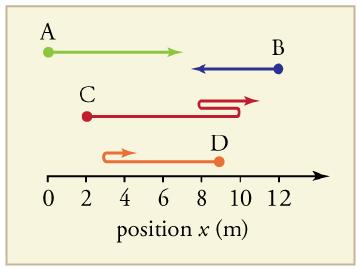
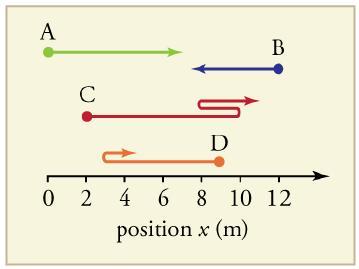
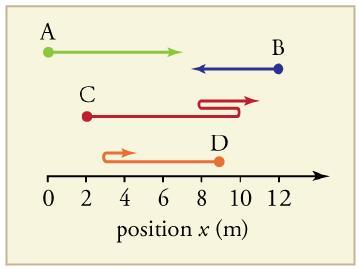
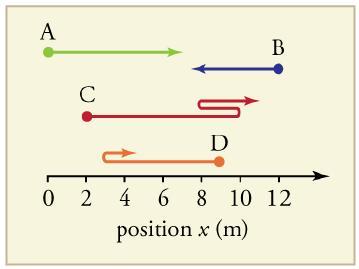
Find the following for path A in Figure 2.57: (a) The distance traveled.(b) The magnitude of the displacement from start to finish.(c) The displacement from start to finish. A C D B 02 4 6 8 10 12 position x (m)
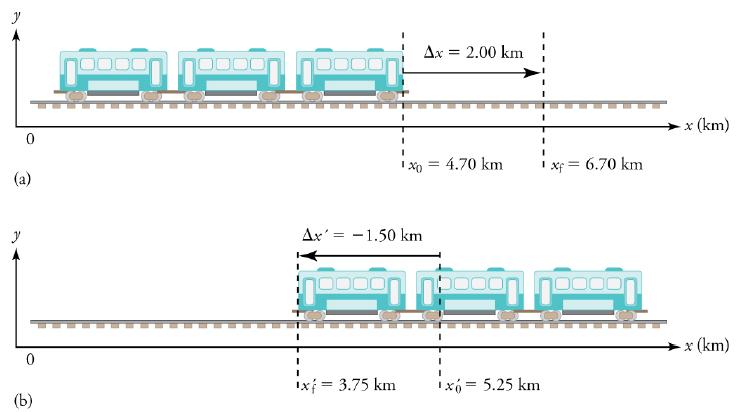
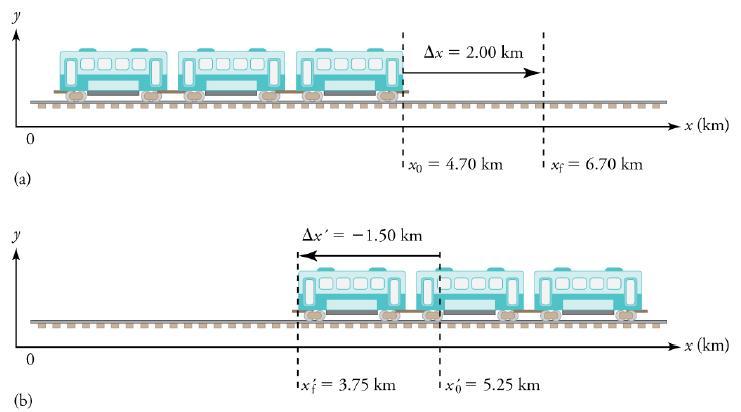
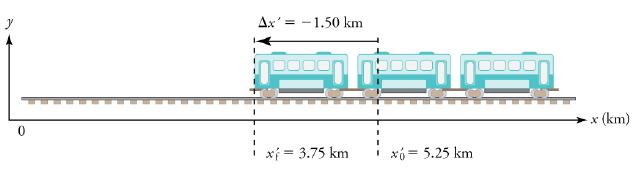
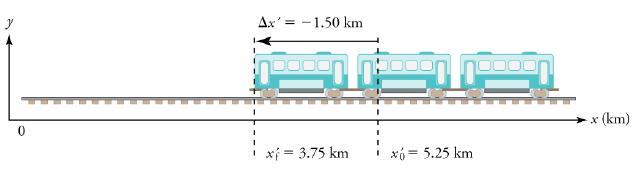
What are the magnitude and sign of displacements for the motions of the subway train shown in parts (a) and (b) of Figure 2.18?Data given in Figure 2.18StrategyA drawing with a coordinate system is already provided, so we don’t need to make a sketch, but we should analyze it to make sure we
Under what circumstances does distance traveled equal magnitude of displacement? What is the only case in which magnitude of displacement and displacement are exactly the same?
Find the following for path B in Figure 2.57: (a) The distance traveled.(b) The magnitude of the displacement from start to finish.(c) The displacement from start to finish. A C D B 02 4 6 8 10 12 position x (m)
A person’s speed can stay the same as they round a corner and changes direction. Given this information, is speed a scalar or a vector quantity? Explain.
What are the distances traveled for the motions shown in parts (a) and (b) of the subway train in Figure 2.18?Data given in Figure 2.18StrategyTo answer this question, think about the definitions of distance and distance traveled, and how they are related to displacement. Distance between two
Find the following for path C in Figure 2.57:(a) The distance traveled.(b) The magnitude of the displacement from start to finish. (c) The displacement from start to finish. A C D B 02 4 6 8 10 12 position x (m)
Bacteria move back and forth by using their flagella (structures that look like little tails). Speeds of up to 50 μ/s (50 x 10-6 m/s) have been observed. The total distance traveled by a bacterium is large for its size, while its displacement is small. Why is this?
A commuter train travels from Baltimore to Washington, DC, and back in 1 hour and 45 minutes. The distance between the two stations is approximately 40 miles. What is(a) The average velocity of the train, and(b) The average speed of the train in m/s?
Find the following for path D in Figure 2.57:(a) The distance traveled.(b) The magnitude of the displacement from start to finish. (c) The displacement from start to finish. A C D B 02 4 6 8 10 12 position x (m)
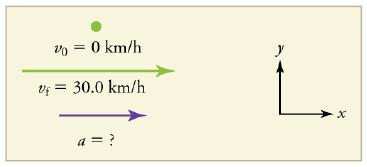
Suppose the train in Figure 2.18(a) accelerates from rest to 30.0 km/h in the first 20.0 s of its motion. What is its average acceleration during that time interval?Data given in Figure 2.18Strategy It is worth it at this point to make a simple sketch:This problem involves three steps. First we
A student writes, "A bird that is diving for prey has a speed of -10 m/s." What is wrong with the student's statement? What has the student actually described? Explain.
An airplane lands on a runway traveling east. Describe its acceleration.
What is the speed of the bird in Exercise 2.4?Data given in Exercise 2.4A student writes, "A bird that is diving for prey has a speed of -10 m/s." What is wrong with the student's statement? What has the student actually described? Explain.
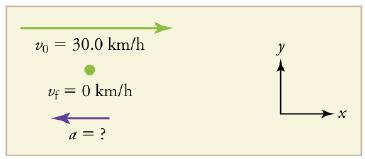
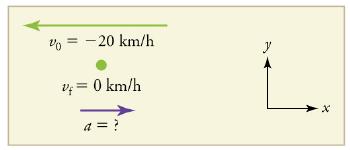
Now suppose that at the end of its trip, the train in Figure 2.18(a) slows to a stop from a speed of 30.0 km/h in 8.00s. What is its average acceleration while stopping?Data given in Figure 2.18 StrategyIn this case, the train is decelerating and its acceleration is negative because it is toward
(a) Calculate Earth’s average speed relative to the Sun.(b) What is its average velocity over a period of one year?
What is the average velocity of the train in part b of Example 2.2, and shown again below, if it takes 5.00 min to make its trip?Data given in Example 2.2 part bStrategyAverage velocity is displacement divided by time. It will be negative here, since the train moves to the left and has a negative
A rocket accelerates at a rate of 20m/s2 during launch. How long does it take the rocket to reach a velocity of 400 m/s?
A chunk of ice breaks off a glacier and falls 30.0 meters before it hits the water. Assuming it falls freely (there is no air resistance), how long does it take to hit the water?
Acceleration is the change in velocity over time. Given this information, is acceleration a vector or a scalar quantity? Explain.
Finally, suppose the train in Figure 2.22 slows to a stop from a velocity of 20.0 km/h in 10.0 s. What is its average acceleration?Data given in Figure 2.22StrategyOnce again, let’s draw a sketch:As before, we must find the change in velocity and the change in time to calculate average
A helicopter blade spins at exactly 100 revolutions per minute. Its tip is 5.00 m from the center of rotation. (a) Calculate the average speed of the blade tip in the helicopter’s frame of reference. (b) What is its average velocity over one revolution?
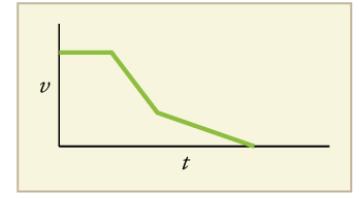
A graph of velocity vs. time of a ship coming into a harbor is shown below. (a) Describe the motion of the ship based on the graph.(b) What would a graph of the ship’s acceleration look like? V t
A weather forecast states that the temperature is predicted to be -5ºC the following day. Is this temperature a vector or a scalar quantity? Explain.
The North American and European continents are moving apart at a rate of about 3 cm/y. At this rate how long will it take them to drift 500 km farther apart than they are at present?
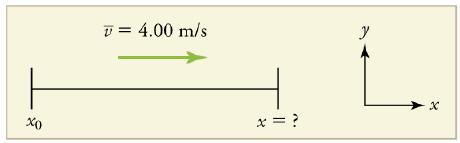
A jogger runs down a straight stretch of road with an average velocity of 4.00 m/s for 2.00 min. What is his final position, taking his initial position to be zero?StrategyDraw a sketch.The final position is given by the equationTo find x, we identify the values of x0, v̅, and t from the statement
Give an example (but not one from the text) of a device used to measure time and identify what change in that device indicates a change in time.
Land west of the San Andreas fault in southern California is moving at an average velocity of about 6 cm/y northwest relative to land east of the fault. Los Angeles is west of the fault and may thus someday be at the same latitude as San Francisco, which is east of the fault. How far in the future
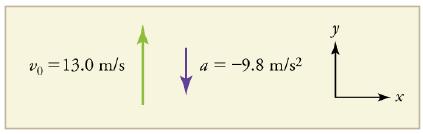
A person standing on the edge of a high cliff throws a rock straight up with an initial velocity of 13.0 m/s. The rock misses the edge of the cliff as it falls back to earth. Calculate the position and velocity of the rock 1.00 s, 2.00 s, and 3.00 s after it is thrown, neglecting the effects of air
There is a distinction between average speed and the magnitude of average velocity. Give an example that illustrates the difference between these two quantities.
On May 26, 1934, a streamlined, stainless steel diesel train called the Zephyr set the world’s nonstop long-distance speed record for trains. Its run from Denver to Chicago took 13 hours, 4 minutes, 58 seconds, and was witnessed by more than a million people along the route. The total distance
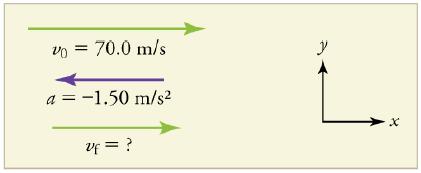
An airplane lands with an initial velocity of 70.0 m/s and then decelerates at 1.50 m/s2 for 40.0 s. What is its final velocity?StrategyDraw a sketch. We draw the acceleration vector in the direction opposite the velocity vector because the plane is decelerating. v0 = 70.0 m/s a = -1.50 m/s² Uf =
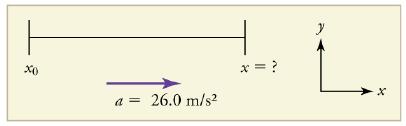
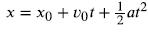
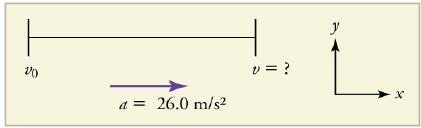
Dragsters can achieve average accelerations of 26.0 m/s2. Suppose such a dragster accelerates from rest at this rate for 5.56 s. How far does it travel in this time?StrategyDraw a sketch.We are asked to find displacement, which is x if we take x0 to be zero. (Think about it like the starting line
Does a car’s odometer measure distance traveled or displacement? Does its speedometer measure speed or velocity?
Calculate the final velocity of the dragster in Example 2.10 without using information about time.Data given in Example 2.10Dragsters can achieve average accelerations of 26.0 m/s2. Suppose such a dragster accelerates from rest at this rate for 5.56 s. How far does it travel in this
Tidal friction is slowing the rotation of the Earth. As a result, the orbit of the Moon is increasing in radius at a rate of approximately 4 cm/year. Assuming this to be a constant rate, how many years will pass before the radius of the Moon's orbit increases by 3.84 x 10⁶ m (1 %)?
If you divide the total distance traveled on a car trip (as determined by the odometer) by the time for the trip, are you calculating the average speed or the magnitude of the average velocity? Under what circumstances are these two quantities the same?
Showing 3400 - 3500
of 3651
First
23
24
25
26
27
28
29
30
31
32
33
34
35
36
37
Step by Step Answers

 Get 50% OFF
Claim Now
Get 50% OFF
Claim Now