New Semester
Started
Get
50% OFF
Study Help!
--h --m --s
Claim Now
Question Answers
Textbooks
Find textbooks, questions and answers
Oops, something went wrong!
Change your search query and then try again
S
Books
FREE
Study Help
Expert Questions
Accounting
General Management
Mathematics
Finance
Organizational Behaviour
Law
Physics
Operating System
Management Leadership
Sociology
Programming
Marketing
Database
Computer Network
Economics
Textbooks Solutions
Accounting
Managerial Accounting
Management Leadership
Cost Accounting
Statistics
Business Law
Corporate Finance
Finance
Economics
Auditing
Tutors
Online Tutors
Find a Tutor
Hire a Tutor
Become a Tutor
AI Tutor
AI Study Planner
NEW
Sell Books
Search
Search
Sign In
Register
study help
physics
college physics 2nd
College Physics 2nd Edition OpenStax - Solutions
You drive 7.50 km in a straight line in a direction 15° east of north.(a) Find the distances you would have to drive straight east and then straight north to arrive at the same point. (This determination is equivalent to find the components of the displacement along the east and north
If someone is riding in the back of a pickup truck and throws a softball straight backward, is it possible for the ball to fall straight down as viewed by a person standing at the side of the road? Under what condition would this occur? How would the motion of the ball appear to the person who
The hat of a jogger running at constant velocity falls off the back of his head. Draw a sketch showing the path of the hat in the jogger’s frame of reference. Draw its path as viewed by a stationary observer.
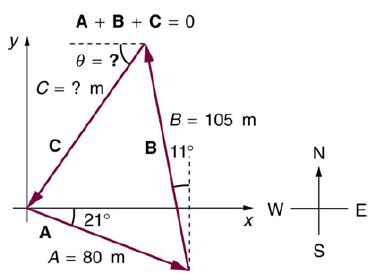
A new landowner has a triangular piece of flat land she wishes to fence. Starting at the west corner, she measures the first side to be 80.0 m long and the next to be 105 m. These sides are represented as displacement vectors A from B in Figure 3.56. She then correctly calculates the length and
A clod of dirt falls from the bed of a moving truck. It strikes the ground directly below the end of the truck. What is the direction of its velocity relative to the truck just before it hits? Is this the same as the direction of its velocity relative to ground just before it hits? Explain your
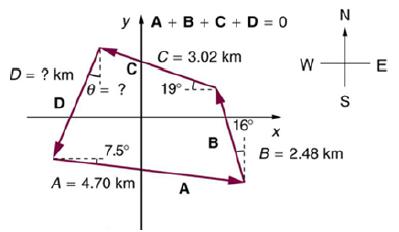
A farmer wants to fence off a four-sided plot of flat land. They measure the first three sides, shown as A, B, and C in Figure 3.57, and then correctly calculate the length and orientation of the fourth side D. What is their result? D = ? km D y A + B + C + D = 0 C = 3.02 km 19°- C /0= ? 7.5° A =
You fly 32.0 km in a straight line in still air in the direction 35.0° south of west.(a) Find the distances you would have to fly straight south and then straight west to arrive at the same point. (This determination is equivalent to finding the components of the displacement along the south and
In an attempt to escape his island, Gilligan builds a raft and sets to sea. The wind shifts a great deal during the day, and he is blown along the following straight lines: 2.50 km 45.0° north of west; then 4.70 km 60.0° south of east; then 1.30 km 25.0° south of west; then 5.10 km straight
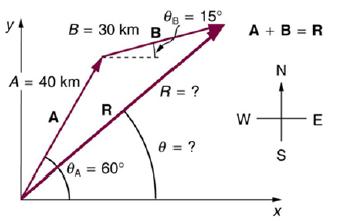
Suppose a pilot flies 40.0 km in a direction 60° north of east and then flies 30.0 km in a direction 15° north of east as shown in Figure 3.58. Find her total distance R from the starting point and the direction θ of the straight-line path to the final position. Discuss qualitatively how this
A projectile is launched at ground level with an initial speed of 50.0 m/s at an angle of 30.0° above the horizontal. It strikes a target above the ground 3.00 seconds later. What are the x and y distances from where the projectile was launched to where it lands?
A ball is kicked with an initial velocity of 16 m/s in the horizontal direction and 12 m/s in the vertical direction. (a) At what speed does the ball hit the ground?(b) For how long does the ball remain in the air?(c) What maximum height is attained by the ball?
(a) A daredevil is attempting to jump his motorcycle over a line of buses parked end to end by driving up a 32° ramp at a speed of 40.0 m/s (144 km/h). How many buses can he clear if the top of the takeoff ramp is at the same height as the bus tops and the buses are 20.0 m long? (b) Discuss what
An archer shoots an arrow at a 75.0 m distant target; the bull’s-eye of the target is at same height as the release height of the arrow. (a) At what angle must the arrow be released to hit the bull’s-eye if its initial speed is 35.0 m/s? In this part of the problem, explicitly show how you
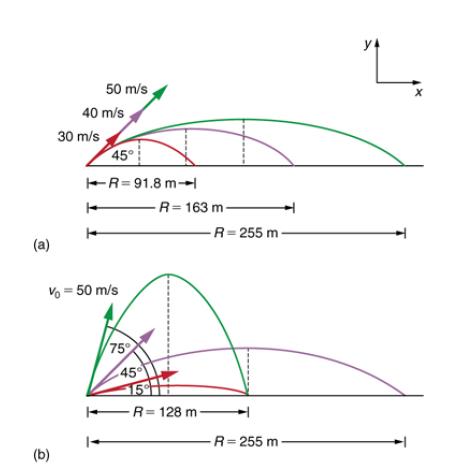
Verify the ranges shown for the projectiles in Figure 3.38(b) for an initial velocity of 50 m/s at the given initial angles.Data given in Figure 3.38 (a) (b) 50 m/s 40 m/s 30 m/s 45° R=91.8 m V=50 m/s 75% 45 -R-163 m- -R=128 m- R=255 m- R=255 m y X
The cannon on a battleship can fire a shell a maximum distance of 32.0 km.(a) Calculate the initial velocity of the shell.(b) What maximum height does it reach? (At its highest, the shell is above 60% of the atmosphere-but air resistance is not really negligible as assumed to make this problem
An arrow is shot from a height of 1.5 m toward a cliff of height H. It is shot with a velocity of 30 m/s at an angle of 60° above the horizontal. It lands on the top edge of the cliff 4.0 s later.(a) What is the height of the cliff?(b) What is the maximum height reached by the arrow along its
A friend tells you they have learned about a new law of nature. What can you know about the information even before your friend describes the law? How would the information be different if your friend told you they had learned about a scientific theory rather than a law?
Models are particularly useful in relativity and quantum mechanics, where conditions are outside those normally encountered by humans. What is a model?
Suppose that you drive the 10.0 km from your school to home in 20.0 min. Calculate your average speed (a) In kilometers per hour (km/h) and(b) In meters per second (m/s).StrategyFirst we calculate the average speed using the given units. Then we can get the average speed into the desired units by
The speed limit on some interstate highways is roughly 100 km/h. (a) What is this in meters per second?(b) How many miles per hour is this?
Some hummingbirds beat their wings more than 50 times per second. A scientist is measuring the time it takes for a hummingbird to beat its wings once. Which fundamental unit should the scientist use to describe the measurement? Which factor of 10 is the scientist likely to use to describe the
How does a model differ from a theory?
A car is traveling at a speed of 33m/s . (a) What is its speed in kilometers per hour?(b) Is it exceeding the 90km/h speed limit?
A grocery store sells 5-lb bags of apples. You purchase four bags over the course of a month and weigh the apples each time. You obtain the following measurements:Week 1 weight: 4.8 lbWeek 2 weight: 5.3 lbWeek 3 weight: 4.9 lbWeek 4 weight: 5.4 lbYou determine that the weight of the 5-lb bag has an
One cubic centimeter is equal to one milliliter. What does this tell you about the different units in the SI metric system?
If two different theories describe experimental observations equally well, can one be said to be more valid than the other.
Can you approximate the height of one of the buildings on your campus, or in your neighborhood? Let us make an approximation based upon the height of a person. In this example, we will calculate the height of a 39-story building.StrategyThink about the average height of an adult male. We can
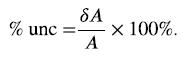
A high school track coach has just purchased a new stopwatch. The stopwatch manual states that the stopwatch has an uncertainty of ±0.05 s. The team's top sprinter clocked a 100 meter sprint at 12.04 seconds last week and at 11.96 seconds this week. Can we conclude that this week's time was faster?
What determines the validity of a theory?
American football is played on a 100-yd-long field, excluding the end zones. How long is the field in meters?
The U.S. federal debt in 2021 was a little more than $28 trillion. Most of us do not have any concept of how much even one trillion actually is. Suppose that you were given a trillion dollars in $100 bills. If you made 100-bill stacks and used them to evenly cover a football field (between the end
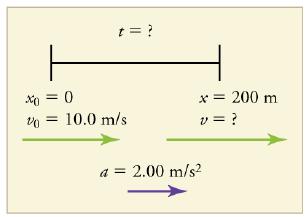
Suppose a car merges into freeway traffic on a 200-m-long ramp. If its initial velocity is 10.0 m/s and it accelerates at 2.00m/s2, how long does it take to travel the 200 m up the ramp? (Such information might be useful to a traffic engineer.)StrategyDraw a sketch.We are asked to solve for the
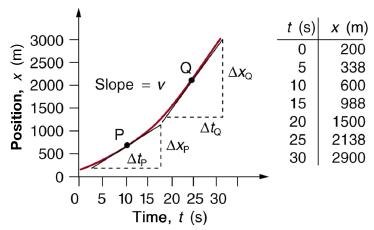
Calculate the velocity of the jet car at a time of 25 s by finding the slope of the vs. graph in the graph below.StrategyThe slope of a curve at a point is equal to the slope of a straight line tangent to the curve at that point. This principle is illustrated in Figure 2.48, where Q is the point at
A swimmer bounces straight up from a diving board and falls feet first into a pool. She starts with a velocity of 4.00 m/s, and her takeoff point is 1.80 m above the pool. (a) How long are her feet in the air?(b) What is her highest point above the board?(c) What is her velocity when her feet hit
A very strong, but inept, shot putter puts the shot straight up vertically with an initial velocity of 11.0 m/s. How long does he have to get out of the way if the shot was released at a height of 2.20 m, and he is 1.80 m tall?
You throw a ball straight up with an initial velocity of 15.0 m/s. It passes a tree branch on the way up at a height of 7.00 m. How much additional time will pass before the ball passes the tree branch on the way back down?
A kangaroo can jump over an object 2.50 m high.(a) Calculate its vertical speed when it leaves the ground.(b) How long is it in the air?
Standing at the base of one of the cliffs of Mt. Arapiles in Victoria, Australia, a hiker hears a rock break loose from a height of 105 m. He can’t see the rock right away but then does, 1.50 s later. (a) How far above the hiker is the rock when he can see it?(b) How much time does he have to
An object is dropped from a height of 75.0 m above ground level. (a) Determine the distance traveled during the first second.(b) Determine the final velocity at which the object hits the ground.(c) Determine the distance traveled during the last second of motion before hitting the ground.
There is a 250-m-high cliff at Half Dome in Yosemite National Park in California. Suppose a boulder breaks loose from the top of this cliff.(a) How fast will it be going when it strikes the ground?(b) Assuming a reaction time of 0.300 s, how long will a tourist at the bottom have to get out of the
A ball is thrown straight up. It passes a 2.00-m high window 7.50 m off the ground on its path up and takes 0.312 s to go past the window. What was the ball’s initial velocity? Next, consider only the distance from the ground to the bottom of the window, and solve for the initial velocity using
Suppose you drop a rock into a dark well and, using precision equipment, you measure the time for the sound of a splash to return.(a) Neglecting the time required for sound to travel up the well, calculate the distance to the water if the sound returns in 2.0000 s. (b) Now calculate the distance
A steel ball is dropped onto a hard floor from a height of 1.50 m and rebounds to a height of 1.45 m.(a) Calculate its velocity just before it strikes the floor. (b) Calculate its velocity just after it leaves the floor on its way back up. (c) Calculate its acceleration during contact with the
A coin is dropped from a hot-air balloon that is 300 m above the ground and rising at 10.0 m/s upward. For the coin, find (a) The maximum height reached, (b) Its position and velocity 4.00 s after being released, and(c) The time before it hits the ground.
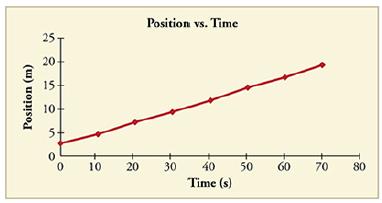
Using approximate values, calculate the slope of the curve in Figure 2.60 to verify that the velocity at t = 30.0 s is approximately 0.24 m/s. Assume all values are known to 2 significant figures. Position (m) 125 20+ 10+ 5- 0 Position vs. Time 10. 20 30 40 50 Time (s) 60 70 80
A soft tennis ball is dropped onto a hard floor from a height of 1.50 m and rebounds to a height of 1.10 m. (a) Calculate its velocity just before it strikes the floor. (b) Calculate its velocity just after it leaves the floor on its way back up. (c) Calculate its acceleration during contact
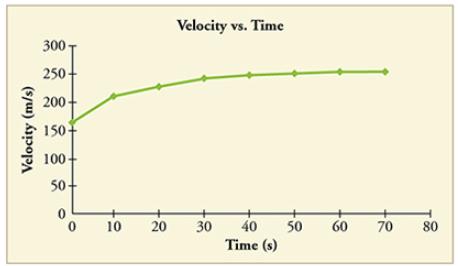
By taking the slope of the curve in Figure 2.61, verify that the acceleration is 3.2 m/s2 at t = 10 s. Velocity (m/s) 300- 250- 200+ 150+ 100+ 50- 0 0 10 20 Velocity vs. Time 30 40 50 Time (s) 60 70 80
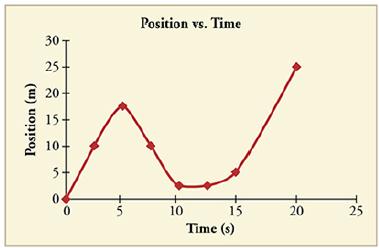
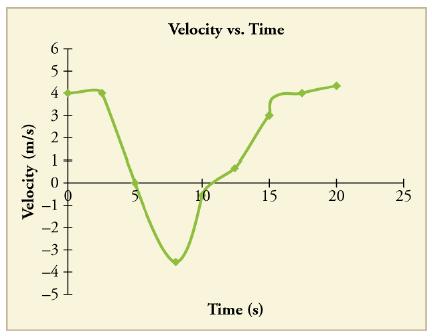
(a) Take the slope of the curve in Figure 2.62 to find the jogger's velocity at t = 2.5 s.(b) Repeat at 7.5 s. These values must be consistent with the graph in Figure 2.63. Position (m) 30 25. €20 15+ 10- 5+ 0 0 5 Position vs. Time 10 15 Time (s) 20 25
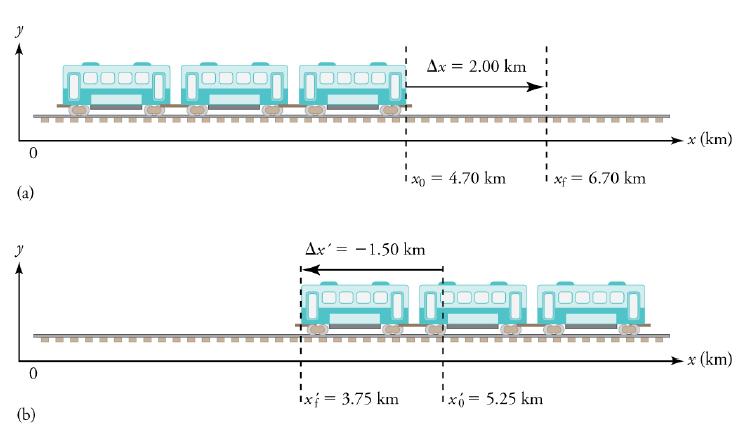
Construct the position graph for the subway shuttle train as shown in Figure 2.18(a). Your graph should show the position of the train, in kilometers, from t = 0 to 20 s. You will need to use the information on acceleration and velocity given in the examples for this figure.Data given in Figure
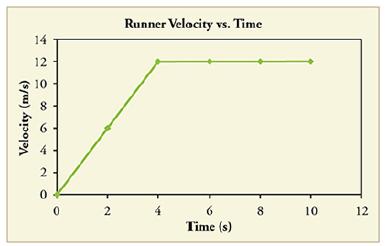
A graph of v(t) is shown for a world-class track sprinter in a 100-m race. (See Figure 2.65).(a) What is his average velocity for the first 4 s?(b) What is his instantaneous velocity at t = 5 s?(c) What is his average acceleration between 0 and 4 s?(d) What is his time for the race? Velocity
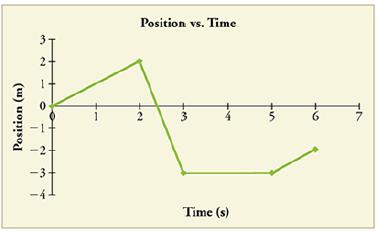
Figure 2.66 shows the position graph for a particle for 6 s.(a) Draw the corresponding Velocity vs. Time graph.(b) What is the acceleration between 0 s and 2 s?(c) What happens to the acceleration at exactly 2 s? Position (m) 2 0 N 3 -4 Position vs. Time Time (s) 6 7
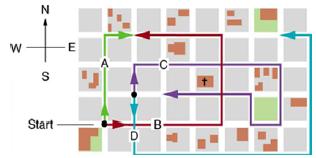
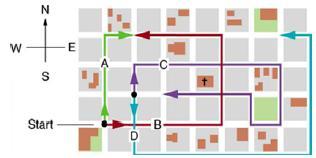
Find the following for path A in Figure 3.49:(a) The total distance traveled, and(b) The magnitude and direction of the displacement from start to finish. W N to S Start E D B
Critical Thinking Two cars are side by side on a path where friction is negligible. Car A starts from rest and has a positive, constant acceleration while car B travels at a constant speed. The cars reach the same check point down the road at the same time.(a) Which car is traveling faster at the
Use the graphical technique for adding vectors to find the total displacement of a person who walks the following three paths (displacements) on a flat field. First, she walks 25.0 m in a direction 49.0º north of east. Then, she walks 23.0 m heading 15.0º north of east. Finally, she turns and
Find the following for path B in Figure 3.49: (a) The total distance traveled, and(b) The magnitude and direction of the displacement from start to finish. W N + S Start E " D B
Which of the following is a vector: a person’s height, the altitude on Mt. Everest, the age of the Earth, the boiling point of water, the cost of this book, the Earth’s population, the acceleration of gravity?
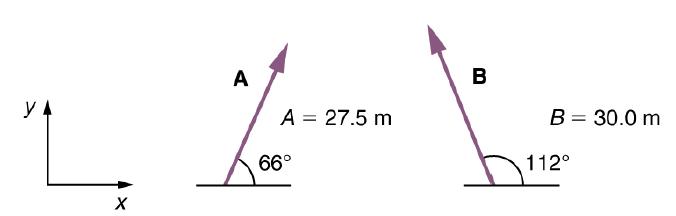
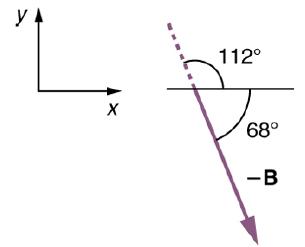
A woman sailing a boat at night is following directions to a dock. The instructions read to first sail 27.5 m in a direction 66.0° north of east from her current location, and then travel 30.0 m in a direction 112° north of east (or 22.0° west of north). If the woman makes a mistake and travels
Give a specific example of a vector, stating its magnitude, units, and direction.
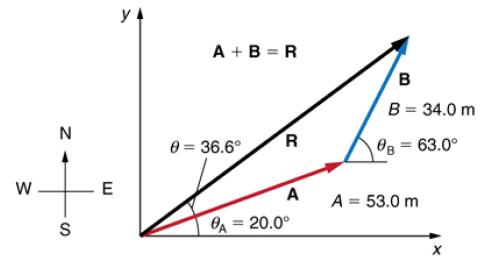
Add the vector A to the vector B shown in Figure 3.31, using perpendicular components along the x- and y-axes. The x- and y-axes are along the east-west and north-south directions, respectively. Vector A represents the first leg of a walk in which a person walks 53.0 m in a direction 20.0° north
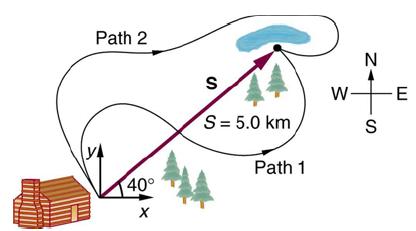
Find the north and east components of the displacement for the hikers shown in Figure 3.47.Data given in Figure 3.47 Path 2 VA 40° X S S = 5.0 km Path 1 zato W- E
What do vectors and scalars have in common? How do they differ?
During a fireworks display, a shell is shot into the air with an initial speed of 70.0 m/s at an angle of above the horizontal, as illustrated in Figure 3.36. The fuse is timed to ignite the shell just as it reaches its highest point above the ground. (a) Calculate the height at which the shell
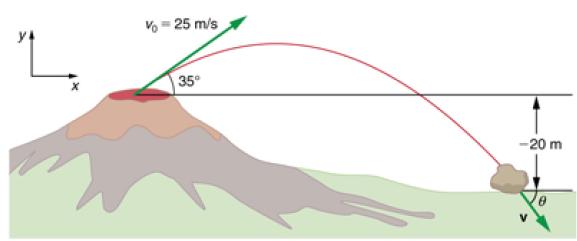
Kilauea in Hawaii is the world's most continuously active volcano. Very active volcanoes characteristically eject red- hot rocks and lava rather than smoke and ash. Suppose a large rock is ejected from the volcano with a speed of 25.0 m/s and at an angle 35.0° above the horizontal, as shown in
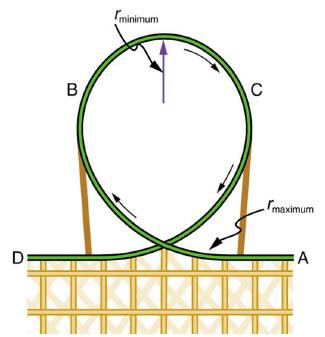
Modern roller coasters have vertical loops like the one shown in Figure 6.35. The radius of curvature is smaller at the top than on the sides so that the downward centripetal acceleration at the top will be greater than the acceleration due to gravity, keeping the passengers pressed firmly into
(a) Calculate the minimum coefficient of friction needed for a car to negotiate an unbanked 50.0 m radius curve at 30.0 m/s.(b) What is unreasonable about the result?(c) Which premises are unreasonable or inconsistent?
The Moon and Earth rotate about their common center of mass, which is located about 4700 km from the center of Earth. (This is 1690 km below the surface.)(a) Calculate the magnitude of the acceleration due to the Moon’s gravity at that point.(b) Calculate the magnitude of the centripetal
The existence of the dwarf planet Pluto was proposed based on irregularities in Neptune's orbit. Pluto was subsequently discovered near its predicted position. But it now appears that the discovery was fortuitous, because Pluto is small and the irregularities in Neptune's orbit were not well known.
A geosynchronous Earth satellite is one that has an orbital period of precisely 1 day. Such orbits are useful for communication and weather observation because the satellite remains above the same point on Earth (provided it orbits in the equatorial plane in the same direction as Earth’s
(a) The Sun orbits the Milky Way galaxy once each 2.60 x 10⁸ y, with a roughly circular orbit averaging 3.00 x 10⁴ light years in radius. (A light year is the distance traveled by light in 1 y.) Calculate the centripetal acceleration of the Sun in its galactic orbit. Does your result support the
A mountain 10.0 km from a person exerts a gravitational force on him equal to 2.00% of his weight.(a) Calculate the mass of the mountain.(b) Compare the mountain’s mass with that of Earth.(c) What is unreasonable about these results?(d) Which premises are unreasonable or inconsistent? (Note that
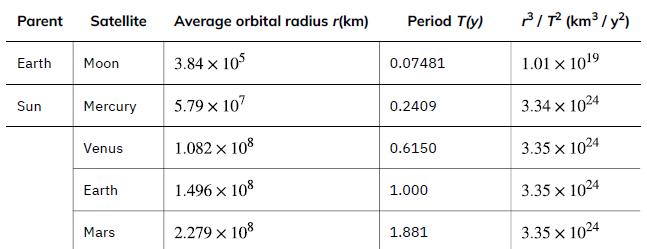
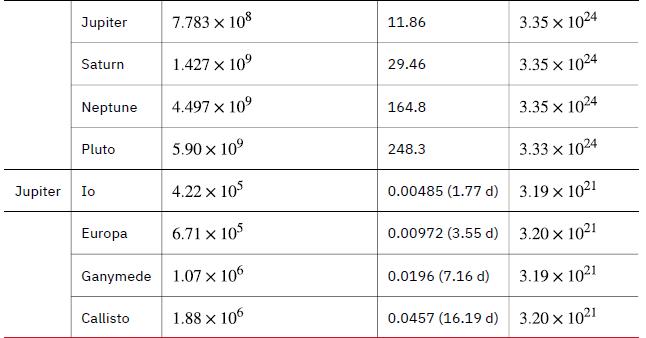
Find the ratio of the mass of Jupiter to that of Earth based on data in Table 6.2.Data given in Table 6.2 Parent Satellite Average orbital radius r(km) 3.84 x 10⁵ 5.79 x 10⁷ Earth Moon Sun Mercury Venus Earth Mars 1.082 x 10⁸ 1.496 × 108 X 2.279 × 108 X Period
Calculate the mass of the Sun based on data for Earth’s orbit and compare the value obtained with the Sun’s actual mass.
(a) Calculate Earth's mass given the acceleration due to gravity at the North Pole is 9.830 m/s2 and the radius of the Earth is 6371 km from center to pole.(b) Compare this with the accepted value of 5.979 x 1024 kg.
(a) Calculate the acceleration due to gravity on the surface of the Sun.(b) By what factor would your weight increase if you could stand on the Sun?
(a) What is the acceleration due to gravity on the surface of the Moon? (b) On the surface of Mars? The mass of Mars is 6.418 x 10²³ kg and its radius is 3.38 x 10⁶ m.
(a) Calculate the magnitude of the acceleration due to gravity on the surface of Earth due to the Moon.(b) Calculate the magnitude of the acceleration due to gravity at Earth due to the Sun.(c) Take the ratio of the Moon’s acceleration to the Sun’s and comment on why the tides are predominantly
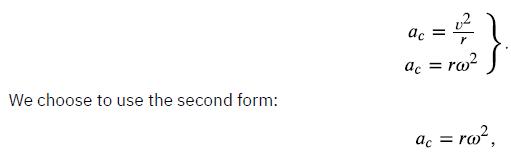
Solve part (b) of Example 6.6 using ac = v2 /r.Data given in Example 6.6(a) Find the acceleration due to Earth’s gravity at the distance of the Moon.(b) Calculate the centripetal acceleration needed to keep the Moon in its orbit (assuming a circular orbit about a fixed Earth), and compare it with
What is the cost of running a 0.200-kW computer 6.00 h per day for 30.0 d if the cost of electricity is $0.120 per kW.h ?StrategyCost is based on energy consumed; thus, we must find E from E = Pt and then calculate the cost. Because electrical energy is expressed in kW.h, at the start of a problem
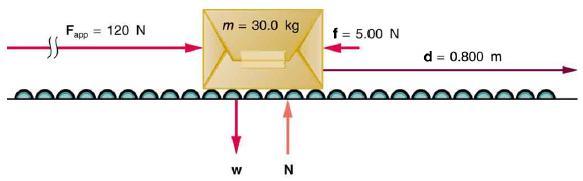
How far does the package in Figure 7.4 coast after the push, assuming friction remains constant? Use work and energy considerations.Data given in Figure 7.4Strategy We know that once the person stops pushing, friction will bring the package to rest. In terms of energy, friction does negative work
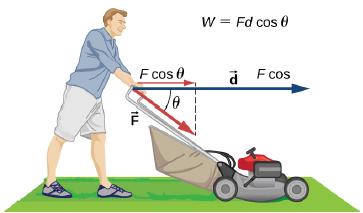
The person in Figure 7.30 does work on the lawn mower. Under what conditions would the mower gain energy? Under what conditions would it lose energy? TI! F cos 0 ¹0 F W = Fd cos 0 d Fcos
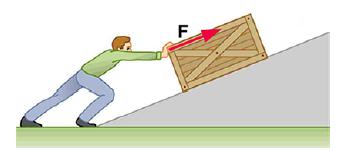
Calculate the work done by an 85.0-kg man who pushes a crate 4.00 m up along a ramp that makes an angle of 20.0° with the horizontal. (See Figure 7.32.) He exerts a force of 500 N on the crate parallel to the ramp and moves at a constant speed. Be certain to include the work he does on the crate
Work done on a system puts energy into it. Work done by a system removes energy from it. Give an example for each statement.
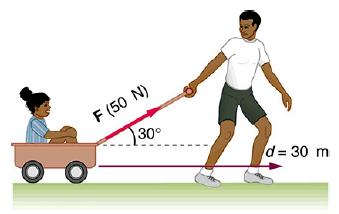
How much work is done by the boy pulling his sister 30.0 m in a wagon as shown in Figure 7.33? Assume no friction acts on the wagon. F (50 N) 30° d= 30 m
A 60.0-kg person jumps onto the floor from a height of 3.00 m. If he lands stiffly (with his knee joints compressing by 0.500 cm), calculate the force on the knee joints.StrategyThis person's energy is brought to zero in this situation by the work done on him by the floor as he stops. The initial
When solving for speed in Example 7.4, we kept only the positive root. Why?Data given in Example 7.4The person in Figure 7.30 does work on the lawn mower. Under what conditions would the mower gain energy? Under what conditions would it lose energy? TI! F cos 0 ¹0 F W = Fd cos 0 d Fcos
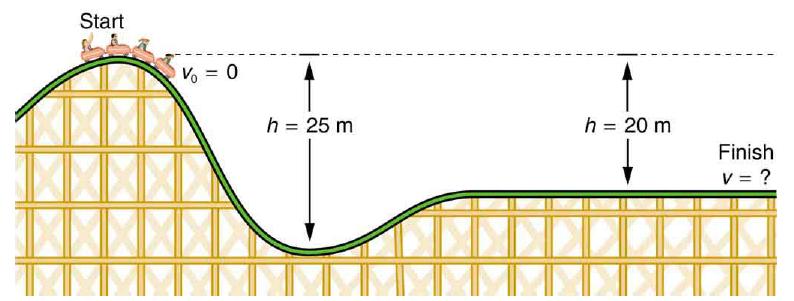
In Example 7.7, we calculated the final speed of a roller coaster that descended 20 m in height and had an initial speed of 5 m/s downhill. Suppose the roller coaster had had an initial speed of 5 m/s uphill instead, and it coasted uphill, stopped, and then rolled back down to a final point 20 m
Compare the kinetic energy of a 20,000-kg truck moving at 110 km/h with that of an 80.0-kg astronaut in orbit moving at 27,500 km/h.
What is a conservative force?
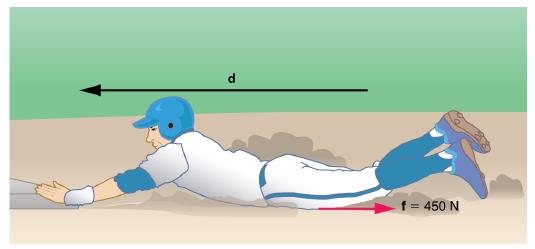
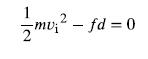
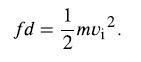
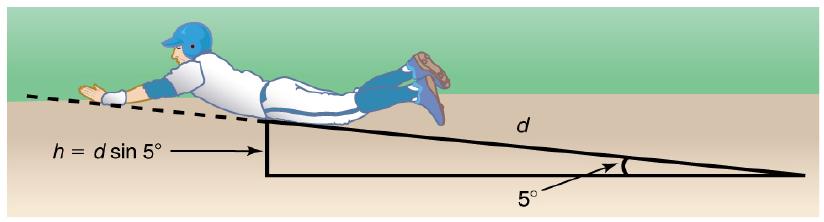
Consider the situation shown in Figure 7.16, where a baseball player slides to a stop on level ground. Using energy considerations, calculate the distance the 65.0-kg baseball player slides, given that his initial speed is 6.00 m/s and the force of friction against him is a constant 450
The force exerted by a diving board is conservative, provided the internal friction is negligible. Assuming friction is negligible, describe changes in the potential energy of a diving board as a swimmer dives from it, starting just before the swimmer steps on the board until just after his feet
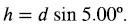
Suppose that the player from Example 7.9 is running up a hill having a 5.00° incline upward with a surface similar to that in the baseball stadium. The player slides with the same initial speed, and the frictional force is still 450 N. Determine how far he slides.StrategyIn this case, the work
(a) How fast must a 3000-kg elephant move to have the same kinetic energy as a 65.0-kg sprinter running at 10.0 m/s?(b) Discuss how the larger energies needed for the movement of larger animals would relate to metabolic rates.
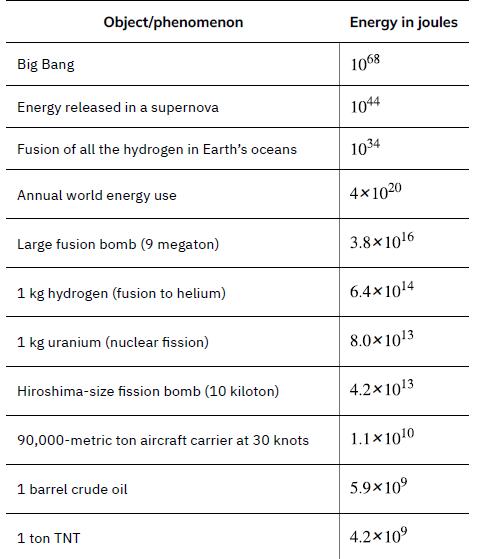
Confirm the value given for the kinetic energy of an aircraft carrier in Table 7.1. You will need to look up the definition of a nautical mile (1 knot = 1 nautical mile/h).Data given in Table 7.1 Big Bang Object/phenomenon Energy released in a supernova Fusion of all the hydrogen in Earth's
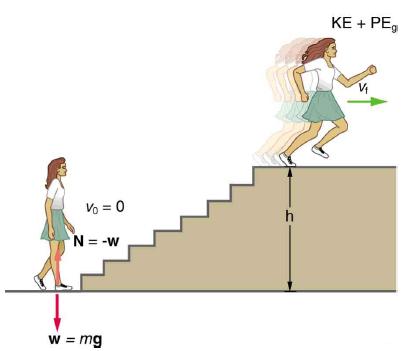
What is the power output for a 60.0-kg woman who runs up a 3.00 m high flight of stairs in 3.50 s, starting from rest but having a final speed of 2.00 m/s? (See Figure 7.21.)Strategy and Concept Vo = 0 N=-W w = mg h KE + PEg
Define mechanical energy. What is the relationship of mechanical energy to nonconservative forces? What happens to mechanical energy if only conservative forces act?
What is the relationship of potential energy to conservative force?
(a) Calculate the force needed to bring a 950-kg car to rest from a speed of 90.0 km/h in a distance of 120 m (a fairly typical distance for a non-panic stop).(b) Suppose instead the car hits a concrete abutment at full speed and is brought to a stop in 2.00 m. Calculate the force exerted on the
Find the speed of the package in Figure 7.4 at the end of the push, using work and energy concepts.Data given in Figure 7.4StrategyHere the work-energy theorem can be used, because we have just calculated the net work, Wnet, and the initial kinetic energy, 1/2mv02. These calculations allow us to
Suppose a car travels 108 km at a speed of 30.0 m/s, and uses 2.0 gal of gasoline. Only 30% of the gasoline goes into useful work by the force that keeps the car moving at constant speed despite friction. (See Table 7.1 for the energy content of gasoline.)(a) What is the magnitude of the force
(a) What is the final speed of the roller coaster shown in Figure 7.8 if it starts from rest at the top of the 20.0 m hill and work done by frictional forces is negligible?(b) What is its final speed (again assuming negligible friction) if its initial speed is 5.00 m/s?StrategyThe roller coaster
Showing 3300 - 3400
of 3651
First
23
24
25
26
27
28
29
30
31
32
33
34
35
36
37
Step by Step Answers

 Get 50% OFF
Claim Now
Get 50% OFF
Claim Now