New Semester
Started
Get
50% OFF
Study Help!
--h --m --s
Claim Now
Question Answers
Textbooks
Find textbooks, questions and answers
Oops, something went wrong!
Change your search query and then try again
S
Books
FREE
Study Help
Expert Questions
Accounting
General Management
Mathematics
Finance
Organizational Behaviour
Law
Physics
Operating System
Management Leadership
Sociology
Programming
Marketing
Database
Computer Network
Economics
Textbooks Solutions
Accounting
Managerial Accounting
Management Leadership
Cost Accounting
Statistics
Business Law
Corporate Finance
Finance
Economics
Auditing
Tutors
Online Tutors
Find a Tutor
Hire a Tutor
Become a Tutor
AI Tutor
AI Study Planner
NEW
Sell Books
Search
Search
Sign In
Register
study help
business
strategic management concepts and cases
Strategic Management Concepts And Cases 2nd Edition Mason Carpenter, Gerry Sanders - Solutions
What are the fundamental and dynamic perspectives of competitive advantage?
Why should you study strategic management?
Identify the characteristics of a firm that the members of your group would like to work for and try to identify an example of this type of firm. What’s the difference between business and corporate strategy at this firm? How might that affect your experiences and opportunities in that
How is international expansion related to business and corporate strategy? Identify a firm that may be thinking of expanding into new international markets. Apply the staging element of the strategy diamond to the firm’s international expansion opportunities or plans. Which markets should it
Should ethics be a formal and explicit part of strategy formulation and implementation? What would you do to achieve this type of objective?
For many of the firms you will study in this class, competitive advantage is measured by some form of financial profitability.How should you evaluate ethical choices in terms of accounting costs and benefits?
Go to Warren Buffet’s Letter to Shareholder’s page at www. berkshirehathaway.com/letters/letters.html and read the most recent letter. How many of the strategy topics covered in this chapter are referenced in the letter? Pick one of the businesses owned by Berkshire Hathaway and draft a
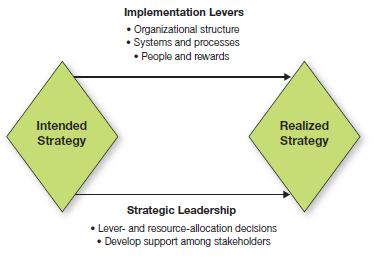
Go back to the discussion of JetBlue in the box entitled “How Would You Do That? 1. ” Use the strategy implementation model in Exhibit 7 to identify what would be necessary to successfully implement JetBlue’s strategy.How would the implementation levers be different for JetBlue than for some
Why is strategic leadership important for effective strategy formulation and implementation?
How do the characteristics of strategic leadership differ between individuals and teams?
How are vision and mission related to strategy? What roles does strategic leadership play in realizing vision and mission?
How does strategy differ from vision and mission?
What is strategic coherence?
Who are a firm’s stakeholders? Why are they important?
What tools can you use to identify the impact of various stakeholders on the firm and the impact of the firm on various stakeholders?
Why are ethics and biases relevant to strategic decision making and strategic leadership?
(a) Craft a vision and mission statement for your business school and then for your college or university as a whole.How are these statements related? How are they similar? How do they differ? How are they similar or different from those that you might craft for a for-profit organization? (b) Using
What roles should strategic leadership play in the realization of the vision and mission statements that you articulated in the previous question? Whom have you identified as strategic leaders?
A slogan on an ethics poster for Boeing states: “Between right and wrong is a troublesome gray area.”What aspects of this statement do you agree or disagree with? As a future business leader, what should you be doing to manage the “gray area”?
When reading the business press, it seems that leaders are regularly challenged by ethical dilemmas. Is this a function of the individual leader or the situation, or both?
Building on the CEO-successor selection process described in the box entitled “How Would You Do That? 1,” devise a succession plan for the dean of your business school. Be sure to include the following in your succession-planning process:(a) Translate your school’s strategy into actual
Based on the framework applied to Tritec Motors in the box entitled “How Would You Do That? 2,” use the opening vignette on AnneMulcahy at Xerox to map out the key stakeholders in her turnaround effort.Which stakeholders would you expect to be most resistant? Most supportive? Create a 90-day
What constitutes the external context of strategy?
What are the five forces affecting industry structure?
What are complementors?
What are strategic groups?
What factors increase industry dynamics?
What is the industry life cycle?
What is a technological discontinuity?
What is the innovator’s dilemma?
How does globalization affect the external context of strategy?
What is industry redefinition?
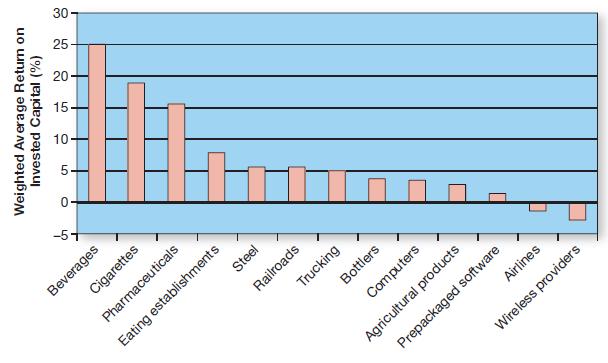
Pick two of the industries listed in Exhibit 1, one on the high end of profitability and one on the low end. What are the boundaries of these industries? What are their market and geographic segments? Who are the key players? Draw up a five-forces model of each industry and compare and contrast
Genetically modified organisms (GMOs) include food products in which genetics have been used to extend product shelf life, deter pests, and other product innovations. Much of the food consumed in the U.S. is genetically modified, while many other developing countries prohibit them for ethical and
Despite the pharmaceutical industry’s notable contributions to human progress, including the development of miracle drugs for treating cancer, AIDS, and heart disease, there is a growing ethical tension between the industry and the public.What are some of the key ethical questions, and how does
The box entitled “HowWould You Do That? 1” illustrates the five-forces model for the airline industry. Use the analysis there as an example and performa five-forces analysis for one of the following industries: soft drinks, cable television, or cell phone service providers.What are the one or
Using the value curve model illustrated in “How Would You Do That? 2,” map the strategic groups in the soft drink industry. What groups are there other than the two dominant companies? How do they compete relative to Coke and Pepsi?
What are resources?Howdo different types of resources differ?
What is a capability?
What are the five components of the VRINE model?
How do time and causal ambiguity relate to the value, rarity, and inimitability of a resource or capability?
What is the difference between a stock of resources and capabilities and a flow of resources and capabilities?
What are dynamic capabilities? How do they differ from general capabilities?
What is a firm’s value chain? How does it figure into a firm’s competitive advantage?
What is your role as a manager in linking resources and capabilities to strategy and competitive advantage?
What is the role of luck in gaining possession of a particular resource or capability? Can a firm manage luck? Give an example of a resource or capability that a firm garnered through luck and determine whether it was subsequently well-managed.
Some firms’ products are so well known that the entire category of products offered in the industry (including rivals’ products) is often referred to by the leading firm’s brand name (which is called an eponym). Identify one such product and discuss whether its brand recognition gives the
Companies are increasingly looking to India for outsourced IT and knowledge work. To attract and accommodate an even greater influx of foreign firms, the government has given a contract to Reliance, a local company, to turn a vast area of farmland near Mumbai into a new high-tech city.And, in the
What are some of the ethical issues that seem to accompany discussions of outsourcing or offshoring? What tradeoffs might a management team be weighing with a particular outsourcing or offshoring option?
In the box entitled “How Would You Do That? 1,” we walked through how to apply the DuPont analysis to better understand the value chain choices, and possibly resources and capabilities, that support a firm’s strategy. Pick two competing firms, and develop a DuPont analysis on both of them.
Based on your analysis, are there activities that this organization performs differently than its rival? Start by looking at the firm’s products, services, or target markets. Do any of the rival firm’s value-chain activities give them a competitive advantage? If so, why don’t others imitate
What are four sets of challenges to sustained competitive advantage outlined in this chapter?
What is industry commoditization? What are two strategies a firm may undertake to combat industry commoditization?
What is a new-market-creation strategy?
What is a low-end disruption strategy?
What are the three levels of activity that underlie strategies for turbulent and hypercompetitive markets?
What is the role of timing and pacing in revolutionary strategies?
What five defensive strategies might industry incumbents pursue in dynamic markets?
How might you apply real-options analysis, financially and conceptually, in the context of revolutionary strategies for turbulent and hypercompetitive markets?
What are the implications of dynamic strategies for strategy formulation and implementation?
If you were the CEO of Napster (which started out as Roxio in the opening vignette), what material from this chapter would be most relevant to you? How would this material help you to formulate a strategy? What might key components of that strategy be? Now put yourself in Microsoft’s shoes; would
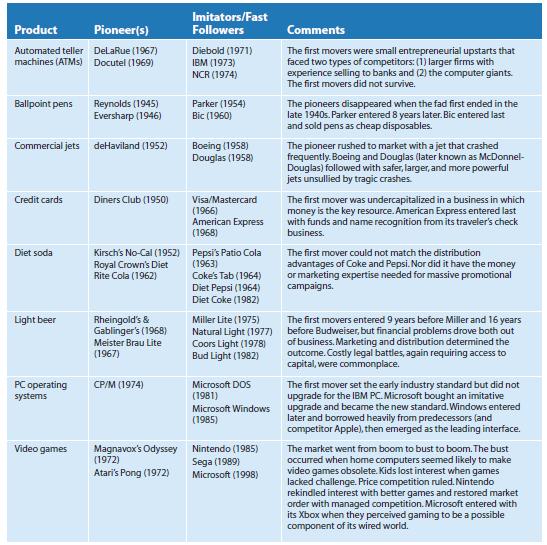
Review the list of first- and second-mover firms in Exhibit 9. What specific resources and capabilities do you think successful first movers must possess? What specific resources and capabilities do you think successful second movers and fast followers must possess? Do you think that a firm could
Some firms manage disruptive strategy threats by investing in the firms that bring them to market, so that if the threat turns out to be wildly successful it can still benefit from it financially. Is this a purely business decision or are there ethical concerns as well?
You learned how incumbents can be blindsided by disruptive strategies. Litigation appears to be a prominent tool that incumbents can use to at least slow new entrants’growth.What might be some of your ethical concerns when using litigation to manage competition? Do you think that a firm’s size
Pick an industry and use the box entitled “How Would You Do That? 1” as a template to map its value curve. What are the key success factors that define industry participation? Does there appear to be more than one strategic group in this industry operating with different value curves? Can you
Identify a firm that you believe is pursuing a revolutionary strategy. How do its actions map onto the four-actions framework?
What do we mean by generic strategies?
What criteria must be met in order for differentiators and low-cost leaders to be successful?
What is the relationship between economies of scale and minimum efficient scale?
What are economies of scope?
How does the learning curve work?
What is market segmentation? What role does it play in strategic positioning?
What is willingness to pay? How does it relate to strategic positioning?
How does the industry life cycle affect business strategy?
What are the steps in testing the quality of a strategy?
Review the opening vignette about the three bicycle manufacturers. Use the strategy-diamond and the generic strategy model to describe the positioning strategy of each firm.Based on what you know about the bicycle industry, can you identify any underserved (or overserved) segments?
Among the global trends facing business, it is increasingly unclear who should provide basic social services (e.g., pensions, public health services, school infrastructure), regulate business and personal behavior (eg, self-regulation vs. government oversight), and be accountable for protecting
Environmental issues, including climate change, are increasingly discussed in the executive suite as it relates to strategy formulation and implementation. How “green” should a company be that is pursuing a low-cost strategy in an increasingly environmentally conscious society? And if following
Let’s revisit the learning curve and change some of the assumptions made in the box entitled “How Would You Do That? 1.” Assume that the first bike took 100 hours, the second 85, and the fourth 72. 25. What would the incremental “cost” in hours be for the 16th bike? For the 124th? For the
Based on the information in the box entitled “How Would You Do That? 1,” assume that you have determined that established leaders have such an experience advantage that you’ll never catch their cost position. Devise a realistic strategy for entering and competing against an established player
How does corporate strategy differ from business strategy?
How has the practice of corporate strategy evolved over time?
What is a conglomerate?
How can managers decide whether they should diversify into a new business?
What are the types of diversification and how is value created by each type?
What is the difference between economies of scope and synergies?
What is the relationship between diversification and firm performance?
What factors tend to limit the attractiveness of diversification?
How does a dynamic industry context affect the possible benefits of diversification?
Choose two firms that are well-known to your group members—perhaps firms that you’ve done case analyses on in the past. For each of these firms, identify their vertical, horizontal, and geographic scope. Having done that, evaluate the resources that are necessary for each business arena for the
Try to apply the profit pool tool to another industry. Where would you turn for data to do this? How “friendly” is that data for the purposes of using this tool? If you are having trouble being precise, make informed estimates for what you are missing. You will likely find some profit pools
Textbook publishers face growing competition on numerous fronts, including new models of textbook delivery. One such model provides students with online textbook content for“free,” on the condition that students provide personal information about themselves to vendors like credit card, student
You can imagine that firms in the alcohol, tobacco, or firearms businesses may feel a need to diversify into less scrutinized or regulated businesses. How might ethical issues related to these core businesses affect their ability to enter, or costs of entry, into new businesses? How might these
The box entitled “How Would You Do That? 1” helps you see how a profit pool model is developed for a particular industry or geographic or product arena. You are given Starbucks and ready-to-drink coffee market as an example, but never shown a profit pool diagram for that industry. Using the
“How Would You Do That? 2” applies a portfolio evaluation tool to Disney. Internally,Disney executives view one of their dynamic capabilities as that of being the best at creating world-class entertainment within financial constraints.What are your thoughts on this view? As you think about
Do most strategic alliances succeed?
What forms can strategic alliances take?
What is the difference between an equity and a nonequity strategic alliance?
Provide an example of a nonequity strategic alliance.
Why do firms enter into alliances?
Showing 2200 - 2300
of 2491
First
11
12
13
14
15
16
17
18
19
20
21
22
23
24
25
Step by Step Answers

 Get 50% OFF
Claim Now
Get 50% OFF
Claim Now