New Semester
Started
Get
50% OFF
Study Help!
--h --m --s
Claim Now
Question Answers
Textbooks
Find textbooks, questions and answers
Oops, something went wrong!
Change your search query and then try again
S
Books
FREE
Study Help
Expert Questions
Accounting
General Management
Mathematics
Finance
Organizational Behaviour
Law
Physics
Operating System
Management Leadership
Sociology
Programming
Marketing
Database
Computer Network
Economics
Textbooks Solutions
Accounting
Managerial Accounting
Management Leadership
Cost Accounting
Statistics
Business Law
Corporate Finance
Finance
Economics
Auditing
Tutors
Online Tutors
Find a Tutor
Hire a Tutor
Become a Tutor
AI Tutor
AI Study Planner
NEW
Sell Books
Search
Search
Sign In
Register
study help
sciences
advanced thermodynamics for engineers
Advanced Thermodynamics For Engineers 2nd Edition D. E. Winterbone, Ali Turan - Solutions
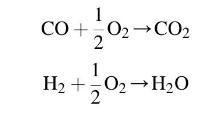
A stoichiometric mixture of carbon monoxide and air reacts in a combustion chamber, forms exhaust products at \(3000 \mathrm{~K}\) and 1 bar. If the products are in chemical equilibrium, but no reactions occur between the nitrogen and the oxygen, show that the molar fraction of carbon monoxide is
A mixture containing hydrogen and oxygen in the ratio of \(2: 1\) by volume is contained in a rigid vessel. This is ignited at \(60{ }^{\circ} \mathrm{C}\) and a pressure of \(1 \mathrm{~atm}(1.013 \mathrm{bar})\), and after some time the temperature is \(2227^{\circ} \mathrm{C}\). Calculate the
A vessel is filled with hydrogen and carbon dioxide in equal parts by volume and the mixture is ignited. If the initial pressure and temperature are \(2 \mathrm{bar}\) and \(60^{\circ} \mathrm{C}\) respectively and the maximum pressure is \(11.8 \mathrm{bar}\), estimate(a) the maximum
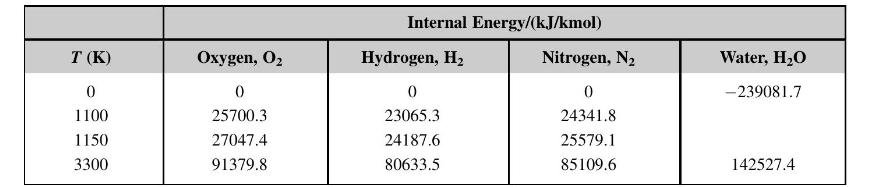
A stoichiometric mixture of hydrogen and air is compressed to 18.63 bar and \(845^{\circ} \mathrm{C}\). It burns adiabatically at constant volume. Show that the final equilibrium temperature is \(3300 \mathrm{~K}\) and the degree of dissociation is \(8.85 \%\). Calculate the final pressure after
A mixture containing equal volumes of carbon dioxide \(\left(\mathrm{CO}_{2}\right)\) and hydrogen \(\left(\mathrm{H}_{2}\right)\) is contained in a rigid vessel. It is ignited at \(60^{\circ} \mathrm{C}\) and a pressure of \(1 \mathrm{~atm}\), and after some time the temperature is \(2227^{\circ}
A gas turbine combustion chamber receives air at 6 bar and \(500 \mathrm{~K}\). It is fuelled using octane \(\left(\mathrm{C}_{8} \mathrm{H}_{18}\right)\) at an equivalence ratio of 0.8 (i.e. weak), which burns at constant pressure. The amount of carbon dioxide and water in the products are \(9.993
A mixture of one part by volume of vapourised benzene to 50 parts by volume of air is ignited in a cylinder and adiabatic combustion ensues at constant volume. If the initial pressure and temperature of the mixture are 10 bar and \(500 \mathrm{~K}\) respectively, calculate the maximum pressure and
A gas engine is operated on a stoichiometric mixture of methane \(\left(\mathrm{CH}_{4}\right)\) and air. At the end of the compression stroke, the pressure and temperature are \(10 \mathrm{bar}\) and \(500 \mathrm{~K}\) respectively. If the combustion process is an adiabatic one at constant
A gas injection system supplies a mixture of propane \(\left(\mathrm{C}_{3} \mathrm{H}_{8}\right)\) and air to a spark-ignition engine, in the ratio of volumes of 1:30. The mixture is trapped at \(1 \mathrm{bar}\) and \(300 \mathrm{~K}\), the volumetric compression ratio is \(12: 1\) and the index
A \(10 \%\) rich mixture of heptane \(\left(\mathrm{C}_{7} \mathrm{H}_{16}\right)\) and air is trapped in the cylinder of an engine at a pressure of \(1 \mathrm{bar}\) and temperature of \(400 \mathrm{~K}\). This is compressed and ignited, and at a particular instant during the expansion stroke,
A turbocharged, intercooled compression ignition engine is operated on octane \(\left(\mathrm{C}_{8} \mathrm{H}_{18}\right)\) and achieves constant pressure combustion. The volumetric compression ratio of the engine is \(20: 1\) and the pressure and temperature at the start of compression are 1.5
A gas engine with a volumetric compression ratio of \(10: 1\) is run on a weak mixture of methane \(\left(\mathrm{CH}_{4}\right)\) and air, with \(\phi=0.9\). If the initial temperature and pressure at the commencement of compression are \(60{ }^{\circ} \mathrm{C}\) and 1 bar respectively,
One method of reducing the maximum temperature in an engine is to run with a rich mixture. A spark-ignition engine with a compression ratio of 10:1, operating on the Otto cycle, runs on a rich mixture of octane and air, with an equivalence ratio of 1.2. The trapped conditions are 1 bar and \(300
A reaction in which the pre-exponential term is independent of temperature is found to be a 100 times faster at \(200^{\circ} \mathrm{C}\) than it is at \(25^{\circ} \mathrm{C}\). Calculate the activation energy of the reaction. What will be the reaction rate at \(1000{ }^{\circ} \mathrm{C}\)
A chemical reaction is found to be 15 times faster at \(100^{\circ} \mathrm{C}\) than at \(25^{\circ} \mathrm{C}\). Measurements show that the pre-exponential term contains temperature to the power of 0.7 . Calculate the activation energy of the reaction. What will be the reaction rate at \(700{
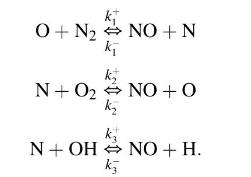
The rate of formation of nitric oxide (NO) is controlled by the three reversible chemical reactionsUse the steady state approximation for the nitrogen atom concentration and the assumption of partial equilibrium for the reactions governing the concentrations of \(\mathrm{O}, \mathrm{O}_{2},
The rate of change of mole concentration of constituent \(A\) in a chemical reaction is expressed as\[\frac{\mathrm{d}[\mathrm{A}]}{\mathrm{d} t}=-k[\mathrm{~A}]^{\mathrm{n}}\]While mole concentration is the dominant property in the reaction it is much more usual for engineers to deal in mole
(a) What is meant by the terms(i) a global reaction;(ii) an elementary reaction;(iii) a reaction mechanism.(b) Describe the steps required to form a chain reaction and explain why chain reactions are important in combustion.(c) A reaction is found to be 25 times faster at \(400 \mathrm{~K}\) than
A combustible mixture of gas and air is contained in a well-insulated combustion bomb. It is ignited at a point and a thin flame propagates through the mixture completely burning the reactants. This mechanism produces multiple zones of products: prove that the temperature of an element of gas
The structure of ethylene is \(\mathrm{H}_{2} \mathrm{C}=\mathrm{CH}_{2}\). Estimate the enthalpy of reaction when \(1 \mathrm{kmol}\) of ethylene is completely oxidised. Compare the value obtained with the tabulated value of \(-1323.2 \mathrm{MJ} / \mathrm{kmol}\). Give reasons for the difference
Describe the construction of a boiler for burning pulverised coal. Explain how this design optimises the temperature, turbulence and time required for good combustion. What are the main emissions from this type of plant, and how can they be reduced.
(a) One of the main problems encountered in the design of a diesel engine combustion system is the mixing of the air and fuel sufficiently rapidly to ensure complete combustion. Explain, using diagrams, how these problems are catered for in the design of(i) large automotive diesel engines;(ii) the
A method of reducing (improving) engine fuel consumption and reducing the emissions of \(\mathrm{NO}_{\mathrm{x}}\) in a spark-ignition engine is to run it lean, i.e. with a weak mixture. Discuss the problems encountered when running engines with weak mixtures, and explain how these can be overcome
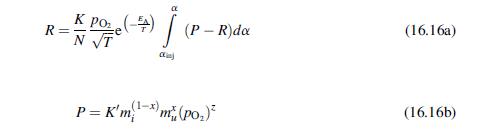
Calculate the ignition delay period (in deg ca) in a diesel engine using Eqns (16.15a) and (16.15b) using the conditions at the beginning of fuel injection that exist after compression in the engine with the following initial parameters.Compare the results to those calculated by the equation
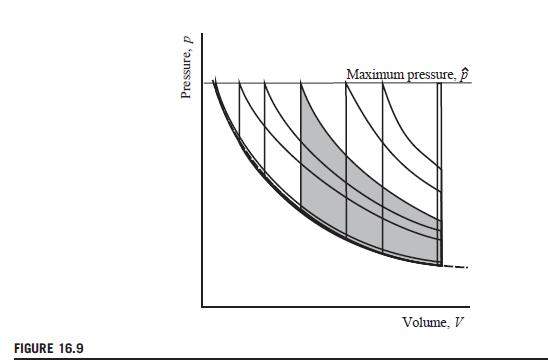
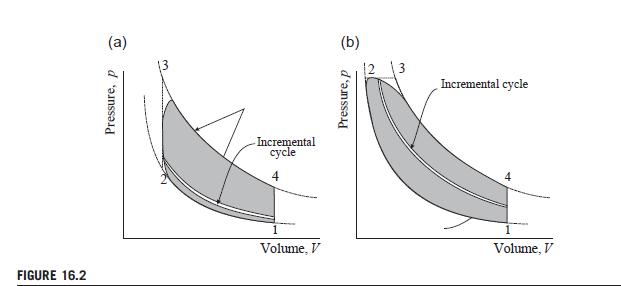
This question is based on Fig. 16.9. An engine operating on an Otto cycle has a maximum peak pressure of \(60 \mathrm{bar}\). If the pressure and temperature at the beginning of the cycle are 1.0 bar and \(300 \mathrm{~K}\) respectively, evaluate the compression ratio that results in the maximum
Compare the air-standard cycle thermal efficiencies of an Otto cycle obtained by calculating the state points around the cycle with the value obtained from Eqn (3.16) for an 'engine' operating with a compression ratio, \(r\), of 15:1, and an air-fuel ratio, \(\varepsilon=28: 1\) The trapped
Compare the air-standard cycle thermal efficiencies of a diesel cycle obtained by calculating the state points around the cycle with the value obtained from Eqn (3.20) for an 'engine' operating with a compression ratio, \(r\), of \(15: 1\), and an air-fuel ratio, \(\varepsilon=28: 1\). The trapped
Recalculate the Otto cycle in P16.5 using EQUIL2 to evaluate the conditions around the cycle. Do these calculations both with and without considering dissociation. How has the use of more accurate data, and a better evaluation of the combustion process affected the results? Is the effect of
Recalculate the diesel cycle in P16.6 using EQUIL2 to evaluate the conditions around the cycle. Do these calculations both with and without considering dissociation. How has the use of more accurate data, and a better evaluation of the combustion process affected the results? Is the effect of
Provide mechanical and molecular definitions of work and heatminor effect on the principles being illustrated). Assume compression ratio \(=9.0: 1\); \(\alpha_{\mathrm{ig}}=695^{\circ}\left(25^{\circ} \mathrm{btdc}\right)\); flame speed factor variable; and residual fraction \(=0.050\).\{Hint: to
A gas turbine engine operates between minimum temperature \(T_{1}\) and maximum temperature \(T_{3}\). Show that the optimum pressure ratio for maximum work output is\[r_{p}=\left(\frac{T_{3}}{T_{1}}\right)^{\frac{\kappa}{2(\kappa-1)}}\]
A gas turbine engine operates at temperature between 300 and \(1200 \mathrm{~K}\). The pressure ratio is 12 and the working fluid is \(\mathrm{CO}_{2}\). Assume an isentropic process,(1) Determine the efficiency and work ratio of the cycle. Assume heat capacity ratio of \(\mathrm{CO}_{2},
Assume the maximum pressure ratio. Determine the efficiency and work ratio of the cycle in P17.1.\([0.75,0\).P17.1.A gas turbine engine operates between minimum temperature \(T_{1}\) and maximum temperature \(T_{3}\). Show that the optimum pressure ratio for maximum work output
Air at \(290 \mathrm{~K}\) flows into the compressor of a gas turbine engine. The temperature increases to \(1350 \mathrm{~K}\) when it flows into the turbine. The pressure ratio is 15 and power output is \(5 \mathrm{MW}\). Assume the whole process is isentropic, evaluate 1. Thermal efficiency.2.
A gas turbine operates at a pressure ratio of 8 . The air flows into the compressor at \(290 \mathrm{~K}\) and flows out of the combustion chamber at \(1400 \mathrm{~K}\). The efficiency of compressor and turbine are 0.8 and 0.9 respectively. A heat exchanger with effectiveness of 0.85 is used.
Prove that the optimum pressure ratio for intercooling of gas turbines with heat exchange is given below:\[\frac{p_{2}}{p_{1}}=\frac{p_{i}}{p_{1}}=\left(\frac{p_{2^{\prime}}}{p_{1}}\right)^{1 / 2}\]Assume that the processes in the turbine and compressor are both isentropic, and that the heat
Air flows into the compressor of a gas turbine engine at \(0.1 \mathrm{MPa}, 300 \mathrm{~K}\) and is compressed to \(0.8 \mathrm{MPa}\). The air is heated to a maximum temperature of \(1100 \mathrm{~K}\) and then expanded through two stages each with a pressure ratio of 3. The intermediate
A turbojet is travelling at high Mach number and the ambient pressure, \(p_{\mathrm{a}}\), and temperature, \(T_{\mathrm{a}}\), are 0.5 bar and \(220 \mathrm{~K}\) respectively. It is also known that the stagnation temperature at the inlet of the compressor is \(T_{01}=400 \mathrm{~K}\). If the
Show that the Joule-Thomson coefficient, \(\mu\), is given by\[\mu=\frac{1}{c_{p}}\left(T\left(\frac{\partial v}{\partial T}\right)_{p}-v\right)\]Hence or otherwise show that the inversion temperature \(\left(T_{\mathrm{i}}\right)\) is\[T_{\mathrm{i}}=\left(\frac{\partial T}{\partial v}\right)_{p}
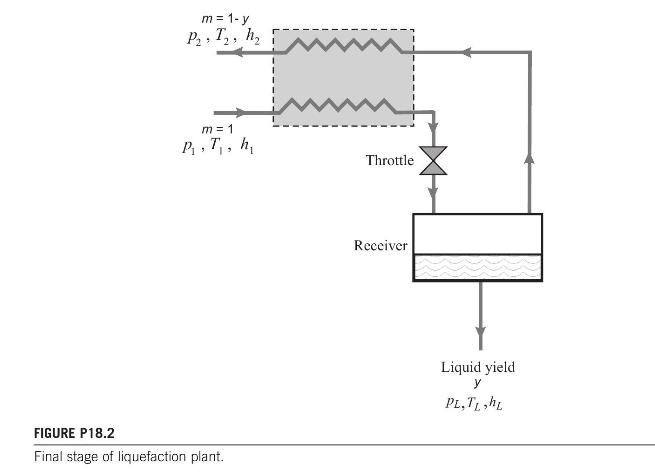
The last stage of a liquefaction process is shown in diagrammatic form in Fig. P18.2. Derive the relationship between \(p_{1}\) and \(T_{1}\) for the maximum yield of liquid at conditions \(p_{L}, T_{L}, h_{L}\) for a gas obeying the state
The equation of state for a certain gas is\[v_{m}=\frac{\Re T}{p}+\frac{k}{\Re T}\]where \(k\) is a constant. Show that the variation of temperature with pressure for an isenthalpic process from 1 to 2 is given by\[T_{1}^{2}-T_{2}^{2}=-\frac{4 k}{c_{p} \Re}\left(p_{1}-p_{2}\right)\]If the initial
A gas has the equation of state\[\frac{p v_{m}}{\Re T}=1+\mathrm{A} p\left(T^{3}-9.75 T_{\mathrm{c}} T^{2}+9 T_{\mathrm{c}}^{2} T\right)+\mathrm{B} p^{2} T\]where \(\mathrm{A}\) and \(\mathrm{B}\) are positive constants and \(T_{\mathrm{c}}\) is the critical temperature. Determine the maximum and
A gas has the equation of state\[\frac{p v_{m}}{\Re T}=1+N p+M p^{2}\]where \(N\) and \(M\) are functions of temperature. Show that the equation of the inversion curve is\[p=-\frac{\mathrm{d} N}{\mathrm{~d} T} / \frac{\mathrm{d} M}{\mathrm{~d} T}\]If the inversion curve is parabolic and of the
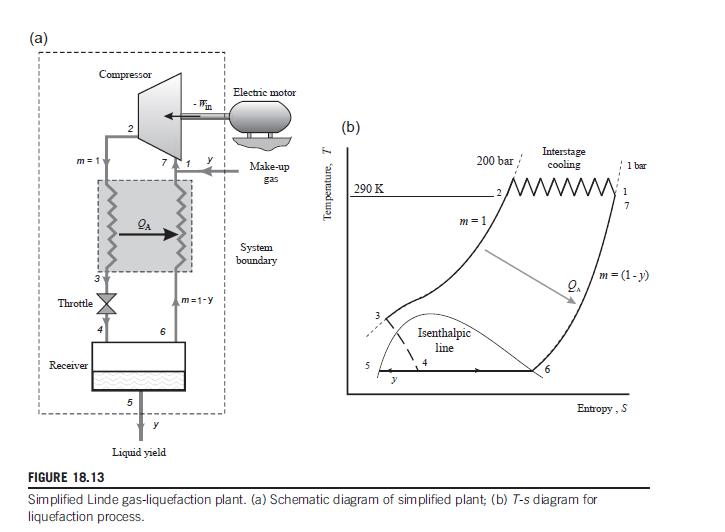
In a simple Linde gas-liquefaction plant (see Fig. 18.13), air is taken in at the ambient conditions of 1 bar and \(300 \mathrm{~K}\). The water-jacketed compressor delivers the air at 200 bar and \(300 \mathrm{~K}\) and has an isothermal efficiency of \(70 \%\). There is zero temperature
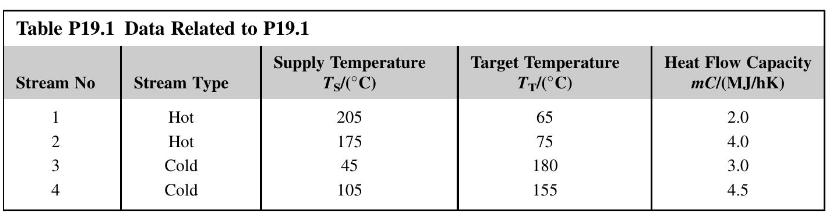
A process plant has two streams of hot fluid and two streams of cold fluid, as defined in Table P19.1. It is required to minimise the energy which must be transferred to hot and cold utilities by transferring energy between the streams. If the minimum temperature difference for effective heat
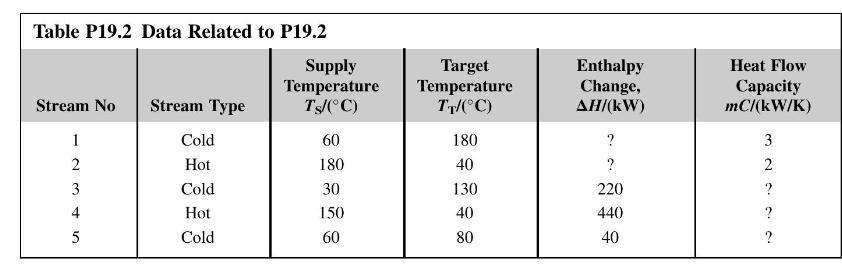
Some stream data have been collected from a process plant, and these are listed in Table P19.2. Assuming the minimum temperature difference between streams, \(\Delta T_{\min }=10^{\circ} \mathrm{C}\)(a) calculate the data missing from Table P19.2;(b) analyse this data to determine the minimum heat
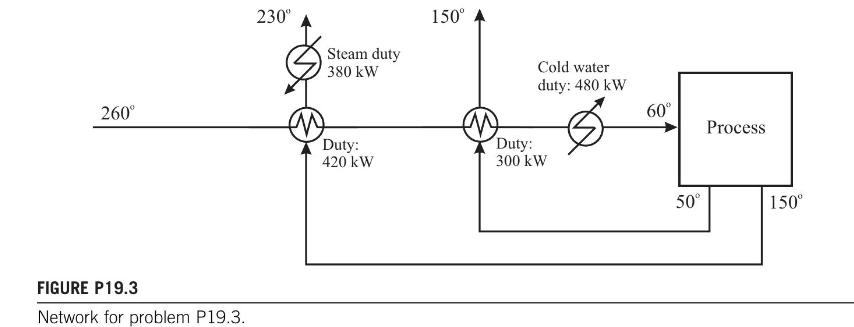
Figure P19.3 shows a network design using steam, cooling water and some heat recovery.(a) Does this design achieve the minimum energy target for \(\Delta T_{\min }=20^{\circ} \mathrm{C}\) ?(b) If the current network does not achieve the targets, show a network design that does.[(a)
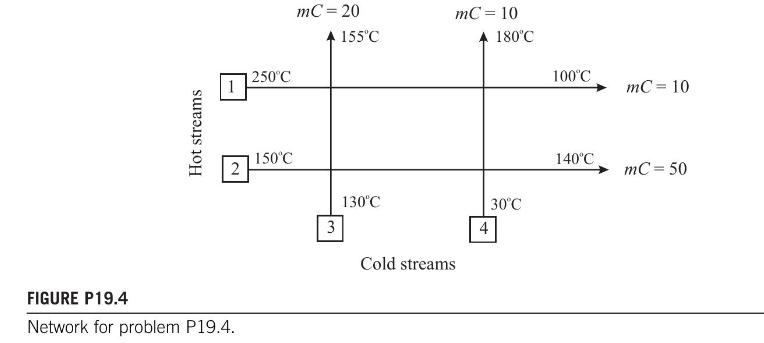
Figure P19.4 shows two hot streams and two cold streams for heat integration (subject to \(\Delta T_{\min }=20^{\circ} \mathrm{C}\) ).(i) What are the energy targets?(ii) Show a network design achieving these targets.\(\left[Q_{\mathrm{H}_{\text {min }}}=0 ; Q_{\mathrm{C}_{\text {min }}}=0\right]\)
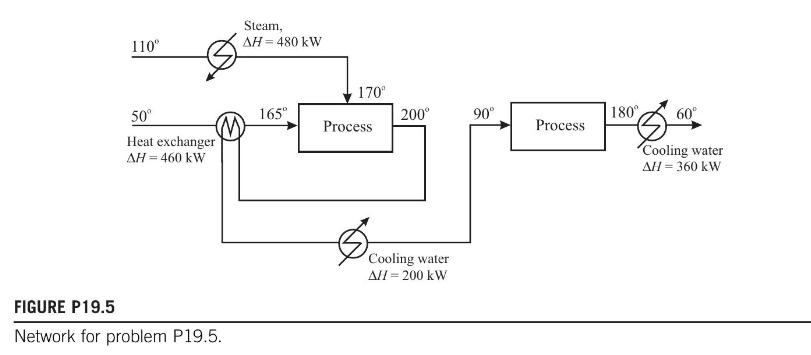
Figure P19.5 shows an existing design of a process plant, containing two exothermic processes. These require streams of reactants as shown in the diagram, and produce products at the temperatures shown. The plant achieves the necessary conditions by providing \(480 \mathrm{~kW}\) of heat from a
Recalculate the problem in P19.5 using a \(\Delta T_{\min }=10{ }^{\circ} \mathrm{C}\). Comment on the effect of reducing the minimum temperature difference.[(a) \(T_{\mathrm{C}_{\text {pinch }}}=110{ }^{\circ} \mathrm{C} ; T_{\mathrm{H}_{\text {pinch }}}=120{ }^{\circ} \mathrm{C}\);(b)
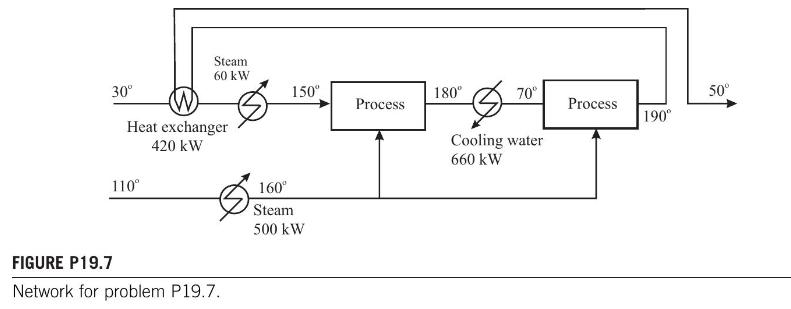
A network for a process plant is shown in Fig P19.7.(a) Calculate the energy targets for \(\Delta T_{\min }=10{ }^{\circ} \mathrm{C}\) and show a design that achieves these targets.(b) Explain why the existing network does not achieve the energy targets.[(a) \(Q_{\mathrm{C}_{\text {min }}}=190
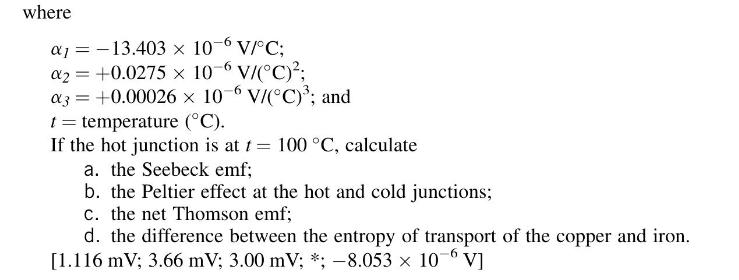
The emf of a copper-iron thermocouple caused by the Seebeck effect, with a cold junction at \(0{ }^{\circ} \mathrm{C}\), is given by\[\varepsilon=\alpha_{1} t+\frac{\alpha_{2}}{2} t^{2}+\frac{\alpha_{3}}{3} t^{3} \quad \mathrm{~V}\] where a = -13.403 x 10⁻⁶ V/C; a2 3 +0.0275 x 10⁶ V/(C); +0.00026
The emf of a copper-iron thermocouple with its cold junction at \(0{ }^{\circ} \mathrm{C}\) is given by\[\varepsilon=-13.403 t+0.0138 t^{2}+0.0001 t^{3} \quad \mu \mathrm{V}\]where \(t=\) temperature \(\left({ }^{\circ} \mathrm{C}\right)\).Show that the difference in the Thomson coefficient for the
A fluid consisting of a single component is contained in two containers at different temperatures. Show that the difference in pressure between the two containers is given by\[\frac{\mathrm{d} p}{\mathrm{~d} T}=\frac{h-u^{*}}{v T}\]where \(h=\) specific enthalpy of the fluid at temperature
A thermocouple is connected across a battery, and a current flows through it. The cold junction is connected to a reservoir at \(0{ }^{\circ} \mathrm{C}\). When its hot junction is connected to a reservoir at \(100^{\circ} \mathrm{C}\) the heat flux due to the Peltier effect is \(2.68 \mathrm{~mW}
A pure monatomic perfect gas with \(c_{p}=5 \Re / 2\) flows from one reservoir to another through a porous plug. The heat of transport of the gas through the plug is \(-\Re T / 2\). If the system is adiabatic, and the thermal conductivities of the gas and the plug are negligible, evaluate the
A thermal conductor with constant thermal and electrical conductivities, \(k\) and \(\lambda\) respectively, connects two reservoirs at different temperatures and also carries an electrical current of density, \(J_{\mathrm{I}}\). Show that the temperature distribution for one-dimensional flows is
A thermal conductor of constant cross-sectional area connects two reservoirs which are both maintained at the same temperature, \(T_{0}\). An electric current is passed through the conductor, and heats it due to Joulean heating and the Thomson effect. Show that if the thermal and electrical
An electric cell has the following chemical reaction\[\mathrm{Zn}(\mathrm{s})+2 \mathrm{AgCl}(\mathrm{s})=\mathrm{ZnCl}_{2}+2 \mathrm{Ag}(\mathrm{s})\]and produces an emf of \(1.005 \mathrm{~V}\) at \(25^{\circ} \mathrm{C}\) and \(1.015 \mathrm{~V}\) at \(0^{\circ} \mathrm{C}\), at a pressure of
An electric cell is based on the reaction \(\mathrm{Pb}+\mathrm{Hg}_{2} \mathrm{Cl}_{2} \rightarrow \mathrm{PbCl}_{2}+2 \mathrm{Hg}\). If the enthalpy of reaction for this reaction, \(Q_{p}\), at \(25^{\circ} \mathrm{C}\) is \(-95,200 \mathrm{~kJ} / \mathrm{kg} \mathrm{Pb}\), calculate the emf, and
Calculate the emf of a hydrogen-oxygen fuel cell operating reversibly if the overall reduction in Gibbs energy is \(238 \mathrm{MJ} / \mathrm{kg} \mathrm{H}_{2}\). If the cell operates at \(75 \%\) of the reversible emf due to internal irreversibilities calculate the magnitude and direction of the
An ideal, isothermal, reversible fuel cell with reactants of oxygen and hydrogen, and a product of water operates at a temperature of \(400 \mathrm{~K}\) and a pressure of 1 bar. If the operating temperature increases to \(410 \mathrm{~K}\) what must be the new pressure if the open circuit voltage
A hydrogen-oxygen fuel cell is required to produce a constant voltage and operate over a pressure range of \(0.125-10\) bars. The datum voltage is \(1.16 \mathrm{~V}\) at a temperature of \(350 \mathrm{~K}\). If all the streams are at the same pressure evaluate the range of temperature required to
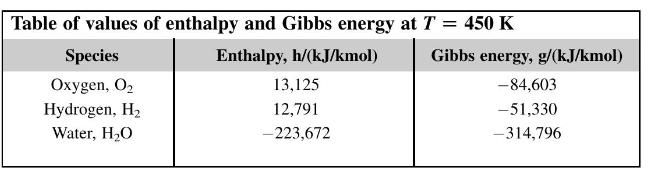
A hydrogen-oxygen fuel cell operates at a temperature of \(450 \mathrm{~K}\) and the reactants and products are all at a pressure of 3 bar. Due to internal resistances the emf of the cell is only \(70 \%\) of the ideal value. Calculate the 'fuel consumption' of the ideal cell and the actual one in
Showing 200 - 300
of 264
1
2
3
Step by Step Answers

 Get 50% OFF
Claim Now
Get 50% OFF
Claim Now