New Semester
Started
Get
50% OFF
Study Help!
--h --m --s
Claim Now
Question Answers
Textbooks
Find textbooks, questions and answers
Oops, something went wrong!
Change your search query and then try again
S
Books
FREE
Study Help
Expert Questions
Accounting
General Management
Mathematics
Finance
Organizational Behaviour
Law
Physics
Operating System
Management Leadership
Sociology
Programming
Marketing
Database
Computer Network
Economics
Textbooks Solutions
Accounting
Managerial Accounting
Management Leadership
Cost Accounting
Statistics
Business Law
Corporate Finance
Finance
Economics
Auditing
Tutors
Online Tutors
Find a Tutor
Hire a Tutor
Become a Tutor
AI Tutor
AI Study Planner
NEW
Sell Books
Search
Search
Sign In
Register
study help
sciences
applied fluid mechanics
Chemical Engineering Fluid Mechanics 3rd Edition Ron Darby, Raj P Chhabra - Solutions
A rotary drum filter is used to filter a slurry. The drum rotates at a rate of $3 \mathrm{~min} / \mathrm{cycle}$, and $40 %$ of the drum surface is submerged beneath the slurry. A constant pressure drop at 3 psi is maintained across the filter. If the drum is $5 \mathrm{ft}$ in diameter and $10
You must filter $1000 \mathrm{lb}_{\mathrm{m}} / \mathrm{min}$ of an aqueous slurry containing $40 %$ solids by weight using a rotary drum filter with a diameter of $4 \mathrm{~m}$ and a length of $4 \mathrm{~m}$, which operates at a vacuum of $25 \mathrm{in}$. Hg with $30 %$ of its surface
A rotary drum filter is to be used to filter a lime slurry. The drum rotates at a rate of $0.2 \mathrm{rpm}$, and $30 %$ of the drum surface is submerged beneath the slurry. The filter operates at a constant $\Delta P$ of 10 psi. The slurry properties were determined from a lab test at a constant
A plate-and-frame filter press operating at a constant $\Delta P$ of $150 \mathrm{psi}$ is to be used to filter a sludge containing $2 \mathrm{lb}_{\mathrm{m}}$ of solids per $\mathrm{ft}^{3}$ of water. The filter must be disassembled and cleaned when the cake thickness builds up to $1
A packed bed composed of crushed rock having a density of $175 \mathrm{lb}_{\mathrm{m}} / \mathrm{ft}^{3}$ is to be used as a filter. The size and shape of the rock particles is such that the average surface area to volume ratio is $50 \mathrm{in.}^{2} / \mathrm{in} .^{3}$ and the bed porosity is
A rotary drum filter has a diameter of $6 \mathrm{ft}$ and a length of $8 \mathrm{ft}$ and rotates at a rate of $30 \mathrm{~s} / \mathrm{cycle}$. The filter operates at a vacuum of $500 \mathrm{~mm} \mathrm{Hg}$, with $30 %$ of its surface submerged. The slurry to be filtered is tested in the lab
A rotary drum filter, $10 \mathrm{ft}$ in diameter and $8 \mathrm{ft}$ long, is to be used to filter a slurry of incompressible solids. The drum rotates at $1.2 \mathrm{rpm}$, and $40 %$ of its surface is submerged beneath the slurry at all times. A vacuum in the drum maintains a constant pressure
A slurry is being filtered at a net rate of $10,000 \mathrm{gal} /$ day by a plate-and-frame filter with 15 frames with an active filtering area of $1.5 \mathrm{ft}^{2}$ per frame, fed by a positive displacement pump. The pressure drop varies from 2 psi at start-up to 25 psi after $10
You want to select a rotary drum filter to filter a coal slurry at a rate of $100,000 \mathrm{gal}$ of the filtrate per day. The filter operates at a differential pressure of $12 \mathrm{psi}$, and $30 %$ of the surface is submerged in the slurry at all times. A sample of the slurry is filtered in
A slurry containing $40 %$ solids by volume is delivered to a rotary drum filter, which is $4 \mathrm{ft}$ in diameter and $6 \mathrm{ft}$ long and operates at a vacuum of $25 \mathrm{in}$. $\mathrm{Hg}$. A lab test is run with a $50 \mathrm{~cm}^{2}$ sample of the filter medium and the slurry, at
A slurry is to be filtered with a rotary drum filter that is $5 \mathrm{ft}$ in diameter, $8 \mathrm{ft}$ long, rotates once every $10 \mathrm{~s}$ and has $20 %$ of its surface immersed in the slurry. The drum operates with a vacuum of $20 \mathrm{in}$. Hg. A lab test was run on a sample of the
A rotary drum filter is to be installed in your plant. You run a test in the lab on the slurry to be filtered using a $0.1 \mathrm{ft}^{2}$ sample of the filter medium at a constant pressure drop of $10 \mathrm{psi}$. After $1 \mathrm{~min}$, you find that $500 \mathrm{cc}$ of the filtrate has
A slurry of $\mathrm{CaCO}_{3}$ in water at $25^{\circ} \mathrm{C}$ containing $20 %$ solids by weight is to be filtered in a plateand-frame filter. The slurry and filter medium are tested in a constant pressure lab filter, having an area of $0.0439 \mathrm{~m}^{2}$, at a pressure drop of $338
An algal sludge is to be clarified by filtering. A lab test is run on the sludge using an area A of the filter medium. At a constant pressure drop of $40 \mathrm{kN} / \mathrm{m}^{2}$, a plot of the time required to collect a volume $\tilde{V}$ of the filtrate times $\Delta P /(\tilde{V} / A)$
A slurry containing $0.2 \mathrm{~kg}$ of solids per $\mathrm{kg}$ water is filtered through a rotary drum filter, operating at a pressure difference of $65 \mathrm{kN} / \mathrm{m}^{2}$. The drum is $0.6 \mathrm{~m}$ in diameter, and $0.6 \mathrm{~m}$ long, rotates once every $350 \mathrm{~s}$,
You want to filter an aqueous slurry using a rotary drum filter, at a total rate (of filtrate) of $10,000 \mathrm{gal} / \mathrm{day}$. The drum rotates at a rate of $0.2 \mathrm{rpm}$, with $25 %$ of the drum surface submerged in the slurry, at a vacuum of $10 \mathrm{psi}$. The properties of the
You want to use a plate-and-frame filter to filter an aqueous slurry at a rate of $1.8 \mathrm{~m}^{3} / 8 \mathrm{~h}$ day. The filter frames are square, with a length on each side of $0.45 \mathrm{~m}$. The "downtime" for the filter press is $300 \mathrm{~s}$ plus an additional $100 \mathrm{~s}$
An aqueous slurry is filtered in a plate-and-frame filter, which operates at a constant $\Delta P$ of $100 \mathrm{psi}$. The filter consists of 20 frames, each of which have a projected area per side of $900 \mathrm{~cm}^{2}$. A total filtrate volume of $0.7 \mathrm{~m}^{3}$ is passed through the
You must transport a sludge product from an open storage tank to a separations unit at $1 \mathrm{~atm}$, through a 4 in. sch 40 steel pipeline that is $2000 \mathrm{ft}$ long, at a rate of $250 \mathrm{gpm}$. The sludge is $30 %$ solids by weight in water and has a viscosity of $50 \mathrm{cP}$
Consider a dilute aqueous slurry containing solid particles with diameters from 0.1 to $1000 \mu \mathrm{m}$ and a density of $2.7 \mathrm{~g} / \mathrm{cc}$, flowing at a rate of $500 \mathrm{gpm}$.(a) If the stream is fed to a settling tank in which all particles with a diameter greater than $100
Calculate the flow rate of water (in gpm) required to fluidize a bed of 1/16 in. diameter lead shot $(S G=11.3)$. The bed is $1 \mathrm{ft}$ in diameter, $1 \mathrm{ft}$ deep, and has a porosity of 0.38 . What water flow rate would be required to sweep the bed away?
Calculate the range of water velocities that will fluidize a bed of glass spheres $(S G=2.1)$ if the sphere diameter is (a) $2 \mathrm{~mm}$, (b) $1 \mathrm{~mm}$, and (c) $0.1 \mathrm{~mm}$.
A coal gasification reactor operates with particles of $500 \mu \mathrm{m}$ diameter and a density of $1.4 \mathrm{~g} / \mathrm{cm}^{3}$. The gas may be assumed to have properties of air at $1000^{\circ} \mathrm{F}$ and $30 \mathrm{~atm}$. Determine the range of superficial gas velocity over which
A bed of coal particles, $2 \mathrm{ft}$ in diameter and $6 \mathrm{ft}$ deep, is fluidized using a hydrocarbon liquid with a viscosity $15 \mathrm{cP}$ and a density of $0.9 \mathrm{~g} / \mathrm{cm}^{3}$. The coal particles have a density of $1.4 \mathrm{~g} / \mathrm{cm}^{3}$ and an equivalent
A catalyst having spherical particles with $d_{p}=50 \mu \mathrm{m}$ and $ho_{s}=1.65 \mathrm{~g} / \mathrm{cm}^{3}$ is used to contact a hydrocarbon vapor in a fluidized reactor at $900^{\circ} \mathrm{F}, 1 \mathrm{~atm}$. At operating conditions, the fluid viscosity is $0.02 \mathrm{cP}$ and its
A fluid bed reactor contains catalyst particles with a mean diameter of $500 \mu \mathrm{m}$ and a density of $2.5 \mathrm{~g} / \mathrm{cm}^{3}$. The reactor feed has properties equivalent to $35^{\circ} \mathrm{API}$ distillate at $400^{\circ} \mathrm{F}$. Determine the range of superficial
Water is pumped upward through a bed of $1 \mathrm{~mm}$ diameter iron oxide particles $(S G=5.3)$. If the bed porosity is 0.45 , over what range of superficial water velocity will the bed be fluidized?
A fluidized bed combustor is $2 \mathrm{~m}$ in diameter and is fed with air at $250^{\circ} \mathrm{F}, 10 \mathrm{psig}$, at a rate of $2000 \mathrm{scfm}$. The coal has a density of $1.6 \mathrm{~g} / \mathrm{cm}^{3}$, and a shape factor of 0.85 . The flue gas from the combustor has an average
A fluid bed incinerator, $3 \mathrm{~m}$ in diameter and $0.56 \mathrm{~m}$ high, operates at $850^{\circ} \mathrm{C}$ using a sand bed. The sand density is $2.5 \mathrm{~g} / \mathrm{cm}^{3}$, and the average sand grain has a mass of $0.16 \mathrm{mg}$ and a sphericity of 0.85 . In the stationary
Determine the range of flow rates (in gpm) that will fluidize a bed of $1 \mathrm{~mm}$ cubic silica particles $(S G=2.5)$ with water. The bed is 10 in. in diameter, 15 in. deep.
Determine the range of velocities over which a bed of granite particles $\left(S G=3.5, \mathrm{a}_{\mathrm{s}}=0.012 \mu \mathrm{m}^{-1}\right.$, $\psi=0.8, \mathrm{~d}=0.6 / \mathrm{a}_{\mathrm{s}}$ would be fluidized using the following fluids:(a) Water at $70^{\circ} \mathrm{F}$(b) Air at
Calculate the velocity of water that would be required to fluidize spherical particles with $S G=1.6$ and a diameter of $1.5 \mathrm{~mm}$, in a tube with a diameter of $10 \mathrm{~mm}$. Also, determine the water velocity that would sweep the particles out of the tube. Use each of the two
You want to fluidize a bed of solid particles using water. The particles are cubical, with a length on each side of $1 / 8$ in., and a SG of 1.2 .(a) What is the sphericity factor for these particles, and their equivalent diameter?(b) What is the approximate bed porosity at the point of
Solid particles with a density of $1.4 \mathrm{~g} / \mathrm{cm}^{3}$ and a diameter of $0.01 \mathrm{~cm}$ are fed from a hopper into a line where they are mixed with water, which is draining by gravity from an open tank, to form a slurry having $0.4 \mathrm{lb}_{\mathrm{m}}$ of solids $/
A sludge is clarified in a thickener, which is $50 \mathrm{ft}$ in diameter. The sludge contains $35 %$ solids by volume $(S G=1.8)$ in water, with an average particle size of $25 \mu \mathrm{m}$. The sludge is pumped into the center of the tank, where the solids are allowed to settle and the
In a batch thickener, an aqueous sludge containing $35 %$ by volume of solids $(S G=1.6)$ with an average particle size of $50 \mu \mathrm{m}$ is allowed to settle. The sludge is fed to the settler at a rate of $1000 \mathrm{gpm}$, and the clear liquid overflows the top. Estimate the minimum tank
Ground coal is slurried with water in a pit, and the slurry is pumped out of the pit at a rate of $500 \mathrm{gpm}$ with a centrifugal pump and into a classifier. The classifier inlet is $50 \mathrm{ft}$ above the slurry level in the pit. The piping system consists of an equivalent length of $350
You want to concentrate a slurry from $5 %$ (by vol.) solids to $30 %$ (by vol.) in a thickener. The solids density is $200 \mathrm{lb}_{\mathrm{m}} / \mathrm{ft}^{3}$ and that of the liquid is $62.4 \mathrm{lb}_{\mathrm{m}} / \mathrm{ft}^{3}$. A batch settling test was run on the slurry, and the
You must determine the maximum feed rate that a thickener can handle to concentrate a waste suspension from $5 %$ solids by volume to $40 %$ solids by volume. The thickener has a diameter of $40 \mathrm{ft}$. A batch flux test in the laboratory for the settled height versus time was analyzed to
Determine the weight of $1 \mathrm{~g}$ mass at sea level in units of:(a) dynes(b) $\mathrm{lb}_{\mathrm{f}}$(c) $\mathrm{g}_{\mathrm{f}}$(d) poundals
One cubic foot of water weighs $62.4 \mathrm{lb}_{\mathrm{f}}$ under conditions of standard gravity.(a) What is its weight in dynes, poundals, and $\mathrm{g}_{\mathrm{f}}$ ?(b) What is its density in $\mathrm{lb}_{\mathrm{m}} / \mathrm{ft}^{3}$ and slugs/ $/ \mathrm{ft}^{3}$ ?(c) What is its
The acceleration due to gravity on the moon is about $5.4 \mathrm{ft} / \mathrm{s}^{2}$. If your weight is $150 \mathrm{lb}_{\mathrm{f}}$ on the earth:(a) What is your mass on the moon, in slugs?(b) What is your weight on the moon, in SI units?(c) What is your weight on earth, in poundals?
You weigh a body with a mass $m$ on an electronic scale, which is calibrated with a known mass.(a) What does the scale actually measure, and what are its dimensions?(b) If the scale is calibrated in the appropriate system of units, what would the scale reading be if the mass of $m$ is (1) $1
Explain why the gravitational "constant" $(g)$ is different at Reykjavik, Iceland, than it is at Quito, Ecuador. At which location is it greatest, and why? If you could measure the value of $g$ at these two locations, what would this tell you about the earth?
You have purchased a $5 \mathrm{oz}$ bar of gold ( $100 %$ pure), at a cost of $\$ 400 / \mathrm{oz}$. Because the bar was weighed in air, you conclude that you got a bargain, because its true mass is greater than $5 \mathrm{oz}$ due to the buoyancy of air. If the true density of the gold is
You purchased $5 \mathrm{oz}$ of gold in Quito, Ecuador $\left(g=977.110 \mathrm{~cm} / \mathrm{s}^{2}\right)$, for $\$ 400 / \mathrm{oz}$. You then took the gold and the same spring scale on which you weighed it in Quito to Reykjavik, Iceland ( $g=$ $983.06 \mathrm{~cm} / \mathrm{s}^{2}$ ), where
Calculate the pressure at a depth of 2 miles below the surface of the ocean. Explain and justify any assumptions you make. The physical principle that applies to this problem can be described by the equation\[\Phi=\text { constant }\]where\[\Phi=P+ho g z\]$z$ is the vertical distance measured
(a) Use the principle in Problem 8 to calculate the pressure at a depth of $1000 \mathrm{ft}$ below the surface of the ocean (in psi, $\mathrm{Pa}$, and atm). Assume that the ocean water density is $64 \mathrm{lb}_{\mathrm{m}} / \mathrm{ft}^{3}$.(b) If this ocean were on the moon, what would be the
The following formula for the pressure drop through a valve was found in a design manual:\[h_{L}=\frac{522 K q^{2}}{d^{4}}\]where$h_{L}$ is the "head loss" in feet of fluid flowing through the valve$K$ is the dimensionless resistance coefficient for the valve$q$ is the flow rate through the valve,
When the energy balance on the fluid in a stream tube is written in the following form, it is known as the Bernoulli equation:\[\frac{P_{2}-P_{1}}{ho}+g\left(z_{2}-z_{1}\right)+\frac{\alpha}{2}\left(V_{2}^{2}-V_{1}^{2}\right)+e_{f}+w=0,\]where$w$ is the work done on a unit mass of fluid$e_{f}$ is
Determine the value of the gas constant, $R$, in units of $\mathrm{ft}^{3} \mathrm{~atm} / \mathrm{lb} \mathrm{mol}{ }^{\circ} \mathrm{R}$ ), starting with the value of the standard molar volume of a perfect gas (i.e., $22.4 \mathrm{~m}^{3} / \mathrm{kg} \mathrm{mol}$ ).
Calculate the value of the Reynolds number for sodium flowing at a rate of $50 \mathrm{gpm}$ through a tube with a $1 / 2$ in. ID, at $400^{\circ} \mathrm{F}$.
The conditions at two different positions along a pipeline (at points 1 and 2) are related by the Bernoulli equation (see Problem 11). For flow in a pipe,\[e_{f}=\left(\frac{4 f L}{D}\right)\left(\frac{V^{2}}{2}\right)\]where$D$ is the pipe diameter$L$ is the pipe length between points 1 and 2If
The Peclet number $\left(N_{P e}\right)$ is defined as\[N_{P e}=N_{R e} N_{P r}=\left(\frac{D V ho}{\mu}\right)\left(\frac{c_{p} \mu}{k}\right)=\frac{D G c_{p}}{\mu},\]where$D$ is the pipe diameter$G$ is the mass flux $=ho V$$c_{p}$ is the specific heat$k$ is the thermal conductivity$\mu$ is the
The heat transfer coefficient $(h)$ for a vapor bubble rising through a boiling liquid is given by\[h=A\left(\frac{k V ho c_{p}}{d}\right)^{1 / 2} \quad \text { where } V=\left(\frac{\Delta ho g \sigma}{ho_{\mathrm{v}}^{2}}\right)\]where$h$ is the heat transfer coefficient [e.g., $\mathrm{Btu}
Determine the value of the Reynolds number for water flowing at a rate of $0.5 \mathrm{gpm}$ through a $1 \mathrm{in}$. ID pipe. If the diameter of the pipe is doubled at the same flow rate, how much will each of the following change:(a) The Reynolds number(b) The pressure drop(c) The friction
The pressure drop for a fluid with a viscosity of $5 \mathrm{cP}$ and a density of $0.8 \mathrm{~g} / \mathrm{cm}^{3}$ flowing at a rate of $30 \mathrm{~g} / \mathrm{s}$ in a $50 \mathrm{ft}$ long $1 / 4 \mathrm{in}$. diameter pipe is $10 \mathrm{psi}$. Use this information to determine the
In the steady flow of a Newtonian fluid through a long uniform circular tube, if $N_{R e}
Perform a dimensional analysis to determine the groups relating the variables that are important in determining the settling rate of very small solid particles falling in a liquid. Note that the driving force for moving the particles is gravity and the corresponding net weight of the particle. At
A simple pendulum consists of a small, heavy ball of mass $m$ at the end of a long string of length $L$. The period of the pendulum should depend on these factors, as well as gravity, which is the driving force for making it move. What information can you get about the relationship between these
An ethylene storage tank in your plant explodes. The distance that the blast wave travels from the blast site $(R)$ depends upon the energy released in the blast $(E)$, the density of the air $(ho)$, and time $(t)$. Use dimensional analysis to determine:(a) The dimensionless group(s) that can be
It is known that the power required to drive a fan depends upon the impeller diameter $(D)$, the impeller rotational speed $(\omega)$, the fluid density $(ho)$, and the volume flow rate $(Q)$. (Note that the fluid viscosity is not important for gases under normal conditions.)(a) What is the minimum
A centrifugal pump with an 8 in. diameter impeller operating at a rotational speed of $1150 \mathrm{rpm}$ requires $1.5 \mathrm{hp}$ to deliver water at a rate of $100 \mathrm{gpm}$ and a pressure of $15 \mathrm{psi}$. Another pump for water, which is geometrically similar but has an impeller
A gas bubble of diameter $D$ rises with a velocity $V$ in a liquid of density $ho$ and viscosity $\mu$.(a) Determine the dimensionless groups that include the effects of all of the significant variables, in such a form that the liquid viscosity appears in only one group. Note that the driving force
You must predict the performance of a large industrial mixer under various operating conditions. To obtain the necessary data, you decide to run a laboratory test on a small-scale model of the unit. You have deduced that the power $(P)$ required to operate the mixer depends upon the following
When an open tank with a free surface is stirred with an impeller, a vortex will form around the shaft. It is important to prevent this vortex from reaching the impeller, because entrainment of air in the liquid tends to cause foaming. The shape of the free surface depends upon (among other things)
The variables involved in the performance of a centrifugal pump include the fluid properties $(\mu$ and $ho$ ), the impeller diameter $(d)$, the casing diameter $(D)$, the impeller rotational speed $(N)$, the volumetric flow rate of the fluid $(Q)$, the head $(H)$ developed by the pump $(\Delta
The purpose of a centrifugal pump is to increase the pressure of a liquid in order to move it through a piping system. The pump is driven by a motor, which must provide sufficient power to operate the pump at the desired conditions. You wish to find the pressure developed by a pump operating at a
When a ship moves through the water, it causes waves. The energy and momentum in these waves must come from the ship, which is manifested as a "wave drag" force on the ship. It is known that this drag force $(F)$ depends upon the ship speed $(V)$, the fluid properties $(ho, \mu)$, the length of the
You want to find the force exerted on an undersea pipeline by a $10 \mathrm{mph}$ current flowing normal to the axis of the pipe. The pipe is $30 \mathrm{in}$. in diameter, and the density of seawater is $64 \mathrm{lb}_{\mathrm{m}} / \mathrm{ft}^{3}$ and its viscosity is $1.5 \mathrm{cP}$. To
You want to determine the thickness of the film when a Newtonian fluid flows uniformly down an inclined plane at an angle $\theta$ with the horizontal at a specified flow rate. To do this, you design a laboratory experiment from which you can scale up measured values to any other Newtonian fluid
You would like to know the thickness of a syrup film as it drains at a rate of $1 \mathrm{gpm}$ down a flat surface that is $6 \mathrm{in}$. wide and is inclined at an angle of $30^{\circ}$ from the vertical. The syrup has a viscosity of $100 \mathrm{cP}$ and a SG of 0.9. In the laboratory, you
The size of liquid droplets produced by a spray nozzle depends upon the nozzle diameter, the fluid velocity, and the fluid properties (which may, under some circumstances, include surface tension).(a) Determine an appropriate set of dimensionless groups for this system.(b) You want to know what
Small solid particles of diameter $d$ and density $ho_{s}$ are carried horizontally by an air stream moving at velocity $V$. The particles are initially at a distance $h$ above the ground, and you want to know how far they will be carried horizontally before they settle to the ground. To find this
You want to find the wind drag on a new automobile design at various speeds. To do this, you test a $1 / 30$ scale model of the car in the lab. You must design an experiment whereby the drag force measured in the lab can be scaled up directly to find the force on the full-scale car at a given
The power required to drive a centrifugal pump and the pressure that the pump will develop depends upon the size (diameter) and speed (angular velocity) of the impeller, the volumetric flow rate through the pump, and the fluid properties. However, if the fluid is not too viscous (e.g., less than
In a distillation column, vapor is bubbled through the liquid to provide good contact between the two phases. The bubbles are formed when the vapor passes upward through a hole (orifice) in a plate (tray) that is in contact with the liquid. The size of the bubbles depends upon the diameter of the
A flag will flutter in the wind at a frequency that depends upon the wind speed, the air density, the size of the flag (length and width), gravity, and the "area density" of the cloth (i.e., the mass per unit area). You have a very large flag ( $40 \mathrm{ft}$ long and $30 \mathrm{ft}$ wide) that
If the viscosity of the liquid is not too high (e.g., less than about $100 \mathrm{cP}$ ), the performance of many centrifugal pumps is not very sensitive to the fluid viscosity. You have a pump with an $8 \mathrm{in}$. diameter impeller that develops a pressure of $15 \mathrm{psi}$ and consumes
The pressure developed by a centrifugal pump depends on the fluid density, the diameter of the pump impeller, the rotational speed of the impeller, and the volumetric flow rate through the pump (centrifugal pumps are not recommended for highly viscous fluids, so viscosity is not commonly an
(a) Using tabulated data for the viscosity of water and SAE 10 lube oil as a function of temperature, plot the data in a form that is consistent with each of the following equations:(i) $\mu=A \exp (B / T)$(ii) $\mu=a T^{b}$(b) Arrange the equations in (a) in such a form that you can use linear
The viscosity of a fluid sample is measured in a cup and bob viscometer. The bob is $15 \mathrm{~cm}$ long with a diameter of $9.8 \mathrm{~cm}$, and the cup has a diameter of $10 \mathrm{~cm}$. The cup rotates, and the torque is measured on the bob. The following data were
A fluid sample is contained between two parallel plates separated by a distance of $2 \pm 0.1 \mathrm{~mm}$. The area of the plates is $100 \pm 0.01 \mathrm{~cm}^{2}$. The bottom plate is stationary, and the top plate moves with a velocity of $1 \mathrm{~cm} / \mathrm{s}$ when a force of $315 \pm
The following materials exhibit flow properties that can be described by models that include a yield stress (e.g., Bingham plastic): (a) catsup, (b) toothpaste, (c) paint, (d) coal slurries, and (e) printing ink. In terms of typical applications of these materials, describe how the yield stress is
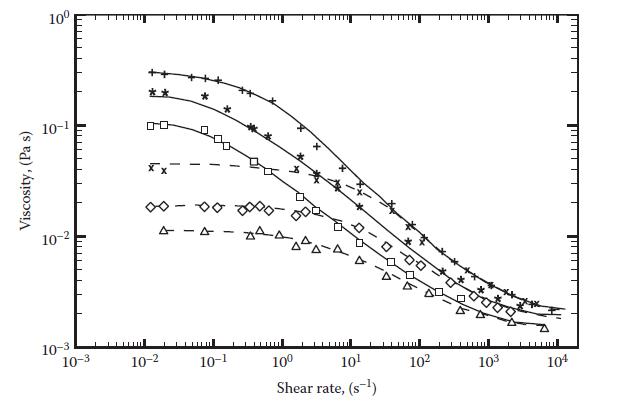
Consider each of the fluids for which the viscosity is shown in Figure 3.7, all of which exhibit a "structural viscosity" characteristic. Explain how the "structure" of each of these fluids influences the nature of the viscosity curve for that fluid. Figure 3.7, Viscosity, (Pas) 10-1 100 10-2
Starting with the equations for $\tau=f n(\dot{\gamma})$ that define the power law and Bingham plastic fluids, derive the equations for the viscosity functions for these models as a function of shear stress, that is, $\eta=f n(\tau)$.
A paint sample is tested in a Couette (cup and bob) viscometer that has an outer radius of $5 \mathrm{~cm}$, an inner radius of $4.9 \mathrm{~cm}$, and a bob length of $10 \mathrm{~cm}$. When the outer cylinder is rotated at a speed of $4 \mathrm{rpm}$, the torque on the bob is $0.0151 \mathrm{~N}
The quantities that are measured in a cup and bob viscometer are the rotation rate of the cup (rpm) and the corresponding torque transmitted to the bob. These quantities are then converted to corresponding values of shear rate $(\dot{\gamma})$ and shear stress $(\tau)$, which in turn can be
What is the difference between shear stress and momentum flux? How are they related? Illustrate each one in terms of the angular flow in the gap in a cup and bob viscometer, in which the outer cylinder (cup) is rotated and the torque is measured at the stationary inner cylinder (bob).
A sample of coal slurry is tested in a Couette (cup and bob) viscometer. The bob has a diameter of \($10.0\) \mathrm{~cm}$ and a length of \($8.0\) \mathrm{~cm}\($,\) and the cup has a diameter of \($10.2\) \mathrm{~cm}\($.\) When the cup is rotated at a rate of \($2\) \mathrm{rpm}\($,\) the torque
You must analyze the viscous properties of blood. Its measured viscosity is $6.49 \mathrm{cP}$ at a shear rate of $10 \mathrm{~s}^{-1}$ and $4.66 \mathrm{cP}$ at a shear rate of $80 \mathrm{~s}^{-1}$.(a) How would you describe these viscous properties?(b) If the blood is subjected to a shear stress
The following data were measured for the viscosity of a $500 \mathrm{ppm}$ polyacrylamide solution in distilled water:Shear Rate $\left(\mathbf{s}^{-1}\right)$Viscosity $(\mathbf{c P})$Shear Rate $\left(\mathbf{s}^{-1}\right)$Viscosity $(\mathbf{c
What viscosity model best represents the following data? Determine the values of the parameters in the model. Show a plot of the data together with the line that represents the model, to show how well the model works. (Hint: The easiest way to do this is by trial and error, fitting the model
You would like to determine the pressure drop in a slurry pipeline. To do this, you need to know the rheological properties of the slurry. To evaluate these properties, you test the slurry by pumping it through a $1 / 8 \mathrm{in}$. ID tube that is $10 \mathrm{ft}$ long. You find that it takes a 5
A film of paint, $3 \mathrm{~mm}$ thick, is applied to a flat surface that is inclined to the horizontal by an angle $\theta$. If the paint is a Bingham plastic, with a yield stress of $150 \mathrm{dyn} / \mathrm{cm}^{2}$, a limiting viscosity of $65 \mathrm{cP}$, and a $\mathrm{SG}$ of 1.3 , how
A thick suspension is tested in a Couette (cup and bob) viscometer that has a cup radius of $2.05 \mathrm{~cm}$, a bob radius of $2.00 \mathrm{~cm}$, and a bob length of $15 \mathrm{~cm}$. The following data are obtained:Cup Speed (rpm)Torque on Bob (dyn cm)22,00046,0001019,0002050,00050150,000What
You have obtained data for a viscous fluid in a cup and bob viscometer that has the following dimensions: cup radius $=2 \mathrm{~cm}$, bob radius $=1.5 \mathrm{~cm}$, bob length $=3 \mathrm{~cm}$. The data are tabulated in the following, where $n^{\prime}$ is the point slope of the $\log T$ versus
A sample of a viscous fluid is tested in a cup and bob viscometer that has a cup radius of $2.1 \mathrm{~cm}$, a bob radius of $2.0 \mathrm{~cm}$, and a bob length of $5 \mathrm{~cm}$. When the cup is rotated at $10 \mathrm{rpm}$, the torque measured at the bob is $6,000 \mathrm{dyn} \mathrm{cm}$,
You have a sample of a sediment that is non-Newtonian. You measure its viscosity in a cup and bob viscometer having a cup radius of $3.0 \mathrm{~cm}$, a bob radius of $2.5 \mathrm{~cm}$, and a length of $5 \mathrm{~cm}$. At a rotational speed of $10 \mathrm{rpm}$, the torque transmitted to the bob
Acrylic latex paint can be described by the Bingham plastic model with a yield stress of $112 \mathrm{dyn} / \mathrm{cm}^{2}$, a limiting viscosity of $80 \mathrm{cP}$, and a density of $0.95 \mathrm{~g} / \mathrm{cm}^{3}$. What is the maximum thickness of this paint that can be applied to a
Showing 100 - 200
of 1550
1
2
3
4
5
6
7
8
9
10
11
12
13
14
15
Last
Step by Step Answers

 Get 50% OFF
Claim Now
Get 50% OFF
Claim Now