New Semester
Started
Get
50% OFF
Study Help!
--h --m --s
Claim Now
Question Answers
Textbooks
Find textbooks, questions and answers
Oops, something went wrong!
Change your search query and then try again
S
Books
FREE
Study Help
Expert Questions
Accounting
General Management
Mathematics
Finance
Organizational Behaviour
Law
Physics
Operating System
Management Leadership
Sociology
Programming
Marketing
Database
Computer Network
Economics
Textbooks Solutions
Accounting
Managerial Accounting
Management Leadership
Cost Accounting
Statistics
Business Law
Corporate Finance
Finance
Economics
Auditing
Tutors
Online Tutors
Find a Tutor
Hire a Tutor
Become a Tutor
AI Tutor
AI Study Planner
NEW
Sell Books
Search
Search
Sign In
Register
study help
sciences
applied fluid mechanics
Chemical Engineering Fluid Mechanics 3rd Edition Ron Darby, Raj P Chhabra - Solutions
Santa Claus and his loaded sleigh are sitting on your roof, which is covered with snow. The sled's two runners each have a length $L$ and width $W$, and the roof is inclined at an angle $\theta$ to the horizontal. The thickness of the snow between the runners and the roof is $H$. If the snow has
You must design a piping system to handle a sludge waste product. However, you don't know the properties of the sludge, so you test it in a cup and bob viscometer with a cup diameter of $10 \mathrm{~cm}$, a bob diameter of $9.8 \mathrm{~cm}$, and a bob length of $8 \mathrm{~cm}$. When the cup is
A fluid sample is tested in a cup and bob viscometer that has a cup diameter of 2.25 in., a bob diameter of $2 \mathrm{in}$., and length of $3 \mathrm{in}$. The following data are obtained:Rotation Rate (rpm)Torque (dyn cm)202,500505,0001008,00020010,000(a) Determine the viscosity of this
You test a sample in a cup and bob viscometer to determine the viscosity. The diameter of the cup is $55 \mathrm{~mm}$, that of the bob is $50 \mathrm{~mm}$, and the length is $65 \mathrm{~mm}$. The cup is rotated and the torque on the bob is measured, giving the following data:Cup Speed
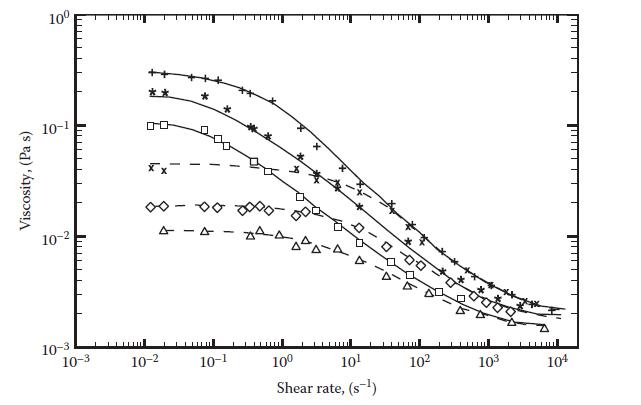
Consider each of the fluids for which the viscosity is shown in Figure 3.7, all of which exhibit a typical "structural viscosity" characteristic. Explain why this is a logical consequence of the composition or "structural makeup" for each of these fluids.Figure 3.7 Viscosity, (Pas) 10-1 100 10-2
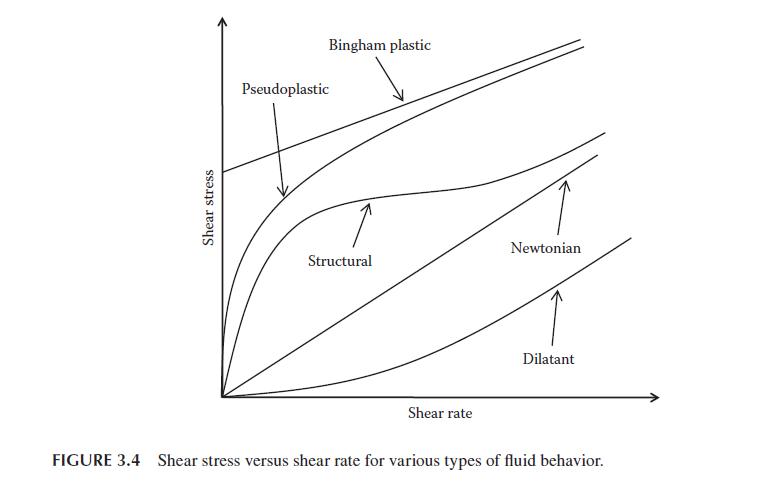
You are asked to measure the viscosity of an emulsion, so you use a tube flow viscometer similar to that illustrated in Figure 3.4, with the container open to the atmosphere. The length of the tube is $10 \mathrm{~cm}$, its diameter is $2 \mathrm{~mm}$, and the diameter of the container is $3
You must determine the horsepower required to pump a coal slurry through an $18 \mathrm{in}$. diameter pipeline, 300 miles long, at a rate of 5 million tons/year. The slurry can be described by the Bingham plastic model, with a yield stress of $75 \mathrm{dyn} / \mathrm{cm}^{2}$, a limiting
You want to determine how fast a rock will settle in mud, which behaves like a Bingham plastic. The first step is to perform a dimensional analysis of the system.(a) List the important variables that have an influence on this problem, with their dimensions (give careful attention to the factors
A pipeline has been proposed to transport a coal slurry 1200 miles from Wyoming to Texas, at a rate of 50 million tons/year, through a 36 in. diameter pipeline. The coal slurry has the properties of a Bingham plastic, with a yield stress of $150 \mathrm{dyn} / \mathrm{cm}^{2}$, a limiting viscosity
A fluid sample is subjected to a "sliding plate" (simple shear) test. The area of the plates is $100 \pm 0.01 \mathrm{~cm}^{2}$ and the spacing between them is $2 \pm 0.1 \mathrm{~mm}$. When the moving plate travels at a speed of $0.5 \mathrm{~cm} / \mathrm{s}$, the force required to move it is
You want to predict how fast a glacier that is $200 \mathrm{ft}$ thick will flow down a slope inclined $25^{\circ}$ to the horizontal. Assume that the glacier ice can be described by the Bingham plastic model with a yield stress of $50 \mathrm{psi}$, a limiting viscosity of 840 poise, and a SG of
Your boss gives you a sample of "gunk" and asks you to measure its viscosity. You do this in a cup and bob viscometer that has an outer (cup) diameter of 2 in., an inner (bob) diameter of $1.75 \mathrm{in}$., and a bob length of $4 \mathrm{in}$. You run the viscometer at three speeds and record the
The dimensions and measured quantities in the viscometer in Problem 34 are known to the following precision:\[\begin{aligned}& \hline T: \pm 1 % \text { of full scale (full scale }=500,000 \text { dyn } \mathrm{cm} \text { ) } \\& \Omega: \quad \pm 1 % \text { of reading } \\& D_{\mathrm{o}},
A concentrated slurry is prepared in an open $8 \mathrm{ft}$ diameter mixing tank, using an impeller with a diameter of $6 \mathrm{ft}$ located $3 \mathrm{ft}$ below the free surface. The slurry is non-Newtonian and can be described as a Bingham plastic with a yield stress of $50 \mathrm{dyn} /
You would like to know the thickness of a paint film as it drains at a rate of $1 \mathrm{gpm}$ down a flat surface that is $6 \mathrm{in}$. wide and is inclined at an angle of $30^{\circ}$ to the vertical. The paint is nonNewtonian and can be described as a Bingham plastic with a limiting
The following data were obtained for a proprietary salad dressing tested at $22^{\circ} \mathrm{C}$ in a cup and bob viscometer (cup diameter $=4.2 \mathrm{~cm}$, bob diameter $=4.01 \mathrm{~cm}$, length of $6 \mathrm{~cm}$ ):rpm2483264256Torque $(\mathrm{N} \mathrm{m}) \times
A kaolin-in-water suspension was tested in a $13 \mathrm{~mm}$ internal diameter horizontal tube, and the following data were reported:$\Gamma\left(\mathrm{s}^{-1}\right)$6608039781208151817902081230026292988$\tau_{w}(\mathrm{~Pa})$37.738.440.141.743.344.846.748.262.773.6Obtain the true shear
The same suspension as that in Problem 39 above was subsequently tested in a $28 \mathrm{~mm}$ internal diameter pipe, and the following data reported:$\Gamma\left(\mathrm{s}^{-1}\right)$127200289406557744951107914091610$\tau_{w}(\mathrm{~Pa})$3132.833.634.236.437.840.043.466.079.25Obtain the true
The manometer equation is $\Delta \Phi=-\Delta ho g \Delta h$, where $\Delta \Phi$ is the difference in the total pressure plus static head $(P+ho g z)$ between the two points to which the manometer is connected, $\Delta ho$ is the difference in the densities of the two fluids in the manometer,
A mercury manometer is used to measure the pressure drop across an orifice that is mounted in a vertical pipe. A liquid with a density of $0.87 \mathrm{~g} / \mathrm{cm}^{3}$ is flowing upward through the pipe and the orifice. The distance between the manometer taps is $1 \mathrm{ft}$. If the
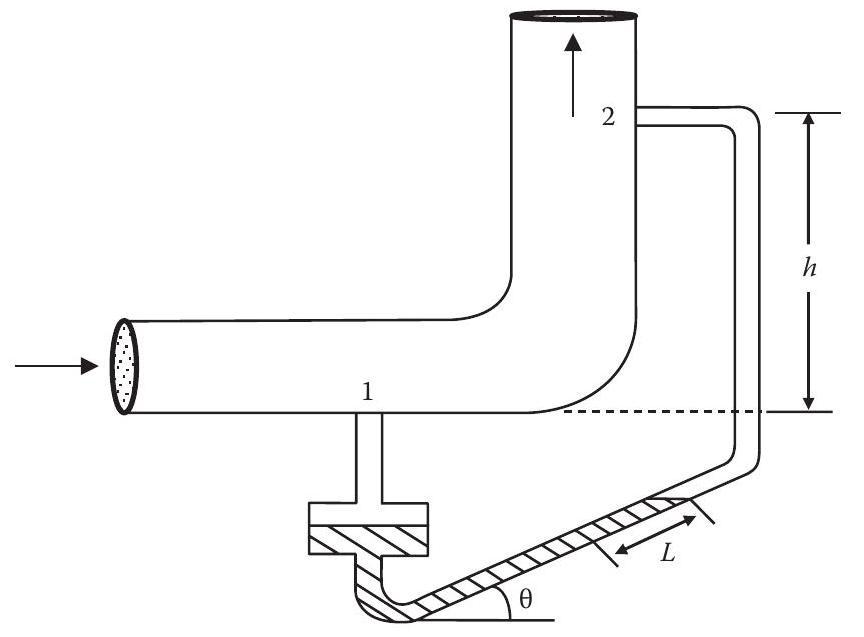
A mercury manometer is connected between two points in a piping system that contains water. The downstream tap is $6 \mathrm{ft}$ higher than the upstream tap, and the manometer reading is $16 \mathrm{in}$.FIGURE P4.5 Inclined manometer (not to scale).If a pressure gage in the pipe at the upstream
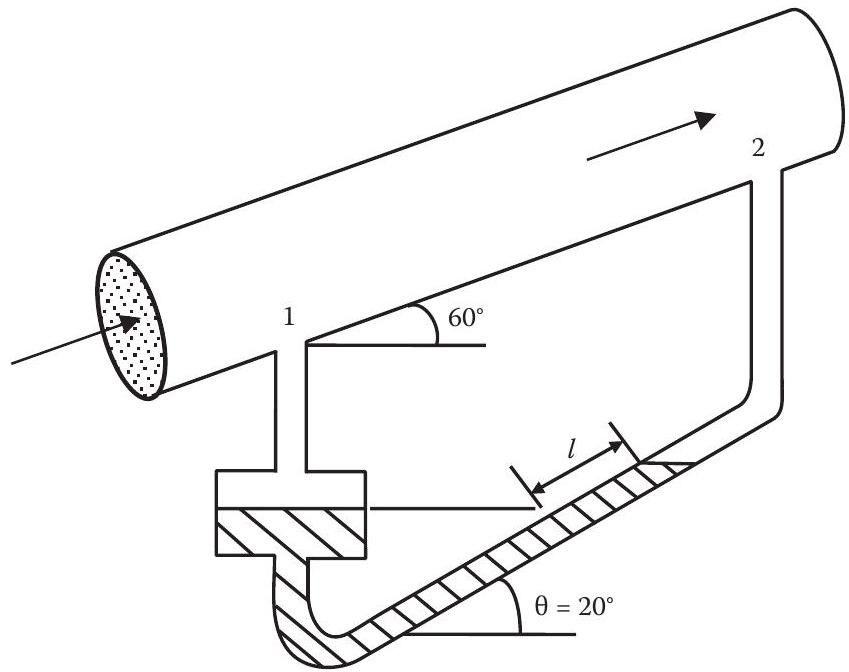
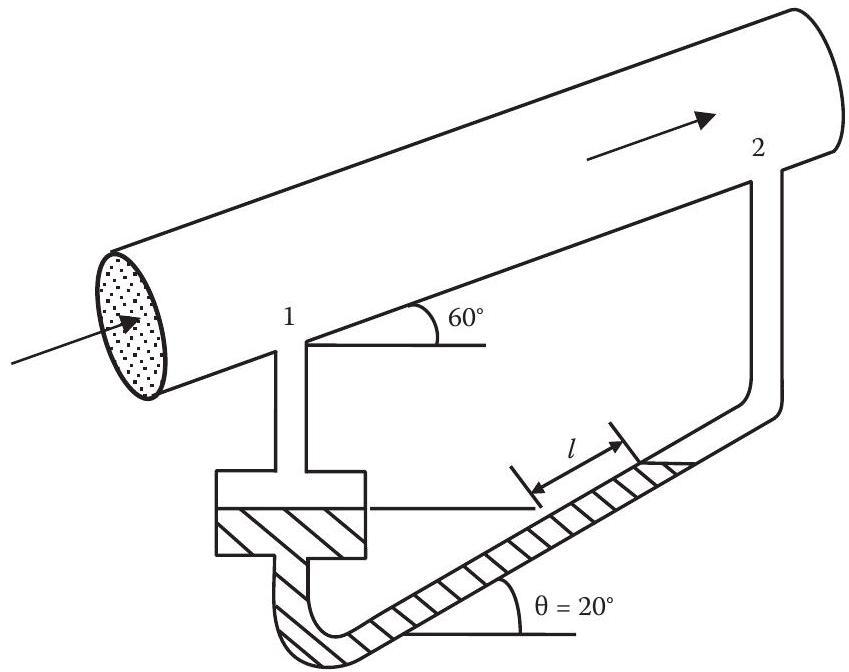
An inclined tube manometer with a reservoir is used to measure the pressure gradient in a large pipe carrying oil $(\mathrm{SG}=0.91)$ (see Figure $\mathrm{P} 4.5)$. The pipe is inclined at an angle of $60^{\circ}$ to the horizontal, and flow is uphill. The manometer tube is inclined at an angle of
Two horizontal pipelines are parallel, with one carrying salt water $\left(ho=1.988\right.$ slugs/ $\left.\mathrm{ft}^{3}\right)$ and the other carrying fresh water $\left(ho=1.937\right.$ slugs $\left./ \mathrm{ft}^{3}\right)$. An inverted manometer using linseed oil $\left(ho=1.828\right.$ slugs
Two identical tanks are $3 \mathrm{ft}$ in diameter and $3 \mathrm{ft}$ high, and they are both vented to the atmosphere. The top of tank B is level with the bottom of tank A, and they are connected by a line from the bottom of A to the top of B with a valve in it. Initially A is full of water, and
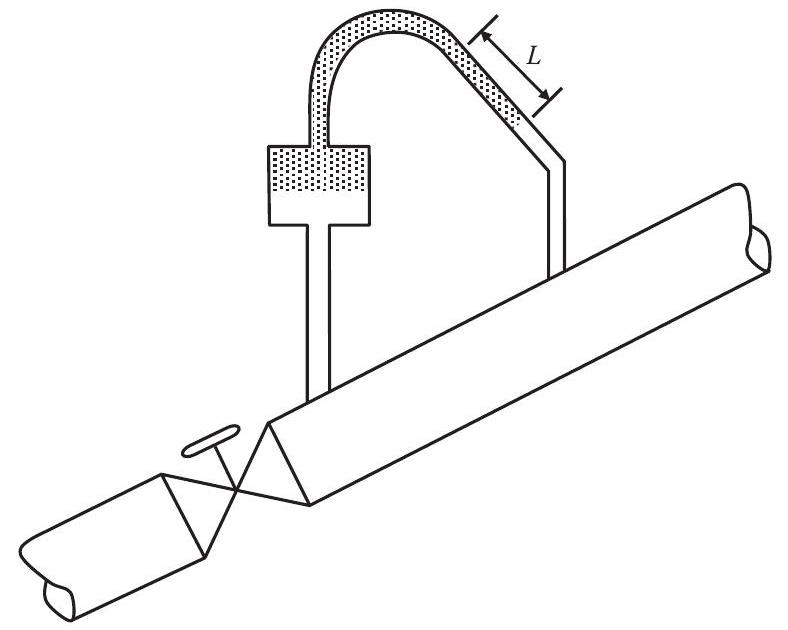
An inclined tube manometer is used to measure the pressure drop in an elbow through which water is flowing (see Figure P4.10). The manometer fluid is an oil with $\mathrm{SG}=1.15$. The distance $L$ is the distance along the inclined tube that the interface has moved from its equilibrium (no
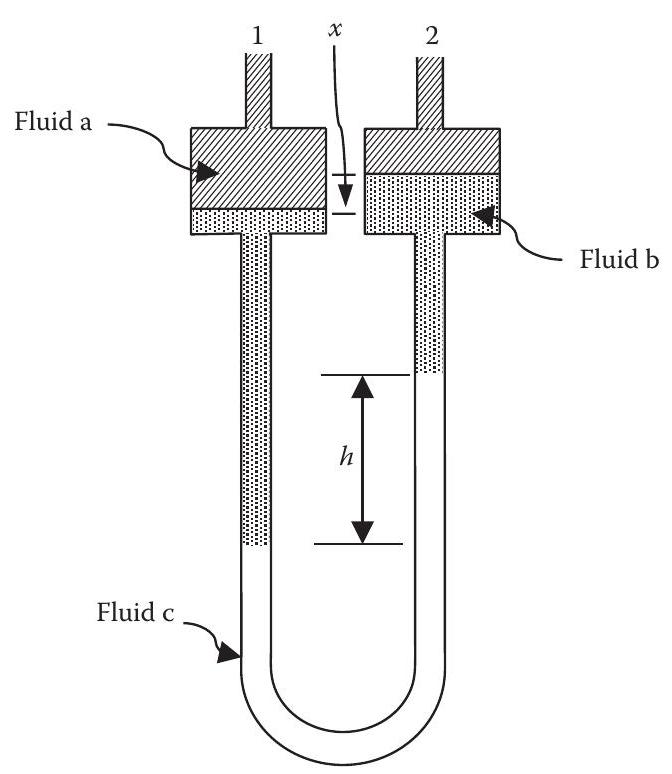
The three-fluid manometer illustrated in Figure P4.11 is used to measure a very small pressure difference $\left(P_{1}-P_{2}\right)$. The cross-sectional area of each of the reservoirs is $A$ and that of the manometer legs is $a$. The three fluids have densities $ho_{a}, ho_{b}$, and $ho_{c}$, and
A tank that is vented to the atmosphere contains a liquid with a density of $0.9 \mathrm{~g} / \mathrm{cm}^{3}$. A dip tube inserted into the top of the tank extends to a point $1 \mathrm{ft}$ from the bottom of the tank. Air is bubbled slowly through the dip tube, and the air pressure in the tube
An inclined manometer is used to measure the pressure drop between two taps on a pipe carrying water, as shown in Figure P4.13. The manometer fluid is an oil with $\mathrm{SG}=0.92$, and the manometer reading $(L)$ is 8 in. The manometer reservoir is $4 \mathrm{in}$. in diameter, the tubing is $1 /
The pressure gradient required to force water through a straight horizontal $1 / 4 \mathrm{in}$. ID tube at a rate of $2 \mathrm{gpm}$ is $1.2 \mathrm{psi} / \mathrm{ft}$. Consider this same tubing coiled in an expanding helix with a vertical axis. Water enters the bottom of the coil and flows
It is possible to achieve a weightless condition for a limited time in an airplane by flying in a circular arc above the earth (like a rainbow). If the plane flies at $650 \mathrm{mph}$, what should the radius of the flight path be (in miles) to achieve weightlessness?
Water is flowing in a horizontal pipe bend at a velocity of $10 \mathrm{ft} / \mathrm{s}$. The radius of curvature of the inside of the bend is 4 in., and the pipe ID is 2 in. A mercury manometer is connected to taps located radially opposite to each other on the inside and outside of the bend.
Calculate the atmospheric pressure at an elevation of $3000 \mathrm{~m}$, assuming (a) air is incompressible, at a temperature of $59^{\circ} \mathrm{F}$; (b) air is isothermal at $59^{\circ} \mathrm{F}$ and an ideal gas; (c) the pressure distribution follows the model of the standard atmosphere,
One pound mass of air $(\mathrm{MW}=29)$ at sea level and $70^{\circ} \mathrm{F}$ is contained in a balloon, which is then carried to an elevation of $10,000 \mathrm{ft}$ in the atmosphere. If the balloon offers no resistance to expansion of the gas, what is its volume at this elevation?
A gas well contains hydrocarbon gases with an average molecular weight of 24 , which can be assumed to be an ideal gas with a specific heat ratio of 1.3. The pressure and temperature at the top of the well are $250 \mathrm{psig}$ and $70^{\circ} \mathrm{F}$, respectively. The gas is being produced
The adiabatic atmosphere obeys the equation\[P / ho^{k}=\text { Constant }\]where$k$ is a constant$ho$ is densityIf the temperature decreases $0.3^{\circ} \mathrm{C}$ for every $100 \mathrm{ft}$ increase in altitude, what is the value of $k$ ? [Note: Air is an ideal gas; $g=32.2 \mathrm{ft} /
Using the actual dimensions of commercial steel pipe from Appendix F, plot the pipe wall thickness versus the pipe diameter for both Schedule 40 and Schedule 80 pipes, and fit the plot with a straight line by linear regression analysis. Rearrange your equation for the line in a form consistent with
The "yield stress" for carbon steel is 35,000 psi, and the "working stress" is one-half of this value. What schedule number would you recommend for a pipe carrying ethylene at a pressure of $2500 \mathrm{psi}$ if the pipeline design calls for a pipe of $2 \mathrm{in}$. ID? Give the dimensions of
Consider a $90^{\circ}$ elbow in a 2 in. pipe (all of which is in the horizontal plane). A pipe tap is drilled through the wall of the elbow on the inside curve of the elbow, and another through the outer wall of the elbow directly across from the inside tap. The radius of curvature of the inside
A pipe carrying water is inclined at an angle of $45^{\circ}$ to the horizontal. A manometer containing a fluid with $\mathrm{SG}$ of 1.2 is attached to taps on the pipe, which are $1 \mathrm{ft}$ apart. If the liquid interface in the manometer leg that is attached to the lower tap is $3
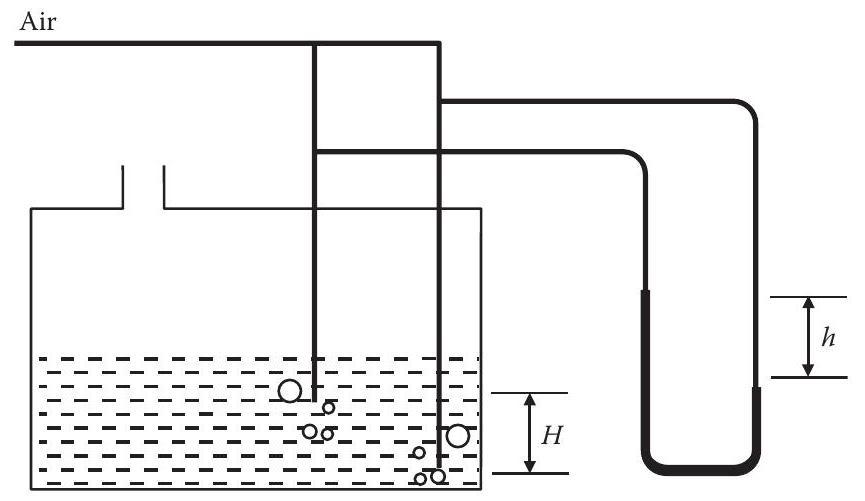
A tank contains a liquid of unknown density (see Figure P4.25). Two dip tubes are inserted into the tank, each to a different level in the tank, through which air is bubbled very slowly through the liquid. A manometer is used to measure the difference in pressure between the two dip tubes. If the
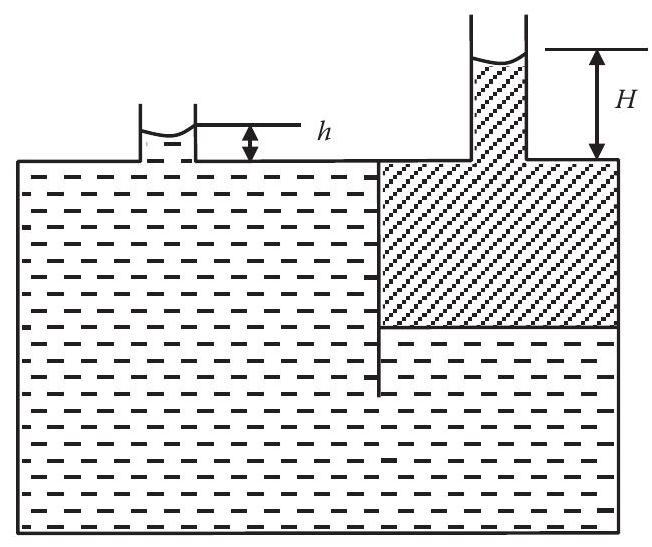
The tank shown in Figure P4.26 has a partition that separates two immiscible liquids. Most of the tank contains water, and oil is floating above the water on the right of the partition. The height of the water in the standpipe $(h)$ is $10 \mathrm{~cm}$, and the interface between the oil and water
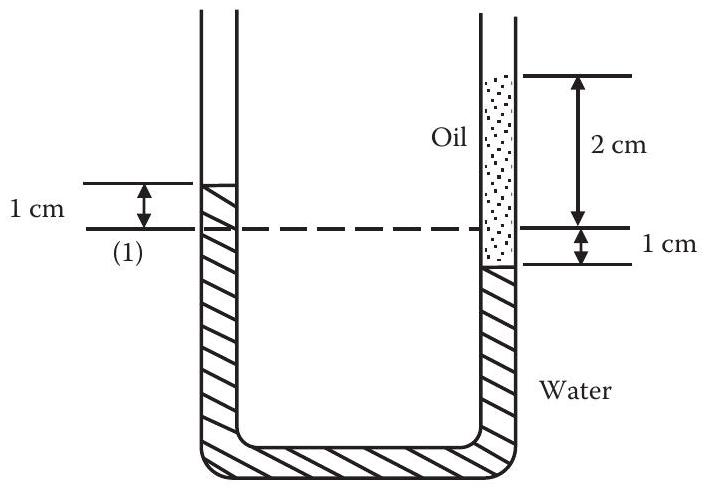
A manometer that is open to the atmosphere contains water, with a layer of oil floating on the water in one leg (see Figure P4.27). If the level of the water in the left leg is $1 \mathrm{~cm}$ above the center of the leg, the interface between the water and oil is $1 \mathrm{~cm}$ below the center
An open cylindrical drum, with a diameter of $2 \mathrm{ft}$ and a length of $4 \mathrm{ft}$, is turned upside down in the atmosphere and then submerged in a liquid so that it floats partially submerged upside down, with air trapped inside. If the drum weighs $150 \mathrm{lb}_{\mathrm{f}}$, and it
A solid spherical particle with a radius of $1 \mathrm{~mm}$ and a density of $1.3 \mathrm{~g} / \mathrm{cm}^{3}$ is immersed in water in a centrifuge. If the particle is $10 \mathrm{~cm}$ from the axis of the centrifuge, which is rotating at ate of $100 \mathrm{rpm}$, what direction will the
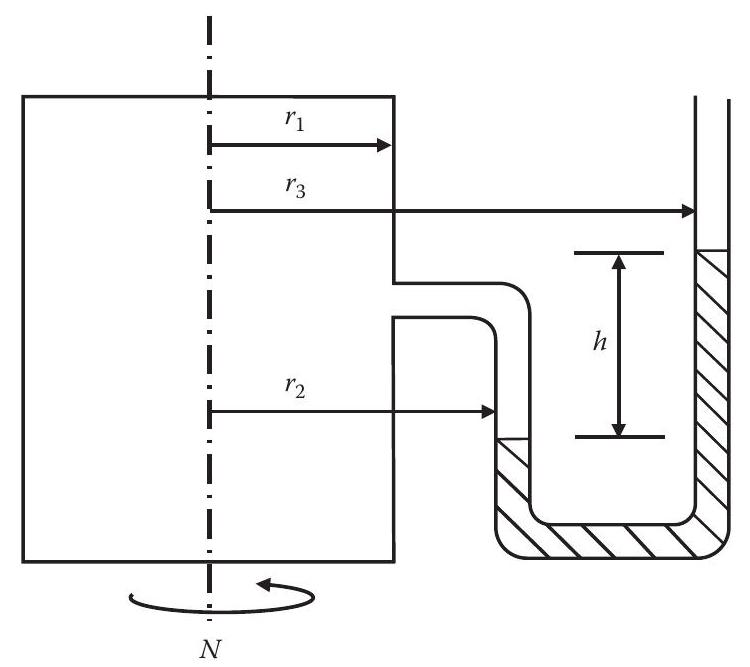
A manometer with mercury as the manometer fluid is attached to the wall of a closed tank containing water (see Figure P4.30). The entire system is rotating about the axis of the tank at $N$ rpm. The radius of the tank is $r_{1}$, the distances from the tank centerline to the manometer legs are
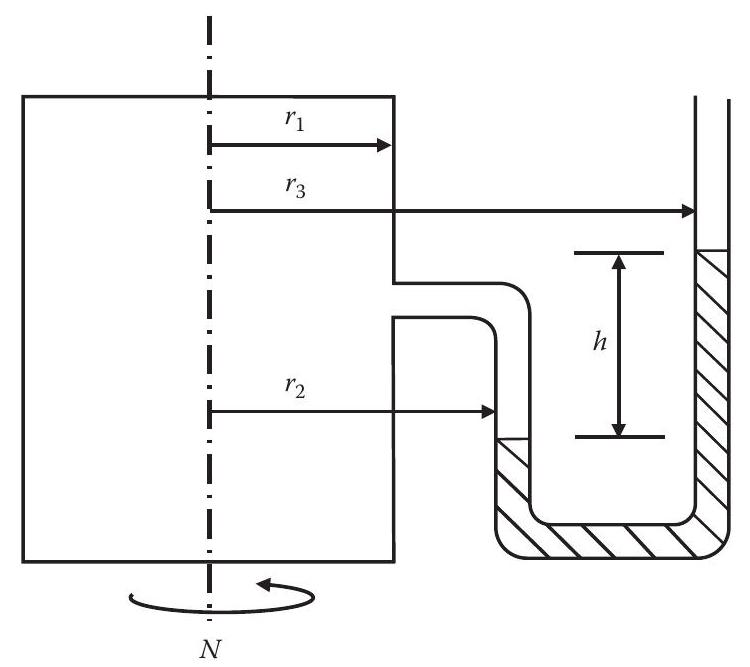
With reference to Figure P4.30, the manometer contains water as the manometer fluid and is attached to a tank that is empty and open to the atmosphere. When the tank is stationary, the water level is the same in both legs of the manometer. If the entire system is rotated about the centerline of the
You want to measure the specific gravity of a liquid. To do this, you first weigh a beaker of the liquid on a scale $\left(W_{L o}\right)$. You then attach a string to a solid body that is heavier than the liquid and while holding the string you immerse the solid body in the liquid and measure the
A vertical U-tube manometer is open to the atmosphere and contains a liquid that has a SG of 0.87 and a vapor pressure of $450 \mathrm{mmHg}$ at the operating temperature. The vertical tubes are $4 \mathrm{in}$. apart, and the level of the liquid in the tubes is $6 \mathrm{in}$. above the bottom of
A spherical particle with $\mathrm{SG}=2.5$ and a diameter of $2 \mathrm{~mm}$ is immersed in water in a cylindrical centrifuge with a diameter of $20 \mathrm{~cm}$. If the particle is initially $8 \mathrm{~cm}$ above the bottom of the centrifuge and $1 \mathrm{~cm}$ from the centerline, what is
Water is flowing into the top of a tank at a rate of $200 \mathrm{gpm}$. The tank is $18 \mathrm{in}$. in diameter and has a 3 in. diameter hole in the bottom, through which the water flows out. If the inflow rate is adjusted to match the outflow rate, what will the height of the water be in the
A vacuum pump operates at a constant volumetric flow rate of $10 \mathrm{~L} / \mathrm{min}$, evaluated at the pump inlet conditions. How long will it take to pump down a $100 \mathrm{~L}$ tank containing air from 1 to $0.01 \mathrm{~atm}$, assuming that the temperature is constant?
Air is flowing at a constant mass flow rate into a tank that has a volume of $3 \mathrm{ft}^{3}$. The temperature of both the tank and the air is constant at $70^{\circ} \mathrm{F}$. If the pressure in the tank is observed to increase at a rate of $5 \mathrm{psi} / \mathrm{min}$, what is the mass
A tank contains water initially at a depth of $3 \mathrm{ft}$. The water flows out of a hole in the bottom of the tank, and air at a constant pressure of $10 \mathrm{psig}$ is admitted to the top of the tank. If the water flow rate is directly proportional to the square root of the gage pressure
The flow rate of a hot coal/oil slurry in a pipeline is measured by injecting a small side stream of cool oil and measuring the resulting temperature change downstream in the pipeline. The slurry is initially at $300^{\circ} \mathrm{F}$ and has a density of $1.2 \mathrm{~g} / \mathrm{cm}^{3}$ and a
A gas enters a horizontal 3 in. schedule 40 pipe at a constant rate of $0.5 \mathrm{lb}_{\mathrm{m}} / \mathrm{s}$, with a temperature of $70^{\circ} \mathrm{F}$ and a pressure of $1.15 \mathrm{~atm}$. The pipe is wrapped with a $20 \mathrm{~kW}$ heating coil, covered with a thick layer of
Water is flowing into the top of an open cylindrical tank (diameter $D$ ) at a volume flow rate of $Q_{i}$ and out of a hole in the bottom at a rate of $Q_{o}$. The tank is made of wood that is very porous, and the water is leaking out through the wall uniformly at a rate of $q$ per unit of wetted
Air is flowing steadily through a horizontal tube at a constant temperature of $32^{\circ} \mathrm{C}$ and a mass flow rate of $1 \mathrm{~kg} / \mathrm{s}$. At one point upstream where the tube diameter is $50 \mathrm{~mm}$ the pressure is $345 \mathrm{kPa}$. At another point downstream, the
Steam is flowing through a horizontal nozzle. At the inlet the velocity is $1000 \mathrm{ft} / \mathrm{s}$ and the enthalpy is $1320 \mathrm{Btu} / \mathrm{lb}_{\mathrm{m}}$. At the outlet the enthalpy is $1200 \mathrm{Btu} / \mathrm{lb}_{\mathrm{m}}$. If heat is lost through the nozzle at a rate
Oil is being pumped from a large storage tank, where the temperature is $70^{\circ} \mathrm{F}$, through a 6 in. ID pipeline. The oil level in the tank is $30 \mathrm{ft}$ above the pipe exit. If a $25 \mathrm{hp}$ pump is required to pump the oil at a rate of $600 \mathrm{gpm}$ through the
Ethylene enters a 1 in. schedule 80 pipe at $170^{\circ} \mathrm{F}$ and $100 \mathrm{psia}$ and a velocity of $10 \mathrm{ft} / \mathrm{s}$. At a point somewhere downstream, the temperature has dropped to $140^{\circ} \mathrm{F}$ and the pressure to 15 psia. Calculate the velocity at the
Number 3 fuel oil $\left(30^{\circ} \mathrm{API}\right)$ is transferred from a storage tank at $60^{\circ} \mathrm{F}$ to a feed tank in a power plant at a rate of $2000 \mathrm{bbl} / \mathrm{day}$. Both tanks are open to the atmosphere and are connected by a pipeline containing $1200 \mathrm{ft}$
Oil with a viscosity of $35 \mathrm{cP}, \mathrm{SG}$ of 0.9 , and a specific heat of $0.5 \mathrm{Btu} /\left(\mathrm{lb}_{\mathrm{m}}{ }^{\circ} \mathrm{F}\right)$ is flowing through a straight pipe at a rate of $100 \mathrm{gpm}$. The pipe is $1 \mathrm{in}$. sch 40, $100 \mathrm{ft}$ long, and
Water is pumped at a rate of $90 \mathrm{gpm}$ by a centrifugal pump driven by a $10 \mathrm{hp}$ motor. The water enters the pump through a $3 \mathrm{in}$. sch 40 pipe at $60^{\circ} \mathrm{F}$ and $10 \mathrm{psig}$ and leaves through a $2 \mathrm{in}$. sch 40 pipe at $100 \mathrm{psig}$. If
A pump driven by a $7.5 \mathrm{hp}$ motor takes water in at $75^{\circ} \mathrm{F}$ and $5 \mathrm{psig}$ and discharges it at $60 \mathrm{psig}$ at a flow rate of $600 \mathrm{lb}_{\mathrm{m}} / \mathrm{min}$. If no heat is transferred to or from the water while it is in the pump, what will the
A high-pressure pump takes water in at $70^{\circ} \mathrm{F}, 1 \mathrm{~atm}$, through a $1 \mathrm{in}$. ID suction line and discharges it at 1000 psig through a 1/8 in. ID line. The pump is driven by a $20 \mathrm{hp}$ motor and is $65 %$ efficient. If the flow rate is $500 \mathrm{~g} /
Water is contained in two closed tanks (A and B) which are connected by a pipe. The pressure in tank A is 5 psig and that in tank B is 20 psig, and the water level in tank A is $40 \mathrm{ft}$ above that in tank B. Which direction does the water flow?
A pump that is driven by a $7.5 \mathrm{hp}$ motor takes water in at $75^{\circ} \mathrm{F}$ and $5 \mathrm{psig}$ and discharges it at $60 \mathrm{psig}$ at a flow rate of $600 \mathrm{lb}_{\mathrm{m}} / \mathrm{min}$. If no heat is transferred between the water in the pump and the surroundings,
A $90 %$ efficient pump driven by a $50 \mathrm{hp}$ motor is used to transfer water at $70^{\circ} \mathrm{F}$ from a cooling pond to a heat exchanger through a 6 in. sch 40 pipeline. The heat exchanger is located $25 \mathrm{ft}$ above the level of the cooling pond, and the water pressure at the
A pump takes water from the bottom of a large tank where the pressure is $50 \mathrm{psig}$ and delivers it through a hose to a nozzle that is $50 \mathrm{ft}$ above the bottom of the tank, at a rate of $100 \mathrm{lb}_{\mathrm{m}} / \mathrm{s}$. The water exits the nozzle into the atmosphere at a
You have purchased a centrifugal pump to transport water at a maximum rate of $1000 \mathrm{gpm}$ from one reservoir to another through an $8 \mathrm{in}$. sch 40 pipeline. The total pressure drop through the pipeline is 50 psi. If the pump has an efficiency of $65 %$ at maximum flow conditions and
The hydraulic turbines at Boulder dam power plant are rated at $86,000 \mathrm{~kW}$ when water is supplied at a rate of $66.3 \mathrm{~m}^{3} / \mathrm{s}$. The water enters at a head of $145 \mathrm{~m}$ at $20^{\circ} \mathrm{C}$ and leaves through a $6 \mathrm{~m}$ diameter duct.(a) Determine
Water is draining from an open conical funnel at the same rate at which it is entering the top. The diameter of the funnel is $1 \mathrm{~cm}$ at the top and is $0.5 \mathrm{~cm}$ at the bottom, and it is $5 \mathrm{~cm}$ high. The friction loss in the funnel per unit mass of fluid is given by $0.4
Water is being transferred by a pump between two open tanks (from A to B) at a rate of $100 \mathrm{gpm}$. The pump receives the water from the bottom of tank A through a $3 \mathrm{in}$. sch 40 pipe and discharges it into the top of tank B through a 2 in. sch 40 pipe. The point of discharge into
A 4 in. diameter open can has a $1 / 4$ in. diameter hole in the bottom. The can is immersed bottom down in a pool of water to a point where the bottom is $6 \mathrm{in}$. below the water surface and is held there while the water flows through the hole into the can. How long will it take for the
Carbon tetrachloride $(\mathrm{SG}=1.6)$ is pumped at a rate of $2 \mathrm{gpm}$ through a pipe that is inclined upward at an angle of $30^{\circ}$. An inclined tube manometer (with a $10^{\circ}$ angle of inclination) using mercury as the manometer fluid $(\mathrm{SG}=13.6)$ is connected between
A pump that is taking water at $50^{\circ} \mathrm{F}$ from an open tank at a rate of $500 \mathrm{gpm}$ is located directly over the tank. The suction line entering the pump is a nominal 6 in. sch 40 straight pipe $10 \mathrm{ft}$ long and extends $6 \mathrm{ft}$ below the surface of the water in
A pump is transferring water from tank A to tank B, both of which are open to the atmosphere, at a rate of $200 \mathrm{gpm}$. The surface of the water in tank A is $10 \mathrm{ft}$ above ground level, and that in tank B is $45 \mathrm{ft}$ above ground level. The pump is located at ground level,
A surface effect (air cushion) vehicle measures $10 \mathrm{ft} \times 20 \mathrm{ft}$ and weighs $6000 \mathrm{lb}_{\mathrm{f}}$. The air is supplied by a blower mounted on top of the vehicle, which must supply sufficient power to lift the vehicle $1 \mathrm{in}$. off the ground. Calculate the
The air cushion car in Problem 29 is equipped with a $2 \mathrm{hp}$ blower that is $70 %$ efficient.(a) What would be the clearance between the skirt of the car and the ground?(b) What is the air flow rate in scfm?
An ejector pump operates by injecting a high-speed fluid stream into a slower stream to increase its pressure. Consider water flowing at a rate of $50 \mathrm{gpm}$ through a $90^{\circ}$ elbow in a $2 \mathrm{in}$. ID pipe. A stream of water is injected at a rate of $10 \mathrm{gpm}$ through a 1/2
A large tank containing water has a $51 \mathrm{~mm}$ diameter hole in the bottom. When the depth of the water is $15 \mathrm{~m}$ above the hole, the flow rate through the hole is found to be $0.0324 \mathrm{~m}^{3} / \mathrm{s}$. What is the head loss due to friction in the hole?
Water at $68^{\circ} \mathrm{F}$ is pumped through a $1000 \mathrm{ft}$ length of 6 in. sch 40 pipe. The discharge end of the pipe is $100 \mathrm{ft}$ above the suction end. The pump is $90 %$ efficient, and it is driven by a $25 \mathrm{hp}$ motor. If the friction loss in the pipe is $70
You want to siphon water out of a large tank using a 5/8 in. ID hose. The highest point of the hose is $10 \mathrm{ft}$ above the water surface in the tank, and the hose exit outside the tank is $5 \mathrm{ft}$ below the inside surface level. If friction is neglected, (a) what would be the flow
It is desired to siphon a volatile liquid out of a deep open tank. If the liquid has a vapor pressure of $200 \mathrm{mmHg}$ and a density of $45 \mathrm{lb}_{\mathrm{m}} / \mathrm{ft}^{3}$ and the surface of the liquid is $30 \mathrm{ft}$ below the top of the tank, is it possible to siphon the
The propeller of a speedboat is $1 \mathrm{ft}$ in diameter and $1 \mathrm{ft}$ below the surface of the water. At what speed (rpm) will cavitation occur? The vapor pressure of the water is $18.65 \mathrm{mmHg}$ at $70^{\circ} \mathrm{F}$.
A conical funnel is full of liquid. The diameter of the top (mouth) is $D_{1}$, and that of the bottom (spout) is $D_{2}$ (where $D_{2} \ll D_{1}$ ), and the depth of the fluid above the bottom is $H_{o}$. Derive an expression for the time required for the fluid to drain by gravity to a level of
An open cylindrical tank of diameter $D$ contains a liquid of density $ho$ at a depth $H$. The liquid drains through a hole of diameter $d$ in the bottom of the tank. The velocity of the liquid through the hole is $C \sqrt{ } h$, where $h$ is the depth of the liquid at any time $t$. Derive an
An open cylindrical tank, that is $2 \mathrm{ft}$ in diameter and $4 \mathrm{ft}$ high is full of water. If the tank has a 2 in. diameter hole in the bottom, how long will it take for half of the water to drain out, if friction is neglected?
A large tank has a $5.1 \mathrm{~mm}$ diameter hole in the bottom. When the depth of liquid in the tank is $1.5 \mathrm{~m}$ above the hole, the flow rate through the hole is found to be $324 \mathrm{~cm}^{3} / \mathrm{s}$. What is the head loss due to friction in the hole (in $\mathrm{ft}$ )?
A window is left slightly open while the air conditioning system is running. The air conditioning blower develops a pressure of 2 in. $\mathrm{H}_{2} \mathrm{O}$ (gage) inside the house, and the window opening measures $1 / 8$ in. $\times 20$ in. Neglecting friction, what is the flow rate of air
Water at $68^{\circ} \mathrm{F}$ is pumped through a $1000 \mathrm{ft}$ length of $6 \mathrm{in}$. sch 40 pipe. The discharge end of the pipe is $100 \mathrm{ft}$ above the suction end. The pump is $90 %$ efficient and is driven by a $25 \mathrm{hp}$ motor. If the friction loss in the pipe is $70
The plumbing in your house is $3 / 4$ in. sch 40 galvanized pipe, and it is connected to an 8 in. sch 80 water main in which the pressure is $15 \mathrm{psig}$. When you turn on a facet in your bathroom (which is $12 \mathrm{ft}$ higher than the water main), the water flows out at a rate of $20
A $60 %$ efficient pump driven by a $10 \mathrm{hp}$ motor is used to transfer bunker $\mathrm{C}$ fuel oil from a storage tank to a boiler through a well-insulated line. The pressure in the tank is $1 \mathrm{~atm}$, and the temperature is $100^{\circ} \mathrm{F}$. The pressure at the burner in
You have probably noticed that when you turn on the garden hose, it will whip about uncontrollably if it is not restrained. This is because of the unbalanced forces developed by the change of momentum in the tube. If a 1/2 in. ID hose carries water at a rate of $50 \mathrm{gpm}$, and the open end
Repeat Problem 45 for the case in which a nozzle is attached to the end of the hose and the water exits the nozzle through a 1/4 in. opening. The loss coefficient for the nozzle is 0.3 based on the velocity through the nozzle.Problem 45You have probably noticed that when you turn on the garden
You are watering your garden with a hose that has a $3 / 4 \mathrm{in}$. ID, and the water is flowing at a rate of $10 \mathrm{gpm}$. A nozzle attached to the end of the hose has an ID of $1 / 4 \mathrm{in}$. The loss coefficient for the nozzle is 20 based on the velocity in the hose. Determine the
A 4 in. ID fire hose discharges water at a rate of $1500 \mathrm{gpm}$ through a nozzle that has a $2 \mathrm{in}$. ID exit. The nozzle is conical and converges through a total included angle of $30^{\circ}$. What is the total force transmitted to the bolts in the flange where the nozzle is
A $90^{\circ}$ horizontal reducing bend has an inlet diameter of $4 \mathrm{in}$. and an outlet diameter of $2 \mathrm{in}$. If water enters the bend at a pressure of $40 \mathrm{psig}$ and a flow rate of $500 \mathrm{gpm}$, calculate the force (net magnitude and direction) exerted on the supports
A fireman is holding the nozzle of a fire hose that he is using to put out a fire. The hose is 3 in. in diameter, and the nozzle is $1 \mathrm{in}$. in diameter. The water flow rate is $200 \mathrm{gpm}$, and the loss coefficient for the nozzle is 0.25 (based on the exit velocity). How much force
Water flows through a $30^{\circ}$ pipe bend at a rate of $200 \mathrm{gpm}$. The diameter of the entrance to the bend is $2.5 \mathrm{in}$. and that of the exit is $3 \mathrm{in}$. The pressure in the pipe is $30 \mathrm{psig}$, and the pressure drop in the bend is negligible. What is the total
Showing 200 - 300
of 1550
1
2
3
4
5
6
7
8
9
10
11
12
13
14
15
Last
Step by Step Answers

 Get 50% OFF
Claim Now
Get 50% OFF
Claim Now