New Semester
Started
Get
50% OFF
Study Help!
--h --m --s
Claim Now
Question Answers
Textbooks
Find textbooks, questions and answers
Oops, something went wrong!
Change your search query and then try again
S
Books
FREE
Study Help
Expert Questions
Accounting
General Management
Mathematics
Finance
Organizational Behaviour
Law
Physics
Operating System
Management Leadership
Sociology
Programming
Marketing
Database
Computer Network
Economics
Textbooks Solutions
Accounting
Managerial Accounting
Management Leadership
Cost Accounting
Statistics
Business Law
Corporate Finance
Finance
Economics
Auditing
Tutors
Online Tutors
Find a Tutor
Hire a Tutor
Become a Tutor
AI Tutor
AI Study Planner
NEW
Sell Books
Search
Search
Sign In
Register
study help
sciences
applied fluid mechanics
Chemical Engineering Fluid Mechanics 3rd Edition Ron Darby, Raj P Chhabra - Solutions
An open tank contains $5 \mathrm{ft}$ of water. The tank drains through a piping system containing $1090^{\circ}$ elbows, 10 branched tees, 6 gate valves, and $40 \mathrm{ft}$ of horizontal Sch. 40 pipe. The surface of the water in the tank and the pipe discharge are both at atmospheric pressure.
A pump takes water from a reservoir and delivers it to a water tower. The water in the tower is at atmospheric pressure and is $120 \mathrm{ft}$ above the reservoir. The pipeline is composed of $1000 \mathrm{ft}$ of 2 in. Sch. 40 pipe containing 32 gate valves, 2 globe valves, and 14 standard
You must determine the pump head and power required to transport a petroleum fraction $(\mu=$ $\left.60 \mathrm{cP}, ho=55 \mathrm{lb}_{\mathrm{m}} / \mathrm{ft}^{3}\right)$ at a rate of $500 \mathrm{gpm}$ from a storage tank to the feed plate of a distillation column. The pressure in the tank is
What horsepower pump would be required to transfer water at a flow rate of $100 \mathrm{gpm}$ from tank A to tank B, if the liquid surface in tank A is $8 \mathrm{ft}$ above ground and that in tank B is $45 \mathrm{ft}$ above ground? The piping between tanks consists of $150 \mathrm{ft}$ of $1
An additive having a viscosity of $2 \mathrm{cP}$ and a density of $50 \mathrm{lb}_{\mathrm{m}} / \mathrm{ft}^{3}$ is fed from a reservoir into a mixing tank. The pressure in both the reservoir and the tank is $1 \mathrm{~atm}$, and the level in the reservoir is $2 \mathrm{ft}$ above the end of the
The pressure in the water main serving your house is $90 \mathrm{psig}$. The plumbing between the main and your outside faucet contains $250 \mathrm{ft}$ of galvanized $3 / 4$ in. Sch. 40 pipe, 16 elbows, and the faucet, which is an angle valve. When the faucet is wide open, what is the flow rate,
You are filling your beer mug from a keg. The pressure in the keg is $5 \mathrm{psig}$, the filling tube from the keg is $3 \mathrm{ft}$ long and $1 / 4 \mathrm{in}$. ID, and the valve is a diaphragm dam type. The tube is attached to the keg by a (threaded) tee used as an elbow. If the beer leaving
You must install a piping system to drain $\mathrm{SAE} 10$ lube oil at $70^{\circ} \mathrm{F}(\mathrm{SG}=0.928)$ from tank $\mathrm{A}$ to tank B by gravity flow. The level in tank A is $10 \mathrm{ft}$ above that in tank B, and the pressure in tank A is 5 psi greater than that in tank B. The
A new industrial plant requires a supply of water at a rate of $5.7 \mathrm{~m}^{3} / \mathrm{min}$. The pressure in the water main is $800 \mathrm{kPa}$, and it is $50 \mathrm{~m}$ from the plant. The line from the main to the plant will have $65 \mathrm{~m}$ of galvanized iron pipe, four standard
A pump is used to transport water at $72^{\circ} \mathrm{F}$ from tank A to tank B at a rate of $200 \mathrm{gpm}$. Both tanks are vented to the atmosphere. Tank A is $6 \mathrm{ft}$ above the ground with a water depth of $4 \mathrm{ft}$ in the tank, and tank B is $40 \mathrm{ft}$ above ground with
A pipeline carrying gasoline ( $\mathrm{SG}=0.72, \mu=0.7 \mathrm{cP}$ ) is 5 miles long and is made of 6 in. $\mathrm{Sch} .40$ commercial steel pipe. The line contains $2490^{\circ}$ elbows, 2 open globe valves, and a pump capable of producing a maximum head of $400 \mathrm{ft}$ is available. The
A water tower supplies water to a small community of 800 homes. The level of the water in the tank is $120 \mathrm{ft}$ above ground level, and the water main from the tower to the housing area is 1 mile of Sch. 40 commercial steel pipe. The water system is designed to provide a minimum pressure of
A 12 in. Sch. 40 pipe, $60 \mathrm{ft}$ long, discharges water at $1 \mathrm{~atm}$ pressure from a reservoir. The pipe is horizontal, and the outlet is $12 \mathrm{ft}$ below the surface of the water in the reservoir.(a) What is the flow rate, in gpm?(b) In order to limit the flow rate to $3500
Crude oil with a viscosity of $12.5 \mathrm{cP}$ and $\mathrm{SG}=0.88$ is to be pumped through a $12 \mathrm{in}$. Sch. 30 commercial steel pipe at a rate of $1900 \space \mathrm{bbl} \space \mathrm{h}$. The pipeline is 15 miles long, with a discharge that is $125 \mathrm{ft}$ above the inlet, and
A pipeline to carry crude oil at a rate of 1 million bbl/day is constructed with $50 \mathrm{in}$. ID pipe, and it is 700 miles long. It contains the equivalent of 70 gate valves but no other fittings.(a) What is the total power required to drive the pumps if they are $70 %$ efficient?(b) How many
You are building a pipeline to transport crude oil $(\mathrm{SG}=0.8$, viscosity $=30 \mathrm{cP})$ from a seaport over a mountain to a tank farm. The top of the mountain is $3000 \mathrm{ft}$ above sea level and $1000 \mathrm{ft}$ above the tank farm. The distance from the port to the mountain top
You want to siphon water from an open tank using a hose. The discharge end of the hose is $10 \mathrm{ft}$ below the level of the water in the tank. The minimum allowable pressure in the hose for proper operation is $1 \mathrm{psia}$. If you wish the water velocity in the hose to be $10 \mathrm{ft}
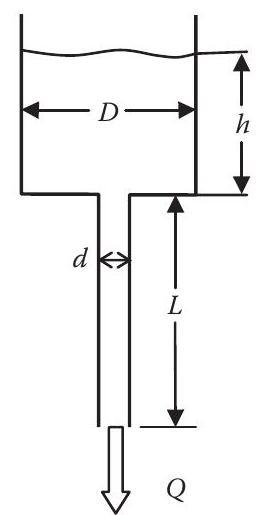
A liquid is draining from a cylindrical vessel through a tube in the bottom of the vessel, as illustrated in Figure P7.45. The liquid has a specific gravity of 1.2 and a viscosity of $2 \mathrm{cP}$. The entrance loss from the tank to the tube is 0.4 , and the system has the following dimensions:
Water from a lake is flowing over a concrete spillway at a rate of $100,000 \mathrm{gpm}$. The spillway is $100 \mathrm{ft}$ wide and is inclined at an angle of $30^{\circ}$ to the vertical. If the effective roughness of the concrete is 0.03 in., what is the depth of water in the stream flowing
A pipeline composed of $1500 \mathrm{ft}$ of $6 \mathrm{in}$. Sch. 40 pipe containing $2590^{\circ}$ elbows and 4 open gate valves carries oil with a viscosity of $35 \mathrm{cP}$ and $\mathrm{SG}=0.85$, at a velocity of $7.5 \mathrm{ft} / \mathrm{s}$, from a storage tank to a plant site. The
Water is pumped at a rate of $500 \mathrm{gpm}$ through a $10 \mathrm{in}$. ID pipeline, $50 \mathrm{ft}$ long, with both entrance and exit from the pipe at ground level. The line contains two standard elbows and a swing check valve. The pressure is $1 \mathrm{~atm}$ entering and leaving the
Water at $70^{\circ} \mathrm{F}$ is flowing in a film down outside a $4 \mathrm{in}$. ID vertical tube at a rate of $1 \mathrm{gpm}$. What is the thickness of the film?
What diameter pipe would be required to transport a liquid with a viscosity of $1 \mathrm{cP}$ and a density of $1 \mathrm{~g} / \mathrm{cm}^{3}$ at a rate of $1500 \mathrm{gpm}$, the length of the pipe is $213 \mathrm{ft}$, the wall roughness of the pipe is $0.006 \mathrm{in}$., and the total
The ETSI pipeline was designed to carry coal slurry from Wyoming to Texas at a rate of $30 \times 10^{6}$ tons/year. The slurry behaves like a Bingham plastic, with a yield stress of $100 \mathrm{dyn} / \mathrm{cm}^{2}$, a limiting viscosity of $40 \mathrm{cP}$, and a density of $1.4 \mathrm{~g} /
A mud slurry is being drained from a tank through a $50 \mathrm{ft}$ long plastic hose. The hose has an elliptical cross section with a major axis of $4 \mathrm{in}$. and a minor axis of $2 \mathrm{in}$. The open end of the hose is $10 \mathrm{ft}$ below the level in the tank. The mud is a Bingham
A $90^{\circ}$ threaded elbow attached to the end of a 3 in. Sch. 40 pipe, and a reducer with an inside diameter of $1 \mathrm{in}$. is threaded into the elbow. If water is pumped through the pipe and out the reducer into the atmosphere at a rate of $500 \mathrm{gpm}$, calculate the forces exerted
A continuous flow reactor vessel contains a liquid reacting mixture with a density of $0.85 \mathrm{~g} / \mathrm{cm}^{3}$ and a viscosity of $7 \mathrm{cP}$ at $1 \mathrm{~atm}$ pressure. Near the bottom of the vessel is a $1 \frac{1}{2} \mathrm{in}$. outlet line containing a safety relief valve.
A pipeline has been proposed to transport a coal slurry 1200 miles from Wyoming to Texas, at a rate of 50 million tons/year, through a 36 in. diameter pipeline. The coalslurry has the properties of a Bingham plastic, with a yield stress of $150 \mathrm{dyn} / \mathrm{cm}^{2}$, a limiting viscosity
The pressure developed by a centrifugal pump for Newtonian liquids that are not highly viscous depends upon the liquid density, the impeller diameter, the rotational speed, and the volumetric flow rate.(a) Determine a suitable set of dimensionless groups that should be adequate to relate all of
The propeller of a speed boat is $1 \mathrm{ft}$ in diameter and is $1 \mathrm{ft}$ below the surface of the water. At what speed (rpm) will cavitation occur at the propeller? Water density $=64 \mathrm{lb}_{\mathrm{m}} / \mathrm{ft}^{3}$, vapor pressure of water, $P_{\mathrm{v}}=18.65
You must specify a pump to be used to transport water at a rate of $5000 \mathrm{gpm}$ through 10 miles of 18 in. sch 40 pipe. The friction loss in valves and fittings is equivalent to $10 %$ of the pipe length, and the pump is $70 %$ efficient. If a $1200 \mathrm{rpm}$ motor is used to drive the
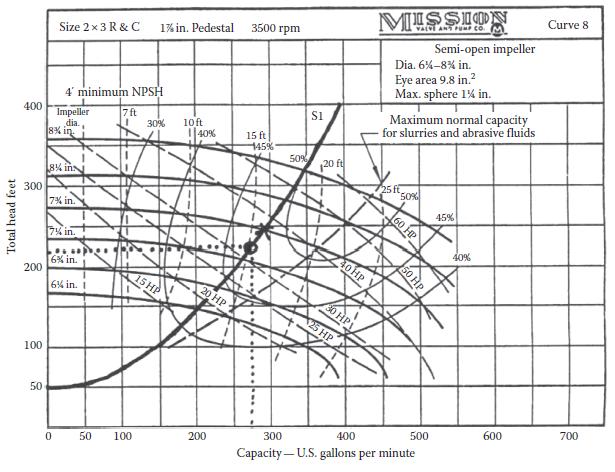
You must select a centrifugal pump that will develop a pressure of $40 \mathrm{psi}$ when pumping a liquid with an SG of 0.88 at a rate of $300 \mathrm{gpm}$. From all the pump characteristic curves in Appendix H, select the best pump for this job. Specify pump head, impeller diameter, motor speed,
An oil with a $32.6^{\circ} \mathrm{API}$ gravity at $60^{\circ} \mathrm{F}$ is to be transferred from a storage tank to a process unit, that is $10 \mathrm{ft}$ above the tank, at a rate of $200 \mathrm{gpm}$. The piping system contains $200 \mathrm{ft}$ of $3 \mathrm{in}$. sch 40 pipe,
You must purchase a centrifugal pump to circulate cooling water that will deliver $5000 \mathrm{gpm}$ at a pressure of $150 \mathrm{psi}$. If the pump is driven by an $1800 \mathrm{rpm}$ motor, what should the horsepower and torque rating of the motor be, and how large (diameter) should the pump
In order to pump a fluid of $\mathrm{SG}=0.9$ at a rate of $1000 \mathrm{gpm}$ through a piping system, a hydraulic power of $60 \mathrm{hp}$ is required. Determine the required pump head, the torque of the driving motor, and the estimated impeller diameter if an $1800 \mathrm{rpm}$ motor is used.
From your prior analysis of pumping requirements for a water circulating system, you have determined that a pump capable of delivering $500 \mathrm{gpm}$ at a pressure of $60 \mathrm{psi}$ is required. If a motor operating at $1800 \mathrm{rpm}$ is chosen to drive the pump, which is $70 %$
You want to pump water at $70^{\circ} \mathrm{F}$ from an open well, $200 \mathrm{ft}$ deep, at a rate of $30 \mathrm{gpm}$ through a $1 \mathrm{in}$. sch 40 pipe, using a centrifugal pump having an NPSH of $8 \mathrm{ft}$. What is the maximum distance above the water level in the well that the
Steam condensate at $1 \mathrm{~atm}$ and $95^{\circ} \mathrm{C}\left(P_{\mathrm{v}}=526 \mathrm{mmHg}\right)$ is returned to a boiler from the condenser by a centrifugal boiler feed pump. The flow rate is $100 \mathrm{gpm}$ through a $2.5 \mathrm{in}$. sch 40 pipe. If the equivalent length of the
Water at $160^{\circ} \mathrm{F}$ is to be pumped at a rate of $100 \mathrm{gpm}$ through a 2 in. sch 80 steel pipe from one tank to another located $100 \mathrm{ft}$ directly above the first. The pressure in the lower tank is $1 \mathrm{~atm}$. If the pump to be used has a required NPSH of $6
A pump with a 1 in. diameter suction line is used to pump water from an open hot water well at a rate of $15 \mathrm{gpm}$. The water temperature is $90^{\circ} \mathrm{C}$, with a vapor pressure of $526 \mathrm{mmHg}$ and density of $60 \mathrm{lb}_{\mathrm{m}} / \mathrm{ft}^{3}$. If the pump NPSH
Hot water is to be pumped out of an underground geothermally heated aquifer located $500 \mathrm{ft}$ below ground level. The temperature and pressure in the aquifer are $325^{\circ} \mathrm{F}$ and $150 \mathrm{psig}$. The water is to be pumped out at a rate of $100 \mathrm{gpm}$ through $2.5
You must install a centrifugal pump to transfer a volatile liquid from a remote tank to a point in the plant $500 \mathrm{ft}$ from the tank. To minimize the distance that the power line to the pump must be strung, it is desirable to locate the pump as close to the plant as possible. If the liquid
It is necessary to pump water at $70^{\circ} \mathrm{F}\left(P_{\mathrm{v}}=0.35 \mathrm{psia}\right)$ from a well that is $150 \mathrm{ft}$ deep, at a flow rate of $25 \mathrm{gpm}$. You do not have a submersible pump, but you do have a centrifugal pump with the required capacity that cannot be
You must select a pump to transfer an organic liquid with a viscosity of $5 \mathrm{cP}$ and $\mathrm{SG}$ of 0.87 at a rate of $1000 \mathrm{gpm}$ through a piping system that contains $1000 \mathrm{ft}$ of $8 \mathrm{in}$. sch 40 pipe, 4 globe valves, 16 gate valves, and 43 std $90^{\circ}$
You need a pump that will develop at least $40 \mathrm{psi}$ at a flow rate of $300 \mathrm{gpm}$ of water. What combination of pump size, motor speed, and impeller diameter from the pump characteristics in Appendix H would be the best for this application? State your reasons for the choice you
A centrifugal pump takes water from a well at $120^{\circ} \mathrm{F}$ (vapor pressure $P_{\mathrm{v}}=87.8 \mathrm{mmHg}$ ) and delivers it at a rate of $50 \mathrm{gpm}$ through a piping system to a storage tank. The pressure in the storage tank is $20 \mathrm{psig}$, and the water level is $40
Water at $20^{\circ} \mathrm{C}$ is pumped at a rate of $300 \mathrm{gpm}$ from an open well in which the water level is $100 \mathrm{ft}$ below ground level into a storage tank that is $80 \mathrm{ft}$ above ground. The piping system contains $700 \mathrm{ft}$ of $3 \frac{1}{2} \mathrm{in}$ in.
An organic fluid is to be pumped at a rate of $300 \mathrm{gpm}$, from a distillation column reboiler to a storage tank. The liquid in the reboiler is $3 \mathrm{ft}$ above ground level, the storage tank is $20 \mathrm{ft}$ above ground, and the pump will be at ground level. The piping system
A liquid with a viscosity of $5 \mathrm{cP}$, density of $45 \mathrm{lb}_{\mathrm{m}} / \mathrm{ft}^{3}$, and vapor pressure of $20 \mathrm{psia}$ is transported from a storage tank in which the pressure is 30 psia to an open tank $500 \mathrm{ft}$ downstream, at a rate of $100 \mathrm{gpm}$. The
You must determine the specifications for a pump to transport water at $60^{\circ} \mathrm{C}$ from one tank to another at a rate of $200 \mathrm{gpm}$. The pressure in the upstream tank is $1 \mathrm{~atm}$, and the water level in this tank is $2 \mathrm{ft}$ above the level of the pump. The
A piping system for transporting a liquid ( $\mu=50 \mathrm{cP}, ho=0.85 \mathrm{~g} / \mathrm{cm}^{3}$ from vessel A to vessel B) consists of $650 \mathrm{ft}$ of $3 \mathrm{in}$. sch 40 commercial steel pipe containing 4 globe valves and 10 elbows. The pressure is atmospheric in A and 5 psig B,
You must choose a centrifugal pump to pump a coal slurry. You have determined that the pump must deliver $200 \mathrm{gpm}$ at a pressure of at least $35 \mathrm{psi}$. Given the pump characteristic curves in Appendix H, tell which pump you would specify (give pump size, speed, and impeller
You must specify a pump to take an organic stream from a distillation reboiler to a storage tank. The liquid has a viscosity of $5 \mathrm{cP}$, an $\mathrm{SG}$ of 0.78 , and a vapor pressure of $150 \mathrm{mmHg}$. The pressure in the storage tank is $35 \mathrm{psig}$, and the inlet to the tank
You have to select a pump to transfer benzene from the reboiler of a distillation column to a storage tank at a rate of $250 \mathrm{gpm}$. The reboiler pressure is $15 \mathrm{psig}$ and the temperature is $60^{\circ} \mathrm{C}$. The tank is $5 \mathrm{ft}$ higher than the reboiler and is at a
A circulating pump takes hot water at $85^{\circ} \mathrm{C}$ from a storage tank, circulates it through a piping system at a rate of $150 \mathrm{gpm}$, and discharges it to the atmosphere. The tank is at atmospheric pressure, and the water level in the tank is $20 \mathrm{ft}$ above the pump. The
A slurry pump must be selected to transport a coal slurry at a rate of $250 \mathrm{gpm}$ from an open storage tank to a rotary drum filter operating at $1 \mathrm{~atm}$. The slurry is $40 %$ solids by volume and has an $\mathrm{SG}$ of 1.2. The level in the filter is $10 \mathrm{ft}$ above that
A red mud slurry residue from a bauxite processing plant is to be pumped from the plant to a disposal pond at a rate of $1000 \mathrm{gpm}$, through a $6 \mathrm{in}$. ID pipeline that is $2500 \mathrm{ft}$ long. The pipeline is horizontal, and the inlet and discharge of the line are both at
A pipeline is installed to transport a red mud slurry from an open tank in an alumina plant to a disposal pond. The line is 5 in. sch 80 commercial steel, 12,000 ft long, and is designed to transport the slurry at a rate of $300 \mathrm{gpm}$. The slurry properties can be described by the Bingham
Calculate the work per pound of gas required to compress air from $70^{\circ} \mathrm{F}$ and 1 atm to $2000 \mathrm{psi}$ with an $80 %$ efficient compressor under the following conditions:(a) Single-stage isothermal compression.(b) Single-stage adiabatic compression.(c) Five-stage adiabatic
It is desired to compress ethylene gas $\left[\mathrm{MW}=28, k=1.3, c_{p}=0.357 \mathrm{Btu} /\left(\mathrm{lb}_{\mathrm{m}}{ }^{\circ} \mathrm{F}\right)\right]$ from $1 \mathrm{~atm}$ and $80^{\circ} \mathrm{F}$ to $10,000 \mathrm{psia}$. Assuming ideal gas behavior, calculate the compression
You have a requirement to compress natural gas $(k=1.3, \mathrm{MW}=18)$ from $1 \mathrm{~atm}$ and $70^{\circ} \mathrm{F}$ to 5000 psig. Calculate the work required to do this per pound of gas in a $100 %$ efficient compressor under the following conditions:(a) Isothermal single-stage
Air is to be compressed from $1 \mathrm{~atm}$ and $70^{\circ} \mathrm{F}$ to 2000 psia. Calculate the work required to do this per pound of air using the following methods:(a) A single-stage $80 %$ efficient isothermal compressor.(b) A single-stage $80 %$ efficient adiabatic compressor.(c) A
It is desired to compress $1000 \mathrm{scfm}$ of air from $1 \mathrm{~atm}$ and $70^{\circ} \mathrm{F}$ to $10 \mathrm{~atm}$. Calculate the total horsepower required if the compressor efficiency is $80 %$ for(a) Isothermal compression.(b) Adiabatic single-stage compression.(c) Adiabatic
You want to compress air from $1 \mathrm{~atm}, 70^{\circ} \mathrm{F}$, to $2000 \mathrm{psig}$, using a staged compressor with interstage cooling to $70^{\circ} \mathrm{F}$. The maximum compression ratio per stage you can use is about 6 , and the compressor efficiency is $70 %$.(a) How many stages
A $12 \mathrm{in}$. ID gas pipeline carries methane (molecular weight $(M=16)$ at a rate of $20,000 \mathrm{scfm}$. The gas enters the line at a pressure of $500 \mathrm{psia}$, and a compressor station is located every 100 miles to boost the pressure back up to $500 \mathrm{psia}$. The pipeline is
Natural gas $\left(\mathrm{CH}_{4}\right)$ is transported through a $6 \mathrm{in}$. ID pipeline at a rate of $10,000 \mathrm{scfm}$. The compressor stations are 150 miles apart, and the compressor suction pressure is maintained at 10 psig above that at which choked flow would occur in the
Natural gas (methane) is transported through a 20 in. sch 40 commercial steel pipeline at a rate of $30,000 \mathrm{scfm}$. The gas enters the line from a compressor at $100 \mathrm{psia}$ and $70^{\circ} \mathrm{F}$. Identicalcompressor stations are located every 10 miles along the line, and at
Natural gas (methane) is transported through an uninsulated 6 in. ID commercial steel pipeline, 1 mile long. The inlet pressure is 100 psia and the outlet pressure is $1 \mathrm{~atm}$. What is the mass flow rate of the gas and the compressor power required to pump it? $T_{1}=70^{\circ}
It is desired to transfer natural gas $\left(\mathrm{CH}_{4}\right)$ at a pressure of $200 \mathrm{psia}$ and a flow rate of $1000 \mathrm{scfs}$ through a 1 mile long uninsulated commercial steel pipeline into a storage tank at 20 psia. Can this be done using either a 6 or 12 in. ID pipe? What
A natural gas (methane) pipeline is designed to transport the gas at a rate of $5000 \mathrm{scfm}$. The pipe is $6 \mathrm{in}$. ID and the maximum pressure that the compressors can develop is $1500 \mathrm{psig}$. The compressor stations are located in the pipeline at the point at which the
Ethylene gas leaves a compressor at a pressure of $3500 \mathrm{psig}$ and is carried in a $2 \mathrm{in}$. sch 40 pipeline, $100 \mathrm{ft}$ long, to a unit where the pressure is $500 \mathrm{psig}$. The line contains two plug valves, one swing check valve, and eight flanged elbows. If the
A $12 \mathrm{in}$. ID natural gas (methane) pipeline carries gas at a rate of $20,000 \mathrm{scfm}$. The compressor stations are 100 miles apart, and the discharge pressure of the compressors is 500 psia. If the temperature of the surroundings is $70^{\circ} \mathrm{F}$, what is the required
The pressure in a reactor fluctuates between 10 and $30 \mathrm{psig}$. It is necessary to feed air to the reactor at a constant rate of $20 \mathrm{lb}_{\mathrm{m}} / \mathrm{h}$ from an air supply at $100 \mathrm{psig}, 70^{\circ} \mathrm{F}$. To do this, you insert an orifice into the air line
Oxygen is fed to a reactor at a constant rate of $10 \mathrm{lb}_{\mathrm{m}} / \mathrm{s}$ from a storage tank in which the pressure is constant at $100 \mathrm{psig}$ and the temperature is $70^{\circ} \mathrm{F}$. The pressure in the reactor fluctuates between 2 and 10 psig, so you want to
Methane is fed to a reactor at a rate of $10 \mathrm{lb}_{\mathrm{m}} / \mathrm{min}$. The methane is available in a pipeline at $20 \mathrm{psia}, 70^{\circ} \mathrm{F}$, but the pressure in the reactor fluctuates between 2 and 10 psia. To control the flow rate, you want to install an orifice
Ethylene gas ( $\mathrm{MW}=28, k=1.3, \mu=0.1 \mathrm{cP}$ ) at $100^{\circ} \mathrm{F}$ is fed to a reaction vessel from a compressor through $100 \mathrm{ft}$ of $2 \mathrm{in}$. sch 40 pipe containing 2 plug valves, one swing check valve, and 8 flanged elbows. If the compressor discharge
Nitrogen is fed from a high-pressure cylinder through $1 \frac{1}{4}$ ID stainless steel tubing, to an experimental unit. The line ruptures at a point that is $10 \mathrm{ft}$ from the cylinder. If the pressure of the nitrogen in the cylinder is $3000 \mathrm{psig}$ and the temperature is
A storage tank contains ethylene at $200 \mathrm{psig}$ and $70^{\circ} \mathrm{F}$. If a $1 \mathrm{in}$. ID line that is $6 \mathrm{ft}$ long containing a globe valve on the end is attached to the tank, what would the flow rate of gas be (in scfm) if(a) The valve is fully open?(b) The line breaks
A 2 in. sch 40 pipeline is connected to a storage tank containing ethylene at $100 \mathrm{psig}$ and $80^{\circ} \mathrm{C}$.(a) If the pipe breaks at a distance of $50 \mathrm{ft}$ from the tank, determine the rate at which the ethylene will leak out of the pipe (in $\mathrm{lb}_{\mathrm{m}} /
Saturated steam at $200 \mathrm{psig}\left(388^{\circ} \mathrm{F}\right.$, specific volume, $\left.u=2.13 \mathrm{ft}^{3} / \mathrm{lb}_{\mathrm{m}}, \mu=0.015 \mathrm{cP}\right)$ is fed from a header to a direct contact evaporator that operates at $10 \mathrm{psig}$. If the steam line is 2 in. sch
Air is flowing from a tank at a pressure of $200 \mathrm{psia}$ and $70^{\circ} \mathrm{F}$ through a venturi meter into another tank at a pressure of 50 psia. The venturi meter is mounted in a 6 ID pipe section (that is quite short) and has a throat diameter of $3 \mathrm{in}$. What is the mass
A tank containing air at $100 \mathrm{psia}$ and $70^{\circ} \mathrm{F}$ is punctured with a hole $1 \frac{1}{4} \mathrm{in}$. diameter. What is the mass flow rate of the air through the hole?
A pressurized tank containing nitrogen at 800 psig is fitted with a globe valve, to which is attached a line with $10 \mathrm{ft}$ of $1 / 4$ ID stainless steel tubing and three standard elbows. The temperature of the system is $70^{\circ} \mathrm{F}$. If the valve is left wide open, what is the
Gaseous chlorine $(\mathrm{M}=71)$ is transferred from a high-pressure storage tank at 500 psia and $60^{\circ} \mathrm{F}$, through an insulated $2 \mathrm{in}$. sch 40 pipe $200 \mathrm{ft}$ long, into another vessel where the pressure is 200 psia. What is the mass flow rate of the gas and its
A storage tank contains ethylene at a pressure of $200 \mathrm{psig}$ and a temperature of $70^{\circ} \mathrm{F}$ springs a leak. If the hole through which the gas is leaking is $1 / 2$ in. diameter, what is the leakage rate of the ethylene, in scfm?
A high-pressure cylinder containing $\mathrm{N}_{2}$ at $200 \mathrm{psig}$ and $70^{\circ} \mathrm{F}$ is connected by $1 / 4 \mathrm{in}$. ID stainless steel tubing, $20 \mathrm{ft}$ long, to a reactor in which the pressure is $15 \mathrm{psig}$. A pressure regulator at the upstream end of the
Oxygen is supplied to an astronaut through an umbilical hose that is $7 \mathrm{~m}$ long. The pressure in the oxygen tank is $200 \mathrm{kPa}$ at a temperature of $10^{\circ} \mathrm{C}$, and the pressure in the space suit is $20 \mathrm{kPa}$. If the umbilical hose has an equivalent roughness of
Ethylene ( $\mathrm{MW}=28)$ is transported from a storage tank, at $250 \mathrm{psig}$ and $70^{\circ} \mathrm{F}$, to a compressor station where the suction pressure is $100 \mathrm{psig}$. The transfer line is $1 \mathrm{in}$. $\mathrm{sch} 80,500 \mathrm{ft}$ long, and contains two ball valves
Air passes from a large reservoir at $70^{\circ} \mathrm{F}$ through an isentropic converging-diverging nozzle into the atmosphere. The area of the nozzle throat is $1 \mathrm{~cm}^{2}$, and that of the exit is $2 \mathrm{~cm}^{2}$. What is the reservoir pressure at which the flow in the nozzle
Air is fed from a reservoir through a converging-diverging nozzle into a $1 / 2 \mathrm{in}$. ID drawn steel tube that is $15 \mathrm{ft}$ long. The flow in the tube is adiabatic, and the reservoir temperature and pressure are $70^{\circ} \mathrm{F}$ and 200 psia.(a) What is the maximum flow rate
A gas storage cylinder contains nitrogen at $250 \mathrm{psig}$ and $70^{\circ} \mathrm{F}$. Attached to the cylinder is a 3 in. long $1 / 4$ in. sch 40 stainless steel pipe nipple, and attached to that is a globe valve followed by a diaphragm valve. Attached to the diaphragm valve is a $1
A compressor supplies natural gas (mainly $\mathrm{CH}_{4}$ ) to a pipeline. The compressor suction pressure is 20 psig and the discharge pressure is $1000 \mathrm{psig}$. The pipe is $5 \mathrm{in}$. sch 40 and the ambient temperature is $80^{\circ} \mathrm{F}$.(a) If the pipe breaks at a point 2
You have to feed a gaseous reactant to a reactor at a constant rate of $1000 \mathrm{scfm}$. The gas is stored in a tank, at $80^{\circ} \mathrm{F}$ and $500 \mathrm{psig}$, that is located $20 \mathrm{ft}$ from the reactor, in which the pressure fluctuates between 10 and 20 psig. You know that if
A pressure vessel containing nitrogen at $300^{\circ} \mathrm{F}$ has a relief valve installed on top of the vessel. The valve is set to open at a set pressure of 125 psig and exhausts its contents at atmosphericpressure. The valve has a nozzle that has a smoothly rounded entrance and is $1.5
A storage tank contains ethylene at $80^{\circ} \mathrm{F}$ and has a relief valve that is set to open at a pressure of $250 \mathrm{psig}$. The valve must be sized to relieve the gas at a rate of $85 \mathrm{lb}_{\mathrm{m}} / \mathrm{s}$ when it opens. The valve has a discharge coefficient (the
Write the general 3D equations for the definitions of each of the following laws: Fick's, Fourier's, Ohm's, and Newton's laws. Identify the conserved quantity in each of these laws. Can you represent all of these laws by the same generalized expression? If so, does that mean that all of these
The general expression for the conservation of any (conserved) quantity Q can be written in the form of Equation 1.12. We have said that “dollars” are also a conserved quantity, so Equation 1.12 should apply. Substituting “$” for Q in this equation and assuming that the “ system” is
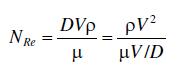
A dimensionless grouping of variables and parameters that are important in pipe flow is called the Reynolds number:where$V$ is the average velocity over the cross section in a pipe of diameter $D$$ho$ is the fluid density$\mu$ is the fluid viscosityComparing the numerator and denominator of the RHS
A layer of water is flowing down a flat plate that is inclined at an angle of $20^{\circ}$ to the vertical. If the depth of the layer is $1 / 4 \mathrm{in}$., what is the shear stress exerted by the plate on the water? (Remember: stress is a dyad, with two directions associated with each component.)
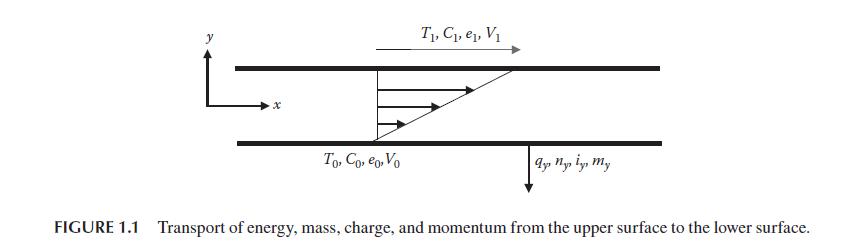
Basic Concepts by considering the simple one-dimensional steady flow between two parallel plates, Figure 1.1. The area of each plate $A_{y}=1 \mathrm{~m}^{2}$ and the gap between the two plates is $0.1 \mathrm{~mm}$ (very thin). Fluids of different viscosities, as listed below, are contained in
Showing 400 - 500
of 1550
1
2
3
4
5
6
7
8
9
10
11
12
13
14
15
Last
Step by Step Answers

 Get 50% OFF
Claim Now
Get 50% OFF
Claim Now