New Semester
Started
Get
50% OFF
Study Help!
--h --m --s
Claim Now
Question Answers
Textbooks
Find textbooks, questions and answers
Oops, something went wrong!
Change your search query and then try again
S
Books
FREE
Study Help
Expert Questions
Accounting
General Management
Mathematics
Finance
Organizational Behaviour
Law
Physics
Operating System
Management Leadership
Sociology
Programming
Marketing
Database
Computer Network
Economics
Textbooks Solutions
Accounting
Managerial Accounting
Management Leadership
Cost Accounting
Statistics
Business Law
Corporate Finance
Finance
Economics
Auditing
Tutors
Online Tutors
Find a Tutor
Hire a Tutor
Become a Tutor
AI Tutor
AI Study Planner
NEW
Sell Books
Search
Search
Sign In
Register
study help
sciences
mechanics
The Fundamentals Of Newtonian Mechanics 1st Edition Maurizio Spurio - Solutions
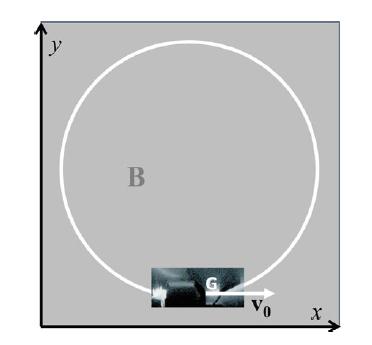
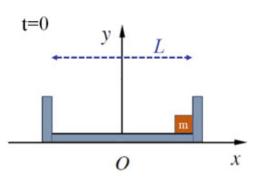
An industrial electromechanical device (Fig. 6.9) is used to stop small objects in motion that have become negatively charged by electrostatic friction during production. The motion of such objects takes place (with completely negligible friction) along the \(x\) axis as shown in the figure, with
A material point of mass \(m=500 \mathrm{~g}\) is suspended from a fixed point \(\mathrm{O}\) by an inextensible wire of length \(L=50 \mathrm{~cm}\). The material point, initially in an equilibrium position, is imparted an initial velocity \(v_{0}\). Calculate:1. the period of the motion, under
In the picture of Fig. 6.10, you see in action a fundamental force of nature (called the Lorentz force) acting on particles with electric charge \(q\). The Lorentz force is expressed by the relation \(\mathbf{F}=q \mathbf{v} \times \mathbf{B}\) where \(\mathbf{v}\) is the velocity of the particle,
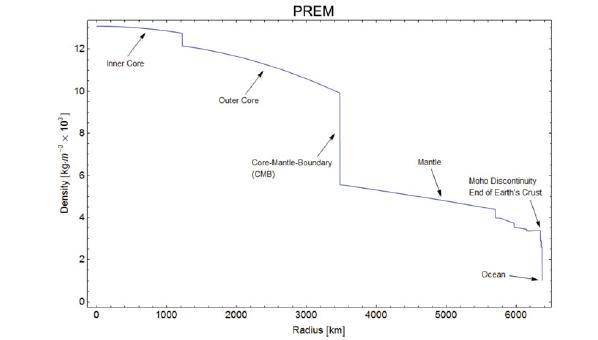
Estimate the mass \(M_{T}\) of the Earth using the density function given in Fig. 7.1. Assume constant density values in the regions of inner core, outer core, mantle, crust. Compare with the tabulated value \(M_{T}=5.97210^{24} \mathrm{~kg}\). Discuss the origin of the possible discrepancy (you
Estimate the number of atoms in a fine grain of sand, knowing that its diameter is about \(20 \mu \mathrm{m}\) and that the atomic distances are of the order of \(1 \AA=10^{-10} \mathrm{~m}\).
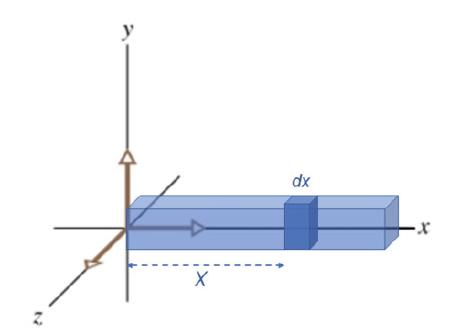
Determine the C.M. position of the rod of Fig. 7.6 in the case where the linear density \(\lambda\) of the rod varies with length according to the relation \(\lambda(x)=\lambda_{0} \frac{x+L}{L}\). Fig. 7.6 X dx -x
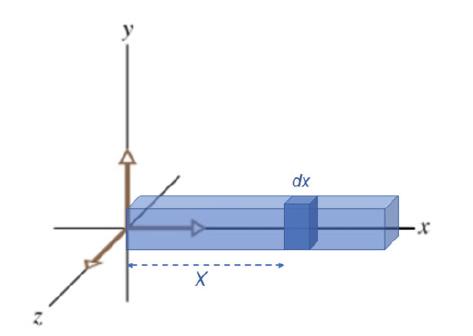
Determine the C.M. position of the rod of Fig. 7.6 in the case when its cross section in the \(y z\) plane is circular as in Fig. 7.7 (right) and with surface density \(\sigma\) of the rod cross section varying with radius according to the relation \(\sigma(r)=\sigma_{\circ}
An isolated system is made by two bodies of mass \(m_{1}=12.0 \mathrm{~kg}\) and \(m_{2}=2.0 \mathrm{~kg}\). They are initially in equilibrium and are separated by a distance \(d=1.23 \mathrm{~cm}\), attracting one another with a force of constant magnitude equal to \(F=0.21 \mathrm{~N}\) and
A person of mass \(m=67 \mathrm{~kg}\) stands on a boat of mass \(M=420 \mathrm{~kg}\). The boat can move, without friction, on the surface of a calm lake. The system is initially in equilibrium. The person starts walking on the boat in the right direction, with a constant speed \(v=4.0
A railway carriage of mass \(m=35.6\) ton moves with speed \(v_{0}=2.10 \mathrm{~m} / \mathrm{s}\) and hits, remaining attached to them, three other identical carriages, joined together and moving in the same direction with speed \(v=1.3 \mathrm{~m} / \mathrm{s}\). What is the magnitude of the
A bullet of mass \(m=120 \mathrm{~g}\) strikes horizontally, with velocity \(v_{0}\), a body of mass \(M=250 \mathrm{~g}\), hanging vertically from a pin by an ideal cable of length \(L=1.2 \mathrm{~m}\). Assuming that the collision between the two bodies is completely inelastic, find the minimum
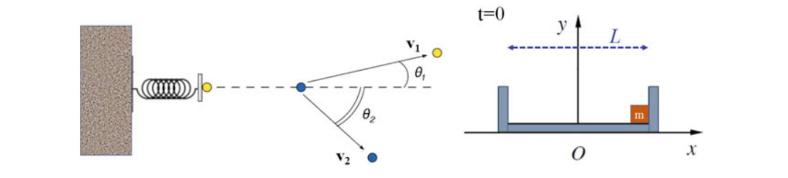
A neutron has a kinetic energy such that its initial velocity is \(\mathbf{v}_{i}^{n}=610^{5} \hat{\mathbf{i}} \mathrm{m} / \mathrm{s}\). It strikes a proton, a particle which can be assumed to have the same mass, initially at rest. It is observed that after the collision the proton moves with a
A firework of mass \(M=0.3 \mathrm{~kg}\) is designed to break into two fragments. It is launched with a velocity of magnitude \(v_{0}=60 \mathrm{~m} / \mathrm{s}\) in a direction that forms an angle of \(60^{\circ}\) with the horizontal plane. At the vertex of the parabola, \(M\) fragments into
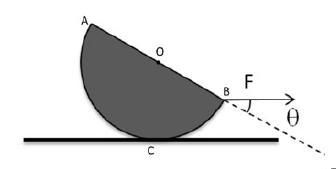
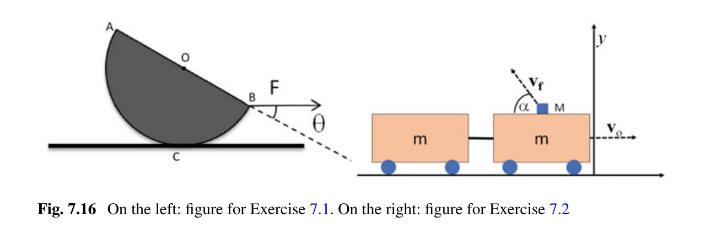
A homogeneous hemisphere, mass \(m=170 \mathrm{~g}\) and radius \(R=3.0 \mathrm{~cm}\), is placed on a horizontal plane and it is pulled by a horizontal force \(\mathbf{F}\), of unknown magnitude, applied at the point B (see Fig. 7.16). In these conditions the hemisphere moves with constant speed
Two carts connected to each other (Fig. 7.16) with a horizontal inextensible bar, move with a constant velocity \(v_{0}=10.0 \mathrm{~m} / \mathrm{s}\) on straight track parallel to the ground. Each cart consists of a horizontal platform of mass \(m=150 \mathrm{~kg}\) and four wheels of negligible
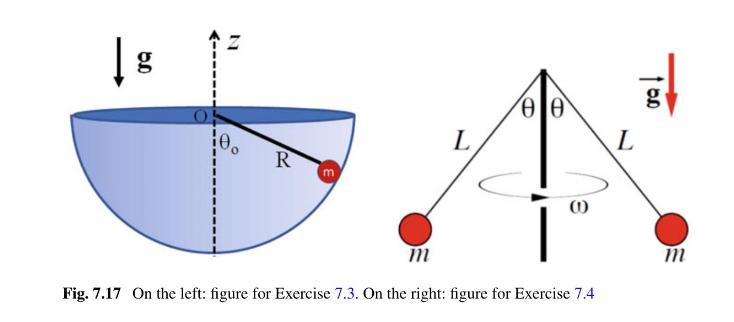
A ball of mass \(m\) and negligible size can slide without friction on the inner wall of a hemisphere of radius \(R=15 \mathrm{~cm}\), as shown in Fig. 7.17. The \(z\) axis shown in figure represents the direction in which gravity acts (downward). At the initial moment, the ball has a horizontal
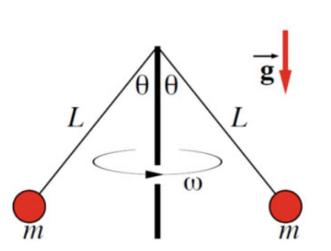
Two identical masses \(m=0.25 \mathrm{~kg}\) are suspended from a vertical rod by two rigid bars of length \(L=20 \mathrm{~cm}\) and negligible mass (Fig. 7.17, ). When the system rotates around the vertical axis with constant angular velocity \(\omega\), there exists a configuration in which the
A body with a mass of \(m=2.5 \mathrm{~kg}\) (including a small amount of negligible mass of explosive) is thrown vertically upwards with an initial velocity of magnitude \(v_{0}\). When it reaches the maximum altitude \(h=250 \mathrm{~m}\), the body explodes into two fragments with masses
A simple estimate of the intensity of an impulsive force can be obtained by dropping a tennis ball (mass \(m=58 \mathrm{~g}\), radius \(R=32.5 \mathrm{~mm}\) ) with a rigid floor. If dropped at rest from an altitude \(h=2.0 \mathrm{~m}\), an almost completely elastic impact can be considered, and
A hollow cylinder is closed at the top end by a movable piston of mass \(M\) that can slide in the hollow part of the cylinder without friction. A flow of gas equal to \(\Phi=\frac{\Delta M_{\text {gas }}}{\Delta t}\left(\mathrm{~g} \mathrm{~s}^{-1}\right)\) is made to flow through a small tube.
A mechanical system consists of a cubic block of mass \(M\) and a spring of elastic constant \(k\) and negligible mass rigidly anchored above the block. The cube \(M\) is stationary on a horizontal plane with friction, and the coefficient of static friction is \(\mu_{s}\). A projectile of mass
A rocket, in the absence of gravity and other external forces, expels gas at a speed \(v_{g}=1.5\) \(\mathrm{km} / \mathrm{s}\) relative to the engines, starting from a standstill. What is its speed increment when it has ejected \(4 / 5\) of its mass?
If \(v_{g}\) is the speed of the ejected gases relative to the engine of a rocket, determine the ratio of the initial mass to the final mass of the rocket to obtain a final rocket speed of \(v_{f}=10 v_{g}\).
Compare the performance of a one-stage rocket with that of a two-stage rocket having similar fuel mass and structure mass. Rocket \(A\) has mass \(M_{A}=11 \mathrm{t}\), of which \(m_{A}^{c}=9.7 \mathrm{t}\) is the fuel mass, and its engines are capable of emitting exhaust gases with velocity
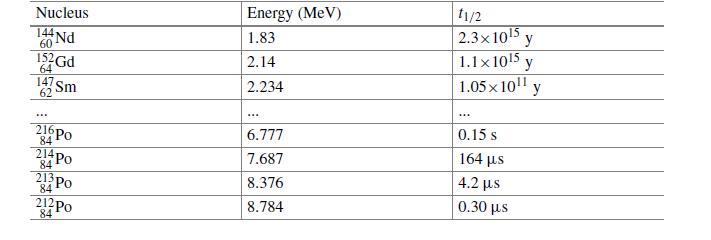
In Table 8.1 are reported half lives of nuclei with values greater than \(10^{15}\) years, while the current age of the Universe is only \(1.37 \times 10^{10}\) years. Could you explain how it is possible to measure half lives of nuclei so much longer than the life of the Universe itself? Table
A projectile particle has mass \(m_{a}\) and that target mass \(m_{b}\). Determine under what conditions, in a perfectly elastic collision, there is maximum energy transfer between the projectile and the initially stationary target \(\left(v_{2}=0\right)\).
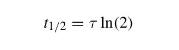
Show that the relationship between half-life \(t_{1 / 2}\) and mean life \(\tau\) is given by the relation 11/2 = 7 In(2)
A small ball of mass \(M=800 \mathrm{~g}\) and negligible size lies on a smooth horizontal plane and is initially attached to the end of a spring of spring constant \(k\) so as to compress it by a distance \(d_{0}=2.00 \mathrm{~cm}\). The ball is subsequently released and moves across the plane
Consider a sled of mass \(M=10 \mathrm{~kg}\) and length \(L=1.0 \mathrm{~m}\) on which is placed a mass \(m=3 \mathrm{~kg}\) (considered point-like) that can slide without friction in the plane of the sled, as in Fig.8.14. Initially, the system is stationary, the center of mass of the sled is at
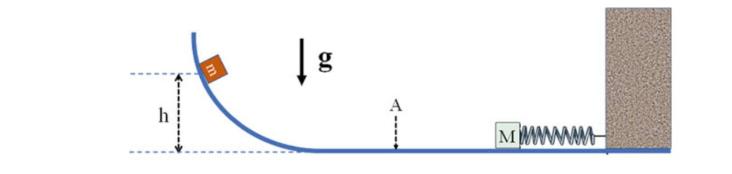
A body of mass \(m=10.0 \mathrm{~g}\) is dropped from an initial height \(h=50.0 \mathrm{~cm}\) along a frictionless circular guide, as in Fig. 8.15. At the end of the circular guide, the body moves on a horizontal plane also without friction and hits into a bumper of mass \(M\), initially
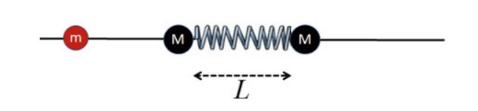
A device schematized in Fig.8.16 consists of: two equal balls of mass \(M=40 \mathrm{~g}\), constrained to move without any friction along a straight guide, connected by a spring of elastic constant \(k=300 \mathrm{~N} / \mathrm{m}\), rest length \(L\) and negligible mass. Initially, the device is
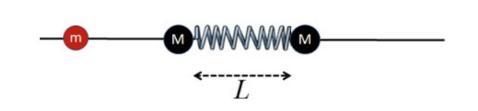
There are the three particles shown in the Fig. 8.16, with \(m=1.00 \mathrm{~kg}\) and \(M=2 m\). The three particles are aligned in the direction of their centers, and no sources of friction are present. The two particles each of mass \(M\) are attached to a spring of negligible mass and elastic
A ball of mass \(m=0.200 \mathrm{~kg}\) is launched from ground level, with velocity \(v_{0}\) and an angle of elevation \(\alpha=65^{\circ}\), toward a smooth wall, perpendicular to the trajectory, which is \(d=0.90\) \(\mathrm{m}\) from the launch point. The ball impacts (almost instantaneously)
The mole is the unit for measuring the amount of substance, and is defined as the amount of substance that contains \(6.0225 \times 10^{23}\) elementary entities. This corresponds to the numerical value of Avogadro's constant, \(N_{A}\). The molecular mass of a substance is the ratio of the mass of
With the data from the previous question, how many water molecules are there in one \(\mathrm{cm}^{3}\) (under standard pressure and temperature conditions)?Previous QuestionThe mole is the unit for measuring the amount of substance, and is defined as the amount of substance that contains \(6.0225
Determine the number \(n\) of atoms per \(\mathrm{cm}^{3}\) present in gold \((Z=79, A=197\), density 19.3 \(\mathrm{g} / \mathrm{cm}^{3}\) ) and estimate the distance between the centers of two atoms, assuming the atoms are arranged on a cubic lattice.
In an experiment in which helium nuclei are sent against a target consisting of \(1 \mathrm{~mm}\) of gold, it is observed that \(99.9 \%\) reaches a detector that is on the beam line. Assuming that all the atomic mass is concentrated in the spherical-shaped nucleus, and neglecting the size of the
The mass of an atom is concentrated in the nucleus. The nuclear radius is expressible in terms of the mass number \(A\) by the relation \(R=1.2 A^{1 / 3} \mathrm{fm}\), where \(1 \mathrm{fm}=10^{-15} \mathrm{~m}\). The quantity \(A\) represents the number of nucleons, that is, the sum of protons
The density of the interstellar medium in our Galaxy is measured to be \(10^{-21} \mathrm{~kg} \mathrm{~m}^{-3}\) and consists mainly of hydrogen. Estimate how many hydrogen atoms per \(\mathrm{cm}^{3}\) are present in the Galaxy.
The Galaxy can be schematized as a disk of radius \(15 \mathrm{kpc}\) and thickness \(200 \mathrm{pc}\). Since we know that \(1 \mathrm{pc}=3.08 \times 10^{16} \mathrm{~m}\), determine the volume of the Galaxy and the total mass of gas in the interstellar medium. Use the data from the question
A glass filled with water has radius \(3 \mathrm{~cm}\); left open, in \(4 \mathrm{~h}\) the level has dropped \(1 \mathrm{~mm}\). Determine, in grams/hour, the rate at which water evaporates. Also determine how many water molecules evaporate in one second per \(\mathrm{cm}^{2}\) of surface area.
A beam sending neutrinos from CERN, Geneva-Switzerland, to the Gran Sasso Laboratories in Italy, near L'Aquila, was operational between 2006 and 2012. The distance as the crow flies (i.e., along the Earth's maximum circle passing between the two sites) is \(730 \mathrm{~km}\). The midpoint
Looking at the relationship (1.12), determine the percent error made using the approximation \(\sin \theta=\theta\) for angles equal to \(10^{\circ}, 5^{\circ}\) and \(1^{\circ}\). sin xx - - 6 +0(x) (1.12)
Three fundamental magnitudes connecting quantities defined in mechanics are: \((i)\) the speed of light in vacuum, \(c=299792458 \mathrm{~m} \mathrm{~s}^{-1}\); (ii) Planck's reduced constant, \(\hbar=1.0545910^{-34}\) J s. It defines the "quantum" of angular momentum, a quantity introduced in
Still making use of the three quantities introduced in the question 13, using dimensional analysis get the quantity with the dimensions of a time, \(t_{P}\), called Planck time. Express \(t_{P}\) in \(\mathrm{s}\).Question 13Three fundamental magnitudes connecting quantities defined in mechanics
Still making use of the three quantities introduced in the question 13, using dimensional analysis get the quantity with the dimensions of a length, \(l_{P}\), called Planck's length. Express \(l_{P}\) in \(\mathrm{m}\).Question 13Three fundamental magnitudes connecting quantities defined in
The law of radioactive decay is given by the relation \(N(t)=N_{o} e^{-\lambda t}\), where \(N_{o}\) is the initial number of nuclei of a certain substance, \(N(t)\) those remaining after a certain time \(t\) and \(\lambda\) a constant characteristic of each radioactive substance. The half-life,
What relation must be valid between the vectors \(\mathbf{a}\) and \(\mathbf{b}\), which are different from each other and nonzero, so that the relation: \((\mathbf{a}+\mathbf{b}) \times(\mathbf{a}-\mathbf{b})=0\) is verified?
Show that if the magnitudes of the sum and difference between two vectors are equal, then the vectors are perpendicular to each other.
In a Cartesian reference system two vectors are defined as \(\mathbf{a}=2 c \hat{\mathbf{i}}-\hat{\mathbf{j}}+4 \hat{\mathbf{k}}\) and \(\mathbf{b}=4 \hat{\mathbf{i}}+\) \((c-1) \hat{\mathbf{j}}+5 \hat{\mathbf{k}}\). For which values of \(c\) are the two vectors orthogonal?
Show that if the sum and difference between two vectors are perpendicular, then the magnitudes of the two vectors are equal.
Two vectors \(\mathbf{a}\) and \(\mathbf{b}\) are equal in magnitude. Their sum has magnitude 4 and their vector product magnitude 16.Determine the magnitude of the two vectors.
Two vectors \(\mathbf{a}\) and \(\mathbf{b}\) comply with the following conditions: \((i) \mathbf{a} \cdot \mathbf{b}=20 ;(\) ii \()(\mathbf{a}+\mathbf{b}) \cdot \mathbf{a}=36\); (iii) \((\mathbf{a}+\mathbf{b}) \cdot \mathbf{b}=45\). Determine the magnitude of the two vectors and the angle
A displacement \(\mathbf{s}\) of magnitude \(3 \mathrm{~m}\) is made in a Cartesian system at an angle \(\theta=30^{\circ}\) with the \(x\)-axis. Express the vector in Cartesian coordinates.
Find the vector \(\mathbf{c}\) which added to the vectors \(\mathbf{a}=(4 \hat{\mathbf{i}}+3 \hat{\mathbf{j}}-2 \hat{\mathbf{k}})\) and \(\mathbf{b}=(2 \hat{\mathbf{i}}-\hat{\mathbf{j}}+\hat{\mathbf{k}})\) gives as a resultant \(\mathbf{r}=(4 \hat{\mathbf{i}}+3 \hat{\mathbf{j}}+1 \hat{\mathbf{k}})\)
Given the two vectors \(\mathbf{a}\) and \(\mathbf{b}\) of the Question 8 express their sum, difference, scalar product and vector product in Cartesian coordinates. What is the angle \(\alpha\) between them?Question 8Find the vector \(\mathbf{c}\) which added to the vectors \(\mathbf{a}=(4
Given two vectors \(\mathbf{a}\) and \(\mathbf{b}\), show that in intrinsic representation their vector product \(\mathbf{A}=\mathbf{a} \times \mathbf{b}\) corresponds to the oriented area of the parallelogram defined by the two vectors. Calculate the magnitude of the area in the case of the two
Given three vectors \(\mathbf{a}, \mathbf{b}\) and \(\mathbf{c}\) show that in intrinsic representation the magnitude: \(V=(\mathbf{a} \times\) b) - c corresponds to the volume of the parallelepiped defined by the three vectors. Calculate the volume in the case of the vectors \(\mathbf{a},
Given three vectors \(\mathbf{a}, \mathbf{b}\) and \(\mathbf{b}\) show, making use of the representation with the determinant that: \((\mathbf{a} \times \mathbf{b}) \cdot \mathbf{c}=\mathbf{a} \cdot(\mathbf{b} \times \mathbf{c})=\mathbf{b} \cdot(\mathbf{a} \times \mathbf{c})\). If not, the
Demonstrate the property of BAC-CAB: \((\mathbf{a} \times \mathbf{b}) \times \mathbf{c}=\mathbf{b}(\mathbf{a} \cdot \mathbf{c})-\mathbf{c}(\mathbf{a} \cdot \mathbf{b})\), verifying it by direct development after arranging the vector \(\mathbf{c}\) along the \(x\) axis and the vector \(\mathbf{b}\)
An automobile A travels on a straight road at the constant speed \(v_{A}=75 \mathrm{~km} / \mathrm{h}\). A second car B arrives at the speed \(v_{B}=130 \mathrm{~km} / \mathrm{h}\) and starts braking inducing a constant deceleration \(a_{B}=-9.0 \mathrm{~m} / \mathrm{s}^{2}\) when it is at the
A particle moves in uniformly accelerated motion on a straight line. After \(t_{1}=4 \mathrm{~s}\) it has traveled \(60 \mathrm{~m}\) and has a velocity \(v_{1}=33 \mathrm{~m} / \mathrm{s}\). Determine the acceleration and initial velocity.
The equation of motion of a material point is expressed by the relation \(x(t)=\alpha t^{3}-\beta t^{2}-\gamma\), with the constants \(\alpha, \beta, \gamma\) real positive. Determine velocity and acceleration. What type of motion is involved?
Verify that the range \(x_{G}\) of a projectile is given by the (3.30). XG 2v sin cos 0 9 v sin 20 (3.30) 9
Two cannons are placed in the same position at different altitudes, \(h_{1}\) and \(h_{2}\). Two projectiles are fired simultaneously and horizontally. Calculate what ratio the two initial velocities \(v_{1}\) and \(v_{2}\) must be for the two projectiles to have the same range.
Verify that the launch angle \(\theta\) that produces the maximum range corresponds to \(45^{\circ}\). Verify further that in the absence of friction, although the trajectory changes, the range remains the same for angles that differ by the same amount (positive or negative) from the angle
A particle moves on a straight line with acceleration \(a(t)=\alpha t+\beta\), with \(\alpha=18 \mathrm{~m} / \mathrm{s}^{3}\) and \(\beta=-8 \mathrm{~m} / \mathrm{s}^{2}\). Calculate its velocity at time \(t_{1}=3 \mathrm{~s}\) knowing that the velocity at the initial time is \(v_{0}=2 \mathrm{~m}
One wants to determine the depth \(h\) of a well experimentally. For this purpose, you throw a stone into it, and you hear the thud at the bottom after a time \(\tau=3.0 \mathrm{~s}\). The speed of sound is worth \(v_{s}=340 \mathrm{~m} / \mathrm{s}\). What is the value \(h\) ?
Determine the angular speed of the hour and minute hands of a clock (of course, with hands and not digital!). If at 3:00 (a.m. or p.m.) the angle between the hour hand and minute hand form an angle of \(90^{\circ}\), calculate after how long the hands are exactly overlapping.
An observer is stationary on a merry-go-round at a distance \(R=3 \mathrm{~m}\) from the axis of rotation. The merry-go-round, starting from a standstill, begins to rotate with constant angular acceleration \(\dot{\omega}=0.1 \mathrm{rad} / \mathrm{s}^{2}\). Determine the time \(t_{1}\) at which
The position vector along a trajectory expressed in terms of the scalar distance \(s\) from the origin is given by the relation \(\mathbf{r}=\mathbf{a} s^{2}+\mathbf{b} s+\mathbf{c}\), with the condition that \(\mathbf{a}=0\) Determine the dimensions of the vectors \(\mathbf{a}, \mathbf{b},
A particle is constrained to move on a circular guideway of radius \(R=3.00 \mathrm{~m}\), on which it can slide without friction, according to the motion equation law \(s(t)=k t^{3}\), with \(k=2.0 \mathrm{~m} / \mathrm{s}^{3}\). Calculate the tangential component \(a_{t}\) and the normal
A particle moves on a predetermined trajectory with the equation of motion \(s(t)=k t^{2}\), with \(k\) constant and with magnitude of the acceleration equal to \(a=2 k\). Show by using (3.74) that the radius of curvature is given by the relation
In the case considered in the question (14), show what the trajectory corresponds to in case the magnitude of acceleration is \(a=2 k \sqrt{1+\frac{t}{T}}\), where \(T=\) cost. Question 14A particle moves on a predetermined trajectory with the equation of motion \(s(t)=k t^{2}\), with \(k\)
The equation of motion of a particle is given in Cartesian coordinates by the relation \(\mathbf{r}(t)=\alpha t^{2} \hat{\mathbf{i}}+\beta t^{2} \hat{\mathbf{j}}\). Determine (i) the trajectory of the motion and (ii) the scalar function \(s(t)\) indicating the distance traveled as time varies. The
A projectile is launched from the Earth's surface with velocity \(v_{0}=50.0 \mathrm{~m} / \mathrm{s}\), at an angle \(\theta=60^{\circ}\) to the vertical. Determine the radius of curvature of the projectile's trajectory at the time immediately following the launch.
The position of a particle is defined by the position vectorwhere numerically \(a=0.33, b=0.71, c=1.0\). Determine:1. the dimensions of \(a, b, c\);2. the function describing the velocity and acceleration vectors;3. the average speed \(v_{m}\) in the time interval between \(t=0 \mathrm{~s}\) and
As an exercise in ballistics, we use the example of a soccer ball approximated as a point object (i.e., not subject to rotations, and the "effects" of the ball related to it). We also neglect all dissipative sources (friction, deformation, etc.). A player kicks a free kick from a distance \(L=19\)
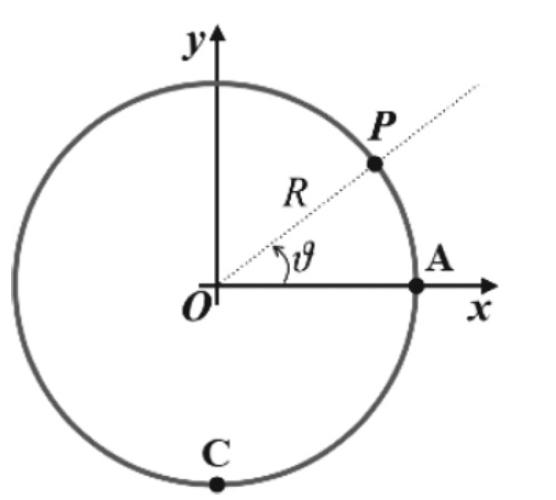
A particle \(\mathrm{P}\) is moving on a circumference of radius \(R=3.50 \mathrm{~m}\) according to an angular speed given by \(\omega(t)=k t^{2}\), with \(k=13.18\) degrees \(/ \mathrm{s}^{3}\) and starting from rest. Consider a system of Cartesian axes placed on the plane of the circle, with
A particle is simultaneously subjected to a force of magnitude \(F_{1}=34 \mathrm{~N}\) along the negative direction of the \(x\) axis, and to a force of magnitude \(F_{2}=25 \mathrm{~N}\) that forms an angle \(\theta=30^{\circ}\) with the positive \(x\) axis. Calculate the magnitude and direction
A particle of mass \(m=650 \mathrm{~g}\), initially stationary, is subjected to the action of a constant force \(\mathbf{F}_{1}=34 \hat{\mathbf{i}} \mathrm{N}\). After a time \(t_{1}=1.5 \mathrm{~s}\) the action of \(\mathbf{F}_{1}\) ceases and it is observed that the particle slows down uniformly,
A passenger car is traveling at \(v_{0}=11.1 \mathrm{~m} / \mathrm{s}\) downhill along a road of slope \(15^{\circ}\). At a certain instant it brakes by locking all wheels simultaneously until it comes to a stop. The dynamic coefficient of friction between tires and asphalt is \(\mu_{d}=0.75\).
A body of mass \(m=2.4 \mathrm{~kg}\) slides on a rough horizontal plane, with static and dynamic coefficients of friction \(\mu_{s}=0.45\) and \(\mu_{d}=0.35\), respectively. If the body is initially stationary, determine the magnitude of the minimum force \(F\) (parallel to the horizontal plane)
Two masses \(m_{1}=5.0 \mathrm{~kg}\) and \(m_{2}=2.0 \mathrm{~kg}\) are joined by an inextensible rope of negligible mass. The mass \(m_{1}\) rests on a rough horizontal plane while \(m_{2}\) is placed on a perfectly smooth plane inclined \(30^{\circ}\) with respect to the ground. Determine the
An AMAZON pack of mass \(7.0 \mathrm{~kg}\) is stationary on a horizontal rough surface. The coefficient of static friction for the pack is \(\mu_{s}=0.85\). The pack sorting device acts with a force \(\mathbf{F}\) that forms an angle of \(30^{\circ}\) with respect to the ground. Draw the forces
Show that for the motion of a pendulum given by (4.40), the speed has maximum value in absolute value and negative sign at the time \(t=\pi / 2 \omega\). This causes the pendulum to continue motion in the negative-angle region. In contrast, the velocity has maximum (positive) value at time \(t=3
A stressed spring moves with harmonic motion of period \(T\). Its elongation at time \(t_{1}=T / 8\) \(\mathrm{s}\) is equal to \(x_{1}=2 \mathrm{~cm}\), and its velocity and acceleration are equal to \(v_{1}=-4 \mathrm{~cm} / \mathrm{s}\) and \(a_{1}=-8 \mathrm{~cm} / \mathrm{s}^{2}\),
A sphere of mass \(m=150 \mathrm{~g}\) rotates with constant angular frequency \(\omega=2.9 \mathrm{rad} / \mathrm{s}\) in a circular path on a horizontal plane, held on the circular trajectory by a spring of rest length \(L=14 \mathrm{~cm}\) and constant \(k=20 \mathrm{~N} / \mathrm{m}\).
Two packs \(\mathrm{A}\) and \(\mathrm{B}\) of mass \(m_{A}=2.2 \mathrm{~kg}\) and \(m_{B}=2.8 \mathrm{~kg}\) are connected by an inextensible rope of negligible mass. Pack A rests on an inclined plane \(25^{\circ}\) relative to the ground plane and is attached at the lower end to a spring of
A particle lies on a smooth plane inclined \(35^{\circ}\) with respect to the ground and resting on a spring of elastic constant \(k=55 \mathrm{~N} / \mathrm{m}\). The spring to support the body shortens by \(\Delta l=10\) \(\mathrm{cm}\). Determine the mass of the particle and what the static
A conical pendulum is a device analogous to a simple pendulum, except that the mass can rotate along a horizontal circumference in the \(x, y\) plane while the acceleration of gravity is along the \(z\) direction. A conical pendulum consists of a particle of mass \(m=80 \mathrm{~g}\) attached to an
A box of mass \(M=38.6 \mathrm{~kg}\) rests on a horizontal plane with static friction coefficients \(\mu_{s}=0.810\) and dynamic friction coefficients \(\mu_{d}=0.525\). You want to move the box by applying a force of magnitude \(F\) through an inextensible rope of negligible mass, which forms an
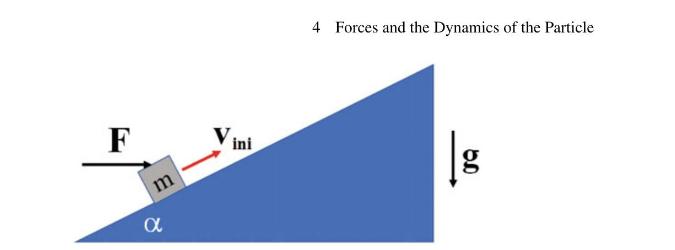
To a block of mass \(m=4.8 \mathrm{~kg}\) that is on an inclined plane at an angle \(\alpha=38^{\circ}\) to the horizontal, is applied the horizontal force, drawn in Fig. 4.13, of magnitude equal to \(F=47 \mathrm{~N}\). The dynamic friction coefficient between block and the inclined plane is
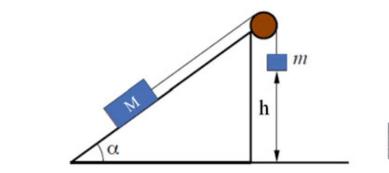
Consider a plane, inclined at an angle \(\alpha=20^{\circ}\) to the horizontal, rough, on which is placed a mass \(M=910 \mathrm{~g}\). The latter is connected to a bucket of mass \(m=490 \mathrm{~g}\) by an inextensible rope of negligible mass and a pulley, also of negligible mass, free to rotate
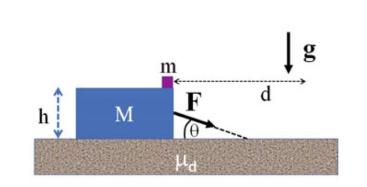
Consider as in Fig. 4.14 a block of mass \(M=1.35 \mathrm{~kg}\) placed on a rough horizontal plane with dynamic coefficient of friction \(\mu_{d}=0.250\) to which a constant force \(\mathbf{F}\) is applied. The force forms with the horizontal an angle \(\theta=40^{\circ}\), so that \(\mathbf{F}\)
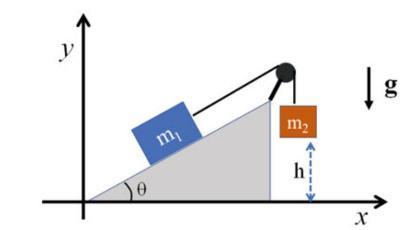
A wedge of very large mass and angle \(\theta=30^{\circ}\) is resting on a horizontal surface as shown in Fig.4.15. Two bodies, of mass \(m_{1}=500 \mathrm{~g}\) and \(m_{2}\) are arranged as in the figure and connected to each other by a inextensible rope of negligible mass, running on a pulley
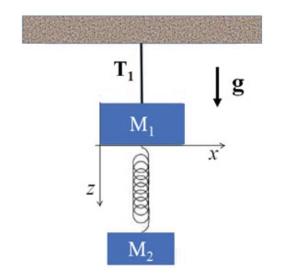
Two blocks of mass \(M_{1}=1.20 \mathrm{~kg}\) and \(M_{2}=0.25 \mathrm{~kg}\) are hung as in Fig. 4.15: \(M_{1}\) is hung from the ceiling by an inextensible wire of negligible mass, while \(M_{2}\) is hung from \(M_{1}\) by an ideal spring of elastic constant \(k=30 \mathrm{~N} / \mathrm{m}\) and
A solid spherical ball of radius \(R=1.0 \mathrm{~cm}\) and mass \(M=2.0 \mathrm{~g}\) rolls, without crawling, on a horizontal plane with center-of-mass velocity equal to \(v_{0}=0.80 \mathrm{~m} / \mathrm{s}\). At the end of the plane the ball falls from a height \(h=0.60 \mathrm{~m}\) reaching
A train is leaving with constant acceleration of \(0.37 \mathrm{~m} / \mathrm{s}^{2}\). A ball is launched from the platform upward with initial velocity \(v_{0}=4.0 \mathrm{~m} / \mathrm{s}\). Determine at what distance from the launch point the ball will fall back.
A truck accelerates down a slope taking, starting at rest, \(6.00 \mathrm{~s}\) to reach a speed of \(30.0 \mathrm{~m} / \mathrm{s}\). An object of mass \(m=250 \mathrm{~g}\) is suspended via a rope from the ceiling of the truck, and during acceleration the rope maintains a direction perpendicular
Showing 100 - 200
of 1040
1
2
3
4
5
6
7
8
9
10
11
Step by Step Answers

 Get 50% OFF
Claim Now
Get 50% OFF
Claim Now