New Semester
Started
Get
50% OFF
Study Help!
--h --m --s
Claim Now
Question Answers
Textbooks
Find textbooks, questions and answers
Oops, something went wrong!
Change your search query and then try again
S
Books
FREE
Study Help
Expert Questions
Accounting
General Management
Mathematics
Finance
Organizational Behaviour
Law
Physics
Operating System
Management Leadership
Sociology
Programming
Marketing
Database
Computer Network
Economics
Textbooks Solutions
Accounting
Managerial Accounting
Management Leadership
Cost Accounting
Statistics
Business Law
Corporate Finance
Finance
Economics
Auditing
Tutors
Online Tutors
Find a Tutor
Hire a Tutor
Become a Tutor
AI Tutor
AI Study Planner
NEW
Sell Books
Search
Search
Sign In
Register
study help
sciences
mechanics
Modern Classical Mechanics 1st Edition T. M. Helliwell, V. V. Sahakian - Solutions
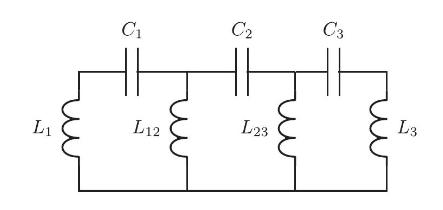
The voltage across a capacitor is \(V_{C}=q / C\), where \(C\) is the capacitance and \(q\) is the charge on the capacitor. The voltage across an inductor is \(V_{L}=L d I / d t\), where \(L\) is the inductance and \(I\) is the current through the inductor. A wire attached to a capacitor whose
A block of mass \(M\) can move without friction on a horizontal rail. A simple pendulum of mass \(m\) and length \(\ell\) hangs from the block. Find the normal mode frequencies for small-amplitude oscillations.
A block of mass \(M\) can move without friction on a horizontal rail. A horizontal spring of force-constant \(k\) connects one end of the block to a stationary wall. A simple pendulum of mass \(m\) and length \(\ell\) hangs from the block. Find the normal mode frequencies for small-amplitude
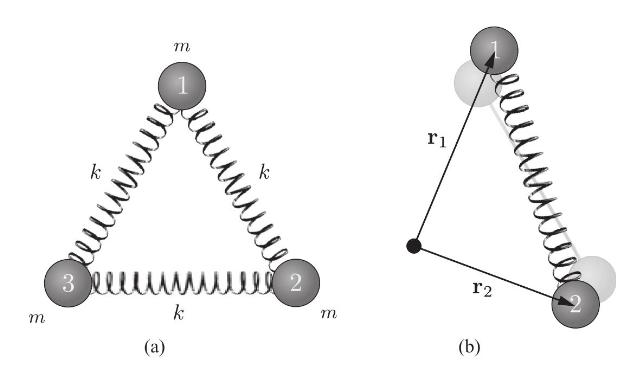
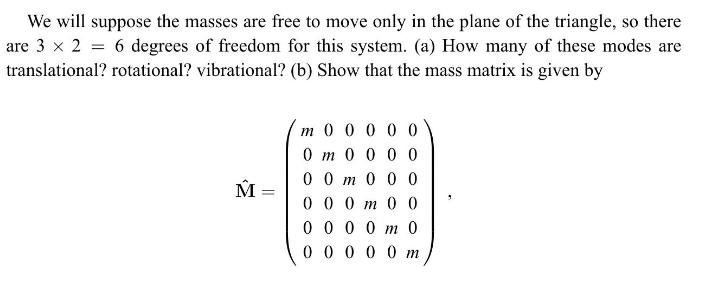
The techniques used can be extended to two- and three dimensional systems. For example, we can find the normal-mode oscillations of a system of three equal masses \(m\) and three equal springs \(k\) in the configuration of an equilateral triangle, as shown in Figure 13.13(a). m 3 (a) k 2 m eulu
In the previous problem, three degenerate normal modes were derived for the case of three equal masses at the vertices of an equilateral triangle, where the springs form the sides of the triangle. Any other oscillation in which the CM remains at rest and the system has no angular momentum must be a
(a) The " \(6-12\) " potential energy \(U(r)=-2 a / r^{6}+b / r^{12}\), where \(a\) and \(b\) are positive constants, is sometimes used to approximate the potential energy between two atoms in a diatomic molecule, where the atoms are separated by a distance \(r\). Find the effective force constant
Consider an infinite number of masses \(m\) connected in a linear array to an infinite number of springs \(k\). In equilibrium the masses are separated by distance \(a\). Now allow small-amplitude transverse displacements of the masses, and take the limit as \(a \rightarrow 0\), with an infinite
A rod of length \(L\) is clamped at both ends \(x=0, L\) so that the displacement function obeys \(\eta(t, 0)=\eta(t, L)=0\). Initially the displacement function is \(\eta(0, x)=\) \(b \sin ^{2}(\pi x / L)\) and \(\partial \eta(t, x) /\left.\partial t\right|_{0}=0\), where \(b\) is a positive
A rod of length \(L\), with ends at \((x=0, L)\), has an initial displacement function \(\eta(0, x)=b\) for \(0 \leq x \leq L / 2\) and \(\eta(0, x)=-b\) for \(L / 2 \leq x \leq L\), where \(b\) is a positive constant. At time \(t=0\) the derivative of \(\eta(t, x)\) is \(\left.\partial \eta(t, x)
A rod of length \(L\), with ends at \((x=0, L)\), has an initial displacement function \(\eta(0,0)=\eta(0, L)=0\) and \(\eta(0, x)=b\) for \(0
One end of a rod of length \(L\) is held at \(x=0\) while the other end is stretched from \(x=L\) to \(x=(1+a) L\), where \(a\) is a constant. In this way an arbitrary point \(x\) in the rod is moved to \((1+a) x\). Then at time \(t=0\) the rod is released. (a) What is the initial value of the
An infinite rod has an initial square-pulse displacement function \(\eta(0, x)=C\), a constant, for \(|x| \leq b\) and \(\eta(0, x)=0\) for \(|x|>b\). (a) Find the displacement function \(\eta(t, x)\) at later times, assuming all mass points in the rod are initially at rest. (b) Carry out a Fourier
An infinite rod has an initial triangular-pulse displacement function \(\eta(0, x)=C-|x|\) for \(|x|
An infinite rod has an initial Gaussian displacement function \(\eta(0, x)=\) \(A e^{-x^{2} / b^{2}}\), where \(A\) and \(b\) are constants. (a) Carry out a Fourier transform of \(\eta(0, x)\), and show that the result is a Gaussian function in \(k\) space. (b) Then show that if the Gaussian in
We derived a general expression for waves \(y(t, x)\) on a long string, in terms of the initial displacement \(y(0, x) \equiv f(x)\) and velocity \(\partial y(0, x) / \partial t \equiv\) \(g(x)\). Suppose that the initial displacement is \(y(0, x)=f(x)\), where \(f(x)\) is some given function.(a)
In the text we saw an example involving a non-diagonal mass matrix arising in the case of a single particle. In this problem, we will look at a similar scenario for two particles. Consider two interacting particles of mass \(m_{1}\) and \(m_{2}\) constrained to move in one dimension described by
Consider a particle of mass \(m\) moving in three dimensions but constrained to the surface of the paraboloid \(z=\alpha\left((x-1)^{2}+(y-1)^{2}\right)\). The particle is also subject to the spring potential \(U(x, y, z)=(1 / 2) k\left(x^{2}+y^{2}\right)\). (a) Show that the Lagrangian of the
A particle of mass \(m\) slides inside a smooth hemispherical bowl of radius \(R\). Use spherical coordinates \(r, \theta\) and \(\phi\) to describe the dynamics. (a) Write the Lagrangian in terms of generalized coordinates and solve the dynamics. (b) Repeat the exercise using a Lagrange
A pendulum consisting of a ball at the end of a rope swings back and forth in a two dimensional vertical plane, with the angle \(\theta\) between the rope and the vertical evolving in time. The rope is pulled upward at a constant rate so that the length \(l\) of the pendulum's arm is decreasing
A particle of mass \(m\) slides inside a smooth paraboloid of revolution whose surface is defined by \(z=\alpha ho^{2}\), where \(z\) and \(ho\) are cylindrical coordinates. (a) Write the Lagrangian for the three-dimensional system using the method of Lagrange multipliers. (b) Find the equations of
A massive particle moves under the acceleration of gravity and without friction on the surface of an inverted cone of revolution with half angle \(\alpha\). (a) Find the Lagrangian in polar coordinates. (b) Provide a complete analysis of the trajectory problem. Do not integrate the final orbit
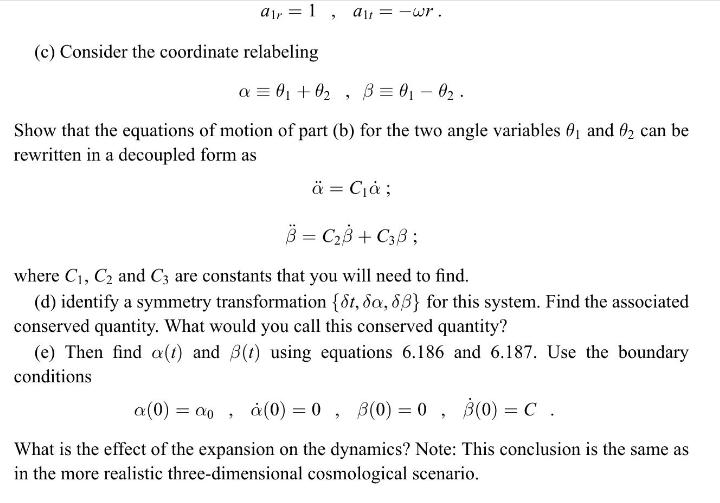
A toy model for our expanding universe during the inflationary epoch consists of a circle of radius \(r(t)=r_{0} e^{\omega t}\) where we are confined on the one-dimensional world that is the circle. To probe the physics, imagine two point masses of identical mass \(m\) free to move on this circle
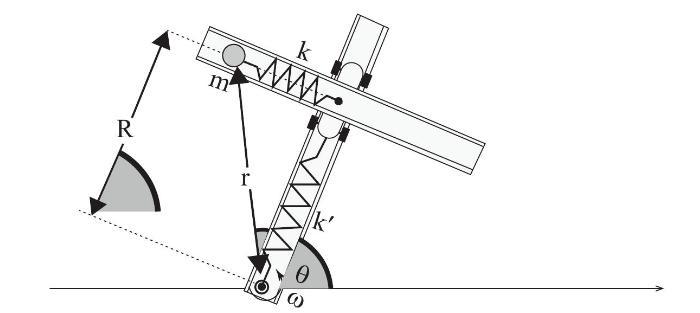
The figure below shows a mass \(m\) connected to a spring of force-constant \(k\) along a wooden track. The mass is restricted to move along this track without friction. The entire system is mounted on a toy wagon of zero mass resting on a track along a second frictionless beam. The wagon is
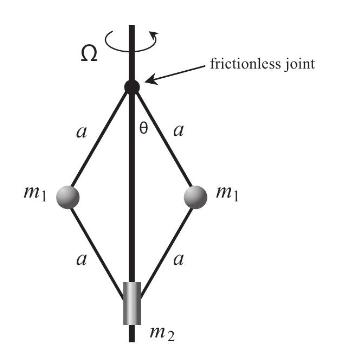
Consider the system shown in the figure below. The particle of mass \(m_{2}\) moves on a vertical axis without friction and the entire system rotates about this axis with a constant angular speed \(\Omega\). The frictionless joint near the top assures that the three masses always lie in the same
Find the equations of motion for the example in the text of a wheel chasing a moving target using the non-holonomic constraint.
Consider the example of the wheel from the example in the text, except that now we have no control over the wheel's steering except of course at time zero. We start the wheel at some position on the plane, give it an initial roll \(\omega_{0}\) and an initial spin \(\dot{\theta}_{0}\). Describe the
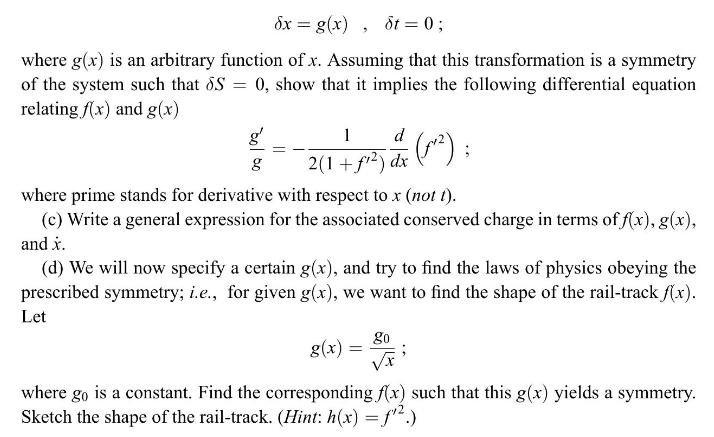
Consider a particle of mass \(m\) moving in two dimensions in the \(x-y\) plane, constrained to a rail-track whose shape is described by an arbitrary function \(y=f(x)\). There is no gravity acting on the particle.(a) Write the Lagrangian in terms of the \(x\) degree of freedom only.(b) Consider
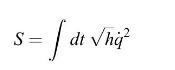
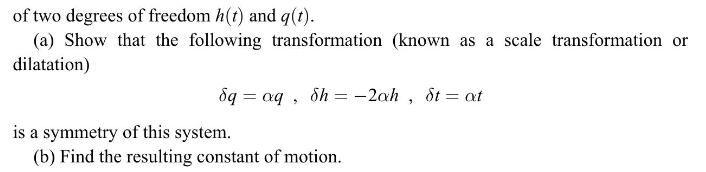
One of the most important symmetries in Nature is that of scale invariance. This symmetry is very common (e.g. arises whenever a substance undergoes a phase transition), fundamental (e.g. it is at the foundation of the concept of renormalization group for which a physics Nobel Prize was awarded in
A massive particle moves under the acceleration of gravity and without friction on the surface of an inverted cone of revolution with half angle \(\alpha\).(a) Find the Lagrangian in polar coordinates.(b) Provide a complete analysis of the trajectory problem. Use Noether charge when useful.
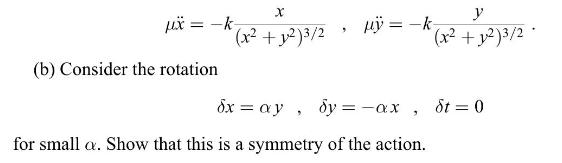
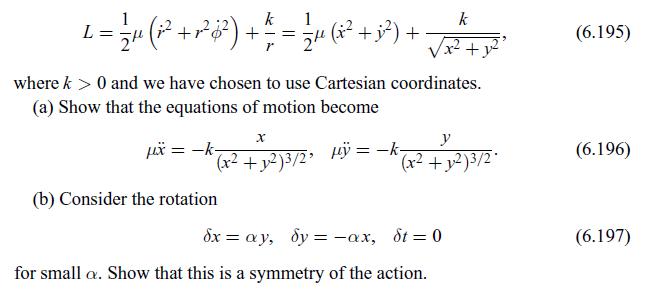
For the two body central-force problem with a Newtonian potential, the effective two-dimensional orbit dynamics can be described by the Lagrangianwhere \(k>0\) and we have chosen to use Cartesian coordinates.(a) Show that the equations of motion become *+*^ + ($+8) m = + (2 + ) * = 7 L
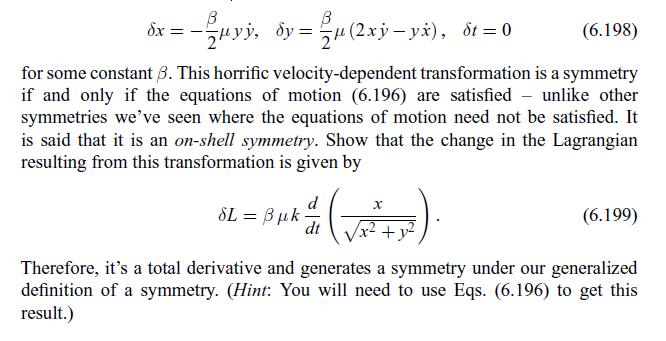
In the previous problem show that the conserved Noether charge associated with the symmetry 6.197 is indeed the angular momentum \(|\mathbf{r} \times \mu \mathbf{v}|\), which is naturally entirely in the \(z\) direction.Data from previous problemFor the two-body central-force problem with a
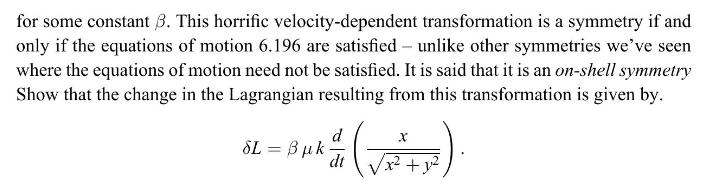
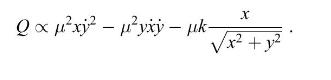
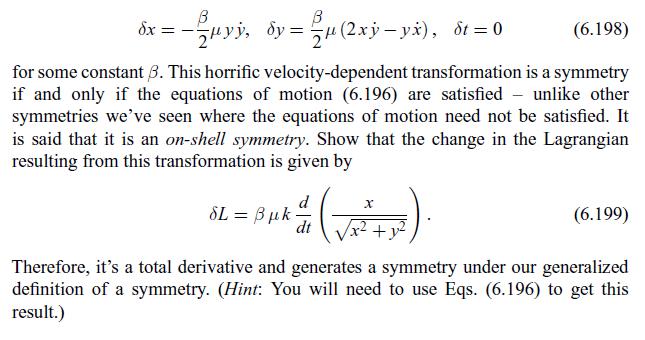
The two body central-force problem we have been dealing with in the previous two problems also has another unexpected and amazing symmetry. Consider the transformationTherefore, it's a total derivative and generates a symmetry under our generalized definition of a symmetry.Data from Problem 6.15In
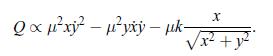
In the previous problem show that the conserved charge associated with the symmetry isData from previous problemThe two-body central-force problem we have been dealing with inthe previous two problems also has another unexpected and amazing symmetry.Consider the transformation Qxx pxyxy - k- x x + y
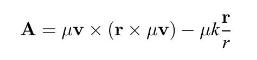
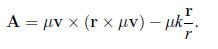
The hidden symmetry of the previous few problems is part of a two-fold transformation - one of which is given by and another similar one that we have not shown; together, they result in the conservation of a vector known as the Laplace-RungeLenz vectorShow that Eq. 6.200 is the \(x\)-component of
Show using (6.201) that \(d \mathbf{A} / d t=0\). Draw an elliptical orbit in the \(x-y\) plane and show on it the Laplace-Runge-Lenz vector \(\mathbf{A}\). The existence of this conserved vector quantity is the reason why one can smoothly deform ellipses into a circle without changing the energy
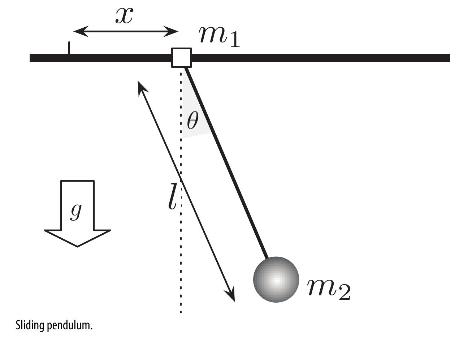
Consider a simple pendulum of mass \(m_{2}\) and arm length \(l\) having its pivot on a point of support of mass \(m_{1}\) that is free to move horizontally on a frictionless rail.(a) Find the Lagrangian of the system in terms of the two degrees of freedom \(x\) and \(\theta\) shown on the figure.
Two satellites of equal mass are each in a circular orbit around the earth. The orbit of satellite \(\mathrm{A}\) has radius \(r_{A}\), and the orbit of satellite \(\mathrm{B}\) has radius \(r_{B}=2 r_{A}\). Find the ratio of their (a) speeds (b) periods (c) kinetic energies (d) potential energies
Halley's comet passes through earth's orbit every 76 years. Make a close estimate of the maximum distance Halley's comet gets from the sun.
Two astronauts are in the same circular orbit of radius \(R\) around the earth, \(180^{\circ}\) apart. Astronaut A has two cheese sandwiches, while Astronaut B has none. How can A throw a cheese sandwich to B? In terms of the astronaut's period of rotation about the earth, how long does it take the
Suppose that the gravitational force exerted by the sun on the planets were inverse \(r\)-squared, but not proportional to the planet masses. Would Kepler's third law still be valid in this case?
Planets in a hypothetical solar system all move in circular orbits, and the ratio of the periods of any two orbits is equal to the ratio of their orbital radii squared. How does the central force depend on the distance from this sun?
An astronaut is marooned in a powerless spaceship in circular orbit around the asteroid Vesta. The astronaut reasons that puncturing a small hole through the spaceship's outer surface into an internal water tank will lead to a jet action of escaping water vapor expanding into space. Which way
A thrown baseball travels in a small piece of an elliptical orbit before it strikes the ground. What is the semi-major axis of the ellipse? (Neglect air resistance.)
Assume that the period of elliptical orbits around the sun depends only upon \(G, M\) (the sun's mass), and \(a\), the semi-major axis of the orbit. Prove Kepler's third law using dimensional arguments alone.
A spy satellite designed to peer closely at a particular house every day at noon has a 24-hour period, and a perigee of \(100 \mathrm{~km}\) directly above the house. What is the altitude of the satellite at apogee? (Earth's radius is \(6400 \mathrm{~km}\).)
Show that the kinetic energy\[K . E=\frac{1}{2} m_{1} \dot{\mathbf{r}}_{1}^{2}+\frac{1}{2} m_{2} \dot{\mathbf{r}}_{2}^{2}\]of a system of two particles can be written in terms of their center-of-mass velocity \(\dot{\mathbf{R}}_{\mathrm{cm}}\) and relative velocity \(\dot{\mathbf{r}}\) as \[K . E
Show that the shape \(r(\varphi)\) for a central spring force ellipse takes the standard form \(r^{2}=a^{2} b^{2} /\left(b^{2} \cos ^{2} \varphi+a^{2} \sin ^{2} \varphi\right)\) if (in equation 7.37) we use the plus sign in the denominator and choose \(\varphi_{0}=\pi / 4\).Data from equation 7.37
Show that the period of a particle that moves in a circular orbit close to the surface of a sphere depends only upon \(G\) and the average density \(ho\) of the sphere. Find what this period would be for any sphere having an average density equal to that of water. (The sphere consisting of the
(a) Communication satellites are placed into geosynchronous orbits; that is, they typically orbit in earth's equatorial plane, with a period of 24 hours. What is the radius of this orbit, and what is the altitude of the satellite above Earth's surface?(b) A satellite is to be placed in a
The perihelion and aphelion of the asteroid Apollo are \(0.964 \times 10^{8} \mathrm{~km}\) and \(3.473 \times 10^{8} \mathrm{~km}\) from the sun, respectively. Apollo therefore swings in and out through Earth's orbit. Find (a) the semi-major axis (b) the period of Apollo's orbit in years, given
The time it takes for a probe of mass \(\mu\) to move from one radius to another under the influence of a central spring force was shown in the chapter to bewhere \(E\) is the energy, \(k\) is the spring constant, and \(\ell\) is the angular momentum. Evaluate the integral in general, and find (in
(a) Evaluate the integral in Eq. (7.29) to find t(r) for a particle moving in a central gravitational field.(b) From the results, derive the equation for the period \(T=(2 \pi / \sqrt{G M}) a^{3 / 2}\) in terms of the semi-major axis \(a\) for particles moving in elliptical orbits around a central
The sun moves at a speed \(v_{S}=220 \mathrm{~km} / \mathrm{s}\) in a circular orbit of radius \(r_{S}=30,000\) light years around the center of the Milky Way galaxy. The earth requires \(T_{E}=1\) year to orbit the sun, at a radius of \(1.50 \times 10^{11} \mathrm{~m}\). (a) Using this
The two stars in a double-star system circle one another gravitationally, with period \(T\). If they are suddenly stopped in their orbits and allowed to fall together, show that they will collide after a time \(T / 4 \sqrt{2}\).
A particle is subjected to an attractive central spring force \(F=-k r\). Show, using Cartesian coordinates, that the particle moves in an elliptical orbit, with the force center at the center of the eilipse, rather than at one focus of the ellipse.
Use equation 7.32 to show that if the central force on a particle is \(F=0\), the particle moves in a straight line.Data from equation 7.32 l = do = 2m dr/2 E-l/2m - U(r)' (7.32)
Find the central force law \(F(r)\) for which a particle can move in a spiral orbit \(r=k \theta^{2}\), where \(k\) is a constant.
Find two second integrals of motion for a particle of mass \(m\) in the case \(F(r)=-k / r^{3}\), where \(k\) is a constant. Describe the shape of the trajectories, assuming that the angular momentum \(\ell>\sqrt{\mathrm{km}}\).
A particle of mass \(m\) is subject to a central force \(F(r)=-G M m / r^{2}-k / r^{3}\), where \(k\) is a positive constant. That is, the particle experiences an inverse-cubed attractive force as well as a gravitational force. Show that if \(k\) is less than some limiting value, the motion is that
Find the allowed orbital shapes for a particle moving in a repulsive inversesquare central force. These shapes would apply to \(\alpha\)-particles scattered by gold nuclei, for example, due to the repulsive Coulomb force between them.
A particle moves in the field of a central force for which the potential energy is \(U(r)=k r^{n}\), where both \(k\) and \(n\) are constants, positive, negative, or zero. For what range of \(k\) and \(n\) can the particle move in a stable, circular orbit at some radius?
A particle of mass m and angular momentum moves in a central spring-like force field \(F=-k r\). (a) Sketch the effective potential energy \(U_{\text {eff }}(r)\). (b) Find the radius \(r_{0}\) of circular orbits. (c) Find the period of small oscillations about this orbit, if the particle is
Find the period of small oscillations about a circular orbit for a planet of mass \(m\) and angular momentum \(\ell\) around the sun. Compare with the period of the circular orbit itself. Is the orbit open or closed for such small oscillations?
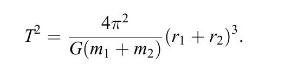
(a) A binary star system consists of two stars of masses m1 and m2 orbiting about one another.Suppose that the orbits of the two stars are circles of radii \(r_{1}\) and \(r_{2}\), centered on their center of mass. Show that the period of the orbital motion is given by(b) The binary system Cygnus
A spacecraft is in a circular orbit of radius \(r\) about the earth. What is the minimum \(\Delta v\) the rocket engines must provide to allow the craft to escape from the earth, in terms of \(G, M_{E}\), and \(r\) ?
A spacecraft departs from the earth. Which takes less rocket fuel: to escape from the solar system or to fall into the sun? (Assume the spacecraft has already escaped from the earth, and do not include possible gravitational assists from other planets.)
After the engines of a \(100 \mathrm{~kg}\) spacecraft have been shut down, the spacecraft is found to be a distance \(10^{7} \mathrm{~m}\) from the center of the earth, moving with a speed of \(7000 \mathrm{~m} / \mathrm{s}\) at an angle of \(45^{\circ}\) relative to a straight line from the earth
A \(100 \mathrm{~kg}\) spacecraft is in circular orbit around the earth, with orbital radius \(10^{4} \mathrm{~km}\) and with speed \(6.32 \mathrm{~km} / \mathrm{s}\). It is desired to turn on the rocket engines to accelerate the spacecraft up to a speed so that it will escape the earth and coast
The earth-sun L5 Lagrange point is a point of stable equilibrium that trails the earth in its heliocentric orbit by \(60^{\circ}\) as the earth (and spacecraft) orbit the sun. Some gravity wave experimenters want to set up a gravity wave experiment at this point. The simplest trajectory from earth
In Stranger in a Strange Land, Robert Heinlein claims that travelers to Mars spent 258 days on the journey out, the same for return, "plus 455 days waiting at Mars while the planets crawled back into positions for the return orbit." Show that travelers would have to wait about 455 days, if both
A spacecraft approaches Mars at the end of its Hohmann transfer orbit. (a) What is its velocity in the sun's frame, before Mars's gravity has had an appreciable influence on it? (b) What \(\Delta v\) must be given to the spacecraft to insert it directly from the transfer orbit into a circular orbit
A spacecraft parked in circular low-earth orbit \(200 \mathrm{~km}\) above the ground is to travel out to a circular geosynchronous orbit, of period 24 hours, where it will remain. (a) What initial \(\Delta v\) is required to insert the spacecraft into the transfer orbit? (b) What final \(\Delta
A spacecraft is in a circular parking orbit \(300 \mathrm{~km}\) above earth's surface. What is the transfer-orbit travel time out to the moon's orbit, and what are the two \(\Delta v^{\prime} s\) needed? Neglect the moon's gravity.
A spacecraft is sent from the earth to Jupiter by a Hohmann transfer orbit. (a) What is the semi-major axis of the transfer ellipse? (b) How long does it take the spacecraft to reach Jupiter? (c) If the spacecraft actually leaves from a circular parking orbit around the earth of radius \(7000
Find the Hohmann transfer-orbit time to Venus, and the \(\Delta v^{\prime} s\) needed to leave an earth parking orbit of radius \(7000 \mathrm{~km}\) and later to enter a parking orbit around Venus, also of \(r=7000 \mathrm{~km}\). Sketch the journey, showing the orbit directions and the directions
Consider an astronaut standing on a weighing scale within a spacecraft. The scale by definition reads the normal force exerted by the scale on the astronaut (or, by Newton's third law, the force exerted on the scale by the astronaut.) By the principle of equivalence, the astronaut can't tell
The luminous matter we observe in our Milky Way galaxy is only about 5\% of the galaxy's total mass: The rest is called "dark matter," which seems to act upon all matter gravitationally but in no other way. As a rough approximation, we can therefore neglect luminous matter entirely as a source of
Within the solar system itself it is often thought that the density of unseen dark matter is quite uniform, with mass density \(ho_{0} \simeq 0.3 \mathrm{GeV} / \mathrm{c}^{2}\) per \(\mathrm{cm}^{3}\) (the mass equivalent of about 1 proton per three cubic centimeters.) The sun itself has mass
Communications satellites are typically placed in orbits of radius \(r_{C S}\) circling the earth once per day. The 24 or so GPS (Global Positioning System) satellites are placed in one of six orbital planes, with each satellite circling the earth twice per day. (a) Find the radius of their orbits
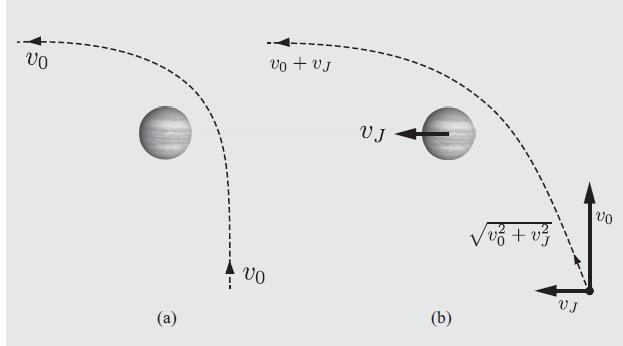
Trajectory specialists plan to send a spacecraft to Saturn requiring a gravitational assist by Jupiter. In Jupiter's rest frame the spacecraft's velocity will be turned \(90^{\circ}\) as it flies by, as illustrated in Figure 7.15(a).Data from Figure 7.15 (a) and (b)(a) If the nearest point on the
Show that the Virial Theorem is correct for a planet in circular orbit around the sun.
Show that the Virial Theorem is correct for a particle of mass \(m\) free to move in a plane, and attached to one end of a Hooke's-law spring exerting the force \(F=-k r\), if the particle is in (a) a circular orbit (b) an elliptical orbit.
Suppose that in studying a particular globular cluster containing \(10^{5}\) stars, whose average mass is that of our sun, astronomers find that the total kinetic energy of the stars is 10 times that of the magnitude of their total potential energy. (a) Estimate the amount of dark matter in the
The cover of this book shows the paths of a number of stars orbiting a massive object named Sagittarius A-Star (Sgr A* for short) at the center of our Milky Way galaxy. One of these stars, called "S2," has an orbit whose period is 16.05 years, a semimajor axis of \(970 \mathrm{au}\), and a
(a) Using the observed characteristics of Star S2's orbit as given in the preceding problem, and assuming it moves in a Keplerian elliptical orbit, find the speed of the star at periastron as a percentage of the speed of light. (b) If its orbit happened to be oriented so that at periastron S2 were
Consider an infinite wire carrying a constant linear charge density λ0. Write the Lagrangian of a probe charge Q in the vicinity, and find its trajectory.
Consider the oscillating Paul trap potential\[U(z, ho)=\frac{U_{0}+U_{1} \cos \Omega t}{ho_{0}^{2}+2 z_{0}^{2}}\left(2 z^{2}+\left(ho_{0}^{2}-ho^{2}\right)\right)\]written in cylindrical coordinates.(a) Show that this potential satisfies Laplace's equation.(b) Consider a point particle of charge
Show that the Coulomb gauge \(abla \cdot \mathbf{A}=0\) is a consistent gauge condition.
Find the residual gauge freedom in the Coulomb gauge.
Show that the Lorentz gauge \(\partial_{\mu} A_{u} \eta_{\mu u}=0\) is a consistent gauge condition.
Find the residual gauge freedom in the Lorentz gauge.
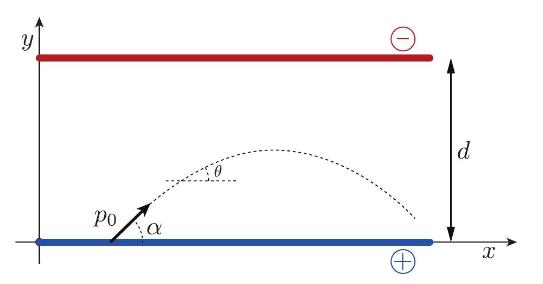
An ultrarelativistic electron with \(v \sim c\) and momentum \(p_{0}\) enters a region between the two plates of a capacitor as shown in the figure. The plate separation is \(d\) and a voltage \(V\) is applied to the plates. y Po a 0 + d X
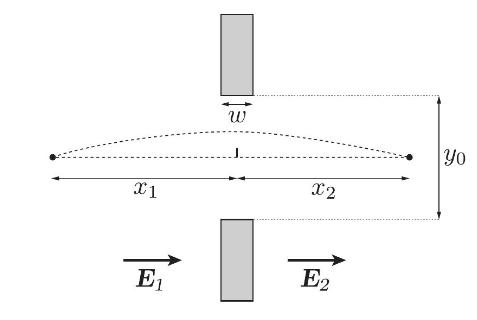
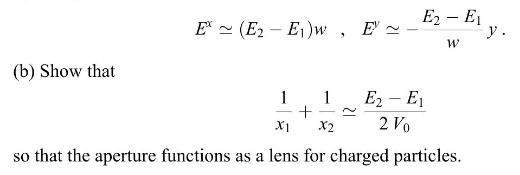
Charged particles are accelerated through a potential difference \(V_{0}\) before falling onto a lens consisting of an aperture of height \(y_{0}\) and thickness \(w\), as shown in the figure.There is a uniform electric field \(\mathbf{E}_{1}\) and \(\mathbf{E}_{2}\) on the left and right of the
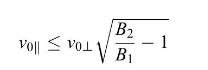
A charged particle is circling a magnetic field that gradually increases in magnitude from \(B_{1}\) to \(B_{2}\) as the particle advances along the field lines. Show that the particle will be reflected ifwhere \(v_{0 \|}\) and \(v_{0 \perp}\) are the components of the particle's velocity parallel
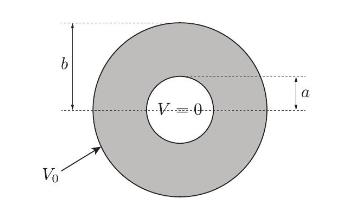
A coaxial cable has a grounded center and a voltage \(V_{0}\) on the rim, as shown in the figure.A uniform magnetic field \(B_{0}\) lies along the cylindrical axis of symmetry. Electrons propagate from the center to the rim. Find the mininum \(V_{0}\) so that current can flow from the center to the
Neutrons have zero charge but carry a magnetic dipole moment \(\mu\). As a result, they are subject to a magnetic force given by \(\mathbf{F}=(\mu \cdot abla) \mathbf{B}\). A beam of neutrons with \(\mu=\mu \hat{\mathbf{x}}\) is moving along the \(z\) direction into a region of magnetic field
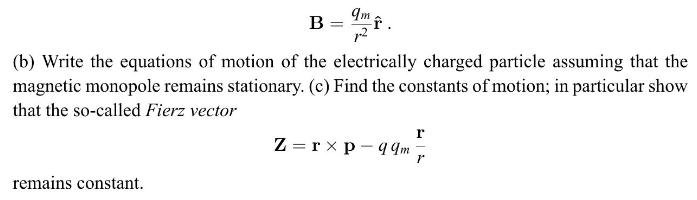
A magnetic monopole is a particle that casts out a radial magnetic field satisfying \(abla \cdot \mathbf{B}=4 \pi q_{m} \delta(\mathbf{r})\) where \(q_{m}\) is the magnetic charge of the monopole. A nonrelativistic electrically charged particle of charge \(q\) is moving near a magnetic monopole of
Consider a charged relativistic particle of charge \(q\) and mass \(m\) moving in a cylindrically symmetric magnetic field with \(\mathrm{B}^{\varphi}=0\).(a) Show that this general setup can be described with a vector potential that has one non-zero component \(\mathrm{A}^{\varphi}(ho, z)\).(b)
For the previous problem, find the angular speed by which the particle spins about the magnetic field in terms of the radius of the circular orbit \(ho\) and other constants in the problem.Data from the previous problemConsider a charged relativistic particle of charge \(q\) and mass \(m\) moving
A cyclotron is made of sheet metal in the form of an empty tuna-fish can, set on a table with a flat-side down and then sliced from above through its center into two D-shaped pieces. The two "Dees" are then separated slightly so there is a small gap between them. A high-frequency alternating
Showing 500 - 600
of 1040
1
2
3
4
5
6
7
8
9
10
11
Step by Step Answers

 Get 50% OFF
Claim Now
Get 50% OFF
Claim Now