New Semester
Started
Get
50% OFF
Study Help!
--h --m --s
Claim Now
Question Answers
Textbooks
Find textbooks, questions and answers
Oops, something went wrong!
Change your search query and then try again
S
Books
FREE
Study Help
Expert Questions
Accounting
General Management
Mathematics
Finance
Organizational Behaviour
Law
Physics
Operating System
Management Leadership
Sociology
Programming
Marketing
Database
Computer Network
Economics
Textbooks Solutions
Accounting
Managerial Accounting
Management Leadership
Cost Accounting
Statistics
Business Law
Corporate Finance
Finance
Economics
Auditing
Tutors
Online Tutors
Find a Tutor
Hire a Tutor
Become a Tutor
AI Tutor
AI Study Planner
NEW
Sell Books
Search
Search
Sign In
Register
study help
sciences
mechanics
Modern Classical Mechanics 1st Edition T. M. Helliwell, V. V. Sahakian - Solutions
Integrating (7.6.17) by parts, show that the effective mass of an excitation, whose energymomentum relationship is denoted by \(\varepsilon(p)\), is given by\[m_{\mathrm{eff}}=\left\langle\frac{1}{3 p^{2}}\left\{\frac{d}{d p}\left(p^{4} \frac{d p}{d \varepsilon}ight)ight\}ightangle\]Check the
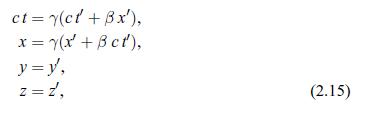
The relativity of simultaneity. Two clocks are placed at rest on the \(x^{\prime}\) axis of the primed frame, clock A at \(x^{\prime}=0\) and clock B at \(x^{\prime}=L_{0}\). They are therefore a distance \(L_{0}\) apart in their mutual (primed) rest frame. Observers in the unprimed frame see both
A primed frame moves at \(V=(3 / 5) c\) relative to an unprimed frame. Just as their origins pass, clocks at the origins of both frames read zero, and a flashbulb explodes at that point. Later, the flash is seen by observer \(A\) at rest in the primed frame, whose position is \(x^{\prime},
Synchronized clocks A and B are at rest in our frame of reference, a distance five light-minutes apart. Clock \(\mathrm{C}\) passes \(\mathrm{A}\) at speed (12/13) \(c\) bound for \(\mathrm{B}\), when \(\mathrm{C}\), and also both \(\mathrm{A}\) and \(\mathrm{B}\), read \(t=0\) in our frame.(a)
Two spaceships are approaching one another. According to observers in our frame,(a) the left-hand ship moves to the right at \((4 / 5) c\) and the right-hand ship moves to the left at \((3 / 5) c\). How fast is the right-hand ship moving in the frame of the left-hand ship?(b) the left-hand ship
Astronaut A boards a spaceship leaving earth for the star Alpha Centauri, 4 light-years from earth, while her friend B stays at home. The ship travels at speed \(4 / 5 c\), and upon arrival immediately turns around and travels back to earth at the same speed 4/5 \(c\).(a) How much has A aged during
Al and Bert are identical twins. When Bert is 24 years old he travels to a distant planet at speed 12/13 \(c\), turns around and heads back at the same speed, arriving home at age 44. Al stays at home.(a) How old is Al when Bert returns?(b) How far away was the planet in Al's frame?(c) Why can't
Incoming high-energy cosmic-ray protons strike Earth's upper atmosphere and collide with the nuclei of atmospheric atoms, producing a downward-directed shower of particles, including (among much else) the pions \(\pi^{+}, \pi^{-}\), and \(\pi^{0}\). The charged pions decay quickly into muons and
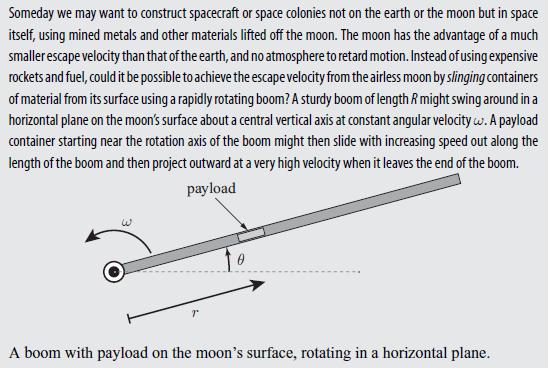
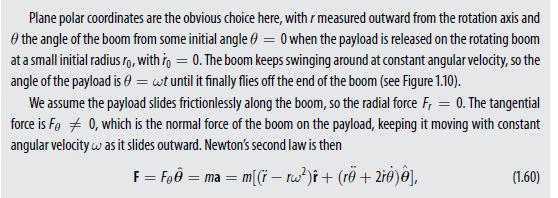
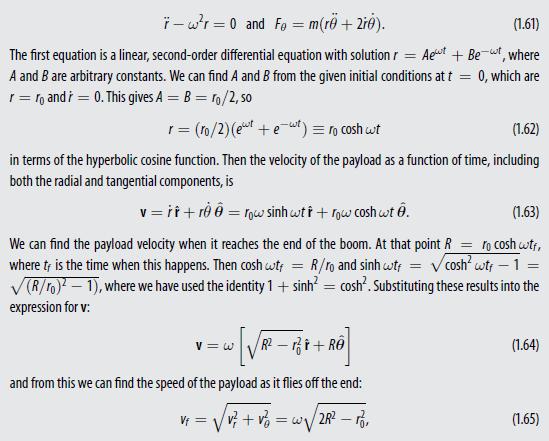
Example 1.3 of Chapter 1 proposed that mined material on the moon might be projected off the moon's surface by a rotating boom that slings the material into space. Assume the boom rotates in a horizontal plane with constant angular velocity \(\omega\), and let \(r\), the distance of the payload
Consider a Lagrangian of the formShow that the resulting Lagrange equations give Newton's second law \(\mathbf{F}=d \mathbf{p} / d t\) for a relativistic particle, if \(F^{i}=-\partial U / \partial x^{i}\). L = mc (11-12/c) U(x, y, z). -
Maxwell's equations for the electric field \(\mathbf{E}\) and magnetic field \(\mathbf{B}\) arewhere \(ho\) is the charge density, \(\mathbf{J}\) is the current density, and \(\epsilon_{0}\) and \(\mu_{0}\) are (respectively) the permittivity and permeability of the vacuum, both constants. Derive
Photons of wavelength \(580 \mathrm{~nm}\) pass through a double-slit system, where the distance between the slits is \(d=0.16 \mathrm{~nm}\) and the slit width is \(a=0.02 \mathrm{~nm}\). If the detecting screen is a distance \(D=60 \mathrm{~cm}\) from the slits, what is the linear distance from
Photons are projected through a double-slit system. (a) What must be the ratio \(d / a\) of the slit separation to slit width, so that there will be exactly nine interference maxima within the central diffraction envelope? (b) Is any change observed on the detecting screen if the photon wavelength
A beam of monoenergetic photons is directed at a triple-slit system, where the distance between adjacent slits is \(d\), and the photon wavelength is \(\lambda=d / 2\). Find the angles \(\theta\) from the forward direction for which there are (a) interference maxima (b) interference minima. (c)
A beam of \(10 \mathrm{keV}\) photons is directed at a double-slit system and the interference pattern is measured on the detecting plane. The wavelength of these photons is less than the slit separation. Then electrons are accelerated so their (nonrelativistic) kinetic energies are also \(10
Consider a grating composed of four very narrow slits each separated by a distance \(d\). (a) What is the probability that a photon strikes a detector centered at the central maximum if the probability that a photon is counted by this detector with a single slit open is \(r\) ? (b) What is the
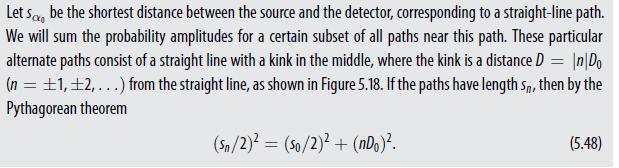
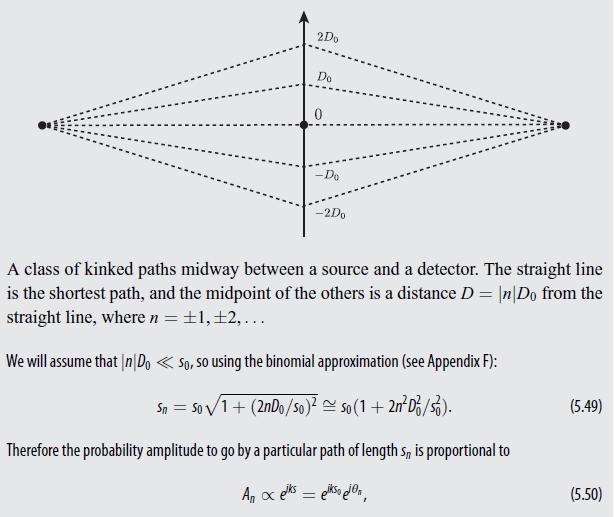
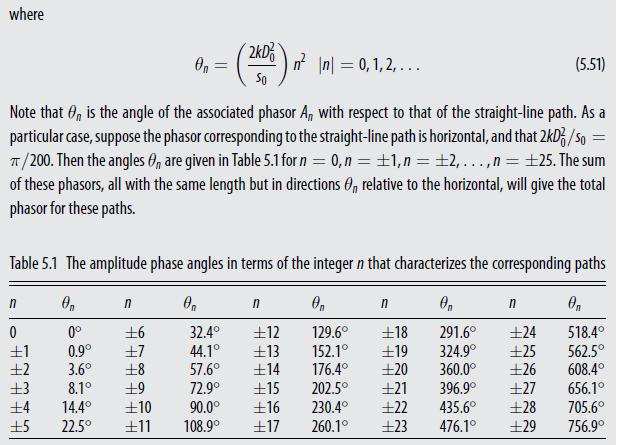
Example 5.2 considered a set of kinked paths about a straight-line path. (a) Using the same set of alternative paths, suppose one considered the sum of phasors about the path with \(n=50\) instead of the sum about the \(n=0\) straight-line path. In particular, if one summed from \(n=25\) to \(n=75,
Example 5.2 considers a particular class of paths near a straight-line path. A different class of paths consists of a set of parabolas of the form \(y=n \alpha\left(1-x / x_{0}ight)^{2}\) fit to the endpoints of the straight line at \((x, y)=(0,0)\) and \((x, y)=\left(x_{0}, 0ight)\). Here
Judge whether or not the following situations are consistent with classical paths. (a) A nitrogen molecule moving with average kinetic energy \(\langle 3 / 2angle k T\) at room temperature \(T=300 \mathrm{~K}\) (where \(k\) is Boltzmann's constant.) (b) A typical hydrogen atom caught in a trap at
(a) What condition would have to be met so that the motion of a \(135 \mathrm{~g}\) baseball would be inconsistent with a classical path? Is this a potentially feasible condition? (b) If we could adjust the value of Planck's constant, how large would it have to be so that the ball in a baseball
According to the Heisenberg indeterminacy principle \(\Delta x \Delta p \geq \hbar\), the uncertainty in position of a particle multiplied by the uncertainty in its momentum must be greater than Planck's constant divided by \(2 \pi\). The neutrons in a particular atomic nucleus are confined to be
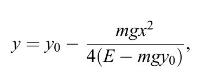
Show from the Newtonian equations \(x=v_{0 \mathrm{x}} t\) and \(y=y_{0}-(1 / 2) g t^{2}\) for a particle moving in a uniform gravitational field \(g\), that the shape of its path is a parabola, given bythe same result we found using the Jacobi principle of least action. y yo- mgx2 4(E-mgyo)
A particle of mass \(m\) can move in two dimensions under the influence of a repulsive spring-like force in the \(x\) direction, \(F=+k x\). Find the shape of its classical path in the \(x, y\) plane using the Jacobi action.
An object of mass \(m\) can move in two dimensions in response to the simple harmonic oscillator potential \(U=(1 / 2) k r^{2}\), where \(k\) is the force constant and \(r\) is the distance from the origin. Using the Jacobi action, find the shape of the orbits using polar coordinates \(r\) and
A comet of mass \(m\) moves in two dimensions in response to the central gravitational potential \(U=-k / r\), where \(k\) is a constant and \(r\) is the distance from the Sun. Using the Jacobi action and polar coordinates \((r, \theta)\), find the possible shapes of the comet's orbit. Show that
A meterstick is at rest in a primed frame of reference, with one end at the origin and the other at \(x^{\prime}=1.0 \mathrm{~m}\).(a) Using the Galilean transformation find the location of each end of the stick in the unprimed frame at a particular time \(t\), and then find the length of the meter
A river of width \(D\) flows uniformly at speed \(V\) relative to the shore. A swimmer swims always at speed \(2 V\) relative to the water.(a) If the swimmer dives in from one shore and swims in a direction perpendicular to the shoreline in the reference frame of the flowing river, how long does it
The crews of two eight-man sculls decide to race one another on a river of width \(D\) that flows at uniform velocity \(V_{0}\). The crew of scull A rows downstream a distance \(D\) and then back upstream, while the crew of scull B rows to a point on the opposite shore directly across from the
Passengers standing in a coasting spaceship observe a distant star at the zenith, i.e., directly overhead. If the spaceship then accelerates to speed \(c / 100\) where \(c\) is the speed of light, at what angle to the zenith (to three significant figures) do the passengers now see the star?
(a) Snow is falling vertically toward the ground at speed \(v\).(a) A bus driver is driving through the snowstorm on a horizontal road at speed \(v / 3\). At what angle to the vertical are the snowflakes falling as seen by the driver?(b) Suppose that the large windshield in the flat, vertical front
The jet stream is flowing due east at velocity \(v_{J}\) relative to the ground. An aircraft is traveling at velocity \(v_{C}\) in the northeast direction relative to the air.(a) Relative to the ground, find the speed of the aircraft and the angle of its motion relative to the east.(b) Keeping the
The earth orbits the sun once/year in a nearly circular orbit of radius \(150 \times 10^{6} \mathrm{~km}\). The speed of light is \(c=3 \times 10^{5} \mathrm{~km} / \mathrm{s}\). Looking through a telescope, we observe that a particular star is directly overhead. If the earth were quickly stopped
A long chain is tied tightly between two trees and a horizontal force \(F_{0}\) is applied at right angles to the chain at its midpoint. The chain comes to equilibrium so that each half of the chain is at angle \(\theta\) from the straight line between the chain endpoints. Neglecting gravity, what
An object of mass \(m\) is subject to a drag force \(F=-k v^{n}\), where \(v\) is its velocity in the medium, and \(k\) and \(n\) are constants. If the object begins with velocity \(v_{0}\) at time \(t=0\), find its subsequent velocity as a function of time.
A small spherical ball of mass \(m\) and radius \(R\) is dropped from rest into a liquid of high viscosity \(\eta\), such as honey, tar, or molasses. The only appreciable forces on it are gravity \(m g\) and a linear drag force given by Stokes's law, \(F_{\text {Stokes }}=-6 \pi \eta R v\), where
We showed in Example 1.2 that the distance a ball falls as a function of time, starting from rest and subject to both gravity \(g\) downward and a quadratic drag force upward, iswhere \(v_{T}\) is its terminal velocity.(a) Invert this equation to find how long it takes the ball to reach the ground
For objects with linear size between a few millimeters and a few meters moving through air near the ground, and with speed less than a few hundred meters per second, the drag force is close to a quadratic function of velocity, \(F_{D}=(1 / 2) C_{D} A ho v^{2}\), where \(ho\) is the mass density of
A damped oscillator consists of a mass \(m\) attached to a spring \(k\), with frictional damping forces. If the mass is released from rest with amplitude \(A\), and after 100 oscillations the amplitude is \(A / 2\), what is the total work done by friction during the 100 oscillations?
The solution of the underdamped harmonic oscillator is \(x(t)=\) \(A e^{-\beta t} \cos \left(\omega_{1} t+\varphiight)\), where \(\omega_{1}=\sqrt{\omega_{0}^{2}-\beta^{2}}\). Find the arbitrary constants \(A\) and \(\varphi\) in terms of the initial position \(x_{0}\) and initial velocity
An overdamped oscillator is released at location \(x=x_{0}\) with initial velocity \(v_{0}\). What is the maximum number of times the oscillator can subsequently pass through \(x=0\) ?
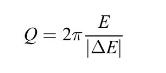
The "quality factor" \(Q\) of an underdamped oscillator can be defined aswhere at some time \(E\) is the total energy of the oscillator and \(|\Delta E|\) is the energy loss in one cycle.(a) Show that \(Q \simeq \pi / \beta P\), where \(\beta\) is the damping constant and \(P\) is the period of
Consider the unit vectors \(\hat{\mathbf{x}}, \hat{\mathbf{y}}, \hat{\mathbf{r}}\), and \(\hat{\boldsymbol{\theta}}\) in a plane.(a) Find \(\hat{\mathbf{r}}\) and \(\hat{\boldsymbol{\theta}}\) in terms of any or all of \(\hat{\mathbf{x}}, \hat{\mathbf{y}}, x\), and \(y\).(b) Find
The mass and mean radius of the moon are \(m=7.35 \times 10^{22} \mathrm{~kg}\) and \(R=1.74 \times 10^{6} \mathrm{~m}\).(a) From these parameters, along with Newton's constant of gravity \(G=6.674 \times 10^{-11} \mathrm{~m}^{3} \mathrm{~kg}^{-1} \mathrm{~s}^{-2}\), find the moon's escape velocity
Ninety percent of the initial mass of a rocket is in the form of fuel. If the rocket starts from rest and then moves in gravity-free empty space, find its final velocity \(v\) if the speed \(u\) of its exhaust is(a) \(3.0 \mathrm{~km} / \mathrm{s}\) (typical chemical burning),(b) \(1000
A space traveler pushes off from his coasting spaceship with relative speed \(v_{0}\); he and his spacesuit together have mass \(M\), and he is carrying a wrench of mass \(m\). Twenty minutes later he decides to return, but his thruster doesn't work. In another forty minutes his oxygen supply will
An astronaut of mass \(M\), initially at rest in some inertial frame in gravity-free empty space, holds \(n\) wrenches, each of mass \(M / 2 n\).(a) Calculate her recoil velocity \(v_{1}\) if she throws all the wrenches at once in the same direction with speed \(u\) relative to her original
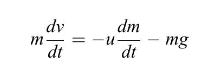
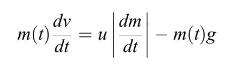
A single-stage rocket rises vertically from its launchpad by burning liquid fuel in its combustion chamber; the gases escape with a net momentum downward, while the rocket, in reaction, accelerates upward. The gravitational field is \(g\).(a) Pretending that air resistance is negligible, show that
A rocket in gravity-free empty space has fueled mass \(M_{0}\) and exhaust velocity \(u\) equal to that of a first-stage Saturn V rocket (as used in sending men to the moon): \(M_{0}=3100\) tons \(=28 \times 10^{6} \mathrm{~kg}\) and \(u=2500 \mathrm{~m} / \mathrm{s}\). The ship's acceleration is
Beginning at time \(t=0\), astronauts in a landing module are descending toward the surface of an airless moon with a downward initial velocity \(-\left|v_{0}ight|\) and altitude \(y=h\) above the surface. The gravitational field \(g\) is essentially constant throughout this descent. An onboard
A spaceprobe of mass \(M\) is propelled by light fired continuously from a bank of lasers on the moon. A mirror covers the rear of the probe; light from the lasers strikes the mirrors and bounces directly back. In the rest-frame of the lasers, \(n_{\gamma}\) photons are fired per second, each with
A proposed interstellar ram-jet would sweep up deuterons in space, burn them in an onboard fusion reactor, and expel the reaction products out the tail of the ship. In a reference frame instantaneously at rest relative to the ship, deuterons, each of mass \(m\), approach the ship at relative
(a) An open railroad coal car of mass \(M\) is rolling along a horizontal track at velocity \(v_{0}\) when a coal chute suddenly dumps a load of coal of mass \(m\) into the coal car, vertically in the frame of the ground. When the load of coal has come to rest relative to the coal car, how fast is
Half of a chain of total mass \(M\) and length \(L\) is placed on a frictionless table top, while the other half hangs over the edge.If the chain is released from rest, what is the speed of the last link just as it leaves the table top?
A particle of mass \(m\) is free to move in one dimension between the coordinates \(x=0\) and \(x=2 \pi / k\), where \(k\) is a positive constant. Within this range the particle is subject to the force \(F=\alpha \sin (k x)\), where \(\alpha\) is a constant.(a) If the maximum value of the
One end of a string of length \(\ell\) is attached to a small ball, and the other end is tied to a hook in the ceiling. A nail juts out from the wall, a distance \(d(d
A rope of mass/length \(\lambda\) is in the shape of a circular loop of radius \(R\). If it is made to rotate about its center with angular velocity \(\omega\), find the tension in the rope. Hint: Consider a small slice of the rope to be a "particle."
A particle is attached to one end of an unstretched Hooke's-law spring of force-constant \(k\). The other end of the spring is fixed in place. If now the particle is pulled so the spring is stretched by a distance \(x\), the potential energy of the particle is \(U=(1 / 2) k x^{2}\).(a) Now suppose
Consider an arbitrary power-law central force \(\mathbf{F}(\mathbf{r})=-k r^{n} \hat{\mathbf{r}}\), where \(k\) and \(n\) are constants and \(r\) is the radius in spherical coordinates. Prove that such a force is conservative, and find the associated potential energy of a particle subject to this
The potential energy of a mass \(m\) on the end of a Hooke's-law spring of force constant \(k\) is \((1 / 2) k x^{2}\). if the maximum speed of the mass with this potential energy is \(v_{0}\), what are the turning points of the motion?
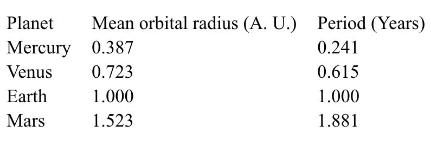
Planets have roughly circular orbits around the sun. Using the table below of the orbital radii and periods of the inner planets, how does the centripetal acceleration of the planets depend upon their orbital radii? That is, find the exponent \(n\) in \(a=\operatorname{con} \times r^{n}\). (Note
Four mathematically equivalent conditions for a force to be conservative are given in the chapter. One condition is that a conservative force can always be written as \(\mathbf{F}=-abla U\). Show then that each of the other three conditions is a necessary consequence.
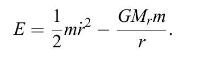
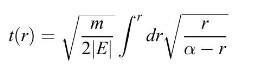
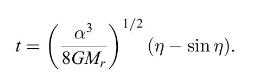
A rock of mass \(m\) is thrown radially outward from the surface of a spherical, airless moon of radius \(R\). From Newton's second law its acceleration is \(\ddot{r}=-G M / r^{2}\), where \(M\) is the moon's mass and \(r\) is the distance from the moon's center to the rock. The energy of the rock
Consider a point mass \(m\) located a distance \(R\) from the origin, and a spherical shell of mass \(\Delta M\), radius \(a\), and thickness \(\Delta a\), centered on the origin. The shell has uniform mass density \(ho\).(a) Find \(\Delta M\) in terms of the other parameters given, assuming
A tunnel is drilled straight through a uniform-density nonrotating sphericallysymmetric airless asteroid of radius \(R\). The tunnel is oriented along the \(x\) axis, with \(x=0\) at the center of the asteroid and of the tunnel. Using the results of the preceding problem,(a) show that if an
Referring to the preceding problem, if a different straight tunnel is drilled through the same asteroid, where this time the tunnel misses the asteroid's center by a distance \(R / 2\),(a) how long would it take the astronaut to fall from one end of the tunnel to the other and back, assuming no
Estimate the radius of the largest spherical asteroid an astronaut could escape from by jumping.
A particle of mass \(m\) is subject to the central attractive force \(\mathbf{F}=-k \mathbf{r}\), like that of a Hooke's-law spring of zero unstretched length, whose other end is fixed to the origin. The particle is placed at a position \(\mathbf{r}_{0}\) and given an initial velocity
A water molecule consists of an oxygen atom with a hydrogen atom on each side. The smaller of the two angles between the two \(\mathrm{OH}\) bonds is \(108^{\circ}\). Find the distance of the center of mass of a water molecule from the oxygen atom in terms of the distance \(d\) between the oxygen
A solid semicircle of radius \(R\) and mass \(M\) is cut from sheet aluminum. Find the position of its center of mass, measured from the midpoint of the straight side of the semicircle.
Star \(\alpha\), of mass \(m\), is headed directly towards Star \(\beta\), of mass \(3 m\), with velocity \(v_{0}\) as measured in \(\beta^{\prime} s\) rest frame.(a) What is the velocity of their mutual center of mass, measured in \(\beta^{\prime} s\) frame?(b) How fast is each star moving in the
A neutron of mass \(m\) and velocity \(v_{0}\) collides head-on with a \({ }^{235} U\) nucleus of mass \(M\) at rest in a nuclear reactor, and the neutron is absorbed to form a \({ }^{236} U\) nucleus.(a) Find the velocity \(v_{A}\) of the \({ }^{236} U\) nucleus in terms of \(m, M\), and
Two balls, with masses \(m_{1}\) and \(m_{2}\), both moving along the same straight line, strike one another head-on in a one-dimensional elastic collision.(a) Show that the magnitude of the relative velocity between the two balls is the same before and after the collision.(b) Also show that if a
Three perfectly elastic superballs are dropped simultaneously from rest at height \(h_{0}\) above a hard floor. They are arranged vertically, in order of mass, with \(M_{1}>>\) \(M_{2}>M_{3}\), where \(M_{1}\) is at the bottom. There are small separations between the balls. When \(M_{1}\) strikes
Classical big-bang cosmological models. Consider a very large sphere of uniform-density dust of mass density \(ho(t)\). That is, at any given time the density is the same everywhere within the sphere, but the density decreases with time if the sphere expands, or increases with time if the sphere
An organist on earth is playing Bach's Toccata and Fugue in D Minor, which is being broadcast by a powerful radio antenna. Travelers in a spaceship moving at speed \(v=3 / 5 c\) away from the earth are listening in. In what key do they hear the music?
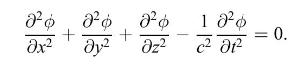
A wave equation for light iswhere \(\phi\) is a scalar potential. Show that the set of all linear transformations of the spacetime coordinates that permit this wave equation to be written as we did, correspond to (i) four possible translations in space and time, (ii) three constant rotations of
Two spaceships with string "paradox". Consider two spaceships, both at rest in our inertial frame, a distance \(D\) apart, one behind the other. There is a light string of restlength \(D\) tied between them. Now the ships, both at the same time in our frame, begin to accelerate uniformly to the
Consider a Lorentz covariant expression that is not a Lorentz scalar, \(C^{\lambda}=\) \(K^{\lambda} h\left(A^{\mu} \eta_{\mu u} B^{u}ight)\), where \(h\) is any function of the quantity in parentheses. Here quantities with a single superscript are four-vectors. Under a Lorentz transformation,
A \(\pi^{-}\)meson with mass \(m_{\pi}=140.0 \mathrm{MeV} / c^{2}\) is produced in a \((p, p)\) collision in an accelerator. The pion subsequently decays into a muon and a muon-type antineutrino, in the reaction \(\pi^{-} ightarrow \mu^{-}+\bar{u}_{\mu}\). The antineutrino has a non-zero but very
The Higgs particle has a mass-energy of \(125 \mathrm{GeV} / c^{2}\). Once created it decays very quickly into various sets of particles: for example, about \(60 \%\) of the time it decays into a \((b \bar{b})\) quark- antiquark pair. Such \(b\) quarks have a mass energy of about \(4.2
Tachyons are hypothetical (and so-far undetected) particles that always travel faster than light.(a) Show that all components of a tachyon's momentum four-vector are real if we assign the tachyon an imaginary mass, say \(m=i m_{0}\), where \(m_{0}\) is real.(b) Then show that the invariant square
Lambda \(\left(\Lambda^{0}ight)\) baryons can be created in high-energy \((p, \bar{p})\) collisions of protons and antiprotons in the reaction \(p+\bar{p} ightarrow \Lambda^{0}+k^{+}+\bar{p}\), where \(k^{+}\)is a positive \(k\) meson.(a) Find the minimum (i.e., threshold) energy required for the
Positive Sigma ( \(\Sigma^{+}\)) baryons can be created along with positive \(k\) mesons \(k^{+}\) in high-energy collisions of protons with protons, in the reactions \(p+p ightarrow \Sigma^{+}+k^{+}+n\), where \(n\) is a neutron.(a) Find the minimum (i.e., threshold) energy required for the
(a) A photon of energy \(E_{0}\) strikes a free electron at rest in the lab. ("Free" here means the electron is not bound inside an atom.) Is it possible for the photon to be absorbed by the electron? If so, find the energy and momentum of the final electron. If not, explain why not.(b) A free
The quantity \(\lambda_{C} \equiv h / m_{e} c\) is called the "Compton wavelength" of the electron.(a) If a photon scatters off an electron at rest with scattering angle \(\theta=45^{\circ}\), what is the photon's change of wavelength in terms of \(\lambda_{C}\) ?(b) For what scattering angle is
The Captain of an interstellar photon-rocket spaceship wishes to maintain a constant acceleration \(a\) in the instantaneous rest-frame of the ship, since that would provide a constant effective gravity for passengers. In that case, at what rate \(|d m / d t|\) (as a function of time) should the
Prove from Fermat's Principle that the angles of incidence and reflection are equal for light bouncing off a mirror. Use neither algebra nor calculus in your proof! (Hint: The result was proven by Hero of Alexandria 2000 years ago.)
An ideal converging lens focusses light from a point object onto a point image. Consider only rays that are straight lines except when crossing an air-glass boundary, such as those shown in the figure. Relative to the ray that passes straight through the center of the lens, do the other rays
Light focusses onto a point I from a point \(\mathrm{O}\) after reflecting off a surface that completely surrounds the two points, as shown in cross section below. The shape of the surface is such that all rays leaving \(\mathrm{O}\) (excepting the single ray which returns to \(\mathrm{O}\) )
Consider the ray shown bouncing off the bottom of the surface in the preceding problem. Replace the surface at this point by the more highly-curved surface shown in dotted lines. The ray still bounces from \(\mathrm{O}\) to \(\mathrm{I}\). Is the ray now a path of minimum time, maximum time, or is
When bouncing off a flat mirror, a light ray travels by a minimum time path.(a) For what shape mirror would the paths of all bouncing light-rays take equal times?(b) Is there a shape for which a bouncing ray would take a path of greatest time, relative to nearby paths?
We seek to find the path \(y(x)\) that minimizes the integral \(I=\int f\left(x, y, y^{\prime}ight) d x\). Find Euler's equation for \(y(x)\) for each of the following integrands \(f\), and then find the solutions \(y(x)\) of each of the resulting differential equations if the two endpoints are
Find a differential equation obeyed by geodesics in a plane using polar coordinates \(r, \theta\). Integrate the equation and show that the solutions are straight lines.
Find two first-order differential equations obeyed by geodesics in threedimensional Euclidean space, using spherical coordinates \(r, \theta, \varphi\).
Two-dimensional surfaces that can be made by rolling up a sheet of paper are called developable surfaces. Find the geodesic equations on the following developable surfaces and solve the equations.(a) A circular cylinder of radius \(R\), using coordinates \(\theta\) and \(z\).(b) A circular cone of
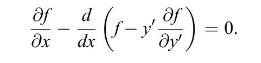
Using Euler's equation for \(y(x)\), prove thatThis equation provides an alternative method for solving problems in which the integrand \(f\) is not an explicit function of \(x\), because in that case the quantity \(f-y^{\prime} \partial f / \partial y^{\prime}\) is constant, which is only a
The time required for a particle to slide from the cusp of a cycloid to the bottom is \(t=\pi \sqrt{a / 2 g}\). Show that if the particle starts from rest at any point other than the cusp, it will take this same length of time to reach the bottom. The cycloid is therefore also the solution of the
A line and two points not on the line are drawn in a plane. A smooth curve is drawn between the two points and then rotated about the given line. Find the shape of the curve that minimizes the area generated by the rotated curve. A lampshade manufacturer might use this result to minimize the
A lifeguard is standing on the beach some distance from the shoreline, when he hears a swimmer calling for help. The swimmer is some distance offshore and also some lateral distance from the lifeguard. The lifeguard knows he can run twice as fast as he can swim. To minimize the time it takes to
Describe the geodesics on a right circular cylinder. That is, given two arbitrary points on the surface of a cylinder, what is the shape of the path of minimum length between them, where the path is confined to the surface? Hint: A cylinder can be made by rolling up a sheet of paper.
Showing 800 - 900
of 1040
1
2
3
4
5
6
7
8
9
10
11
Step by Step Answers

 Get 50% OFF
Claim Now
Get 50% OFF
Claim Now