New Semester
Started
Get
50% OFF
Study Help!
--h --m --s
Claim Now
Question Answers
Textbooks
Find textbooks, questions and answers
Oops, something went wrong!
Change your search query and then try again
S
Books
FREE
Study Help
Expert Questions
Accounting
General Management
Mathematics
Finance
Organizational Behaviour
Law
Physics
Operating System
Management Leadership
Sociology
Programming
Marketing
Database
Computer Network
Economics
Textbooks Solutions
Accounting
Managerial Accounting
Management Leadership
Cost Accounting
Statistics
Business Law
Corporate Finance
Finance
Economics
Auditing
Tutors
Online Tutors
Find a Tutor
Hire a Tutor
Become a Tutor
AI Tutor
AI Study Planner
NEW
Sell Books
Search
Search
Sign In
Register
study help
sciences
mechanics
Statistical Mechanics 3rd Edition Paul D. Beale - Solutions
A nice feature of the cyclotron described in the preceding problem is that the alternating current frequency applied to the "Dees" is a constant \(\omega=q B / m c\) for nonrelativistic particles, regardless of their energy, so the circulating particles will arrive at the gaps at just the right
Several problems are encountered in trying to scale up cyclotrons to produce increasingly energetic protons. One of them is that the external magnets have to be made larger and larger, which is prohibitively expensive and ultimately becomes completely unfeasible. A newer generation of machines
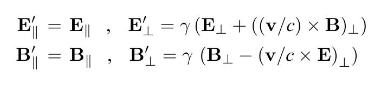
Consider two inertial frames \(\mathcal{O}\) and \(\mathcal{O}^{\prime}\) where \(\mathcal{O}^{\prime}\) is moving with velocity \(\mathbf{v}\) relative to \(\mathcal{O}\). We split all three-vectors in components parallel and perpendicular to the direction of the Lorentz boost, \(\mathbf{v}\) :
We discovered in the text that the scalar and vector potentials are components of a four vector \(A^{\mu}=(\phi, \mathbf{A})\). In this problem, we will take as given the existence of this four-vector potential \(A^{\mu}\) and, using the known Lorentz transformation of a four-vector and the
In the previous problem, you derived the Lorentz transformations of the B field starting with the assumption that the scalar and vector potentials are components of a four vector \(A^{\mu}=(\phi, \mathbf{A})\). Using a similar approach, derive the Lorentz transformation of the electric field
Using the Lorentz transformations of the \(\mathbf{E}\) and \(\mathbf{B}\) fields, show that \(E^{2}-B^{2}\) is a Lorentz invariant; that is, show that \({E^{\prime}}^{2}-B^{\prime 2}=E^{2}-B^{2}\).
Using the Lorentz transformations of the \(\mathbf{E}\) and \(\mathbf{B}\) fields, show that \(\mathbf{E} \cdot \mathbf{B}\) is a Lorentz invariant; that is, show that \(\mathbf{E}^{\prime} \cdot \mathbf{B}^{\prime}=\mathbf{E} \cdot \mathbf{B}\).
Show that the action of a relativistic charged particle (8.43) is invariant under a gauge transformationData from 8.43 S = m [dt 1 1 + 9 [ d (0+ A~). -
Using Noether's theorem, find the conserved quantity that results from the invariance of the action (8.43) under a gauge transformation of the four-vector potential. For this, consider an infinitesimal but arbitrary gauge transformation.Data from 8.43 dt 22 S = mc [ di 1 2 + 9 [ dt (0+ A ).
Derive the equations of motion resulting from the action of a relativistic charged particle (8.43) and verify that you get the Lorentz force law.Data from 8.43 dt 22 S = mc [ di 1 2 + 9 [ dt (0+ A ).
Show that Maxwell's equations given by 8.16 imply the wave equations\[abla^{2} \phi-\frac{1}{c^{2}} \frac{\partial^{2} \phi}{\partial t^{2}}=-4 \pi ho_{Q}\]and\[abla^{2} \mathbf{A}-\frac{1}{c^{2}} \frac{\partial^{2} \mathbf{A}}{\partial t^{2}}=-\frac{4 \pi}{c} \mathbf{J}\]To do this, you will need
Using the Lorentz transformation of the four-vector potential \(A^{\mu}\) and the wave equations from the previous problem, deduce the Lorentz transformations of charge density \(ho_{Q}\) and current density \(\mathbf{J}\).Data from previous problemShow that Maxwell's equations given by 8.16 imply
A relativistic particle with charge \(Q\) and mass \(M\) moves in the presence of a uniform electric field \(\mathbf{E}=E_{0} \hat{\boldsymbol{z}}\). The initial energy is \(K_{0}\) and the momentum is \(p_{0}\) in the \(\hat{\boldsymbol{y}}\) direction. Show that the trajectory in the \(y\)-z
A relativistic particle of charge Q and mass M is moving in uniform circular motion bound by a radial potential. We learned from Eq. (8.167) that the charge will lose energy to electromagnetic radiation. Assuming that this loss of energy is slow, we can describe the particle as gradually spiraling
A particle of charge \(Q\) and mass \(M\) moves through a region of uniform magnetic and gravitational fields described by constant field vectors \(\mathbf{B}\) and \(\mathbf{g}\) respectively. Show that the particle will have a drift velocity given by \(M c(\mathbf{g} \times \mathbf{B}) / Q
A particle of charge \(Q\) and mass \(M\) starts at the origin of the coordinate system with initial speed \(v_{0}\) in the \(\hat{\boldsymbol{z}}\) direction. There are uniform electric and magnetic fields \(E\) and \(B\) in the \(\hat{\boldsymbol{x}}\) direction. Find the location of the particle
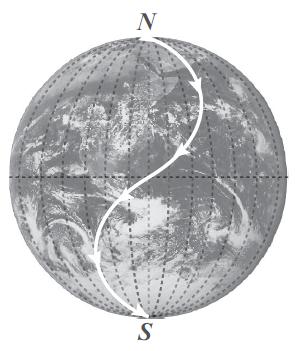
A satellite is in a polar orbit around the earth, passing successively over the north and south poles (see Figure 9.21). As we stand on the ground, what is the motion of the satellite as we see it from our rotating frame?Data from Figure 9.21 N S
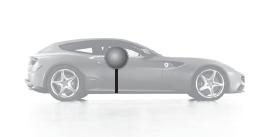
The string on a helium balloon is attached inside a car at rest, as shown in Figure 9.22 (a). If the car accelerates forward, does the balloon tilt forward or backward? If \(a\) is the car's acceleration and \(g\) is the gravitational field, what is the balloon's tilt angle from the vertical when
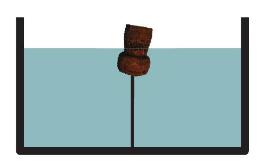
A cork floats in a fish tank half full of water; it is attached to the bottom of the tank by a stretched rubber band, as shown in Figure 9.22 (b). If the tank and contents are uniformly accelerated to the right, sketch the water surface, cork, and rubber band after the water has stopped sloshing
In the rotating frame of the earth, stars appear to orbit in circles, with a period of 24 hours. Show that the centrifugal and Coriolis pseudoforces acting together provide the net force needed in the rotating frame to cause a star to orbit as described.
A cylindrical space colony rotates about its symmetry axis with period 62.8 seconds. If the effective gravity felt by colonists standing on the inner rim is one earth "gee", what is the radius of the colony? What then is the percentage difference in the effective gravity acting upon the head and on
(a) A uniformly rotating merry-go-round spins clockwise as seen from above. A rider stands at the rotation axis, and then slowly walks radially outward toward the rim. How will the centrifugal and Coriolis pseudoforces affect her? How will she have to lean to keep from falling over? (b) Now suppose
In Rendezvous with Rama by Arthur C. Clarke, observers inside a cylindrical spaceship view a waterfall, which originates at one of the endcaps at a point halfway between the rotation axis and rim, and then "falls" to the rim. The spaceship is rotating clockwise about its symmetry axis as seen in an
A train runs around the inside of the outer rim of a cylindrical space colony of radius \(R\) and angular velocity \(\omega\) along its symmetry axis. How would the effective gravity on the passengers depend upon the train's speed \(v\) relative to the rim (a) if the train travels in the rotation
Why don't we notice Coriolis effects when we walk, drive cars, or throw baseballs? In contrast, why may Coriolis effects be significant for long-range artillery or moving air masses?
In 1914 there was a World War I naval battle between British and German battle cruisers near the Falkland Islands, at \(52^{\circ}\) south latitude (i. e., \(\lambda=-52^{\circ}\).) Guns on the British ships fired 12-inch shells at German ships up to about \(15 \mathrm{~km}\) distant. The great
In World War I the German army set up an enormous cannon (which they called the "Paris gun") to fire shells at Paris, \(120 \mathrm{~km}\) away from the cannon situated at a point NNE of Paris. The muzzle velocity was \(1640 \mathrm{~m} / \mathrm{s}\). (a) Neglecting both air resistance and the
A satellite in low-earth orbit with a 90-min period passes over the north pole, headed south along the 0◦ line of longitude passing through Greenwich, England.(a) What is its longitude when it reaches the latitude of Greenwich \(\left(\lambda=50^{\circ}\right)\) ?(b) When it reaches the equator,
(a) Find the centrifugal acceleration of a particle on the earth's surface at the equator, due to earth's rotation, as a fraction of the gravitational field \(g\) at that point.(b) Do the same for the centrifugal acceleration due to the motion of earth around the sun. Note that this acceleration is
Suppose we flatten and smooth out the ice at the south pole, and place a hockey puck at rest on the ice exactly at the pole. We then give it a small velocity, initially along longitude \(0^{\circ}\). Pretend that there is no friction between the puck and the ice, and that there is no air resistance
A merry-go-round has a \(5 \mathrm{~m}\) radius and rotates with a \(10 \mathrm{~s}\) period. If one "gee" is the gravitational force/mass experienced by a person standing still on the earth, how many gees are felt by a person walking from the center toward the rim of the merrygo-round at velocity
A ball is dropped from height \(h\) by someone standing still on the earth's equator.(a) Does it fall to the east or west of a point just beneath the position from which it was dropped?(b) When it strikes the ground, how far is the ball from the point originally directly beneath it, in terms of
A ball at a point on the earth with latitude \(\lambda\) is thrown vertically upward to a small altitude \(h\). (a) Does the ball fall to the east or west of its starting point? (b) Show that the ball strikes the ground a distance \((4 / 3) \Omega \cos \lambda(2 h / g)^{3 / 2}\) from its starting
Show that the usual formula \(P=2 \pi \sqrt{R / g}\) for the period of small-amplitude oscillations of a pendulum of length \(R\) becomes instead \(P=2 \pi \sqrt{R / g}\left(\sqrt{m_{\mathrm{I}} / m_{\mathrm{G}}}\right)\) if the inertial and gravitational masses of the pendulum bob differ. (Newton
If an artillery shell is fired a short distance from a point on earth's surface at latitude \(\lambda\), with speed \(v_{0}\) and an angle of inclination \(\alpha\) to the horizontal, show that (pretending there is no air resistance) its lateral deflection when it strikes the ground iswhere
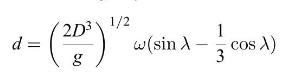
An artillery shell is projected due north from a point at latitude λ at an angle of 45◦ to the horizontal, and aimed at a target whose distance is D, where D is small compared with earth’s radius. (a) Show that due to the Coriolis pseudoforce, and neglecting air resistance, the shell will miss
In a rotating cylindrical space colony of radius \(R\) and angular velocity \(\omega\) about its axis of rotation, a ball of mass \(m\) is thrown with speed \(v=\omega R / 2\) ) from a point halfway between the rotation axis and rim, in a direction exactly opposite to the rotation direction, as
A ball is released from rest in the frame of a rotating cylindrical space colony, at a point halfway between the rotation axis and rim. (a) Sketch the subsequent path of the ball as seen by an inertial observer who sees the colony rotating counterclockwise with angular velocity \(\omega\). (b) If
A cylindrical space colony of radius \(R\) rotates with angular velocity \(\omega\) about its symmetry axis. A colonist standing on the rim throws a ball straight "up" (i.e., aimed at the rotation axis) with speed \(v=R \omega\) from the colonist's point of view. (a) Sketch the subsequent path of
For the film 2001 Space Odyssey, director Stanley Kubrick had a giant centrifuge constructed, of diameter 11.6 m. On the movie set, motors rotated the centrifuge about a horizontal axis, like a Ferris wheel. This was the home for fictional astronauts on their long journey to the planet Jupiter,
(a) Prove that there is no work done by the Coriolis pseudoforce acting on a particle moving in a rotating frame. (b) If the Coriolis pseudoforce were the only force acting on a particle, what could you conclude about the particle's speed in the rotating frame?
Show that the formula \(d \mathbf{A}=d \boldsymbol{\theta} \times \mathbf{A}\) for the change in an inertial frame of a vector \(\mathbf{A}\) that is stationary in a rotating frame is still valid when \(\mathbf{A}\) is not perpendicular to \(\boldsymbol{\Omega}\) and when the tail of \(\mathbf{A}\)
A well-known actor and television crew, filming a travel documentary, were driving south in Africa when they were approached by a local citizen as they neared the equator. He offered (for a fee) to demonstrate the change in swirl direction of water in a hand basin. They all walked a few minutes
Prevailing winds in middle latitudes of the northern hemisphere are westerly, blowing from west to east at typical speed \(v\). The tendency of the Coriolis pseudoforce to deflect the path southward is typically balanced by a horizontal pressure gradient that keeps the air flowing eastward. The
The Gulf Stream flows northward off the Florida coast, so tends to be deflected eastward. This causes the water level to rise on the eastern side, since the more stationary Atlantic waters cannot easily be moved aside. The higher waters on the eastern side provide the higher pressures needed to
A spherical asteroid of radius \(R\) and uniform density \(ho\) rotates with angular velocity \(\Omega\) about an axis through its center. Visiting astronauts drill a smooth hole from one point on the equator clear through the asteroid's center to a point on the opposite side. (a) If an astronaut
(a) Find the radius of a toroidal space colony spinning once every two minutes, if the effective gravity for colonists living within the torus is \(10 \mathrm{~m} / \mathrm{s}^{2}\). (b) Arriving tourists dock at the central hub, and are then transported to the torus by an elevator running through
A cylindrical space station rotating with angular velocity \(\Omega\) contains an atmosphere with molecular weight \(M\) and temperature \(T\). Show that if \(P_{0}\) is the atmospheric pressure at the rotation axis, the pressure at radius \(ho\) is \(P=P_{0} \exp \left(M \Omega^{2} ho^{2} / 2 R
An astronaut is stranded in space above the earth, in the same orbit as a space station, but 200 m behind it. Both are circling 280 km above earth’s surface in a 90-min orbit. The astronaut and spacesuit together have a mass of 100 kg.(a) In what direction, and with what speed, can the astronaut
Only the centrifugal and Coriolis pseudoforces act upon a particular projectile moving within a rotating cylindrical space colony of radius \(R\). (a) Find the differential equations of motion of the projectile in the rotating frame, using Cartesian coordinates centered on the rotation axis. (b)
A uniform electric charge density \(ho\) fills a very long stationary cylinder.(a) Show from Gauss's law \(\oint \mathbf{E} \cdot d \mathbf{S}=4 \pi q_{\text {in }}\) that the electric field within the cylinder is \(\mathbf{E}=2 \pi ho ho\), where \(ho\) is the radius vector out from the symmetry
Show that for the problem of a spacecraft rendezvous and docking discussed in the text, the dynamics in the \(z\) direction decouples from that in the \(x-y\) plane. What is the equation of motion of the \(z\) coordinate?
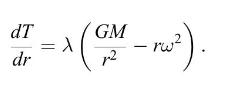
Space visits for everyone? An alternative way to visit space has been proposed: A space station of mass \(m\) is tethered to one end of a long cable and the other end of the cable is attached to a point on the earth's equator, a distance \(R\) from the center of the earth. In the rotating frame of
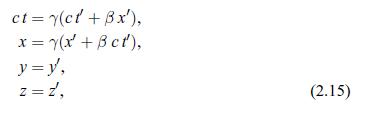
Time dilation and length contraction. Clock A is placed at the origin of the primed frame; it reads time \(t^{\prime}=0\) just as the origins of the primed and unprimed frames coincide. At a later time \(t\) to observers in unprimed frame, find from the Lorentz transformation of Eqs. 2.15Data from
The invariance of transverse lengths. A stick of length \(L_{0}\) is placed at rest along the \(y^{\prime}\) axis of the primed frame, extending from \(y^{\prime}=y_{1}^{\prime}\) to \(y^{\prime}=y_{2}^{\prime}\). Observers in the unprimed frame measure the position of both ends of the stick at the
The Global Positioning System (GPS) features 24 earth satellites orbiting at altitude \(20,200 \mathrm{~km}\) above earth's surface. Each satellite carries 4 highly precise atomic clocks; this precision is essential in allowing us to know our positions on the ground within a few meters or less.
Suppose that in the distant future astronomers build a telescope so powerful they can see aliens on a planet that is 10 light-years from earth. One day they observe the aliens board a spaceship and blast off toward earth. According to earth clocks, the ship and its alien crew arrive at the earth
A distant galactic nucleus ejects a jet of material at right angles \(\left(90^{\circ} \right)\) to our line of sight. We know the distance of the galaxy from the redshift of its spectral lines, so we can calculate how far the jet has traveled in a given time using the very small but growing angle
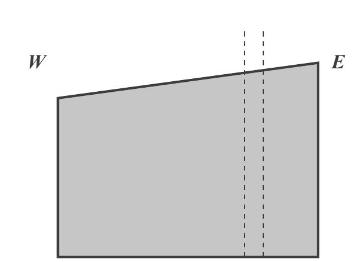
A bullet train of rest-length \(500 \mathrm{~m}\) is chugging along a straight track at speed \(4 / 5 c\) when it enters a tunnel of length \(400 \mathrm{~m}\). Due to length contraction in the frame of the tunnel, the train apparently briefly fits inside the tunnel all at once. From the point of
A carrot-slicing machine consists of eight parallel blades spaced 5 cm apart, held together in a framework that allows all the blades to descend at once upon an unsuspecting carrot laid out horizontally in the machine. The result is several carrot pieces of length \(5 \mathrm{~cm}\), plus random
By differentiating the velocity transformation equations one can obtain transformation laws for acceleration. Find the acceleration transformations for the \(x\) component \(a_{x}\), in terms of \(a_{x}, v_{x}\), and \(V\), the relative frame velocity.
An electron moves at velocity \(0.9 c\). How fast must it move to double its momentum?
An atomic nucleus starts at rest in the lab, and is then struck by two photons, one after the other, each with momentum \(p_{\gamma}\) in the same direction. The photons are absorbed in the nucleus. If the mass of the final (excited) nucleus is \(M^{*}\), calculate its velocity.
Two particles make a head-on collision, stick together, and stop dead. The first particle has mass \(m\) and speed (24/25) \(c\), and the second has mass \(M\) and speed (5/13) \(c\). Find \(M\) in terms of \(m\).
Spaceship A, moving away from the earth at velocity \(3 / 5 c\), is sending messages to spaceship B, which left the earth earlier at speed \(4 / 5 c\) in the same direction. The messages sent by A are contained in pulses sent by a laser on A, with the pulses separated by 100 femtoseconds in A's
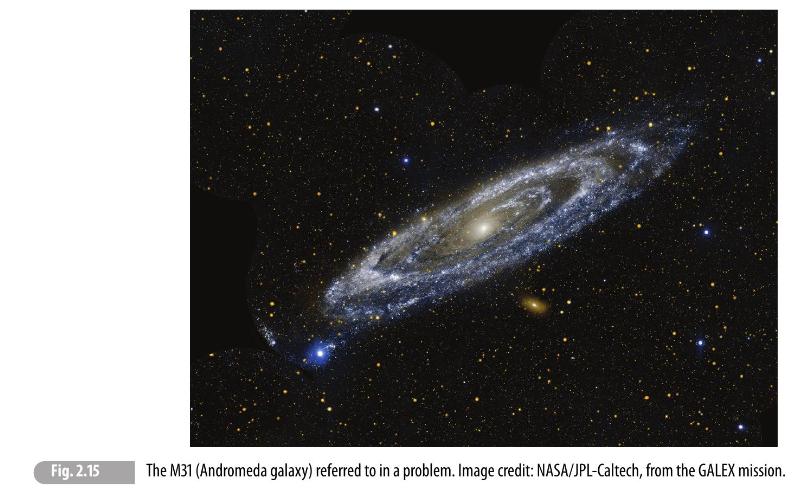
The Andromeda galaxy, also known to astronomers by the catalog number M31, is in our local group of galaxies, about 2.5 million light-years from our own Milky Way (MW) galaxy. When using spectrometers to measure the wavelengths of light emitted by stars in M31, astronomers find the redshift to be
A proton moves in the \(x, y\) plane with velocity \(v=(3 / 5) c\), at an angle of \(45^{\circ}\) to both the \(x\) and \(y\) axes. (a) Find all four components of the proton's four-vector velocity \(v^{\mu}\) and evaluate the invariant square of its components \(\eta_{\mu u} u^{\mu} v^{u}\).
A particular pion \(\pi^{+}\)decays in 26 nanoseconds in its own rest-frame. Suppose a particle accelerator produces the pion with total energy \(E=100 m c^{2}\), where \(m\) is its mass. (a) How far (in meters) will it travel before decaying? (b) A different pion has a kinetic energy equal to its
A photon of total energy \(E=12,000 \mathrm{MeV}\) is absorbed by a nucleus of mass \(M_{0}\), originally at rest. Afterwards, the excited nucleus has mass \(M\) and is moving at speed (12/13) \(c\). Find its momentum in the units \(\mathrm{MeV} / c\), and both \(M\) and \(M_{0}\) in the units
A team plans to accelerate a probe of mass \(2.0 \mathrm{~kg}\) away from the far side of the Moon by a bank of lasers that push the probe with the constant force \(F\) in the rest frame of the Moon. What \(F\) would be required to accelerate the probe to velocity \(0.9 c\) in one week?
Two spaceships with string "paradox". Consider two spaceships, both at rest in our inertial frame, a distance \(D\) apart, one behind the other. There is a light string of restlength \(D\) tied between them. Now the ships, both at the same time in our frame, begin to accelerate uniformly to the
(a) Prove that the time order of two events is the same in all inertial frames if and only if they can be connected by a signal traveling at or below speed \(c\). (b) Suppose that in an unprimed inertial frame a particular signal from A to B can travel at velocity \(v=2 c\). Then find a relative
we derived the Doppler formulae for light. Using the same strategy, find the relativistic Doppler formulae for waves traveling at a speed \(v
The concept of Lorentz covariance is important because it allows us to quickly determine the transformation properties of expressions under changes of inertial reference frames. The principle of relativity requires that all laws of physics are unchanged as seen by different inertial observers.
Show that the most general Lorentz transformation can be written as a \(4 \times 4\) matrix \(\hat{\Lambda}\) satisfying\[\hat{\boldsymbol{\Lambda}}^{\mathrm{T}} \cdot \hat{\eta} \cdot \hat{\boldsymbol{\Lambda}}=\hat{\eta} \quad \text { and } \quad|\hat{\boldsymbol{\Lambda}}|=1\]Since a Lorentz
Tachyons are hypothetical (and so-far undetected) particles that always travel faster than light. (a) Show that all components of a tachyon's momentum four-vector are real if we assign the tachyon an imaginary mass, say \(m=i m_{0}\), where \(m_{0}\) is real. (b) Then show that the invariant
Consider a relativistic elastic collision between two particles of equal mass, such as two protons. In the lab frame the target proton is at rest, and the incident proton has three-vector velocity \(v\). For nonrelativistic equal-mass collisions the two protons emerge at right angles to one
We derived the differential equation of motion of a nonrelativistic rocket, by conserving both momentum and total mass over a short time interval \(\Delta t\). That is, the momentum of the rocket at time \(t\) was set equal to the sum of the momenta of the rocket and bit of exhaust at time
By integrating the relativistic rocket differential equation of motion from the preceding problem, show that in terms of the ratio \(\mathrm{m} / \mathrm{m}_{0}\), the relative rocket velocity \(v / \mathrm{c}\) is given by\[\frac{v}{c}=\frac{\left.1-\left(m / m_{0}\right)\right)^{2 u /
A hypothetical object called a straight cosmic string (which may have been formed in the early universe and may persist today) makes the \(r, \theta\) space around it conical. That is, set an infinite straight cosmic string along the \(z\) axis; the two-dimensional space perpendicular to this,
Model earth's atmosphere as a spherical shell \(100 \mathrm{~km}\) thick, with index of refraction \(n_{t}=1.00000\) at the top and \(n_{b}=1.00027\) at the bottom. Is a light ray's final angle \(\varphi_{\mathrm{f}}\) relative to the normal at the ground greater or less than its initial angle
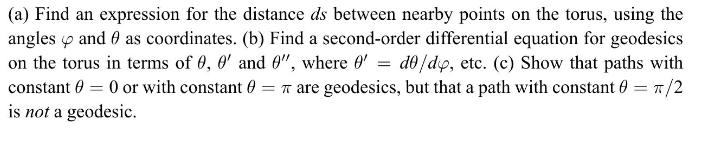
A torus can be defined by two radii: A large radius \(R\) running around the center of the torus, and a small radius \(r\) corresponding to a cross-sectional slice. Let \(R\) live in the \(x, y\) plane. Then if \(\varphi\) is an angle relative to the \(x\) axis and lying in the \(x, y\) plane, and
Derive Snell's law from Fermat's Principle.
Suppose that earth's atmosphere is as described in the preceding problem, except that \(n^{2}(y)=1+\alpha y+\beta y^{2}\), where \(\alpha\) and \(\beta\) are positive constants. Find the light-ray trajectory \(x(y)\) in this case.
Using the result found in the preceding problem, and supposing that \(n^{2}(r)=\) \(1+\alpha / r^{2}\) (where \(\alpha\) is a constant), find the light-ray trajectory expressed either as \(r(\theta)\) or \(\theta(r)\).
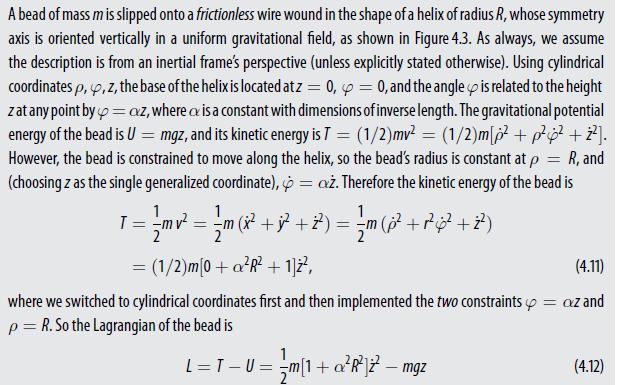
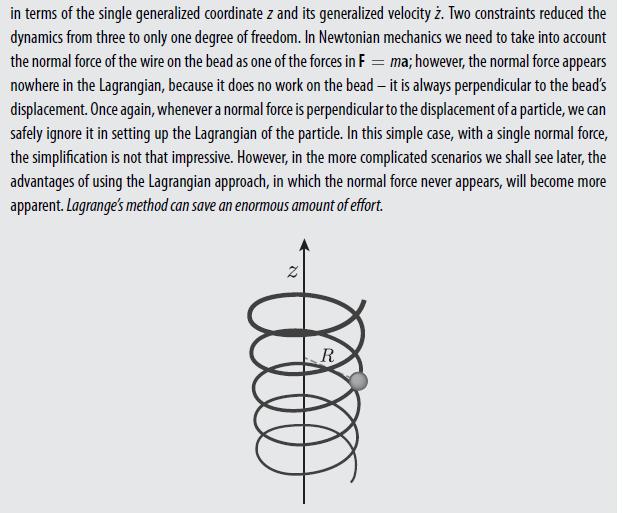
Example 4.2 featured a bead sliding on a vertically-oriented helix of radius \(R\). The angle \(\theta\) about the symmetry axis was related to its vertical coordinate \(z\) on the wire by \(\theta=\alpha z\). There is a uniform gravitational field \(g\) vertically downward.(a) Rewrite the
Repeat the preceding problem for a particle sliding inside a smooth cone defined by \(z=\alpha r\).Data from preceding problemA particle of mass \(m\) slides inside a smooth paraboloid of revolution whose axis of symmetry \(z\) is vertical. The surface is defined by the equation \(z=\alpha
A particle moves with a cylindrically symmetric potential energy \(U=U(ho, z)\) where \(ho, \varphi, z\) are cylindrical coordinates.(a) Write the Lagrangian for an unconstrained particle of mass \(m\) in this case.(b) Are there any cyclic coordinates? If so, what symmetries do they correspond to,
A wire is bent into the shape of a cycloid, defined by the parametric equations \(x=A(\varphi+\sin \varphi)\) and \(y=A(1-\cos \varphi)\), where \(\varphi\) is the parameter \((-\pi
A mass \(M_{1}\) is hung on an unstretchable string A, and the other end of string A is passed over a fixed, frictionless, non-rotating pulley \(P_{1}\), as shown. This other end of string A is then attached to the center of a second frictionless, non-rotating pulley \(P_{2}\) of mass \(M_{2}\),
There are thought to be three types of the particles called neutrinos: electrontype \(\left(u_{e}\right)\), muon type \(\left(u_{\mu}\right)\), and tau-type \(\left(u_{\tau}\right)\). If they were all massless they could not spontaneously convert from one type into a different type. But if there is
A spherical pendulum consists of a bob of mass \(m\) on the end of a light string of length \(R\) hung from a point on the ceiling, and with a uniform gravitational field \(g\) downward. The position of the bob can be specified by the polar angle \(\theta\) of the string (the angle of the string
(a) A neutron in a nuclear reactor makes a head-on elastic collision with a carbon nucleus, which is initially at rest and has 12 times the mass of a neutron. What fraction of the neutron's initial speed is lost in the collision?(b) Repeat part (a) if instead the neutron collides head-on with a
The Friedmann equations have played an important role in relativistic bigbang cosmologies. They feature a "scale factor" \(a(t)\), proportional to the distance between any two points (such as the positions of two galaxies) that are sufficiently remote from one another that local random motions can
The Joule-Thomson coefficient of a gas is given by\[\left(\frac{\partial T}{\partial P}ight)_{H}=-\frac{(\partial H / \partial P)_{T}}{(\partial H / \partial T)_{P}}=\frac{1}{C_{P}}\left[T\left(\frac{\partial V}{\partial T}ight)_{P}-Vight]=\frac{N}{C_{P}}\left[\left(\frac{\partial
Assume that the molecules of the nitrogen gas interact through the potential of the previous problem. Making use of the experimental data given next, determine the "best" empirical values for the parameters \(D, r_{1}\), and \(u_{0} / k\) : T (in K) 100 200 9223 (in K per atm) -1.80 -4.26 x 10⁻¹
The pressure is given by\[\frac{P}{n k T}=1-\frac{n}{2 d k T} \int r g(r) \frac{d u}{d r} d \boldsymbol{r}\]where \(g(r)=y(r) e^{-\beta u(r)}\). This gives\[\frac{P}{n k T}=1-\frac{n}{2 d k T} \int r y(r) \frac{d u}{d r} e^{-\beta u(r)} d \boldsymbol{r}=1+\frac{n}{2 d} \int r y(r) \frac{d}{d
Consider a gas, of infinite extent, divided into regions \(A\) and \(B\) by an imaginary sheet running through the system. The molecules of the gas interact through a potential energy function \(u(r)\). Show that the average net force \(\boldsymbol{F}\) experienced by all the molecules on the
The pressure is given by\[p=-\left(\frac{\partial A}{\partial V}ight)_{N, T}=n^{2}\left(\frac{\partial A / N}{\partial n}ight)_{T}\]and the excess pressure is given by\(P^{\mathrm{ex}}=P_{c s}-P_{\text {ideal }}=n k T\left(\frac{1+\eta+\eta^{2}-\eta^{3}}{(1-\eta)^{3}}-1ight)=n k T \frac{4 \eta-2
The virial expansion for a two-dimensional system of hard disks gives the following series when expressed in terms of the two-dimensional packing fraction \(\eta=\pi n D^{2} / 4\) :\[\begin{aligned}\frac{P}{n k T}= & 1+2 \eta+3.128018 \eta^{2}+4.257854 \eta^{3}+5.33689664 \eta^{4}+6.363026 \eta^{5}
Showing 600 - 700
of 1040
1
2
3
4
5
6
7
8
9
10
11
Step by Step Answers

 Get 50% OFF
Claim Now
Get 50% OFF
Claim Now