New Semester
Started
Get
50% OFF
Study Help!
--h --m --s
Claim Now
Question Answers
Textbooks
Find textbooks, questions and answers
Oops, something went wrong!
Change your search query and then try again
S
Books
FREE
Study Help
Expert Questions
Accounting
General Management
Mathematics
Finance
Organizational Behaviour
Law
Physics
Operating System
Management Leadership
Sociology
Programming
Marketing
Database
Computer Network
Economics
Textbooks Solutions
Accounting
Managerial Accounting
Management Leadership
Cost Accounting
Statistics
Business Law
Corporate Finance
Finance
Economics
Auditing
Tutors
Online Tutors
Find a Tutor
Hire a Tutor
Become a Tutor
AI Tutor
AI Study Planner
NEW
Sell Books
Search
Search
Sign In
Register
study help
sciences
mechanics
Statistical Mechanics 3rd Edition Paul D. Beale - Solutions
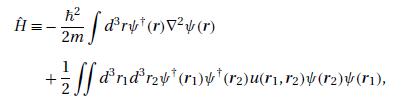
(a) Show that, for bosons as well as fermions,\[ \left[\psi\left(\boldsymbol{r}_{j}ight), \hat{H}ight]=\left(-\frac{\hbar^{2}}{2 m} abla_{j}^{2}+\int d^{3} r \psi^{\dagger}(\boldsymbol{r}) u\left(\boldsymbol{r}, \boldsymbol{r}_{j}ight) \psi(\boldsymbol{r})ight) \psi\left(\boldsymbol{r}_{j}ight)
The grand partition function of a gaseous system composed of mutually interacting bosons is given by\[ \ln \mathcal{Q} \equiv \frac{P V}{k T}=\frac{V}{\lambda^{3}}\left[g_{5 / 2}(z)-2\left\{g_{3 / 2}(z)ight\}^{2} \frac{a}{\lambda}+O\left(\frac{a^{2}}{\lambda^{2}}ight)ight] \]Study the analytic
The relevant results for \(TT_{c}\) follow from eqn. (11.2.10) by neglecting \(n_{0}\) altogether; we get, to the first order in \(a\),\[\begin{align*}\frac{1}{N} A(N, V, T) & =\frac{1}{N} A_{i d}(N, V, T)+\frac{4 \pi a \hbar^{2}}{m \mathrm{v}}, \tag{13a}\\P & =P_{i d}+\frac{4 \pi a \hbar^{2}}{m
We invert the given equation for \(n\) and write\[\mu_{0}=\frac{4 \pi a \hbar^{2} n}{m}\left[1+\frac{32}{3 \pi^{1 / 2}}\left(n a^{3}ight)^{1 / 2}+\ldotsight]\]Substituting this into the given expressions for \(E_{0}\) and \(P_{0}\), we get\[\begin{aligned}\frac{E_{0}}{V} & =\frac{2 \pi a \hbar^{2}
By eqns. (11.3.11), the number operator \(\hat{n}_{\mathrm{p}}\) for the real particles is given by\[\hat{n}_{\mathrm{p}}=a_{\mathrm{p}}^{+} a_{\mathrm{p}}=\frac{1}{1+\alpha_{\mathrm{p}}^{2}}\left\{b_{\mathrm{p}}^{+} b_{\mathrm{p}}-\alpha_{\mathrm{p}}\left(b_{-\mathrm{p}}
The excitation energy of liquid \(\mathrm{He}^{4}\), carrying a single excitation above the ground state, is determined by the minimum value of the quantity\[\varepsilon=\int \Psi^{*}\left\{-\frac{\hbar^{2}}{2 m} \sum_{i} abla_{i}^{2}+V-E_{0}ight\} \Psi d^{3 N} r / \int \Psi^{*} \Psi d^{3 N}
Show that, for a sufficiently large momentum \(\hbar k\) (in fact, such that the slope \(d \varepsilon / d k\) of the energy spectrum is greater than the initial slope \(\hbar c\) ), a state of double excitation in liquid \(\mathrm{He}^{4}\) is energetically more favorable than a state of single
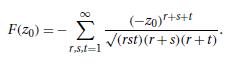
Establish the asymptotic formula (11.7.30) for the function \(F\left(z_{0}ight)\).[Write the coefficient that appears in the sum (11.7.24) in the form\[\begin{aligned}& \frac{1}{\sqrt{ }(r s t)(r+s)(r+t)} \\& =\left(\frac{2}{\sqrt{ } \pi}ight)^{3} \int_{0}^{\infty} e^{-X^{2} r-Y^{2} s-Z^{2}
The grand partition function of a gaseous system composed of mutually interacting, spin-half fermions has been evaluated by Lee and Yang (1957), with the result \({ }^{27}\)\[\begin{aligned}\ln \mathcal{Q} \equiv \frac{P V}{k T}=\frac{V}{\lambda^{3}}[ & 2 f_{5 / 2}(z)-\frac{2
The energy spectrum \(\varepsilon(p)\) of a gas composed of mutually interacting, spin-half fermions is given by (Galitskii, 1958; Mohling, 1961)\[\begin{aligned}\frac{\varepsilon(p)}{p_{F}^{2} / 2 m} \simeq x^{2}+\frac{4}{3 \pi}\left(k_{F} aight)+ & \frac{4}{15 \pi^{2}}\left(k_{F} aight)^{2}
At \(T=0 K\), the chemical potential of a thermodynamic system is given by\[\mu=\left(\frac{\partial E}{\partial N}ight)_{v}=\frac{\partial(E / V)}{\partial(N / V)}\]It follows that, in the ground state of the given system,\[E=V \int_{0}^{n} \mu(n) d n=\frac{N}{n} \int_{0}^{n} \mu(n) d n
Correction to the first printing of third edition: In line 3, the definition of the dimensionless wavefunction should read: \(\psi=a_{\text {osc }}^{3 / 2} \Psi / \sqrt{N}\). Using that substitution and \(a_{\mathrm{osc}}=\sqrt{\hbar /\left(m \omega_{0}ight)}\) gives\[-\frac{1}{2} \tilde{abla}^{2}
The solution for the case \(V=0\) is \(\Psi=\sqrt{N / V}\) which gives \(\mu=N u_{0} / V\) and \(E=\left(2 \pi a \hbar^{2} N^{2}ight) /(m V)\).
For the case \(a ightarrow 0\) the dimensionless G-P equation is\[-\frac{1}{2} \tilde{abla}^{2} \psi+\frac{1}{2} s^{2} \psi+=\mu \psi\]which has solution \(\psi=\frac{1}{\pi^{3 / 4}} \exp \left(-\frac{1}{2} s^{2}ight)\) with \(E /\left(N \hbar \omega_{0}ight)=3 / 2\), i.e. the zero point energy for
Use the dimensionless form from problem 11.17. Ignoring the kinetic energy term\[\psi=\frac{\sqrt{\tilde{\mu}-\frac{s^{2}}{2}}}{\sqrt{4 \pi N a / a_{0}}} .\]The normalization is\[1=\frac{4 \pi a_{0}}{4 \pi N a} \int_{0}^{\sqrt{2 \tilde{\mu}}}\left(\tilde{\mu}-\frac{s^{2}}{2}ight) d s\]which
Referring to Fig. 8.11 and noting that the slope of the tangent at the point \(x=\xi\) is \(-1 / 4\), the approximate distribution is given by\[f(x)=\left\{\begin{array}{cc}1 & 0 \leq x \leq(\xi-2) \\(\xi+2-x) / 4 & (\xi-2) \leq x \leq(\xi+2) \\0 & (\xi+0) \leq x\end{array}ight.\]where
By eqns. (8.1.4) and (8.1.5), the temperature \(T_{0}\) is given by\[\begin{equation*}T_{0}=\left(\frac{N}{g V f_{3 / 2}(1)}ight)^{2 / 3}\left(\frac{h^{2}}{2 \pi m k}ight) \tag{1}\end{equation*}\]At the same time, the Fermi temperature \(T_{F}\) is given by, see eqn.
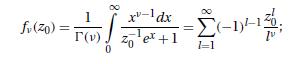
This problem is similar to Problem 7.4 of the Bose gas and can be done the same way - only the functions \(g_{\mathrm{v}}(z)\) get replaced by \(f_{\mathrm{v}}(z)\).To obtain the low-temperature expression for \(\gamma\), we make use of expansions (8.1.30-32), with the result\[\begin{aligned}\gamma
(a) Show that the isothermal compressibility \(\kappa_{T}\) and the adiabatic compressibility \(\kappa_{S}\) of an ideal Fermi gas are given by\[\kappa_{T}=\frac{1}{n k T} \frac{f_{1 / 2}(z)}{f_{3 / 2}(z)}, \quad \kappa_{S}=\frac{3}{5 n k T} \frac{f_{3 / 2}(z)}{f_{5 / 2}(z)}\]where \(n(=N / V)\) is
Evaluate \(\left(\partial^{2} P / \partial T^{2}ight)_{u},\left(\partial^{2} \mu / \partial T^{2}ight)_{u}\), and \(\left(\partial^{2} \mu / \partial T^{2}ight)_{P}\) of an ideal Fermi gas and check that your results satisfy the thermodynamic relations\[C_{V}=V T\left(\frac{\partial^{2} P}{\partial
By eqns. (8.1.4, 5 and 24 ), the Fermi energy \(\varepsilon_{F}\) is given by\[\varepsilon_{F}=\left\{\frac{3}{4 \pi} f_{3 / 2}(z)ight\}^{2 / 3} \frac{h^{2}}{2 m \lambda^{2}}=\left\{\frac{3 \pi^{1 / 2}}{4} f_{3 / 2}(z)ight\}^{2 / 3} k T\]With the help of Sommerfeld's lemma (E.17), this
For a Fermi gas confined to a two-dimensional region of area A,N=Aλ2f1(zF)=Aλ2ln(1+zF),EF=AkTλ2f2(zF)while the corresponding results for the Bose gas areN=Aλ2g1(zB)=Aλ2ln(1−zB),EB=AkTλ2g2(zB)Equating (la) and (2a), we get1+zF=11−zB, i.e. zF=zB1−zB or zB=zF1+zFLetting T→0, we
Calculate the fraction of the conduction electrons in tungsten \(\left(\varepsilon_{F}=9.0 \mathrm{eV}ight)\) at \(3000 \mathrm{~K}\) whose kinetic energy \(\varepsilon\left(=\frac{1}{2} m u^{2}ight)\) is greater than \(W(=13.5 \mathrm{eV})\). Also calculate the fraction of the electrons whose
The total energy \(E\) of the electron cloud in an atom can be written as\[E=K+V_{n e}+V_{e e},\]where \(K\) is the kinetic energy of the electrons, \(V_{n e}\) the interaction energy between the electrons and the nucleus, and \(V_{e e}\) the mutual interaction energy of the electrons. Show that,
Study the density matrix and the partition function of a system of free particles, using the unsymmetrized wavefunction (5.4.3) instead of the symmetrized wavefunction (5.5.7). Show that, following this procedure, one encounters neither the Gibbs' correction factor \((1 / N\) !) nor a spatial
Show that in the first approximation the partition function of a system of \(N\) noninteracting, indistinguishable particles is given by\[Q_{N}(V, T)=\frac{1}{N ! \lambda^{3 N}} Z_{N}(V, T),\]where\[Z_{N}(V, T)=\int \exp \left\{-\beta \sum_{i
Determine the values of the degeneracy discriminant \(\left(n \lambda^{3}ight)\) for hydrogen, helium, and oxygen at NTP. Make an estimate of the respective temperature ranges where the magnitude of this quantity becomes comparable to unity and hence quantum effects become important.
Show that the quantum-mechanical partition function of a system of \(N\) interacting particles approaches the classical form\[Q_{N}(V, T)=\frac{1}{N ! h^{3 N}} \int e^{-\beta E(\boldsymbol{q}, \boldsymbol{p})} d^{3 N} q d^{3 N} p\]as the mean thermal wavelength \(\lambda\) becomes much smaller than
Prove the following theorem due to Peierls. "If \(\hat{H}\) is the hermitian Hamiltonian operator of a given physical system and \(\left\{\phi_{n}ight\}\) an arbitrary orthonormal set of wavefunctions satisfying the symmetry requirements and the boundary conditions of the problem, then the
Show that the entropy of an ideal gas in thermal equilibrium is given by the formula\[S=k \sum_{\varepsilon}\left[\left\langle n_{\varepsilon}+1ightangle \ln \left\langle n_{\varepsilon}+1ightangle-\left\langle n_{\varepsilon}ightangle \ln \left\langle n_{\varepsilon}ightangleight]\]in the case of
Derive, for all three statistics, the relevant expressions for the quantity \(\left\langle n_{\varepsilon}^{2}ightangle-\left\langle n_{\varepsilon}ightangle^{2}\) from the respective probabilities \(p_{\varepsilon}(n)\). Show that, quite generally,\[\left\langle
Refer to Section 6.2 and show that, if the occupation number \(n_{\varepsilon}\) of an energy level \(\varepsilon\) is restricted to the values \(0,1, \ldots, l\), then the mean occupation number of that level is given by\[\left\langle n_{\varepsilon}ightangle=\frac{1}{z^{-1} e^{\beta
The potential energy of a system of charged particles, characterized by particle charge \(e\) and number density \(n(\boldsymbol{r})\), is given by\[U=\frac{e^{2}}{2} \iint \frac{n(\boldsymbol{r}) n\left(\boldsymbol{r}^{\prime}ight)}{\left|\boldsymbol{r}-\boldsymbol{r}^{\prime}ight|} d
Show that the root-mean-square deviation in the molecular energy \(\varepsilon\), in a system obeying Maxwell-Boltzmann distribution, is \(\sqrt{ }(2 / 3)\) times the mean molecular energy \(\bar{\varepsilon}\). Compare this result with that of Problem 3.18.
Show that, for any law of distribution of molecular speeds,\[\left\{\langle uangle\left\langle\frac{1}{u}ightangleight\} \geq 1\]Check that the value of this quantity for the Maxwellian distribution is \(4 / \pi\).
Through a small window in a furnace, which contains a gas at a high temperature \(T\), the spectral lines emitted by the gas molecules are observed. Because of molecular motions, each spectral line exhibits Doppler broadening. Show that the variation of the relative intensity \(I(\lambda)\) with
An ideal classical gas composed of \(N\) particles, each of mass \(m\), is enclosed in a vertical cylinder of height \(L\) placed in a uniform gravitational field (of acceleration \(g\) ) and is in thermal equilibrium; ultimately, both \(N\) and \(L ightarrow \infty\). Evaluate the partition
Centrifuge-based uranium enrichment: Natural uranium is composed of two isotopes: \({ }^{238} \mathrm{U}\) and \({ }^{235} \mathrm{U}\), with percentages of \(99.27 \%\) and \(0.72 \%\), respectively. If uranium hexafluoride gas \(\mathrm{UF}_{6}\) is injected into a rapidly spinning hollow metal
(a) Show that, if the temperature is uniform, the pressure of a classical gas in a uniform gravitational field decreases with height according to the barometric formula\[P(z)=P(0) \exp \{-m g z / k T\}\]where the various symbols have their usual meanings. \({ }^{17}\)(b) Derive the corresponding
(a) Show that the momentum distribution of particles in a relativistic Boltzmannian gas, with \(\varepsilon=c\left(p^{2}+m_{0}^{2} c^{2}ight)^{1 / 2}\), is given by\[f(\boldsymbol{p}) d \boldsymbol{p}=C e^{-\beta c\left(p^{2}+m_{0}^{2} c^{2}ight)^{1 / 2}} p^{2} d p,\]with the normalization
(a) Considering the loss of translational energy suffered by the molecules of a gas on reflection from a receding wall, derive, for a quasistatic adiabatic expansion of an ideal nonrelativistic gas, the well-known relation\[P V^{\gamma}=\text { const., }\]where \(\gamma=(3 a+2) / 3 a, a\) being the
(a) Determine the number of impacts made by gas molecules on a unit area of the wall in a unit time for which the angle of incidence lies between \(\theta\) and \(\theta+d \theta\).(b) Determine the number of impacts made by gas molecules on a unit area of the wall in a unit time for which the
Consider the effusion of molecules of a Maxwellian gas through an opening of area \(a\) in the walls of a vessel of volume \(V\).(a) Show that, while the molecules inside the vessel have a mean kinetic energy \(\frac{3}{2} k T\), the effused ones have a mean kinetic energy \(2 k T, T\) being the
A polyethylene balloon at an altitude of \(30,000 \mathrm{~m}\) is filled with helium gas at a pressure of \(10^{-2} \mathrm{~atm}\) and a temperature of \(300 \mathrm{~K}\). The balloon has a diameter of \(10 \mathrm{~m}\), and has numerous pinholes of diameter \(10^{-5} \mathrm{~m}\) each. How
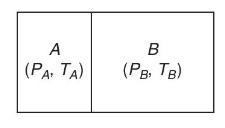
Consider two Boltzmannian gases \(A\) and \(B\), at pressures \(P_{A}\) and \(P_{B}\) and temperatures \(T_{A}\) and \(T_{B}\), respectively, contained in two regions of space that communicate through a very narrow opening in the partitioning wall; see Figure 6.8. Show that the dynamic equilibrium
A small sphere, with initial temperature \(T\), is immersed in an ideal Boltzmannian gas at temperature \(T_{0}\). Assuming that the molecules incident on the sphere are first absorbed and then reemitted with the temperature of the sphere, determine the variation of the temperature of the sphere
Show that the mean value of the relative speed of two molecules in a Maxwellian gas is \(\sqrt{ } 2\) times the mean speed of a molecule with respect to the walls of the container.
What is the probability that two molecules picked at random from a Maxwellian gas will have a total energy between \(E\) and \(E+d E\) ? Verify that \(\langle Eangle=3 k T\).
The energy difference between the lowest electronic state \({ }^{1} S_{0}\) and the first excited state \({ }^{3} S_{1}\) of the helium atom is \(159,843 \mathrm{~cm}^{-1}\). Evaluate the relative fraction of the excited atoms in a sample of helium gas at a temperature of \(6000 \mathrm{~K}\).
Derive an expression for the equilibrium constant \(K(T)\) for the reaction \(\mathrm{H}_{2}+\mathrm{D}_{2} \leftrightarrow 2 \mathrm{HD}\) at temperatures high enough to allow classical approximation for the rotational motion of the molecules. Show that \(K(\infty)=4\).
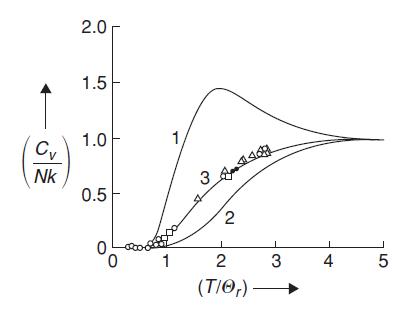
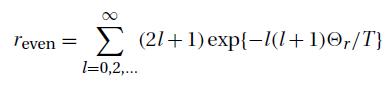
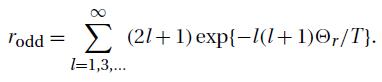
With the help of the Euler-Maclaurin formula (6.5.19), derive high-temperature expansions for \(r_{\text {even }}\) and \(r_{\text {odd }}\), as defined by equations (6.5.29) and (6.5.30), and obtain corresponding expansions for \(C_{\text {even }}\) and \(C_{\text {odd }}\), as defined by equation
The potential energy between the atoms of a hydrogen molecule is given by the (semiempirical) Morse potential\[V(r)=V_{0}\left\{e^{-2\left(r-r_{0}ight) / a}-2 e^{-\left(r-r_{0}ight) / a}ight\}\]where \(V_{0}=7 \times 10^{-12} \mathrm{erg}, r_{0}=8 \times 10^{-9} \mathrm{~cm}\), and \(a=5 \times
Show that the fractional change in the equilibrium value of the internuclear distance of a diatomic molecule, as a result of rotation, is given by\[\frac{\Delta r_{0}}{r_{0}} \simeq\left(\frac{\hbar}{\mu r_{0}^{2} \omega}ight)^{2} J(J+1)=4\left(\frac{\Theta_{r}}{\Theta_{v}}ight)^{2} J(J+1)\]here,
The ground state of an oxygen atom is a triplet, with the following fine structure:\[\varepsilon_{J=2}=\varepsilon_{J=1}-158.5 \mathrm{~cm}^{-1}=\varepsilon_{J=0}-226.5 \mathrm{~cm}^{-1} .\]Calculate the relative fractions of the atoms occupying different \(J\)-levels in a sample of atomic oxygen
Calculate the contribution of the first excited electronic state, namely \({ }^{1} \Delta\) with \(g_{e}=2\), of the \(\mathrm{O}_{2}\) molecule toward the Helmholtz free energy and the specific heat of oxygen gas at a temperature of \(5000 \mathrm{~K}\); the separation of this state from the
The rotational kinetic energy of a rotator with three degrees of freedom can be written as\[\varepsilon_{\mathrm{rot}}=\frac{M_{\xi}^{2}}{2 I_{1}}+\frac{M_{\eta}^{2}}{2 I_{2}}+\frac{M_{\zeta}^{2}}{2 I_{3}}\]where \((\xi, \eta, \zeta)\) are coordinates in a rotating frame of reference whose axes
Determine the translational, rotational, and vibrational contributions toward the molar entropy and the molar specific heat of carbon dioxide at NTP. Assume the ideal-gas formulae and use the following data: molecular weight \(M=44.01\); moment of inertia \(I\) of a \(\mathrm{CO}_{2}\) molecule
Determine the molar specific heat of ammonia at a temperature of \(300 \mathrm{~K}\). Assume the ideal-gas formula and use the following data: the principal moments of inertia: \(I_{1}=4.44 \times 10^{-40} \mathrm{gcm}^{2}\), \(I_{2}=I_{3}=2.816 \times 10^{-40} \mathrm{gcm}^{2}\); wave numbers of
Derive the equilibrium concentration equation (6.6.6) from the equilibrium condition (6.6.3).Data From Equation (6.6.6) [X]x[Y]VY = K(T) = exp(-BA(0)), [A]VA [B]VB
Use the following values to determine the equilibrium constant for the reaction \(2 \mathrm{CO}+\mathrm{O}_{2} ightleftarrows 2 \mathrm{CO}_{2}\). At a combustion temperature of \(T=1500 \mathrm{~K}: \beta \mu_{\mathrm{CO}_{2}}^{(0)}=-60.95, \beta \mu_{\mathrm{CO}}^{(0)}=-35.18\), and \(\beta
Derive an expression for the equilibrium constant \(K(T)\) for the reaction \(\mathrm{N}_{2}+\mathrm{O}_{2} ightleftarrows 2 \mathrm{NO}\) in terms of the ground state energy change \(\Delta \varepsilon_{0}=2 \varepsilon_{\mathrm{NO}}-\varepsilon_{\mathrm{N}_{2}}-\varepsilon_{\mathrm{O}_{2}}\) and
Analyze the combustion reaction\[\begin{equation*}\mathrm{CH}_{4}+2 \mathrm{O}_{2} ightleftarrows \mathrm{CO}_{2}+2 \mathrm{H}_{2} \mathrm{O}, \tag{6.6.8}\end{equation*}\]
Determine the equilibrium ionization fraction for the reaction\[\mathrm{Na} ightleftarrows \mathrm{Na}^{+}+e^{-}\]in a sodium vapor. Treat all three species as ideal classical monatomic gases. The ionization energy of sodium is \(5.139 \mathrm{eV}, \mathrm{Na}^{+}\)ions are spin-zero, and neutral
By considering the order of magnitude of the occupation numbers \(\left\langle n_{\varepsilon}ightangle\), show that it makes no difference to the final results of Section 7.1 if we combine a finite number of \((\varepsilon eq 0)\)-terms of the sum (7.1.2) with the \((\varepsilon=0)\)-part of
Deduce the virial expansion (7.1.13) from equations (7.1.7) and (7.1.8), and verify the quoted values of the virial coefficients.
Combining equations (7.1.24) and (7.1.26), and making use of the first two terms of formula (D.9) in Appendix D, show that, as \(T\) approaches \(T_{c}\) from above, the parameter \(\alpha(=-\ln z)\) of the ideal Bose gas assumes the form\[\alpha \approx \frac{1}{\pi}\left(\frac{3 \zeta(3 /
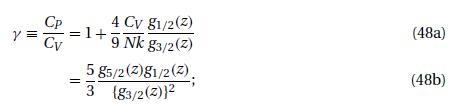
Show that for an ideal Bose gas\[\frac{1}{z}\left(\frac{\partial z}{\partial T}ight)_{P}=-\frac{5}{2 T} \frac{g_{5 / 2}(z)}{g_{3 / 2}(z)}\]compare this result with equation (7.1.36). Hence show that\[\gamma \equiv \frac{C_{P}}{C_{V}}=\frac{(\partial z / \partial T)_{P}}{(\partial z / \partial
(a) Show that the isothermal compressibility \(\kappa_{T}\) and the adiabatic compressibility \(\kappa_{S}\) of an ideal Bose gas are given by\[\kappa_{T}=\frac{1}{n k T} \frac{g_{1 / 2}(z)}{g_{3 / 2}(z)}, \quad \kappa_{S}=\frac{3}{5 n k T} \frac{g_{3 / 2}(z)}{g_{5 / 2}(z)}\]where \(n(=N / V)\) is
Show that for an ideal Bose gas the temperature derivative of the specific heat \(C_{V}\) is given by\[\frac{1}{N k}\left(\frac{\partial C_{V}}{\partial T}ight)_{V}= \begin{cases}\frac{1}{T}\left[\frac{45}{8} \frac{g_{5 / 2}(z)}{g_{3 / 2}(z)}-\frac{9}{4} \frac{g_{3 / 2}(z)}{g_{1 /
Evaluate the quantities \(\left(\partial^{2} P / \partial T^{2}ight)_{u},\left(\partial^{2} \mu / \partial T^{2}ight)_{u}\), and \(\left(\partial^{2} \mu / \partial T^{2}ight)_{P}\) for an ideal Bose gas and check that your results satisfy the thermodynamic relationships\[C_{V}=V
The velocity of sound in a fluid is given by the formula\[w=\sqrt{ }(\partial P / \partial ho)_{s}\]where \(ho\) is the mass density of the fluid. Show that for an ideal Bose gas\[w^{2}=\frac{5 k T}{3 m} \frac{g_{5 / 2}(z)}{g_{3 / 2}(z)}=\frac{5}{9}\left\langle u^{2}ightangle\]where \(\left\langle
Show that for an ideal Bose gas\[\langle uangle\left\langle\frac{1}{u}ightangle=\frac{4}{\pi} \frac{g_{1}(z) g_{2}(z)}{\left\{g_{3 / 2}(z)ight\}^{2}}\]\(u\) being the speed of a particle. Examine and interpret the limiting cases \(z ightarrow 0\) and \(z ightarrow 1\); compare with Problem 6.6.
Consider an ideal Bose gas in a uniform gravitational field of acceleration \(g\). Show that the phenomenon of Bose-Einstein condensation in this gas sets in at a temperature \(T_{c}\) given by\[T_{c} \simeq T_{c}^{0}\left[1+\frac{8}{9} \frac{1}{\zeta\left(\frac{3}{2}ight)}\left(\frac{\pi m g L}{k
Consider an ideal Bose gas consisting of molecules with internal degrees of freedom. Assuming that, besides the ground state \(\varepsilon_{0}=0\), only the first excited state \(\varepsilon_{1}\) of the internal spectrum needs to be taken into account, determine the condensation temperature of the
Consider an ideal Bose gas in the grand canonical ensemble and study fluctuations in the total number of particles \(N\) and the total energy \(E\). Discuss, in particular, the situation when the gas becomes highly degenerate.
Consider an ideal Bose gas confined to a region of area \(A\) in two dimensions. Express the number of particles in the excited states, \(N_{e}\), and the number of particles in the ground state, \(N_{0}\), in terms of \(z, T\), and \(A\), and show that the system does not exhibit Bose-Einstein
Consider an \(n\)-dimensional Bose gas whose single-particle energy spectrum is given by \(\varepsilon \propto p^{s}\), where \(s\) is some positive number. Discuss the onset of Bose-Einstein condensation in this system, especially its dependence on the numbers \(n\) and \(s\). Study the
At time \(t=0\), the ground state wavefunction of a one-dimensional quantum harmonic oscillator with potential \(V(x)=\frac{1}{2} m \omega_{0}^{2} x^{2}\) is given by\[\psi(x, 0)=\frac{1}{\pi^{1 / 4} \sqrt{a}} \exp \left(-\frac{x^{2}}{2 a^{2}}ight)\]where \(a=\sqrt{\frac{\hbar}{m \omega_{0}}}\). At
At time \(t=0\), a collection of classical particles is in equilibrium at temperature \(T\) in a threedimensional harmonic oscillator potential \(V(\boldsymbol{r})=\frac{1}{2} m \omega_{0}^{2}|\boldsymbol{r}|^{2}\). At \(t=0\), the harmonic potential is abruptly removed. Use the momentum
As shown in Section 7.1, \(n \lambda^{3}\) is a measure of the quantum nature of the system. Use equations (7.2.11) and (7.2.15) to determine \(n \lambda^{3}\) at the center of the harmonic trap at \(T=T_{c} / 2\) for the condensed and noncondensed fractions.
Show that the integral of the semiclassical spatial density in equation (7.2.15) gives the correct counting of the atoms that are not condensed into the ground state.
Construct a theory for \(N\) bosons in an isotropic two-dimensional trap. This corresponds to a trap in which the energy level spacing due to excitations in the \(z\) direction is much larger than the spacing in the other directions. Determine the density of states \(a(\varepsilon)\) of this
The (canonical) partition function of the blackbody radiation may be written as\[Q(V, T)=\prod_{\omega} Q_{1}(\omega, T)\]so that\[\ln Q(V, T)=\sum_{\omega} \ln Q_{1}(\omega, T) \approx \int_{0}^{\infty} \ln Q_{1}(\omega, T) g(\omega) d \omega\]here, \(Q_{1}(\omega, T)\) is the single-oscillator
Show that the mean energy per photon in a blackbody radiation cavity is very nearly \(2.7 k T\).
Considering the volume dependence of the frequencies \(\omega\) of the vibrational modes of the radiation field, establish relation (7.3.17) between the pressure \(P\) and the energy density \(U / V\).
The sun may be regarded as a black body at a temperature of \(5800 \mathrm{~K}\). Its diameter is about \(1.4 \times 10^{9} \mathrm{~m}\) while its distance from the earth is about \(1.5 \times 10^{11} \mathrm{~m}\).(a) Calculate the total radiant intensity (in \(\mathrm{W} / \mathrm{m}^{2}\) ) of
Calculate the photon number density, entropy density, and energy density of the \(2.725 \mathrm{~K}\) cosmic microwave background.
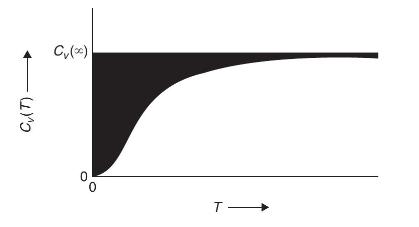
Figure 7.20 is a plot of \(C_{V}(T)\) against \(T\) for a solid, the limiting value \(C_{V}(\infty)\) being the classical result \(3 N k\). Show that the shaded area in the figure, namely\[\int_{0}^{\infty}\left\{C_{V}(\infty)-C_{V}(T)ight\} d T\]is exactly equal to the zero-point energy of the
Show that the zero-point energy of a Debye solid composed of \(N\) atoms is equal to \(\frac{9}{8} N k \Theta_{D}\).
Show that, for \(T \ll \Theta_{D}\), the quantity ( \(C_{P}-C_{V}\) ) of a Debye solid varies as \(T^{7}\) and hence the ratio \(\left(C_{P} / C_{V}ight) \simeq 1\).
Determine the temperature \(T\), in terms of the Debye temperature \(\Theta_{D}\), at which one-half of the oscillators in a Debye solid are expected to be in the excited states.
Determine the value of the parameter \(\Theta_{D}\) for liquid \(\mathrm{He}^{4}\) from the empirical result (7.4.28).
(a) Compare the "mean thermal wavelength" \(\lambda_{T}\) of neutrons at a typical room temperature with the "minimum wavelength" \(\lambda_{\min }\) of phonons in a typical crystal.(b) Show that the frequency \(\omega_{D}\) for a sodium chloride crystal is of the same order of magnitude as the
Proceeding under conditions (7.4.16) rather than (7.4.13), show that\[C_{V}(T)=N k\left\{D\left(x_{0, L}ight)+2 D\left(x_{0, T}ight)ight\}\]where \(x_{0, L}=\left(\hbar \omega_{D, L} / k Tight)\) and \(x_{0, T}=\left(\hbar \omega_{D, T} / k Tight)\). Compare this result with equation (7.4.17), and
A mechanical system consisting of \(n\) identical masses (each of mass \(m\) ) connected in a straight line by identical springs (of stiffness \(K\) ) has natural vibrational frequencies given by\[\omega_{r}=2 \sqrt{\left(\frac{K}{m}ight) \sin \left(\frac{r}{n} \cdot \frac{\pi}{2}ight) ; r=1,2,
Assuming the dispersion relation \(\omega=A k^{\mathcal{s}}\), where \(\omega\) is the angular frequency and \(k\) the wave number of a vibrational mode existing in a solid, show that the respective contribution toward the specific heat of the solid at low temperatures is proportional to \(T^{3 /
Assuming the excitations to be phonons \((\omega=A k)\), show that their contribution toward the specific heat of an \(n\)-dimensional Debye system is proportional to \(T^{n}\).
The (minimum) potential energy of a solid, when all its atoms are "at rest" at their equilibrium positions, may be denoted by the symbol \(\Phi_{0}(V)\), where \(V\) is the volume of the solid. Similarly, the normal frequencies of vibration, \(\omega_{i}(i=1,2, \ldots, 3 N-6)\), may be denoted by
Apply the general formula (6.4.3) for the kinetic pressure of a gas, namely\[P=\frac{1}{3} n\langle p uangle\]to a gas of rotons and verify that the result so obtained agrees with the Boltzmannian relationship \(P=n k T\).
Show that the free energy \(A\) and the inertial density \(ho\) of a roton gas in mass motion are given by\[A(v)=A(0) \frac{\sinh x}{x}\]and\[ho(v)=ho(0) \frac{3(x \cosh x-\sinh x)}{x^{3}},\]where \(x=v p_{0} / k T\).
Showing 700 - 800
of 1040
1
2
3
4
5
6
7
8
9
10
11
Step by Step Answers

 Get 50% OFF
Claim Now
Get 50% OFF
Claim Now