New Semester
Started
Get
50% OFF
Study Help!
--h --m --s
Claim Now
Question Answers
Textbooks
Find textbooks, questions and answers
Oops, something went wrong!
Change your search query and then try again
S
Books
FREE
Study Help
Expert Questions
Accounting
General Management
Mathematics
Finance
Organizational Behaviour
Law
Physics
Operating System
Management Leadership
Sociology
Programming
Marketing
Database
Computer Network
Economics
Textbooks Solutions
Accounting
Managerial Accounting
Management Leadership
Cost Accounting
Statistics
Business Law
Corporate Finance
Finance
Economics
Auditing
Tutors
Online Tutors
Find a Tutor
Hire a Tutor
Become a Tutor
AI Tutor
AI Study Planner
NEW
Sell Books
Search
Search
Sign In
Register
study help
sciences
mechanics
Modern Classical Mechanics 1st Edition T. M. Helliwell, V. V. Sahakian - Solutions
Show that there are no stable circular orbits of a particle in the Schwarzschild geometry with a radius less than \(6 G M / c^{2}\).
Show from the effective potential corresponding to the Schwarzschild metric that if \(U_{\text {eff }}\) can be used for arbitrarily small radii, there are actually two radii at which a particle can be in a circular orbit. The outer radius corresponds to the usual stable, circular orbit such as a
Kepler's second law for classical orbits states that planets sweep out equal areas in equal times. Is that still true in Schwarzschild spacetime, assuming orbital radii \(r>2 G M / c^{2}\) ? (a) First suppose that "time" here means the coordinate time \(t\) in Schwarzschild coordinates. (b) Then
Earth's orbit has a semimajor axis \(a=1.496 \times 10^{8} \mathrm{~km}\) and eccentricity \(\epsilon=0.017\). Find the general relativistic precession of the earth's perihelion in seconds of arc per century.
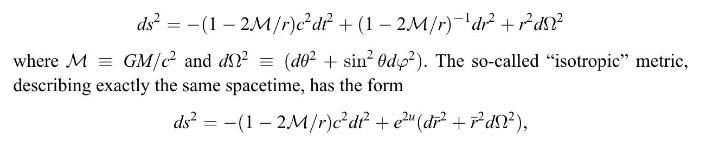
Sometimes more than one coordinate system can usefully describe the same spacetime geometry. This is true in particular for the Schwarzschild geometry surrounding a spherically symmetric mass \(M\). The usual Schwarzschild metric iswith the same \(d t^{2}\) term, while the other terms contain a new
The geometry on the surface of a sphere is noneuclidean, so the circumference \(C\) and radius \(R\) of a circle drawn on the sphere do not obey \(C=2 \pi R\), where for example the circumference is a constant-latitude path and the radius is drawn on the sphere down from the north pole along a
Before the age of relativity, some people calculated that light would be deflected by the sun in a classical model in which light consists of particles of tiny mass \(m\) moving at speed (c\), pulled by the sun's Newtonian gravity. Find in that case the approximate deflection of a light beam in
(a) Find the escape velocity \(d r / d \tau\) of a particle of mass \(m\) starting from rest at radius \(r_{0}=4 G M / c^{2}\) in a Schwarzschild spacetime of mass \(M\), where \(\tau\) is read on the particle's own clock. (b) Then find the escape velocity \(d r / d \tau\) of the particle, starting
Tachyons are hypothetical particles (never observed, at least so far) that always travel faster than light. Therefore in general relativistic spacetimes they would follow spacelike (rather than timelike or null) geodesics. Prove that the deflection of such a particle in passing by the sun would be
Consider two concentric coplanar circles in the Schwarzschild metric surrounding the sun, with measured circumferences \(C_{1}\) and \(C_{2}\). In terms of \(C_{1}\) and \(C_{2}\), find an expression for (a) the radial coordinate distance \(\Delta r\) between them. (b) the radial measured distance
The Robertson-Walker metrics\[d s^{2}=-c^{2} d t^{2}+a(t)^{2}\left[\frac{d r^{2}}{1-k(r / R)^{2}}+r^{2} d \theta^{2}+r^{2} \sin ^{2} \theta d \varphi^{2}\right]\]are applicable to universes that are both spatially homogenous and isotropic: That is, they have no preferred positions or directions.
Inspired from equations 10.77, write gravitational field vectors describing a gravitational wave of angular frequency \(\omega\) propagating in vacuum in the positive \(z\) direction, specifying both the 'electric' and 'magnetic' field vectors. Assume the 'electric' gravitational field amplitude is
Show that there is exactly one radius at which a light beam can move in a circular orbit around a spherical black hole, and find this radius. Then show that the orbit is unstable, by showing that a tangential beam beginning at a slightly larger radius will spiral outward and never return, and a
Write the Lagrangian of a charged particle in terms of potentials in the case where we use the static gauge condition, and show that it appears to be different than the Lagrangian in the absence of any gauge fixing. Then show that even though the Lagrangian is different, the Lagrange equations of
Show that for a Gaussian probability distribution\[p(x)=\frac{e^{-\frac{\left(x-x_{0}\right)^{2}}{2 a^{2}}}}{\sqrt{2 \pi a^{2}}}\]all the moments are given by \[\left\langle\left(x-x_{0}\right)^{n}\rightangle=1 \times 3 \times 5 \times(n-1) \times a^{n}\]for even \(n\), and are zero otherwise.
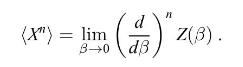
(a) Show that for any probability distribution, if we compute the generating function \(Z(\beta) \equiv\left\langle e^{\beta X}\rightangle\) for arbitrary \(\beta\) and \(X\) being the stochastic variable, we can compute all moments using(b) Use the generating function to compute the moments of a
For the stochastic equation studied in the text, show that\[\overline{X(t)^{2}}=\frac{\sigma^{2}}{\alpha^{2}}\left(t+\frac{1}{2 \alpha} e^{-2 \alpha t}\right) \rightarrow \frac{\sigma^{2}}{\alpha^{2}} t\]
Using the generating function \(Z\) introduced in an earlier problem, show that:(a) If \(X\) is a stochastic variable with a gaussian distribution with mean \(x_{0}\) and variance \(\sigma^{2}\), then \(a+b X\) is a stochastic variable with a Gaussian distribution with mean \(a+b x_{0}\) and
Show that if the initial condition \(C\) of the linear stochastic differential equation introduced in the text has a Gaussian distribution, so does the solution of the stochastic differential equation.
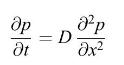
Show that the case of a particle executing a random walk as described by the statistical moments of its position computed in the text, the probability function \(p(x, t)\) satisfies the so-called diffusion equationwhere the constant \(D\) is called the diffusion coefficient. = D
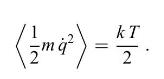
From statistical mechanics, for each degree of freedom \(q\) of a free system in thermal equilibrium at temperature \(T\), the corresponding thermal fluctuations of \(\dot{q}\) is given byHere \(m\) is the mass associated in the kinetic energy expression written in terms of \(q\). Mapping this
A team of researchers has long tracked the path of a star named S2 that orbits the supermassive black hole Sagittarius A* at the center of our Milky Way galaxy. (The orbit is one of those shown on the cover of this book.) The orbital period of S2 is 16.05 years, its semimajor axis is 970 au, where
Suppose that the orbit of Star S2, as described in the preceding problem, lies in a plane that is perpendicular to our line of sight. Then at periastron, when S2 is a distance 120 au from the central black hole, there will be both a transverse Doppler effect and a gravitational redshift for light
Find the Legendre transform \(B(x, z)\) of the function \(A(x, y)=x^{4}-(y+a)^{4}\), and verify that \(-\partial A / \partial x=\partial B / \partial x\).
In thermodynamics the enthalpy \(H\) (no relation to the Hamiltonian \(H\) ) is a function of the entropy \(S\) and pressure \(P\) such that \(\partial H / \partial S=T\) and \(\partial H / \partial P=V\), so that\[d H=T d S+V d P\]where \(T\) is the temperature and \(V\) the volume. The enthalpy
In thermodynamics, for a system such as an enclosed gas, the internal energy \(U(S, V)\) can be expressed in terms of the independent variables of entropy \(S\) and volume \(V\), such that \(d U=T d S-P d V\), where \(T\) is the temperature and \(P\) the pressure. Suppose we want to find a related
The energy of a relativistic free particle is the Hamiltonian H = \(\sqrt{p^{2} c^{2}+m^{2} c^{4}}\) in terms of the particle's momentum and mass.(a) Using one of Hamilton's equations in one dimension, find the particle's velocity \(v\) in terms of its momentum and mass.(b) Invert the result to
The Lagrangian for a particular system is\[L=\dot{x}^{2}+a \dot{y}+b \dot{x} \dot{z}\]where \(a\) and \(b\) are constants. Find the Hamiltonian, identify any conserved quantities, and write out Hamilton's equations of motion for the system.
A system with two degrees of freedom has the Lagrangian\[L=\dot{q}_{1}^{2}+\alpha \dot{q}_{1} \dot{q}_{2}+\beta q_{2}^{2} / 2,\]where \(\alpha\), and \(\beta\) are constants. Find the Hamiltonian, identify any conserved quantities, and write out Hamilton's equations of motion.
Write the Hamiltonian and find Hamilton's equations of motion for a simple pendulum of length \(\ell\) and mass \(m\). Sketch the constant \(H\) contours in the \(\theta, p_{\theta}\) phase plane.
(a) Write the Hamiltonian for a spherical pendulum of length \(\ell\) and mass \(m\), using the polar angle \(\theta\) and azimuthal angle \(\varphi\) as generalized coordinates. (b) Then write out Hamilton's equations of motion, and identify two first-integrals of motion. (c) Find a first-order
A Hamiltonian with one degree of freedom has the form\[H=\frac{p^{2}}{2 m}+\frac{k q^{2}}{2}-2 a q^{3} \sin \alpha t\]where \(m, k, a\), and \(\alpha\) are constants. Find the Lagrangian corresponding to this Hamiltonian. Write out both Hamilton's equations and Lagrange's equations, and show
A particle of mass \(m\) slides on the inside of a frictionless vertically-oriented cone of semi-vertical angle \(\alpha\). (a) Find the Hamiltonian \(H\) of the particle, using generalized coordinates \(r\), the distance of the particle from the vertex of the cone, and \(\varphi\), the azimuthal
A particle of mass \(m\) is attracted to the origin by a force of magnitude \(k / r^{2}\). Using plane polar coordinates, find the Hamiltonian and Hamilton's equations of motion. Sketch constant- \(H\) contours in the \(\left(r, p_{r}\right)\) phase plane.
A double pendulum consists of two strings of equal length \(\ell\) and two bobs of equal mass \(m\). The upper string is attached to the ceiling, while the lower end is attached to the first bob. One end of the lower string is attached to the first bob, while the other end is attached to the second
A double Atwood's machine consists of two massless pulleys, each of radius \(R\), some massless string, and three weights, with masses \(m_{1}, m_{2}\), and \(m_{3}\). The axis of pulley 1 is supported by a strut from the ceiling. A piece is string of length \(\ell_{1}\) is slung over the pulley,
A massless unstretchable string is slung over a massless pulley. A weight of mass \(2 m\) is attached to one end of the string and a weight of mass \(m\) is attached to the other end. One end of a spring of force constant \(k\) is attached beneath \(m\), and a second weight of mass \(m\) is hung on
(a) A particle is free to move only in the \(x\) direction, subject to the potential energy \(U=U_{0} e^{-\alpha x^{2}}\), where \(\alpha\) and \(U_{0}\) are positive constants. Sketch constant-Hamiltonian curves in a phase diagram, including values of \(H\) with \(HU_{0}\).(b) Repeat part (a) if
A cyclic coordinate \(q_{k}\) is a coordinate absent from the Lagrangian (even though \(\dot{q}_{k}\) is present in L.) (a) Show that a cyclic coordinate is likewise absent from the Hamiltonian. (b) Show from the Hamiltonian formalism that the momentum \(p_{k}\) canonical to a cyclic coordinate
Show that the Poisson bracket of two constants of the motion is itself a constant of the motion, even when the constants depend explicitly on time.
Prove the anticommutativity and distributivity of Poisson brackets by showing that (a) \(\{A, B\}_{\mathrm{q}, \mathrm{p}}=-\{B, A\}_{\mathrm{q}, \mathrm{p}}\) (b) \(\{A, B+C\}_{\mathrm{q}, \mathrm{p}}=\{A, B\}_{\mathrm{q}, \mathrm{p}}+\{A, C\}_{\mathrm{q}, \mathrm{p}}\).
Show that Hamilton's equations of motion can be written in terms of Poisson brackets as\[\dot{q}=\{q, H\}_{\mathrm{q}, \mathrm{p}}, \quad \dot{p}=\{p, H\}_{\mathrm{q}, \mathrm{p}}\]
A Hamiltonian has the form\[H=q_{1} p_{1}-q_{2} p_{2}+a q_{1}^{2}-b q_{2}^{2}\]where \(a\) and \(b\) are constants. (a) Using the method of Poisson brackets, show that\[f_{1} \equiv q_{1} q_{2} \quad \text { and } \quad f_{2} \equiv \frac{1}{q_{1}}\left(p_{2}+b q_{2}\right)\]are constants of the
Show, using the Poisson bracket formalism, that the Laplace-Runge-Lenz vector\[\mathbf{A} \equiv \mathbf{p} \times \mathbf{L}-\frac{m k \mathbf{r}}{r}\]is a constant of the motion for the Kepler problem of a particle moving in the central inverse-square force field \(F=-k / r^{2}\). Here
A beam of protons with a circular cross-section of radius \(r_{0}\) moves within a linear accelerator oriented in the \(x\) direction. Suppose that the transverse momentum components \(\left(p_{y}, p_{z}\right)\) of the beam are distributed uniformly in momentum space, in a circle of radius
A large number of particles, each of mass \(m\), move in response to a uniform gravitational field \(g\) in the negative \(z\) direction. At time \(t=0\), they are all located within the corners of a rectangle in \(\left(z, p_{z}\right)\) phase space, whose positions are: (1) \(z=z_{0},
In an electron microscope, electrons scattered from an object of height \(z_{0}\) are focused by a lens at distance \(D_{0}\) from the object and form an image of height \(z_{1}\) at a distance \(D_{1}\) behind the lens. The aperture of the lens is \(A\). Show by direct calculation that the area in
Show directly that the transformation\[Q=\ln \left(\frac{1}{q} \sin p\right) \quad P=q \cot p\]is canonical.
Show that if the Hamiltonian and some quantity \(Q\) are both constants of the motion, then the \(n^{\text {th }}\) partial derivative of \(Q\) with respect to time must also be a constant of the motion.
Prove the Jacobi identity for Poisson brackets,\[\left\{A,\{B, C\}_{\mathrm{q}, \mathrm{p}}\right\}_{\mathrm{q}, \mathrm{p}}+\left\{B,\{C, A\}_{\mathrm{q}, \mathrm{p}}\right\}_{\mathrm{q}, \mathrm{p}}+\left\{C,\{A, B\}_{\mathrm{q}, \mathrm{p}}\right\}_{\mathrm{q}, \mathrm{p}}=0 .\]
(a) Find the Hamiltonian for a projectile of mass \(m\) moving in a uniform gravitational field \(g\), using coordinates \(x, y\). (b) Then find Hamilton's equations of motion and solve them.
(a) Find the Hamiltonian for a projectile of mass \(m\) moving in a force field with potential energy \(U(ho, \varphi, z)\), where \(ho, \varphi, z\) are cylindrical coordinates. (b) Find Hamilton's equations of motion. (c) Solve them as far as possible if \(U=U(ho)\) alone.
Consider a particle of mass \(m\) with relativistic Hamiltonian \(H=\) \(\sqrt{p^{2} c^{2}+m^{2} c^{4}}+U(x, y, z)\) where \(U\) is its relativistic potential energy. Find the particle's equations of motion.
We found Hamilton's equations by starting with the Lagrangian \(L\left(q_{i}, \dot{q}_{i}, t\right)\) and using a Legendre transformation to define the Hamiltonian \(H\left(q_{i}, p_{i}, t\right)\). Now starting with the Hamiltonian and Hamilton's equations, use a reverse Legendre transformation to
Suppose that for some situations the coordinates \(p, q\) are canonical. Show that the transformed coordinates \(P=\frac{1}{2}\left(p^{2}+q^{2}\right), Q=\tan ^{-1}(q / p)\) are also canonical.
Prove that if one makes two successive canonical transformations, the result is also canonical.
Prove that the Poisson bracket is invariant under a canonical transformation.
A plane pendulum consists of a rod of length \(R\) and negligible mass supporting a plumb bob of mass \(m\) that swings back and forth in a uniform gravitational field \(g\). The point of support at the top end of the rod is forced to oscillate vertically up and down with \(y=A \cos \omega t\).
A plane pendulum consists of a string supporting a plumb bob of mass \(m\) free to swing in a vertical plane and free to swing subject to uniform gravity \(g\). The upper end of the string is threaded through a hole in the ceiling and steadily pulled upward, so the length of the string beneath the
At time \(t=0\) a large number of particles, each of mass \(m\), is strung out along the \(x\) axis from \(x=0\) to \(x=\Delta x\), with momenta \(p_{x}\) varying from \(p=p_{0}\) to \(p=p_{0}+\Delta p\). No forces act on the particles and they do not collide. (a) Show that the points representing
Any spherically symmetric function of the canonical coordinate and momentum of a particle can depend only on \(r^{2}, p^{2}\), and \(\mathbf{r} \cdot \mathbf{p}\). Show that the Poisson bracket of any such function \(f\) with a component of the particle's angular momentum is zero. In particular,
Write the Hamiltonian of a free particle of mass \(m\) in a reference frame that is rotating uniformly with angular velocity \(\boldsymbol{\omega}\) with respect to an inertial frame.
Three objects, starting from rest at the same altitude, roll without slipping down an inclined plane. One is a ring of mass \(M\) and radius \(R\); another is a uniform-density disk of mass \(2 M\) and radius \(R\), and the last is a uniform-density sphere of mass \(M\) and radius \(2 R\). In what
A cylindrical pole is inserted into a frozen lake so the pole stands vertically. One end of a rope is attached to a point on the surface of the pole near where it enters the ice, and the rope is then laid out in a straight line on the surface. An ice skater with initial velocity
Humanity collectively uses energy at the average rate of about 18 Terawatts. (a) At that rate, after one year how long would the length of the day have increased if during that year we were able to power our activities purely by harnessing the rotational kinetic energy of the earth? (The earth has
In a supernova explosion, the core of a heavy star collapses and the outer layers are blown away. Before collapse, suppose the core of a given star has twice the mass of the sun and the same radius as the sun, and rotates with period 20 days. The core collapses in a few seconds to become a neutron
In some theoretical models of pulsars, which are rotating neutron stars, the braking torque slowing the pulsar's spin rate is proportional to the \(n^{\text {th }}\) power of the pulsar's angular velocity \(\Omega\); that is, \(\dot{\Omega}=-K \Omega^{n}\), where \(K\) is a constant. (a) Find a
Tidal effects of the moon on the earth have caused the earth's rotation rate to slow, thus reducing the spin angular momentum of the earth leading to an increase in earth's day by \(0.1 \mathrm{~s}\) in the past 3800 years. This reduction has been made up for by an increase in the orbital angular
Compute the moment of inertia matrix of a solid circular cylinder of height \(H\) and base radius \(R\), and of uniform mass density \(ho=ho_{0}\). In this expression, the cylinder is arranged so that its symmetry axis is along the \(\mathrm{z}\) axis and its top cap sits on the \(x, y\) plane;
A rod of length \(\ell\) and mass \(m\) is attached to a pivot on one end. The rim of a disc of radius \(R\) and mass \(M\) is attached to its other end in such a way that the disc can pivot in the same plane in which the rod is restricted to swing. Find the Lagrangian and equations of motion.
(a) Using Euler angles, write the constraint of rolling without slipping for a sphere of radius \(R\) moving on a flat surface. (b) Write the Lagrangian and equations of motion using Lagrange multipliers. (c) Show that the rotational and translational kinetic energies are independently conserved.
(a) Find the moment of inertia \(I_{z z}\) of a thin disk of mass \(m\) and radius \(R\) about an axis through its center and perpendicular to the plane of the disk. (b) What are \(I_{x x}\) and \(I_{y y}\) in this case? (c) A solid cylinder of mass \(M\), radius \(R\), and length \(L\) can be
A private plane has a single propeller in front, which rotates in the clockwise sense as seen by the pilot. Flying horizontally, the pilot causes the tail rudder to extend out to the left from the plane's flight direction. (a) If the plane is ultralight and the propeller is large, heavy, and
A uniform-density cone has mass M, base radius R, and height H. Find its inertia matrix if the origin is at the center of the circular base in the x, y plane, the axis of symmetry is along the z axis, and the apex of the cone is at positive z.
The Crab Nebula is a bright, reddish nebula consisting of the debris from a supernova explosion observed on earth in \(1054 \mathrm{AD}\). The estimated total power it emits, mostly in X-rays, UV, and visible light, is of order \(10^{31} \mathrm{~W}\). The nebula harbors a pulsar in its center,
A cylindrical space station is a hollow cylinder of mass \(M\), radius \(R\), and length \(D\), and endcaps of negligible mass. It spins about its symmetry axis ( \(z\) axis) with angular velocity \(\omega_{0}\).(a) Find its inertia matrix about its center. A meteor of mass \(m\) and velocity
(a) Find all elements of the principal moment of inertia matrix for a thin uniform rod of mass \(\Delta m\) and length \(D\) if the rod is oriented along the \(x\) axis and the origin of coordinates is at the center of the rod.(b) Use the parallel-axis theorem, the perpendicular axis theorem for
(a) Find the principal moments of inertia for a thin disk of mass \(\Delta m\) and radius \(R\), if its mass density is uniform, the origin of coordinates is at the center of the disk, the \(x\) and \(y\) axes are in the plane of the disk, and the \(z\) axis is perpendicular to the disk.(b) Use
(a) Find all elements of the moment of inertia matrix for a cube of mass \(M\) and edge length \(\ell\) using its principal axes. (b) Then find all elements of the moment of inertia matrix for the cube if the axes have been turned by \(45^{\circ}\) about the original \(z\) axis.
If the entire human race were to leave their current habitats, estimate how much the length of the day would be changed if (a) they gathered at the equator; (b) they gathered at the poles.
Consider a square plane lamina with coordinate axes \(x, y\) in the plane with origin at the center of the square and which are perpendicular to edges of the square. If the moment of inertia about each of these two axes is \(I_{0}\), what are the moments of inertia about axes \(x^{\prime}\) and
An equilateral triangle of mass \(M\) and side-length \(L\) is cut from uniformdensity sheet metal. (a) Draw the triangle along with the three perpendicular bisectors, each of which extends from the middle of a side to the opposite vertex. Show that each bisector has length \(\sqrt{3} L / 2\). (b)
Using the rotation matrices appropriate for each of the three Euler angles, find the overall \(3 \times 3\) rotation matrix for arbitrary rotations in terms of the angles \(\varphi, \theta\), and \(\psi\), applied in the prescribed order.
A rigid body has principal moments of inertia \(I_{x x}=I_{0}, I_{y y}=I_{z z}=2 I_{0} / 3\). (a) Find all elements of the moment of inertia matrix in a reference frame that has been rotated by \(30^{\circ}\) about the \(z\) axis in the counterclockwise sense relative to the initial axes. (b) In
Show that any antisymmetric part of the moment of inertia matrix of a rigid body does not contribute to the body's equations of motion. Therefore we may safely assume that the moment of inertia matrix is symmetric.
(a) Write the Lagrangian for the Euler problem of a rigid body undergoing torque-free precession. (b) Write the equations of motion and show that they agree with those in the text.
Write the six equations of motion for the Lagrangian of a hoop attached to a spring.
Show that the magnitude of the angular momentum vector for the torque-free rigid body dynamics case is given by \(L=I_{3} p_{\psi} / \cos \theta\).
Show that \(\dot{u}=0\) if \(g=0\) from equation 12.200.Data from equation 12.200 1 (p-up) + 2 R 1 (2H13 - (p) 2Mgl, 2 113
Show that if\[I_{1} \geq I_{2} \geq I_{3}\]for a torque-free rigid body, we then have\[\sqrt{2 T I_{3}} \leq L \leq \sqrt{2 T I_{1}}\]
Show that \(u \rightarrow 1\) is a stable point for the gyroscope, and find the corresponding nutation. Show that there is a criticial angular momnetum \(p_{\psi}=2 \sqrt{M g l I}\).
A rigid body has an axis of symmetry, which we designate as axis 1. The principal moment of inertia about this axis is \(I_{1}\), while the principal moments of inertia about the remaining two principal axes are \(I_{2}=I_{3} \equiv I_{0} eq I_{1}\). (a) Write the Euler equations of rotational
Using Euler’s equations, show that a rigid body rotating without applied torque has a total angular momentum whose magnitude is constant.
Two blocks, of masses \(m\) and \(M\), are connected by a single spring of forceconstant \(k\). The blocks are free to slide on a frictionless table. Beginning with the Lagrangian, find the oscillation frequency of the system in terms of \(k\) and the reduced mass \(\mu \equiv m M /(m+M)\). Show
Two blocks, of masses \(m\) and \(2 m\), are connected together linearly by three springs of equal force-constants \(k\). The outer springs are also attached to stationary walls, while the middle spring connects the two masses. Find the normal mode frequencies.
Reconsider the problem of two equal-mass blocks and three springs, in a straight line with the outer springs attached to stationary walls. Now suppose the outer springs have the same force-constant \(k\), while the central spring has force-constant \(2 k\). Find the eigenfrequencies and
A hypothetical linear molecule of four atoms is free to move in three dimensions. How many degrees of freedom are there? How many translational modes? How many rotational modes? How many vibrational modes? Then suppose instead that the four atoms are all in the same plane but not lined up, still
Find the normal modes of oscillation for small-amplitude motions of a double pendulum (a lower mass \(m\) hanging from an upper mass \(M\) ) where the pendulum lengths are equal. Find the normal mode frequencies and the amplitude ratios of \(M\) and \(m\) in each case. Let the generalized
A uniform horizontal rod of mass \(m\) and length \(\ell\) is supported against gravity by two identical springs, one at each end of the rod. Assuming the motion is confined to the vertical plane, find the normal modes and frequencies of the system. Then find the motion in case just one end of the
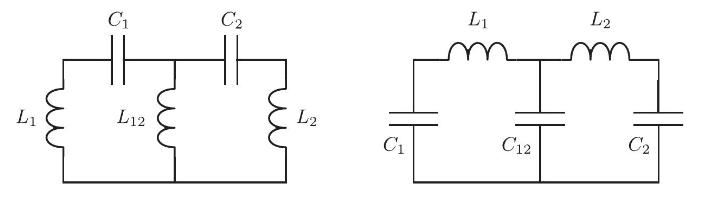
The voltage across a capacitor is \(V_{C}=q / C\), where \(C\) is the capacitance and \(q\) is the charge on the capacitor. The voltage across an inductor is \(V_{L}=L d I / d t\), where \(L\) is the inductance and \(I\) is the current through the inductor. A wire attached to a capacitor whose
Showing 400 - 500
of 1040
1
2
3
4
5
6
7
8
9
10
11
Step by Step Answers

 Get 50% OFF
Claim Now
Get 50% OFF
Claim Now