New Semester
Started
Get
50% OFF
Study Help!
--h --m --s
Claim Now
Question Answers
Textbooks
Find textbooks, questions and answers
Oops, something went wrong!
Change your search query and then try again
S
Books
FREE
Study Help
Expert Questions
Accounting
General Management
Mathematics
Finance
Organizational Behaviour
Law
Physics
Operating System
Management Leadership
Sociology
Programming
Marketing
Database
Computer Network
Economics
Textbooks Solutions
Accounting
Managerial Accounting
Management Leadership
Cost Accounting
Statistics
Business Law
Corporate Finance
Finance
Economics
Auditing
Tutors
Online Tutors
Find a Tutor
Hire a Tutor
Become a Tutor
AI Tutor
AI Study Planner
NEW
Sell Books
Search
Search
Sign In
Register
study help
sciences
mechanics
Statistical Mechanics 3rd Edition Paul D. Beale - Solutions
Replacing the sum in (3.9.18) by an integral, evaluate \(Q_{1}(\beta)\) of the given magnetic dipole and study the thermodynamics following from it. Compare these results with the ones following from the Langevin theory.
Atoms of silver vapor, each having a magnetic moment \(\mu_{B}\left(g=2, J=\frac{1}{2}ight)\), align themselves either parallel or antiparallel to the direction of an applied magnetic field. Determine the respective fractions of atoms aligned parallel and antiparallel to a field of flux density
(a) Show that, for any magnetizable material, the heat capacities at constant field \(H\) and at constant magnetization \(M\) are connected by the relation\[C_{H}-C_{M}=-T\left(\frac{\partial H}{\partial T}ight)_{M}\left(\frac{\partial M}{\partial T}ight)_{H}\](b) Show that for a paramagnetic
A system of \(N\) spins at a negative temperature \((E>0)\) is brought into contact with an ideal-gas thermometer consisting of \(N^{\prime}\) molecules. What will the nature of their state of mutual equilibrium be? Will their common temperature be negative or positive, and in what manner will it
Consider the system of \(N\) magnetic dipoles, studied in Section 3.10, in the microcanonical ensemble. Enumerate the number of microstates, \(\Omega(N, E)\), accessible to the system at energy \(E\) and evaluate the quantities \(S(N, E)\) and \(T(N, E)\). Compare your results with equations
Consider a system of charged particles (not dipoles), obeying classical mechanics and classical statistics. Show that the magnetic susceptibility of this system is identically zero (Bohr-van Leeuwen theorem).[Note that the Hamiltonian of this system in the presence of a magnetic field
The expression (3.3.13) for the entropy \(S\) is equivalent to Shannon's (1949) definition of the information contained in a message \(I=-\sum_{r} P_{r} \ln \left(P_{r}ight)\), where \(P_{r}\) represents the probability of message \(r\).(a) Show that information is maximized if the probabilities of
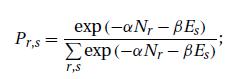
Show that the entropy of a system in the grand canonical ensemble can be written as\[S=-k \sum_{r, s} P_{r, s} \ln P_{r, s}\]where \(P_{r, s}\) is given by equation (4.1.9).Equation (4.1.9) Prs exp(-aN-BES) exp(-aN-BES)" r,s
In the thermodynamic limit (when the extensive properties of the system become infinitely large, while the intensive ones remain constant), the \(q\)-potential of the system may be calculated by taking only the largest term in the sum\[\sum_{N_{r}=0}^{\infty} z^{N_{r}} Q_{N_{r}}(V, T)\]Verify this
A vessel of volume \(V^{(0)}\) contains \(N^{(0)}\) molecules. Assuming that there is no correlation whatsoever between the locations of the various molecules, calculate the probability, \(P(N, V)\), that a region of volume \(V\) (located anywhere in the vessel) contains exactly \(N\) molecules.(a)
The probability that a system in the grand canonical ensemble has exactly \(N\) particles is given by\[p(N)=\frac{z^{N} Q_{N}(V, T)}{\mathcal{Q}(z, V, T)}\]Verify this statement and show that in the case of a classical, ideal gas the distribution of particles among the members of a grand canonical
Show that expression (4.3.20) for the entropy of a system in the grand canonical ensemble can also be written as\[S=k\left[\frac{\partial}{\partial T}(T q)ight]_{\mu, V} .\]
Define the isobaric partition function\[Y_{N}(P, T)=\frac{1}{\lambda^{3}} \int_{0}^{\infty} Q_{N}(V, T) e^{-\beta P V} d V\]Show that in the thermodynamic limit the Gibbs free energy (4.7.1) is proportional to \(\ln Y_{N}(P, T)\). Evaluate the isobaric partition function for a classical ideal gas
Consider a classical system of noninteracting, diatomic molecules enclosed in a box of volume \(V\) at temperature \(T\). The Hamiltonian of a single molecule is given by\[H\left(\boldsymbol{r}_{1}, \boldsymbol{r}_{2}, \boldsymbol{p}_{1}, \boldsymbol{p}_{2}ight)=\frac{1}{2
Determine the grand partition function of a gaseous system of "magnetic" atoms (with \(J=\frac{1}{2}\) and \(g=2\) ) that can have, in addition to the kinetic energy, a magnetic potential energy equal to \(\mu_{B} H\) or \(-\mu_{B} H\), depending on their orientation with respect to an applied
Study the problem of solid-vapor equilibrium (Section 4.4) by setting up the grand partition function of the system.
(a) Show that, for two large systems in thermal contact, the number \(\Omega^{(0)}\left(E^{(0)}, E_{1}ight)\) of Section 1.2 can be expressed as a Gaussian in the variable \(E_{1}\). Determine the root-mean-square deviation of \(E_{1}\) from the mean value \(\bar{E}_{1}\) in terms of other
Assuming that the entropy \(S\) and the statistical number \(\Omega\) of a physical system are related through an arbitrary functional form\[S=f(\Omega),\]show that the additive character of \(S\) and the multiplicative character of \(\Omega\) necessarily require that the function \(f(\Omega)\) be
Two systems \(A\) and \(B\), of identical composition, are brought together and allowed to exchange both energy and particles, keeping volumes \(V_{A}\) and \(V_{B}\) constant. Show that the minimum value of the quantity \(\left(d E_{A} / d N_{A}ight)\) is given by\[\frac{\mu_{A} T_{B}-\mu_{B}
In a classical gas of hard spheres (of diameter \(D\) ), the spatial distribution of the particles is no longer uncorrelated. Roughly speaking, the presence of \(n\) particles in the system leaves only a volume \(\left(V-n u_{0}ight)\) available for the \((n+1)\) th particle; clearly, \(u_{0}\)
Read Appendix A and establish formulae (1.4.15) and (1.4.16). Estimate the importance of the linear term in these formulae, relative to the main term \((\pi / 6) \varepsilon^{* 3 / 2}\), for an oxygen molecule confined to a cube of side \(10 \mathrm{~cm}\); take \(\varepsilon=0.05 \mathrm{eV}\).
A cylindrical vessel \(1 \mathrm{~m}\) long and \(0.1 \mathrm{~m}\) in diameter is filled with a monatomic gas at \(P=1\) atm and \(T=300 \mathrm{~K}\). The gas is heated by an electrical discharge, along the axis of the vessel, which releases an energy of \(10^{4}\) joules. What will the
Study the statistical mechanics of an extreme relativisitic gas characterized by the single-particle energy states\[\varepsilon\left(n_{x}, n_{y}, n_{z}ight)=\frac{h c}{2 L}\left(n_{x}^{2}+n_{y}^{2}+n_{z}^{2}ight)^{1 / 2}\]instead of (1.4.5), along the lines followed in Section 1.4. Show that the
Consider a system of quasiparticles whose energy eigenvalues are given by\[\varepsilon(n)=n h v ; \quad n=0,1,2, \ldots\]Obtain an asymptotic expression for the number \(\Omega\) of this system for a given number \(N\) of the quasiparticles and a given total energy \(E\). Determine the temperature
Making use of the fact that the entropy \(S(N, V, E)\) of a thermodynamic system is an extensive quantity, show that\[N\left(\frac{\partial S}{\partial N}ight)_{V, E}+V\left(\frac{\partial S}{\partial V}ight)_{N, E}+E\left(\frac{\partial S}{\partial E}ight)_{N, V}=S\]Note that this result implies
A mole of argon and a mole of helium are contained in vessels of equal volume. If argon is at \(300 \mathrm{~K}\), what should the temperature of helium be so that the two have the same entropy?
Four moles of nitrogen and one mole of oxygen at \(P=1 \mathrm{~atm}\) and \(T=300 \mathrm{~K}\) are mixed together to form air at the same pressure and temperature. Calculate the entropy of mixing per mole of the air formed.
Show that the various expressions for the entropy of mixing, derived in Section 1.5 , satisfy the following relations:(a) For all \(N_{1}, V_{1}, N_{2}\), and \(V_{2}\),\[(\Delta S)_{1 \equiv 2}=\left\{(\Delta S)-(\Delta S)^{*}ight\} \geq 0\]the equality holding when and only when \(N_{1} /
If the two gases considered in the mixing process of Section 1.5 were initially at different temperatures, say \(T_{1}\) and \(T_{2}\), what would the entropy of mixing be in that case? Would the contribution arising from this cause depend on whether the two gases were different or identical?
Show that for an ideal gas composed of monatomic molecules the entropy change, between any two temperatures, when the pressure is kept constant is \(5 / 3\) times the corresponding entropy change when the volume is kept constant. Verify this result numerically by calculating the actual values of
We have seen that the \((P, V)\)-relationship during a reversible adiabatic process in an ideal gas is governed by the exponent \(\gamma\), such that\[P V^{\gamma}=\text { const. }\]Consider a mixture of two ideal gases, with mole fractions \(f_{1}\) and \(f_{2}\) and respective exponents
Establish thermodynamically the formulae\[V\left(\frac{\partial P}{\partial T}ight)_{\mu}=S \quad \text { and } \quad V\left(\frac{\partial P}{\partial \mu}ight)_{T}=N\]Express the pressure \(P\) of an ideal classical gas in terms of the variables \(\mu\) and \(T\), and verify the above formulae.
Show that the volume element\[d \omega=\prod_{i=1}^{3 N}\left(d q_{i} d p_{i}ight)\]of the phase space remains invariant under a canonical transformation of the (generalized) coordinates \((q, p)\) to any other set of (generalized) coordinates \((Q, P)\).Before considering the most general
(a) Verify explicitly the invariance of the volume element \(d \omega\) of the phase space of a single particle under transformation from the Cartesian coordinates \(\left(x, y, z, p_{x}, p_{y}, p_{z}ight)\) to the spherical polar coordinates \(\left(r, \theta, \phi, p_{r}, p_{\theta},
Starting with the line of zero energy and working in the (two-dimensional) phase space of a classical rotator, draw lines of constant energy that divide phase space into cells of "volume" \(h\). Calculate the energies of these states and compare them with the energy eigenvalues of the corresponding
By evaluating the "volume" of the relevant region of its phase space, show that the number of microstates available to a rigid rotator with angular momentum \(\leq M\) is \((M / \hbar)^{2}\). Hence determine the number of microstates that may be associated with the quantized angular momentum
Consider a particle of energy \(E\) moving in a one-dimensional potential well \(V(q)\), such that\[m \hbar\left|\frac{d V}{d q}ight| \ll\{m(E-V)\}^{3 / 2}\]Show that the allowed values of the momentum \(p\) of the particle are such that\[\oint p d q=\left(n+\frac{1}{2}ight) h\]where \(n\) is an
The generalized coordinates of a simple pendulum are the angular displacement \(\theta\) and the angular momentum \(m l^{2} \dot{\theta}\). Study, both mathematically and graphically, the nature of the corresponding trajectories in the phase space of the system, and show that the area \(A\)
Derive (i) an asymptotic expression for the number of ways in which a given energy \(E\) can be distributed among a set of \(N\) one-dimensional harmonic oscillators, the energy eigenvalues of the oscillators being \(\left(n+\frac{1}{2}ight) \hbar \omega ; n=0,1,2, \ldots\), and (ii) the
Following the method of Appendix C, replacing equation (C.4) by the integral∫∞0e−rr2dr=2∫0∞e−rr2dr=2show thatV3N=∫∫N0≤1ri≤R…N∏i=1(4πr2idri)=(8πR3)N/(3N)!V3N=∫∫0≤1Nri≤R…∏i=1N(4πri2dri)=(8πR3)N/(3N)!Using this result, compute the "volume" of the relevant region
Showing 1000 - 1100
of 1040
1
2
3
4
5
6
7
8
9
10
11
Step by Step Answers

 Get 50% OFF
Claim Now
Get 50% OFF
Claim Now