New Semester
Started
Get
50% OFF
Study Help!
--h --m --s
Claim Now
Question Answers
Textbooks
Find textbooks, questions and answers
Oops, something went wrong!
Change your search query and then try again
S
Books
FREE
Study Help
Expert Questions
Accounting
General Management
Mathematics
Finance
Organizational Behaviour
Law
Physics
Operating System
Management Leadership
Sociology
Programming
Marketing
Database
Computer Network
Economics
Textbooks Solutions
Accounting
Managerial Accounting
Management Leadership
Cost Accounting
Statistics
Business Law
Corporate Finance
Finance
Economics
Auditing
Tutors
Online Tutors
Find a Tutor
Hire a Tutor
Become a Tutor
AI Tutor
AI Study Planner
NEW
Sell Books
Search
Search
Sign In
Register
study help
sciences
mechanics
Statistical Mechanics 3rd Edition Paul D. Beale - Solutions
A particle falls along a cycloidal path from the origin to the final point \((x, y)=\) \((\pi a / 2, a)\); the time required is \(\pi \sqrt{a / 2 g}\). How long would it take the particle to slide along a straight-line path between the same points? Express the time for the straight-line path in the
A unique transport system is built between two stations \(1 \mathrm{~km}\) apart on the surface of the moon. A tunnel in the shape of a full cycloid cycle is dug, and the tunnel is lined with a frictionless material. If mail is dropped into the tube at one station, how much later (in seconds) does
A hollow glass tube is bent into the form of a slightly tilted rectangle, as shown in the figure. Two small ball bearings can be introduced into the tubes at one corner; one rolls clockwise and the other counterclockwise down to the opposite corner at the bottom. The balls are started out
Assume earth's atmosphere is essentially flat, with index of refraction \(n=1\) at the top and \(n=n(y)\) below, with \(y\) measured from the top, and the positive \(y\) direction downward. Suppose also that \(n^{2}(y)=1+\alpha y\), where \(\alpha\) is a positive constant. Find the light-ray
Consider earth's atmosphere to be spherically symmetric above the surface, with index of refraction \(n=n(r)\), where \(r\) is measured from the center of the earth. Using polar coordinates \(r, \theta\) to describe the trajectory of a light ray entering the atmosphere from high altitudes,(a) find
(a) Show that the pressure difference between two points in an incompressible liquid of density \(ho\) in static equilibrium is \(\Delta P=ho g s\), where \(s\) is the vertical separation between the two points and \(g\) is the local gravitational field.(b) The liquid is caused to flow through a
The surface of a paraboloid of revolution is defined by \(z=a\left(x^{2}+y^{2}ight)\) where \(a\) is a constant. Find the differential equation for a geodesic originating at a point \((x, y)=\) \(\left(x_{0}, 0ight)\) with slope \((d y / d x)_{0}=0\). Does the geodesic return to the same point?
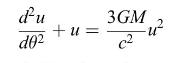
According to Einstein's general theory of relativity, light rays are deflected as they pass by a massive object like the sun. The trajectory of a ray influenced by a central, spherically symmetric object of mass \(M\) lies in a plane with coordinates \(r\) and \(\theta\) (so-called Schwarzschild
A clock is thrown straight upward on an airless planet with uniform gravity \(g\), and it falls back to the surface at a time \(t_{f}\) after it was thrown, according to clocks at rest on the ground.(a) Using the clock's motion as derived in Section 3.7, how much more time than \(t_{f}\) will have
(a) An automobile driver, stopped at an intersection, ties a helium-filled balloon on a string attached to the floor of her car, so the balloon floats up. When the light turns green she accelerates the car forward. Relative to the car, does the balloon move forward, backward, or remain vertically
A skyscraper elevator comes equipped with two weighing scales: The first is a typical bathroom scale containing springs that compress when someone stands on it, and the second is the type often used in doctor's offices, where weights are adjusted to balance that of the patient.(a) A rider enters
A laser is aimed horizontally near earth's surface, a distance \(y_{0}\) above the ground; a pulse of light is then emitted.(a) How far will the pulse fall by the time it has travelled a distance \(L\) ?(b) What is the value of \(L\) if the pulse falls by \(0.1 \mathrm{~nm}\), roughly the diameter
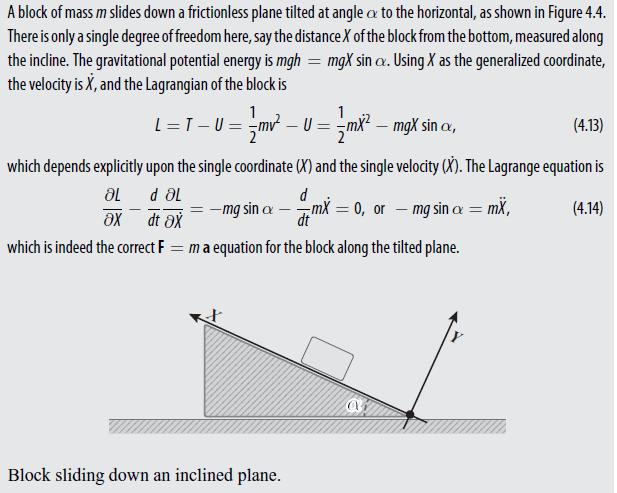
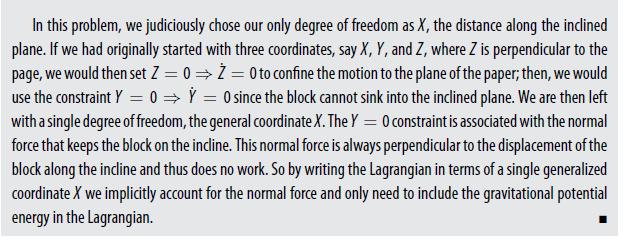
In Example 4.3 we found the equation of motion of a block on an inclined plane, using the generalized coordinate \(X\), the distance of the block from the bottom of the incline. Solve the equation for \(X(t)\) in terms of an arbitrary initial position \(X(0)\) and velocity \(\dot{X}(0)\).Data from
Note that in the Hafele-Keating experiments the total error in the eastward and westward flights was comparable, \(\pm 23\) and \(\pm 21\) nanoseconds, respectively, but that the percentage error was much greater for the eastward flights.(a) What is the reason for that? What is the lesson one might
A hypothetical planet has an equatorial circumference of 40,000 km, a gravity \(g=10 \mathrm{~m} / \mathrm{s}^{2}\), and completes one revolution every 24 hours. Aircraft A circles eastward around the equator at constant altitude \(10 \mathrm{~km}\), while Aircraft B circles westward around the
A particle of mass \(m\) slides inside a smooth hemispherical bowl of radius \(R\). Beginning with spherical coordinates \(r, \theta\) and \(\varphi\) to describe the dynamics, select generalized coordinates, write the Lagrangian, and find the differential equations of motion of the particle.
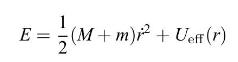
A small block of mass \(m\) and a weight of mass \(M\) are connected by a string of length \(D\). The string has been threaded through a small hole in a tabletop, so the block can slide without friction on the tabletop, while the weight hangs vertically beneath the tabletop. We can let the hole be
Two blocks of equal mass \(m\), connected by a Hooke's-law spring of unstretched length \(\ell\), are free to move in one dimension. Find the equations of motion of the system, using the relative and center of mass coordinates introduced in the preceding problem.Data from Problem 4.20Center of
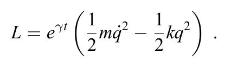
In certain situations, it is possible to incorporate frictional effects in a simple way into a Lagrangian problem. As an example, consider the Lagrangian(a) Find the equation of motion for the system.(b) Do a coordinate change \(s=e^{\gamma t / 2} q\). Rewrite the dynamics in terms of \(s\).(c) How
Consider a vertical circular hoop of radius \(R\) rotating about its vertical symmetry axis with constant angular velocity \(\Omega\). A bead of mass \(m\) is threaded onto the hoop, so is free to move along the hoop. Let the angle \(\theta\) of the bead be measured up from the bottom of the
Consider a particle moving in three dimensions with Lagrangian L = \((1 / 2) m\left(\dot{x}^{2}+\dot{y}^{2}+\dot{z}^{2}ight)+a \dot{x}+b\), where \(a\) and \(b\) are constants.(a) Find the equations of motion and show that the particle moves in a straight line at constant speed, so that it must be
Consider a Lagrangian that depends on second derivatives of the coordinatesThrough the variational principle, find the resulting differential equations of motion. L = L(qk, ak, ak, t).
Consider the Lagrangian \(L^{\prime}=m \dot{x} \dot{y}-k x y\) for a particle free to move in two dimensions, where \(x\) and \(y\) are Cartesian coordinates, and \(m\) and \(k\) are constants.(a) Show that his Lagrangian gives the equations of motion appropriate for a two-dimensional simple
A pendulum consists of a plumb bob of mass \(m\) on the end of a string that swings back and forth in a plane. The upper end of the string passes through a small hole in the ceiling, and the angle \(\theta\) of the bob relative to the vertical changes with time as it swings back and forth. The
A spherical pendulum consists of a particle of mass \(m\) on the end of a string of length \(R\). The position of the particle can be described by a polar angle \(\theta\) and an azimuthal angle \(\varphi\). The length of the string decreases at the rate \(d R / d t=-f(t)\), where \(f(t)\) is a
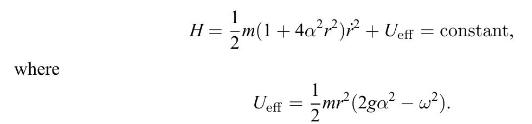
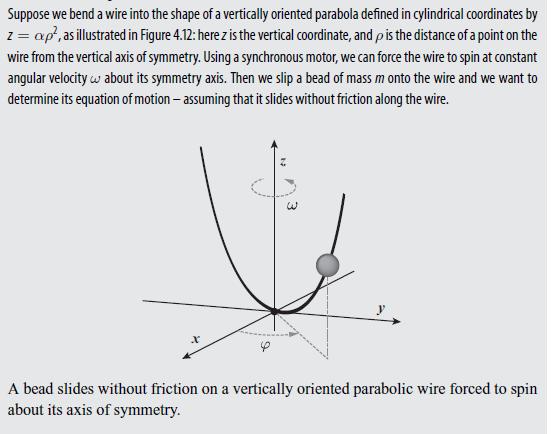
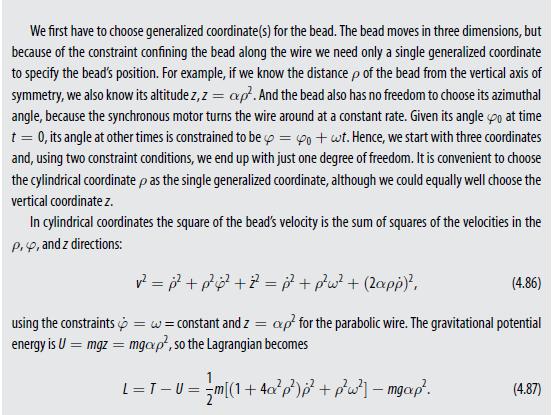
The Hamiltonian of a bead on a parabolic wire turning with constant angular velocity ω iswhere \(H\) is a constant. Reduce the problem to quadrature: That is, find an equation for the time \(t\) is terms of an integral over \(r\). H = m[(1 + 4a); = r] +mgar,
One end of a wire is tied to a point A on the ceiling and the other end is tied to a point on a ring of radius \(R\) and negligible mass. The ring therefore hangs from the wire in a vertical plane and in a gravitational field \(g\). A bead of mass \(m\) is threaded onto the ring so it can slide
A particle moves in a cylindrically symmetric potential \(U(ho, z)\). Use cylindrical coordinates \(ho, \varphi\), and \(z\) to parameterize the space.(a) Write the Lagrangian for an unconstrained particle of mass \(m\) (using cylindrical coordinates) in the presence of this potential.(b) Write the
A particle of mass \(m\) slides inside a smooth paraboloid of revolution whose axis of symmetry \(z\) is vertical. The surface is defined by the equation \(z=\alpha ho^{2}\), where \(z\) and \(ho\) are cylindrical coordinates, and \(\alpha\) is a constant. There is a uniform gravitational field
A spring pendulum features a pendulum bob of mass \(m\) attached to one end of a spring of force-constant \(k\) and unstretched length \(R\). The other end of the spring is attached to a fixed point on the ceiling. The pendulum is allowed to swing in a plane. Use \(r\), the distance of the bob from
A pendulum is constructed from a bob of mass \(m\) on one end of a light string of length \(D\). The other end of string is attached to the top of a circular cylinder of radius \(R\) \((R
A plane pendulum is made with a plumb bob of mass \(m\) hanging on a Hooke'slaw spring of negligible mass, force constant \(k\), and unstretched length \(\ell_{0}\). The spring can stretch but is not allowed to bend. There is a uniform downward gravitational field \(g\).(a) Select generalized
A particle of mass \(m\) and charge \(q\) moves within a parallel-plate capacitor whose charge \(Q\) decays exponentially with time, \(Q=Q_{0} e^{-t / \tau}\), where \(\tau\) is the time constant of the decay. Find the equations of motion of the particle. Ignore the effect of any magnetic field
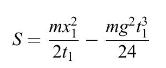
A particle of mass \(m\) travels between two points \(x=0\) and \(x=x_{1}\) on Earth's surface, leaving at time \(t=0\) and arriving at \(t=t_{1}\). The gravitational field \(g\) is uniform.(a) Suppose \(m\) moves along the ground (keeping altitude \(z=0\) ) at steady speed. Find the total action
Suppose the particle of the preceding problem moves instead at constant speed along an isoceles triangular path between the beginning point and the end point, with the high point at height \(z_{1}\) above the ground, at \(x=x_{1} / 2\) and \(t=t_{1} / 2\).(a) Find the action for this path.(b) Find
A plane pendulum consists of a light rod of length R supporting a plumb bob of mass \(m\) in a uniform gravitational field \(g\). The point of support of the top end of the rod is forced to oscillate back and forth in the horizontal direction with \(x=A \cos \omega t\). Using the angle \(\theta\)
Solve the preceding problem if instead of being forced to oscillate in the horizontal direction, the upper end of the rod is forced to oscillate in the vertical direction with \(y=A \cos \omega t\).Data from preceding problemA plane pendulum consists of a light rod of length R supporting a plumb
A particle of mass \(m\) on a frictionless table top is attached to one end of a light string. The other end of the string is threaded through a small hole in the table top, and held by a person under the table. If given a sideways velocity \(v_{0}\), the particle circles the hole with radius
A rod is bent in the middle by angle \(\alpha\). The bottom portion is kept vertical and the top portion is therefore oriented at angle \(\alpha\) to the vertical. A bead of mass \(m\) is slipped onto the top portion and the bottom portion is forced by a motor to rotate at constant angular speed
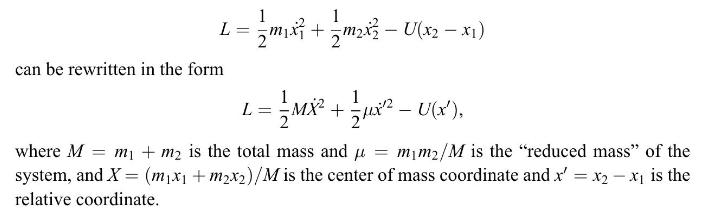
Center of mass and relative coordinates. Show that for two particles moving in one dimension, with coordinates \(x_{1}\) and \(x_{2}\), with a potential that depends only upon their separation \(x_{2}-x_{1}\), then the Lagrangian can be rewritten in the form 1 L = mx + mx - U(x2 x1) - L = 1 = x +
Consider a Lagrangian \(L^{\prime}=L+d f / d t\), where the Lagrangian is \(L=\) \(L\left(q_{k}, \dot{q}_{k}, tight)\), and the function \(f=f\left(q_{k}, tight)\).(a) Show that \(L^{\prime}=L^{\prime}\left(q_{k}, \dot{q}_{k}, tight)\), so that it depends upon the proper variables. Show that this
Show that the function \(L^{\prime}\) given in the preceding problem must obey Lagrange's equations if \(L\) does, directly from the principle of stationary action. Lagrange's equations do not have to be written down for this proof!
In Example 4.8 we analyzed the case of a bead on a rotating parabolic wire. The energy of the bead was not conserved, but the Hamiltonian was:There is an equilibrium point at \(r=0\) which is unstable if \(\omega>\omega_{0} \equiv \sqrt{2 g} \alpha\), neutrally stable if \(\omega=\omega_{0}\),
One point on a horizontal circular wire \(\mathrm{C}\) of radius \(R\) is attached to a thin, vertical axle which turns at constant angular velocity \(\Omega\) about the vertical axis, causing \(\mathrm{C}\) to turn around with it. A bead of mass \(m\) moves without friction on C.(a) Show that
A frictionless slide is constructed in the shape of a cycloid. The horizontal coordinate x and vertical coordinate y of the slide are given in parametric form bywhere \(A\) is a constant. Here the \(y\) coordinate is positive upward. The slide is the portion of the cycloid with \(=-\pi \leq \varphi
The wire described in the preceding problem is now forced to rotate about its vertical axis of symmetry with constant angular velocity \(\Omega\).(a) Find \(\Omega_{c}\), the critical value of \(\Omega\) for which the equilibrium point at \(x=0\) is no longer a stable equilibrium point, and find
A wire bent in the shape of a hyperbolic cosine function y = a cosh(x/x0) is supported in a vertical plane, where \(x\) and \(y\) are the horizontal and vertical coordinates, respectively. and \(a\) and \(x_{0}\) are positive constants. A bead of mass \(m\) is threaded onto the wire and is free to
A wire is bent into the shape of a quartic function \(y=a x^{4}\) and oriented in a vertical plane, with \(x\) horizontal, \(y\) vertical, and \(a\) a positive constant. A bead of mass \(m\) is threaded onto the wire, and the wire is then forced to rotate with constant angular velocity \(\Omega\)
A bead of mass \(m\) is placed on a vertically-oriented circular hoop of radius \(R\) that is forced to rotate with constant angular velocity \(\omega\) about a vertical axis through its center.(a) Using the polar angle \(\theta\) measured up from the bottom as the single generalized coordinate,
A surface with \(N_{0}\) adsorption centers has \(N\left(\leq N_{0}ight)\) gas molecules adsorbed on it. Show that the chemical potential of the adsorbed molecules is given by\[\mu=k T \ln \frac{N}{\left(N_{0}-Night) a(T)},\]where \(a(T)\) is the partition function of a single adsorbed molecule.
Study the state of equilibrium between a gaseous phase and an adsorbed phase in a singlecomponent system. Show that the pressure in the gaseous phase is given by the Langmuir equation\[P_{g}=\frac{\theta}{1-\theta} \times(\text { a certain function of temperature })\]where \(\theta\) is the
Show that for a system in the grand canonical ensemble\[\{\overline{(N E)}-\bar{N} \bar{E}\}=\left(\frac{\partial U}{\partial N}ight)_{T, V} \overline{(\Delta N)^{2}}\]
Define a quantity \(J\) as\[J=E-N \mu=T S-P V\]Show that for a system in the grand canonical ensemble\[\overline{(\Delta J)^{2}}=k T^{2} C_{V}+\left\{\left(\frac{\partial U}{\partial N}ight)_{T, V}-\muight\}^{2} \overline{(\Delta N)^{2}}\]
Assuming that the latent heat of vaporization of water \(L_{\mathrm{V}}=2260 \mathrm{~kJ} / \mathrm{kg}\) is independent of temperature and the specific volume of the liquid phase is negligible compared to the specific volume of the vapor phase, \(v_{\text {vapor }}=k T / P_{\sigma}(T)\), integrate
Assuming that the latent heat of sublimation of ice \(L_{\mathrm{S}}=2500 \mathrm{~kJ} / \mathrm{kg}\) is independent of temperature and the specific volume of the solid phase is negligible compared to the specific volume of the vapor phase, \(v_{\text {vapor }}=k T / P_{\sigma}(T)\), integrate the
Calculate the slope of the solid-liquid transition line for water near the triple point \(T=273.16 \mathrm{~K}\), given that the latent heat of melting is \(80 \mathrm{cal} / \mathrm{g}\), the density of the liquid phase is \(1.00 \mathrm{~g} / \mathrm{cm}^{3}\), and the density of the ice phase is
Show that the Clausius-Clapeyron equation (4.7.7) guarantees that each of the coexistence curves at the triple point of a material "points into" the third phase; for example, the slope of the solid-vapor coexistence line has a value in-between the slopes of the the the solid-liquid and liquid-vapor
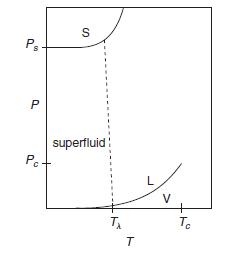
Sketch the \(P-V\) phase diagram for helium-4 using the sketch of the \(P-T\) phase diagram in Figure 4.3. Ps S P Pc+ superfluid! TA T V To
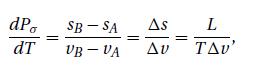
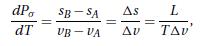
Derive the equivalent of the Clausius-Clapeyron equation (4.7.7) for the slope of the coexistence chemical potential as a function of temperature. Use the fact that the pressures \(P(\mu, T)\) in two different phases are equal on the coexistence curve.Equation (4.7.7) dPg dT SB-SA As L VB-VA TAV'
Sketch the \(P-T\) and \(P-V\) phase diagrams of water, taking into account the fact that the mass density of the liquid phase is larger than the mass density of the solid phase.
Evaluate the density matrix \(ho_{m n}\) of an electron spin in the representation that makes \(\hat{\sigma}_{x}\) diagonal.Next, show that the value of \(\left\langle\sigma_{z}ightangle\), resulting from this representation, is precisely the same as the one obtained in Section 5.3.The
Prove that\[\left\langle q\left|e^{-\beta \hat{H}}ight| q^{\prime}ightangle=\exp \left[-\beta \hat{H}\left(-i \hbar \frac{\partial}{\partial q}, qight)ight] \delta\left(q-q^{\prime}ight)\]where \(\hat{H}(-i \hbar \partial / \partial q, q)\) is the Hamiltonian operator of the system in the
(a) Solve the integral∫3N0≤∑3Ni=1|xi|≤R(dx1…dx3N)∫3N0≤∑i=13N|xi|≤R(dx1…dx3N)and use it to determine the "volume" of the relevant region of the phase space of an extreme relativistic gas (ε=pc(ε=pc ) of 3N3N particles moving in one dimension. Determine, as well, the number of
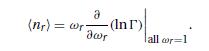
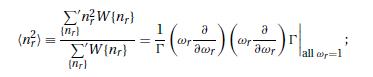
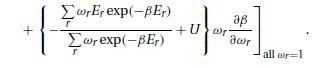
(a) Derive formula (3.2.36) from equations (3.2.14) and (3.2.35).Data From Equations (3.2.14)Data From Equations (3.2.35)(b) Derive formulae (3.2.39) and (3.2.40) from equations (3.2.37) and (3.2.38).Data From Equation (3.2.37)Data From Equation (3.2.38) (nr)=wr (In) a awr all wor=1
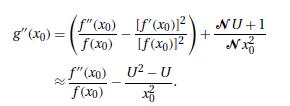
Prove that the quantity \(g^{\prime \prime}\left(x_{0}ight)\), see equations (3.2.25), is equal to \(\left\langle(E-U)^{2}ightangle \exp (2 \beta)\). Thus show that equation (3.2.28) is physically equivalent to equation (3.6.9).Data From Equation (3.2.25)Data From Equation (3.2.28)Data From
Using the fact that \((1 / n !)\) is the coefficient of \(x^{n}\) in the power expansion of the function \(\exp (x)\), derive an asymptotic formula for this coefficient by the method of saddle-point integration. Compare your result with the Stirling formula for \(n\) !.
Verify that the quantity \((k / \mathcal{N}) \ln \Gamma\), where\[\Gamma(\mathcal{N}, U)=\sum_{\left\{n_{r}ight\}}^{\prime} W\left\{n_{r}ight\}\]is equal to the (mean) entropy of the given system. Show that this leads to essentially the same result for \(\ln \Gamma\) if we take, in the foregoing
Making use of the fact that the Helmholtz free energy \(A(N, V, T)\) of a thermodynamic system is an extensive property of the system, show that\[N\left(\frac{\partial A}{\partial N}ight)_{V, T}+V\left(\frac{\partial A}{\partial V}ight)_{N, T}=A\]
Let's go to part (c) right away. Our problem here is to maximize the expression \(S / k=-\sum_{r, s} P_{r, s} \ln P_{r, s}\), subject to the constraints \(\sum_{r, s} P_{r, s}=\) 1, \(\sum_{r, s} E_{s} P_{r, s}=\bar{E}\) and \(\sum_{r, s} N_{r} P_{r, s}=\bar{N}\). Varying \(P\) 's and using the
Prove that, quite generally,\[C_{P}-C_{V}=-k \frac{\left[\frac{\partial}{\partial T}\left\{T\left(\frac{\partial \ln Q}{\partial V}ight)_{T}ight\}ight]_{V}^{2}}{\left(\frac{\partial^{2} \ln Q}{\partial V^{2}}ight)_{T}}>0 .\]Verify that the value of this quantity for a classical ideal classical gas
Show that, for a classical ideal gas,\[\frac{S}{N k}=\ln \left(\frac{Q_{1}}{N}ight)+T\left(\frac{\partial \ln Q_{1}}{\partial T}ight)_{P}\]
If an ideal monatomic gas is expanded adiabatically to twice its initial volume, what will the ratio of the final pressure to the initial pressure be? If during the process some heat is added to the system, will the final pressure be higher or lower than in the preceding case? Support your answer
(a) The volume of a sample of helium gas is increased by withdrawing the piston of the containing cylinder. The final pressure \(P_{f}\) is found to be equal to the initial pressure \(P_{i}\) times \(\left(V_{i} / V_{f}ight)^{1.2}, V_{i}\) and \(V_{f}\) being the initial and final volumes. Assuming
Determine the work done on a gas and the amount of heat absorbed by it during a compression from volume \(V_{1}\) to volume \(V_{2}\), following the law \(P V^{n}=\) const.
If the "free volume" \(\bar{V}\) of a classical system is defined by the equation\[\bar{V}^{N}=\int e^{\left\{\bar{U}-U\left(\boldsymbol{q}_{i}ight)ight\} / k T} \prod_{i=1}^{N} d^{3} q_{i}\]where \(\bar{U}\) is the average potential energy of the system and \(U\left(\boldsymbol{q}_{i}ight)\) the
(a) Evaluate the partition function and the major thermodynamic properties of an ideal gas consisting of \(N_{1}\) molecules of mass \(m_{1}\) and \(N_{2}\) molecules of mass \(m_{2}\), confined to a space of volume \(V\) at temperature \(T\). Assume that the molecules of a given kind are mutually
Consider a system of \(N\) classical particles with mass \(m\) moving in a cubic box with volume \(V=L^{3}\). The particles interact via a short-ranged pair potential \(u\left(r_{i j}ight)\) and each particle interacts with each wall with a short-ranged interaction \(u_{\text {wall }}(z)\), where
Show that the partition function \(Q_{N}(V, T)\) of an extreme relativistic gas consisting of \(N\) monatomic molecules with energy-momentum relationship \(\varepsilon=p c, c\) being the speed of light, is given by\[Q_{N}(V, T)=\frac{1}{N !}\left\{8 \pi V\left(\frac{k T}{h
Consider a system similar to the one in the preceding problem but consisting of \(3 N\) particles moving in one dimension. Show that the partition function in this case is given by\[Q_{3 N}(L, T)=\frac{1}{(3 N) !}\left[2 L\left(\frac{k T}{h c}ight)ight]^{3 N}\]\(L\) being the "length" of the space
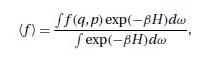
If we take the function \(f(q, p)\) in equation (3.5.3) to be \(U-H(q, p)\), then clearly \(\langle fangle=0\); formally, this would meanData From Equation (3.5.3)\[\int[U-H(q, p)] e^{-\beta H(q, p)} d \omega=0\]Derive, from this equation, expression (3.6.3) for the mean-square fluctuation in the
Show that for a system in the canonical ensemble\[\left\langle(\Delta E)^{3}ightangle=k^{2}\left\{T^{4}\left(\frac{\partial C_{V}}{\partial T}ight)_{V}+2 T^{3} C_{V}ight\}\]Verify that for an ideal gas\[\left\langle\left(\frac{\Delta E}{U}ight)^{2}ightangle=\frac{2}{3 N} \quad \text { and }
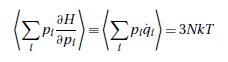
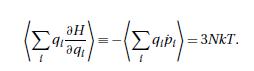
Consider the long-time averaged behavior of the quantity \(d G / d t\), where\[G=\sum_{i} q_{i} p_{i}\]and show that the validity of equation (3.7.5) implies the validity of equation (3.7.6), and vice versa.Data From Equation (3.7.5)Data From Equation (3.7.6) ) = 3 3NKT
Show that, for a statistical system in which the interparticle potential energy \(u(\boldsymbol{r})\) is a homogeneous function (of degree \(n\) ) of the particle coordinates, the virial \(\mathcal{V}\) is given by\[\mathcal{V}=-3 P V-n U\]and, hence, the mean kinetic energy \(K\)
(a) Calculate the time-averaged kinetic energy and potential energy of a one-dimensional harmonic oscillator, both classically and quantum-mechanically, and show that the results obtained are consistent with the result established in the preceding problem (with \(n=2\) ).(b) Consider, similarly,
The restoring force of an anharmonic oscillator is proportional to the cube of the displacement. Show that the mean kinetic energy of the oscillator is twice its mean potential energy.
Derive the virial equation of state equation (3.7.15) from the classical canonical partition function (3.5.5). Show that in the thermodynamic limit the interparticle terms dominate the ones that come from interactions of the particles with the walls of the container.Equation (3.7.15) P 1 =1+ nkT
Show that in the relativistic case the equipartition theorem takes the form\[\left\langle m_{0} u^{2}\left(1-u^{2} / c^{2}ight)^{-1 / 2}ightangle=3 k T \text {, }\]where \(m_{0}\) is the rest mass of the particle and \(u\) its speed. Check that in the extreme relativistic case the mean thermal
Develop a kinetic argument to show that in a noninteracting system the average value of the quantity \(\sum_{i} p_{i} \dot{q}_{i}\) is precisely equal to \(3 P V\). Hence show that, regardless of relativistic considerations, \(P V=N k T\).
The energy eigenvalues of an \(s\)-dimensional harmonic oscillator can be written as\[\varepsilon_{j}=(j+s / 2) \hbar \omega ; \quad j=0,1,2, \ldots\]Show that the \(j\) th energy level has a multiplicity \((j+s-1) ! / j !(s-1) !\). Evaluate the partition function, and the major thermodynamic
Obtain an asymptotic expression for the quantity \(\ln g(E)\) for a system of \(N\) quantum-mechanical harmonic oscillators by using the inversion formula (3.4.7) and the partition function (3.8.15). Hence show that\[\frac{S}{N k}=\left(\frac{E}{N \hbar \omega}+\frac{1}{2}ight) \ln \left(\frac{E}{N
(a) When a system of \(N\) oscillators with total energy \(E\) is in thermal equilibrium, what is the probability \(p_{n}\) that a particular oscillator among them is in the quantum state \(n\) ? [Hint: Use expression (3.8.25).]Show that, for \(N \gg 1\) and \(R \gg n, p_{n} \approx(\bar{n})^{n}
The potential energy of a one-dimensional, anharmonic oscillator may be written as\[V(q)=c q^{2}-g q^{3}-f q^{4}\]where \(c, g\), and \(f\) are positive constants; quite generally, \(g\) and \(f\) may be assumed to be very small in value. Show that the leading contribution of anharmonic terms to
The energy levels of a quantum-mechanical, one-dimensional, anharmonic oscillator may be approximated as\[\varepsilon_{n}=\left(n+\frac{1}{2}ight) \hbar \omega-x\left(n+\frac{1}{2}ight)^{2} \hbar \omega ; \quad n=0,1,2, \ldots\]The parameter \(x\), usually \(\ll 1\), represents the degree of
Study, along the lines of Section 3.8, the statistical mechanics of a system of \(N\) "Fermi oscillators," which are characterized by only two eigenvalues, namely 0 and \(\varepsilon\).
The quantum states available to a given physical system are (i) a group of \(g_{1}\) equally likely states, with a common energy \(\varepsilon_{1}\) and (ii) a group of \(g_{2}\) equally likely states, with a common energy \(\varepsilon_{2}>\varepsilon_{1}\). Show that this entropy of the system is
Gadolinium sulphate obeys Langevin's theory of paramagnetism down to a few degrees Kelvin. Its molecular magnetic moment is \(7.2 \times 10^{-23} \mathrm{amp}-\mathrm{m}^{2}\). Determine the degree of magnetic saturation in this salt at a temperature of \(2 \mathrm{~K}\) in a field of flux density
Oxygen is a paramagnetic gas obeying Langevin's theory of paramagnetism. Its susceptibility per unit volume, at \(293 \mathrm{~K}\) and at atmospheric pressure, is \(1.80 \times 10^{-6} \mathrm{mks}\) units. Determine its molecular magnetic moment and compare it with the Bohr magneton (which is
(a) Consider a gaseous system of \(N\) noninteracting, diatomic molecules, each having an electric dipole moment \(\mu\), placed in an external electric field of strength \(E\). The energy of such a molecule will be given by the kinetic energy of rotation as well as translation plus the potential
Consider a pair of electric dipoles \(\boldsymbol{\mu}\) and \(\boldsymbol{\mu}^{\prime}\), oriented in the directions \((\theta, \phi)\) and \(\left(\theta^{\prime}, \phi^{\prime}ight)\), respectively; the distance \(R\) between their centers is assumed to be fixed. The potential energy in this
Evaluate the high-temperature approximation of the partition function of a system of magnetic dipoles to show that the Curie constant \(C_{J}\) is given by\[C_{J}=\frac{N_{0} g^{2} \mu_{B}^{2}}{k} \overline{m^{2}}\]Hence derive the formula (3.9.26).
Showing 900 - 1000
of 1040
1
2
3
4
5
6
7
8
9
10
11
Step by Step Answers

 Get 50% OFF
Claim Now
Get 50% OFF
Claim Now