New Semester
Started
Get
50% OFF
Study Help!
--h --m --s
Claim Now
Question Answers
Textbooks
Find textbooks, questions and answers
Oops, something went wrong!
Change your search query and then try again
S
Books
FREE
Study Help
Expert Questions
Accounting
General Management
Mathematics
Finance
Organizational Behaviour
Law
Physics
Operating System
Management Leadership
Sociology
Programming
Marketing
Database
Computer Network
Economics
Textbooks Solutions
Accounting
Managerial Accounting
Management Leadership
Cost Accounting
Statistics
Business Law
Corporate Finance
Finance
Economics
Auditing
Tutors
Online Tutors
Find a Tutor
Hire a Tutor
Become a Tutor
AI Tutor
AI Study Planner
NEW
Sell Books
Search
Search
Sign In
Register
study help
social science
behavioral psychology
Psychology 10th Edition David G. Myers - Solutions
LOQ 8-2: How do memory models help us study memory, and how has later research updated the three-stage information-processing model?
LOQ 8-1: What is memory, and how is it measured?
RP-8 If you try to make the material you are learning personally meaningful, are you processing at a shallow or a deep level? Which level leads to greater retention?
RP-7 Which strategies are better for long-term retention: cramming and rereading material, or spreading out learning over time and repeatedly testing yourself?
In the discussion of mnemonics, we gave you six words and told you we would quiz you about them later. How many of these words can you now recall? Of these, how many are high-imagery words? How many are lowimagery?
How have you used hierarchies to organize material that you are trying to remember? How would you do so for a section of this chapter?
RP-6 At which of Atkinson-Shiffrin’s three memory stages would iconic and echoic memory occur?
RP-5 What is the difference between automatic and effortful processing, and what are some examples of each?
Does it surprise you to learn how much of your memory processing is automatic? What might life be like if all memory processing were effortful?
RP-4 What are two basic functions of working memory?
RP-3 How does the working memory concept update the classic Atkinson-Shiffrin three-stage information-processing model?
What has your memory system encoded, stored, and retrieved today?
RP-2 If you want to be sure to remember what you’re learning for an upcoming test, would it be better to use recall or recognition to check your memory? Why?
RP-1 Multiple-choice questions test our . Fill-in-the-blank questions test our .
Imagine having an injury that significantly impairs your ability to form new memories. Now, imagine having a recordsetting ability to remember, like Feng Wang. How would each condition affect your daily routine?
9. Most experts agree that repeated viewing of media violencea. makes all viewers significantly more aggressive.b. has little effect on viewers.c. is a risk factor for viewers’ increased aggression.d. makes viewers angry and frustrated.
8. Some scientists believe that the brain has neurons that enable empathy and imitation.
7. Parents are most effective in getting their children to imitate them ifa. their words and actions are consistent.b. they have outgoing personalities.c. one parent works and the other stays home to care for the children.d. they carefully explain why a behavior is acceptable in adults but not in
6. According to Bandura, we learn by watching models because we experience reinforcement or punishment.
5. Children learn many social behaviors by imitating parents and other models.This type of learning is called .
. Rats that explored a maze without any reward were later able to run the maze as well as other rats that had received food rewards for running the maze. The rats that had learned without reinforcement demonstrated.
3. Evidence that cognitive processes play an important role in learning comes in part from studies in which rats running a maze develop a of the maze.
2. Taste-aversion research has shown that some animals develop aversions to certain tastes but not to sights or sounds. Which of Darwin’s principles does this support?
1. Garcia and Koelling’s - studies showed that conditioning can occur even when the unconditioned stimulus (US) does not immediately follow the neutral stimulus (NS).
LOQ 7-19: What is the violence-viewing effect?
LOQ 7-18: What is the impact of prosocial modeling and of antisocial modeling?
LOQ 7-17: How may observational learning be enabled by neural mirroring?
LOQ 7-16: What is observational learning?
LOQ 7-15: How do cognitive processes affect classical and operant conditioning?
LOQ 7-14: How do biological constraints affect classical and operant conditioning?
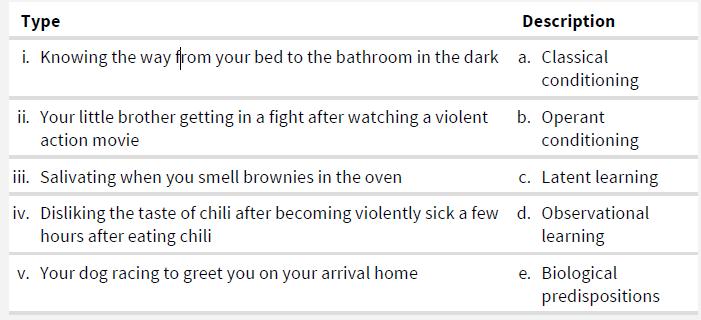
RP-4 Match the examples (i–v) to the appropriate underlying learning principle (a–e): Description i. Knowing the way from your bed to the bathroom in the dark a. Classical ii. Your little brother getting in a fight after watching a violent action movie iii. Salivating when you smell brownies in
Who has been a significant role model for you? What did you learn from observing this person? For whom are you a role model? How might you become a better role model for others?
RP-3 Emily’s parents and older friends all drive over the speed limit, but they advise her not to. Hannah’s parents and friends drive within the speed limit, but they say nothing to deter her from speeding. Will Emily or Hannah be more likely to speed?
RP-2 Instinctive drift and latent learning are examples of what important idea
Can you remember examples from your childhood of learning through classical conditioning (salivating at the sound or smell of some delicious food cooking in the kitchen?), operant conditioning (deciding not to repeat a behavior because you disliked its consequence?), and cognitive learning
RP-1 How did Garcia and Koelling’s taste-aversion studies help disprove Gregory Kimble’s early claim that “just about any activity of which the organism is capable can be conditioned … to any stimulus that the organism can perceive”?
8. A medieval proverb notes that “a burnt child dreads the fire.” In operant conditioning, the burning would be an example of aa. primary reinforcer.b. negative reinforcer.c. punisher.d. positive reinforcer.
7. The partial reinforcement schedule that reinforces a response after unpredictable time periods is a - schedule.
6. A restaurant is running a special deal. After you buy four meals at full price, you will get a free appetizer. This is an example of a -schedule of reinforcement.a. fixed-ratiob. variable-ratioc. fixed-intervald. variable-interval
5. Reinforcing a desired response only some of the times it occurs is called reinforcement.
4. How could your psychology instructor use negative reinforcement to encourage your attentive behavior during class?
3. Your dog is barking so loudly that it’s making your ears ring. You clap your hands, the dog stops barking, your ears stop ringing, and you think to yourself, “I’ll have to do that when he barks again.” The end of the barking was for you aa. positive reinforcer.b. negative reinforcer.c.
2. One way to change behavior is to reward natural behaviors in small steps, as the organism gets closer and closer to a desired behavior. This process is called .
1. Thorndike’s law of effect was the basis for ’s work on operant conditioning and behavior control.
LOQ 7-13: How does operant conditioning differ from classical conditioning?
LOQ 7-12: Why did Skinner’s ideas provoke controversy, and how might his operant conditioning principles be applied?
LOQ 7-11: How does punishment differ from negative reinforcement, and how does punishment affect behavior?
LOQ 7-10: How do different reinforcement schedules affect behavior?
LOQ 7-9: How do positive and negative reinforcement differ, and what are the basic types of reinforcers?
LOQ 7-8: Who was Skinner, and how is operant behavior reinforced and shaped?
LOQ 7-7: What is operant conditioning?
RP-6 Salivating in response to a tone paired with food is a(n) behavior; pressing a bar to obtain food is a(n) behavior
Conditioning principles may also be applied in clinical settings. Play the role of a researcher exploring these applications by engaging online with the activity How Would You Know If People Can Learn to Reduce Anxiety?
RP-5 Joslyn constantly misbehaves at preschool even though her teacher scolds her repeatedly. Why does Joslyn’s misbehavior continue, and what can her teacher do to stop it?
Think of a bad habit of yours. How could you use operant conditioning to break it?
RP-4 Fill in the blanks with one of the following terms: positive reinforcement (PR), negative reinforcement (NR), positive punishment (PP), or negative punishment (NP). We have provided the first answer (PR) for you. Type of Stimulus Desired (for example, a teen's use of the car)
RP-3 People who send spam email are reinforced by which schedule? Home bakers checking the oven to see if the cookies are done are reinforced on which schedule? Sandwich shops that offer a free sandwich after every 10 purchased are using which reinforcement schedule?
Can you recall a time when a teacher, coach, family member, or employer helped you learn something by shaping your behavior in little steps until you achieved your goal?
RP-1 With classical conditioning, we learn associations between events we (do/do not) control. With operant conditioning, we learn associations between our behavior and (resulting/random) events.
6. “Sex sells!” is a common saying in advertising. Using classical conditioning terms, explain how sexual images in advertisements can condition your response to a product.
5. After Watson and Rayner classically conditioned Little Albert to fear a white rat, the child later showed fear in response to a rabbit, a dog, and a furry coat.This illustratesa. extinction.b. generalization.c. spontaneous recovery.d. discrimination between two stimuli.
4. Dogs have been taught to salivate to a circle but not to a square. This process is an example of .
3. In Pavlov’s experiments, the tone started as a neutral stimulus, and then became a(n) stimulus.
2. Two forms of associative learning are classical conditioning, in which the organism associates , and operant conditioning, in which the organism associates .a. two or more responses; a response and its consequenceb. two or more stimuli; two or more responsesc. two or more stimuli; a response and
1. Learning is defined as “the process of acquiring through experience new and relatively enduring or .”
LOQ 7-6: What have been some applications of Pavlov’s work to human health and well-being? How did Watson apply Pavlov’s principles to learned fears?
LOQ 7-4: In classical conditioning, what are the processes of acquisition, extinction, spontaneous recovery, generalization, and discrimination?
LOQ 7-3: Who was Pavlov, and what are the basic components of classical conditioning?
LOQ 7-2: What is behaviorism’s view of learning?
LOQ 7-1: How do we define learning, and what are some basic forms of learning?
RP-7 In Watson and Rayner’s experiments, “Little Albert” learned to fear a white rat after repeatedly experiencing a loud noise as the rat was presented. In these experiments, what was the US? The UR? The NS? The CS? The CR?
RP-6 Companies often pay to make their products visible in popular movies—such as when admired actors drink certain beverages. Based on classical conditioning principles, what might be an effect of this pairing?
Why does Pavlov’s work remain so important?
RP-5 What conditioning principle is influencing the snail’s affections? S.GROSS "I don't care if she's a tape dispenser. I love her." Myers/DeWall, Psychology, 13e, 2021 Worth Publishers
RP-4 The first step of classical conditioning, when an NS becomes a CS, is called . When a US no longer follows the CS, and the CR becomes weakened, this is called .
RP-3 If the aroma of a baking cake sets your mouth to watering, what is the US? The CS? The CR?
Psychologist Michael Tirrell recalled coming to associate his girlfriend’s onion breath with arousal. Can you remember ever experiencing something that would normally be neutral (or even unpleasant), but came to mean something special to you?
RP-2 An experimenter sounds a tone just before delivering an air puff that causes your eye to blink. After several repetitions, you blink to the tone alone. What is the NS? The US? The UR? The CS? The CR?
RP-1 Why are habits, such as having something sweet with that cup of coffee, so hard to break?
What are sensation and perceptionpg15 What do we mean by bottom-up processing and top-down processingpg15
How does day care affect childrenpg15
From the perspectives of Piaget, Vygotsky, and today’s researchers, how does a child’s mind developpg15
What is the course of prenatal development, and how do teratogens affect that developmentpg15
What three issues have engaged developmental psychologistspg15
A loved one’s death triggers what range of reactionspg15
Do self-confidence and life satisfaction vary with life stagespg15
Does marriage correlate with happiness because marital support and intimacy breed happiness, or because happy people are more likely to marrypg15
What themes and influences mark our social journey from early adulthood to deathpg15
How does memory change with agepg15
What physical changes occur during middle and late adulthoodpg15
What is emerging adulthoodpg15
How do parents and peers influence adolescentspg15
What are the social tasks and challenges of adolescencepg15
How did Piaget, Kohlberg, and later researchers describe adolescent cognitive and moral developmentpg15
How is adolescence defined, and what physical changes mark this periodpg15
What are three parenting styles, and how do children’s traits relate to thempg15
How do children’s self-concepts developpg15
Does childhood neglect, abuse, or family disruption affect children’s attachmentspg15
How have psychologists studied attachment differences, and what have they learnedpg15
How do parent-infant attachment bonds formpg15
Showing 1600 - 1700
of 2883
First
10
11
12
13
14
15
16
17
18
19
20
21
22
23
24
Last
Step by Step Answers

 Get 50% OFF
Claim Now
Get 50% OFF
Claim Now