New Semester
Started
Get
50% OFF
Study Help!
--h --m --s
Claim Now
Question Answers
Textbooks
Find textbooks, questions and answers
Oops, something went wrong!
Change your search query and then try again
S
Books
FREE
Study Help
Expert Questions
Accounting
General Management
Mathematics
Finance
Organizational Behaviour
Law
Physics
Operating System
Management Leadership
Sociology
Programming
Marketing
Database
Computer Network
Economics
Textbooks Solutions
Accounting
Managerial Accounting
Management Leadership
Cost Accounting
Statistics
Business Law
Corporate Finance
Finance
Economics
Auditing
Tutors
Online Tutors
Find a Tutor
Hire a Tutor
Become a Tutor
AI Tutor
AI Study Planner
NEW
Sell Books
Search
Search
Sign In
Register
study help
social science
behavioral psychology
Psychology 13th Edition David G. Myers, C. Nathan DeWall - Solutions
RP-3 Those studying the heritability of a trait try to determine how much of the person-to-person variation in that trait among members of a specific group is due to their differing.
RP-2 How do researchers use twin and adoption studies to learn about psychological principles?
Do you know biological siblings who, despite having been raised together, have very different personalities? (Are you one of these siblings perhaps?) Knowing what you do of their lives and upbringing, what do you think contributed to these differences?
RP-1 Put the following cell structures in order from smallest to largest: nucleus, gene, chromosome.
7. An important psychological contributor to drug use isa. inflated self-esteem.b. the feeling that life is meaningless and directionless.c. genetic predispositions.d. overprotective parents.
6. Use of marijuanaa. impairs motor coordination, perception, reaction time, and memory.b. inhibits people’s emotions.c. leads to dehydration and overheating.d. stimulates brain cell development.
5. Near-death experiences are strikingly similar to the experiences evoked by drugs.
4. Long-term use of Ecstasy cana. depress sympathetic nervous system activity.b. deplete the brain’s supply of epinephrine.c. deplete the brain’s supply of dopamine.d. damage serotonin-producing neurons.
3. Why might alcohol make a person more helpful or more aggressive?
2. The depressants include alcohol, barbiturates,a. and opiates.b. cocaine, and morphine.c. caffeine, nicotine, and marijuana.d. and amphetamines.
1. After continued use of a psychoactive drug, the drug user needs to take larger doses to get the desired effect. This is referred to as .
LOQ 3-16: Why do some people become regular users of consciousness-altering drugs?
LOQ 3-15: What are hallucinogens, and what are their effects?
LOQ 3-14: What are stimulants, and what are their effects?
LOQ 3-13: What are depressants, and what are their effects?
LOQ 3-12: What roles do tolerance and addiction play in substance use disorders, and how has the concept of addiction changed?
LOQ 3-11: What are substance use disorders?
RP-7 Studies have found that people who begin drinking in their early teens are much more likely to develop alcohol use disorder than are those who begin at age 21 or after. What possible explanations might there be for this correlation?
RP-6 Why do tobacco companies try so hard to get customers hooked as teens?
“How curiously [pleasure] is related to what is thought to be its opposite, pain! … Wherever the one is found, the other follows up behind.” (Plato, Phaedo, fourth century B.C.E.)RP-5 How does this pleasure-pain description apply to the repeated use of psychoactive drugs?
RP-4 What withdrawal symptoms should your friend expect when quitting smoking?
Think of a friend or family member who is addicted to nicotine. What do you think would be most effective to say to that person to convince them to try to quit?
RP-3 Alcohol, barbiturates, and opiates are all in a class of drugs called .
RP-2 Can someone become “addicted” to shopping?
RP-1 What is the process that generally leads to drug tolerance?
10. The tendency for REM sleep to increase following REM sleep deprivation is referred to as .
9. “For what one has dwelt on by day, these things are seen in visions of the night” (Menander of Athens [342–292 B.C.E.], Fragments). How might we use the information-processing perspective on dreaming to interpret this ancient Greek quote?
8. How has activation-synthesis been used to explain why we dream?
7. In interpreting dreams, Freud was most interested in theira. information-processing function.b. physiological function.c. manifest content, or story line.d. latent content, or hidden meaning.
6. What is the difference between narcolepsy and sleep apnea?
5. Which of the following is NOT one of the reasons that have been proposed to explain why we need sleep?a. Sleep has survival value.b. Sleep helps us recuperate.c. Sleep rests the eyes.d. Sleep plays a role in the growth process.
4. As the night progresses, what happens to the REM stage of sleep?
3. The brain emits large, slow delta waves during sleep.
2. During the N1 sleep stage, a person is most likely to experiencea. sleep spindles.b. hallucinations.c. night terrors or nightmares.d. rapid eye movements.
1. Our body temperature tends to rise and fall in sync with a biological clock, which is referred to as the .
LOQ 3-10: What do we dream, and what functions have theorists proposed for dreams?
LOQ 3-9: How does sleep loss affect us, and what are the major sleep disorders?
LOQ 3-8: What are sleep’s functions?
LOQ 3-7: How do biology and environment interact in our sleep patterns?
LOQ 3-6: What is the biological rhythm of our sleeping and dreaming stages?
LOQ 3-5: How do our biological rhythms influence our daily functioning?
LOQ 3-4: What is sleep?
RP-7 What five theories propose explanations for why we dream?
Which explanation for why we dream makes the most sense to you? How well does it explain your own dreams?
Does eating spicy foods cause us to dream more?
RP-6 A well-rested person would be more likely to have ________ (trouble concentrating/quick reaction times)and a sleep-deprived person would be more likely __________ to (gain weight/fight off a cold).
RP-5 What are five proposed reasons for our need for sleep?
RP-4 The ________ nucleus helps monitor the brain’s release of melatonin, which affects our ________ rhythm.
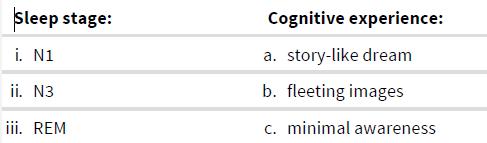
RP-3 Match the sleep stage (i–iii) with the cognitive experience (a–c). Sleep stage: i. N1 ii. N3 iii. REM Cognitive experience: story-like dream b. fleeting images c. minimal awareness
RP-2 What are the sleep stages, and in what order do we normally travel through those stages?
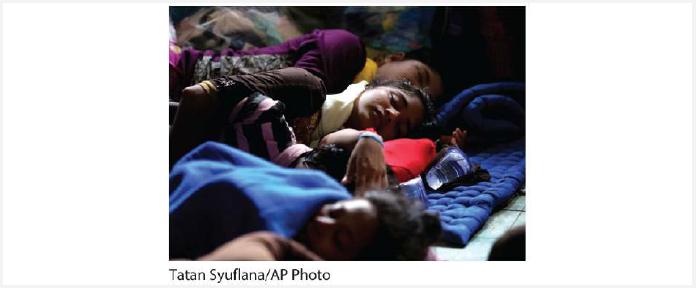
RP-1 Why would communal sleeping provide added protection for those whose safety depends on vigilance, such as these refugees in Paris? Tatan Syuflana/AP Photo
Would you consider yourself a night owl or a morning lark? When do you usually feel most energetic? What time of day works best for you to study?
3. Inattentional blindness is a product of our ________ attention.
2. We register and react to stimuli outside of our awareness by means of ___________ processing. When we devote deliberate attention to stimuli, we use ____________ processing.
1. Failure to see visible objects because our attention is occupied elsewhere is called __________ _________ .
LOQ 3-3: What is the dual processing being revealed by today’s cognitive neuroscience?
LOQ 3-2: How does selective attention direct our perceptions?
LOQ 3-1: What is the place of consciousness in psychology’s history?
RP-3 What are the mind’s two tracks, and what is dual processing?
RP-2 Explain two attentional principles that magicians may use to fool us.
Can you recall a recent time when, as your attention focused on one thing, you were oblivious to something else—perhaps to pain, to someone’s approach, or to music lyrics? (If you’re reading this while listening to exciting music, you may have struggled to understand the question
RP-1 Those working in the interdisciplinary field called________ ________ study the brain activity associated with the mental processes of perception, thinking, memory, and language.
9. Damage to the brain’s right hemisphere is most likely to reduce a person’s ability toa. recite the alphabet rapidly.b. make inferences.c. understand verbal instructions.d. solve arithmetic problems.
8. Studies of people with split brains and brain scans of those with undivided brains indicate that the left hemisphere excels ina. processing language.b. visual perceptions.c. making inferences.d. neurogenesis.
7. An experimenter flashes the word HERON across the visual field of a man whose corpus callosum has been severed. HER is transmitted to his right hemisphere and ON to his left hemisphere. When asked to indicate what he saw, the man says he saw ____________ but his left hand points to _____________.
6. The flexible brain’s ability to respond to damage is especially evident in the brains ofa. split-brain patients.b. young adults.c. young children.d. right-handed people.
5. The “uncommitted” areas that make up about three-fourths of the cerebral cortex are called ________ _________.
4. Judging and planning are enabled by the ___________ lobes.
3. Which of the following body regions has the greatest representation in the somatosensory cortex?a. Upper armb. Toesc. Lipsd. All regions are equally represented.
2. How do different neural networks communicate with one another to let you respond when a friend greets you at a party?
1. If a neurosurgeon stimulated your right motor cortex, you would most likelya. see light.b. hear a sound.c. feel a touch on the right arm.d. move your left leg.
LOQ 2-14: What do split brains reveal about the functions of our two brain hemispheres?
LOQ 2-13: To what extent can a damaged brain reorganize itself, and what is neurogenesis?
LOQ 2-12: Is it true that 90 percent of our brain isn’t really used?
LOQ 2-11: What four lobes make up the cerebral cortex, and what are the functions of the motor cortex, somatosensory cortex, and association areas?
Why do you think our brain evolved into so many interconnected structures with varying functions?
RP-5 (a) If we flash a red light to the right hemisphere of a person with a split brain, and flash a green light to the left hemisphere, will each observe its own color? (b) Will the person be aware that the colors differ? (c) What will the person verbally report seeing?
RP-4 Why are association areas important?
RP-3 Our brain’s ________ cortex registers and processes body touch and movement sensations. The ___________ cortex controls our voluntary movements.
RP-2 If you are able, try moving your right hand in a circular motion, as if cleaning a table. Then start your right foot doing the same motion, synchronized with your hand. Now reverse the right foot’s motion, but not the hand’s. Finally, try moving the left foot opposite to the right hand.a.
RP-1 Which area of the human brain is most similar to that of less complex animals? Which part of the human brain distinguishes us most from less complex animals?
8. The initial reward center discovered by Olds and Milner was located in the ___________.
7. The neural structure that most directly regulates eating, drinking, and body temperature is thea. endocrine system.b. hypothalamus.c. hippocampus.d. amygdala.
6. A cat’s ferocious response to electrical brain stimulation would lead you to suppose the electrode had touched the __________.
5. Two parts of the limbic system are the amygdala and thea. cerebral hemispheres.b. hippocampus.c. thalamus.d. pituitary.
4. The part of the brain that coordinates voluntary movement and enables nonverbal learning and memory is the __________.
3. The lower brain structure that governs arousal is thea. spinal cord.b. cerebellum.c. reticular formation.d. medulla.
2. The thalamus functions as aa. memory bank.b. balance center.c. breathing regulator.d. sensory control center.
1. The part of the brainstem that controls heartbeat and breathing is thea. cerebellum.b. medulla.c. cortex.d. thalamus.
LOQ 2-10: What are the limbic system’s structures and functions?
LOQ 2-9: What structures make up the brainstem, and what are the functions of the brainstem, thalamus, reticular formation, and cerebellum?
LOQ 2-8: How do neuroscientists study the brain’s connections to behavior and mind?
RP-5 What are the three key structures of the limbic system, and what functions do they serve?
RP-3 In what brain region would damage be most likely to (a) disrupt your ability to jump rope? (b) disrupt your ability to hear? (c) leave you in a coma? (d) cut off the very breath and heartbeat of life?
RP-2 The ___________ is a crossover point where nerves from the left side of the brain are mostly linked to the right side of the body, and vice versa.
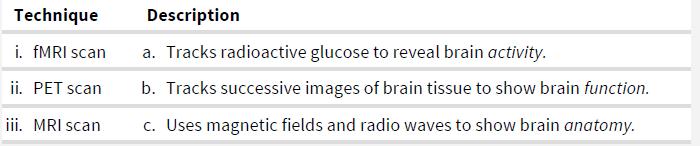
RP-1 Match the scanning technique (i–iii) with the correct description (a–c). Technique i. fMRI scan ii. PET scan iii. MRI scan Description a. Tracks radioactive glucose to reveal brain activity. b. Tracks successive images of brain tissue to show brain function. c. Uses magnetic fields and
Were you surprised to learn that there are so many technological tools to study the brain’s structures and functions?Which techniques do you find most interesting? Why?
7. The autonomic nervous system controls internal functions, such as heart rate and glandular activity. The word autonomic meansa. calming..b. voluntary.c. self-regulating.d. arousing.8. The sympathetic nervous system arouses us for action and the parasympathetic nervous system calms us down.
6. Endorphins are released in the brain in response toa. morphine or heroin.b. pain or vigorous exercise.c. the all-or-none response.d. all of the above.
5. In a sending neuron, when an action potential reaches an axon terminal, the impulse triggers the release of chemical messengers called _____________.
Showing 2200 - 2300
of 2883
First
15
16
17
18
19
20
21
22
23
24
25
26
27
28
29
Step by Step Answers

 Get 50% OFF
Claim Now
Get 50% OFF
Claim Now