New Semester
Started
Get
50% OFF
Study Help!
--h --m --s
Claim Now
Question Answers
Textbooks
Find textbooks, questions and answers
Oops, something went wrong!
Change your search query and then try again
S
Books
FREE
Study Help
Expert Questions
Accounting
General Management
Mathematics
Finance
Organizational Behaviour
Law
Physics
Operating System
Management Leadership
Sociology
Programming
Marketing
Database
Computer Network
Economics
Textbooks Solutions
Accounting
Managerial Accounting
Management Leadership
Cost Accounting
Statistics
Business Law
Corporate Finance
Finance
Economics
Auditing
Tutors
Online Tutors
Find a Tutor
Hire a Tutor
Become a Tutor
AI Tutor
AI Study Planner
NEW
Sell Books
Search
Search
Sign In
Register
study help
social science
behavioral psychology
Psychology 13th Edition David G. Myers, C. Nathan DeWall - Solutions
RP-2 How has Kohlberg’s theory of moral reasoning been criticized?
RP-1 According to Kohlberg, morality focuses on self-interest, morality focuses on selfdefined ethical principles, and morality focuses on upholding laws and social rules.
Think about a difficult decision you had to make in early adolescence and later regretted. What did you do? How would you do things differently now?
How will you look back on your life 10 years from now? What could you change so that someday you will recall your choices with satisfaction?
8. In a series of experiments, the Harlows found that monkeys raised with artificial mothers tended, when afraid, to cling to their cloth mother rather than to a wire mother holding the feeding bottle. Why was this finding important?
7. An 8-month-old infant who reacts to a new babysitter by crying and clinging to his father’s shoulder is showing .
6. Although Piaget’s stage theory continues to inform our understanding of children’s thinking, many researchers believe thata. Piaget’s stages begin earlier and development is more continuous than he realized.b. children do not progress as rapidly as Piaget predicted.c. few children progress
5. Use Piaget’s first three stages of cognitive development to explain why young children are not just miniature adults in the way they think.
4. Why can’t we consciously recall learning to walk?
3. Which of the following is true of motor-skill development?a. It is determined solely by genetic factors.b. The sequence, but not the timing, is universal.c. The timing, but not the sequence, is universal.d. It is determined solely by environmental factors.
2. Between ages 3 and 6, the human brain experiences the greatest growth in the lobes, which enable reasoning and planning.
1. Stroke a newborn’s cheek and the infant will root for a nipple. This illustratesa. a reflex.b. nurture.c. a preference.d. continuity.
LOQ 5-13: What outcomes are associated with each parenting style?
LOQ 5-12: What are the four main parenting styles?
LOQ 5-11: How do children’s self-concepts develop?
LOQ 5-10: How does childhood neglect or abuse affect children’s attachments?
LOQ 5-9: How have psychologists studied attachment differences, and what have they learned?
LOQ 5-8: How do caregiver-infant attachment bonds form?
LOQ 5-7: What does it mean to develop a theory of mind, and how is this impaired in those with autism spectrum disorder?
LOQ 5-6: How did Vygotsky view children’s cognitive development?
LOQ 5-5: How did Piaget broaden our understanding of the way a child’s mind develops, and how have today’s researchers built on his work?
LOQ 5-4: During infancy and childhood, how do the brain and motor skills develop?
RP-6 For those who value children’s self-reliance, the four parenting styles may be described as “too hard, too soft, too uncaring, and just right.” Which parenting style goes with each of these descriptions, and how do children benefit from the “just right” style?
What mistakes do you think parents of the past most often made? What mistakes do you think today’s parents might be making, and that as a parent you would want to (or already try to) avoid?
How has your upbringing affected your attachment style?
RP-5 What distinguishes imprinting from attachment?
RP-4 What does theory of mind have to do with autism spectrum disorder?
RP-3 Label each of the following developmental phenomena (i–vi) with the correct cognitive developmental stage: (a)sensorimotor, (b) preoperational, (c) concrete operational, or (d) formal operational.i. Thinking about abstract concepts, such as “freedom.”ii. Enjoying imaginary play (such as
RP-2 Object permanence, pretend play, conservation, and abstract logic are developmental milestones for which of Piaget’s stages, respectively?
Can you recall a time when you misheard some song lyrics because you assimilated them into your own schema? (For hundreds of examples of this, visit KissThisGuy.com.)
What do you regard as your earliest memory? Now that you know about infantile amnesia, has your opinion changed about the accuracy of that memory?
RP-1 The biological growth process called explains why most children begin walking by about 12 to 15 months.
5. Chemicals that the placenta isn’t able to screen out that can harm an embryo or fetus are called .
4. Body organs first begin to form and function during the period of the; within 6 months, during the period of the , the organs are sufficiently functional to provide a good chance of surviving and thriving.a. zygote; embryob. zygote; fetusc. embryo; fetusd. placenta; fetus
3. Although development is lifelong, there is stability of personality over time.For example,a. most personality traits emerge in infancy and persist throughout life.b. temperament tends to remain stable throughout life.c. few people change significantly after adolescence.d. people tend to undergo
2. The three major issues that interest developmental psychologists are nature/nurture, stability/change, and / .
1. How do cross-sectional and longitudinal studies differ?
LOQ 5-3: What are some newborn abilities, and how do researchers explore infants’mental abilities?
LOQ 5-2: What is the course of prenatal development, and how do teratogens affect that development?
LOQ 5-1: What three issues have engaged developmental psychologists?
RP-4 Infants’ to repeated stimulation helps developmental psychologists study what infants can learn and remember.
RP-2 What findings in psychology support (1) the stage theory of development and (2) the idea of stability in personality across the life span?
RP-1 Developmental researchers who emphasize learning and experience are supporting ; those who emphasize biological maturation are supporting .
Are you the same person you were as a preschooler? As an 8-year-old? As a 12-year-old? How are you different? How are you the same?
9. Our sense of being male, female, neither, or some combination of male and female is known as our ___________ .
8. Gender role refers to oura. sense of being male, female, neither, or some combination of male and female.b. culture’s expectations about the “right” way for men and women to behave.c. assigned birth sex—our chromosomes and anatomy.d. unisex characteristics.
7. A person born with a combination of male and female biological sexual characteristics is __________.
6. On average, girls begin puberty at about the age of __________ , boys at about the age of ________ .
5. Primary sex characteristics relate to ___________ ; secondary sex characteristics refer to _________ .a. spermarche; menarcheb. breasts and facial hair; ovaries and testesc. emotional maturity; hormone surgesd. reproductive organs; nonreproductive traits
4. A fertilized egg will develop into a male if it receives a/n ________ chromosome from its father.
3. Females and males are very similar, but one way they differ is thata. females interrupt more often than males.b. males are more democratic than females in their leadership roles.c. as children, females tend to play in small groups, while males tend to play in large groups.d. females are more
2. In psychology, ________ is the biologically influenced characteristics by which people define male, female, and intersex. The behavioral characteristics that people associate with boy, girl, man, and woman is __________ .
1. Individualist cultures tend to value __________ ; collectivist cultures tend to value _________.a. interdependence; independenceb. independence; interdependencec. solidarity; uniquenessd. duty; fulfillment
LOQ 4-20: How do nature, nurture, and our own choices influence gender roles and other aspects of our lives?
LOQ 4-19: How do we form our gender identity?
LOQ 4-18: What are the effects of sexual aggression? How have cultural views changed, and how can we reduce sexual aggression?
LOQ 4-17: What are some cultural influences on gender roles?
LOQ 4-16: How do sex hormones influence prenatal and adolescent sexual development?
LOQ 4-15: What factors contribute to gender bias in the workplace?
LOQ 4-14: What are some of the ways in which males and females tend to be alike and to differ?
LOQ 4-13: How does the meaning of gender differ from the meaning of sex?
LOQ 4-12: How do individualist and collectivist cultures differ in their values and goals?
LOQ 4-11: How does culture affect our behavior?
LOQ 4-10: In what ways do parents and peers shape children’s development?
LOQ 4-9: How do early experiences modify the brain?
RP-6 How does the biopsychosocial approach explain our individual development?
How gender-typed are you? What has influenced your feelings of being male, female, neither, or some combination of male and female?
RP-5 What are gender roles, and what do their variations tell us about our human capacity for learning and adaptation?
RP-4 Prenatal sexual development begins about __________ weeks after conception. Adolescence is marked by the onset of _______.
RP-3 ________ (Men/Women) are more likely to commit relational aggression, and _______ (men/women)are more likely to commit physical aggression.
RP-2 How do people in individualist and collectivist cultures differ?
Do you consider yourself to be more of a collectivist or an individualist? How do you think this sense of self has influenced your behavior, emotions, and thoughts?
RP-1 What is the selection effect, and how might it affect a teen’s decision to join sports teams at school?
What skills did you practice the most as a child—sports, music, cooking, video gaming? How do you think this affected your brain development? How will you continue to develop your brain with new learning and new skills?
How Does Experience Influence Development?
3. How do evolutionary psychologists use the principle of natural selection to explain differences in mating preferences in women and men?
2. Evolutionary psychologists are most likely to focus ona. how individuals differ from one another.b. the social consequences of learned behaviors.c. the natural selection of traits that helped our ancestors survive and reproduce.d. social scripts.
1. Behavior geneticists are most interested in exploring(commonalities/differences) in our behaviors. Evolutionary psychologists are most interested in exploring (commonalities/differences).
LOQ 4-8: What are the key criticisms of evolutionary explanations of human sexuality, and how do evolutionary psychologists respond?
LOQ 4-7: How might an evolutionary psychologist explain male-female differences in sexuality and mating preferences?
LOQ 4-6: How do evolutionary psychologists use natural selection to explain behavior tendencies?
RP-3 What are the three main criticisms of the evolutionary explanation of human sexuality?
RP-2 How do evolutionary psychologists explain male-female differences in sexuality?
Based on what you’ve learned so far, how would you say that genes and environment work together to influence sexual behavior?
RP-1 How are Belyaev and Trut’s breeding practices similar to, and how do they differ from, the way natural selection normally occurs?
9. Epigenetics is the study of the molecular mechanisms by which trigger or block genetic expression.
8. is the proportion of variation among individuals in groups that we can attribute to genes.
7. From the very first weeks of life, infants differ in their characteristic emotional reactions, with some infants being intense and anxious, while others are easygoing and relaxed. These differences are usually explained as differences in .
6. Adoption studies seek to understand genetic influences on personality. They do this mainly bya. comparing adopted children with nonadopted children.b. evaluating whether adopted children’s personalities more closely resemble those of their adoptive parents or their biological parents.c.
5. ________ twins share the same DNA.
4. Fraternal twins result whena. a single egg is fertilized by a single sperm and then splits.b. a single egg is fertilized by two sperm and then splits.c. two eggs are fertilized by two sperm.d. two eggs are fertilized by a single sperm.
3. When the mother’s egg and the father’s sperm unite, each contributesa. one chromosome pair.b. 23 chromosomes.c. 23 chromosome pairs.d. 25,000 chromosomes.
2. A small segment of DNA that codes for particular proteins is referred to as a _________.
1. The threadlike structures made largely of DNA molecules are called _________.
LOQ 4-5: How is molecular genetics research changing our understanding of the effects of nature and nurture?
LOQ 4-4: What is heritability, and how does it relate to individuals and groups?
LOQ 4-3: What have psychologists learned about temperament?
LOQ 4-2: How do twin and adoption studies help us understand the effects and interactions of nature and nurture?
LOQ 4-1: What are chromosomes, DNA, genes, and the human genome? How do behavior geneticists explain our individual differences?
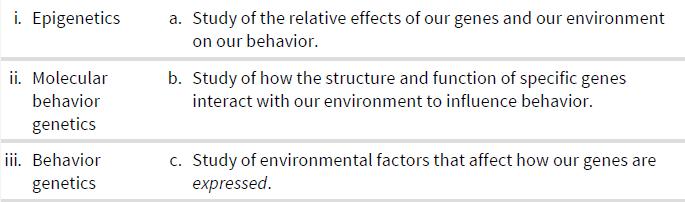
RP-4 Match the following terms (i–iii) to the correct explanation (a–c). i. Epigenetics ii. Molecular behavior genetics iii. Behavior genetics a. Study of the relative effects of our genes and our environment on our behavior. b. Study of how the structure and function of specific genes interact
Showing 2100 - 2200
of 2883
First
15
16
17
18
19
20
21
22
23
24
25
26
27
28
29
Step by Step Answers

 Get 50% OFF
Claim Now
Get 50% OFF
Claim Now