New Semester
Started
Get
50% OFF
Study Help!
--h --m --s
Claim Now
Question Answers
Textbooks
Find textbooks, questions and answers
Oops, something went wrong!
Change your search query and then try again
S
Books
FREE
Study Help
Expert Questions
Accounting
General Management
Mathematics
Finance
Organizational Behaviour
Law
Physics
Operating System
Management Leadership
Sociology
Programming
Marketing
Database
Computer Network
Economics
Textbooks Solutions
Accounting
Managerial Accounting
Management Leadership
Cost Accounting
Statistics
Business Law
Corporate Finance
Finance
Economics
Auditing
Tutors
Online Tutors
Find a Tutor
Hire a Tutor
Become a Tutor
AI Tutor
AI Study Planner
NEW
Sell Books
Search
Search
Sign In
Register
study help
social science
behavioral psychology
Psychology 13th Edition David G. Myers, C. Nathan DeWall - Solutions
1. The snail-shaped tube in the inner ear, where sound waves are converted into neural activity, is called the .
LOQ 6-24: What are the claims of ESP, and what have most research psychologists concluded after putting these claims to the test?
LOQ 6-23: How does sensory interaction influence our perceptions, and what is embodied cognition?
LOQ 6-22: How do we sense our body’s position and movement?
LOQ 6-21: In what ways are our senses of taste and smell similar, and how do they differ?
LOQ 6-20: What biological, psychological, and social-cultural influences affect our experience of pain? How do placebos, distraction, and hypnosis help control pain?
LOQ 6-19: What are the four basic touch sensations, and how do we sense touch?
LOQ 6-18: How do we detect loudness, discriminate pitch, and locate sounds?
LOQ 6-17: How does the ear transform sound energy into neural messages?
LOQ 6-16: What are the characteristics of the air pressure waves that we hear as sound?
RP-8 If an ESP event did occur under controlled conditions, what would be the next step to confirm that ESP really exists?
When have you experienced a feeling that you think could be explained by embodied cognition?
RP-7 Where are the kinesthetic receptors and the vestibular sense receptors located?
RP-6 How does our system for sensing smell differ from our systems for touch and taste?
RP-5 Which of the following options has NOT been proven to reduce pain?a. Distractionb. Hypnosisc. Phantom limb sensationsd. Endorphins
What methods of pain control do you usually turn to when you need it? Has learning about these ways to control pain given you some new ideas about other effective strategies to try?
RP-4 Which theory of pitch perception would best explain a symphony audience’s enjoyment of a high-pitched piccolo?How about a low-pitched cello?
RP-3 The longer the sound waves, the _______ (lower/higher) their frequency and the _________ higher/lower) their pitch.
RP-2 The amplitude of a sound wave determines our perception of (loudness/pitch).
RP-1 What are the basic steps in transforming sound waves into perceived sound?
What do you hear at www.tinyurl.com/YannyLaurel? With a unique, top-down hearing system, each of us may process the same sound differently. Some people hear Yanny and some hear Laurel—two rather different names.
16. In experiments, people have worn glasses that turned their visual fields upside down. After a period of adjustment, they learned to function quite well.This ability is called .
15. After surgery to restore vision, adults who had been blind from birth had difficultya. recognizing objects by touch.b. recognizing objects by sight.c. distinguishing figure from ground.d. distinguishing between bright and dim light.
14. Perceiving a tomato as consistently red, despite lighting shifts, is an example ofa. shape constancy.b. perceptual constancy.c. a binocular cue.d. continuity.
13. Two examples of depth cues are interposition and linear perspective.
12. Depth perception underlies our ability toa. group similar items in a gestalt.b. perceive objects as having a constant shape or form.c. judge distances.d. fill in the gaps in a figure.
11. The visual cliff experiments suggest thata. infants have not yet developed depth perception.b. crawling human infants and very young animals perceive depth.c. we have no way of knowing whether infants can perceive depth.d. unlike other species, humans are able to perceive depth in infancy.
10. Our tendencies to fill in the gaps and to perceive a pattern as continuous are two different examples of the organizing principle calleda. interposition.b. depth perception.c. shape constancy.d. grouping.
9. In listening to a concert, you attend to the solo instrument and perceive the orchestra as accompaniment. This illustrates the organizing principle ofa. figure-ground.b. shape constancy.c. grouping.d. depth perception.
8. The brain’s ability to process many aspects of an object or a problem simultaneously is called .
7. The cells in the visual cortex that respond to certain lines, edges, and angles are called .
6. What mental processes allow you to perceive a lemon as yellow?
5. Two theories together account for color vision. The Young-Helmholtz trichromatic theory shows that the eye contains , and Hering’s theory accounts for the nervous system’s having .a. opposing retinal processes; three pairs of color receptorsb. opponent-process cells; three types of color
4. Cones are the eye’s receptor cells that are especially sensitive to light and are responsible for our vision.a. bright; black-and-whiteb. dim; colorc. bright; colord. dim; black-and-white
3. The blind spot in your retina is located wherea. there are rods but no cones.b. there are cones but no rods.c. the optic nerve leaves the eye.d. the bipolar cells meet the ganglion cells.
2. The amplitude of a light wave determines our perception ofa. brightness.b. color.c. meaning.d. distance.
1. The characteristic of light that determines the color we experience, such as blue or green, is .
LOQ 6-15: What does research on restored vision, sensory restriction, and perceptual adaptation reveal about the effects of experience on perception?
LOQ 6-14: How do perceptual constancies help us construct meaningful perceptions?
LOQ 6-13: How do we use binocular and monocular cues to see in three dimensions, and how do we perceive motion?
LOQ 6-12: How did the Gestalt psychologists understand perceptual organization, and how do figure-ground and grouping principles contribute to our perceptions?
LOQ 6-11: How does the brain use parallel processing to construct visual perceptions?
LOQ 6-10: Where are feature detectors located, and what do they do?
LOQ 6-9: How do we perceive color in the world around us?
LOQ 6-8: How do the rods and cones process information, and what is the path information travels from the eye to the brain?
LOQ 6-7: What are the characteristics of the energy that we see as visible light? What structures in the eye help focus that energy?
Consider someone you know (could be yourself) who has a visual disability of some kind. What sort of disruption in the visual process might cause that disability?
RP-8 How do we normally perceive depth?
RP-7 What do we mean when we say that, in perception, “the whole may exceed the sum of its parts”?
RP-6 In terms of perception, a band’s lead singer would be considered (figure/ground), and the other musicians would be considered (figure/ground).
RP-5 What is the rapid sequence of events that occurs when you see and recognize a friend?
RP-4 What are two key theories of color vision? Are they contradictory or complementary? Explain
Does it surprise you to learn that colors don’t “live” in the objects we perceive—that in fact, these objects are everything but the color we experience? If someone had asked you, “Is grass green?” before you read this section, how would you have responded?
RP-3 Cats are able to open their much wider than we can, which allows more light into their eyes so they can see better at night.
RP-2 Some nocturnal animals, such as toads, mice, rats, and bats, have impressive night vision thanks to having many more (rods/cones) than (rods/cones) in their retinas. These creatures probably have very poor (color/black-and-white) vision.
Consider your activities in the last day. Which of them relied on your rods? Which relied on your cones? How would these activities be different—or impossible—without these cells’ different abilities?
RP-1 There are no receptor cells where the optic nerve leaves the eye. This creates a blind spot in your vision. To demonstrate, close your left eye, look at the black dot, and move your face away until one of the cars disappears. (Which one do you predict it will be?) Repeat with your right eye
7. Our perceptual set influences what we perceive. This mental tendency reflects oura. experiences, assumptions, and expectations.b. sensory adaptation.c. priming ability.d. difference thresholds.
6. Sensory adaptation helps us focus ona. visual stimuli.b. auditory stimuli.c. constant features of the environment.d. important changes in the environment.
5. Weber’s law states that for a difference to be perceived, two stimuli must differ bya. a fixed or constant energy amount.b. a constant minimum percentage.c. a constantly changing amount.d. more than 7 percent.
4. Another term for difference threshold is the.
3. Subliminal stimuli area. too weak to be processed by the brain.b. consciously perceived more than 50 percent of the time.c. strong enough to affect our behavior at least 75 percent of the time.d. below our absolute threshold for conscious awareness.
2. The process by which we organize and interpret sensory information is called.
1. Sensation is to as perception is to .a. absolute threshold; difference thresholdb. bottom-up processing; top-down processingc. interpretation; detectiond. grouping; priming
LOQ 6-6: How do our expectations, contexts, motivation, and emotions influence our perceptions?
LOQ 6-5: What is the function of sensory adaptation?
LOQ 6-4: How are we affected by subliminal stimuli?
LOQ 6-3: How do absolute thresholds and difference thresholds differ?
LOQ 6-2: What three steps are basic to all our sensory systems?
LOQ 6-1: What are sensation and perception? What do we mean by bottom-up processing and top-down processing?
RP-4 Does perceptual set involve bottom-up or top-down processing? Why?
Can you think of a time when your expectations caused you to misperceive the intentions of a person or a group? How might you use awareness of context effects to modify your expectations?
RP-3 Why is it that after wearing shoes for a while, you cease to notice them (until questions like this draw your attention back to them)?
What types of sensory adaptation have you experienced in the last 24 hours?
RP-2 Using sound as your example, explain how these concepts differ: absolute threshold, subliminal stimulation, and difference threshold.
RP-1 What is the rough distinction between sensation and perception?
3. Contrary to what many people assume,a. older people are significantly less happy than adolescents are.b. people become less happy as they move from their teen years into midlife.c. positive feelings tend to grow after midlife.d. those whose children have recently left home—the empty
2. Freud defined the healthy adult as one who is able to love and work. Erikson agreed, observing that the adult struggles to attain intimacy and.
1. By age 65, a person would be most likely to experience a cognitive decline in the ability toa. recall and list all the important terms and concepts in a chapter.b. select the correct definition in a multiple-choice question.c. recall their own birth date.d. practice a well-learned skill, such as
LOQ 5-24: What range of reactions does a loved one’s death trigger?
LOQ 5-23: How does our well-being change across the life span?
LOQ 5-22: What themes and influences mark our social journey from early adulthood to death?
LOQ 5-21: How do neurocognitive disorders and Alzheimer’s disease affect cognitive ability?
LOQ 5-20: How does memory change with age?
LOQ 5-19: What physical changes occur during middle and late adulthood?
RP-1 Freud defined the healthy adult as one who is able to and to .
What do you think? Does marriage correlate with happiness because marital support and intimacy breed happiness, because happy people more often marry and stay married, or both?
Imagining the future, how do you think you might change? How might you stay the same? In what ways do you most want to grow as a person?
4. Some developmental psychologists refer to the period that occurs in some Western cultures from age 18 to the mid-twenties as ________.
3. In Erikson’s stages, the primary task during adolescence isa. attaining formal operations.b. forging an identity.c. developing a sense of intimacy with another person.d. living independent of parents.
2. According to Piaget, a person who can think logically about abstractions is in the stage.
1. Adolescence is marked by the onset ofa. an identity crisis.b. puberty.c. moral reasoning.d. parent-child conflict.
LOQ 5-18: What is emerging adulthood?
LOQ 5-17: How do parents and peers influence adolescents?
LOQ 5-16: What are the social tasks and challenges of adolescence?
LOQ 5-15: How did Piaget, Kohlberg, and later researchers describe adolescent cognitive and moral development?
LOQ 5-14: How is adolescence defined, and how do physical changes affect developing teens?
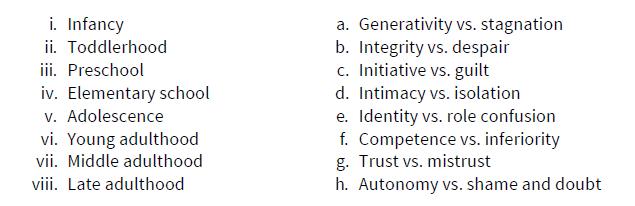
RP-3 Match the psychosocial development stage below (i–viii) with the issue that Erikson believed we wrestle with at that stage (a–h). i. Infancy ii. Toddlerhood iii. Preschool iv. Elementary school v. Adolescence vi. Young adulthood vii. Middle adulthood viii. Late adulthood a. Generativity
What do you think makes a person an adult? Do you feel like an adult? Why or why not?
What are the most positive and the most negative things you remember about your own adolescence? Who do you credit or blame more—your parents or your peers?
Showing 2000 - 2100
of 2883
First
14
15
16
17
18
19
20
21
22
23
24
25
26
27
28
Last
Step by Step Answers

 Get 50% OFF
Claim Now
Get 50% OFF
Claim Now