New Semester
Started
Get
50% OFF
Study Help!
--h --m --s
Claim Now
Question Answers
Textbooks
Find textbooks, questions and answers
Oops, something went wrong!
Change your search query and then try again
S
Books
FREE
Study Help
Expert Questions
Accounting
General Management
Mathematics
Finance
Organizational Behaviour
Law
Physics
Operating System
Management Leadership
Sociology
Programming
Marketing
Database
Computer Network
Economics
Textbooks Solutions
Accounting
Managerial Accounting
Management Leadership
Cost Accounting
Statistics
Business Law
Corporate Finance
Finance
Economics
Auditing
Tutors
Online Tutors
Find a Tutor
Hire a Tutor
Become a Tutor
AI Tutor
AI Study Planner
NEW
Sell Books
Search
Search
Sign In
Register
study help
social science
behavioral psychology
Psychology 10th Edition David G. Myers - Solutions
16. The laboratory environment is designed toa. exactly re-create the events of everyday life.b. re-create psychological forces under controlled conditions.c. re-create psychological forces under random conditions.d. minimize the use of animals and humans in psychological research.
15. A researcher wants to determine whether noise level affects workers’ blood pressure. In one group, she varies the level of noise in the environment and records participants’ blood pressure. In this experiment, the level of noise is the _____________ ____________ .
14. In a double-blind procedure,a. only the participants know whether they are in the control group or the experimental group.b. experimental and control group members will be carefully matched for age, sex, income, and education level.c. neither the participants nor the researchers know who is in
13. To test the effect of a new drug on depression, we randomly assign people to control and experimental groups. Those in the control group take a pill that contains no medication. This pill is a ____________.
12. To explain behaviors and clarify cause and effect, psychologists use ____________.
11. Here are some recently reported correlations, with interpretations drawn by journalists. Knowing just these correlations, can you come up with other possible explanations for each of these?a. Alcohol use is associated with violence. (One interpretation: Drinking triggers or unleashes aggressive
10. Knowing that two events are correlated providesa. a basis for prediction.b. an explanation of why the events are related.c. proof that as one increases, the other also increases.d. an indication that an underlying third factor is at work.
9. How can regression toward the mean influence our interpretation of events?
8. In a _____________correlation, the scores rise and fall together; in a(n)_____________correlation, one score falls as the other rises.a. positive; negativeb. positive; illusoryc. negative; weakd. strong; weak
7. A ____________provides a visual representation of the direction and the strength of a relationship between two variables.
6. A study finds that the more childbirth training classes women attend, the less pain medication they require during childbirth. This finding can be stated as a ___________(positive/negative) correlation.
5. For your survey, you need to establish a group of people who represent your country’s entire adult population. To do this, you will need to question a __________sample of the population.
4. Which of the following is NOT one of the descriptive methods psychologists use to observe and describe behavior?a. A case studyb. Naturalistic observationc. Correlational researchd. A phone survey
3. A theory-based prediction is called a(n) _______________.
2. As scientists, psychologistsa. keep their methods private so others will not repeat their research.b. assume the truth of articles published in leading scientific journals.c. reject evidence that competes with traditional findings.d. are willing to ask questions and to reject claims that cannot
1. _____________ ____________ refers to our tendency to perceive events as obvious or inevitable after the fact.
RP-14 How are animal and human research participants protected?
What other questions or concerns do you have about psychology?
Why do psychologists study animals, and what ethical research guidelines safeguard human and animal welfare? How do psychologists’ values influence what they study and how they apply their results?
How can simplified laboratory conditions illuminate everyday life?
If you could conduct a study on any psychological question, which question would you choose? How would you design the study?
How would you know which research design to use?
RP-13 Why, when testing a new drug to control blood pressure, would we learn more about its effectiveness from giving it to half the participants in a group of 1000 than to all 1000 participants?
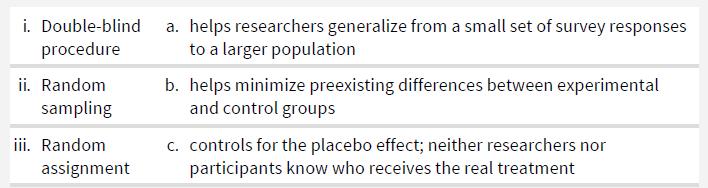
RP-12 Match the term on the left (i through iii) with the description on the right (a through c). i. Double-blind procedure ii. Random sampling iii. Random assignment a. helps researchers generalize from a small set of survey responses to a larger population b. helps minimize preexisting
RP-11 By using random assignment, researchers are able to control for_______________ , which are other factors besides the independent variable(s) that may influence research results.
RP-10 What measures do researchers use to prevent the placebo effect from confusing their results?
What are the characteristics of experimentation that make it possible to isolate cause and effect?
RP-9 Length of marriage positively correlates with hair loss in men. Does this mean that marriage causes men to lose their hair (or that balding men make better husbands)?
RP-8 You hear the school basketball coach telling her friend that she rescued her team’s winning streak by yelling at the players after an unusually bad first half. What is another explanation of why the team’s performance improved?
What are illusory correlations, and what is regression toward the mean?
RP-7 Indicate whether each association is a positive correlation or a negative correlation.1. The more husbands viewed internet pornography, the worse their marital relationships (Muusses et al., 2015).2. The more time teen girls spend absorbed with online social media, the more at risk they are
What does it mean when we say two things are correlated, and what are positive and negative correlations?
RP-6 What is an unrepresentative sample, and how do researchers avoid it?
RP-5 What are the advantages and disadvantages of naturalistic observation?
RP-4 We cannot assume that case studies always reveal general principles that apply to all of us. Why not?
How do psychologists use case studies, naturalistic observations, and surveys to observe and describe behavior, and why is random sampling important?
RP-3 Why is replication important?
RP-2 What does a good theory do?
How do theories advance psychological science?
Why are we so vulnerable to believing untruths?
Play the role of a researcher using scientific inquiry to think smarter about random hot streaks in sports. Engage online with the activity How Would You Know If There Is a “Hot Hand” in Basketball?
RP-1 Why, after friends start dating, do we often feel that we knew they were meant to be together?
Do you have a hard time believing you may be overconfident? Could overconfidence be at work in that self-assessment?How might reading this section about overconfidence help reduce your tendency to be overconfident?
How does our everyday thinking sometimes lead us to a wrong conclusion?
What are sensation and perception? What do we mean by bottom-up processing and top-down processing
5–21: A loved one’s death triggers what range of reactions?
5–20: Do self-confidence and life satisfaction vary with life stages?
5–19: What themes and influences mark our social journey from early adulthood to death?
5–18: How does memory change with age?
5–17: What physical changes occur during middle and late adulthood?
5–16: What is emerging adulthood?Adulthood
5–15: How do parents and peers influence adolescents?
5–14: What are the social tasks and challenges of adolescence?
5–13: How did Piaget, Kohlberg, and later researchers describe adolescent cognitive and moral development?
5–12: How is adolescence defined, and what physical changes mark this period?
5–11: What are three parenting styles, and how do children’s traits relate to them?Adolescence
5–10: How do children’s self-concepts develop?
5–9: How does day care affect children?
5–8: Does childhood neglect, abuse, or family disruption affect children’s attachments?
5–7: How have psychologists studied attachment differences, and what have they learned?
5–6: How do parent-infant attachment bonds form?
5–5: From the perspectives of Piaget, Vygotsky, and today’s researchers, how does a child’s mind develop?
5–4: During infancy and childhood, how do the brain and motor skills develop?
5–3: What are some newborn abilities, and how do researchers explore infants’ mental abilities?
5–2: What is the course of prenatal development, and how do teratogens affect that development?
5–1: What three issues have engaged developmental psychologists?Prenatal Development and the Newborn
A loved one’s death triggers what range of reactions?
Do self-confidence and life satisfaction vary with life stages?
What do you think? Does marriage correlate with happiness because marital support and intimacy breed happiness, because happy people more often marry and stay married, or both?
What themes and influences mark our social journey from early adulthood to death?
How does memory change with age?
What physical changes occur during middle and late adulthood?
What is emerging adulthood?
How do parents and peers influence adolescents?
What are the social tasks and challenges of adolescence?
How did Piaget, Kohlberg, and later researchers describe adolescent cognitive and moral development?
How is adolescence defined, and what physical changes mark this period?
What are three parenting styles, and how do children’s traits relate to them?
How do children’s self-concepts develop?
Does childhood neglect, abuse, or family disruption affect children’s attachments?
How have psychologists studied attachment differences, and what have they learned?
How do parent-infant attachment bonds form?
During infancy and childhood, how do the brain and motor skills develop?
What are some newborn abilities, and how do researchers explore infants’ mental abilities?
3. Stability and change: Which of our traits persist through life? How do we change as we age?
2. Continuity and stages: What parts of development are gradual and continuous, like riding an escalator? What parts change abruptly in separate stages, like climbing rungs on a ladder?
1. Nature and nurture: How does our genetic inheritance (our nature) interact with our experiences (our nurture) to influence our development?
4–3: What is heritability, and how does it relate to individuals and groups?
4–2: What is the promise of molecular genetics research?
4–1: What are genes, and how do behavior geneticists explain our individual differences?
4–15: What is included in the biopsychosocial approach to development?
4–14: How do gender roles and gender typing influence gender development?Reflections on Nature and Nurture
4–13: How is our biological sex determined, and how do sex hormones influence gender development?
4–12: What are some ways in which males and females tend to be alike and to differ?
4–11: How do individualist and collectivist cultures influence people?Gender Development
4–10: How do cultural norms affect our behavior?
4–9: In what ways do parents and peers shape children’s development?
4–8: How do early experiences modify the brain?
4–7: What are the key criticisms of evolutionary psychology, and how do evolutionary psychologists respond?
4–6: How might an evolutionary psychologist explain gender differences in sexuality and mating preferences?
Showing 2500 - 2600
of 2883
First
15
16
17
18
19
20
21
22
23
24
25
26
27
28
29
Step by Step Answers

 Get 50% OFF
Claim Now
Get 50% OFF
Claim Now