New Semester
Started
Get
50% OFF
Study Help!
--h --m --s
Claim Now
Question Answers
Textbooks
Find textbooks, questions and answers
Oops, something went wrong!
Change your search query and then try again
S
Books
FREE
Study Help
Expert Questions
Accounting
General Management
Mathematics
Finance
Organizational Behaviour
Law
Physics
Operating System
Management Leadership
Sociology
Programming
Marketing
Database
Computer Network
Economics
Textbooks Solutions
Accounting
Managerial Accounting
Management Leadership
Cost Accounting
Statistics
Business Law
Corporate Finance
Finance
Economics
Auditing
Tutors
Online Tutors
Find a Tutor
Hire a Tutor
Become a Tutor
AI Tutor
AI Study Planner
NEW
Sell Books
Search
Search
Sign In
Register
study help
engineering
mechanical engineering
Vector Mechanics For Engineers Statics And Dynamics 8th Edition Ferdinand Beer, E. Russell Johnston, Jr., Elliot Eisenberg, William Clausen, David Mazurek, Phillip Cornwell - Solutions
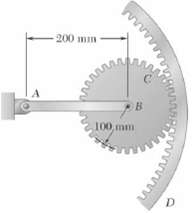
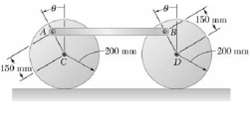
Gear C has a mass of 5 kg and a centroidal radius of gyration of 75 mm. The uniform bar AB has a mass of 3 kg and gear D is stationary. If the system is released from rest in the position shown, determine (a) The angular acceleration of gear C, (b) The acceleration of point B.
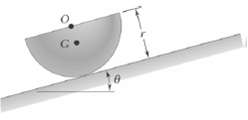
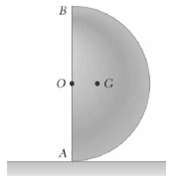
A hemisphere of mass m and radius r is released from rest in the position shown. Knowing that the hemisphere rolls without slipping, determine its initial angularacceleration
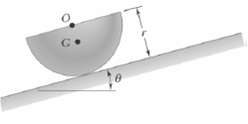
Solve Prob. 16.105, considering a half cylinder instead of a hemisphere.
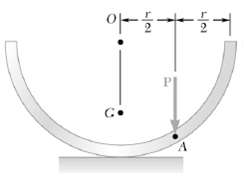
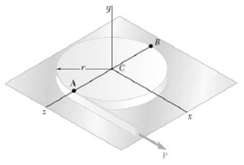
A half section of a uniform thin pipe of mass m is at rest when a force P is applied as shown. Assuming that the section rolls without sliding, determine (a) Its initial angular acceleration, (b) The minimum value of the coefficient of static friction consistent with the motion.
Solve Prob. 16.107 assuming that the force P applied at point A is directed horizontally to the right.
A hemisphere of weight W and radius r is released from rest in the position shown. Determine (a) The minimum value of μs for which the hemisphere starts to roll without sliding, (b) The corresponding acceleration of point B.
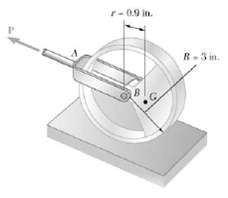
The center of gravity G of a 3.5-lb unbalanced tracking wheel is located at a distance r = 0.9 in. from its geometric center B. The radius of the wheel is R = 3 in. and its centroidal radius of gyration is 2.2 in. At the instant shown the center B of the wheel has a velocity of 1.05 ft/s and an
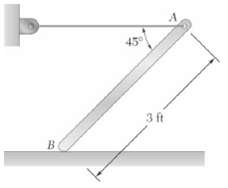
End A of a uniform 15-lb bar is attached to a horizontal rope and end B contacts a floor with negligible friction. Knowing that the bar is released from rest in the position shown, determine immediately after release (a) The angular acceleration of the bar, (b) The tension in the rope, (c) The
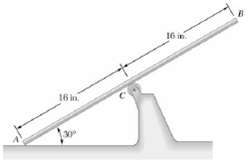
The 16-lb uniform slender rod AB is supported by a small wheel at C and end A can slide on the horizontal surface. Knowing that the rod is released from rest in the position shown and neglecting friction at A and C, determine immediately after release (a) The angular acceleration of the rod, (b)
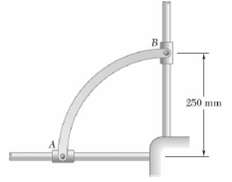
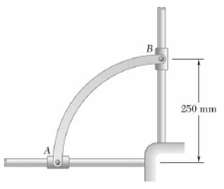
The 2-kg uniform rod AB is in the shape of a quarter circle and its ends are attached to collars of negligible weight that slide without friction along fixed rods. Knowing that rod AB is released from rest in the position shown, determine immediately after release (a) The angular acceleration of
The 2-kg uniform rod AB is in the shape of a quarter circle and its ends are attached to collars of negligible weight that slide along fixed rods. Rod AB is released from rest in the position shown. Assuming no friction at A and a friction force of magnitude 0.9 N at B, determine the angular
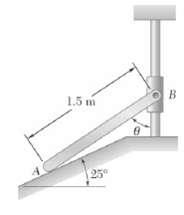
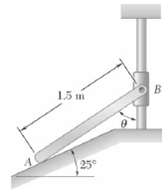
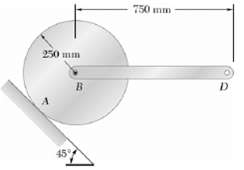
End A of the 6-kg uniform rod AB rests on the inclined surface, while end B is attached to a collar of negligible mass which can slide along the vertical rod shown. Knowing that the rod is released from rest when θ = 35? and neglecting the effect of friction, determine immediately after
End A of the 6-kg uniform rod AB rests on the inclined surface, while end B is attached to a collar of negligible mass which can slide along the vertical rod shown. When the rod is at rest a vertical force P is applied at B, causing end B of the rod to start moving upward with an acceleration of 4
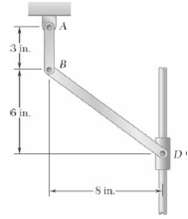
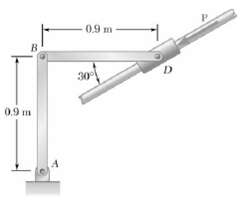
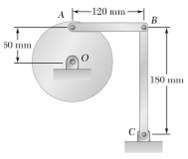
The 3-lb uniform rod BD is connected to crank AB and to a collar of negligible weight. A couple (not shown) is applied to crank AB causing it to rotate with an angular velocity of 12 rad/s counterclockwise and an angular acceleration of 80 rad/s2 clockwise at the instant shown. Neglecting the
In Prob. 16.117, determine the reaction at D, knowing that in the position shown crank AB has an angular velocity of 12 rad/s and an angular acceleration of 80 rad/s2, both counter clockwise.
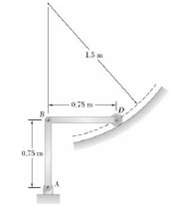
The 4-kg uniform slender bar BD is attached to bar AB and a wheel of negligible mass which rolls on a circular surface. Knowing that at the instant shown bar AB has an angular velocity of 6 rad/s and no angular acceleration, determine the reaction at point D.
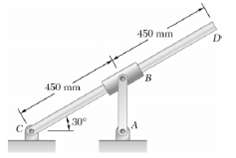
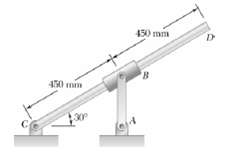
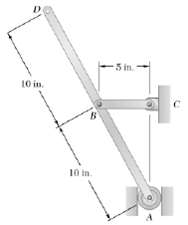
The collar B of negligible mass can slide freely on the 4-kg uniform rod CD. Knowing that in the position shown crank AB rotates with an angular velocity of 5 rad/s and an angular acceleration of 60 rad/s2, both clockwise, determine the force exerted on rod CD by collar B.
The collar B of negligible mass can slide freely on the 4-kg uniform rod CD. Knowing that in the position shown crank AB rotates with an angular velocity of 5 rad/s and an angular acceleration of 60 rad/s2, both counterclockwise, determine the force exerted on rod CD by collar B.
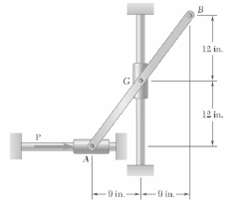
The uniform 8.05-lb bar AGB is attached to two collars of negligible weight that slide with negligible friction along fixed rods. Its motion is controlled by the force P applied to collar A. Knowing that at the instant shown the speed and acceleration of collar A are 2 ft/s and zero, respectively,
The 10-lb uniform rod ABD is attached to the crank BC and is fitted with a small wheel that can roll without friction along a vertical slot. Knowing that at the instant shown crank BC rotates with an angular velocity of 6 rad/s clockwise and an angular acceleration of 15 rad/s2 counterclockwise,
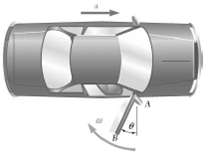
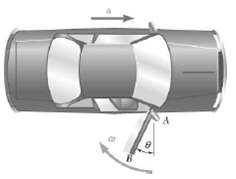
A driver starts his car with the door on the passenger??s side wide open (θ = 0). The 36-kg door has a centroidal radius of gyration k = 250 mm, and its mass center is located at a distance r = 440 mm from its vertical axis of rotation. Knowing that the driver maintains a constant acceleration of
For the car of Prob. 16.124, determine the smallest constant acceleration that the driver can maintain if the door is to close and latch, knowing that as the door hits the frame its angular velocity must be at least 2 rad/s for the latching mechanism to operate.
The linkage ABD is formed by connecting two 4-kg bars and a collar of negligible mass. The motion of the linkage is controlled by the force P applied to the collar. Knowing that at the instant shown the angular velocity and angular acceleration of bar AB are zero and 10 rad/s2 counterclockwise,
Solve Prob. 16.126 assuming that at the instant shown the angular velocity and angular acceleration of bar AB are 5 rad/s clockwise and zero, respectively.
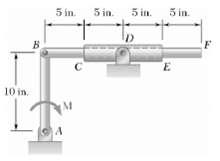
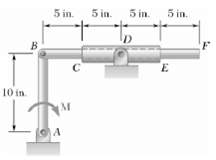
The 4-lb uniform slender rod AB, the 8-lb uniform slender rod BF, and the 4-lb uniform thin sleeve CE are connected as shown and move without friction in a vertical plane. The motion of the linkage is controlled by the couple M applied to rod AB. Knowing that at the instant shown the angular
The 4-lb uniform slender rod AB, the 8-lb uniform slender rod BF, and the 4-lb uniform thin sleeve CE are connected as shown and move without friction in a vertical plane. The motion of the linkage is controlled by the couple M applied to rod AB. Knowing that at the instant shown the angular
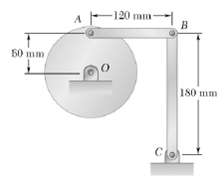
The 2-kg rod AB and the 3-kg rod BC are connected as shown to a disk that is made to rotate in a vertical plane at a constant angular velocity of 6 rad/s clockwise. For the position shown, determine the forces exerted at A and B on rod AB.
The 2-kg rod AB and the 3-kg rod BC are connected as shown to a disk that is made to rotate in a vertical plane. Knowing that at the instant shown the disk has an angular acceleration of 18 rad/s2 clockwise and no angular velocity, determine the components of the forces exerted at A and B on rod AB.
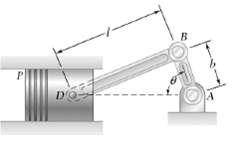
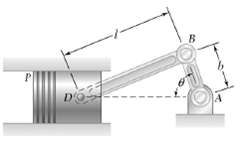
In the engine system shown l = 10 in. and b = 4 in. The connecting rod BD is assumed to be a 3-lb uniform slender rod and is attached to the 4.5-lb piston P. During a test of the system, crank AB is made to rotate with a constant angular velocity of 600 rpm clockwise with no force applied to the
Solve Prob. 16.132 when θ = 0.
Three uniform bars which have different lengths but equal masses are connected to form a linkage which lies in a vertical plane. Knowing that the system is released from rest in the position shown, determine the initial angular acceleration of each bar.
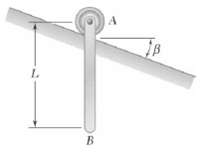
A uniform rod AB, of mass 4 kg and length L = 1.5 m, is released from rest in the position shown. Knowing that β = 20?, determine the values immediately after release of (a) The angular acceleration of the rod, (b) The acceleration of end A, (c) The reaction at A. Neglect the mass and friction of
The uniform slender 2-kg bar BD is attached to the uniform 6-kg uniform disk by a pin at B and released from rest in the position shown. Assuming that the disk rolls without slipping, determine (a) The initial reaction at the contact point A, (b) The corresponding smallest allowable value of the
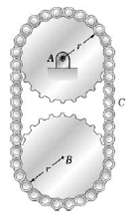
Two disks, each of mass m and radius r, are connected as shown by a continuous chain belt of negligible mass. If a pin at point C of the chain belt is suddenly removed, determine (a) The angular acceleration of each disk, (b) The tension in the left-hand portion of the belt, (c) The acceleration of
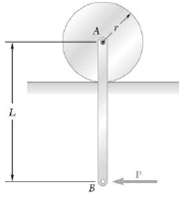
A uniform slender bar AB of mass m is suspended as shown from a uniform disk of the same mass m. Determine the accelerations of points A and B immediately after a horizontal force P has been applied at B.
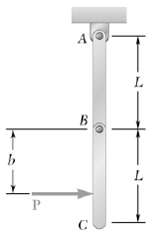
Each of the 6-lb bars AB and BC is of length h L = 25 in. A horizontal force P of magnitude 5 lb is applied to bar BC as shown. Knowing that b = L (P is applied at C), determine the angular acceleration each bar.
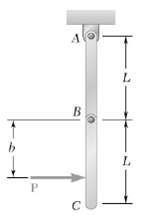
Each of the 6-lb bars AB and BC is of length h L = 25 in. A horizontal force P of magnitude 5 lb is applied to bar BC. For the position shown, determine (a) The distance b for which the bars move as if they formed a single rigid body, (b) The corresponding angular acceleration of the bars.
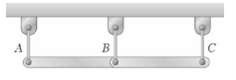
Two identical uniform rods are connected by a pin at B and are held in a horizontal position by three wires as shown. If the wires attached at A and B is cut simultaneously, determine at that instant the acceleration of (a) Point A, (b) Point B.
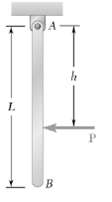
(a) Determine the magnitude and the location of the maximum bending moment in the rod of Prob. 16.73. (b) Show that the answer to part a is independent of the mass of the rod.
Draw the shear and bending-moment diagrams for the rod of Prob. 16.79 immediately after the cable at B breaks.
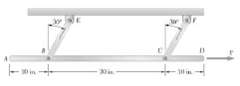
At the instant shown the angular velocity of links BE and CF is 6 rad/s counterclockwise and is decreasing at the rate of 12 rad/s2. Knowing that the length of each link is 15 in. and neglecting the weight of the links, determine (a) The force P, (b) The corresponding force in each link. The weight
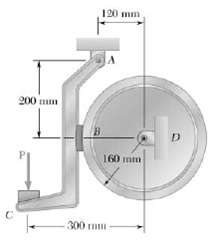
The 160-mm-radius brake drum is attached to a larger flywheel that is not shown. The total mass moment of inertia of the drum and the flywheel is 18 kg ?? m2 and the coefficient of kinetic friction between the drum and the brake shoe is 0.35. Knowing that the angular velocity of the flywheel is 360
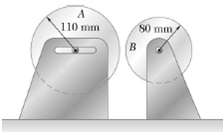
Disk A has a mass of 8 kg and an initial angular velocity of 480 rpm clockwise; disk B has a mass of 4 kg and is initially at rest. The disks are brought together by applying a horizontal force of magnitude 30 N to the axle of disk A. Knowing that μk = 0.15 between the disks and neglecting bearing
A force P of magnitude 0.75 lb is applied to a tape wrapped around a uniform 6-lb disk. Knowing that the disk rests on a frictionless horizontal surface, determine the acceleration of (a) Point A, (b) Point B.
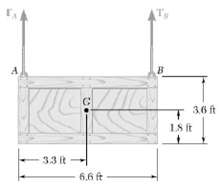
The 400-lb crate shown is lowered by means of two overhead cranes. Knowing that at the instant shown the deceleration of cable A is 3 ft/s2 and that of cable B is 1 ft/s2, determine the tension in each cable.
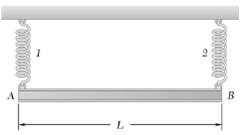
A beam AB of mass m and of uniform cross section is suspended from two springs as shown. If spring 2 breaks, determine at that instant (a) The angular acceleration of the beam, (b) The acceleration of point A, (c) The acceleration of point B.
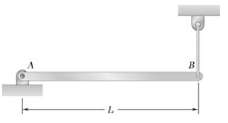
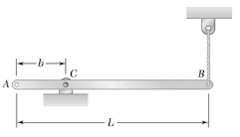
A uniform rod of length L and mass m is supported as shown with b = 0.2 L when the cable attached to end B suddenly breaks. Determine at this instant (a) The acceleration of end B, (b) The reaction at the pin support.
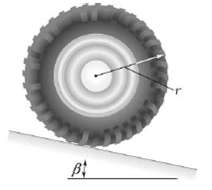
A wheel of radius r and centroidal radius of gyration k is released from rest on the incline and rolls without sliding. Derive an expression for the acceleration of the center of the wheel in terms of r, k, β, and g.
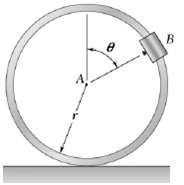
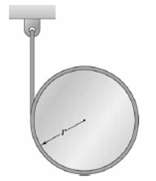
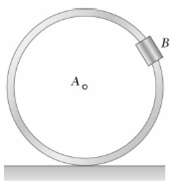
A small clamp of mass mB is attached at B to a hoop of mass mh. The system is released from rest when θ = 90? and rolls without sliding. Knowing that mh = 5mB, determine (a) The angular acceleration of the hoop, (b) The horizontal and vertical components of the acceleration of B.
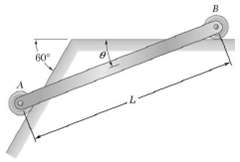
The motion of the uniform rod AB of mass 8 kg and length h L = 900 mm is guided by small wheels of negligible mass that roll on the surface shown. If the rod is released from rest when θ =20?, determine (a) The angular acceleration of the rod, (b) The reaction at A.
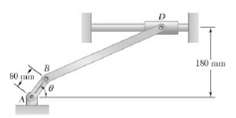
The 300-mm uniform rod BD of mass 3 kg is connected as shown to crank AB and to collar D of negligible mass, which can slide freely along a horizontal rod. Knowing that crank AB rotates counterclockwise at the constant rate of 300 rpm, determine the reaction at D when θ = 0.
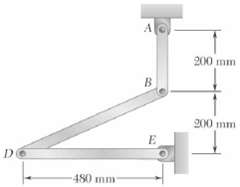
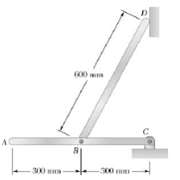
Two 3-kg uniform bars are connected to form the linkage shown. Neglecting the effect of friction, determine the reaction at D immediately after the linkage is released from rest in the position shown.
The rotor of an electric motor has an angular velocity of 3600 rpm when the load and power are cut off. The 110-lb rotor, which has a centroidal radius of gyration of 9 in., then coasts to rest. Knowing that the kinetic friction of the rotor produces a couple of magnitude 2.5 lb ⋅ ft, determine
A 200-kg flywheel is at rest when a constant 300 N ⋅ m couple is applied. After executing 560 revolutions, the flywheel reaches its rated speed of 2400 rpm. Knowing that the radius of gyration of the flywheel is 400 mm, determine the average magnitude of the couple due to kinetic friction in the
The flywheel of a small punching machine rotates at 360 rpm. Each punching operation requires 2034 J of work and it is desired that the speed of the flywheel after each punching be not less that 95 percent of the original speed.(a) Determine the required moment of inertia of the flywheel.(b) If a
A 500-lb flywheel is at rest when a constant 200 lb ⋅ ft couple is applied. After executing 750 revolutions, the flywheel reaches its rated speed of 3000 rpm and the couple is removed. Assuming that the kinetic friction results in a constant couple of magnitude 12.5 lb ⋅ ft, determine(a) The
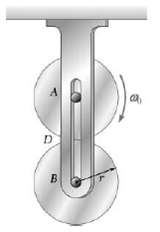
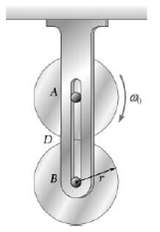
The uniform cylinder A, of mass m and radius r, has an angular velocity ω0 when it is brought into contact with an identical cylinder B which is at rest. The coefficient of kinetic friction at the contact point D is μk. After a period of slipping, the cylinders attain constant angular velocities
The uniform 4-kg cylinder A, of radius r = 150 mm, has an angular velocity ω0 = 50 rad/s when it is brought into contact with an identical cylinder B which is at rest. The coefficient of kinetic friction at the contact point D is μk. After a period of slipping, the cylinders attain constant
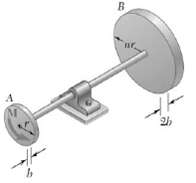
Two uniform disks of the same material are attached to a shaft as shown. Disk A has a weight of 10 lb and a radius r = 6 in. Disk B is twice as thick as disk A. Knowing that a couple M of magnitude 22 lb ?? ft is applied to disk A when the system is at rest, determine the radius nr of disk B if the
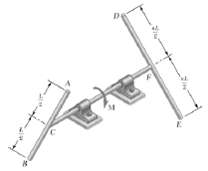
Two uniform slender rods AB and DE of weight w per unit length are attached to shaft CF as shown. The length of rod AB is L and the length of rod DE is nL A couple M of constant moment is applied to shaft CF when the system is at rest and removed after the system has executed one complete
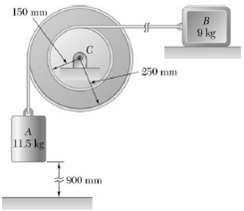
The double pulley shown has a mass of 14 kg and a centroidal radius of gyration of 165 mm. Cylinder A and block B are attached to cords that are wrapped on the pulleys as shown. The coefficient of kinetic friction between block B and the surface is 0.25. Knowing that the system is released from
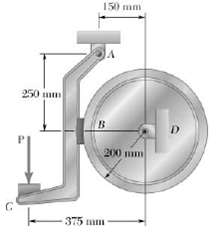
The 200-mm-radius brake drum is attached to a larger flywheel that is not shown. The total mass moment of inertia of the flywheel and drum is 19 kg ?? m2 and the coefficient of kinetic friction between the drum and the brake shoe is 0.35. Knowing that the initial angular velocity of the flywheel is
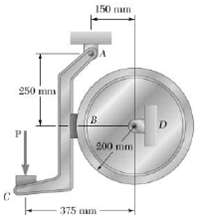
Solve Prob. 17.10 assuming that the initial angular velocity of the flywheel is 360 rpm clockwise. Problem 17.10: The 200-mm-radius brake drum is attached to a larger flywheel that is not shown. The total mass moment of inertia of the flywheel and drum is 19 kg ?? m2 and the coefficient of kinetic
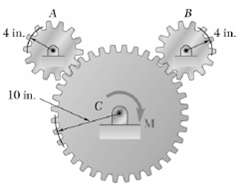
Each of the gears A and B has a weight of 5 lb and a radius of gyration of 4 in., while gear C has a weight of 25 lb and a radius of gyration of 7.5 in. A couple M of magnitude 6.75 lb ??ft is applied to gear C. Determine (a) The number of revolutions of gear C required for its angular velocity to
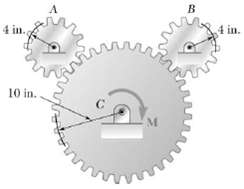
Solve Prob. 17.12 assuming that the 6.75 lb ??ft couple is applied to gear B. Problem 17.12: Each of the gears A and B has a weight of 5 lb and a radius of gyration of 4 in., while gear C has a weight of 25 lb and a radius of gyration of 7.5 in. A couple M of magnitude 6.75 lb ?? ft is applied to
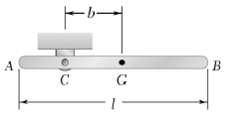
A slender rod of length l is pivoted about a point C located at a distance b from its center G. It is released from rest in a horizontal position and swings freely. Determine (a) The distance b for which the angular velocity of the rod as it passes through a vertical position is maximum (b) The
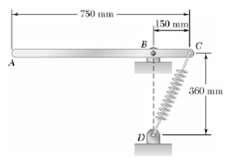
A 3-kg slender rod rotates in a vertical plane about a pivot at B. A spring of constant k = 300 N/m and of un-stretched length 120 mm is attached to the rod as shown. Knowing that in the position shown the rod has an angular velocity of 4 rad/s clock wise, determine the angular velocity of the rod
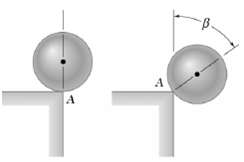
A uniform sphere of radius r is placed at corner A and is given a slight clockwise motion. Assuming that the corner is sharp and becomes slightly embedded in the sphere, so that the coefficient of static friction at A is very large, determine (a) The angle β through which the sphere will have
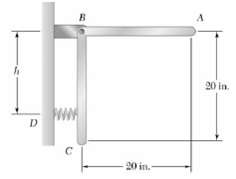
Two identical slender rods AB and BC are welded together to form an L-shaped assembly. The assembly is pressed against a spring at D and released from the position shown. Knowing that the maximum angle of rotation of the assembly in its subsequent motion is 90? counterclockwise, determine the
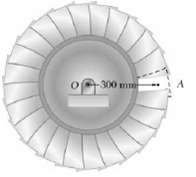
The 30-kg turbine disk has a centroidal radius of gyration of 175 mm and is rotating clockwise at a constant rate of 60 rpm when a small blade of mass 51 grams at point A becomes loose and is thrown off. Neglecting friction, determine the change in the angular velocity of the turbine disk after it
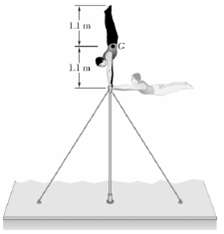
A 73-kg gymnast is executing a series of full-circle swings on the horizontal bar. In the position shown he has a small and negligible clockwise angular velocity and will maintain his body straight and rigid as he swings downward. Assuming that during the swing the centroidal radius of gyration of
A rope is wrapped around a cylinder of radius r and mass m as shown. Knowing that the cylinder is released from rest, determine the velocity of the center of the cylinder after it has moved downward a distance s.
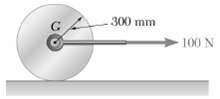
A 24-kg uniform cylindrical roller, initially at rest, is acted upon by a 100-N force as shown. Knowing that the body rolls without slipping, determine (a) The velocity of its center G after it has moved 1.8 m, (b) The friction force required to prevent slipping.
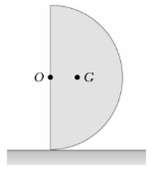
A half-cylinder of mass m and radius r is released from rest in the position shown. Knowing that the half-cylinder rolls without sliding, determine (a) Its angular velocity after it has rolled through ugh 90?, (b) The reaction at the horizontal surface at the same instant.
A collar B, of mass m and negligible dimensions, is attached to the rim of a hoop of the same mass m and of radius r that rolls without sliding on a horizontal surface. Determine the angular velocity ω1 of the hoop in terms of g and r when B is directly above the center A, knowing that the angular
The 9-kg rod AB is attached by pins to two 6-kg uniform disks as shown. The assembly rolls without sliding on a horizontal surface. If the assembly is released from rest when θ = 60?, determine? (a) The angular velocity of the disks when θ = 180?,? (b) The force exerted by the surface on each
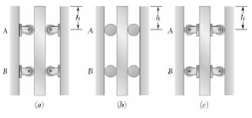
A bar of mass m = 5 kg is held as shown between four disks each of mass m?? = 2 kg and radius r = 75 mm. Knowing that the forces exerted on the disks are sufficient to prevent slipping and that the bar is released from rest, for each of the cases shown determine the velocity of the bar after it has
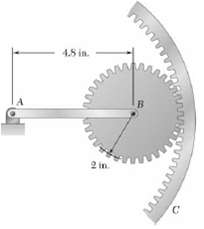
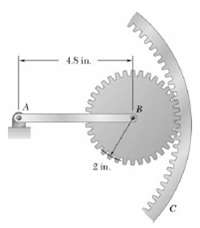
The 3-lb uniform slender bar AB is connected to the 6-lb gear B which meshes with the stationary outer gear C. The centroidal radius of gyration of gear B is 1.2 in. Knowing that the system is released from rest in the position shown, determine (a) The angular velocity of the bar as it passes
The 3-lb uniform slender bar AB is connected to the 6-lb gear B which meshes with the stationary outer gear C. The centroidal radius of gyration of gear B is 1.2 in. The system is released in the position shown when the angular velocity of the bar is 4 rad/s counterclockwise. Knowing that the
Two identical uniform cylinders are connected by a cable of negligible mass and roll without sliding on the surfaces shown. Knowing that the system is released from rest when β = 5?, determine the angular velocity of each cylinder when β = 15?.
The motion of the uniform rod AB is guided by small wheels of negligible mass that roll on the surface shown. If the rod is released from rest when θ = 0, determine the velocities of A and B when θ = 30?.
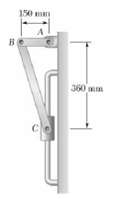
The mechanism shown is one of two identical mechanisms attached to the two sides of a 90-kg uniform rectangular door. Edge ABC of the door is guided by wheels of negligible mass that roll in horizontal and vertical tracks. A spring of constant k = 600 N/m is attached to wheel B. Knowing that the
The mechanism shown is one of two identical mechanisms attached to the two sides of a 90-kg uniform rectangular door. Edge ABC of the door is guided by wheels of negligible mass that roll in horizontal and vertical tracks. A spring of constant k is attached to wheel B in such a way that its tension
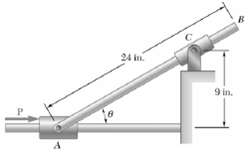
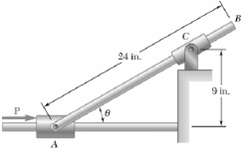
The motion of the uniform slender 5-lb rod AB is guided at A and C by collars of negligible mass. The system is released from rest in the position θ = 45?. Knowing that the applied force P is zero, determine the angular velocity of rod AB when θ = 30?.
The motion of the uniform slender 5-lb rod AB is guided at A and C by collars of negligible mass. The system is released from rest in the position θ = 30?. Knowing that the magnitude of the force P applied to collar A is 2 lb, determine the angular velocity of rod AB when θ = 45?.
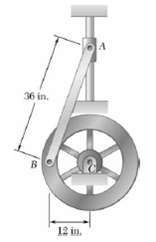
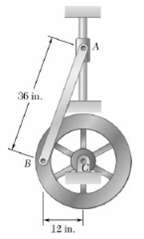
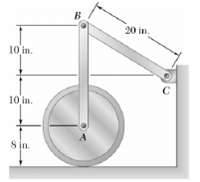
The 8-lb rod AB is attached to a collar of negligible weight at A and to a flywheel at B. The flywheel has a weight of 32 lb and a radius of gyration of 9 in. Knowing that in the position shown the angular velocity of the flywheel is 60 rpm clock wise determine the velocity of the flywheel when
If in Prob. 17.34 the angular velocity of the flywheel is to be the same in the position shown and when point B is directly above C, determine the required value of its angular velocity in the position shown. Problem 17.34: The 8-lb rod AB is attached to a collar of negligible weight at A and to a
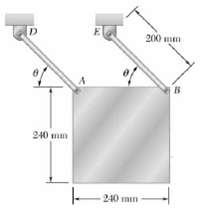
A 5-kg uniform square plate is supported by two identical 1.5-kg uniform slender rods AD and BE and is released from rest in the position θ = 45?. Knowing that the angular velocity of AD as it passes through the vertical position is 5.2 rad/s, determine the amount of energy dissipated in friction.
The uniform rods AB and BC are of mass 3 kg and 8 kg, respectively, and collar C has a mass of 4 kg. Knowing that at the instant shown the velocity of collar C is 0.9 m/s downward; determine the velocity of point B after rod AB has rotated through 90?.
Wheel A weighs 15 lb, has a centroidal radius of gyration of 6 in., and rolls without sliding on the horizontal surface. Each of the uniform rods AB and BC is 20 in. long and weighs 8 lb. If point A is moved slightly to the left and released, determine the velocity of point A as rod BC passes
Knowing that the maximum allowable couple that can be applied to a shaft is 1.75kN ⋅ m, determine the maximum power that can be transmitted by the shaft at(a) 180 rpm,(b) 480 rpm
The flywheel shown has a radius of 500 mm, a mass of 110 kg and a radius of gyration of 375 mm. A 20-kg block A is attached to a wire that is wrapped around the flywheel. Determine the power delivered by the electric motor attached to the shaft of the flywheel at the instant when the velocity of
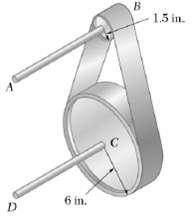
The shaft-disk-belt arrangement shown is used to transmit 3.2 hp from point A to point D, Knowing that the maximum allowable couples that can be applied to shafts AB and CD are 18 lb ?? ft and 58 lb ?? ft, respectively, determine the required minimum speed of shaft AB.
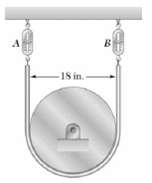
The experimental setup shown is used to measure the power output of a small turbine. When the turbine is operating at 200 rpm, the readings of the two spring scales are 10 and 22 lb, respectively. Determine the power being developed by the turbine.
A 400-lb flywheel is at rest when a constant 18 lb ⋅ ft couple is applied. It is observed that 4.3 min are required for the flywheel to reach its rated speed of 2400 rpm. Knowing that the radius of gyration of the flywheel is 14 in, determine the average magnitude of the couple due to kinetic
A 250-kg flywheel is at rest when a constant 300 N ⋅ m couple is applied at time t = 0. At t = 28 s the flywheel reaches its rated speed of 3000 rpm and the couple is removed. Assuming that the kinetic friction results in a constant couple of magnitude 12.5 N ⋅ m, determine(a) The radius of
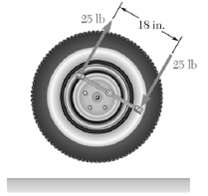
A bolt located 2 in from the center of an automobile wheel is tightened by applying the couple shown for 0.10s, assuming that the wheel is free to rotate and is initially at rest determine the resulting angular velocity of the wheel. The wheel weighs 42 lb and has a radius of gyration of 10.8 in.
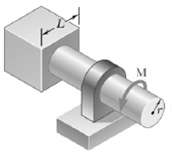
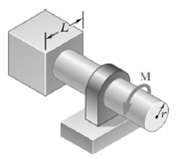
A uniform 144-lb cube is attached to a uniform 136-lb circular shaft as shown and a couple M of constant magnitude is applied to the shaft when the system is at rest. Knowing that r = 4 in., L = 12 in., and the angular velocity of the system is 960 rpm after 4 s, determine the magnitude of the
A uniform 75-kg cube is attached to a uniform 70-kg circular shaft as shown and a couple M of constant magnitude 20 N ?? m is applied to the shaft. Knowing that r = 100 mm and L = 300 mm, determine the time required for the angular velocity of the system to increase from 1000 rpm to 2000 rpm.
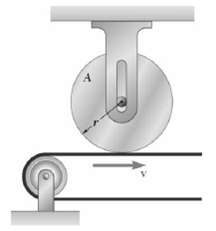
A disk of constant thickness, initially at rest, is placed in contact with a belt that moves with a constant velocity v. Denoting by μk the coefficient of kinetic friction between the disk and the belt, derive an expression for the time required for the disk to reach a constant angular velocity.
Showing 11500 - 11600
of 18200
First
109
110
111
112
113
114
115
116
117
118
119
120
121
122
123
Last
Step by Step Answers

 Get 50% OFF
Claim Now
Get 50% OFF
Claim Now