New Semester
Started
Get
50% OFF
Study Help!
--h --m --s
Claim Now
Question Answers
Textbooks
Find textbooks, questions and answers
Oops, something went wrong!
Change your search query and then try again
S
Books
FREE
Study Help
Expert Questions
Accounting
General Management
Mathematics
Finance
Organizational Behaviour
Law
Physics
Operating System
Management Leadership
Sociology
Programming
Marketing
Database
Computer Network
Economics
Textbooks Solutions
Accounting
Managerial Accounting
Management Leadership
Cost Accounting
Statistics
Business Law
Corporate Finance
Finance
Economics
Auditing
Tutors
Online Tutors
Find a Tutor
Hire a Tutor
Become a Tutor
AI Tutor
AI Study Planner
NEW
Sell Books
Search
Search
Sign In
Register
study help
physics
electricity and magnetism
College Physics 7th Edition Raymond A. Serway, Jerry S. Faughn, Chris Vuille, Charles A. Bennett - Solutions
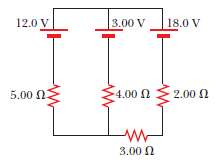
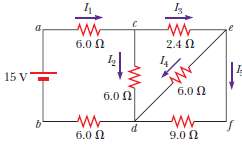
Find the current in each resistor infigure.
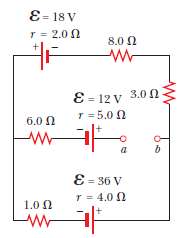
(a) Determine the potential difference ?Vab for the circuit in figure. Note that each battery has an internal resistance as indicated in the figure. (b) If points a and b are connected by a 7.0-? resistor, what is the current in this resistor?
Find the potential difference across each resistor infigure.
Show that τ = RC has units of time.
Consider a series RC circuit for which C = 6.0 µF, R = 2.0 x 10⁶ Ω , and ε 20 V. Find (a) The time constant of the circuit and (b) The maximum charge on the capacitor after a switch in the circuit is closed.
An uncharged capacitor and a resistor are connected in series to a source of emf. If ε = 9.00 V, C = 20.0 µF, and R = 100 Ω, find (a) The time constant of the circuit, (b) The maximum charge on the capacitor, and (c) The charge on the capacitor after one time constant.
Consider a series RC circuit for which R = 1.0 M Ω, C = 5.0 µF, and ε = 30 V. Find the charge on the capacitor 10 s after the switch is closed.
A series combination of a 12-k Ω resistor and an unknown capacitor is connected to a 12-V battery. One second after the circuit is completed, the voltage across the capacitor is 10 V. Determine the capacitance of the capacitor.
A capacitor in an RC circuit is charged to 60.0% of its maximum value in 0.900 s. What is the time constant of the circuit.
A series RC circuit has a time constant of 0.960 s. The battery has an emf of 48.0 V, and the maximum current in the circuit is 0.500 mA. What are? (a) The value of the capacitance and (b) The charge stored in the capacitor 1.92 s after the switch is closed?
An electric heater is rated at 1300 W, a toaster at 1000 W, and an electric grill at 1500 W. The three appliances are connected in parallel to a common 120-V circuit. (a) How much current does each appliance draw? (b) Is a 30.0-A circuit breaker sufficient in this situation? Explain.
A lamp (R = 150 Ω), an electric heater (R = 25 Ω), and a fan (R = 50 Ω) are connected in parallel across a 120-V line.(a) What total current is supplied to the circuit? (b) What is the voltage across the fan? (c) What is the current in the lamp? (d) What power is expended in the heater?
A heating element in a stove is designed to dissipate 3 000 W when connected to 240 V.(a) Assuming that the resistance is constant, calculate the current in the heating element if it is connected to 120 V.(b) Calculate the power it dissipates at that voltage.
Your toaster oven and coffeemaker each dissipate 1 800 W of power. Can you operate them together if the 120-V line that feeds them has a circuit breaker rated at 15 A? Explain.
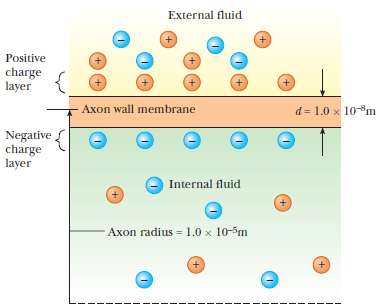
Assume that a length of axon membrane of about 10 cm is excited by an action potential (length excited = nerve speed pulse duration = 50 m/s 2.0 ms ? 10 cm). In the resting state, the outer surface of the axon wall is charged positively with K+ ions and the inner wall has an equal and opposite
Consider the model of the axon as a capacitor from Problem 41 and figure. (a) How much energy does it take to restore the inner wall of the axon to – 70 mV, starting from + 30 mV? (b) Find the average current in the axon wall during this process.
Using figure b and the results of Problems d and 18.42a, find the power supplied by the axon per action potential.
Consider an RC circuit in which the capacitor is being charged by a battery connected in the circuit. After a time equal to two time constants, what percentage of the final charge is present on the capacitor?
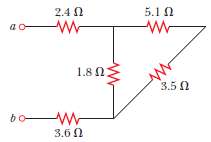
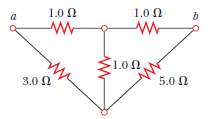
Find the equivalent resistance between points a and b infigure.
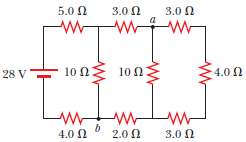
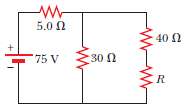
For the circuit in figure, calculate (a) The equivalent resistance of the circuit and (b) The power dissipated by the entire circuit. (c) Find the current in the 5.0-? resistor.
Find (a) the equivalent resistance of the circuit in figure,(b) Each current in the circuit,(c) The potential difference across each resistor, and(d) The power dissipated by eachresistor.
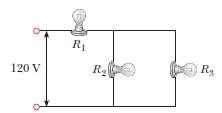
Three 60.0-W, 120-V lightbulbs are connected across a 120-V power source, as shown in Figure. Find(a) The total power delivered to the three bulbs and(b) The potential difference across each. Assume that the resistance of each bulb is constant (even though, in reality, the resistance increases
An automobile battery has an emf of 12.6 V and an internal resistance of 0.080 Ω. The headlights have a total resistance of 5.00 Ω (assumed constant). What is the potential difference across the headlight bulbs? (a) When they are the only load on the battery and (b) When the starter motor is
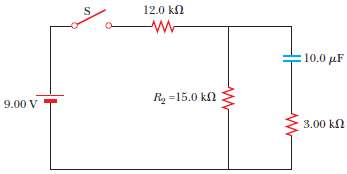
In figure, suppose that the switch has been closed for a length of time sufficiently long for the capacitor to become fully charged. Find(a) The steady-state current in each resistor and(b) The charge on thecapacitor.
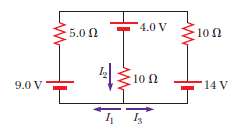
Find the values of Il, I2, and I3 for the circuit infigure.
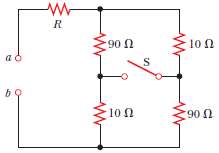
The resistance between points a and b in figure drops to one-half its original value when switch S is closed. Determine the value ofR.
A generator has a terminal voltage of 110 V when it delivers 10.0 A and 106 V when it delivers 30.0 A. Calculate the emf and the internal resistance of the generator.
An emf of 10 V is connected to a series RC circuit consisting of a resistor of 2.0 x 10⁶ Ω and a capacitor of 3.0 µF. Find the time required for the charge on the capacitor to reach 90% of its final value.
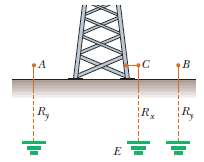
The student engineer of a campus radio station wishes to verify the effectiveness of the lightning rod on the antenna mast (Fig. P18.55). The unknown resistance Rx is between points C and E. Point E is a ?true ground,? but is inaccessible for direct measurement, since the stratum in which it is
The resistor R in figure dissipates 20 W of power. Determine the value ofR.
A voltage ∆V is applied to a series configuration of n resistors, each of resistance R. The circuit components are reconnected in a parallel configuration, and voltage ∆V is again applied. Show that the power consumed by the series configuration is 1/n2 times the power consumed by the parallel
For the network in figure, show that the resistance between points a and b is Rab = 27/17 ?.
A battery with an internal resistance of 10.0 Ω produces an open-circuit voltage of 12.0 V. A variable load resistance with a range from 0 to 30.0 is connected across the battery. (Note: A battery has a resistance that depends on the condition of its chemicals and that increases as the battery
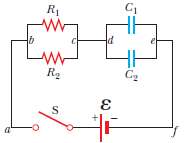
The circuit in Figure P18.60 contains two resistors, R1 = 2.0 k? and R2 = 3.0 k?, and two capacitors, C1 = 2.0 ?F and C2 = 3.0 ?F, connected to a battery with emf ? = 120 V. If there are no charges on the capacitors before switch S is closed, determine the charges q1 and q2 on capacitors C1 and C2,
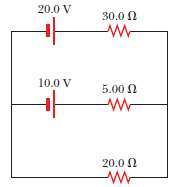
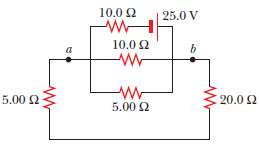
Consider the circuit shown in figure. Find (a) The potential difference between points a and b and (b) The current in the20.0-? resistor.
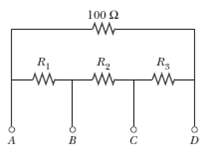
In figure, R1 = 0.100 ?, R2 = 1.00 ?, and R3 = 10.0 ?. Find the equivalent resistance of the circuit and the current in each resistor when a 5.00-V power supply is connected between (a) Points A and B, (b) Points A and C, and (c) Points A and D.
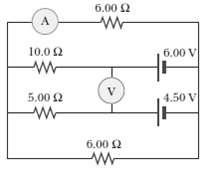
What are the expected readings of the ammeter and voltmeter for the circuit inFigure?
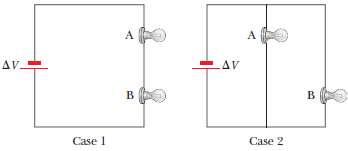
Consider the two arrangements of batteries and bulbs shown in figure. The two bulbs are identical and have resistance R, and the two batteries are identical with output voltage ?V. (a) In case 1, with the two bulbs in series, compare the brightness of each bulb, the current in each bulb, and the
Given three lightbulbs and a battery, sketch as many different circuits as you can.
1. (a) A group of resistors connected in parallel have the same(i) Current in them,(ii) Potential difference across them, or(iii) Neither of the above.(b) A group of resistors connected in series have the same(i) Current in them,(ii) Potential difference across them, or(iii) Neither of the above.
1. (a) The equivalent resistance of a group of resistors connected in parallel is (i) Greater than any of the resistors in the group, (ii) Less than any of the resistors in the group, or (iii) Neither of the above. (b) The equivalent resistance of a group of resistors connected in series is (i)
A short circuit is a circuit containing a path of very low resistance in parallel with some other part of the circuit. Discuss the effect of a short circuit on the portion of the circuit it parallels. Use a lamp with a frayed line cord as an example.
If electrical power is transmitted over long distances, the resistance of the wires becomes significant. Why? Which mode of transmission would result in less energy loss— high current and low voltage or low current and high voltage? Discuss.
(a) Two resistors are connected in series across a battery. The power delivered to each resistor is (i) The same or (ii) Not necessarily the same. (b) Two resistors are connected in parallel across a battery. The power delivered to each resistor is (i) The same or (ii) Not necessarily the same.
A ski resort consists of a few chairlifts and several interconnected downhill runs on the side of a mountain, with a lodge at the bottom. The lifts are analogous to batteries and the runs are analogous to resistors. Describe how two runs can be in series. Describe how three runs can be in parallel.
Why is it dangerous to turn on a light when you are in a bathtub?
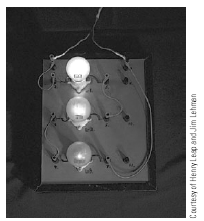
Figure shows a series connection of three lamps, all rated at 120 V, with power ratings of 60 W, 75 W, and 200 W, respectively. Why do the intensities of the lamps differ? Which lamp has the greatest resistance? How would their intensities differ if they were connected inparallel?
An electron gun fires electrons into a magnetic field directed straight downward. Find the direction of the force exerted by the field on an electron for each of the following directions of the electron’s velocity: (a) Horizontal and due north; (b) Horizontal and 30° west of north; (c) Due
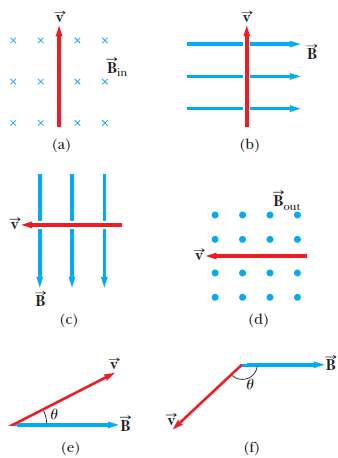
(a) Find the direction of the force on a proton (a positively charged particle) moving through the magnetic fields in figure as shown.(b) Repeat part (a), assuming the moving particle is an electron.
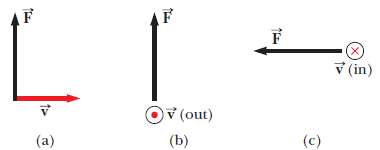
Find the direction of the magnetic field acting on the positively charged particle moving in the various situations shown in figure if the direction of the magnetic force acting on it is asindicated.
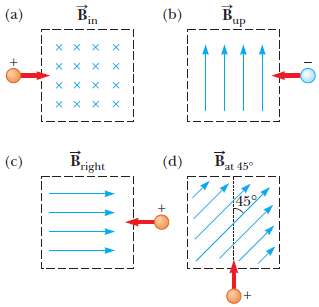
Determine the initial direction of the deflection of charged particles as they enter the magnetic fields, as shown infigure.
At the equator, near the surface of Earth, the magnetic field is approximately 50.0 µT northward, and the electric field is about 100 N/C downward in fair weather. Find the gravitational, electric, and magnetic forces on an electron with an instantaneous velocity of 6.00 × 10⁶ m/s directed to the
The magnetic field of the Earth at a certain location is directed vertically downward and has a magnitude of 50.0 µT. A proton is moving horizontally toward the west in this field with a speed of 6.20 x 10⁶ m/s. What are the direction and magnitude of the magnetic force the field exerts on the
What velocity would a proton need to circle Earth 1 000 km above the magnetic equator, where Earth’s magnetic field is directed horizontally north and has a magnitude of 4.00 x 10⁻⁸ T?
An electron is accelerated through 2 400 V from rest and then enters a region where there is a uniform 1.70-T magnetic field. What are? (a) The maximum and (b) The minimum magnitudes of the magnetic force acting on this electron?
A proton moves perpendicularly to a uniform magnetic field B at 1.0 x 10⁷ m/s and exhibits an acceleration of 2.0 x 10¹³ m/s2 in the x-direction when its velocity is in the z -direction. Determine the magnitude and direction of the field.
Sodium ions (Na+) move at 0.851 m/s through a bloodstream in the arm of a person standing near a large magnet. The magnetic field has a strength of 0.254 T and makes an angle of 51.0° with the motion of the sodium ions. The arm contains 100 cm3 of blood with 3.00 x 10²⁰ Na ions per cubic
A current I = 15 A is directed along the positive x-axis and perpendicular to a magnetic field. A magnetic force per unit length of 0.12 N/m acts on the conductor in the negative y -direction. Calculate the magnitude and direction of the magnetic field in the region through which the current passes.
In figure assume that in each case the velocity vector shown is replaced with a wire carrying a current in the direction of the velocity vector. For each case, find the direction of the magnetic force acting on the wire.
In figure assume that in each case the velocity vector shown is replaced with a wire carrying a current in the direction of the velocity vector. For each case, find the direction of the magnetic field that will produce the magnetic force shown.
A wire having a mass per unit length of 0.500 g/cm carries a 2.00-A current horizontally to the south. What are the direction and magnitude of the minimum magnetic field needed to lift this wire vertically upward?
Figure shows two permanent magnets, each having a hole through its center. Note that the upper magnet is levitated above the lower one. (a) How does this occur?(b) What purpose does the pencil serve? (c) What can you say about the poles of the magnets from this observation? (d) If the upper magnet
At a certain location, Earth has a magnetic field of 0.60 x 10⁻⁴ T, pointing 75° below the horizontal in a north–south plane. A 10.0-m-long straight wire carries a 15-A current. (a) If the current is directed horizontally toward the east, what are the magnitude and direction of the magnetic
A wire with a mass of 1.00 g/cm is placed on a horizontal surface with a coefficient of friction of 0.200. The wire carries a current of 1.50 A eastward and moves horizontally to the north. What are the magnitude and the direction of the smallest vertical magnetic field that enables the wire to
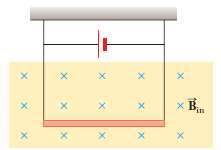
A conductor suspended by two flexible wires as shown in figure has a mass per unit length of 0.0400 kg/m. What current must exist in the conductor for the tension in the supporting wires to be zero when the magnetic field is 3.60 T into the page? What is the required direction for thecurrent?
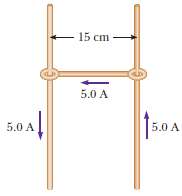
An unusual message delivery system is pictured in figure. A 15-cm length of conductor that is free to move is held in place between two thin conductors. When a 5.0-A current is directed as shown in the figure, the wire segment moves upward at a constant velocity. If the mass of the wire is 15 g,
A wire 2.80 m in length carries a current of 5.00 A in a region where a uniform magnetic field has a magnitude of 0.390 T. Calculate the magnitude of the magnetic force on the wire, assuming the angle between the magnetic field and the current is (a) 60.0°, (b) 90.0°, (c) 120°.
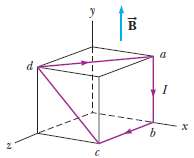
In figure the cube is 40.0 cm on each edge. Four straight segments of wire?ab, bc, cd, and da?form a closed loop that carries a current I = 5.00 A in the direction shown. A uniform magnetic field of magnitude B = 0.020 0 T is in the positive y-direction. Determine the magnitude and direction of the
A current of 17.0 mA is maintained in a single circular loop with a circumference of 2.00 m. A magnetic field of 0.800 T is directed parallel to the plane of the loop. What is the magnitude of the torque exerted by the magnetic field on the loop?
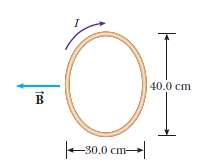
An eight-turn coil encloses an elliptical area having a major axis of 40.0 cm and a minor axis of 30.0 cm (figure). The coil lies in the plane of the page and has a 6.00-A current flowing clockwise around it. If the coil is in a uniform magnetic field of 2.00 x 10?4 T directed toward the left of
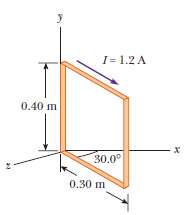
A rectangular loop consists of 100 closely wrapped turns and has dimensions 0.40 m by 0.30 m. The loop is hinged along the y-axis, and the plane of the coil makes an angle of 30.0? with the x-axis (Figure). What is the magnitude of the torque exerted on the loop by a uniform magnetic field of 0.80
A long piece of wire with a mass of 0.100 kg and a total length of 4.00 m is used to make a square coil with a side of 0.100 m. The coil is hinged along a horizontal side, carries a 3.40-A current, and is placed in a vertical magnetic field with a magnitude of 0.010 0 T. (a) Determine the angle
A copper wire is 8.00 m long and has a cross-sectional area of 1.00 x 10⁻⁴ m2. The wire forms a one-turn loop in the shape of square and is then connected to a battery that applies a potential difference of 0.100 V. If the loop is placed in a uniform magnetic field of magnitude 0.400 T, what is
A proton moving freely in a circular path perpendicular to a constant magnetic field takes 1.00 µs to complete one revolution. Determine the magnitude of the magnetic field.
A cosmic-ray proton in interstellar space has an energy of 10.0 MeV and executes a circular orbit having a radius equal to that of Mercury’s orbit around the Sun, which is 5.80 x 10¹⁰ m. What is the magnetic field in that region of space?
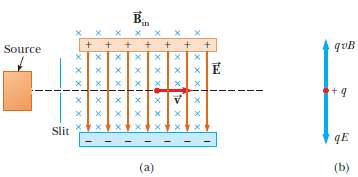
Figure a is a diagram of a device called a velocity selector, in which particles of a specific velocity pass through undeflected while those with greater or lesser velocities are deflected either upwards or downwards. An electric field is directed perpendicular to a magnetic field, producing an
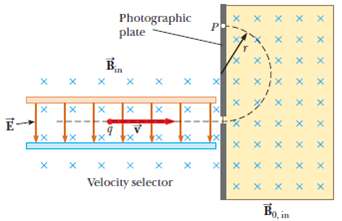
Consider the mass spectrometer shown schematically in figure. The electric field between the plates of the velocity selector is 950 V/m, and the magnetic fields in both the velocity selector and the deflection chamber have magnitudes of 0.930 T. Calculate the radius of the path in the system for a
A singly charged positive ion has a mass of 2.50 x 10⁻²⁶ kg. After being accelerated through a potential difference of 250 V, the ion enters a magnetic field of 0.500 T, in a direction perpendicular to the field. Calculate the radius of the path of the ion in the field.
A mass spectrometer is used to examine the isotopes of uranium. Ions in the beam emerge from the velocity selector at a speed of 3.00 x 10⁵ m/s and enter a uniform magnetic field of 0.600 T directed perpendicularly to the velocity of the ions. What is the distance between the impact points formed
A proton is at rest at the plane vertical boundary of a region containing a uniform vertical magnetic field B. An alpha particle moving horizontally makes a head-on elastic collision with the proton. Immediately after the collision, both particles enter the magnetic field, moving perpendicular to
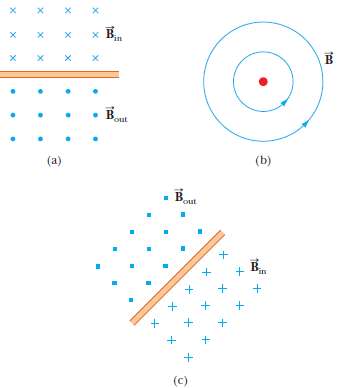
In each of parts (a), (b), and (c) of figure, find the direction of the current in the wire that would produce a magnetic field directed asshown.
A lightning bolt may carry a current of 1.00 x 10⁴ A for a short time. What is the resulting magnetic field 100 m from the bolt? Suppose that the bolt extends far above and below the point of observation.
In 1962, measurements of the magnetic field of a large tornado were made at the Geophysical Observatory in Tulsa, Oklahoma. If the magnitude of the tornado’s field was B = 1.50 x 10⁻⁸ T pointing north when the tornado was 9.00 km east of the observatory, what current was carried up or down the
A cardiac pacemaker can be affected by a static magnetic field as small as 1.7 mT. How close can a pacemaker wearer come to a long, straight wire carrying 20 A?
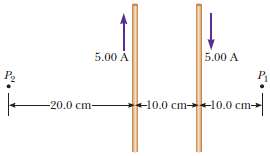
The two wires shown in figure carry currents of 5.00 A in opposite directions and are separated by 10.0 cm. Find the direction and magnitude of the net magnetic field(a) At a point midway between the wires;(b) At point P1, 10.0 cm to the right of the wire on the right, and(c) At point P2, 20.0 cm
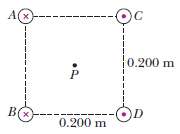
Four long, parallel conductors carry equal currents of I = 5.00 A. Figure is an end view of the conductors. The direction of the current is into the page at points A and B (indicated by the crosses) and out of the page at C and D (indicated by the dots). Calculate the magnitude and direction of the
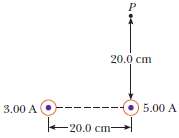
The two wires in figure carry currents of 3.00 A and 5.00 A in the direction indicated.(a) Find the direction and magnitude of the magnetic field at a point midway between the wires.(b) Find the magnitude and direction of the magnetic field at point P, located 20.0 cm above the wire carrying the
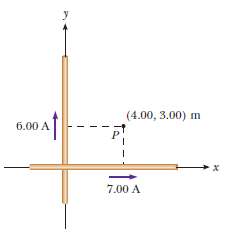
A wire carries a 7.00-A current along the x-axis, and another wire carries a 6.00-A current along the y -axis, as shown in figure. What is the magnetic field at point P, located at x = 4.00 m, y = 3.00m?
A long, straight wire lies on a horizontal table and carries a current of 1.20 µA. In a vacuum, a proton moves parallel to the wire (opposite the direction of the current) with a constant velocity of 2.30 x 10⁴ m/s at a constant distance d above the wire. Determine the value of d. (You may ignore
The magnetic field 40.0 cm away from a long, straight wire carrying current 2.00 A is 1.00 µT. (a) At what distance is it 0.100 µT? (b) At one instant, the two conductors in a long household extension cord carry equal 2.00-A currents in opposite directions. The two wires are 3.00 mm apart. Find
Two parallel wires are 10.0 cm apart, and each carries a current of 10.0 A. (a) If the currents are in the same direction, find the force per unit length exerted on one of the wires by the other. Are the wires attracted to or repelled by each other? (b) Repeat the problem with the currents in
A wire with a weight per unit length of 0.080 N/m is suspended directly above a second wire. The top wire carries a current of 30.0 A and the bottom wire carries a current of 60.0 A. Find the distance of separation between the wires so that the top wire will be held in place by magnetic repulsion.
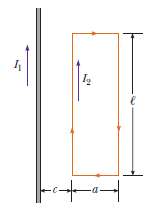
In Figure the current in the long, straight wire is I1 = 5.00 A, and the wire lies in the plane of the rectangular loop, which carries 10.0 A. The dimensions shown are c = 0.100 m, α = 0.150 m, and ?? = 0.450 m. Find the magnitude and direction of the net force exerted by the magnetic field due to
What current is required in the windings of a long solenoid that has 1 000 turns uniformly distributed over a length of 0.400 m in order to produce a magnetic field of magnitude 1.00 x 10⁻⁴ T at the center of the solenoid?
It is desired to construct a solenoid that will have a resistance of 5.00 Ω (at 20°C) and produce a magnetic field of 4.00 x 10⁻² T at its center when it carries a current of 4.00 A. The solenoid is to be constructed from copper wire having a diameter of 0.500 mm. If the radius of the solenoid
A single-turn square loop of wire 2.00 cm on a side carries a counterclockwise current of 0.200 A. The loop is inside a solenoid, with the plane of the loop perpendicular to the magnetic field of the solenoid. The solenoid has 30 turns per centimeter and carries a counterclockwise current of 15.0
An electron is moving at a speed of 1.0 x 10⁴ m/s in a circular path of radius of 2.0 cm inside a solenoid. The magnetic field of the solenoid is perpendicular to the plane of the electron’s path. Find (a) The strength of the magnetic field inside the solenoid and (b) The current in the solenoid
A circular coil consisting of a single loop of wire has a radius of 30.0 cm and carries a current of 25 A. It is placed in an external magnetic field of 0.30 T. Find the torque on the wire when the plane of the coil makes an angle of 35° with the direction of the field.
An electron enters a region of magnetic field of magnitude 0.010 0 T, traveling perpendicular to the linear boundary of the region. The direction of the field is perpendicular to the velocity of the electron. (a) Determine the time it takes for the electron to leave the “field-filled” region,
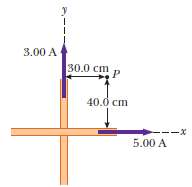
Two long, straight wires cross each other at right angles, as shown in figure.(a) Find the direction and magnitude of the magnetic field at point P, which is in the same plane as the two wires.(b) Find the magnetic field at a point 30.0 cm above the point of intersection (30.0 cm out of the page,
Showing 5300 - 5400
of 8940
First
47
48
49
50
51
52
53
54
55
56
57
58
59
60
61
Last
Step by Step Answers

 Get 50% OFF
Claim Now
Get 50% OFF
Claim Now