New Semester
Started
Get
50% OFF
Study Help!
--h --m --s
Claim Now
Question Answers
Textbooks
Find textbooks, questions and answers
Oops, something went wrong!
Change your search query and then try again
S
Books
FREE
Study Help
Expert Questions
Accounting
General Management
Mathematics
Finance
Organizational Behaviour
Law
Physics
Operating System
Management Leadership
Sociology
Programming
Marketing
Database
Computer Network
Economics
Textbooks Solutions
Accounting
Managerial Accounting
Management Leadership
Cost Accounting
Statistics
Business Law
Corporate Finance
Finance
Economics
Auditing
Tutors
Online Tutors
Find a Tutor
Hire a Tutor
Become a Tutor
AI Tutor
AI Study Planner
NEW
Sell Books
Search
Search
Sign In
Register
study help
physics
electricity and magnetism
Fundamentals of Ethics for Scientists and Engineers 1st Edition Edmund G. Seebauer, Robert L. Barry - Solutions
Repeat Problem 69 for cobalt, which has a density of 8.9 g/cm3, a molecular mass of 58.9 g/mol, and a saturation magnetization given by μ0Ms = 1.79 T.
Show that Curie's law predicts that the magnetic susceptibility of a paramagnetic substance is Χm = μμ0Ms/3kT.
In a simple model of paramagnetism, we can consider that some fraction f of the molecules have their magnetic moments aligned with the external magnetic field and that the rest of the molecules are randomly oriented and so do not contribute to the magnetic field.(a) Use this model and Curie's law
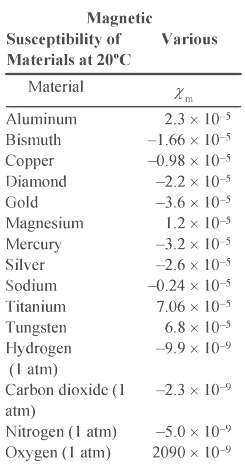
Assume that the magnetic moment of an aluminum atom is 1 Bohr magneton. The density of aluminum is 2.7 g/cm3, and its molecular mass is 27 g/mol. (a) Calculate Ms and ?0Ms for aluminum. (b) Use the results of Problem 71 to calculate ?m at T = 300 K. (c) Explain why the result for part (b) is larger
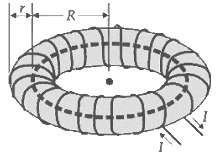
A toroid with N turns carrying a current I has mean radius R and cross-sectional radius r, where r
A toroid is filled with liquid oxygen that has a susceptibility of 4 × 10⁻³. The toroid has 2000 turns and carries a current of 15 A. Its mean radius is 20 cm, and the radius of its cross section is 0.8 cm.(a) What is the magnetization M?(b) What is the magnetic field B?(c) What is the percentage
A toroid has an average radius of 14 cm and a cross-sectional area of 3 cm2. It is wound with fine wire, 60 turns/cm measured along its mean circumference, and the wire carries a current of 4 A. The core is filled with a paramagnetic material of magnetic susceptibility 2.9 × 10⁻⁴.(a) What is the
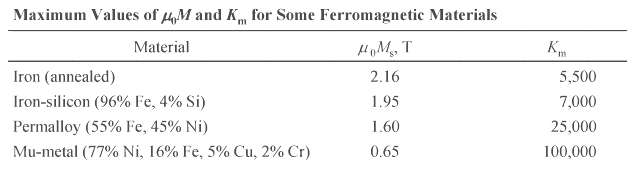
For annealed iron, the relative permeability Km has its maximum value of about 5500 at Bapp = 1.57 × 10⁻⁴ T. Find M and B when Km is maximum.
The saturation magnetization for annealed iron occurs when Bapp = 0.201 T. Find the permeability ? and the relative permeability Km of annealed iron at saturation. (See Table 29-2.)
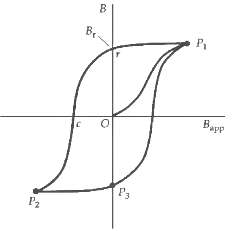
The coercive force is defined to be the applied magnetic field needed to bring B?back to zero along the hysteresis curve (point c?in Figure). For a certain permanent bar magnet, the coercive force Bapp = 5.53 ? 10?2 T. The bar magnet is to be demagnetized by placing it inside a 15-cm-long solenoid
A long solenoid with 50 turns/cm carries a current of 2 A. The solenoid is filled with iron, and B is measured to be 1.72 T.(a) Neglecting end effects, what is Bapp?(b) What is M?(c) What is the relative permeability Km?
When the current in Problem 80 is 0.2 A, the magnetic field is measured to be 1.58 T.(a) Neglecting end effects, what is Bapp?(b) What is M?(c) What is the relative permeability Km?
A long, iron-core solenoid with 2000 turns/m carries a current of 20 mA. At this current, the relative permeability of the iron core is 1200.(a) What is the magnetic field within the solenoid?(b) With the iron core removed, what current will produce the same field within the solenoid?
The toroid of Problem 75 has its core filled with iron. When the current is 10 A, the magnetic field in the toroid is 1.8 T.(a) What is the magnetization M?(b) Find the values for Km, μ, and for the iron sample.
Find the magnetic field in the toroid of Problem 76 if the current in the wire is 0.2 A and soft iron, having a relative permeability of 500, is substituted for the paramagnetic core?
A long, straight wire with a radius of 1.0 mm is coated with an insulating ferromagnetic material that has a thickness of 3.0 mm and a relative magnetic permeability of Km = 400. The coated wire is in air and the wire itself is nonmagnetic. The wire carries a current of 40 A.(a) Find the magnetic
A circular loop of wire carries a current I. Is there angular momentum associated with the magnetic moment of the loop? If so, why is it not noticed?
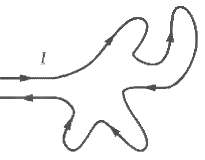
When a current is passed through the wire in Figure, will it tend to bunch up or form acircle?
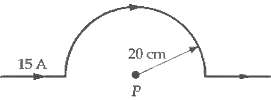
Find the magnetic field at point P in Figure.
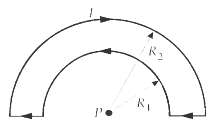
In Figure, find the magnetic field at point P, which is at the common center of the two semicircular arcs.
A wire of length ℓ is wound into a circular coil of N loops and carries a current I. Show that the magnetic field at the center of the coil is given by B = μ0πN 2I/ ℓ .
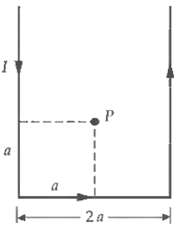
A very long wire carrying a current I is bent into the shape shown in Figure. Find the magnetic field at point P.
A loop of wire of length ℓ carries a current I. Compare the magnetic fields at the center of the loop when it is(a) A circle,(b) A square, and(c) An equilateral triangle. Which field is largest?
A power cable carrying 50.0 A is 2.0 m below the earth's surface, but its direction and precise position are unknown. Show how you could locate the cable using a compass. Assume that you are at the equator, where the earth's magnetic field is 0.7 G north.
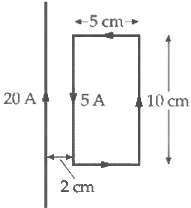
A long, straight wire carries a current of 20 A as shown in Figure. A rectangular coil with two sides parallel to the straight wire has sides 5 cm and 10 cm with the near side a distance 2 cm from the wire. The coil carries a current of 5 A. (a) Find the force on each segment of the rectangular
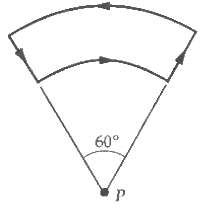
The closed loop shown in Figure carries a current of 8.0 A in the counterclockwise direction. The radius of the outer arc is 60 cm, that of the inner arc is 40 cm. Find the magnetic field at point P.
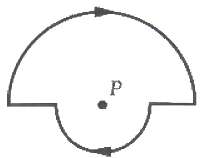
A closed circuit consists of two semicircles of radii 40 and 20 cm that are connected by straight segments as shown in Figure. A current of 3.0 A flows around this circuit in the clockwise direction. Find the magnetic field at point P.
A very long, straight wire carries a current of 20.0 A. An electron 1.0 cm from the center of the wire is moving with a speed of 5.0 × 10⁶ m/s. Find the force on the electron when it moves(a) Directly away from the wire,(b) Parallel to the wire in the direction of the current, and(c) Perpendicular
A current I is uniformly distributed over the cross section of a long, straight wire of radius 1.40 mm. At the surface of the wire, the magnitude of the magnetic field is B = 2.46 mT. Find the magnitude of the magnetic field at(a) 2.10 mm from the axis and(b) 0.60 mm from the axis.(c) Find the
A large, 50-turn circular coil of radius 10.0 cm carries a current of 4.0 A. At the center of the large coil is a small 20-turn coil of radius 0.5 cm carrying a current of 1.0 A. The planes of the two coils are perpendicular. Find the torque exerted by the large coil on the small coil. (Neglect any
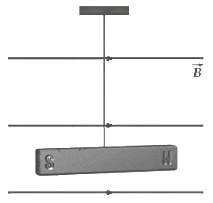
Figure shows a bar magnet suspended by a thin wire that provides a restoring torque -??. The magnet is 16 cm long, has a mass of 0.8 kg, a dipole moment of ? = 0.12 A???m2, and it is located in a region where a uniform magnetic field B can be established. When the external magnetic field is 0.2 T
A long, narrow bar magnet that has magnetic moment m parallel to its long axis is suspended at its center as a frictionless compass needle. When placed in a magnetic field B, the needle lines up with the field. If it is displaced by a small angle θ, show that the needle will oscillate about its
A small bar magnet of mass 0.1 kg, length 1 cm, and magnetic moment μ = 0.04 A · m2 is located at the center of a 100-turn loop of 0.2 m diameter. The loop carries a current of 5.0 A. At equilibrium, the bar magnet is aligned with the field due to the current loop. The bar magnet is given a
Suppose the needle in Problem 106 is a uniformly magnetized iron rod that is 8 cm long and has a cross-sectional area of 3 mm2. Assume that the magnetic dipole moment for each iron atom is 2.2?B and that all the iron atoms have their dipole moments aligned. Calculate the frequency of small
The needle of a magnetic compass has a length of 3 cm, a radius of 0.85 mm, and a density of 7.96 × 10³ kg/m3. It is free to rotate in a horizontal plane, where the horizontal component of the earth's magnetic field is 0.6 G. When disturbed slightly, the compass executes simple harmonic motion
An iron bar of length 1.4 m has a diameter of 2 cm and a uniform magnetization of 1.72 ? 106 A/m directed along the bar's length. The bar is stationary in space and is suddenly demagnetized so that its magnetization disappears. What is the rotational angular velocity of the bar if its angular
The magnetic dipole moment of an iron atom is 2.219 μB.(a) If all the atoms in an iron bar of length 20 cm and cross-sectional area 2 cm2 have their dipole moments aligned, what is the dipole moment of the bar?(b) What torque must be supplied to hold the iron bar perpendicular to a magnetic field
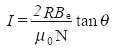
A relatively inexpensive ammeter called a tangent galvanometer can be made using the earth's field. A plane circular coil of N turns and radius R is oriented such that the field Bc it produces in the center of the coil is either east or west. A compass is placed at the center of the coil. When
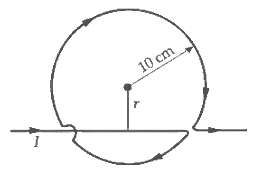
An infinitely long, straight wire is bent as shown in Figure. The circular portion has a radius of 10 cm with its center a distance r from the straight part. Find r such that the magnetic field at the center of the circular portion is zero.
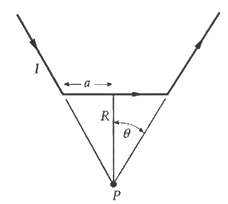
(a) Find the magnetic field at point P for the wire carrying current I shown in Figure. (b) Use your result from (a) to find the field at the center of a polygon of N sides. Show that when N is very large, your result approaches that for the magnetic field at the center of acircle.
The current in a long, cylindrical conductor of radius R = 10 cm varies with distance from the axis of the cylinder according to the relation I(r) = (50 A/m)r. Find the magnetic field at(a) r = 5 cm(b) At r = 10 cm, and(c) r = 20 cm.
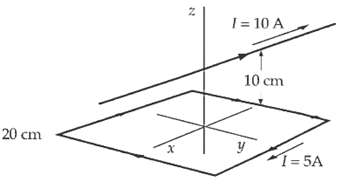
Figure shows a square loop, 20 cm per side, in the xy plane with its center at the origin. The loop carries a current of 5 A. Above it at y = 0, z = 10 cm is an infinitely long wire parallel to the x axis carrying a current of 10 A. (a) Find the torque on the loop. (b) Find the net force on theloop
In the Bohr model of the hydrogen atom, an electron in the ground state orbits a proton at a radius of 5.29 × 10⁻¹¹ m. In a reference frame in which the orbiting electron is at rest, the proton circulates about the electron at a radius of 5.29 x 10⁻¹¹ m with the same angular velocity as that
The proton also has an intrinsic magnetic moment whose magnitude is 1.52 × 10⁻³μB. The orientation of the proton's magnetic moment is quantized; it can only be parallel or antiparallel to the magnetic field at the location of the proton. Using the result of Problem 117, determine the energy
In the calculation of the hyperfine structure splitting in Problem 117, you neglected the magnetic field at the proton's position due to the intrinsic magnetic moment of the electron. Calculate the magnetic field due to the intrinsic magnetic moment of the electron at a distance of 5.29 × 10¹¹ m
A disk of radius R carries a fixed charge density σ and rotates with angular velocity ω.(a) Consider a circular strip of radius r and width dr with charge dq. Show that the current produced by this strip dI = (ω/2π) dq = ωσr dr.(b) Use your result from part (a) to show that the magnetic field
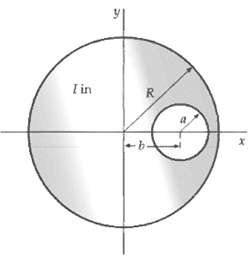
A very long, straight conductor with a circular cross section of radius R carries a current I. Inside the conductor, there is a cylindrical hole of radius a whose axis is parallel to the axis of the conductor a distance b from it (Figure). Let the z axis be the axis of the conductor, and let the
For the cylinder with the hole in Problem 121, show that the magnetic field inside the hole is uniform, and find its magnitude and direction.
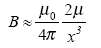
A square loop of side ? lies in the yz plane with its center at the origin. It carries a current I. Find the magnetic field B at any point on the x axis and show from your expression that for x much larger than ?, Where ? = I?2 is the magnetic moment of the loop.
A circular loop carrying current I lies in the yz plane with its axis along the x axis.(a) Evaluate the line integral ∫C B • dℓ along the axis of the loop from x = – ℓ1 to x = +ℓ1.(b) Show that when ℓ1 → ∞, the line integral approaches μ0I. This result can be related to Ampere's
The current in a long cylindrical conductor of radius R is given by I(r) = I0(1 – er/a). Derive expressions for the magnetic field for r < R and for r > R.
In Example 29-8 we calculated the magnetic field inside and outside a wire of radius R carrying a uniform current I. Consider a filament of current at a distance r from the center of the wire. Show that this filament experiences a force directed toward the center of the wire and that, therefore,
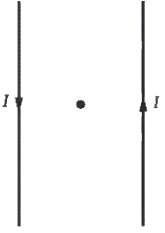
(Multiple choice) (1) The Biot--Savart law is similar to Coulomb's law in that both (a) Are inverse square laws. (b) Deal with forces on charged particles. (c) Deal with excess charges. (d) Include the permeability of free space. (e) Are not electrical in nature. (2) Two wires lie Figure Problem 19
A measure of the density of the free-electron gas in a metal is the distance rs, which is defined as the radius of the sphere whose volume equals the volume per conduction electron.(a) Show that rs = (3/4πn)1/3, where n is the free-electron number density.(b) Calculate rs for copper in nanometers.
(a) Given a mean free path λ = 0.4 nm and a mean speed vav = 1.17 × 10⁵ m/s for the current flow in copper at a temperature of 300 K, calculate the classical value for the resistivity ρ of copper.(b) The classical model suggests that the mean free path is temperature independent and that vav
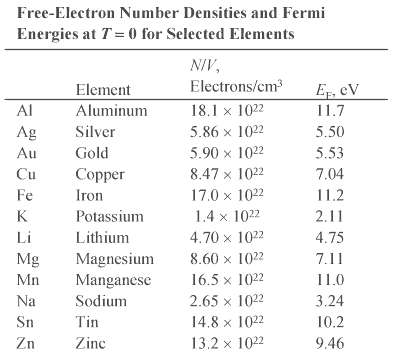
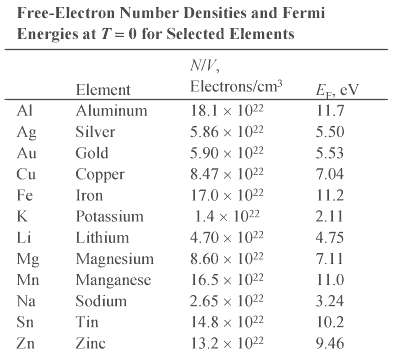
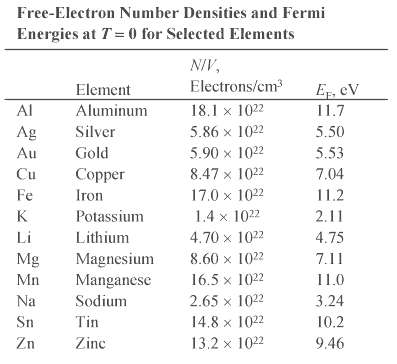
Calculate the number density of free electrons in (a) Ag (? = 10.5 g/cm3) and (b) Au (? = 19.3 g/cm3), assuming one free electron per atom, and compare your results with the values listed in Table 27-1.
The density of aluminum is 2.7 g/cm3. How many free electrons are present per aluminum atom?
The density of tin is 7.3 g/cm3. How many free electrons are present per tin atom?
Calculate the Fermi temperature for(a) Al,(b) K, and(c) Sn.
What is the speed of a conduction electron whose energy is equal to the Fermi energy EF for,(a) Na,(b) Au, and(c) Sn?
Calculate the Fermi energy for (a) Al, (b) K, and (c) Sn using the number densities given in Table27-1.
Find the average energy of the conduction electrons at T = 0 in(a) Copper and(b) Lithium.
Calculate(a) The Fermi temperature and(b) The Fermi energy at T = 0 for iron.
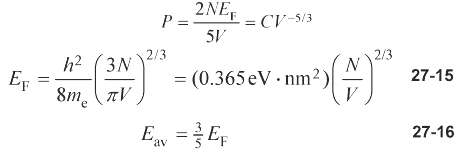
The pressure of an ideal gas is related to the average energy of the gas particles by PV = 2/3NEav, where N is the number of particles and Eav is the average energy. Use this to calculate the pressure of the Fermi electron gas in copper in newtons per square meter, and compare your result with
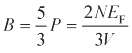
The bulk modulus B of a material can be defined by (a) Use the ideal-gas relation PV = 3/2 NEav and Equations 27-15 and 27-16 to show that where C is a constant independent of V. (b) Show that the bulk modulus of the Fermi electron gas is therefore (c) Compute the bulk modulus in newtons per
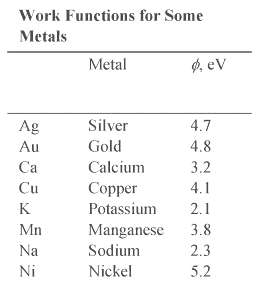
Thomas refuses to believe that a potential difference can be created simply by bringing two different metals into contact with each other. John talks him into making a small wager, and is about to cash in. (a) Which two metals from Table 27-2 would demonstrate his point most effectively? (b) What
Calculate the contact potential between(a) Ag and Cu,(b) Ag and Ni, and(c) Ca and Cu.
When the temperature of pure copper is lowered from 300 K to 4 K, its resistivity drops by a much greater factor than that of brass when it is cooled in the same way. Why?
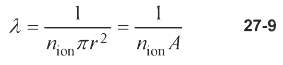
The resistivities of Na, Au, and Sn at T = 273 K are 4.2 μΩ • cm, 2.04 μΩ • cm, and 10.6 μΩ • cm, respectively. Use these values and the Fermi speeds calculated in Problem 8 to find the mean free paths λ for the conduction electrons in these elements.
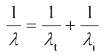
The resistivity of pure copper is increased by about 1 ? 10-8 ? ? m by the addition of 1% (by number of atoms) of an impurity throughout the metal. The mean free path depends on both the impurity and the oscillations of the lattice ions according to the equation (a) Estimate ?i from data given in
You are an electron sitting at the top of the valence band in a silicon atom, longing to jump across the 1.14- eV energy gap that separates you from the bottom of the conduction band and all of the adventures that it may contain. What you need, of course, is a photon. What is the maximum photon
Work Problem 22 for germanium, for which the energy gap is 0.74 eV.
Work Problem 22 for diamond, for which the energy gap is 7.0 eV.
A photon of wavelength 3.35 μm has just enough energy to raise an electron from the valence band to the conduction band in a lead sulfide crystal.(a) Find the energy gap between these bands in lead sulfide.(b) Find the temperature T for which kT equals this energy gap.
(a) Use Equation 27-24 to calculate the superconducting energy gap for tin (Tc = 3.72 K) and compare your result with the measured value of 6 ? 10?4 eV. (b) Use the measured value to calculate the wavelength of a photon having sufficient energy to break up Cooper pairs in tin at T = 0.
Repeat Problem 26 for lead (Tc = 7.19 K), which has a measured energy gap of 2.73 × 10⁻³ eV.
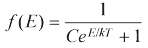
The number of electrons in the conduction band of an insulator or intrinsic semiconductor is governed chiefly by the Fermi factor. Since the valence band in these materials is nearly filled and the conduction band is nearly empty, the Fermi energy EF is generally midway between the top of the
What is the difference between the energies at which the Fermi factor is 0.9 and 0.1 at 300 K in(a) Copper,(b) Potassium, and(c) Aluminum.
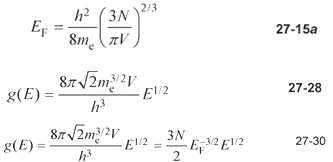
Show that g(E) = (3N / 2)EF -3/2 E1/2 (Equation 27-30) follows from Equation 27-28 for g(E), and Equation 27-15a forEF.
The density of the electron states in a metal can be written g(E) = AE1/2, where A is a constant and E is measured from the bottom of the conduction band.(a) Show that the total number of states is 2/3AE3/2F(b) Approximately what fraction of the conduction electrons are within kT of the Fermi
What is the probability that a conduction electron in silver will have a kinetic energy of 5.49 eV at T = 300 K?
Use the density-of-states function, Equation 27-28, to estimate the fraction of the conduction electrons in copper that can absorb energy from collisions with the vibrating lattice ions at (a) 77 K and (b) 300K.
In an intrinsic semiconductor, the Fermi energy is about midway between the top of the valence band and the bottom of the conduction band. In germanium, the forbidden energy band has a width of 0.7 eV. Show that at room temperature the distribution function of electrons in the conduction band is
(a) Show that for E ? 0, the Fermi factor may be written as (b) Show that if C?>> e?E/kT, f(E) = Ae?E/kT (d) Using the result obtained in part (c), show that the classical approximation is applicable when the electron concentration is very small and/or the temperature is very high. (e) Most
Show that the condition for the applicability of the classical distribution function for an electron gas (A << 1 in Problem 38) is equivalent to the requirement that the average separation between electrons is much greater than their de Broglie wavelength.
The root-mean-square (rms) value of a variable is obtained by calculating the average value of the square of that variable and then taking the square root of the result. Use this procedure to determine the rms energy of a Fermi distribution. Express your result in terms of EF and compare it to the
When a star with a mass of about twice that of the sun exhausts its nuclear fuel, it collapses to a neutron star, a dense sphere of neutrons of about 10 km diameter. Neutrons are spin –½ particles and, like electrons, are subject to the exclusion principle.(a) Determine the neutron density of
How does the change in the resistivity of copper compare with that of silicon when the temperature increases?
Calculate the number density of free electrons for (a) Mg (? = 1.74 g/cm3) and (b) Zn (? = 7.1 g/cm3), assuming two free electrons per atom, and compare your results with the values listed in Table 27-1.
Estimate the fraction of free electrons in copper that are in excited states above the Fermi energy at(a) Room temperature of 300 K and(b) 1000 K.
A 2-cm2 wafer of pure silicon is irradiated with light having a wavelength of 775 nm. The intensity of the light beam is 4.0 W/m2 and every photon that strikes the sample is absorbed and creates an electron–hole pair.(a) How many electron–hole pairs are produced in one second?(b) If the number
(Multiple Choice)(1)A metal is a good conductor because the valence energy band for electrons is (a) Completely full. (b) Full, but there is only a small gap to a higher empty band. (c) Partly full. (d) Empty. (e) None of these is correct.(2)Insulators are poor conductors
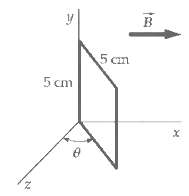
A uniform magnetic field of magnitude 2000 G is parallel to the x?axis. A square coil of side 5 cm has a single turn and makes an angle ??with the z?axis as shown in Figure. Find the magnetic flux through the coil when (a) ??= 0o, (b) ??= 30o, (c) ??= 60o, and (d) ??= 90o.
A circular coil has 25 turns and a radius of 5 cm. It is at the equator, where the earth's magnetic field is 0.7 G north. Find the magnetic flux through the coil when its plane is(a) Horizontal,(b) Vertical with its axis pointing north,(c) Vertical with its axis pointing east, and
A magnetic field of 1.2 T is perpendicular to a square coil of 14 turns. The length of each side of the coil is 5 cm.(a) Find the magnetic flux through the coil.(b) Find the magnetic flux through the coil if the magnetic field makes an angle of 60o with the normal to the plane of the coil.
A circular coil of radius 3.0 cm has its plane perpendicular to a magnetic field of 400 G.(a) What is the magnetic flux through the coil if the coil has 75 turns?(b) How many turns must the coil have for the flux to be 0.015 Wb?
A uniform magnetic field B is perpendicular to the base of a hemisphere of radius R. Calculate the magnetic flux through the spherical surface of the hemisphere.
Find the magnetic flux through a solenoid of length 25 cm, radius 1 cm, and 400 turns that carries a current of 3 A.
Work Problem 6 for an 800-turn solenoid of length 30 cm, and radius 2 cm, carrying a current of 2 A.
Showing 4800 - 4900
of 8940
First
42
43
44
45
46
47
48
49
50
51
52
53
54
55
56
Last
Step by Step Answers

 Get 50% OFF
Claim Now
Get 50% OFF
Claim Now