New Semester
Started
Get
50% OFF
Study Help!
--h --m --s
Claim Now
Question Answers
Textbooks
Find textbooks, questions and answers
Oops, something went wrong!
Change your search query and then try again
S
Books
FREE
Study Help
Expert Questions
Accounting
General Management
Mathematics
Finance
Organizational Behaviour
Law
Physics
Operating System
Management Leadership
Sociology
Programming
Marketing
Database
Computer Network
Economics
Textbooks Solutions
Accounting
Managerial Accounting
Management Leadership
Cost Accounting
Statistics
Business Law
Corporate Finance
Finance
Economics
Auditing
Tutors
Online Tutors
Find a Tutor
Hire a Tutor
Become a Tutor
AI Tutor
AI Study Planner
NEW
Sell Books
Search
Search
Sign In
Register
study help
physics
electricity and magnetism
Fundamentals of Ethics for Scientists and Engineers 1st Edition Edmund G. Seebauer, Robert L. Barry - Solutions
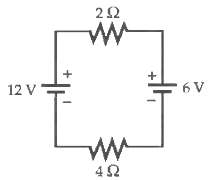
For the circuit in Figure, find (a) The current, (b) The power delivered or absorbed by each emf, and (c) The rate of Joule heating in each resistor. (Assume that the batteries have negligible internalresistance.)
A sick car battery with an emf of 11.4 V and an internal resistance of 0.01 Ω is connected to a load of 2.0 Ω. To help the ailing battery, a second battery with an emf of 12.6 V and an internal resistance of 0.01 Ω is connected by jumper cables to the terminals of the first battery.(a) Draw a
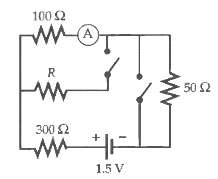
In the circuit in Figure, the reading of the ammeter is the same with both switches open and both closed. Find the resistance R.
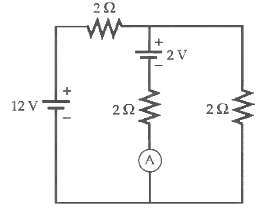
In the circuit in Figure, the batteries have negligible internal resistance, and the ammeter has negligible resistance. (a) Find the current through the ammeter. (b) Find the energy delivered by the 12-V battery in 3 s. (c) Find the total Joule heat produced in 3 s. (d) Account for the difference
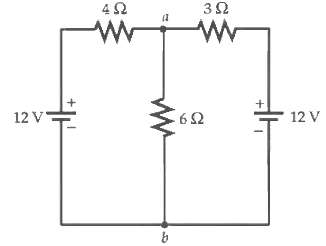
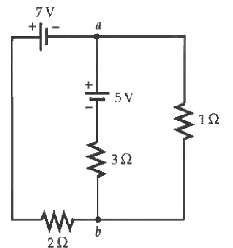
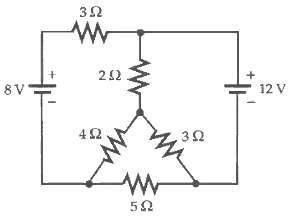
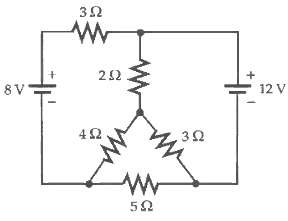
In the circuit in Figure, the batteries have negligible internal resistance. Find (a) The current in each resistor, (b) The potential difference between points a and b,? (c) The power supplied by eachbattery.
Repeat Problem 87 for the circuit in Figure.
Two identical batteries, each with an emf E and an internal resistance r, can be connected across a resistance R either in series or in parallel. Is the power supplied to R greater when R < r or when R > r?
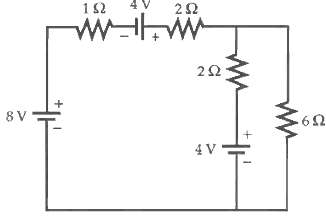
For the circuit in Figure, find (a) The current in each resistor, (b) The power supplied by each emf, and (c) The power dissipated in each resistor.
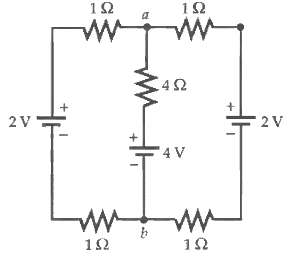
For the circuit in Figure, find the potential difference between points a and b.
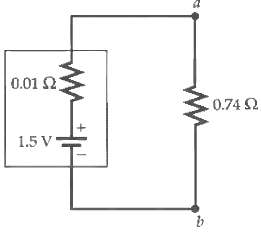
The battery in the circuit shown in Figure has an internal resistance of 0.01 ?. (a) An ammeter with a resistance of 0.01 ? is inserted in series with the 0.74-? resistor at point a. What is the reading of the ammeter? (b) By what percentage is the current changed because of the ammeter? (c) The
You have two batteries, one with E = 9.0 V and r = 0.8 Ω and the other with E = 3.0 V and r = 0.4 Ω.(a) Show how you would connect the batteries to give the largest current through a resistor R. Find the current for(b) R = 0.2 Ω,(c) R = 0.6 Ω,(d) R = 1.0 Ω, and(e) R = 1.5 Ω.
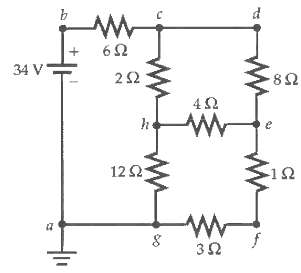
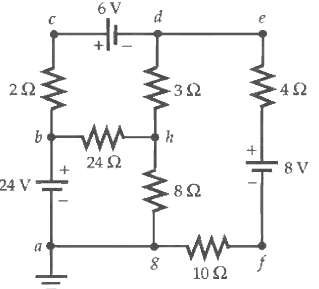
(a) Find the current in each part of the circuit shown in Figure. (b) Use your results from (a) to assign a potential at each indicated point assuming the potential at point a is zero.
In Problem 84, assume that the emf of the first battery increases at a constant rate of 0.2 V/h while the emf of the second battery and the internal resistances remain constant.(a) Find the current in each part of the circuit as a function of time.(b) Sketch a graph of the power delivered to the
(a) Find the current in each part of the circuit shown in Figure. (b) Use your results from (a) to assign a potential at each indicated point assuming the potential at point a is zero.
Find the current in each resistor of the circuit shown in Figure.
Suppose that the emf of the left battery in Figure is unknown but that the current delivered by the 12- V battery is known to be 0.6 A. Find the emf of the left battery and the current delivered by it.
A capacitor, resistor, and battery are connected in series. If R is doubled, how does this affect(a) The total energy stored,(b) The rate of energy storage, and(c) The time required to store 1/e of the final energy?
A capacitor, resistor, and battery are connected in series. If C is doubled, how does this affect(a) The total energy stored,(b) The rate of energy storage, and(c) The time required to store 1/e of the final energy?
A 6-μF capacitor is charged to 100 V and is then connected across a 500-Ω resistor.(a) What is the initial charge on the capacitor?(b) What is the initial current just after the capacitor is connected to the resistor?(c) What is the time constant of this circuit?(d) How much charge is on the
(a) Find the initial energy stored in the capacitor of Problem 105.(b) Show that the energy stored in the capacitor is given by U = U0e –2t /t, where U0 is the initial energy and τ = RC is the time constant.(c) Sketch a plot of the energy U in the capacitor versus time t.
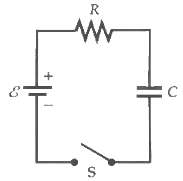
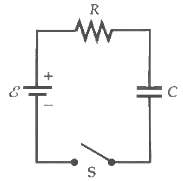
In the circuit of Figure, emf E = 50 V and C = 2.0 ?F; the capacitor is initially uncharged. At 4.0 s after switch S is closed, the voltage drop across the resistor is 20 V. Find the resistance of the resistor.
A 0.12-μF capacitor is given a charge Q0. After 4 s, its charge is ½Q0. What is the effective resistance across this capacitor?
A 1.6-μF capacitor, initially uncharged, is connected in series with a 10-kΩ resistor and a 5.0-V battery of negligible internal resistance.(a) What is the charge on the capacitor after a very long time?(b) How long does it take the capacitor to reach 99% of its final charge?
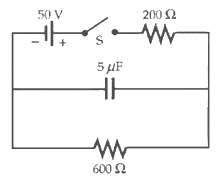
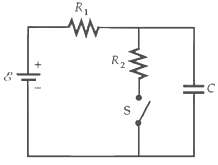
Consider the circuit shown in Figure. From your knowledge of how capacitors behave in circuits, find (a) The initial current through the battery just after the switch is closed, (b) The steady-state current through the battery when the switch has been closed for a long time, and (c) The maximum
A 2-MΩ resistor is connected in series with a 1.5-μF capacitor and a 6.0-V battery of negligible internal resistance. The capacitor is initially uncharged. After a time t = t = RC, find(a) The charge on the capacitor,(b) The rate at which the charge is increasing,(c) The current,(d) The power
Repeat Problem 111 for the time t = 2τ.
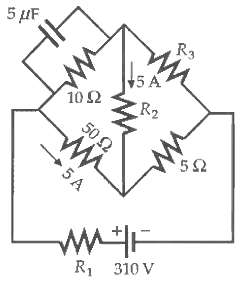
In the steady state, the charge on the 5-?F capacitor in the circuit in Figure is 1000 ?C. (a) Find the battery current. (b) Find the resistances R1, R2, and R3.
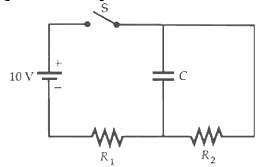
(a) What is the voltage across the capacitor in the circuit in Figure? (b) If the battery is disconnected, give the capacitor current as a function of time. (c) How long does it take the capacitor to discharge until the potential difference across it is 1 V?
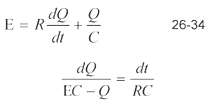
Show that Equation 26-34 can be written Integrate this equation to derive the solution given by Equation 26-35.
A photojournalist’s flash unit uses a 9.0-V battery pack to charge a 0.15-μF capacitor, which is then discharged through the flash lamp of 10.5-Ω resistance when a switch is closed. The minimum voltage necessary for the flash discharge is 7.0 V. The capacitor is charged through a 18-kΩ
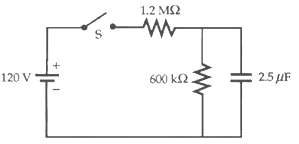
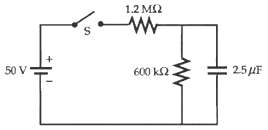
For the circuit in Figure, (a) What is the initial battery current immediately after switch S is closed? (b) What is the battery current a long time after switch S is closed? (c) What is the current in the 600-? resistor as a function of time?
For the circuit in Figure, (a) What is the initial battery current immediately after switch S is closed? (b) What is the battery current a long time after switch S is closed? (c) If the switch has been closed for a long time and is then opened, find the current through the 600-k? resistor as a
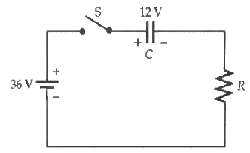
In the circuit shown in Figure, the capacitor has a capacitance of 2.5 ?F and the resistor a resistance of 0.5 M?. Before the switch is closed, the potential drop across the capacitor is 12 V, as shown. Switch S is closed at t = 0. (a) What is the current in R immediately after S is closed? (b) At
Repeat Problem 119 if the capacitor is connected with reversed polarity.
A 10.0-Ω resistor is rated as being capable of dissipating 5.0 W of power.(a) What maximum current can this resistor tolerate?(b) What voltage across this resistor will produce the maximum current?
Margaret is economizing by turning off her space heater and warming herself with a toaster. She pushes the toaster plunger down and dozes off, but after 4 min it pops up again. Eventually the cold wakes her up, so she pushes the plunger down again and gets a little more sleep. This happens once
A 12-V car battery has an internal resistance of 0.4 Ω.(a) What is the current if the battery is shorted momentarily?(b) What is the terminal voltage when the battery delivers a current of 20 A to start the car?
The current drawn from a battery is 1.80 A when a 7.0-Ω resistor is connected across the battery terminals. If a second 12-Ω resistor is connected in parallel with the 7-Ω resistor, the battery delivers a current of 2.20 A. What are the emf and internal resistance of the battery?
A 16-gauge copper wire insulated with rubber can safely carry a maximum current of 6 A.(a) How great a potential difference can be applied across 40 m of this wire?(b) Find the electric field in the wire when it carries a current of 6 A.(c) Find the power dissipated in the wire when it carries a
An automobile jumper cable 3 m long is constructed of multiple strands of copper wire that has an equivalent cross-sectional area of 10.0 mm2. (a) What is the resistance of the jumper cable?(b) When the cable is used to start a car, it carries a current of 90 A. What is the potential drop that
A coil of Nichrome wire is to be used as the heating element in a water boiler that is required to generate 8.0 g of steam per second. The wire has a diameter of 1.80 mm and is connected to a 120-V power supply. Find the length of wire required.
A closed box has two metal terminals a and b. The inside of the box contains an unknown emf E in series with a resistance R. When a potential difference of 21 V is maintained between a and b, there is a current of 1 A between the terminals a and b. If this potential difference is reversed, a
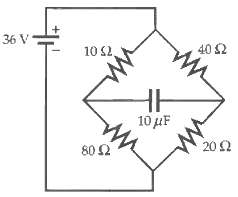
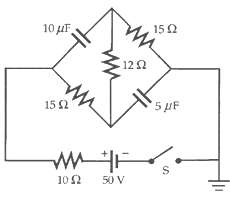
The capacitors in the circuit in Figure are initially uncharged. (a) What is the initial value of the battery current when switch S is closed? (b) What is the battery current after a long time? (c) What are the final charges on thecapacitors?
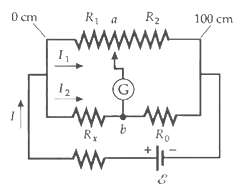
The circuit in Figure is a slide-type Wheatstone bridge.?It is used for determining an unknown resistance Rx in terms of the known resistances R1, R2, and R0. The resistances R1 and R2 comprise a wire 1 m long. Point a?is a sliding contact that is moved along the wire to vary these resistances.
For the Wheatstone bridge of Problem 138, the bridge balances at the 98-cm mark when R0 = 200 Ω.(a) What is the unknown resistance?(b) What effect would an error of 2 mm in the location of the balance point have on the measured value of the unknown resistance?(c) How should R0 be changed so that
The wires in a house must be large enough in diameter so that they do not get hot enough to start a fire. Suppose a certain wire is to carry a current of 20 A, and it is determined that the Joule heating of the wire should not exceed 2 W/m. What diameter must a copper wire have to be safe for this
You are given n identical cells, each with emf E and internal resistance r = 0.2 Ω. When these cells are connected in parallel to form a battery, and a resistance R is connected to the battery terminal, the current through R is the same as when the cells are connected in series and R is attached
A cyclotron produces a 3.50-μA proton beam of 60-MeV energy. The protons impinge and come to rest inside a 50-g copper target within the vacuum chamber.(a) Determine the number of protons that strike the target per second.(b) Find the energy deposited in the target per second.(c) How much time
Compact fluorescent light bulbs cost $6 each and have an expected lifetime of 8000 h. These bulbs consume 20 W of power, but produce the illumination equivalent to 75-W incandescent bulbs. Incandescent bulbs cost about $1.50 each and have an expected lifetime of 1200 h. If the average household
The space between the plates of a parallel-plate capacitor is filled with a dielectric of constant κρ and resistivity ρ.(a) Show that the time constant for the decrease of charge on the plates is τ = ε0κρ(b) If the dielectric is mica, for which κ = 5.0 and ρ = 9 × 10¹³ Ω · m,
The belt of a Van de Graaff generator carries a surface charge density of 5 mC/m2. The belt is 0.5 m wide and moves at 20 m/s.(a) What current does it carry?(b) If this charge is raised to a potential of 100 kV, what is the minimum power of the motor needed to drive the belt?
Conventional large electromagnets use water cooling to prevent excessive heating of the magnet coils. A large laboratory electromagnet draws 100 A when a voltage of 240 V is applied to the terminals of the energizing coils. To cool the coils, water at an initial temperature of 15oC is circulated
We show in Figure the basis of the sweep circuit used in an oscilloscope. S is an electronic switch that closes whenever the potential across its terminals reaches a value Vc and opens when the potential has dropped to 0.2 V. The emf E, much greater than Vc, charges the capacitor C?through a
In the circuit shown in Figure, R1 = 2.0 M?, R2 = 5.0 M?, and C = 1.0 ?F. At t = 0, switch S is closed, and at t = 2.0 s, switch S is opened. (a) Sketch the voltage across C and the current through R2 between t = 0 and t = 10 s. (b) Find the voltage across the capacitor at t = 2 s and at t = 8 s.
If the capacitor in the circuit in Figure is replaced by a 30-? resistor, what currents flow through the resistors?
Two batteries with emf E1 and E2 and internal resistances r1 and r2 are connected in parallel. Prove that if a resistor is connected in parallel with this combination, the optimal load resistance (the resistance at which maximum power is delivered) is R = r1r2/(r1 + r2).
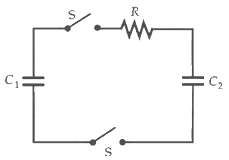
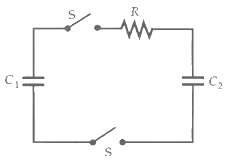
Capacitors C1 and C2 are connected in parallel by a resistor and two switches as shown in Figure. Capacitor C1 is initially charged to a voltage V0, and capacitor C2 is uncharged. The switches S are then closed. (a) What are the final charges on C1 and C2? (b) Compare the initial and final stored
(a) In Problem 151, find the current through R after the switches S are closed as a function of time. (b) Find the energy dissipated in the resistor as a function of time. (c) Find the total energy dissipated in the resistor and compare it with the loss of stored energy found in part (b) of Problem
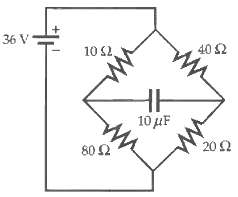
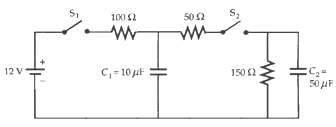
In the circuit in Figure, the capacitors are initially uncharged. Switch S2 is closed and then switch S1 is closed. (a) What is the battery current immediately after S1 is closed? (b) What is the battery current a long time after both switches are closed? (c) What is the final voltage across
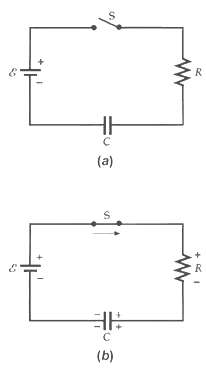
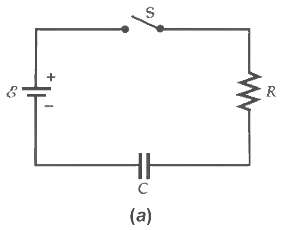
In the RC circuit in Figure (a), the capacitor is initially uncharged and the switch is closed at time t = 0. (a) What is the power supplied by the battery as a function of time? (b) What is the power dissipated in the resistor as a function of time? (c) What is the rate at which energy is stored
A linear accelerator produces a pulsed beam of electrons. The current is 1.6 A for the 0.1-μs duration of each pulse.(a) How many electrons are accelerated in each pulse?(b) What is the average current of the beam if there are 1000 pulses per second?(c) If each electron acquires an energy of 400
(Multiple choice)(1)Two wires of the same material with the same length have different diameters. Wire A has twice the diameter of wire B. If the resistance of wire B is R, then what is the resistance of wire A? (a) R (b) 2R (c) R/2 (d) 4R (e) R/4(2)A metal bar is to be
(Multiple choice) (1) Kirchoff's loop rule follows from (a) Conservation of charge. (b) Conservation of energy. (c) Newton's laws. (d) Coulomb's law. (e) Quantization of charge. (2) The capacitor C in Figure is initially uncharged. Just after the switch S is closed, (a) The voltage across C
Find the magnetic force on a proton moving with velocity 4.46 Mm/s in the positive x direction in a magnetic field of 1.75 T in the positive z direction.
A charge q = – 3.64 nC moves with a velocity of 2.75 × 10⁶ m/s i. Find the force on the charge if the magnetic field is(a) B = 0.38 T j,(b) B = 0.75 T i + 0.75 T j,(c) B = 0.65 T i,(d) B = 0.75 T i + 0.75 T k.
A uniform magnetic field of magnitude 1.48 T is in the positive z direction. Find the force exerted by the field on a proton if the proton’s velocity is(a) v = 2.7 Mm/s i,(b) v = 3.7 Mm/s j,(c) v = 6.8 Mm/s k, and(d) v = 4.0 Mm/s i + 3.0 Mm/s j.
An electron moves with a velocity of 2.75 Mm/s in the xy plane at an angle of 60o to the x axis and 30o to the y axis. A magnetic field of 0.85 T is in the positive y direction. Find the force on the electron.
A straight wire segment 2 m long makes an angle of 30o with a uniform magnetic field of 0.37 T. Find the magnitude of the force on the wire if it carries a current of 2.6 A.
A straight wire segment I ℓ = (2.7 A) * (3 cm i + 4 cm j) is in a uniform magnetic field B = 1.3 T i. Find the force on the wire.
What is the force (magnitude and direction) on an electron with velocity v = (2i – 3j) × 106 m/s in a magnetic field B = (0.8i + 0.6j – 0.4k) T?
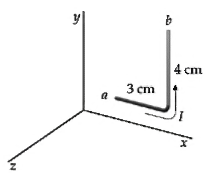
The wire segment in Figure carries a current of 1.8 A from a to b. There is a magnetic field B = 1.2 T k. Find the total force on the wire and show that it is the same as if the wire were a straight segment from a tob.
A straight, stiff, horizontal wire of length 25 cm and mass 50 g is connected to a source of emf by light, flexible leads. A magnetic field of 1.33 T is horizontal and perpendicular to the wire. Find the current necessary to float the wire, that is, the current such that the magnetic force balances
A simple gaussmeter for measuring horizontal magnetic fields consists of a stiff 50-cm wire that hangs from a conducting pivot so that its free end makes contact with a pool of mercury in a dish below. The mercury provides an electrical contact without constraining the movement of the wire. The
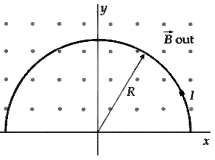
A current-carrying wire is bent into a semicircular loop of radius R that lies in the xy plane. There is a uniform magnetic field B = Bk perpendicular to the plane of the loop (Figure). Show that the force acting on the loop is F =2IRBj.
A 10-cm length of wire carries a current of 4.0 A in the positive z direction. The force on this wire due to a magnetic field B is F = (–0.2i + 0.2j) N. If this wire is rotated so that the current flows in the positive x direction, the force on the wire is F = 0.2k N. Find the magnetic field B.
A 10-cm length of wire carries a current of 2.0 A in the positive x direction. The force on this wire due to the presence of a magnetic field B is F = (3.0j + 2.0k) N. If this wire is now rotated so that the current flows in the positive y direction, the force on the wire is F = (–3.0i – 2.0k)
A wire bent in some arbitrary shape carries a current I in a uniform magnetic field B. Show explicitly that the total force on the part of the wire from some point a to some point b is F = Iℓ × B, where l is the vector from a to b.
A moving charged particle enters a region in which it is suddenly deflected perpendicular to its motion. How can you tell if the deflection was caused by a magnetic field or an electric field?
A proton moves in a circular orbit of radius 65 cm perpendicular to a uniform magnetic field of magnitude 0.75 T.(a) What is the period for this motion?(b) Find the speed of the proton.(c) Find the kinetic energy of the proton.
An electron of kinetic energy 45 keV moves in a circular orbit perpendicular to a magnetic field of 0.325 T.(a) Find the radius of the orbit.(b) Find the frequency and period of the motion.
Protons and deuterons (each with charge +e) and alpha particles (with charge +2e) of the same kinetic energy enter a uniform magnetic field B that is perpendicular to their velocities. Let rp, rd, and ra be the radii of their circular orbits. Find the ratios rd/rp and ra /rp. Assume that ma = 2md =
A proton and an alpha particle move in a uniform magnetic field in circles of the same radii. Compare(a) Their velocities,(b) Their kinetic energies, and(c) Their angular momenta. (See Problem 22.)
A particle of charge q and mass m has momentum p = mv and kinetic energy K = ½mv 2 = p2/2m. If the particle moves in a circular orbit of radius r perpendicular to a uniform magnetic field B, show that(a) p = Bqr and(b) K = B2q2r2/2m.
A beam of particles with velocity v enters a region of uniform magnetic field B that makes a small angle θ with v. Show that after a particle moves a distance 2π (m/qB)v cos θ measured along the direction of B, the velocity of the particle is in the same direction as it was when it entered the
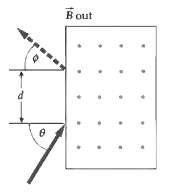
A proton with velocity v = 107 m/s enters a region of uniform magnetic field B = 0.8 T, which is into the page, as shown in Figure. The angle ? = 60o. Find the angle ? and the distance d.
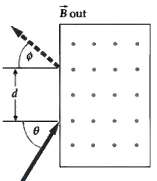
Suppose that in Figure B = 0.6 T, the distance d = 0.4 m, and ? = 24o. Find the speed v and the angle ? if the particles are (a) Protons and (b) Deuterons
A velocity selector has a magnetic field of magnitude 0.28 T perpendicular to an electric field of magnitude 0.46 MV/m.(a) What must the speed of a particle be for it to pass through undeflected? What energy must.(b) Protons and(c) Electrons have to pass through undeflected?
A beam of protons moves along the x axis in the positive x direction with a speed of 12.4 km/s through a region of crossed fields balanced for zero deflection.(a) If there is a magnetic field of magnitude 0.85 T in the positive y direction, find the magnitude and direction of the electric field.(b)
The plates of a Thomson q/m apparatus are 6.0 cm long and are separated by 1.2 cm. The end of the plates is 30.0 cm from the tube screen. The kinetic energy of the electrons is 2.8 keV.(a) If a potential of 25.0 V is applied across the deflection plates, by how much will the beam deflect?(b) Find
Chlorine has two stable isotopes, 35Cl and 37Cl, whose natural abundances are about 76% and 24%, respectively. Singly ionized chlorine gas is to be separated into its isotopic components using a mass spectrometer. The magnetic field in the spectrometer is 1.2 T. What is the minimum value of the
A singly ionized 24Mg ion (mass 3.983 × 10⁻²⁶ kg) is accelerated through a 2.5-kV potential difference and deflected in a magnetic field of 557 G in a mass spectrometer.(a) Find the radius of curvature of the orbit for the ion.(b) What is the difference in radius for 26Mg and 24Mg ions? (Assume
In Example 28-6, determine the time required for a 58Ni ion and a 60Ni ion to complete the semicircular path.
Before entering a mass spectrometer, ions pass through a velocity selector consisting of parallel plates separated by 2.0 mm and having a potential difference of 160 V. The magnetic field between the plates is 0.42 T. The magnetic field in the mass spectrometer is 1.2 T. Find(a) The speed of the
A cyclotron for accelerating protons has a magnetic field of 1.4 T and a radius of 0.7 m.(a) What is the cyclotron frequency?(b) Find the maximum energy of the protons when they emerge.(c) How will your answers change if deuterons, which have the same charge but twice the mass, are used instead of
A certain cyclotron with magnetic field of 1.8 T is designed to accelerate protons to 25 MeV.(a) What is the cyclotron frequency?(b) What must the minimum radius of the magnet be to achieve a 25-MeV emergence energy?(c) If the alternating potential applied to the dees has a maximum value of 50 kV,
Show that the cyclotron frequencies of deuterons and alpha particles are the same and are half that of a proton in the same magnetic field. (See Problem 22.)
Show that the radius of the orbit of a charged particle in a cyclotron is proportional to the square root of the number of orbits completed.
A small circular coil of 20 turns of wire lies in a uniform magnetic field of 0.5 T such that the normal to the plane of the coil makes an angle of 60o with the direction of B. The radius of the coil is 4 cm, and it carries a current of 3 A.(a) What is the magnitude of the magnetic moment of the
What is the maximum torque on a 400-turn circular coil of radius 0.75 cm that carries a current of 1.6 mA and resides in a uniform magnetic field of 0.25 T?
A current-carrying wire is bent into the shape of a square of sides L = 6 cm and is placed in the xy plane. It carries a current I = 2.5 A. What is the torque on the wire if there is a uniform magnetic field of 0.3 T(a) In the z direction, and(b) In the x direction?
Showing 4600 - 4700
of 8940
First
40
41
42
43
44
45
46
47
48
49
50
51
52
53
54
Last
Step by Step Answers

 Get 50% OFF
Claim Now
Get 50% OFF
Claim Now