New Semester
Started
Get
50% OFF
Study Help!
--h --m --s
Claim Now
Question Answers
Textbooks
Find textbooks, questions and answers
Oops, something went wrong!
Change your search query and then try again
S
Books
FREE
Study Help
Expert Questions
Accounting
General Management
Mathematics
Finance
Organizational Behaviour
Law
Physics
Operating System
Management Leadership
Sociology
Programming
Marketing
Database
Computer Network
Economics
Textbooks Solutions
Accounting
Managerial Accounting
Management Leadership
Cost Accounting
Statistics
Business Law
Corporate Finance
Finance
Economics
Auditing
Tutors
Online Tutors
Find a Tutor
Hire a Tutor
Become a Tutor
AI Tutor
AI Study Planner
NEW
Sell Books
Search
Search
Sign In
Register
study help
physics
electricity and magnetism
College Physics 7th Edition Raymond A. Serway, Jerry S. Faughn, Chris Vuille, Charles A. Bennett - Solutions
The plates of a capacitor are connected to a battery. What happens to the charge on the plates if the connecting wires are removed from the battery? What happens to the charge if the wires are removed from the battery and connected to each other?
Explain why a dielectric increases the maximum operating voltage of a capacitor even though the physical size of the capacitor doesn’t change.
(a) The equivalent capacitance for a group of capacitors connected in parallel is (i) Greater than the capacitance of any of the capacitors in the group, (ii) Less than the capacitance of any of the capacitors in the group, or (iii) Neither of the above. (b) The equivalent capacitance for a group
If a current of 80.0 mA exists in a metal wire, how many electrons flow past a given cross section of the wire in 10.0 min? Sketch the direction of the current and the direction of the electrons’ motion.
A certain conductor has 7.50 x 1028 free electrons per cubic meter, a cross-sectional area of 4.00 x 10⁻⁶ m2, and carries a current of 2.50 A. Find the drift speed of the electrons in the conductor.
A 1.00-V potential difference is maintained across a 10.0-Ω resistor for a period of 20.0 s. What total charge passes through the wire in this time interval?
In a particular television picture tube, the measured beam current is 60.0 µA. How many electrons strike the screen every second?
In the Bohr model of the hydrogen atom, an electron in the lowest energy state moves at a speed of 2.19 × 10⁶ m/s in a circular path having a radius of 5.29 × 10 –11 m. What is the effective current associated with this orbiting electron?
If 3.25 × 10⁻³ kg of gold is deposited on the negative electrode of an electrolytic cell in a period of 2.78 h, what is the current in the cell during that period? Assume that the gold ions carry one elementary unit of positive charge.
A 200-km-long high-voltage transmission line 2.0 cm in diameter carries a steady current of 1 000 A. If the conductor is copper with a free charge density of 8.5 × 1028 electrons per cubic meter, how many years does it take one electron to travel the full length of the cable?
An aluminum wire carrying a current of 5.0 A has a cross-sectional area of 4.0 × 10⁻⁶ m2. Find the drift speed of the electrons in the wire. The density of aluminum is 2.7 g/cm3. (Assume that one electron is supplied by each atom.)
If the current carried by a conductor is doubled, what happens to (a) The charge carrier density? (b) The electron drift velocity?
We have seen that an electric field must exist inside a conductor that carries a current. How is that possible in view of the fact that in electrostatics we concluded that the electric field must be zero inside a conductor?
A person notices a mild shock if the current along a path through the thumb and index finger exceeds 80 µA. Compare the maximum possible voltage without shock across the thumb and index finger with a dry-skin resistance of 4.0 × 10⁵ and a wet-skin resistance of 2 000 Ω.
Suppose that you wish to fabricate a uniform wire out of 1.00 g of copper. If the wire is to have a resistance R = 0.500 Ω, and if all of the copper is to be used, what will be (a) The length and (b) The diameter of the wire?
Calculate the diameter of a 2.0-cm length of tungsten filament in a small lightbulb if its resistance is 0.050 Ω.
What single experimental requirement makes superconducting devices expensive to operate? In principle, can this limitation be overcome?
A potential difference of 12 V is found to produce a current of 0.40 A in a 3.2-m length of wire with a uniform radius of 0.40 cm. What is (a) The resistance of the wire?(b) The resistivity of the wire?
Make an order-of-magnitude estimate of the cost of one person’s routine use of a hair dryer for 1 yr. If you do not use a blow dryer yourself, observe or interview someone who does. State the quantities you estimate and their values.
A wire 50.0 m long and 2.00 mm in diameter is connected to a source with a potential difference of 9.11 V, and the current is found to be 36.0 A. Assume a temperature of 20°C, and, using Table 17.1, identify the metal out of which the wire is made.
A rectangular block of copper has sides of length 10 cm, 20 cm, and 40 cm. If the block is connected to a 6.0-V source across two of its opposite faces, what are (a) The maximum current and (b) The minimum current that the block can carry?
A wire of initial length L0 and radius r0 has a measured resistance of 1.0 Ω. The wire is drawn under tensile stress to a new uniform radius of r × 0.25r0. What is the new resistance of the wire?
A certain lightbulb has a tungsten filament with a resistance of 19Ω when cold and 140 Ω when hot. Assume that Equation 17.7 can be used over the large temperature range involved here, and find the temperature of the filament when it is hot. Assume an initial temperature of 20°C.
While taking photographs in Death Valley on a day when the temperature is 58.0°C, Bill Hiker finds that a certain voltage applied to a copper wire produces a current of 1.000 A. Bill then travels to Antarctica and applies the same voltage to the same wire. What current does he register there if
A metal wire has a resistance of 10.00 Ω at a temperature of 20°C. If the same wire has a resistance of 10.55 Ω at 90°C, what is the resistance of the wire when its temperature is – 20°C?
At 20°C, the carbon resistor in an electric circuit connected to a 5.0-V battery has a resistance of 200 Ω. What is the current in the circuit when the temperature of the carbon rises to 80°C?
A wire 3.00 m long and 0.450 mm2 in cross-sectional area has a resistance of 41.0 Ω at 20°C. If its resistance increases to 41.4 Ω at 29.0°C, what is the temperature coefficient of resistivity?
The copper wire used in a house has a cross-sectional area of 3.00 mm2. If 10.0 m of this wire is used to wire a circuit in the house at 20.0°C, find the resistance of the wire at temperatures of (a) 30.0°C and (b) 10.0°C.
A 100-cm-long copper wire of radius 0.50 cm has a potential difference across it sufficient to produce a current of 3.0 A at 20°C. (a) What is the potential difference?(b) If the temperature of the wire is increased to 200°C, what potential difference is now required to produce a current of 3.0 A?
(a) A 34.5-m length of copper wire at 20.0°C has a radius of 0.25 mm. If a potential difference of 9.0 V is applied across the length of the wire, determine the current in the wire. (b) If the wire is heated to 30.0°C while the 9.0-V potential difference is maintained, what is the resulting
A toaster rated at 1 050 W operates on a 120-V household circuit and a 4.00-m length of nichrome wire as its heating element. The operating temperature of this element is 320°C. What is the cross-sectional area of the wire?
In one form of plethysmograph (a device for measuring volume), a rubber capillary tube with an inside diameter of 1.00 mm is filled with mercury at 20°C. The resistance of the mercury is measured with the aid of electrodes sealed into the ends of the tube. If 100.00 cm of the tube is wound in a
A platinum resistance thermometer has resistances of 200.0 Ω when placed in a 0°C ice bath and 253.8 Ω when immersed in a crucible containing melting potassium. What is the melting point of potassium?
A toaster is rated at 600 W when connected to a 120-V source. What current does the toaster carry, and what is its resistance?
If electrical energy costs 12 cents, or $0.12, per kilowatt-hour, how much does it cost to (a) Burn a 100-W lightbulb for 24 h? (b) Operate an electric oven for 5.0 h if it carries a current of 20.0 A at 220 V?
How many 100-W lightbulbs can you use in a 120-V circuit without tripping a 15-A circuit breaker? (The bulbs are connected in parallel, which means that the potential difference across each lightbulb is 120 V.)
A high-voltage transmission line with a resistance of 0.31 /km carries a current of 1 000 A. The line is at a potential of 700 kV at the power station and carries the current to a city located 160 km from the station. (a) What is the power loss due to resistance in the line? (b) What fraction of
The heating element of a coffeemaker operates at 120 V and carries a current of 2.00 A. Assuming that the water absorbs all of the energy converted by the resistor, calculate how long it takes to heat 0.500 kg of water from room temperature (23.0°C) to the boiling point.
The power supplied to a typical black-and-white television set is 90 W when the set is connected to 120 V. (a) How much electrical energy does this set consume in 1 hour?(b) A color television set draws about 2.5 A when connected to 120 V. How much time is required for it to consume the same energy
What is the required resistance of an immersion heater that will increase the temperature of 1.50 kg of water from 10.0°C to 50.0°C in 10.0 min while operating at 120 V?
A certain toaster has a heating element made of Nichrome resistance wire. When the toaster is first connected to a 120-V source of potential difference (and the wire is at a temperature of 20.0°C), the initial current is 1.80 A. However, the current begins to decrease as the resistive element
A copper cable is designed to carry a current of 300 A with a power loss of 2.00 W/m. What is the required radius of this cable?
A small motor draws a current of 1.75 A from a 120-V line. The output power of the motor is 0.20 hp. (a) At a rate of $0.060/kWh, what is the cost of operating the motor for 4.0 h? (b) What is the efficiency of the motor?
It has been estimated that there are 270 million plug-in electric clocks in the United States, approximately one clock for each person. The clocks convert energy at the average rate of 2.50 W. To supply this energy, how many metric tons of coal are burned per hour in coal-fired electric generating
The cost of electricity varies widely throughout the United States; $0.120/kWh is a typical value. At this unit price, calculate the cost of (a) Leaving a 40.0-W porch light on for 2 weeks while you are on vacation, (b) Making a piece of dark toast in 3.00 min with a 970-W toaster, and(c) Drying a
How much does it cost to watch a complete 21-hour-long World Series on a 180-W television set? Assume that electricity costs $0.070/kWh.
A house is heated by a 24.0-kW electric furnace that uses resistance heating. The rate for electrical energy is $0.080/kWh. If the heating bill for January is $200, how long must the furnace have been running on an average January day?
An 11-W energy-efficient fluorescent lamp is designed to produce the same illumination as a conventional 40-W lamp. How much does the energy-efficient lamp save during 100 hours of use? Assume a cost of $0.080/kWh for electrical energy.
An office worker uses an immersion heater to warm 250 g of water in a light, covered, insulated cup from 20°C to 100°C in 4.00 minutes. The heater is a Nichrome resistance wire connected to a 120-V power supply. Assume that the wire is at 100°C throughout the 4.00-min time interval. Specify a
The heating coil of a hot-water heater has a resistance of 20 Ω and operates at 210 V. If electrical energy costs $0.080/kWh, what does it cost to raise the 200 kg of water in the tank from 15°C to 80°C?
One lightbulb is marked “25 W 120 V,” and another “100 W 120 V”; this means that each converts its respective power when plugged into a constant 120-V potential difference. (a) Find the resistance of each bulb. (b) How long does it take for 1.00 C to pass through the dim bulb? How is this
A particular wire has a resistivity of 3.0 × 10⁻⁸ Ω m and a cross-sectional area of 4.0 × 10⁻⁶ m2. A length of this wire is to be used as a resistor that will develop 48 W of power when connected across a 20-V battery. What length of wire is required?
A steam iron draws 6.0 A from a 120-V line. (a) How many joules of internal energy are produced in 20 min?(b) How much does it cost, at $0.080/kWh, to run the steam iron for 20 min?
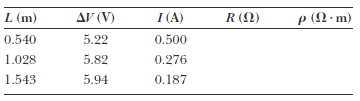
An experiment is conducted to measure the electrical resistivity of Nichrome in the form of wires with different lengths and cross-sectional areas. For one set of measurements, a student uses 30-gauge wire, which has a cross-sectional area of 7.30 ?? 10???8 m2. The student measures the potential
Birds resting on high-voltage power lines are a common sight. The copper wire on which a bird stands is 2.2 cm in diameter and carries a current of 50 A. If the bird’s feet are 4.0 cm apart, calculate the potential difference across its body.
You are cooking breakfast for yourself and a friend using a 1 200-W waffle iron and a 500-W coffeepot. Usually, you operate these appliances from a 110-V outlet for 0.500 h each day.(a) At 12 cents per kWh, how much do you spend to cook breakfast during a 30.0 day period?(b) You find yourself
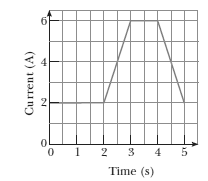
The current in a conductor varies in time as shown in figure. (a) How many coulombs of charge pass through a cross section of the conductor in the interval from t = 0 to t = 5.0 s? (b) What constant current would transport the same total charge during the 5.0-s interval as does the actualcurrent?
An electric car is designed to run off a bank of 12.0-V batteries with a total energy storage of 2.00 × 10⁷ J.(a) If the electric motor draws 8.00 kW, what is the current delivered to the motor?(b) If the electric motor draws 8.00 kW as the car moves at a steady speed of 20.0 m/s, how far will the
(a) A 115-g mass of aluminum is formed into a right circular cylinder, shaped so that its diameter equals its height. Calculate the resistance between the top and bottom faces of the cylinder at 20°C.(b) Calculate the resistance between opposite faces if the same mass of aluminum is formed into a
A length of metal wire has a radius of 5.00 × 10⁻³ m and a resistance of 0.100 Ω. When the potential difference across the wire is 15.0 V, the electron drift speed is found to be 3.17 × 10⁻⁴ m/s. On the basis of these data, calculate the density of free electrons in the wire.
A carbon wire and a Nichrome wire are connected one after the other. If the combination has a total resistance of 10.0 kΩ at 20°C, what is the resistance of each wire at 20°C so that the resistance of the combination does not change with temperature?
(a) Determine the resistance of a lightbulb marked 100 W @ 120 V. (b) Assuming that the filament is tungsten and has a cross-sectional area of 0.010 mm2, determine the length of the wire inside the bulb when the bulb is operating. (c) Why do you think the wire inside the bulb is tightly coiled? (d)
In a certain stereo system, each speaker has a resistance of 4.00 Ω. The system is rated at 60.0 W in each channel. Each speaker circuit includes a fuse rated at a maximum current of 4.00 A. Is this system adequately protected against overload?
A resistor is constructed by forming a material of resistivity 3.5 × 10⁵ Ω ∙ m into the shape of a hollow cylinder of length 4.0 cm and inner and outer radii 0.50 cm and 1.2 cm, respectively. In use, a potential difference is applied between the ends of the cylinder, producing a current
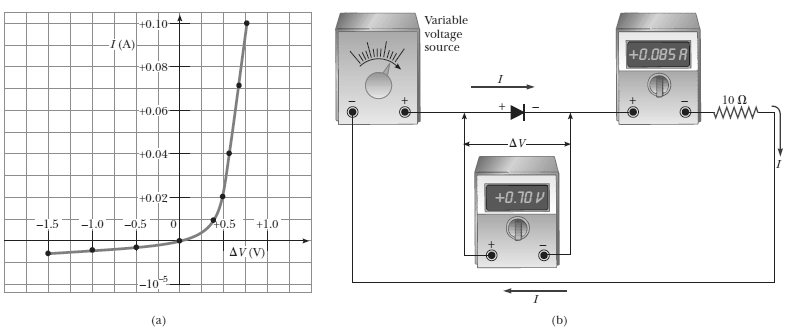
The graph in figure a shows the current I in a diode as a function of the potential difference ∆V across the diode. Figure b shows the circuit used to make the measurements. The symbol represents the diode. (a) Using Equation 17.3, make a table of the resistance of the diode for different values
An x-ray tube used for cancer therapy operates at 4.0 MV, with a beam current of 25 mA striking the metal target. Nearly all the power in the beam is transferred to a stream of water flowing through holes drilled in the target. What rate of flow, in kilograms per second, is needed if the rise in
A 50.0-g sample of a conducting material is all that is available. The resistivity of the material is measured to be 11 ? 10?8 ? ? m, and the density is 7.86 g/cm3. The material is to be shaped into a solid cylindrical wire that has a total resistance of 1.5 ?. (a) What length of wire is
(a) A sheet of copper (ρ = 1.7 × 10⁻⁸ Ω ∙ m) is 2.0 mm thick and has surface dimensions of 8.0 cm × 24 cm. If the long edges are joined to form a tube 24 cm in length, what is the resistance between the ends? (b) What mass of copper is required to manufacture a 1 500-m-long spool of
When a straight wire is heated, its resistance changes according to the equation R = R0?[1 + ?(T ? T0)] (Eq. 17.7), where is the temperature coefficient of resistivity. (a) Show that a more precise result, which includes the fact that the length and area of a wire change when it is heated,
A man wishes to vacuum his car with a canister vacuum cleaner marked 535 W at 120 V. The car is parked far from the building, so he uses an extension cord 15.0 m long to plug the cleaner into a 120-V source. Assume that the cleaner has constant resistance. (a) If the resistance of each of the two
1. In an analogy between traffic flow and electrical current, what would correspond to the charge Q? What would correspond to the current I?2. A lightbulb has a resistance of 240 Ω when operating at a voltage of 120 V. What is the current in the bulb?
Two light bulbs are each connected to a voltage of 120 V. One has a power of 25 W, the other 100 W. Which bulb has the higher resistance? Which bulb carries more current?
1. There is an old admonition given to experimenters to “keep one hand in the pocket” when working around high voltages. Why is this warning a good idea? 2. Eighteen-gauge wire has a diameter of 1.024 mm. Calculate the resistance of 15 m of 18-gauge copper wire at 20°C.
1. Some homes have light dimmers that are operated by rotating a knob. What is being changed in the electric circuit when the knob is rotated?2. Use the atomic theory of matter to explain why the resistance of a material should increase as its temperature increases.
A battery having an emf of 9.00 V delivers 117 mA when connected to a 72.0-Ω load. Determine the internal resistance of the battery.
A 4.0- Ω resistor, an 8.0-Ω resistor, and a 12-Ω resistor are connected in series with a 24-V battery. What are? (a) The equivalent resistance and (b) The current in each resistor?(c) Repeat for the case in which all three resistors are connected in parallel across the battery.
A lightbulb marked “75 W [at] 120 V” is screwed into a socket at one end of a long extension cord in which each of the two conductors has a resistance of 0.800 Ω. The other end of the extension cord is plugged into a 120-V outlet. Draw a circuit diagram, and find the actual power of the bulb
A 9.0-Ω resistor and a 6.0-Ω resistor are connected in series with a power supply. (a) The voltage drop across the 6.0-Ω resistor is measured to be 12 V. Find the voltage output of the power supply. (b) The two resistors are connected in parallel across a power supply, and the current through
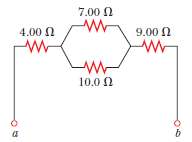
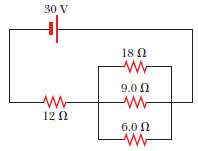
(a) Find the equivalent resistance between points a and b in figure.(b) Calculate the current in each resistor if a potential difference of 34.0 V is applied between points a andb.
Find the equivalent resistance of the circuit infigure.
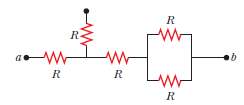
What is the equivalent resistance of the combination of resistors between points a and b in figure? Note that one end of the vertical resistor is leftfree.
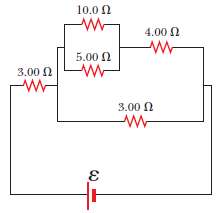
(a) Find the equivalent resistance of the circuit in figure.(b) If the total power supplied to the circuit is 4.00 W, find the emf of thebattery.
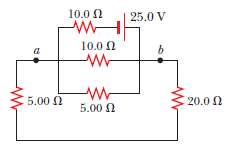
Consider the circuit shown in figure. Find (a) The current in the 20.0-? resistor and (b) The potential difference between points a and b.
Two resistors, A and B, are connected in parallel across a 6.0-V battery. The current through B is found to be 2.0 A. When the two resistors are connected in series to the 6.0-V battery, a voltmeter connected across resistor A measures a voltage of 4.0 V. Find the resistances of A and B.
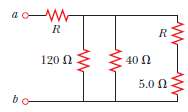
The resistance between terminals a and b in figure is 75 ?. If the resistors labeled R have the same value, determine R.
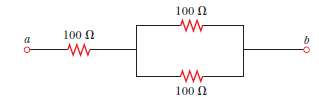
Three 100-? resistors are connected as shown in figure. The maximum power that can safely be delivered to any one resistor is 25.0 W. (a) What is the maximum voltage that can be applied to the terminals a and b? (b) For the voltage determined in part (a), what is the power delivered to each
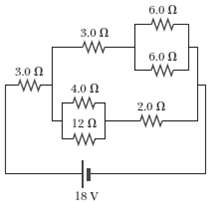
Find the current in the 12-? resistor in figure.
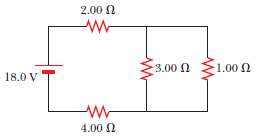
Calculate the power delivered to each resistor in the circuit shown infigure.
(a) You need a 45-Ω resistor, but the stockroom has only 20-Ω and 50-Ω resistors. How can the desired resistance be achieved under these circumstances? (b) What can you do if you need a 35-Ω resistor?
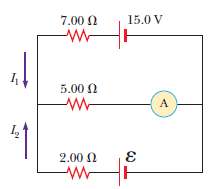
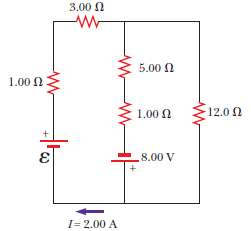
The ammeter shown in figure reads 2.00 A. Find I1, I 2, and ?.
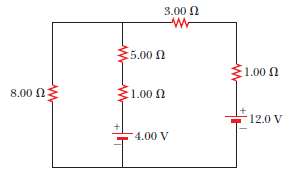
Determine the current in each branch of the circuit shown infigure.
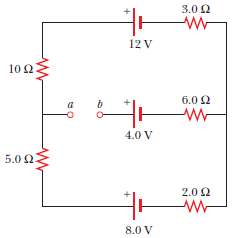
Determine the potential difference ??Vab for the circuit infigure.
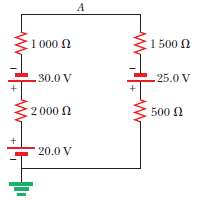
Figure shows a circuit diagram. Determine (a) The current, (b) The potential of wire A relative to ground, and (c) The voltage drop across the 1 500-? resistor.
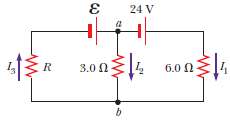
In the circuit of figure, the current I1 is 3.0 A while the values of ? and R are unknown. What are the currents I2 and I3?
What is the emf ? of the battery in the circuit of figure?
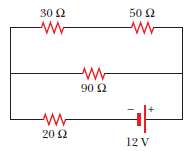
Four resistors are connected to a battery with a terminal voltage of 12 V, as shown in figure. Determine the power delivered to the 50-? resistor.
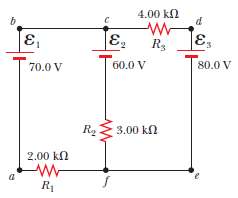
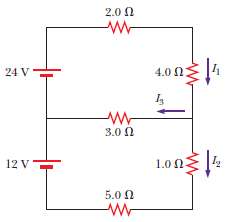
Using Kirchhoff's rules, (a) Find the current in each resistor shown in figure and (b) Find the potential difference between points c andf.
Two 1.50-V batteries—with their positive terminals in the same direction—are inserted in series into the barrel of a flashlight. One battery has an internal resistance of 0.255 Ω, the other an internal resistance of 0.153 Ω. When the switch is closed, a current of 0.600 A passes through the
Calculate each of the unknown currents I1, I 2, and I3 for the circuit offigure.
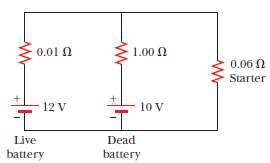
A dead battery is charged by connecting it to the live battery of another car with jumper cables (Figure). Determine the current in the starter and in the deadbattery.
Showing 5200 - 5300
of 8940
First
46
47
48
49
50
51
52
53
54
55
56
57
58
59
60
Last
Step by Step Answers

 Get 50% OFF
Claim Now
Get 50% OFF
Claim Now