New Semester
Started
Get
50% OFF
Study Help!
--h --m --s
Claim Now
Question Answers
Textbooks
Find textbooks, questions and answers
Oops, something went wrong!
Change your search query and then try again
S
Books
FREE
Study Help
Expert Questions
Accounting
General Management
Mathematics
Finance
Organizational Behaviour
Law
Physics
Operating System
Management Leadership
Sociology
Programming
Marketing
Database
Computer Network
Economics
Textbooks Solutions
Accounting
Managerial Accounting
Management Leadership
Cost Accounting
Statistics
Business Law
Corporate Finance
Finance
Economics
Auditing
Tutors
Online Tutors
Find a Tutor
Hire a Tutor
Become a Tutor
AI Tutor
AI Study Planner
NEW
Sell Books
Search
Search
Sign In
Register
study help
physics
electricity and magnetism
College Physics 7th Edition Raymond A. Serway, Jerry S. Faughn, Chris Vuille, Charles A. Bennett - Solutions
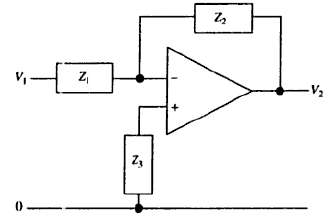
In the generalized operational amplifier circuit shown in figure, Z1, Z2 and Z3 are impedances. The operational amplifier has an input impedance greater than 10 M? and a gain equal to up to 100 Hz but inversely proportional to frequency at higher frequencies. (a) It Z1 = 1 k? and Z2 = 100 k?, draw
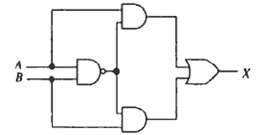
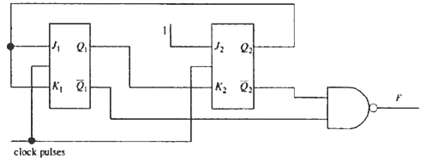
Give the truth table for the circuit shown in figure
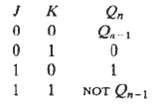
The following table gives the state of a J-K flip-flow after receipt of the nth clock pulse: For the circuit shown in figure, deduce how the output F changes on receipt of a regular train of clock pulses, given that the initial state is Q1 = Q2 =0
The electric potential at a perpendicular distance r from a long straight wire of cross-sectional radius a is given by V(r) = – K In(r/a)Where K is a constant. Calculate the electric field as a function of distance. Hence, using Gauss’s theorem, determine the charge q per unit length of the
A soap bubble 10 cm in radius with a wall thickness of 3.3 x 10⁻⁶ cm is charged to potential of 100 V. The bubble bursts and falls as spherical drop. Estimate the potential of the drop.
A spherical nucleus has a total charge Q (uniformly distributed) and radius R. Find the electric field at any point inside the nucleus at a distance r from the centre. Hence find the potential difference between the centre of the nucleus and its surface.
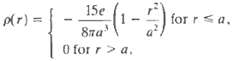
Determine the electric field as a function of radius r in a spherically symmetric model of an atom in which the nucleus is a point charge of magnitude + e and the electron charge is distributed with charge per unit volume ρ(r) given by Where a is a constant.
Show that the potential energy of a charge Q uniformly distributed throughout a sphere of radius R is 3/5 Q2/4πε0R
Show that the maximum values of the electric field |E| for points on the axis of a uniform ring of charge q and radius a occur at a distance x = ± a/√2.If an electron is placed at the centre of the ring and is then displaced a small distance x along the axis (x
An infinite line of charge λ per unit length is parallel to the line of intersection of two infinite conducting planes set at right angles to one another, such that it is a distance a from one and b from the other. Show that this arrangement is equivalent to four line charges so far as the
A telephone wire of diameter 1 mm is suspended parallel to the ground at a height of 10m. What is the capacitance to ground of this wire per unit length? (Assume the ground to be a conducting plane.)
Near the surface of the Earth there is a downward-directed electric field of 150 Vm-1. Using Gauss’s theorem, calculate the surface charge density at the Earth’s surface. Assume the Earth is a conducting medium. At 200 m above the surface of the Earth the downward field is 100 Vm-1. Calculate
A 15 nF capacitor is connected across a 70 V battery. How much work must be done in order to double the plate separation(a) With the battery connected, and (b) With it disconnected?
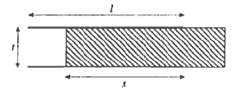
An air spaced parallel-plate capacitor has square plates of side l separated by a distance t. Write down an expression for its capacitance C. A square block of dielectric of side l, thickness t and relative permittivity εr is now inserted so as to completely fill the space between the plates.
Estimate the capacitance of a thundercloud. If the breakdown electric field in air is 3 x 10⁶ Vm-1, what charge flows down a lightning bolt?
An air-filled coaxial cable consists of a metal wire of diameter d surrounded by a thin metal sheath of diameter D. When the wire is charged, deduce expressions for the electric field E(r) and electric potential V(r) at a radial distance r (d/2 < r < D/2) from the central axis. Hence deduce the
A coaxial cable consists of two thin coaxial cylinders electrically connected at one end; an inner cylindrical conducting tube of radius a carrying a steady current I which is screened by an outer cylindrical conducting sheath of radius b which provides a return path. There is no dielectric medium
A long straight copper wire, of circular cross section, contains n conduction electrons per unit volume, each of charge q. Show that the current I in the wire is given by I = nqvπa2, where v is the drift velocity and a is the radius of the wire. At a radial distance r from the axis of the wire,
Two coaxial plane coils, each of n turns of radius, a are separated by a distance a. Calculate the magnetic field on the axis at the point midway between them when a current I flows in the same sense through each coil. Electrons in a colour television tube are accelerated through a potential
Use Ampere’s law to find the magnetic field strength well inside a very long solenoid of length l, cross-sectional area A and total number of turns N, carrying current I. Show that the magnetic field strength at the centre of the solenoid is approximately twice the value at each end, on the axis
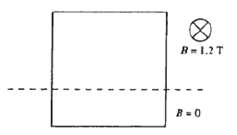
A vertical square loop of copper wire with sides of length 10 cm is falling as shown from a region where the magnetic field is horizontal and of magnitude 1.2 T into a region where the field is zero, as shown if figure. The wire has a diameter of 1 mm. (i) Calculate the magnitude of the current
In a certain region there are a uniform electric field E and a uniform magnetic field B both directed along the z-axis. A particle of charge Q and mass m is injected at time t = 0 with a velocity v0 along the x-axis. Find the velocity of the particle at time t. what would be the motion of the
State the Biot-Savart law which gives the magnetic field B at a distance r from a current element. Hence obtain an expression for the magnetic field BQ due to a point charge Q moving with constant velocity v (assumed non-relativistic). Point charges Q and Q’ are constrained to move along the
What is the mass of singly charged ions which follow a circular path of radius 0.41m when placed in a transverse magnetic field of 0.223 T, the initial energy being 100keV? What electric field must be superimposed if the ions are to pass undeflected through the magnetic field?
In a helium dilution refrigerator 3He are mixed in a special chamber to obtain extremely low temperatures. A Bainbridge mass spectrometer is used to measure the ratio of the two isotopes.(a) If the spectrometer were used with 100 V cm–1 between the plates and a magnetic field of 0.2 T, what would
Two long concentric cylindrical conductors of radii a and b (b < a) are maintained at a potential difference V and carry equal and opposite current I. Show that an electron with a particular velocity u parallel to the axis may travel undeviated in the evacuated region between the conductors, and
Two parallel rectangular superconducting plates of length l, width be and separation a (l >> b >> a) are joined at each end to form a one-turn coil of negligible resistance. What is the its self-inductance? How much energy is stored in the magnetic field when a steady current I flows? The
A circular parallel-plate capacitor of radius a and plate separation d is connected in series with a resistor R and a switch, initially open, to a constant voltage source V0. The switch is closed at time t = 0. Assuming that the charging time of the capacitor, τ = CR, is very long compared with
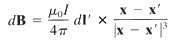
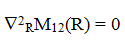
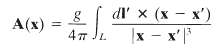
Starting with the differential expression for the magnetic induction at the point P with coordinate x produced by an increment of current I dl at x', show explicitly that for a closed loop carrying a current I the magnetic induction at P is B = ?0I/4??? where ? is the solid angle subtended by
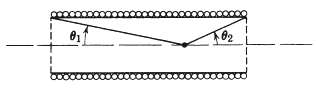
A right-circular solenoid of finite length L and radius a has N turns per unit length and carries a current I. Show that the magnetic induction on the cylinder axis in the limit NL?? is Bz = ?0NI/2 (cos ?1 + cos ?2) Where the angles are defined in the figure
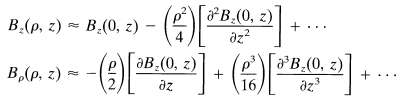
A magnetic induction ? in a current-free region in a uniform medium is cylindrically symmetric with components Bz(?, z) and B?(?, z) and with a known Bz(0, z) on the axis of symmetry. The magnitude of the axial field varies slowly in z. (a) Show that near the axis the axial and radial components of
A cylindrical conductor of radius a has a hole of radius b bored parallel to, and centered a distance d from, the cylinder axis (d + b < a). The current density is uniform throughout the remaining metal of the cylinder and is parallel to the axis. Use Ampere's law and principle of linear
The two circular coils of radius a and separation b of Problem 5.7 can be described in cylindrical coordinates by the current densityJ = фIδ(ρ – a)[δ(z – b/2) + δ(z + b/2)](a) Using the formalism of Problem 5.8, calculate the internal and external multipole moments for L = 1,..., 5.(b)
A circular current loop of radius a carrying a current I lies in the x-y plane with its center at the origin. (a) Show that the only nonvanishing component of the vector potential is Where ? (?>) is the smaller (larger) of a and ?. (b) Show that an alternative expression for ?? is
A circular loop of wire carrying a current / is located with its center at the origin of coordinates and the normal to its plane having spherical angles θ0, ф0. There is an applied magnetic field, Bx = B0(1 + βy) and By = B0(1 + βx).(a) Calculate the force acting on the loop without making any
A sphere of radius a carries a uniform surface-charge distribution σ. The sphere is rotated about a diameter with constant angular velocity ω. Find the vector potential and magnetic-flux density both inside and outside the sphere.
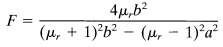
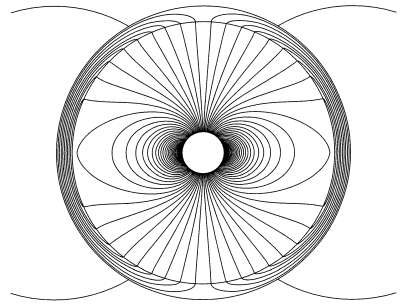
A long, hollow, right circular cylinder of inner (outer) radius a (b), and of relative permeability μr, is placed in a region of initially uniform magnetic-flux density B0 at right angles to the field. Find the flux density at all points in space, and sketch the logarithm of the ratio of the
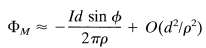
Consider two long, straight wires, parallel to the z axis, spaced a distance d apart and carrying currents I in opposite directions. Describe the magnetic field H in terms of a magnetic scalar potential ?M, with H = ? ???. (a) If the wires are parallel to the z axis with positions, x = ?d/2, ? = 0,
A magnetically "hard" material is in the shape of a right circular cylinder of length L and radius a. The cylinder has a permanent magnetization M0, uniform through-out its volume and parallel to its axis.(a) Determine the magnetic field H and magnetic induction В at all points on the axis of the
(a) Starting from the force equation (5.12) and the fact that a magnetization M inside a volume V bounded by a surface S is equivalent to a volume current density JM = (Ñ × M) and a surface current density (M × n), show that in the absence of macroscopic conduction currents the total magnetic
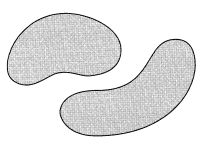
A magnetostatic field is due entirely to a localized distribution of permanent magnetization. (a) Show that ? B ? H d3x = 0 Provided the integral is taken over all space. (b) From the potential energy (5.72) of a dipole in an external field, show that for a continuous distribution of permanent
Show that in general a long, straight bar of uniform cross-sectional area A with uniform lengthwise magnetization M, when placed with its flat end against an infinitely permeable flat surface, adheres with a force given approximately byF ≈ μ0/2 AM2Relate your discussion to the electrostatic
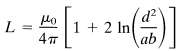
A two-wire transmission line consists of a pair of nonpermeable parallel wires of radii a and b separated by a distance d > a + b. A current flows down one wire and back the other. It is uniformly distributed over the cross section of each wire. Show that the self-inductance per unit lengthis
A circuit consists of a long thin conducting shell of radius a and a parallel return wire of radius b on axis inside. If the current is assumed distributed uniformly throughout the cross section of the wire, calculate the self-inductance per unit length. What is the self-inductance if the inner
The figure represents a transmission line consisting of two, parallel perfect conductors of arbitrary, but constant, cross section. Current flows down one conductor and returns via the other.Show that the product of the inductance per unit length L and the capacitance per unit length С isLC =
Consider two current loops (as in Fig) whose orientation in space is fixed, but whose relative separation can be changed. Let O1 and O2 be origins in the two loops, fixed relative to each loop, and x1 and x2 be coordinates of elements dI1 and dI2, respectively, of the loops referred to the
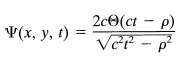
In three dimensions the solution to the wave equation (6.32) for a point source in space and time (a light flash at t' = 0, x' = 0) is a spherical shell disturbance of radius R = ct, namely the Green function G(+) (6.44). It may be initially surprising that in one or two dimensions, the disturbance
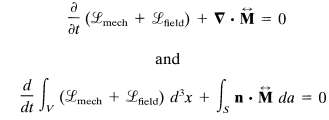
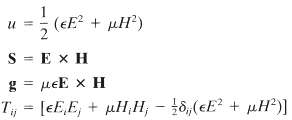
With the same assumptions as in Problem 6.9 discuss the conservation of angular momentum. Show that the differential and integral forms of the conservation law are Where the field angular-momentum density is ?field = x ? g = ?? x ? (E ? H) And the flux of angular momentum is described by the
A transverse plane wave is incident normally in vacuum on a perfectly absorbing flat screen. (a) From the law of conservation of linear momentum, show that the pressure (called radiation pressure) exerted on the screen is equal to the field energy per unit volume in the wave. (b) In the
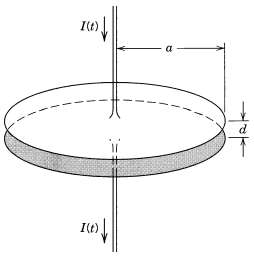
A parallel plate capacitor is formed of two flat rectangular perfectly conducting sheets of dimensions a and b separated by a distance d small compared to a or b. Current is fed in and taken out uniformly along the adjacent edges of length b. With the input current and voltage defined at this end
An ideal circular parallel plate capacitor of radius a and plate separation d (a) Calculate the electric and magnetic fields between the plates to second order in powers of the frequency (or wave number), neglecting the effects of fringing fields. (b) Calculate the volume integrals of we and wm
If a conductor or semiconductor has current flowing in it because of an applied electric field, and a transverse magnetic field is applied, there develops a component of electric field in the direction orthogonal to both the applied electric field (direction of current flow) and the magnetic field,
(a) Calculate the force in Newton’s acting on a Dirac monopole of the minimum magnetic charge located a distance 0.5 A from and in the median plane of a magnetic dipole with dipole moment equal to one nuclear magneton (eh/2mρ).(b) Compare the force in part a with atomic forces such as the direct
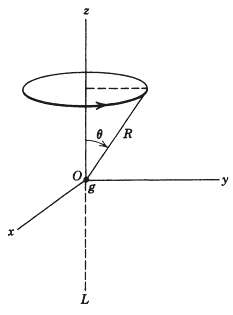
Consider the Dirac expression For the vector potential of a magnetic monopole and its associated string L. Suppose for definiteness that the monopole is located at the origin and the string along the negative z axis.(a) Calculate A explicitly and show that in spherical coordinates it has
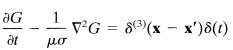
The homogeneous diffusion equation (5.160) for the vector potential for quasi-static fields in unbounded conducting media has a solution to the initial value problem ?of the form, A(x, t) = ? d3x' G(x - x', r)A(x', 0) where A(x', 0) describes the initial field configuration and G is an appropriate
A uniformly magnetized and conducting sphere of radius R and total magnetic moment m = 4?MR3/3 rotates about its magnetization axis with angular speed ?. In the steady state no current flows in the conductor. The motion is non-relativistic; the sphere has no excess charge on it. (a) By considering
A localized electric charge distribution produces an electrostatic field, E = –Ñф. Into this field is placed a small localized time-independent current density J(x), which generates a magnetic field H.(a) Show that the momentum of these electromagnetic fields, (6.117), can be transformed
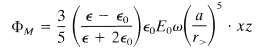
A dielectric sphere of dielectric constant e and radius a is located at the origin. There is a uniform applied electric field E0 in the x direction. The sphere rotates with an angular velocity ? about the z axis. Show that there is a magnetic field Where r> is the larger of r and a. The motion
Discuss the conservation of energy and linear momentum for a macroscopic system of sources and electromagnetic fields in a uniform, isotropic medium described by a permittivity e and a permeability /?. Show that in a straightforward calculation the energy density, Poynting vector, field-momentum
Part of a single rectangular loop of wire with dimensions shown in Fig. 21-51 is situated inside a region of uniform magnetic field of 0.550 T. The total resistance of the loop is 0.230 Ω. Calculate the force required to pull loop from the field (to the right) at a constant velocity of 3.40
Why must hospital personnel wear special conducting shoes while working around oxygen in an operating room. What might happen if the personnel wore shoes with rubber soles?
If a suspended object A is attracted to a charged object B, can we conclude that A is charged? Explain.
A spherical surface surrounds a point charge q. Describe what happens to the total flux through the surface if (a) The charge is tripled, (b) The volume of the sphere is doubled, (c) The surface is changed to a cube, (d) The charge is moved to another location inside the surface, and (e) The
An electron moving horizontally passes between two horizontal plates, the upper charged negatively, the lower positively. A uniform, upward-directed electric field exists in the region between the plates, and this field exerts an electric force downward on the electron. Describe the movement of
A charge of 4.5 × 10⁻⁹ C is located 3.2 m from a charge of − 2.8 × 10⁻⁹ C. Find the electrostatic force exerted by one charge on the other.
The Moon and Earth are bound together by gravity. If, instead, the force of attraction were the result of each having a charge of the same magnitude but opposite in sign, find the quantity of charge that would have to be placed on each to produce the required force.
An alpha particle (charge = + 2.0e) is sent at high speed toward a gold nucleus (charge = + 79e). What is the electrical force acting on the alpha particle when it is 2.0 × 10⁻¹⁴ m from the gold nucleus?
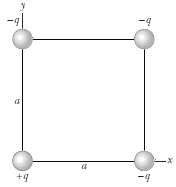
Four point charges are situated at the corners of a square with sides of length a, as in Figure. Find the expression for the resultant force on the positive chargeq.
The nucleus of 8Be, which consists of 4 protons and 4 neutrons, is very unstable and spontaneously breaks into two alpha particles (helium nuclei, each consisting of 2 protons and 2 neutrons). (a) What is the force between the two alpha particles when they are 5.00 × 10⁻¹⁵ m apart, and (b) What
A molecule of DNA (deoxyribonucleic acid) is 2.17 μm long. The ends of the molecule become singly ionized— negative on one end, positive on the other. The helical molecule acts like a spring and compresses 1.00% upon becoming charged. Determine the effective spring constant of the molecule.
Suppose that 1.00 g of hydrogen is separated into electrons and protons. Suppose also that the protons are placed at the Earth’s North Pole and the electrons are placed at the South Pole. What is the resulting compressional force on the Earth?
An electron is released a short distance above the surface of the Earth. A second electron directly below it exerts an electrostatic force on the first electron just great enough to cancel the gravitational force on it. How far below the first electron is the second?
Two identical conducting spheres are placed with their centers 0.30 m apart. One is given a charge of 12 × 10−9 C, the other a charge of −18 − 10−9 C. (a) Find the electrostatic force exerted on one sphere by the other. (b) The spheres are connected by a conducting wire. Find the
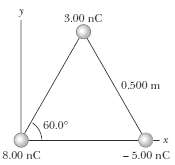
Calculate the magnitude and direction of the Coulomb force on each of the three charges shown inFigure.
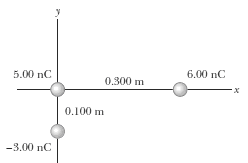
Three charges are arranged as shown in Figure. Find the magnitude and direction of the electrostatic force on the charge at theorigin.
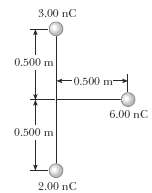
Three charges are arranged as shown in Figure. Find the magnitude and direction of the electrostatic force on the 6.00-nCcharge.
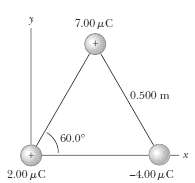
Three point charges are located at the corners of an equilateral triangle as in Figure. Calculate the net electric force on the 7.00-μC charge.
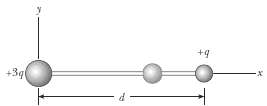
Two small beads having positive charges 3q and q are fixed at the opposite ends of a horizontal insulating rod, extending from the origin to the point x = d. As shown in Figure, a third small charged bead is free to slide on the rod. At what position is the third bead in equilibrium? Can it be in
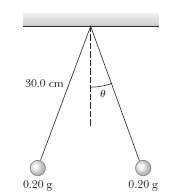
Two small metallic spheres, each of mass 0.20 g, are suspended as pendulums by light strings from a common point as shown in Figure. The spheres are given the same electric charge, and it is found that they come to equilibrium when each string is at an angle of 5.0? with the vertical. If each
A charge of 6.00 × 10⁻⁹ C and a charge of − 3.00 × 10⁻⁹ C are separated by a distance of 60.0 cm. Find the position at which a third charge, of 12.0 × 10⁻⁹ C, can be placed so that the net electrostatic force on it is zero.
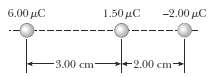
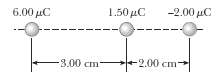
(a) Determine the electric field strength at a point 1.00 cm to the left of the middle charge shown in Figure.(b) If a charge of ?? 2.00 μC is placed at this point, what are the magnitude and direction of the force on it?
An airplane is flying through a thundercloud at a height of 2 000 m. (This is a very dangerous thing to do because of updrafts, turbulence, and the possibility of electric discharge.) If there are charge concentrations of + 40.0 C at a height of 3 000 m within the cloud and − 40.0 C at a height
An electron is accelerated by a constant electric field of magnitude 300 N/C. (a) Find the acceleration of the electron. (b) Use the equations of motion with constant acceleration to find the electron’s speed after 1.00 × 10⁻⁸ s, assuming it starts from rest.
Each of the protons in a particle beam has a kinetic energy of 3.25 × 10⁻¹⁵ J. What are the magnitude and direction of the electric field that will stop these protons in a distance of 1.25 m?
A proton accelerates from rest in a uniform electric field of 640 N/C. At some later time, its speed is 1.20 × 10⁶ m/s. (a) Find the magnitude of the acceleration of the proton.(b) How long does it take the proton to reach this speed?(c) How far has it moved in that interval? (d) What is its
Three charges are at the corners of an equilateral triangle, as shown in Figure. Calculate the electric field at a point midway between the two charges on the x-axis.
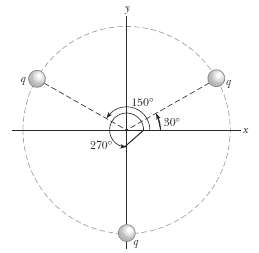
Three identical charges (q = ?? 5.0 μC) lie along a circle of radius 2.0 m at angles of 30?, 150?, and 270?, as shown in Figure. What is the resultant electric field at the center of the circle?
Two point charges lie along the y -axis. A charge of q1 = − 9.0 μ C is at y = 6.0 m, and a charge of q2 = − 8.0 μ C is at y = − 4.0 m. Locate the point (other than infinity) at which the total electric field is zero.
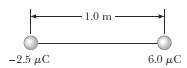
In Figure, determine the point (other than infinity) at which the total electric field is zero.
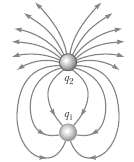
Figure shows the electric field lines for two point charges separated by a small distance.(a) Determine the ratio q1 /q2.(b) What are the signs of q1 and q2?
(a) Sketch the electric field lines around an isolated point charge q> 0. (b) Sketch the electric field pattern around an isolated negative point charge of magnitude − 2q.
(a) Sketch the electric field pattern around two positive point charges of magnitude 1 μC placed close together. (b) Sketch the electric field pattern around two negative point charges of − 2 μC, placed close together. (c) Sketch the pattern around two point charges of + 1 μC and − 2 μC,
Two point charges are a small distance apart. (a) Sketch the electric field lines for the two if one has a charge four times that of the other and both charges are positive. (b) Repeat for the case in which both charges are negative.
(a) Sketch the electric field pattern set up by a positively charged hollow sphere. Include regions inside and regions outside the sphere. (b) A conducting cube is given a positive charge. Sketch the electric field pattern both inside and outside the cube.
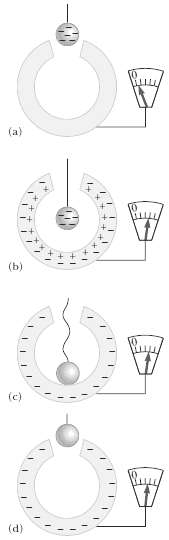
Refer to Figure. The charge lowered into the center of the hollow conductor has a magnitude of 5 μC. Find the magnitude and sign of the charge on the inside and outside of the hollow conductor when the charge is as shown in(a) Figure a. and(b) Figure b.(c) Figure c. and(d) Figured.
The dome of a Van de Graaff generator receives a charge of 2.0 × 10⁻⁴ C. Find the strength of the electric field (a) Inside the dome; (b) At the surface of the dome, assuming it has a radius of 1.0 m; and (c) 4.0 m from the center of the dome. [Hint: See Section 15.6 to review properties of
If the electric field strength in air exceeds 3.0 × 10⁶ N/C, the air becomes a conductor. Using this fact, determine the maximum amount of charge that can be carried by a metal sphere 2.0 m in radius. (See the hint in Problem 34.)
In the Millikan oil drop experiment, an atomizer (a sprayer with a fine nozzle) is used to introduce many tiny droplets of oil between two oppositely charged parallel metal plates. Some of the droplets pick up one or more excess electrons. The charge on the plates is adjusted so that the electric
A Van de Graaff generator is charged so that the electric field at its surface is 3.0 × 10⁴ N/C. Find(a) The electric force exerted on a proton released at its surface and(b) The acceleration of the proton at that instant of time.
A flat surface having an area of 3.2 m2 is rotated in a uniform electric field of magnitude E = 6.2 × 10⁵ N/C. Determine the electric flux through this area (a) When the electric field is perpendicular to the surface and (b) When the electric field is parallel to the surface.
Showing 5000 - 5100
of 8940
First
44
45
46
47
48
49
50
51
52
53
54
55
56
57
58
Last
Step by Step Answers

 Get 50% OFF
Claim Now
Get 50% OFF
Claim Now





.PNG)





.PNG)