New Semester
Started
Get
50% OFF
Study Help!
--h --m --s
Claim Now
Question Answers
Textbooks
Find textbooks, questions and answers
Oops, something went wrong!
Change your search query and then try again
S
Books
FREE
Study Help
Expert Questions
Accounting
General Management
Mathematics
Finance
Organizational Behaviour
Law
Physics
Operating System
Management Leadership
Sociology
Programming
Marketing
Database
Computer Network
Economics
Textbooks Solutions
Accounting
Managerial Accounting
Management Leadership
Cost Accounting
Statistics
Business Law
Corporate Finance
Finance
Economics
Auditing
Tutors
Online Tutors
Find a Tutor
Hire a Tutor
Become a Tutor
AI Tutor
AI Study Planner
NEW
Sell Books
Search
Search
Sign In
Register
study help
physics
electricity and magnetism
Fundamentals of Ethics for Scientists and Engineers 1st Edition Edmund G. Seebauer, Robert L. Barry - Solutions
Repeat Problem 44 if the wire is bent into an equilateral triangle of sides 8 cm.
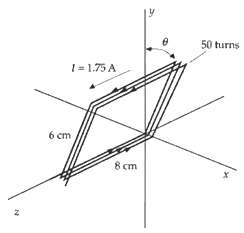
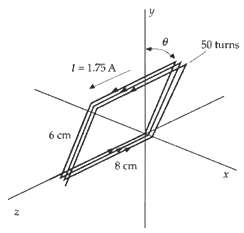
A rectangular, 50-turn coil has sides 6.0 and 8.0 cm long and carries a current of 1.75 A. It is oriented as shown in Figure and pivoted about the z axis. (a) If the wire in the xy plane makes an angle ? = 37o with the y axis as shown, what angle does the unit normal n make with the x axis? (b)
The coil in Problem 47 is pivoted about the z?axis and held at various positions in a uniform magnetic field B?= 2.0 T j. Sketch the position of the coil and find the torque exerted when the unit normal is (a) n?= i, (b) n?= j, (c) n?= ? j, and (d) n = (i + j) / ?2 .
The SI unit for the magnetic moment of a current loop is A • m2. Use this to show that 1 T = 1 N/A • m.
A small magnet of length 6.8 cm is placed at an angle of 60o to the direction of a uniform magnetic field of magnitude 0.04 T. The observed torque has a magnitude of 0.10 N · m. Find the magnetic moment of the magnet.
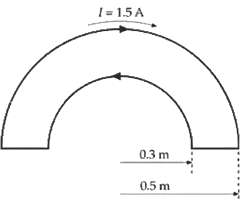
A wire loop consists of two semicircles connected by straight segments (Figure). The inner and outer radii are 0.3 and 0.5 m, respectively. A current of 1.5 A flows in this loop with the current in the outer semicircle in the clockwise direction. What is the magnetic moment of this currentloop?
A wire of length L is wound into a circular coil of N loops. Show that when this coil carries a current I, its magnetic moment has the magnitude IL2/4πN.
A particle of charge q and mass m moves in a circle of radius r and with angular velocity ω.(a) Show that the average current is I = qω/2π and that the magnetic moment has the magnitude μ = ½qωr2.(b) Show that the angular momentum of this particle has the magnitude L = mr2ω and that the
A single loop of wire is placed around the circumference of a rectangular piece of cardboard whose length and width are 70 and 20 cm, respectively. The cardboard is now folded along a line perpendicular to its length and midway between the two ends so that the two planes formed by the folded
Repeat Problem 54 if the line along which the cardboard is folded is 40 cm from one end.
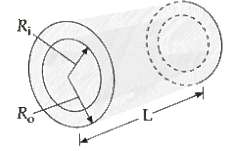
A hollow cylinder has length L and inner and outer radii Ri and Ro, respectively (Figure). The cylinder carries a uniform charge density ?. Derive an expression for the magnetic moment as a function of ?, the angular velocity of rotation of the cylinder about its axis.
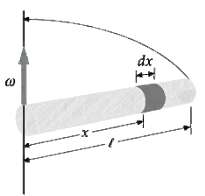
A nonconducting rod of mass M and length ? has a uniform charge per unit length ? and rotates with angular velocity ? about an axis through one end and perpendicular to the rod. (a) Consider a small segment of the rod of length dx and charge dq = ? dx at a distance x from the pivot (Figure). Show
A nonuniform, nonconducting disk of mass M, radius R, and total charge Q has a surface charge density σ = σ0r/R and a mass per unit area σm = (M/Q)σ. The disk rotates with angular velocity ω about its axis.(a) Show that the magnetic moment of the disk has a magnitude μ = 1/5 πωσ0R4 = 3/10
A spherical shell of radius R carries a surface charge density σ. The sphere rotates about its diameter with angular velocity ω. Find the magnetic moment of the rotating sphere.
A solid sphere of radius R carries a uniform volume charge density ρ. The sphere rotates about its diameter with angular velocity ω. Find the magnetic moment of this rotating sphere.
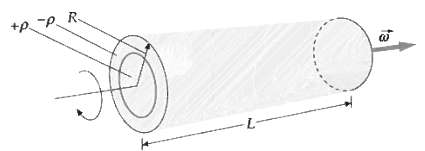
A solid cylinder of radius R and length L carries a uniform charge density +ρ between r = 0 and r = Rs and an equal charge density of opposite sign, –ρ, between r = Rs and r = R. What must be the radius Rs so that on rotation of the cylinder about its
A solid cylinder of radius R?and length L?carries a uniform charge density ??= ??0 between r?= 0 and r = ? R?and a positive charge density of equal magnitude, +?0, between r = ?R and r = R (Figure). The cylinder rotates about its axis with angular velocity ?. Derive an expression for the magnetic
A cylindrical shell of length L with inner radius Ri and outer radius Ro carries a uniform charge density, +ρ0, between Ri and radius Rs and an equal charge density of opposite sign, –ρ0, between Rs and Ro. The cylinder rotates about its axis with angular velocity ω. Derive an expression for
A solid sphere of radius R carries a uniform charge density, +ρ0, between r = 0 and r = Rs and an equal charge density of opposite sign, –ρ0, between r = Rs and r = R. The sphere rotates about its diameter with angular velocity ω. Find Rs such that magnetic moment of the sphere is zero. What
A solid sphere of radius R carries a uniform charge density, +ρ0, between r = 0 and r = ½ R and an equal charge density of opposite sign, –ρ0, between r = ½R and r = R. The sphere rotates about its diameter with angular velocity ω. Derive an expression for the magnetic moment of this
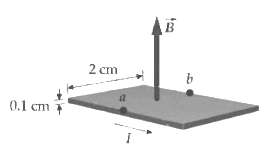
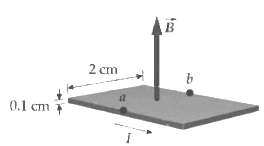
A metal strip 2.0 cm wide and 0.1 cm thick carries a current of 20 A in a uniform magnetic field of 2.0 T, as shown in Figure. The Hall voltage is measured to be 4.27 ?V. (a) Calculate the drift velocity of the electrons in the strip. (b) Find the number density of the charge carriers in the
The number density of free electrons in copper is 8.47 ?? 1022 electrons per cubic centimeter. If the metal strip in Figure is copper and the current is 10 A, find (a) The drift velocity vd and (b) The Hall voltage.
Because blood contains charged ions, moving blood develops a Hall voltage across the diameter of an artery. A large artery with a diameter of 0.85 cm has a flow speed of 0.6 m/s. If a section of this artery is in a magnetic field of 0.2 T, what is the potential difference across the diameter of the
The Hall coefficient R is defined as R = Ey / JxBz , where Jx is the current per unit area in the x direction in the slab, Bz is the magnetic field in the z direction, and Ey is the resulting Hall field in the y direction. Show that the Hall coefficient is 1/nq, where q is the charge of the charge
Aluminum has a density of 2.7 × 10³ kg/m3 and a molar mass of 27 g/mol. The Hall coefficient of aluminum is R = –0.3 × 10⁻¹⁰ m3/C. (See Problem 70 for the definition of R.) Find the number of conduction electrons per aluminum atom.
Magnesium is a divalent metal. Its density is 1.74 × 10³ kg/m3 and its molar mass is 24.3 g/mol. Assuming that each magnesium atom contributes two conduction electrons, what should be the Hall coefficient of magnesium? How does your result compare to the measured value of –0.94 × 10⁻¹⁰ m3/C?
Show that the force on a current element is the same in direction and magnitude regardless of whether positive charges, negative charges, or a mixture of positive and negative charges create the current.
How are magnetic field lines similar to electric field lines? How are they different?
A long wire parallel to the x axis carries a current of 6.5 A in the positive x direction. There is a uniform magnetic field B = 1.35 T j. Find the force per unit length on the wire.
An alpha particle (charge +2e) travels in a circular path of radius 0.5 m in a magnetic field of 1.0 T. Find(a) The period,(b) The speed, and(c) The kinetic energy (in electron volts) of the alpha particle. Take m = 6.65 × 10– 27 kg for the mass of the alpha particle.
The pole strength qm of a bar magnet is defined by qm = |μ|/L, where L is the length of the magnet. Show that the torque exerted on a bar magnet in a uniform magnetic field B is the same as if a force +qm B is exerted on the north pole and a force –qmB is exerted on the south pole.
A particle of mass m and charge q enters a region where there is a uniform magnetic field B along the x axis. The initial velocity of the particle is v = v0x i + v0y j so the particle moves in a helix.(a) Show that the radius of the helix is r = mv0y
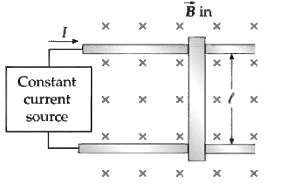
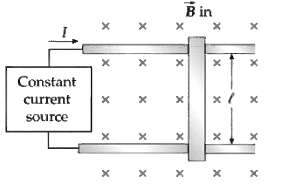
A metal crossbar of mass M rides on a pair of long, horizontal conducting rails separated by a distance ? and connected to a device that supplies constant current I to the circuit, as shown in Figure. A uniform magnetic field B is established as shown. (a) If there is no friction and the bar starts
Assume that the rails in Figure are frictionless but tilted upward so that they make an angle ? with the horizontal. (a) What vertical magnetic field B is needed to keep the bar from sliding down the rails? (b) What is the acceleration of the bar if B has twice the value found in part (a)?
A long, narrow bar magnet that has magnetic moment parallel to its long axis is suspended at its center as a frictionless compass needle. When placed in a magnetic field B, the needle lines up with the field. If it is displaced by a small angle θ, show that the needle will oscillate about its
A conducting wire is parallel to the y axis. It moves in the positive x direction with a speed of 20 m/s in a magnetic field B = 0.5 T k.(a) What are the magnitude and direction of the magnetic force on an electron in the conductor?(b) Because of this magnetic force, electrons move to one end of
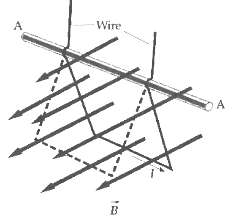
The rectangular frame in Figure is free to rotate about the axis A-A on the horizontal shaft. The frame is 10 cm long and 6 cm wide and the rods that make up the frame have a mass per unit length of 20 g/cm. A uniform magnetic field B?= 0.2 T is directed as shown. A current may be sent around the
A stiff, straight, horizontal wire of length 25 cm and mass 20 g is supported by electrical contacts at its ends, but is otherwise free to move vertically upward. The wire is in a uniform, horizontal magnetic field of magnitude 0.4 T perpendicular to the wire. A switch connecting the wire to a
A solid sphere of radius R carries a charge density –ρ0 in the region r = 0 to r = Rs and an equal charge density of opposite sign, +ρ0, between r = Rs and r = R. The net charge carried by the sphere is zero.(a) What must be the ratio R/Rs?(b) If this sphere rotates
A circular loop of wire with mass M carries a current I in a uniform magnetic field. It is initially in equilibrium with its magnetic moment vector aligned with the magnetic field. The loop is given a small twist about a diameter and then released. What is the period of the motion?
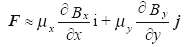
A small bar magnet has a magnetic moment I?B that makes an angle ??with the x?axis and lies in a nonuniform magnetic field given by B = Bx (x)i + By(y)j. Use Fx = ? dU/dx?and Fy = ? dU/dy to show that there is a net force on the magnet that is given by
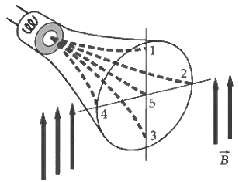
(Multiple choice) (1) When a cathode-ray tube is placed horizontally in a magnetic field that is directed vertically upward, the electrons emitted from the cathode follow one of the dashed paths to the face of the tube in Figure. The correct path is __________.? (a) 1? (d) 4? (b) 2? (e) 5? (c)
Compare the directions of the electric and magnetic forces between two positive charges, which move along parallel paths(a) In the same direction, and(b) In opposite directions.
At time t = 0, a particle with charge q = 12 μC is located at x = 0, y = 2 m; its velocity at that time is v = 30 m/s i. Find the magnetic field at(a) The origin(b) x = 0, y = 1 m(c) x = 0, y = 3 m; and(d) x = 0, y = 4 m.
For the particle in Problem 2, find the magnetic field at(a) x = 1 m, y = 3 m(b) x = 2 m, y = 2 m and(c) x = 2 m, y = 3 m.
A proton (charge +e) traveling with a velocity of v = 1 × 10⁴ m/s i + 2 × 10⁴ m/s j is located at x = 3 m, y = 4 m at some time t. Find the magnetic field at the following positions:(a) x = 2 m, y = 2 m(b) x = 6 m, y = 4 m; and(c) x = 3 m, y = 6 m.
An electron orbits a proton at a radius of 5.29 × 10⁻¹¹ m. What is the magnetic field at the proton due to the orbital motion of the electron?
Two equal charges q located at (0, 0, 0) and (0, b, 0) at time zero are moving with speed v in the positive x direction (v << c). Find the ratio of the magnitudes of the magnetic and electrostatic force on each.
A small current element I dℓ, with dℓ = 2 mm k and I = 2 A, is centered at the origin. Find the magnetic field dB at the following points:(a) On the x axis at x = 3 m,(b) On the x axis at x = –6 m,(c) On the z axis at z = 3 m, and(d) On the y axis at y = 3 m.
For the current element in Problem 8, find the magnitude and direction of dB at x = 0, y = 3 m, z = 4 m.
For the current element in Problem 8, find the magnitude of dB and indicate its direction on a diagram at(a) x = 2 m, y = 4 m, z = 0 and(b) x = 2 m, y = 0, z = 4 m.
A single loop of wire of radius 3 cm carries a current of 2.6 A. What is the magnitude of B on the axis of the loop at(a) The center of the loop,(b) 1 cm from the center,(c) 2 cm from the center, and(d) 35 cm from the center?
A single-turn, circular loop of radius 10.0 cm is to produce a field at its center that will just cancel the earth's magnetic field at the equator, which is 0.7 G directed north. Find the current in the loop and make a sketch showing the orientation of the loop and the current.
For the loop of wire in Problem 13, at what point along the axis of the loop is the magnetic field(a) 10% of the field at the center,(b) 1% of the field at the center, and(c) 0.1% of the field at the center?
A single-turn circular loop of radius 8.5 cm is to produce a field at its center that will just cancel the earth's field of magnitude 0.7 G directed at 70o below the horizontal north direction. Find the current in the loop and make a sketch showing the orientation of the loop and the current.
A circular current loop of radius R carrying a current I is centered at the origin with its axis along the x axis. Its current is such that it produces a magnetic field in the positive x direction.(a) Sketch a graph of Bx versus x for points on the x axis. Include both positive and negative values
Two coils that are separated by a distance equal to their radius and that carry equal currents such that their axial fields add are called Helmholtz coils. A feature of Helmholtz coils is that the resultant magnetic field between the coils is very uniform. Let R = 10 cm, I = 20 A, and N = 300 turns
Two Helmholtz coils with radii R have their axes along the x axis (see Problem 17). One coil is in the yz plane and the other is in a parallel plane at x = R. Show that at the midpoint of the coils (x = ½R), dBx/dx = 0, d2Bx/dx2 = 0, and d3Bx/dx3 = 0. This shows that the magnetic field at points
A long, straight wire carries a current of 10 A. Find the magnitude of B at(a) 10 cm,(b) 50 cm, and(c) 2 m from the center of the wire.
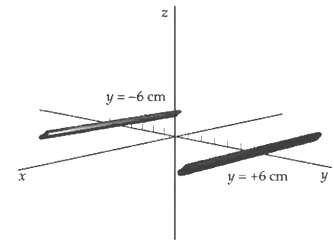
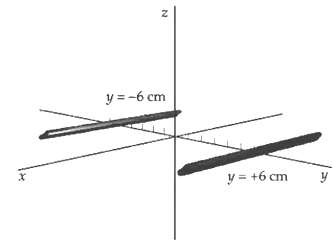
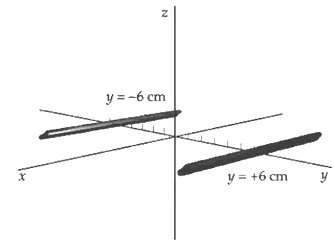
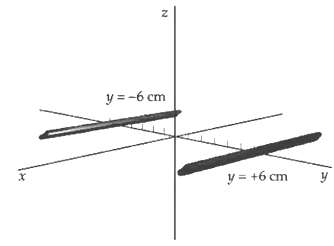
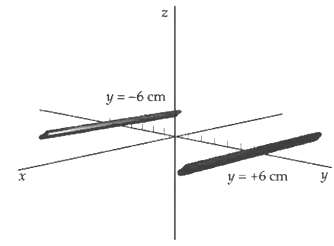
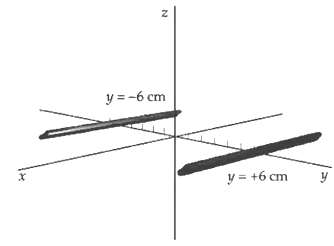
If the currents in Figure are in the negative x?direction, find B?at the points on the y?axis at (a) y?= ?3 cm, (b) y?= 0, (c) y?= +3 cm, and (d) y = +9 cm.
Sketch Bz versus y for points on the y axis when both currents are in the negative x direction.
Find B at points on the y axis as in Problem 24 when the current in the wire at y = ?6 cm is in the negative x direction and the current in the wire at y = +6 cm is in the positive x direction. Use the results of Problem 24 but reverse the direction of B+.
Sketch Bz versus y for points on the y axis when the directions of the currents are opposite to those in Problem 26.
Find B on the z axis at z = +8 cm if (a) The currents are parallel, as in Problem 24 and (b) The currents are antiparallel, as in Problem 26.
Find the magnitude of the force per unit length exerted by one wire on the other.
Two long, straight, parallel wires 8.6 cm apart carry currents of equal magnitude I. They repel each other with a force per unit length of 3.6 nN/m.(a) Are the currents parallel or antiparallel?(b) Find I.
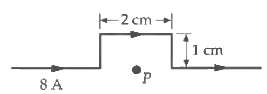
The current in the wire of Figure is 8.0 A. Find B at point P due to each wire segment and sum to find the resultant B.
A wire of length 16 cm is suspended by flexible leads above a long, straight wire. Equal but opposite currents are established in the wires such that the 16-cm wire floats 1.5 mm above the long wire with no tension in its suspension leads. If the mass of the 16-cm wire is 14 g, what is the current?
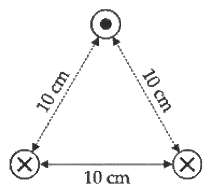
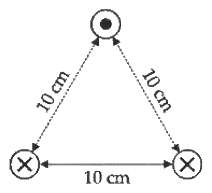
Three long, parallel, straight wires pass through the corners of an equilateral triangle of sides 10 cm as shown in Figure, where a dot means that the current is out of the paper and a cross means that it is into the paper. If each current is 15.0 A, find (a) The force per unit length on the upper
Work Problem 33 with the current in the lower right corner of Figure reversed.
An infinitely long wire lies along the z axis and carries a current of 20 A in the positive z direction. A second infinitely long wire is parallel to the z axis at x = 10 cm.(a) Find the current in the second wire if the magnetic field at x = 2 cm is zero.(b) What is the magnetic field at x = 5 cm?
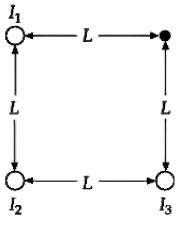
Three very long, parallel wires are at the corners of a square, as shown in Figure. They each carry a current of magnitude I. Find the magnetic field B?at the unoccupied corner of the square when (a) All the currents are into the paper, (b) I1 and I3 are in and I2 is out, and (c) I1 and I2 are in
Four long, straight, parallel wires each carry current I. In a plane perpendicular to the wires, the wires are at the corners of a square of side a. Find the force per unit length on one of the wires if(a) All the currents are in the same direction, and(b) The currents in the wires at adjacent
An infinitely long, nonconducting cylinder of radius R lies along the z axis. Five long, conducting wires are parallel to the cylinder and spaced equally on the upper half of its surface. Each wire carries a current I in the positive z direction. Find the magnetic field on the z axis.
A solenoid with length 30 cm, radius 1.2 cm, and 300 turns carries a current of 2.6 A. Find B on the axis of the solenoid(a) At the center,(b) Inside the solenoid at a point 10 cm from one end, and(c) At one end.
A solenoid 2.7 m long has a radius of 0.85 cm and 600 turns. It carries a current I of 2.5 A. What is the approximate magnetic field B on the axis of the solenoid?
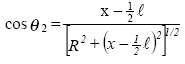
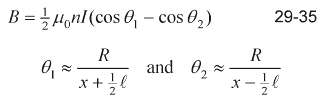
A solenoid has n turns per unit length and radius R and carries a current I. Its axis is along the x axis with one end at x = ??? and the other end at x = +?? where ? is the total length of the solenoid. Show that the magnetic field B at a point on the axis outside the solenoid is given
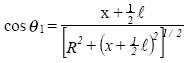
In Problem 42, a formula for the magnetic field along the axis of a solenoid is given. For x?>> ??and ??> R, the angles ?1 and ?2 in Equation 29-35 are very small, so the small-angle approximation cos ? ? 1 ? ?2/2 is valid. (a) Draw a diagram and show that (b) Show that the magnetic field
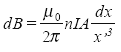
In this problem, you will derive Equation 29-37 by another method. Consider a long, tightly wound solenoid of length l and radius R
A long, straight, thin-walled, cylindrical shell of radius R carries a current I. Find B inside and outside the cylinder.
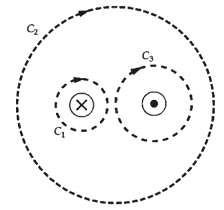
In Figure, one current is 8 A into the paper, the other current is 8 A out of the paper, and each curve is a circular path. (a) Find ?CB?d? for each path indicated. (b) Which path, if any, can be used to find B?at some point due to these currents?
A very long, coaxial cable consists of an inner wire and a concentric outer cylindrical conducting shell of radius R. At one end, the wire is connected to the shell. At the other end, the wire and shell are connected to opposite terminals of a battery, so there is a current down the wire and back
A wire of radius 0.5 cm carries a current of 100 A that is uniformly distributed over its cross-sectional area. Find B(a) 0.1 cm from the center of the wire,(b) At the surface of the wire, and(c) At a point outside the wire 0.2 cm from the surface of the wire.(d) Sketch a graph of B versus the
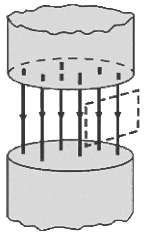
Show that a uniform magnetic field with no fringing field, such as that shown in Figure, is impossible because it violates Ampere's law. Do this by applying Ampere's law to the rectangular curve shown by the dashedlines.
A coaxial cable consists of a solid inner cylindrical conductor of radius 1.00 mm and an outer cylindrical shell conductor of inner radius 2.00 mm and outer radius 3.00 mm. There is a current of 18 A down the inner wire and an equal return current in the outer conductor. The currents are uniform
An infinitely long, thick, cylindrical shell of inner radius a and outer radius b carries a current I uniformly distributed across a cross section of the shell. Find the magnetic field for(a) r < a,(b) a < r < b, and(c) r > b.
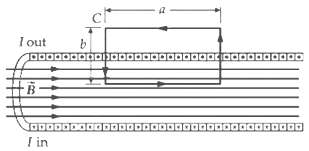
Figure shows a solenoid carrying a current I with n turns per unit length. Apply Ampere's law to the rectangular curve shown to derive an expression for B assuming that it is uniform inside the solenoid and zero outsideit.
A tightly wound toroid of inner radius 1 cm and outer radius 2 cm has 1000 turns of wire and carries a current of 1.5 A.(a) What is the magnetic field at a distance of 1.1 cm from the center?(b) What is the field 1.5 cm from the center?
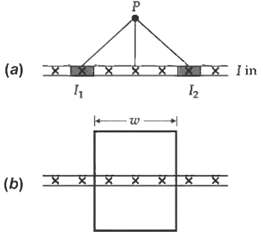
The xz plane contains an infinite sheet of current in the positive z direction. The current per unit length (along the x direction) is ?. Figure(a) shows a point P above the sheet (y > 0) and two portions of the current sheet labeled I1 and I2. (a) What is the direction of the magnetic field B
A tightly wound solenoid 20 cm long has 400 turns and carries a current of 4 A such that its axial field is in the z direction. Neglecting end effects, find B and Bapp at the center when(a) There is no core in the solenoid, and(b) There is an iron core with a magnetization M = 1.2 × 10⁶ A/m.
If the solenoid of Problem 58 has an aluminum core, find Bapp, M, and B at the center, neglecting end effects.
Repeat Problem 60 for a tungsten core.
A long solenoid is wound around a tungsten core and carries a current.(a) If the core is removed while the current is held constant, does the magnetic field inside the solenoid decrease or increase?(b) By what percentage?
When a sample of liquid is inserted into a solenoid carrying a constant current, the magnetic field inside the solenoid decreases by 0.004% what is the magnetic susceptibility of the liquid?
A long solenoid carrying a current of 10 A has 50 turns/cm. What is the magnetic field in the interior of the solenoid when the interior is(a) A vacuum,(b) Filled with aluminum, and(c) Filled with silver?
An engineer intends to fill a solenoid with a mixture of oxygen and nitrogen at room temperature and 1 atmosphere pressure such that Km is exactly 1. Assume that the magnetic dipole moments of the gas molecules are all aligned and that the susceptibility of a gas is proportional to the number
A cylinder of magnetic material is placed in a long solenoid of n turns per unit length and current I. Table 29- 3 gives the magnetic field B versus nI. Use these values to plot B versus Bapp and Km versus nI.
A small magnetic sample is in the form of a disk having a radius of 1.4 cm, a thickness of 0.3 cm, and a uniform magnetization along its axis throughout its volume. The magnetic moment of the sample is 1.5 × 10⁻² A • m2.(a) What is the magnetization M of the sample?(b) If this magnetization is
The magnetic moment of the earth is about 9 × 10²² A · m2.(a) If the magnetization of the earth's core were 1.5 × 10⁹ A/m, what is the core volume?(b) What is the radius of such a core if it were spherical and centered with the earth?
Nickel has a density of 8.7 g/cm3 and molecular mass of 58.7 g/mol. Its saturation magnetization is given by μ0Ms = 0.61 T. Calculate the magnetic moment of a nickel atom in Bohr magnetons.
Showing 4700 - 4800
of 8940
First
41
42
43
44
45
46
47
48
49
50
51
52
53
54
55
Last
Step by Step Answers

 Get 50% OFF
Claim Now
Get 50% OFF
Claim Now




-2.PNG)