New Semester
Started
Get
50% OFF
Study Help!
--h --m --s
Claim Now
Question Answers
Textbooks
Find textbooks, questions and answers
Oops, something went wrong!
Change your search query and then try again
S
Books
FREE
Study Help
Expert Questions
Accounting
General Management
Mathematics
Finance
Organizational Behaviour
Law
Physics
Operating System
Management Leadership
Sociology
Programming
Marketing
Database
Computer Network
Economics
Textbooks Solutions
Accounting
Managerial Accounting
Management Leadership
Cost Accounting
Statistics
Business Law
Corporate Finance
Finance
Economics
Auditing
Tutors
Online Tutors
Find a Tutor
Hire a Tutor
Become a Tutor
AI Tutor
AI Study Planner
NEW
Sell Books
Search
Search
Sign In
Register
study help
physics
electricity and magnetism
College Physics 7th Edition Raymond A. Serway, Jerry S. Faughn, Chris Vuille, Charles A. Bennett - Solutions
An electric field of intensity 3.50 kN/C is applied along the x-axis. Calculate the electric flux through a rectangular plane 0.350 m wide and 0.700 m long if(a) The plane is parallel to the yz-plane;(b) The plane is parallel to the xy-plane; and(c) The plane contains the y-axis, and its normal
The electric field everywhere on the surface of a thin spherical shell of radius 0.750 m is measured to be equal to 890 N/C and points radially toward the center of the sphere.(a) What is the net charge within the sphere’s surface?(b) What can you conclude about the nature and distribution of
A 40-cm-diameter loop is rotated in a uniform electric field until the position of maximum electric flux is found. The flux in that position is measured to be 5.2 × 10⁵ N ∙ m2/C. Calculate the electric field strength in this region.
A point charge q is located at the center of a spherical shell of radius a that has a charge − q uniformly distributed on its surface. Find the electric field(a) For all points outside the spherical shell and (b) For a point inside the shell a distance r from the center.
An infinite plane conductor has charge spread out on its surface as shown in Figure. Use Gauss’s law to show that the electric field at any point outside the conductor is given by E = σ/ε0, where
Show that the electric field just outside the surface of a good conductor of any shape is given by E = σ/ε0, where is the charge per unit area on the conductor. [Hint: The electric field just outside the surface of a charged conductor is perpendicular to its surface.]
Two protons in an atomic nucleus are typically separated by a distance of 2 × 10⁻¹⁵ m. The electric repulsion force between the protons is huge, but the attractive nuclear force is even stronger and keeps the nucleus from bursting apart. What is the magnitude of the electrical force between two
In the Bohr theory of the hydrogen atom, an electron moves in a circular orbit about a proton. The radius of the orbit is 0.53 _ 10_10 m. (a) Find the electrostatic force acting on each particle. (b) If this force causes the centripetal acceleration of the electron, what is the speed of the
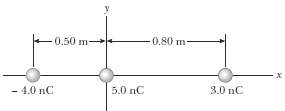
Three point charges are aligned along the x -axis as shown in Figure. Find the electric field at the position x = + 2.0 m, y =0.
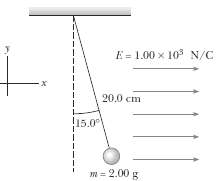
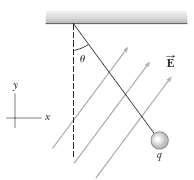
A small 2.00-g plastic ball is suspended by a 20.0-cm-long string in a uniform electric field, as shown in Figure. If the ball is in equilibrium when the string makes a 15.0? angle with the vertical as indicated, what is the net charge on theball?
(a) Two identical point charges + q are located on the y -axis at y = + a and y = − a. What is the electric field along the x -axis at x = b? (b) A circular ring of charge of radius a has a total positive charge Q distributed uniformly around it. The ring is in the x = 0 plane with its center
A positively charged bead having a mass of 1.00 g falls from rest in a vacuum from a height of 5.00m in a uniform vertical electric field with a magnitude of 1.00 × 10⁴ N/C. The bead hits the ground at a speed of 21.0 m/s. Determine (a) The direction of the electric field (upward or downward),
A solid conducting sphere of radius 2.00 cm has a charge of 8.00 μC. A conducting spherical shell of inner radius 4.00cm and outer radius 5.00cm is concentric with the solid sphere and has a charge of − 4.00 μC. Find the electric field at (a) r = 1.00 cm, (b) r
Two small silver spheres, each with a mass of 100 g, are separated by 1.00 m. Calculate the fraction of the electrons in one sphere that must be transferred to the other in order to produce an attractive force of 1.00 × 10⁴ N (about a ton) between the spheres. (The number of electrons per atom of
A 2.00-μC charged 1.00-g cork ball is suspended vertically on a 0.500-m-long light string in the presence of a uniform downward-directed electric field of magnitude E = 1.00 × 10⁵ N/C. If the ball is displaced slightly from the vertical, it oscillates like a simple pendulum. (a) Determine the
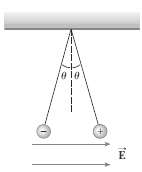
Two 2.0-g spheres are suspended by 10.0-cm-long light strings (Fig.). A uniform electric field is applied in the x-direction. If the spheres have charges of ?? 5.0 × 10??8 C and + 5.0 × 10??8 C, determine the electric field intensity that enables the spheres to be in equilibrium at θ =10?.
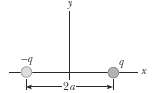
Two point charges like those in Figure are called an electric dipole. Show that the electric field at a distant point along the x-axis is given by Ex = 4keqa/x3.
A charged cork ball of mass 1.00 g is suspended on a light string in the presence of a uniform electric field as in Figure. When the electric field has an x-component of 3.00 × 10⁵ N/C and a y -component of 5.00 × 10⁵ N/C, the ball is in equilibrium at θ = 37.0?. Find(a) The charge on the ball
A point charge of magnitude 5.00 μC is at the origin of a coordinate system, and a charge of − 4.00 μC is at the point x = 1.00 m. There is a point on the x-axis, at x less than infinity, where the electric field goes to zero. (a) Show by conceptual arguments that this point cannot be located
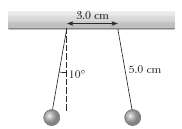
Two hard rubber spheres of mass 15 g are rubbed vigorously with fur on a dry day and are then suspended from a rod with two insulating strings of length 5.0 cm. They are observed to hang at equilibrium as shown in Figure, each at an angle of 10? with the vertical. Estimate the amount of charge that
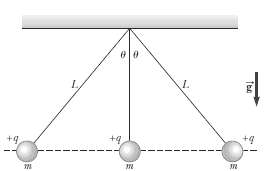
Three identical point charges, each of mass m = 0.100 kg, hang from three strings, as shown in Figure. If the lengths of the left and right strings are each L = 30.0 cm, and if the angle θ is 45.0?, determine the value ofq.
Each of the electrons in a particle beam has a kinetic energy of 1.60 × 10⁻¹⁷ J. (a) What is the magnitude of the uniform electric field (pointing in the direction of the electrons’ movement) that will stop these electrons in a distance of 10.0 cm? (b) How long will it take to stop the
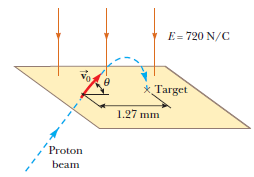
Protons are projected with an initial speed υ0 = 9 550 m/s into a region where a uniform electric field E = 720 N/C is present (Figure.). The protons are to hit a target that lies a horizontal distance of 1.27 mm from the point where the protons are launched. Find (a) The two projection
An object with a net charge of 24 μC is placed in a uniform electric field of 610 N/C, directed vertically. What is the mass of the object if it “floats” in the electric field?
A Styrofoam ® ball covered with a conducting paint has a mass of 5.0 × 10⁻³ kg and has a charge of 4.0 μC. What electric field directed upward will produce an electric force on the ball that will balance its weight?
A point charge of + 5.00 μC is located at the center of a sphere with a radius of 12.0 cm. Determine the electric flux through the surface of the sphere.
Use Gauss’s law and the fact that the electric field inside any closed conductor in electrostatic equilibrium is zero to show that any excess charge placed on the conductor must reside on its surface.
A vertical electric field of magnitude 2.00 × 10⁴ N/C exists above the Earth’s surface on a day when a thunderstorm is brewing. A car with a rectangular size of 6.00 m by 3.00 m is traveling along a roadway sloping downward at 10.0°. Determine the electric flux through the bottom of the car.
A proton moves 2.00 cm parallel to a uniform electric field of E = 200 N/C.(a) How much work is done by the field on the proton?(b) What change occurs in the potential energy of the proton?(c) What potential difference did the proton move through?
A uniform electric field of magnitude 250 V/m is directed in the positive x-direction. A 12-µC charge moves from the origin to the point (x, y) = (20 cm, 50 cm). (a) What was the change in the potential energy of this charge?(b) Through what potential difference did the charge move?
A potential difference of 90 mV exists between the inner and outer surfaces of a cell membrane. The inner surface is negative relative to the outer surface. How much work is required to eject a positive sodium ion (Na+) from the interior of the cell?
An ion accelerated through a potential difference of 60.0 V has its potential energy decreased by 1.92 x 10⁻¹⁷ J. Calculate the charge on the ion.
The potential difference between the accelerating plates of a TV set is about 25 kV. If the distance between the plates is 1.5 cm, find the magnitude of the uniform electric field in the region between the plates.
To recharge a 12-V battery, a battery charger must move 3.6 x 10⁵ C of charge from the negative terminal to the positive terminal. How much work is done by the charger? Express your answer in joules.
Oppositely charged parallel plates are separated by 5.33 mm. A potential difference of 600 V exists between the plates. (a) What is the magnitude of the electric field between the plates? (b) What is the magnitude of the force on an electron between the plates?(c) How much work must be done on the
(a) Calculate the speed of a proton that is accelerated from rest through a potential difference of 120 V. (b) Calculate the speed of an electron that is accelerated through the same potential difference.
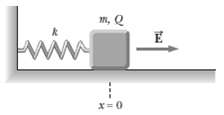
A 4.00-kg block carrying a charge Q = 50.0 ?C is connected to a spring for which k = 100 N/m. The block lies on a frictionless horizontal track, and the system is immersed in a uniform electric field of magnitude E = 5.00 x 10⁵ V/m directed as in Figure.(a) If the block is released at rest when the
On planet Tehar, the free-fall acceleration is the same as that on Earth, but there is also a strong downward electric field that is uniform close to the planet’s surface. A 2.00-kg ball having a charge of 5.00 µC is thrown upward at a speed of 20.1 m/s. It hits the ground after an interval of
(a) Find the electric potential 1.00 cm from a proton.(b) What is the electric potential difference between two points that are 1.00 cm and 2.00 cm from a proton?
Two point charges are on the y -axis, one of magnitude 3.0 x 10⁻⁹ C at the origin and a second of magnitude 6.0 x 10⁻⁹ C at the point y = 30 cm. Calculate the potential at y = 60 cm.
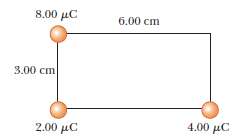
(a) Find the electric potential, taking zero at infinity, at the upper right corner (the corner without a charge) of the rectangle in figure.(b) Repeat if the 2.00-?C charge is replaced with a charge of ??2.00?C.
Three charges are situated at corners of a rectangle as in figure. How much energy would be expended in moving the 8.00-µC charge to infinity?
Two point charges Q1 = +5.00nC and Q2 = –3.00nC are separated by 35.0 cm. (a) What is the electric potential at a point midway between the charges? (b) What is the potential energy of the pair of charges? What is the significance of the algebraic sign of your answer?
A point charge of 9.00 x 10⁻⁹ C is located at the origin. How much work is required to bring a positive charge of 3.00 x 10⁻⁹ C from infinity to the location x = 30.0 cm?
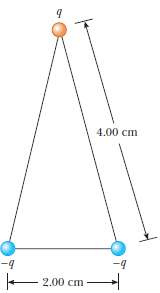
The three charges in figure are at the vertices of an isosceles triangle. Let q = 7.00 nC, and calculate the electric potential at the midpoint of thebase.
An electron starts from rest 3.00 cm from the center of a uniformly charged sphere of radius 2.00 cm. If the sphere carries a total charge of 1.00 x 10⁻⁹ C, how fast will the electron be moving when it reaches the surface of the sphere?
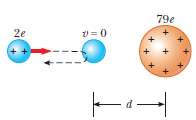
In Rutherford??s famous scattering experiments that led to the planetary model of the atom, alpha particles (having charges of +2e and masses of 6.64 x 10??27 kg) were fired toward a gold nucleus with charge +79e. An alpha particle, initially very far from the gold nucleus, is fired at 2.00 x 10⁷
Starting with the definition of work, prove that the surface must be perpendicular to the local electric field at every point on an equipotential surface.
A small spherical object carries a charge of 8.00 nC. At what distance from the center of the object is the potential equal to 100 V? 50.0 V? 25.0 V? Is the spacing of the equipotentials proportional to the change in voltage?
(a) How much charge is on each plate of a 4.00-µF capacitor when it is connected to a 12.0-V battery? (b) If this same capacitor is connected to a 1.50-V battery, what charge is stored?
Consider the Earth and a cloud layer 800 m above the planet to be the plates of a parallel-plate capacitor. (a) If the cloud layer has an area of 1.0 km2 = 1.0 x 10⁶ m2, what is the capacitance? (b) If an electric field strength greater than 3.0 x 10⁶ N/C causes the air to break down and conduct
The potential difference between a pair of oppositely charged parallel plates is 400 V. (a) If the spacing between the plates is doubled without altering the charge on the plates, what is the new potential difference between the plates? (b) If the plate spacing is doubled while the potential
An air-filled capacitor consists of two parallel plates, each with an area of 7.60 cm2 and separated by a distance of 1.80 mm. If a 20.0-V potential difference is applied to these plates, calculate (a) The electric field between the plates,(b) The capacitance, and (c) The charge on each plate.
A 1-megabit computer memory chip contains many 60.0 x 10⁻¹⁵-F capacitors. Each capacitor has a plate area of 21.0 x 10⁻¹² m2. Determine the plate separation of such a capacitor. (Assume a parallel-plate configuration). The diameter of an atom is on the order of 10–10 m = 1 Å. Express the
A parallel-plate capacitor has an area of 5.00 cm2, and the plates are separated by 1.00 mm with air between them. The capacitor stores a charge of 400 pC. (a) What is the potential difference across the plates of the capacitor?(b) What is the magnitude of the uniform electric field in the region
A small object with a mass of 350 mg carries a charge of 30.0 nC and is suspended by a thread between the vertical plates of a parallel-plate capacitor. The plates are separated by 4.00 cm. If the thread makes an angle of 15.0° with the vertical, what is the potential difference between the plates?
A series circuit consists of a 0.050-µF capacitor, a 0.100-µF capacitor, and a 400-V battery. Find the charge (a) On each of the capacitors and (b) On each of the capacitors if they are reconnected in parallel across the battery.
Three capacitors, C1 = 5.00 µF, C2 = 4.00 µF, and C3 = 9.00 µF, are connected together. Find the effective capacitance of the group (a) If they are all in parallel, and (b) If they are all in series.
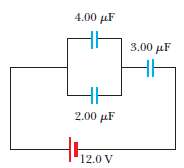
(a) Find the equivalent capacitance of the capacitors in figure.(b) Find the charge on each capacitor and the potential difference acrossit.
Two capacitors give an equivalent capacitance of 9.00 pF when connected in parallel and an equivalent capacitance of 2.00 pF when connected in series. What is the capacitance of each capacitor?
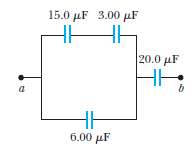
Four capacitors are connected as shown in figure.(a) Find the equivalent capacitance between points a and b.(b) Calculate the charge on each capacitor if a 15.0-V battery is connected across points a andb.
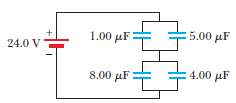
Consider the combination of capacitors in figure.(a) What is the equivalent capacitance of the group?(b) Determine the charge on eachcapacitor.
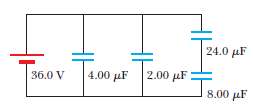
Find the charge on each of the capacitors in figure.
To repair a power supply for a stereo amplifier, an electronics technician needs a 100-µF capacitor capable of withstanding a potential difference of 90 V between its plates. The only available supply is a box of five 100-µF capacitors, each having a maximum voltage capability of 50 V. Can the
A 25.0-µF capacitor and a 40.0-µF capacitor are charged by being connected across separate 50.0-V batteries.(a) Determine the resulting charge on each capacitor.(b) The capacitors are then disconnected from their batteries and connected to each other, with each negative plate connected to the
A 10.0-µF capacitor is fully charged across a 12.0-V battery. The capacitor is then disconnected from the battery and connected across an initially uncharged capacitor with capacitance C. The resulting voltage across each capacitor is 3.00 V. What is the value of C?
A 1.00-µF capacitor is charged by being connected across a 10.0-V battery. It is then disconnected from the battery and connected across an uncharged 2.00-µF capacitor. Determine the resulting charge on each capacitor.
Find the equivalent capacitance between points a and b for the group of capacitors connected as shown in figure if C1 = 5.00 ?F, C2 = 10.0 ?F, and C3 = 2.00 ?F.
For the network described in the previous problem and in figure, if the potential between points a and b is 60.0 V, what charge is stored onC3?
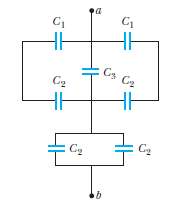
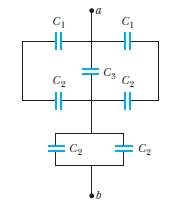
Find the equivalent capacitance between points a and b in the combination of capacitors shown inFigure.
A parallel-plate capacitor has 2.00-cm2 plates that are separated by 5.00 mm with air between them. If a 12.0-V battery is connected to this capacitor, how much energy does it store?
Two capacitors, C1 = 25.0 µF and C2 = 5.00 µF, are connected in parallel and charged with a 100-V power supply. (a) Calculate the total energy stored in the two capacitors. (b) What potential difference would be required across the same two capacitors connected in series in order that the
Consider the parallel-plate capacitor formed by the Earth and a cloud layer as described in Problem 16.23. Assume this capacitor will discharge (i.e., produce lightning) when the electric field strength between the plates reaches 3.0 x 10⁶ N/C. What is the energy released if the capacitor
A certain storm cloud has a potential difference of 1.00 x 10⁸ V relative to a tree. If, during a lightning storm, 50.0 C of charge is transferred through this potential difference and 1.00% of the energy is absorbed by the tree, how much water (sap in the tree) initially at 30.0°C can be boiled
A capacitor with air between its plates is charged to 100 V and then disconnected from the battery. When a piece of glass is placed between the plates, the voltage across the capacitor drops to 25 V. What is the dielectric constant of the glass? (Assume the glass completely fills the space between
Two parallel plates, each of area 2.00 cm2, are separated by 2.00 mm with purified nonconducting water between them. A voltage of 6.00 V is applied between the plates. Calculate(a) The magnitude of the electric field between the plates, (b) The charge stored on each plate, and (c) The charge stored
Determine (a) The capacitance and(b) The maximum voltage that can be applied to a Teflon®-filled parallel-plate capacitor having a plate area of 175 cm2 and an insulation thickness of 0.040 0 mm.
50. A commercial capacitor is constructed as in figure 16.25a. This particular capacitor is made from a strip of aluminum foil separated by two strips of paraffin-coated paper. Each strip of foil and paper is 7.00 cm wide. The foil is 0.004 00 mm thick, and the paper is 0.025 0 mm thick and has a
A model of a red blood cell portrays the cell as a spherical capacitor—a positively charged liquid sphere of surface area A separated from the surrounding negatively charged fluid by a membrane of thickness t. Tiny electrodes introduced into the interior of the cell show a potential difference of
Three parallel-plate capacitors are constructed, each having the same plate spacing d and with C1 having plate area A1, C2 having area A2, and C3 having area A3. Show that the total capacitance C of the three capacitors connected in parallel is the same as that of a capacitor having plate spacing d
Three parallel-plate capacitors are constructed, each having the same plate area A and with C1 having plate spacing d1, C2 having plate spacing d2, and C3 having plate spacing d3. Show that the total capacitance C of the three capacitors connected in series is the same as a capacitor of plate area
Two capacitors give an equivalent capacitance of Cp when connected in parallel and an equivalent capacitance of Cs when connected in series. What is the capacitance of each capacitor?
An isolated capacitor of unknown capacitance has been charged to a potential difference of 100 V. When the charged capacitor is disconnected from the battery and then connected in parallel to an uncharged 10.0-µF capacitor, the voltage across the combination is measured to be 30.0 V. Calculate the
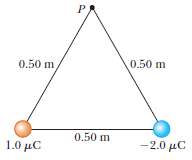
Two charges of 1.0 ?C and ?2.0 ?C are 0.50 m apart at two vertices of an equilateral triangle as in figure. (a) What is the electric potential due to the 1.0-?C charge at the third vertex, point P? (b) What is the electric potential due to the ?2.0-C charge at P? (c) Find the total electric
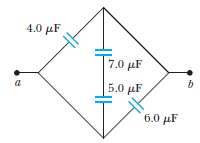
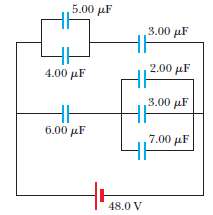
Find the equivalent capacitance of the group of capacitors shown infigure.
A spherical capacitor consists of a spherical conducting shell of radius b and charge –Q concentric with a smaller conducting sphere of radius a and charge Q. (a) Find the capacitance of this device. (b) Show that as the radius b of the outer sphere approaches infinity, the capacitance approaches
The immediate cause of many deaths is ventricular fibrillation, an uncoordinated quivering of the heart, as opposed to proper beating. An electric shock to the chest can cause momentary paralysis of the heart muscle, after which the heart will sometimes start organized beating again. A
When a certain air-filled parallel-plate capacitor is connected across a battery, it acquires a charge of 150 µC on each plate. While the battery connection is maintained, a dielectric slab is inserted into, and fills, the region between the plates. This results in the accumulation of an
Capacitors C1 = 6.0 µF and C2 = 2.0 µF are charged as a parallel combination across a 250-V battery. The capacitors are disconnected from the battery and from each other. They are then connected positive plate to negative plate and negative plate to positive plate. Calculate the resulting charge
Capacitors C1 = 4.0 µF and C2 = 2.0 µF are charged as a series combination across a 100-V battery. The two capacitors are disconnected from the battery and from each other. They are then connected positive plate to positive plate and negative plate to negative plate. Calculate the resulting
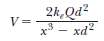
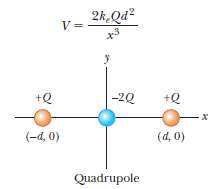
The charge distribution shown in figure is referred to as a linear quadrupole.(a) Show that the electric potential at a point on the x-axis where x d is (b) Show that the expression obtained in (a) when x >> d reducesto
The energy stored in a 52.0-µF capacitor is used to melt a 6.00-mg sample of lead. To what voltage must the capacitor be initially charged, assuming that the initial temperature of the lead is 20.0°C? Lead has a specific heat of 128 J/kg ∙ °C, a melting point of 327.3°C, and a latent heat of
Consider a parallel-plate capacitor with charge Q and area A, filled with dielectric material having dielectric constant κ. It can be shown that the magnitude of the attractive force exerted on each plate by the other is F = Q2/(2κε0 A). When a potential difference of 100 V exists between the
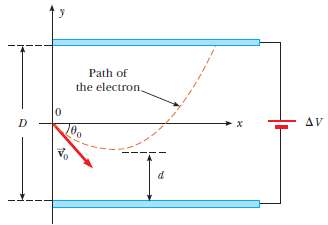
An electron is fired at a speed v0 = 5.6 x 10⁶ m/s and at an angle ?0 = ? 45? between two parallel conducting plates that are D = 2.0 mm apart, as in figure. If the voltage difference between the plates is ?V = 100 V, determine (a) How close, d, the electron will get to the bottom plate and (b)
Describe how you can increase the maximum operating voltage of a parallel-plate capacitor for a fixed plate separation.
Distinguish between electric potential and electrical potential energy.
If you are given three different capacitors C1, C2, and C3, how many different combinations of capacitance can you produce, using all capacitors in your circuits.
Is it always possible to reduce a combination of capacitors to one equivalent capacitor with the rules developed in this chapter? Explain.
(a) Under what conditions can the equation VB – VA = –Ex∆x be used? (b) Can the equation be used to find the difference in potential between two points in an electric field set up by a point charge? (c) Can the equation be used to find the difference in potential between two points in the
Why is it important to avoid sharp edges or points on conductors used in high-voltage equipment?
Showing 5100 - 5200
of 8940
First
45
46
47
48
49
50
51
52
53
54
55
56
57
58
59
Last
Step by Step Answers

 Get 50% OFF
Claim Now
Get 50% OFF
Claim Now