New Semester
Started
Get
50% OFF
Study Help!
--h --m --s
Claim Now
Question Answers
Textbooks
Find textbooks, questions and answers
Oops, something went wrong!
Change your search query and then try again
S
Books
FREE
Study Help
Expert Questions
Accounting
General Management
Mathematics
Finance
Organizational Behaviour
Law
Physics
Operating System
Management Leadership
Sociology
Programming
Marketing
Database
Computer Network
Economics
Textbooks Solutions
Accounting
Managerial Accounting
Management Leadership
Cost Accounting
Statistics
Business Law
Corporate Finance
Finance
Economics
Auditing
Tutors
Online Tutors
Find a Tutor
Hire a Tutor
Become a Tutor
AI Tutor
AI Study Planner
NEW
Sell Books
Search
Search
Sign In
Register
study help
business
data analytics accounting
ISE Data Analytics For Accounting 3rd Edition Ryan A. Teeter, Vernon Richardson, Katie L. Terrell - Solutions
Using Exhibit 3-2, identify the appropriate approach for the following questions:a. Will a customer purchase item X if given incentive A?b. Should we offer a customer a line of credit?c. What quantity of products will the customer purchase?
Describe the use of prescriptive analytics, including decision support systems, machine learning, and artificial intelligence.
Understand the techniques associated with predictive analytics, including regression and classification.
Explain the diagnostic approach to Data Analytics, including profiling and clustering.
Explain several descriptive analytics approaches, including summary statistics and data reduction, and how they summarize results.
Analytics in performing the test plan.
Understand and distinguish among the four types of Data
Compare and Contrast: Compare the methods for analyzing transactions across states in Excel versus Tableau. Which tool was more intuitive for you to work with? Which provides more interesting results?
Is 5 days of data sufficient to capture the statistical relationship among and between different variables? What will Excel do if you have more than 1 million rows? How might a query help?
How does creating a query to connect to the data allow quicker and more efficient access and analysis of the data than connecting to entire tables?
What is the average of transactions for North Carolina? Round your answer to the nearest dollar.
Which state has the highest average transaction amount?
Compare and Contrast: Compare viewing the data distribution and filtering data in Tableau Prep’s Clean step to Microsoft Power BI’s Data Profiling options. Which method is easier to interact with?
Compare and Contrast: Compare the methods for identifying data types in each table in Tableau Prep versus Microsoft Power BI.Which method is easier to interact with?
Compare and Contrast: Compare the methods for previewing data in the tables in Tableau Prep versus Microsoft Power BI. Which method is easier to interact with?
What do “P” type transactions and “R” type transactions represent?
What do you notice about the TRAN_AMT for transactions with TRAN_TYPE “R”?
What do you notice about the TRAN_AMT for transactions with TRAN_TYPE “P”?
Which tables are related to the Customer table? (Hint: Do not forget the foreign keys that you discovered in the Transact table.)
What is the primary key for the SKU table?
What is the primary key for the CUSTOMER table?
Compare and Contrast: Compare the methods for viewing (and creating) relationships in Tableau versus Power BI. Which is easier to work with? Which provides more insight and flexibility?
Compare and Contrast: Compare the methods for connecting to data in Tableau versus Power BI. Which is more intuitive?
What types of data would you guess that Dillard’s, a retail store, gathers that might be useful beyond the scope of the sales data available on the remote desktop? How could Dillard’s suppliers use these data to predict future purchases?
How would a view of the entire database or certain tables out of that database allow us to get a feel for the data?
What is the name of the key that relates the TRANSACT and CUSTOMER tables?
Which table does the DEPARTMENT table relate to?
How many tables relate directly to the TRANSACT table?
What would happen if we excluded all schools that don’t report an average SAT score?
How would that change to the average affect the way you would interpret the data?
In the checksums, you validated that the average SAT score for all of the records is 1,059.07. When we work with the data more rigorously, several tests will require us to transform NULL or blank values. If you were to transform the NULL SAT values into 0, what would happen to the average (would it
How many schools report data to the U.S. Department of Education?
What is the average completion rate (C150 4) of all the schools?
How many schools report average SAT scores?
Compare and contrast: What are some of the summary statistics measures that are unique to Power Query? To Tableau Desktop?
Compare and contrast: Why do Power Query and Tableau Desktop return different values for their summary statistics?
Does the Numerical Count provide a more useful/accurate value for validating your data? Why or why not do you think that is the case?
Compare the loan amounts to the validation given by LendingClub for borrowers from PA: Funded loans: $123,262.53 Number of approved loans: 8,427 Do the numbers in your analysis match the numbers provided by LendingClub? What explains the discrepancy, if any?
What is the average annual income of an approved borrower from PA?
What is the average interest rate assigned to a loan to an approved borrower from PA?
What is the maximum loan amount that was approved for borrowers from PA?
What are some steps you could take to clean the data and resolve the difficulties you identified?
Did you run into any major issues when you attempted to clean the data? How did you resolve those?
What do you think would happen in your analysis if you didn’t remove the text values?
Why do you think it is important to remove text values from your data before you conduct your analysis?
How many attributes or columns appear in your cleaned dataset?
How many records or rows appear in your cleaned dataset?
Given this list of attributes, what types of questions do you think you could answer regarding approved loans? (If you worked through Lab 1-2, what concerns do you have with the data’s ability to predict answers to the questions you identified in Chapter 1)?
What do you expect will be major data quality issues with LendingClub’s data?
Which attribute most directly impacts a borrower’s cost of capital?
Which attributes would you expect to contain numerical values?
Which attributes would you expect to contain text values?
Which attributes would you expect to contain date values?
In Chapter 4, we’ll discuss some visualization techniques. Describe a way you could present these data as a chart or graph.
Write a brief paragraph about how you would interpret the results of your analysis in plain English. For example, which data points stand out?
If you wanted to provide more detail, what other attributes would be useful to add as additional rows or columns to your report, or what other reports would you create?
If the owner of Sláinte wishes to identify which product sold the most, how would you make this report more useful?
Which product is experiencing the worst sales performance in January 2020?
What was the total sales volume for all products in January 2020?
What was the total sales volume for Imperial Stout in January 2020?
Compare and Contrast: If you completed this part with multiple tools, which tool options do you think will be most useful for preparing future data for analysis?
Have you used the Microsoft or Tableau tools before this class?
How many rows were loaded for the Finished_Goods_Products query?
How many rows were loaded for the Sales_Order query?
How many tables did you just load?
What additional tables and attributes would you need to answer your questions?
Evaluate your original questions and responses from Part 1.Can you still answer the original questions that you identified in step 1 with the data provided?
What new question can you answer using the data extract?
Which tables and attributes are missing from the data extract that would be necessary to answer the question “How many products were sold in each state?”
Finally, for each question, identify the specific tables and fields that are needed to answer your questions. Use the data dictionary and ER Diagram provided in Appendix J for guidance on what tables and attributes are available. For example, to answer the question about state sales, you would need
Now hypothesize the answers to each of the questions. Remember, your answers don’t have to be correct at this point. They will help you understand what type of data you are looking for. For example:500 in Missouri, 6,000 in Pennsylvania, 4,000 in New York, and so on.
Given that you are new and trying to get a grasp on Sláinte’s operations, list three questions related to sales that would help you begin your analysis. For example, how many products were sold in each state?
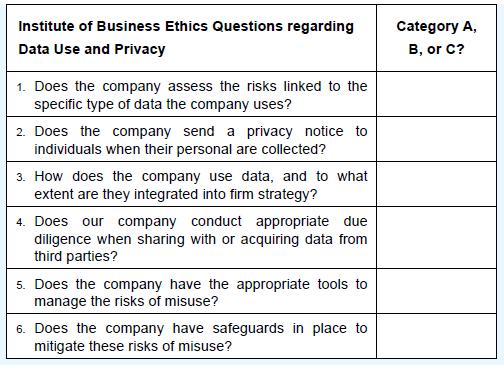
(LO 2-4) The Institute of Business Ethics proposes that a company protect the privacy of stakeholders by considering these questions of its third-party data providers:Does our company conduct appropriate due diligence when sharing with or acquiring data from third parties?Do third-party data
(LO 2-3) As part of master the data, analysts must make certain trade-offs when they consider which data to use. Consider these three different scenarios:a. Analysis: What are the trade-offs of using data that are highly relevant to the question, but have a lot of missing data?b. Analysis: What are
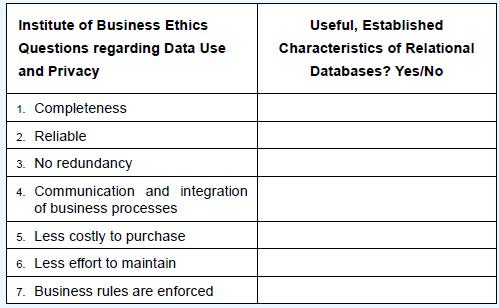
(LO 2-2) Which of the following are useful, established characteristics of using a relational database? Institute of Business Ethics Questions regarding Data Use and Privacy 1. Completeness 2. Reliable 3. No redundancy 4. Communication and integration of business processes 5. Less costly to
(LO 2-4) For each of the six questions suggested by the Institute of Business Ethics to evaluate data privacy, categorize each question into one of these three types:A. Evaluate the company’s purpose of the data B. Evaluate the company’s use or misuse of the data C. Evaluate the due diligence
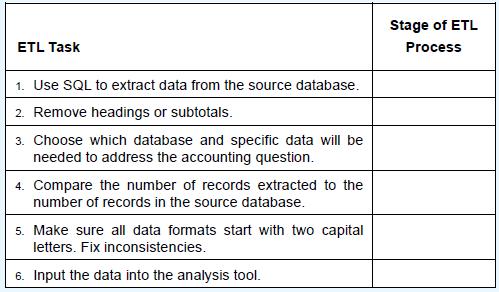
(LO 2-3) Match each ETL task to the stage of the ETL process:Determine purpose Obtain Validate Clean Load ETL Task 1. Use SQL to extract data from the source database. 2. Remove headings or subtotals. 3. Choose which database and specific data will be needed to address the accounting question. 4.
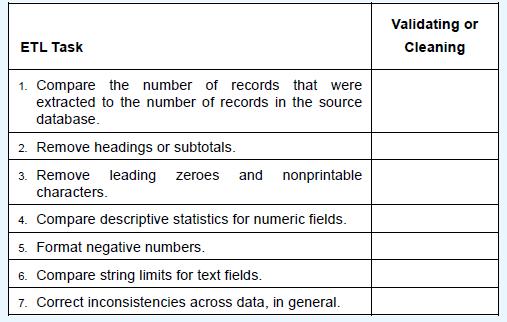
(LO 2-3) Identify which ETL tasks would be considered “Validating” the data, and which would be considered “Cleaning” the data. ETL Task 1. Compare the number of records that were extracted to the number of records in the source database. 2. Remove headings or subtotals. 3. Remove leading
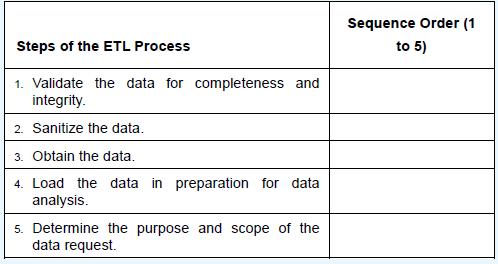
(LO 2-3) Identify the order sequence in the ETL process as part of mastering the data (i.e., 1 is first;5 is last). Steps of the ETL Process 1. Validate the data for completeness and integrity. 2. Sanitize the data. 3. Obtain the data. 4. Load the data in preparation for data analysis. 5. Determine
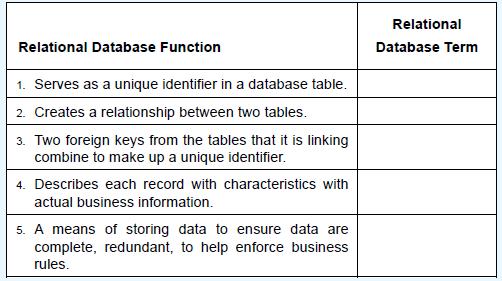
(LO 2-2) Match the relational database function to the appropriate relational database term:Composition primary key Descriptive attribute Foreign key Primary key Relational database Relational Relational Database Function 1. Serves as a unique identifier in a database table. 2. Creates a
(LO 2-4) What is the theme of each of the six questions proposed by the Institute of Business Ethics? Which one addresses the purpose of the data? Which one addresses how the risks associated with data use and collection are mitigated? How could these two specific objectives be achieved at the same
(LO 2-3) In the ETL process, one important step to process when transforming the data is to work with null, n/a, and zero values in the dataset. If you have a field of quantitative data (e.g., number of years each individual in the table has held a full-time job), what would be the effect of the
(LO 2-3) Regarding the data request form, why do you think it is important to the database administrator to know the purpose of the request? What would be the importance of the “To be used in” and “Intended audience” fields?
(LO 2-3) In the ETL process, when an analyst is completing the data request form, there are a number of fields that the analyst is required to complete. Why do you think it is important for the analyst to indicate the frequency of the report? How do you think that would affect what the database
(LO 2-3) In the ETL process, if the analyst does not have the security permissions to access the data directly, then he or she will need to fill out a data request form. While this doesn’t necessarily require the analyst to know extraction techniques, why does the analyst still need to understand
(LO 2-3) In the ETL process, the first step is extracting the data. When you are obtaining the data yourself, what are the steps to identifying the data that you need to extract?
(LO 2-2) What is the purpose of a data dictionary? Identify four different attributes that could be stored in a data dictionary, and describe the purpose of each.
(LO 2-2) Among the advantages of using a relational database is enforcing business rules. Based on your understanding of how the structure of a relational database helps prevent data redundancy and other advantages, how does the primary key/foreign key relationship structure help enforce a business
(LO 2-2) Even though it is preferable to store data in a relational database, storing data across separate tables can make data analysis cumbersome. Describe three reasons it is worth the trouble to store data in a relational database.
(LO 2-2) The advantages of a relational database include integrating business processes. Why is it preferable to integrate business processes in one information system, rather than store different business process data in separate, isolated databases?
(LO 2-2) The advantages of a relational database include limiting the amount of redundant data that are stored in a database. Why is this an important advantage? What can go wrong when redundant data are stored?
(LO 2-4) Which of the following questions are not suggested by the Institute of Business Ethics to allow a business to create value from data use and analysis, and still protect the privacy of stakeholders?a. How does the company use data, and to what extent are they integrated into firm
(LO 2-2) What are attributes that exist in a relational database that are neither primary nor foreign keys?a. Nondescript attributesb. Descriptive attributesc. Composite keysd. Relational table attributes
(LO 2-2) Why is Supplier ID considered to be a primary key for a Supplier table?a. It contains a unique identifier for each supplier.b. It is a 10-digit number.c. It can either be for a vendor or miscellaneous provider.d. It is used to identify different supplier categories.
(LO 2-3) As mentioned in the chapter, which of the following is not a common way that data will need to be cleaned after extraction and validation?a. Remove headings and subtotals.b. Format negative numbers.c. Clean up trailing zeroes.d. Correct inconsistencies across data.
(LO 2-2) The metadata that describe each attribute in a database are which of the following?a. Composite primary keyb. Data dictionaryc. Descriptive attributesd. Flat file
(LO 2-2) Which attribute is required to exist in each table of a relational database and serves as the“unique identifier” for each record in a table?a. Foreign keyb. Unique identifierc. Primary keyd. Key attribute
(LO 2-3) The purpose of transforming data is:a. to validate the data for completeness and integrity.b. to load the data into the appropriate tool for analysis.c. to obtain the data from the appropriate source.d. to identify which data are necessary to complete the analysis.
(LO 2-2) The advantages of storing data in a relational database include which of the following?a. Help in enforcing business rulesb. Increased information redundancyc. Integrating business processesd. All of the answers are correcte. a and bf. b and c g. a and c
(LO 2-3) Which of the following describes part of the goal of the ETL process?a. Identify which approach to Data Analytics should be used.b. Load the data into a relational database for storage.c. Communicate the results and insights found through the analysis.d. Identify and obtain the data needed
Showing 800 - 900
of 1576
First
2
3
4
5
6
7
8
9
10
11
12
13
14
15
16
Step by Step Answers

 Get 50% OFF
Claim Now
Get 50% OFF
Claim Now