New Semester
Started
Get
50% OFF
Study Help!
--h --m --s
Claim Now
Question Answers
Textbooks
Find textbooks, questions and answers
Oops, something went wrong!
Change your search query and then try again
S
Books
FREE
Study Help
Expert Questions
Accounting
General Management
Mathematics
Finance
Organizational Behaviour
Law
Physics
Operating System
Management Leadership
Sociology
Programming
Marketing
Database
Computer Network
Economics
Textbooks Solutions
Accounting
Managerial Accounting
Management Leadership
Cost Accounting
Statistics
Business Law
Corporate Finance
Finance
Economics
Auditing
Tutors
Online Tutors
Find a Tutor
Hire a Tutor
Become a Tutor
AI Tutor
AI Study Planner
NEW
Sell Books
Search
Search
Sign In
Register
study help
business
elementary statistics
Elementary Statistics 3rd Edition William Navidi, Barry Monk - Solutions
Find the area under the standard normal curve to the right ofa. z = −1.55b. z = 0.32c. z = 3.20d. z = −2.39
Find the area under the standard normal curve to the right ofa. z = 0.47b. z = −2.91c. z = 2.04d. z = 1.09
Find the area under the standard normal curve that lies betweena. z = −0.75 and z = 1.70b. z = −2.30 and z = 1.08c. z = −3.27 and z = −1.44d. z = 1.26 and z = 2.32
Find the area under the standard normal curve that lies betweena. z = −1.28 and z = 1.36b. z = −0.82 and z = −0.42c. z = 1.58 and z = 2.06d. z = −2.19 and z = 0.07
Find the area under the standard normal curve that lies outside the interval betweena. z = −0.38 and z = 1.02b. z = −1.42 and z = 1.78c. z = 0.01 and z = 2.67d. z = −2.45 and z = −0.34
Find the area under the standard normal curve that lies outside the interval betweena. z = −1.11 and z = 3.21b. z = −1.93 and z = 0.59c. z = 0.46 and z = 1.75d. z = −2.73 and z = −1.39
Find the z-score for which the area to its left is 0.54.
Find the z-score for which the area to its left is 0.13.
Find the z-score for which the area to its left is 0.93.
Find the z-score for which the area to its left is 0.25.
Find the z-score for which the area to its right is 0.84.
Find the z-score for which the area to its right is 0.14.
Find the z-score for which the area to its right is 0.35.
Find the z-score for which the area to its right is 0.92.
Find the z-scores that bound the middle 50% of the area under the standard normal curve.
Find the z-scores that bound the middle 70% of the area under the standard normal curve.
Find the z-scores that bound the middle 80% of the area under the standard normal curve.
Find the z-scores that bound the middle 98% of the area under the standard normal curve.
The area under the standard normal curve to the left of z = −1.75 is 0.0401. What is the area to the right of z = 1.75?
The area under the standard normal curve to the right of z = −0.51 is 0.6950. What is the area to the left of z = 0.51?
The area under the standard normal curve between z = −1.93 and z = 0.59 is 0.6956. What is the area between z = −0.59 and z = 1.93?
The area under the standard normal curve between z = 1.32 and z = 1.82 is 0.0590. What is the area between z = −1.82 and z = −1.32?
Let a be the number such that the area to the right of z = a is 0.3. Without using a table or technology, find the area to the left of z = −a.
Let a be the number such that the area to the right of z = a is 0.21. Without using a table or technology, find the area between z = −a and z = a.
8P1 In Exercises 17–22, evaluate the permutation.
45P5 In Exercises 17–22, evaluate the permutation.
Let A and B be events with P (A) = 0.2 and P (B) = 0.9.Assume that A and B are independent. Find P (A and B).
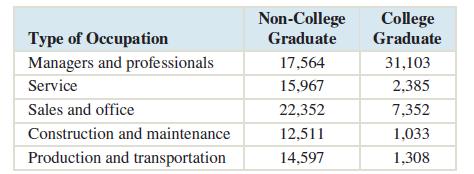
The following table presents numbers of U.S. workers, in thousands, categorized by type of occupation and educational level.a. What is the probability that a randomly selected worker is a college graduate?b. What is the probability that the occupation of a randomly selected worker is categorized
The law of large numbers states that as a probability experiment is repeated, the proportion of times that a given outcome occurs will approach its probability.In Exercises 9–12, determine whether the statement is true or false. If the statement is false, rewrite it as a true statement.
Refer to Exercise 5.Four of the eight students are from Middle Georgia State University. What is the probability that all three of the interviewed students are from Middle Georgia State University?
A jar contains 4 red marbles, 3 blue marbles, and 5 green marbles. Two marbles are drawn from the jar one at a time without replacement. What is the probability that the second marble is red, given that the first was blue?
When sampling without replacement, if the sample size is less than ______________ % of the population, the sampled items may be treated as independent.In Exercises 7–10, fill in each blank with the appropriate word or phrase.
A compound event is formed by combining two or more events.In Exercises 9–12, determine whether the statement is true or false. If the statement is false, rewrite it as a true statement.
9!In Exercises 11–16, evaluate the factorial.
Two events are _______________ if the occurrence of one does not affect the probability that the other event occurs.In Exercises 7–10, fill in each blank with the appropriate word or phrase.
The Empirical Method can be used to calculate the exact probability of an event.In Exercises 9–12, determine whether the statement is true or false. If the statement is false, rewrite it as a true statement.
In a combination, order is not important.In Exercises 9 and 10, determine whether the statement is true or false. If the statement is false, rewrite it as a true statement.
A student is chosen at random. Which of the following pairs of events are independent?i. A: The student was born on a Monday. B: The student’s mother was born on a Monday.ii. A: The student is above average in height. B: The student’s mother is above average in height.
Two events are mutually exclusive if both events can occur.In Exercises 9–12, determine whether the statement is true or false. If the statement is false, rewrite it as a true statement.
Individual plays on a slot machine are independent. The probability of winning on any play is 0.38. What is the probability of winning 3 plays in a row?
P (B | A) represents the probability that A occurs under the assumption that B occurs.In Exercises 11–14, determine whether the statement is true or false. If the statement is false, rewrite it as a true statement.
If an event occurs, then its complement also occurs.In Exercises 9–12, determine whether the statement is true or false. If the statement is false, rewrite it as a true statement.
If A and B are independent events, then P (A and B) = P (A)P (B).In Exercises 11–14, determine whether the statement is true or false. If the statement is false, rewrite it as a true statement.
5!In Exercises 11–16, evaluate the factorial.
For any event A, 0 ≤ P (A) ≤ 1.In Exercises 9–12, determine whether the statement is true or false. If the statement is false, rewrite it as a true statement.
A college student must take courses in English, history, mathematics, biology, and physical education.She decides to choose three of these courses to take in her freshman year. In how many ways can this choice be made?
Refer to Problem 11.Suppose that the slot machine is played 5 times in a row. What is the probability of winning at least once?Problem 11Individual plays on a slot machine are independent. The probability of winning on any play is 0.38. What is the probability of winning 3 plays in a row?
If P (A) = 0.75, P (B) = 0.4, and P (A and B) = 0.25, find P (A or B).
0!In Exercises 11–16, evaluate the factorial.
Find P (2).In Exercises 13–18, assume that a fair die is rolled. The sample space is {1, 2, 3, 4, 5, 6}, and all the outcomes are equally likely.
The Roman alphabet (the one used to write English) consists of five vowels(a,e, i, o, u), along with 21 consonants (we are considering y to be a consonant). Gregory needs to make up a computer password containing seven characters. He wants the first six characters to alternate—consonant, vowel,
When sampling without replacement, it is possible to draw the same item from the population more than once.In Exercises 11–14, determine whether the statement is true or false. If the statement is false, rewrite it as a true statement.
Refer to Exercise 12.Assume the student chooses three courses at random. What is the probability that she chooses English, mathematics, and biology?Exercise 12 A college student must take courses in English, history, mathematics, biology, and physical education.She decides to choose three of these
If P (A) = 0.45, P (B) = 0.7, and P (A and B) = 0.65, find P (A or B).
12!In Exercises 11–16, evaluate the factorial.
Find P (Even number).In Exercises 13–18, assume that a fair die is rolled. The sample space is {1, 2, 3, 4, 5, 6}, and all the outcomes are equally likely.
A caterer offers 24 different types of dessert. In how many ways can 5 of them be chosen for a banquet if the order doesn’t matter?
When sampling with replacement, the sampled items are independent.In Exercises 11–14, determine whether the statement is true or false. If the statement is false, rewrite it as a true statement.
Bart has six books: a novel, a biography, a dictionary, a self-help book, a statistics textbook, and a comic book.a. Bart’s bookshelf has room for only three of the books. In how many ways can Bart choose and order three books?b. In how many ways may the books be chosen and ordered if he does not
If P (A) = 0.2, P (B) = 0.5, and A and B are mutually exclusive, find P (A or B).
1!In Exercises 11–16, evaluate the factorial.
Find P (Less than 3).In Exercises 13–18, assume that a fair die is rolled. The sample space is {1, 2, 3, 4, 5, 6}, and all the outcomes are equally likely.
Let A and B be events with P (A) = 0.4, P (B) = 0.7, and P (B | A) = 0.3. Find P (A and B).
In a standard game of pool, there are 15 balls labeled 1 through 15.a. In how many ways can the 15 balls be ordered?b. In how many ways can 3 of the 15 balls be chosen and ordered?
If P (A) = 0.7, P (B) = 0.1, and A and B are mutually exclusive, find P (A or B).
3!In Exercises 11–16, evaluate the factorial.
Find P (Greater than 2).In Exercises 13–18, assume that a fair die is rolled. The sample space is {1, 2, 3, 4, 5, 6}, and all the outcomes are equally likely.
Let A and B be events with P (A) = 0.6, P (B) = 0.4, and P (B | A) = 0.4. Find P (A and B).
If P (A) = 0.3, P (B) = 0.4, and P (A or B) = 0.7, are A and B mutually exclusive?
7P3 In Exercises 17–22, evaluate the permutation.
Find P (7).In Exercises 13–18, assume that a fair die is rolled. The sample space is {1, 2, 3, 4, 5, 6}, and all the outcomes are equally likely.
Let A and B be events with P (A) = 0.5 and P (B) = 0.7.Assume that A and B are independent. Find P (A and B).
If P (A) = 0.5, P (B) = 0.4, and P (A or B) = 0.8, are A and B mutually exclusive?
Find P (Less than 10).In Exercises 13–18, assume that a fair die is rolled. The sample space is {1, 2, 3, 4, 5, 6}, and all the outcomes are equally likely.
If P (A) = 0.35, find P (Ac).
35P2 In Exercises 17–22, evaluate the permutation.
A fair coin has probability 0.5 of coming up heads.a. If you toss a fair coin twice, are you certain to get one head and one tail?b. If you toss a fair coin 100 times, are you certain to get 50 heads and 50 tails?c. As you toss the coin more and more times, will the proportion of heads approach 0.5?
Let A and B be events with P (A) = 0.8, P (B) = 0.1, and P (B | A) = 0.2. Find P (A and B).
5P4 In Exercises 17–22, evaluate the permutation.
If P (B) = 0.6, find P (Bc).
Roulette wheels in Nevada have 38 pockets. They are numbered 0, 00, and 1 through 36.On each spin of the wheel, a ball lands in a pocket, and each pocket is equally likely.a. If you spin a roulette wheel 38 times, is it certain that each number will come up once?b. If you spin a roulette wheel 3800
Let A and B be events with P (A) = 0.3, P (B) = 0.5, and P (B | A) = 0.7. Find P (A and B).
If P (Ac) = 0.27, find P (A).
Is the following a probability model for this experiment? Why or why not?In Exercises 21–24, assume that a coin is tossed twice. The coin may not be fair. The sample space consists of the outcomes {HH, HT, TH, TT}. Outcome HH HT TH TT Probability 0.55 0.42 0.31 0.25
20P0 In Exercises 17–22, evaluate the permutation.
If P (Bc) = 0.64, find P (B).
Let A, B, and C be independent events with P (A) = 0.7, P (B) = 0.8, and P (C) = 0.5. Find P (A and B and C).
Is the following a probability model for this experiment? Why or why not?In Exercises 21–24, assume that a coin is tossed twice. The coin may not be fair. The sample space consists of the outcomes {HH, HT, TH, TT}. Outcome HH HT TH TT Probability 0.36 0.24 0.24 0.16
A fair coin is tossed four times. What is the probability that all four tosses are heads?
Let A, B, and C be independent events with P (A) = 0.4, P (B) = 0.9, and P (C) = 0.7. Find P (A and B and C).
If P (A) = P (Ac), find P (A).
If P (A) = 0, find P (Ac).
Is the following a probability model for this experiment? Why or why not?In Exercises 21–24, assume that a coin is tossed twice. The coin may not be fair. The sample space consists of the outcomes {HH, HT, TH, TT}. Outcome HH HT TH TT Probability 0.09 0.21 0.21 0.49
A fair coin is tossed four times. What is the probability that the sequence of tosses is HTHT?
9C5 In Exercises 23–28, evaluate the combination.
7C1 In Exercises 23–28, evaluate the combination.
Is the following a probability model for this experiment? Why or why not?In Exercises 21–24, assume that a coin is tossed twice. The coin may not be fair. The sample space consists of the outcomes {HH, HT, TH, TT}. Outcome Probability HH HT TH TT 0.33 0.46 -0.18 0.4
25C3 In Exercises 23–28, evaluate the combination.
A: Sophie is a member of the debate team; B: Sophie is the president of the theater club.In Exercises 25–30, determine whether events A and B are mutually exclusive.
A fair die is rolled three times. What is the probability that the sequence of rolls is 1, 2, 3?
Showing 6500 - 6600
of 7930
First
59
60
61
62
63
64
65
66
67
68
69
70
71
72
73
Last
Step by Step Answers

 Get 50% OFF
Claim Now
Get 50% OFF
Claim Now