New Semester
Started
Get
50% OFF
Study Help!
--h --m --s
Claim Now
Question Answers
Textbooks
Find textbooks, questions and answers
Oops, something went wrong!
Change your search query and then try again
S
Books
FREE
Study Help
Expert Questions
Accounting
General Management
Mathematics
Finance
Organizational Behaviour
Law
Physics
Operating System
Management Leadership
Sociology
Programming
Marketing
Database
Computer Network
Economics
Textbooks Solutions
Accounting
Managerial Accounting
Management Leadership
Cost Accounting
Statistics
Business Law
Corporate Finance
Finance
Economics
Auditing
Tutors
Online Tutors
Find a Tutor
Hire a Tutor
Become a Tutor
AI Tutor
AI Study Planner
NEW
Sell Books
Search
Search
Sign In
Register
study help
business
measures integrals and martingales
Measures Integrals And Martingales 2nd Edition René L. Schilling - Solutions
Let \(u: \mathbb{R} ightarrow \mathbb{R}\) be measurable. Which of the following functions are measurable:\(u(x-2)\)\(e^{u(x)}\),\(\sin (u(x)+8)\),\(u^{\prime \prime}(x)\),\(\operatorname{sgn} u(x-7) ?\)
Check the following. In the proof of the factorization lemma (Lemma 8.14 ) we cannot, in general, replace \(\liminf _{n} w_{n}\) by \(\lim _{n} w_{n}\).[ find a sequence \(\left(w_{n}ight)_{n}\) and a map \(T\) such that \(\left(w_{n} \circ Tight)_{n}\) is convergent and \(\left(w_{n}ight)_{n}\)
One can show that there are non-Borel measurable sets \(A \subset \mathbb{R}\), see Appendix \(\mathrm{G}\). Taking this fact for granted, show that measurability of \(|u|\) does not, in general, imply measurability of \(u\). (The converse is, of course, true: measurability of \(u\) always
Show that every increasing function \(u: \mathbb{R} ightarrow \mathbb{R}\) is \(\mathscr{B}(\mathbb{R}) / \mathscr{B}(\mathbb{R})\)-measurable. Under which additional condition(s) do we have \(\sigma(u)=\mathscr{B}(\mathbb{R})\) ?[ show that \(\{u
Let \(\mathscr{A}=\sigma(\mathscr{G})\) be a \(\sigma\)-algebra on \(X\), where \(\mathscr{G}=\left\{G_{i}: i \in \mathbb{N}ight\}\) is a countable generator. Let \(g:=\sum_{i=1}^{\infty} 2^{-i} \mathbb{1}_{G_{i}}\). Show that \(\sigma(g)=\mathscr{A}\).
Show that any left- or right-continuous function \(u: \mathbb{R} ightarrow \mathbb{R}\) is Borel measurable.
Show that every linear map \(f: \mathbb{R}^{n} ightarrow \mathbb{R}^{m}\) is \(\mathscr{B}\left(\mathbb{R}^{n}ight) / \mathscr{B}\left(\mathbb{R}^{m}ight)\)-measurable. Provide an example in which measurability of linear functions may fail if we use the completions of the Borel
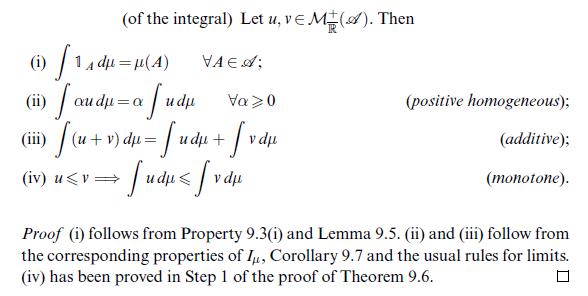
Complete the proof of Properties 9.8.Data from properties 9.8 (of the integral) Let u, v M(). Then (1) [1 d= (4) (audu-adp VAEA; Va>0 (iii) [(u + v) d = [ud + + [vd Sud < [vd (iv) u
Let \(f: X ightarrow \mathbb{R}\) be a positive simple function of the form \(f(x)=\sum_{n=1}^{m} \xi_{n} \mathbb{1}_{A_{n}}(x), \xi_{n} \geqslant 0\), \(A_{n} \in \mathscr{A}\) - but not necessarily disjoint. Show that \(I_{\mu}(f)=\sum_{n=1}^{m} \xi_{n} \mu\left(A_{n}ight)\).[use additivity and
Let \((X, \mathscr{A}, \mu)\) be a measure space and \(A_{1}, \ldots, A_{N} \in \mathscr{A}\) such that \(\mu\left(A_{n}ight)
Find an example showing that an 'increasing sequence of functions' is, in general, different from a 'sequence of increasing functions'.
Let \((X, \mathscr{A}, \mu)\) be a measure space. Show the following variant of Theorem 9.6. If \(u_{n} \geqslant 0\) are measurable functions such that for some \(u\) we have\[\exists K \in \mathbb{N} \quad \forall x: u_{n+K}(x) \uparrow u(x) \text { as } n ightarrow \infty\]then \(u \geqslant
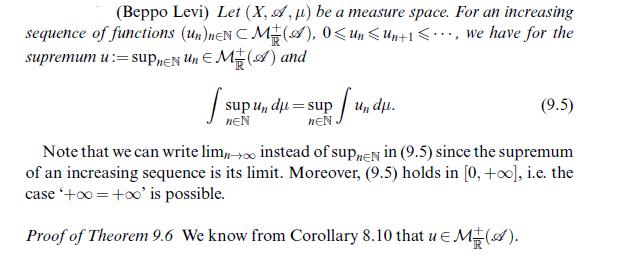
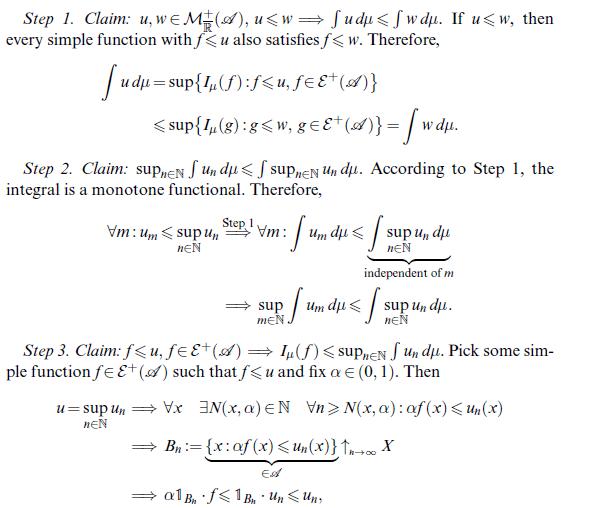
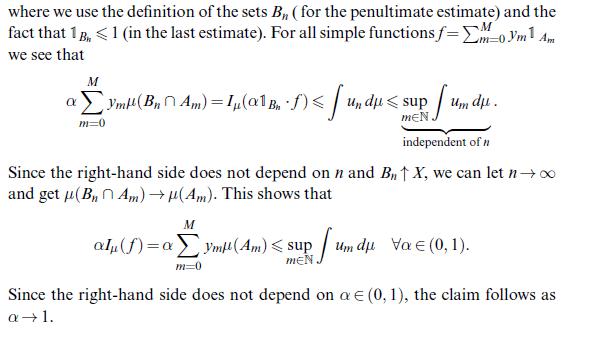
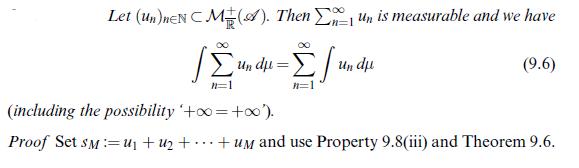
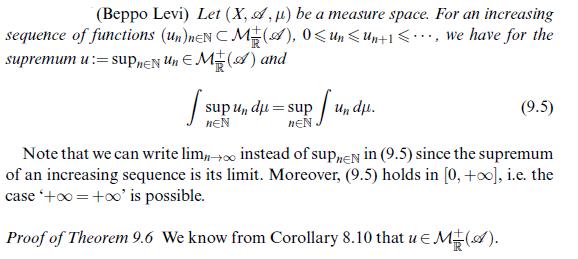
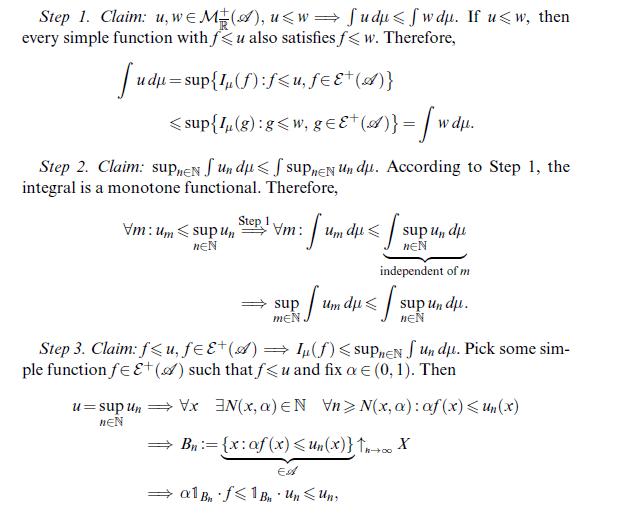
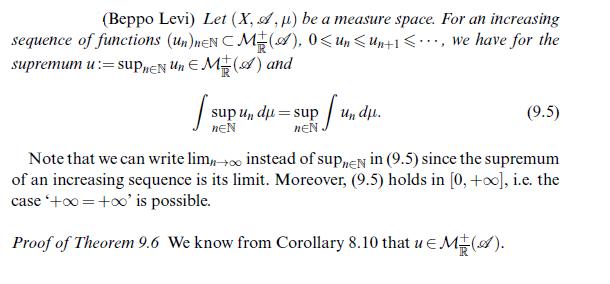
Complete the proof of Corollary 9.9 and show that (9.6) is actually equivalent to (9.5) in Beppo Levi's theorem.Data from corollary 9.9Data from theorem 9.6 18 Let (Un)neNCM(A). Then 1 un is measurable and we have n=1 (9.6) h=1 = / to the un du = (including the possibility "toc = +00). Proof
Let \((X, \mathscr{A}, \mu)\) be a measure space and \(u \in \mathcal{M}^{+}(\mathscr{A})\). Show that \(A \mapsto \int \mathbb{1}_{A} u d \mu, A \in \mathscr{A}\), is a measure.
Prove that every function \(u: \mathbb{N} ightarrow \mathbb{R}\) on \((\mathbb{N}, \mathscr{P}(\mathbb{N}))\) is measurable.
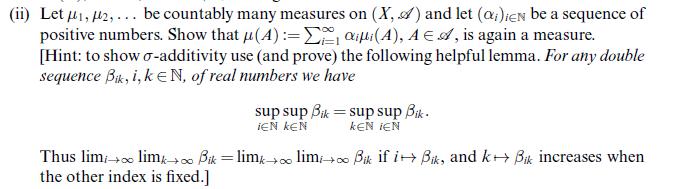
Let \((X, \mathscr{A})\) be a measurable space and \(\left(\mu_{n}ight)_{n \in \mathbb{N}}\) be a sequence of measures thereon. Set, as in Example 9.10(ii), \(\mu=\sum_{n \in \mathbb{N}} \mu_{n}\). By Problem 4.7(ii) this is again a measure. Show that\[\int u d \mu=\sum_{n \in \mathbb{N}} \int u d
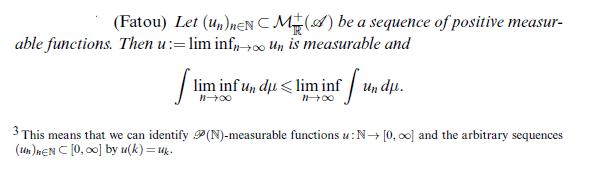
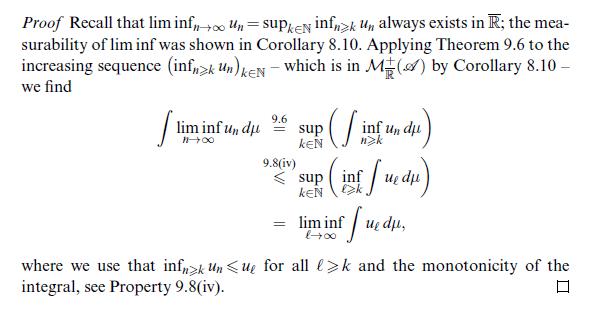
Reverse Fatou lemma. Let \((X, \mathscr{A}, \mu)\) be a measure space and \(\left(u_{n}ight)_{n \in \mathbb{N}} \subset \mathcal{M}^{+}(\mathscr{A})\). If \(u_{n} \leqslant u\) for all \(n \in \mathbb{N}\) and some \(u \in \mathcal{M}^{+}(\mathscr{A})\) with \(\int u d \mu
Let \(\left(A_{n}ight)_{n \in \mathbb{N}} \subset \mathscr{A}\) be a sequence of disjoint sets such that \(\bigcup_{n \in \mathbb{N}} A_{n}=X\). Show that for every \(u \in \mathcal{M}^{+}(\mathscr{A})\)\[\int u d \mu=\sum_{n=1}^{\infty} \int \mathbb{1}_{A_{n}} u d \mu\]Use this to construct on a
Kernels. Let \((X, \mathscr{A}, \mu)\) be a measure space. A map \(N: X \times \mathscr{A} ightarrow[0, \infty]\) is called a kernel if\[\begin{array}{rlrl}A & \mapsto N(x, A) & & \text { is a measure for every } x \in X, \\x \mapsto N(x, A) & & \text { is a measurable function for every } A \in
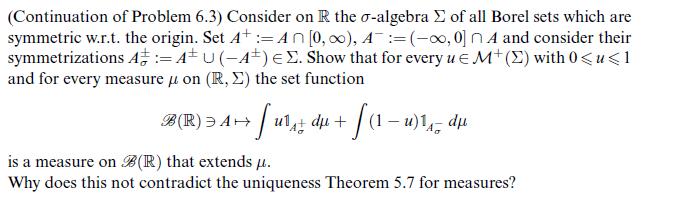
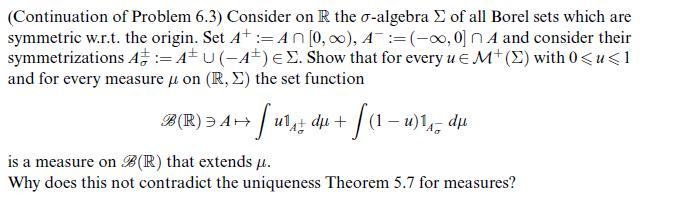
(Continuation of Problem 6.3) Consider on \(\mathbb{R}\) the \(\sigma\)-algebra \(\Sigma\) of all Borel sets which are symmetric w.r.t. the origin. Set \(A^{+}:=A \cap[0, \infty), A^{-}:=(-\infty, 0] \cap A\) and consider their symmetrizations \(A_{\sigma}^{ \pm}:=A^{ \pm} \cup\left(-A^{
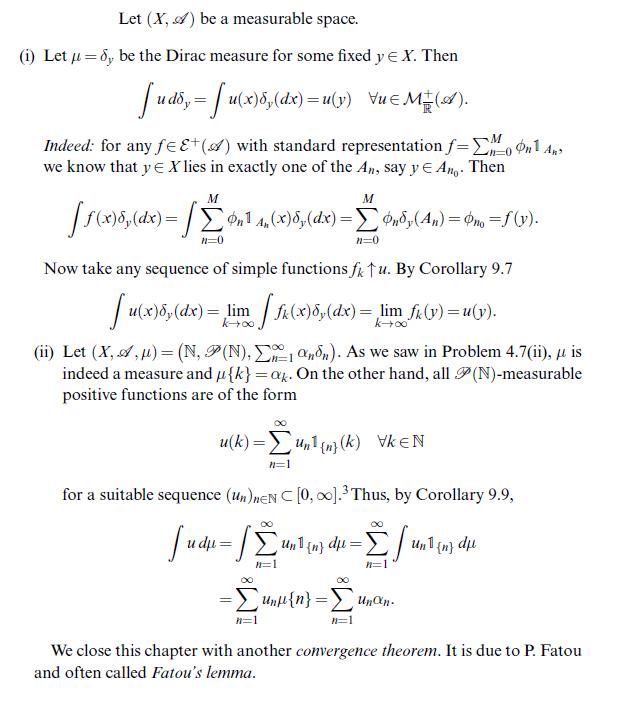
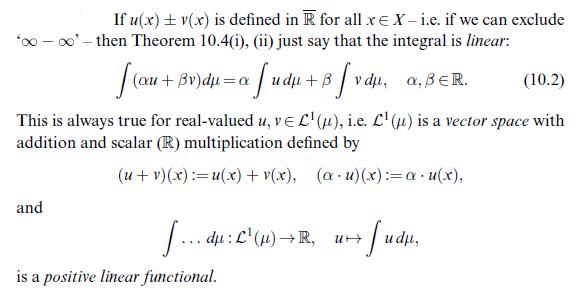
Prove Remark 10.5, i.e. prove the linearity of the integral.Data from remark 10.5 If u(x) = v(x) is defined in R for all x EX-i.e. if we can exclude '-' - then Theorem 10.4(i), (ii) just say that the integral is linear: [(au+Bv)d= [ud + B [vd, , BER. (10.2) This is always true for real-valued u, ve
Let \((\Omega, \mathscr{A}, \mathbb{P})\) be a probability space. Find a counterexample to the claim that every \(\mathbb{P}\)-integrable function \(u \in \mathcal{L}^{1}(\mathbb{P})\) is bounded.[ you could try to take \(\Omega=(0,1), \mathbb{P}=\lambda^{1}\) and show that \(1 / \sqrt{x}\) is
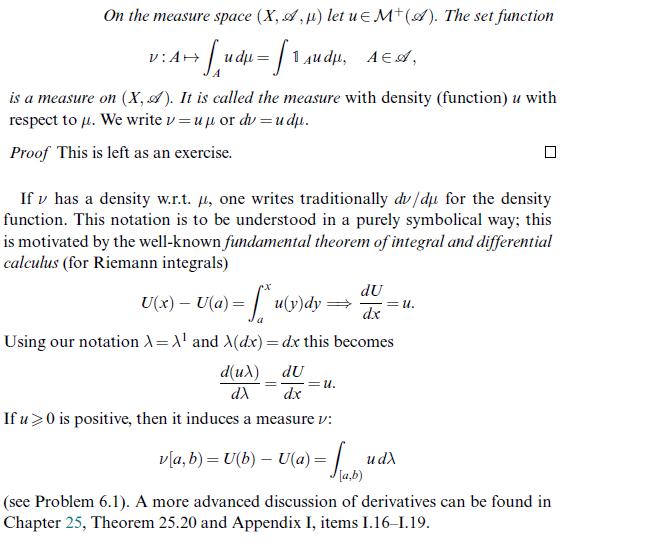
Prove Lemma 10.8.Data from lemma 10.8 On the measure space (X, A,p) let us M(A). The set function + 1 ud = [1 sudu, AE A V: A+ is a measure on (X, A). It is called the measure with density (function) u with respect to . We write v=up or du=udp. Proof This is left as an exercise. If v has a density
Let \(\left(A_{n}ight)_{n \in \mathbb{N}} \subset \mathscr{A}\) be a sequence of mutually disjoint sets. Show that\[u \mathbb{1}_{\cup_{n} A_{n}} \in \mathcal{L}^{1}(\mu) \Longleftrightarrow u \mathbb{1}_{A_{n}} \in \mathcal{L}^{1}(\mu) \quad \text { and } \quad \sum_{n=1}^{\infty} \int_{A_{n}}|u|
Let \((X, \mathscr{A}, \mu)\) be a measure space and \(u \in \mathcal{M}(\mathscr{A})\). Show that\[u \in \mathcal{L}^{1}(\mu) \Longleftrightarrow \sum_{n \in \mathbb{Z}} 2^{n} \mu\left\{2^{n} \leqslant|u|
Let \((X, \mathscr{A}, \mu)\) be a finite measure space. Show that(i) \(u \in \mathcal{L}^{1}(\mu) \Longleftrightarrow u \in \mathcal{M}(\mathscr{A})\) and \(\sum_{n=0}^{\infty} \mu\{|u| \geqslant n\}
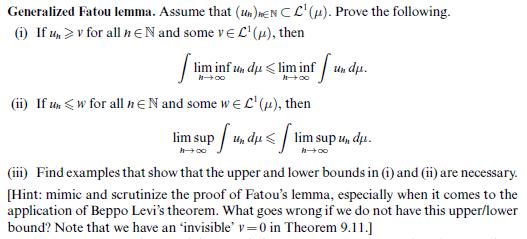
Generalized Fatou lemma. Assume that \(\left(u_{n}ight)_{n \in \mathbb{N}} \subset \mathcal{L}^{1}(\mu)\). Prove the following.(i) If \(u_{n} \geqslant v\) for all \(n \in \mathbb{N}\) and some \(v \in \mathcal{L}^{1}(\mu)\), then\[\int \liminf _{n ightarrow \infty} u_{n} d \mu \leqslant \liminf
Independence (2). Let \((\Omega, \mathscr{A}, P)\) be a probability space and assume that the \(\sigma\)-algebras \(\mathscr{B}, \mathscr{C} \subset \mathscr{A}\) are independent (see Problem 5.11). Show that \(u \in \mathcal{M}^{+}(\mathscr{B})\) and \(w \in \mathcal{M}^{+}(\mathscr{C})\)
Integrating complex functions. Let \((X, \mathscr{A}, \mu)\) be a measure space. For a complex number \(z=x+i y \in \mathbb{C}\) we write \(x=\operatorname{Re} z\) and \(y=\operatorname{Im} z\) for the real and imaginary parts, respectively; \(\mathscr{O}_{\mathbb{C}}\) denotes the usual
True or false: if \(f \in \mathcal{L}^{1}\) we can change \(f\) on a set \(N\) of measure zero (e.g. by\[\tilde{f}(x):= \begin{cases}f(x) & \text { if } x otin N \\ \beta & \text { if } x \in N\end{cases}\]where \(\beta \in \overline{\mathbb{R}}\) is any number) and \(\tilde{f}\) is still
Every countable set is a \(\lambda^{1}\)-null set. Use the Cantor ternary set \(C\) (see Problem 7.12) to illustrate that the converse is not true. What happens if we change \(\lambda^{1}\) to \(\lambda^{2}\) ?Data from problem 7.12
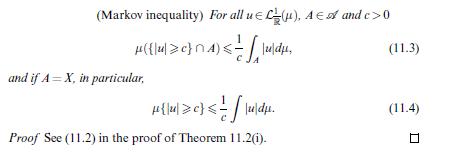
Prove the following variants of the Markov inequality Proposition 11.5 . For all \(\alpha, c>0\) and whenever the expressions involved make sense/are finite,(i) \(\mu\{|u|>c\} \leqslant \frac{1}{c} \int|u| d \mu\)(ii) \(\mu\{|u|>c\} \leqslant \frac{1}{c^{p}} \int|u|^{p} d \mu\) for all
Show that \(\int|u|^{p} d \mu
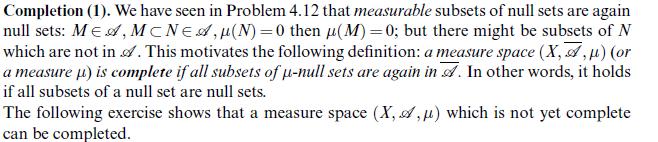
Completion (3). Let \((X, \overline{\mathscr{A}}, \bar{\mu})\) be the completion of \((X, \mathscr{A}, \mu)\), see Problems 4.15 , and 6.4.(i) Show that for every \(f^{*} \in \mathcal{E}^{+}(\overline{\mathscr{A}})\) there are \(f, g \in \mathcal{E}^{+}(\mathscr{A})\) with \(f \leqslant f^{*}
Completion (4). Inner measure and outer measure. Let \((X, \mathscr{A}, \mu)\) be a finite measure space. Define for every \(E \subset X\) the outer resp. inner measure\[\begin{aligned}& \mu^{*}(E):=\inf \{\mu(A): A \in \mathscr{A}, A \supset E\}, \\& \mu_{*}(E):=\sup \{\mu(A): A \in \mathscr{A}, A
Let \((X, \mathscr{A}, \mu)\) be a measure space and assume that \(u \in \mathcal{M}(\mathscr{A})\) and \(u=w\) almost everywhere w.r.t. \(\mu\). When can we say that \(w \in \mathcal{M}(\mathscr{A})\) ?
'a.e.' is a tricky business. When working with 'a.e.' properties one has to be extremely careful. For example, the assertions ' \(u\) is continuous a.e.' and ' \(u\) is a.e. equal to an (everywhere) continuous function' are far apart! Illustrate this by considering the functions
Let \(\mu\) be a \(\sigma\)-finite measure on the measurable space \((X, \mathscr{A})\). Show that there exists a finite measure \(P\) on \((X, \mathscr{A})\) such that \(\mathscr{N}_{\mu}=\mathscr{N}_{P}\), i.e. \(\mu\) and \(P\) have the same null sets.
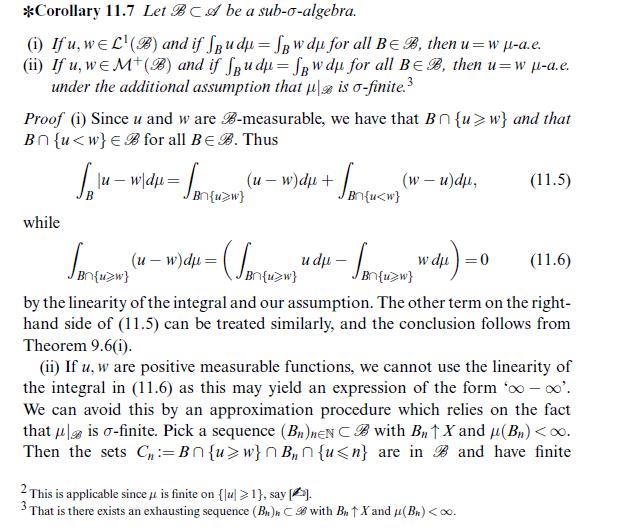
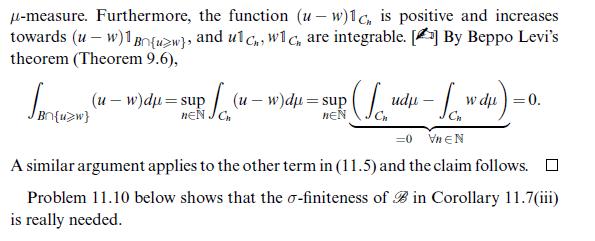
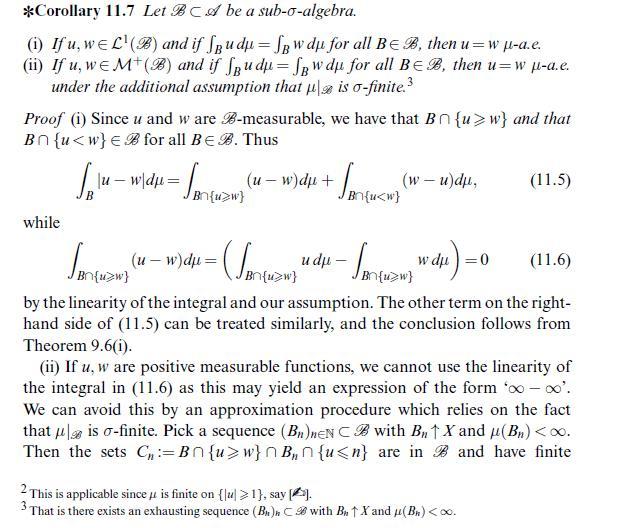
Construct an example showing that for \(u, w \in \mathcal{M}^{+}(\mathscr{B})\) the equality \(\int_{B} u d \mu=\int_{B} w d \mu\) for all \(B \in \mathscr{B}\) does not necessarily imply that \(u=w\) almost everywhere.[ in view of Corollary \(\left.11.7 \muight|_{\mathscr{B}}\) cannot be
Show the following extension of Corollary 11.7 . Let \(\mathscr{C} \subset \mathscr{P}(X)\) be a \(\cap\)-stable generator of \(\mathscr{A}\) which contains a sequence \(C_{n} \uparrow X\) such that \(\mu\left(C_{n}ight)\[\int_{C} u d \mu=\int_{C} w d \mu \quad \forall C \in \mathscr{C} \quad
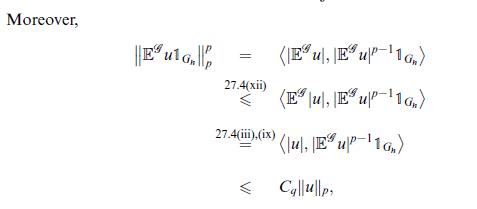
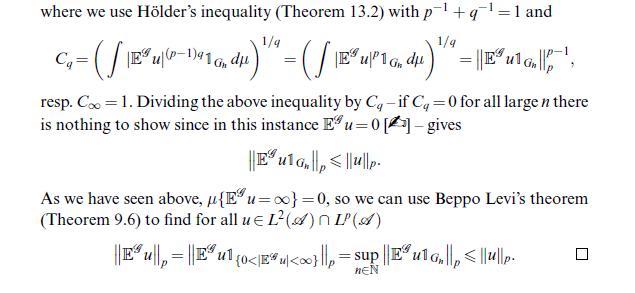
Egorov's theorem. Let \((X, \mathscr{A}, \mu)\) be a finite measure space and \(f_{n}: X ightarrow \mathbb{R}, n \in \mathbb{N}\), a sequence of measurable functions. Prove the following assertions.(i) \(C_{f}:=\left\{x \in X: f(x)=\lim _{n} f_{n}(x)ight.\) exists \(\}\)\[=\bigcap_{k=1}^{\infty}
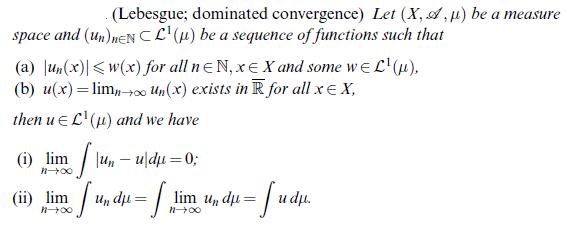
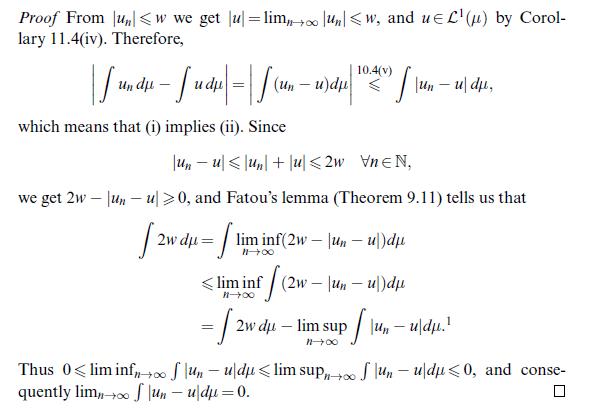
Adapt the proof of Theorem 12.2 to show that any sequence (un)n∈N⊂M(A)(un)n∈N⊂M(A) with limn→∞un(x)=u(x)limn→∞un(x)=u(x) and |un|⩽g|un|⩽g for some g⩾0g⩾0 with gp∈L1(μ)gp∈L1(μ) satisfieslimn→∞∫|un−u|pdμ=0limn→∞∫|un−u|pdμ=0[mimic the proof of Theorem
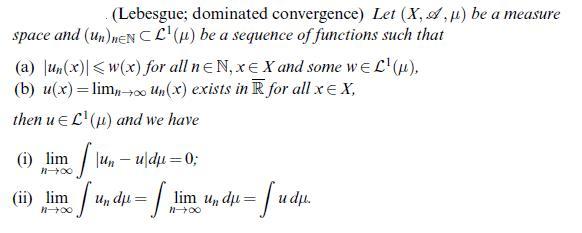
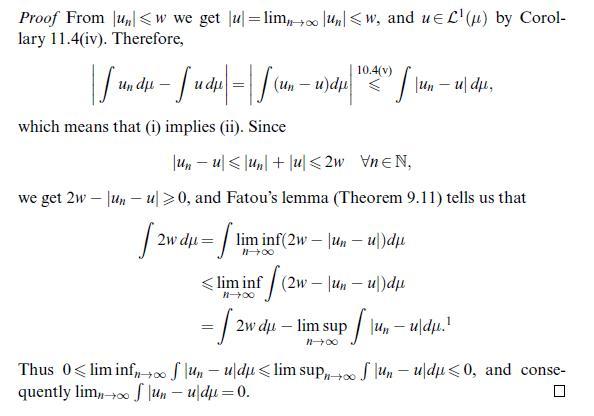
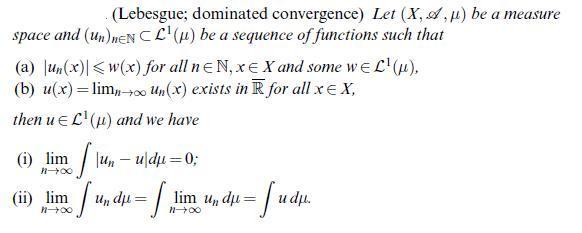
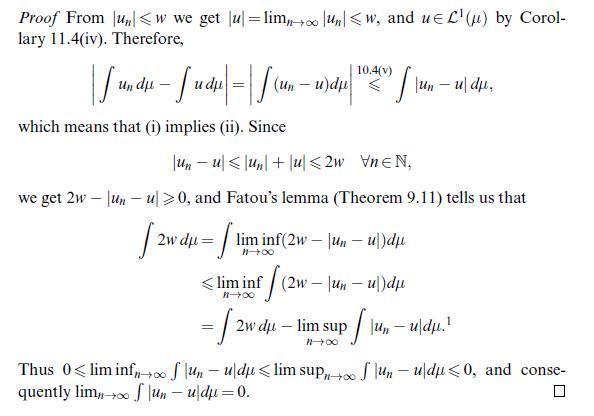
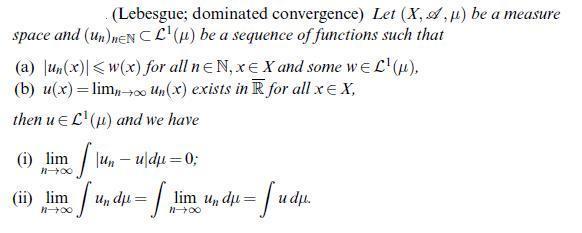
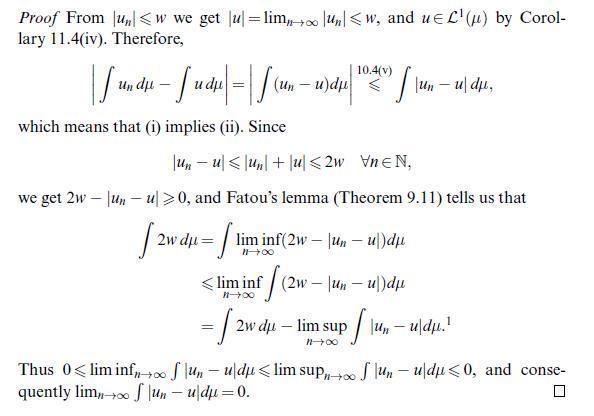
Give an alternative proof of Theorem 12.2 (ii) using the generalized Fatou theorem from Problem 10.7.Data from theorem 12.2Data from problem 10.7 (Lebesgue; dominated convergence) Let (X, A, u) be a measure space and (un)nEN CL () be a sequence of functions such that (a) un(x)
Prove the following result of W.H. Young [60]; among statisticians it is also known as Pratt's lemma, see J. W. Pratt [38].Theorem (Young; Pratt). Let (fk)k,(gk)k(fk)k,(gk)k and (Gk)k(Gk)k be sequences of integrable functions on a measure space (X,A,μ)(X,A,μ). If(a)
Let (un)n∈N(un)n∈N be a sequence of integrable functions on (X,A,μ)(X,A,μ). Show that, if ∑∞n=1∫|un|dμ∞∑n=1∞∫|un|dμ∞, the series ∑∞n=1un∑n=1∞un converges a.e. to a real-valued function u(x)u(x), and that in this
Let \(\left(u_{n}\right)_{n \in \mathbb{N}}\) be a sequence of positive integrable functions on a measure space \((X, \mathscr{A}, \mu)\). Assume that the sequence decreases to \(0: u_{1} \geqslant u_{2} \geqslant u_{3} \geqslant \cdots\) and \(u_{n} \downarrow 0\). Show that
Find a sequence of integrable functions (un)n∈N(un)n∈N with un(x)→u(x)un(x)→u(x) for all xx and an integrable function uu but such that limn→∞∫undμ≠∫udμlimn→∞∫undμ≠∫udμ. Does this contradict Lebesgue's dominated convergence theorem (Theorem 12.2 )?Data from theorem
Let \(\mu\) be a finite measure on \(([0, \infty), \mathscr{B}[0, \infty))\). Find the limit \(\lim _{r\rightarrow \infty} \int_{[0, \infty)} e^{-r x} \mu(d x)\).
Let \(\lambda\) denote Lebesgue measure on \(\mathbb{R}^{n}\).(i) Let \(u \in \mathcal{L}^{1}(\lambda)\) and \(K \subset \mathbb{R}^{n}\) be a compact (i.e. closed and bounded) set. Show that \(\lim _{|x| ightarrow \infty} \int_{K+x}|f| d \lambda=0\).(ii) Let \(u\) be uniformly continuous and
Let \(\lambda\) denote Lebesgue measure on \(\mathbb{R}^{n}\) and \(u \in \mathcal{L}^{1}(\lambda)\).(i) For every \(\epsilon>0\) there is a set \(B \in \mathscr{B}\left(\mathbb{R}^{n}ight), \lambda(B)
Let \((X, \mathscr{A}, \mu)\) be a measure space and \(\left(u_{n}ight)_{n \in \mathbb{N}} \subset \mathcal{L}^{1}(\mu)\) be a uniformly convergent sequence.(i) If \(\mu(X)
Consider the following variation of Cantor's set: fix \(r \in(0,1)\) and delete from \(I_{0}=[0,1]\) the open interval \(\left(\frac{1}{2}-\frac{1}{4} r, \frac{1}{2}+\frac{1}{4} ight)\). This defines the set \(I_{1}\) consisting of two intervals, \(\left[0, \frac{1}{2}-\frac{1}{4} ight]\) and
Let \(A, B, C \subset X\). The symmetric difference of \(A\) and \(B\) is \(A \triangle B:=(A \backslash B) \cup(B \backslash A)\). Verify that\[(A \cup B \cup C) \backslash(A \cap B \cap C)=(A \triangle B) \cup(B \triangle C)\]
Show that the following sets have the same cardinality as \(\mathbb{N}:\{m \in \mathbb{N}: m\) is odd \(\}, \mathbb{N} \times \mathbb{Z}\), \(\mathbb{Q}^{m}(m \in \mathbb{N}), \bigcup_{m \in \mathbb{N}} \mathbb{Q}^{m}\)
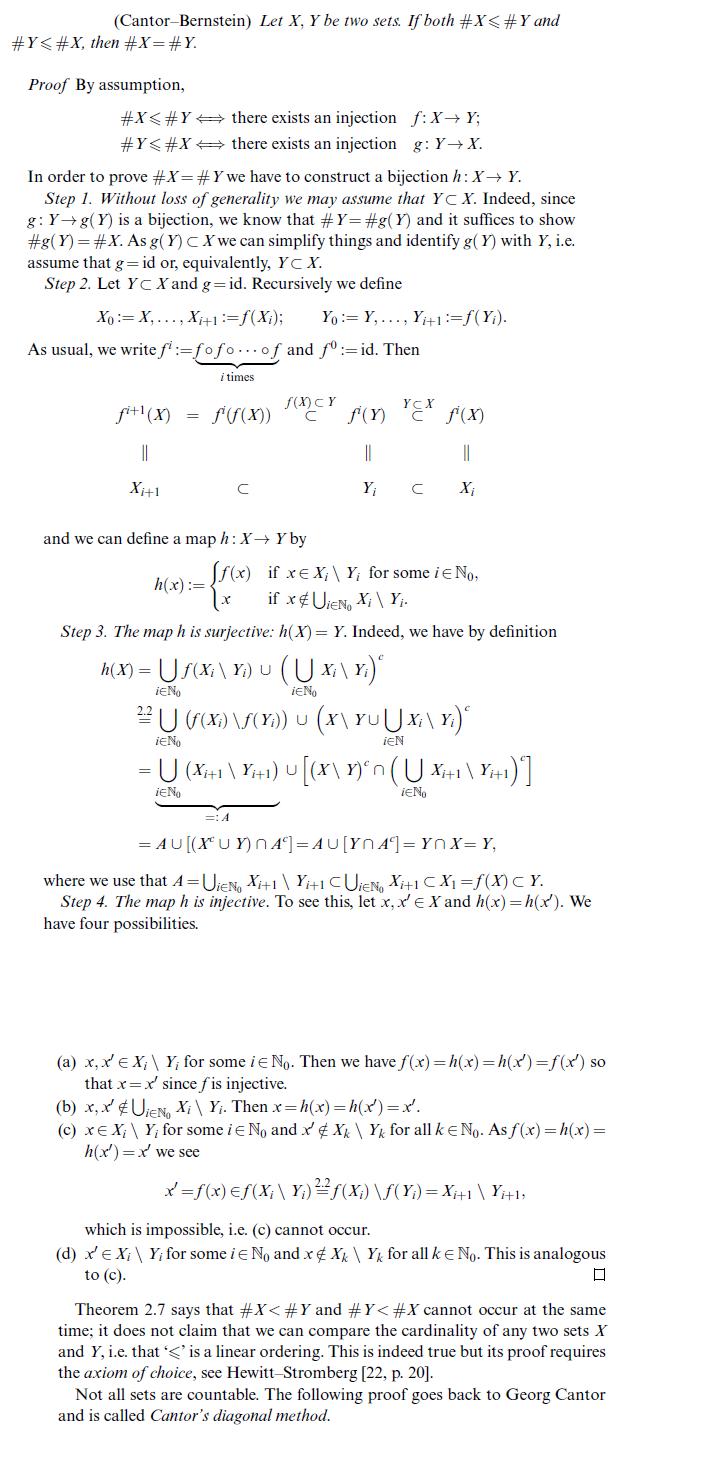
Use Theorem 2.7 to show that \(\# \mathbb{N} \times \mathbb{N}=\# \mathbb{N}\).[ \(\# \mathbb{N}=\# \mathbb{N} \times\{1\}\) and \(\mathbb{N} \times\{1\} \subset \mathbb{N} \times \mathbb{N}\). \(]\)Data from theorem 2.7 (Cantor-Bernstein) Let X, Y be two sets. If both #X < #Y and #Y
Show that if \(E \subset F\) we have \(\# E \leqslant \# F\). In particular, subsets of countable sets are again countable.
Let \(\mathscr{F}:=\{F \subset \mathbb{N}: \# F
Show - not using Theorem 2.10 - that \(\# \mathscr{P}(\mathbb{N})>\# \mathbb{N}\). Conclude that there are more than countably many maps \(f: \mathbb{N} ightarrow \mathbb{N}\).[ use the diagonal method.]
If \(A \subset \mathbb{N}\) we can identify the indicator function \(\mathbb{1}_{A}: \mathbb{N} ightarrow\{0,1\}\) with the 0 -1-sequence \(\left(\mathbb{1}_{A}(i)ight)_{i \in \mathbb{N}}\), i.e. \(\mathbb{1}_{A} \in\{0,1\}^{\mathbb{N}}\). Show that the map \(\mathscr{P}(\mathbb{N}) i A \mapsto
Show that for \(A_{n}^{0}, A_{n}^{1} \subset X, n \in \mathbb{N}\), we have\[\bigcup_{n \in \mathbb{N}}\left(A_{n}^{0} \cap A_{n}^{1}ight)=\bigcap_{i=(i(k))_{k \in \mathbb{N}} \in\{0,1\}^{\mathbb{N}}} \bigcup_{k \in \mathbb{N}} A_{k}^{i(k)} .\]
Let \(\mathscr{A}\) be a \(\sigma\)-algebra. Show that(i). if \(A_{1}, A_{2}, \ldots, A_{N} \in \mathscr{A}\), then \(A_{1} \cap A_{2} \cap \cdots \cap A_{N} \in \mathscr{A}\);(ii). \(A \in \mathscr{A}\) if, and only if, \(A^{c} \in \mathscr{A}\);(iii). if \(A, B \in \mathscr{A}\), then \(A
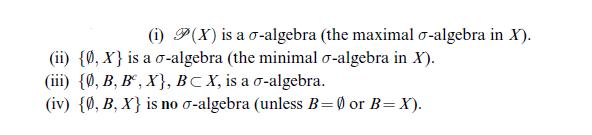
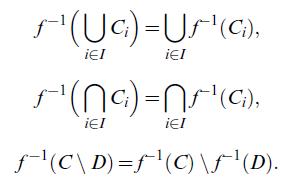
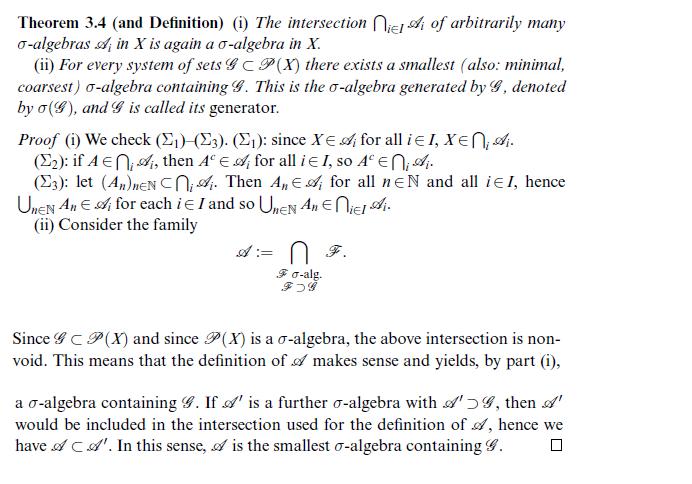
Prove the assertions made in Example 3.3 (iv), (vi) and (vii). [ use (2.6) for (vii).]Data from example 3.3Equation 2.6 (i) P(X) is a o-algebra (the maximal o-algebra in X). (ii) {0, X) is a o-algebra (the minimal o-algebra in X). (iii) {0, B, B, X), BC X, is a o-algebra. (iv) {0, B, X) is no
Let \(X=\mathbb{R}\). Find the \(\sigma\)-algebra generated by the singletons \(\{\{x\}: x \in \mathbb{R}\}\).
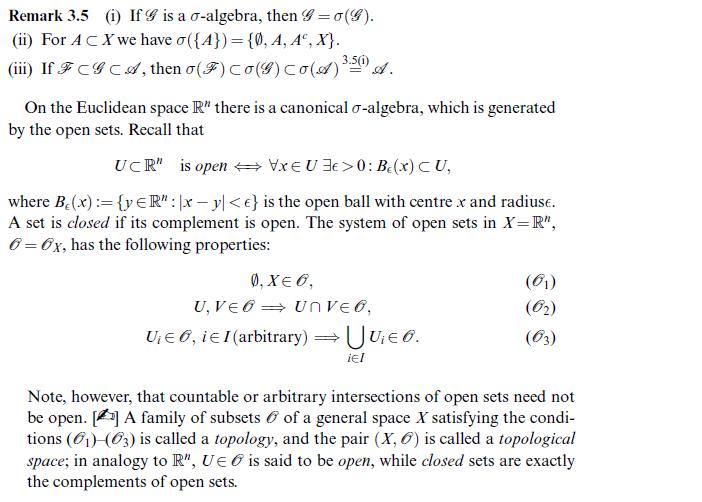
Verify the assertions made in Remark 3.5 .Data from remark 3.5 Remark 3.5 (i) If is a o-algebra, then 9 = o(9). (ii) For ACX we have o({4})= {0, A, A, X}. (iii) If FCICA, then o(F) Co (9) Co(A) 3.5) A. On the Euclidean space R" there is a canonical o-algebra, which is generated by the open sets.
Let \(X=[0,1]\). Find the \(\sigma\)-algebra generated by the sets(i). \(\left(0, \frac{1}{2}ight)\);(ii). \(\left[0, \frac{1}{4}ight),\left(\frac{3}{4}, 1ight]\);(iii). \(\left[0, \frac{3}{4}ight],\left[\frac{1}{4}, 1ight]\).
Let \((X, \mathscr{A})\) be a measurable space. Show that there cannot be a \(\sigma\)-algebra \(\mathscr{A}\) which contains countably infinitely many sets.[recall that \(A \in \mathscr{A}\) is an atom if \(A\) contains no proper subset \(\emptyset eq B \in \mathscr{A}\). Show that \(\#
Let \((X, \mathscr{A})\) be a measurable space and \(\left(\mathscr{A}_{n}ight)_{n \in \mathbb{N}}\) be a strictly increasing sequence of \(\sigma\)-algebras, i.e. \(\mathscr{A}_{n} \subsetneq \mathscr{A}_{n+1}\). Show that \(\mathscr{A}_{\infty}:=\bigcup_{n \in \mathbb{N}} \mathscr{A}_{n}\) is
Verify the properties \(\left(\mathscr{O}_{1}ight)\)-( \(\left.\mathscr{O}_{3}ight)\) for open sets in \(\mathbb{R}^{n}\). Is \(\mathscr{O}\) a \(\sigma\)-algebra?
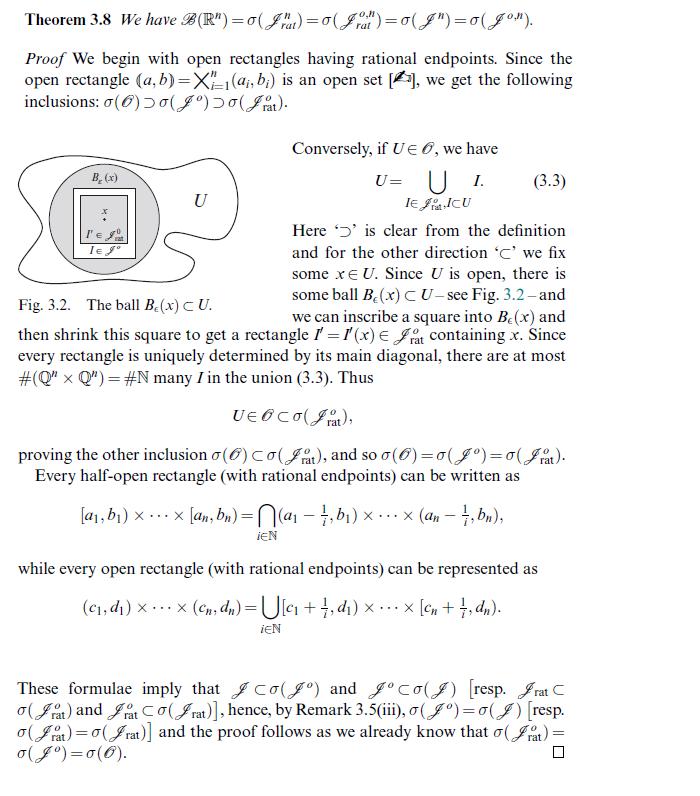
Denote by \(B_{r}(x)\) an open ball in \(\mathbb{R}^{n}\) with centre \(x\) and radius \(r\). Show that the Borel sets \(\mathscr{B}\left(\mathbb{R}^{n}ight)\) are generated by all open balls \(\mathbb{B}:=\left\{B_{r}(x): x \in \mathbb{R}^{n}, r>0ight\}\). Is this still true for the family
Let \(\mathscr{O}\) be the collection of open sets (topology) in \(\mathbb{R}^{n}\) and let \(A \subset \mathbb{R}^{n}\) be an arbitrary subset. We can introduce a topology \(\mathscr{O}_{A}\) on \(A\) as follows: a set \(V \subset A\) is called open (relative to \(A\) ) if \(V=U \cap A\) for some
Monotone classes (1). A family \(\mathscr{M} \subset \mathscr{P}(X)\) which contains \(X\) and is stable under countable unions of increasing sets and countable intersections of decreasing sets.is called a monotone class. Assume that \(\mathscr{M}\) is a monotone class and \(\mathscr{F} \subset
Let \(X\) be an arbitrary set and \(\mathscr{F} \subset \mathscr{P}(X)\). Show that\[\sigma(\mathscr{F})=\bigcup\{\sigma(\mathscr{C}): \mathscr{C} \subset \mathscr{F} \text { countable sub-family }\}\]
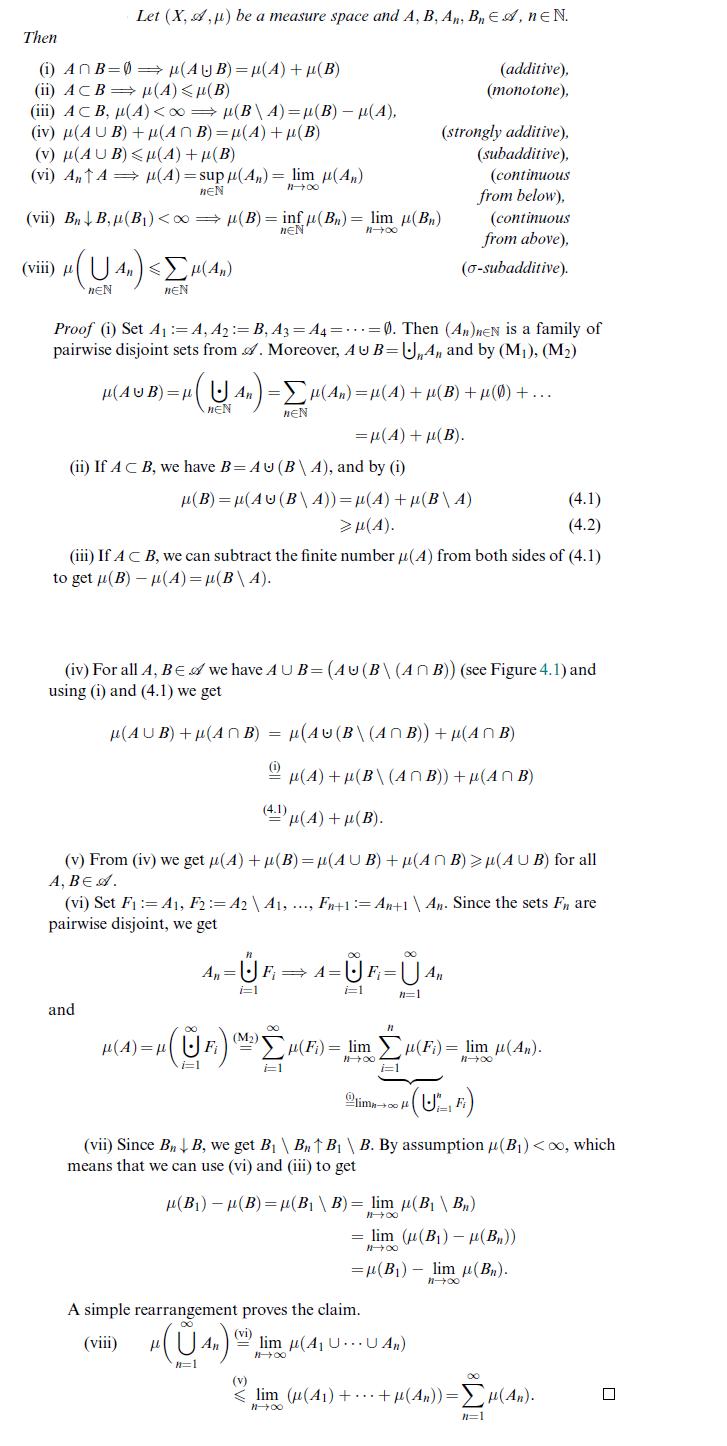
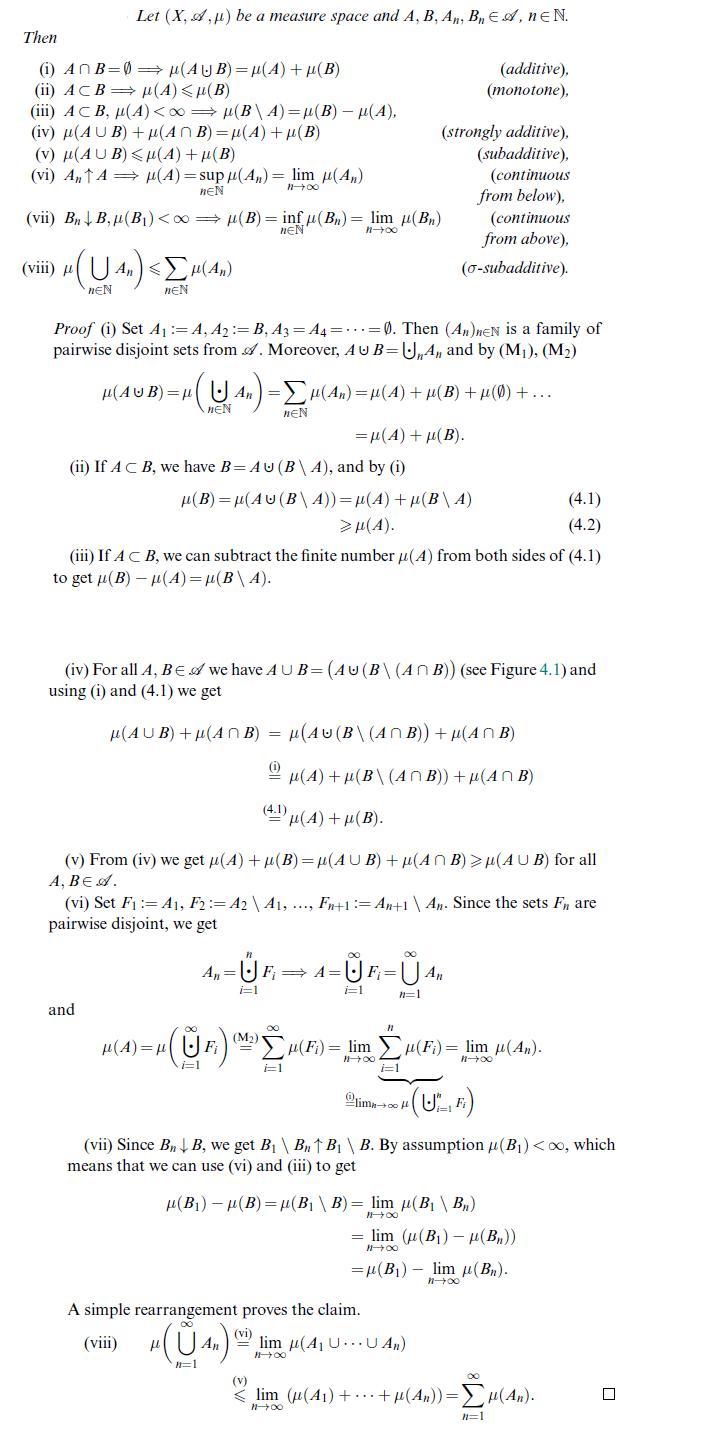
Extend Proposition 4.3(i)4.3(i), (iv) and (v) to finitely many sets A1,A2,…,AN∈AA1,A2,…,AN∈A.Data from proposition 4.3 Let (X, A,) be a measure space and A, B, An, BnA, nN. Then (1) ANB=0 (AJB)=(A) + (B) (ii) ACB (A) (B) (iii) ACB, (A)
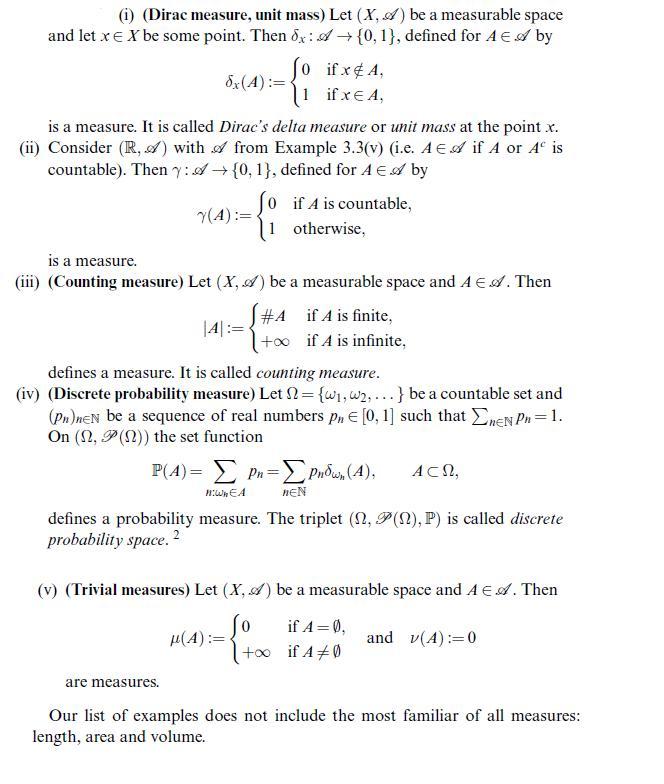
Is the set function \(\gamma\) of Example 4.5 (ii) still a measure on the measurable space \((\mathbb{R}, \mathscr{B}(\mathbb{R}))\) ? Is it still a measure on the measurable space \((\mathbb{Q}, \mathbb{Q} \cap \mathscr{B}(\mathbb{R}))\) ?Data from example 4.5 (i) (Dirac measure, unit mass) Let
Let \(X=\mathbb{R}\). For which \(\sigma\)-algebras are the following set functions measures:(i) \(\quad \mu(A)= \begin{cases}0, & \text { if } A=\emptyset \\ 1, & \text { if } A eq \emptyset\end{cases}\)(ii) \(\quad u(A)= \begin{cases}0, & \text { if } A \text { is finite, } \\ 1, & \text { if }
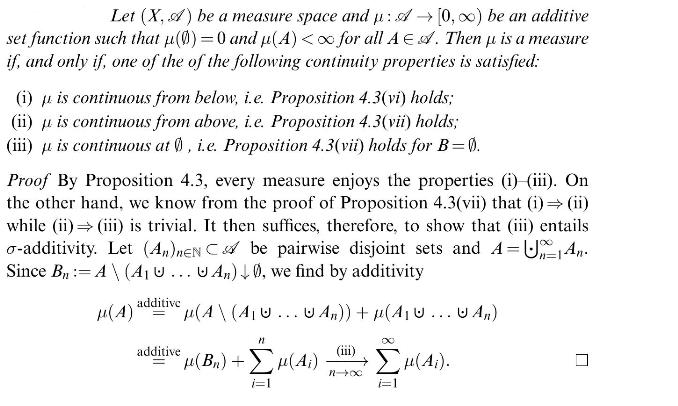
Find an example showing that the finiteness condition in Proposition 4.3 (vii) or Lemma 4.9 is essential.[ use Lebesgue measure or the counting measure on infinite tails \([k, \infty) \downarrow \emptyset\).]Data from proposition 4.3Data from lemma 4.9 Then (i) An B=0 (AUB) = (A) +(B) (ii) ACBp(A)
Find a measure \(\mu\) on \((\mathbb{R}, \mathscr{B}(\mathbb{R}))\) which is \(\sigma\)-finite but assigns to every interval \([a, b)\) with \(b-a>2\) finite mass.
Let \((X, \mathscr{A})\) be a measurable space and assume that \(\mu: \mathscr{A} ightarrow[0, \infty]\) finitely additive and \(\sigma\)-subadditive. Show that \(\mu\) is \(\sigma\)-additive.
Let \((X, \mathscr{A}, \mu)\) be a measure space and \(F \in \mathscr{A}\). Show that \(\mathscr{A} i A \mapsto \mu(A \cap F)\) defines a measure.
Let \((\Omega, \mathscr{A}, \mathbb{P})\) be a probability space and \(\left(A_{n}ight)_{n \in \mathbb{N}} \subset \mathscr{A}\) a sequence of sets with \(\mathbb{P}\left(A_{n}ight)=1\) for all \(n \in \mathbb{N}\). Show that \(\mathbb{P}\left(\bigcap_{n \in \mathbb{N}} A_{n}ight)=1\).
Null sets. Let \((X, \mathscr{A}, \mu)\) be a measure space. A set \(N \in \mathscr{A}\) is called a null set or \(\mu\)-null set if \(\mu(N)=0\). We write \(\mathscr{N}_{\mu}\) for the family of all \(\mu\)-null sets. Check that \(\mathscr{N}_{\mu}\) has the following properties:(i) \(\emptyset
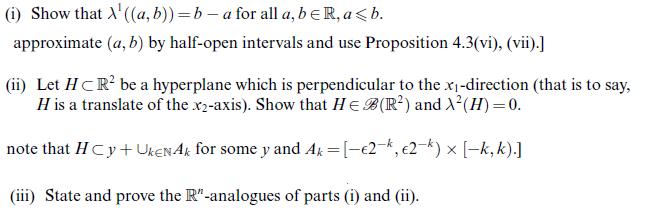
Let \(\lambda\) be one-dimensional Lebesgue measure.(i). Show that for all \(x \in \mathbb{R}\) the set \(\{x\}\) is a Borel set with \(\lambda\{x\}=0\).[ consider the intervals \([x-1 / k, x+1 / k), k \in \mathbb{N}\) and use Proposition 4.3 (vii).](ii). Prove in two ways that \(\mathbb{Q}\) is a
Determine all null sets of the measure \(\delta_{a}+\delta_{b}, a, b \in \mathbb{R}\), on \((\mathbb{R}, \mathscr{B}(\mathbb{R}))\).
Verify the claims made in Remark 5.2Data from remark 5.2 As for o-algebras, see Properties 3.2, one sees that 0 and that finite disjoint unions are again in 2: D, E = D, DnE=0 DUE 9. Of course, every o-algebra is a Dynkin system, but the converse is, in general, wrong, [] Problem 5.2.
The following exercise shows that Dynkin systems and \(\sigma\)-algebras are, in general, different. Let \(X=\{1,2,3, \ldots, 4 k-1,4 k\}\) for some \(k \in \mathbb{N}\). Then \(\mathscr{D}=\{A \subset X: \# A\) is even \(\}\) is a Dynkin system, but not a \(\sigma\)-algebra.
Let \(\mathscr{D}\) be a Dynkin system. Show that for all \(A, B \in \mathscr{D}\) with \(A \subset B\) the difference \(B \backslash A \in \mathscr{D}\). [ use \(R \backslash Q=\left((R \cap Q) \cup R^{c}ight)^{c}\), where \(R, Q \subset X\).]
Let \(\mathscr{A}\) be a \(\sigma\)-algebra, \(\mathscr{D}\) be a Dynkin system and \(\mathscr{G} \subset \mathscr{H} \subset \mathscr{P}(X)\) two collections of subsets of \(X\). Show that(i) \(\delta(\mathscr{A})=\mathscr{A}\) and \(\delta(\mathscr{D})=\mathscr{D}\);(ii) \(\delta(\mathscr{G})
Let \(A, B \subset X\). Compare \(\delta(\{A, B\})\) and \(\sigma(\{A, B\})\). When are they equal?
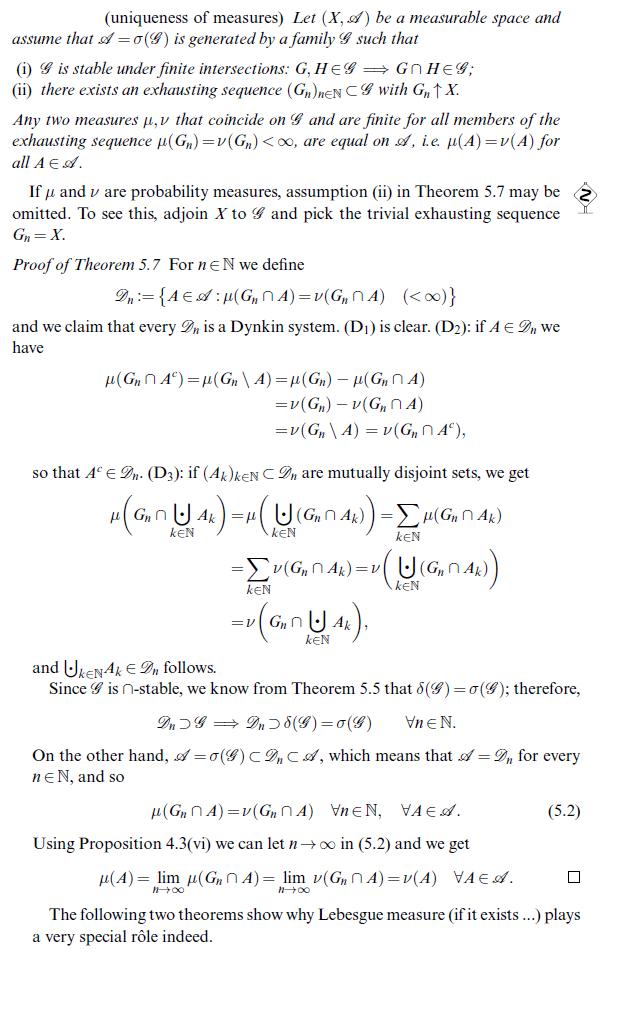
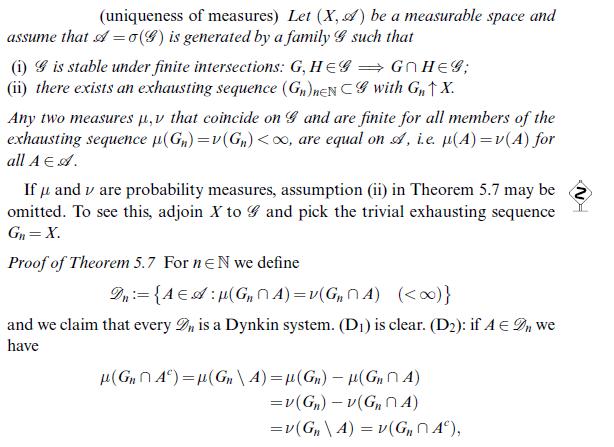
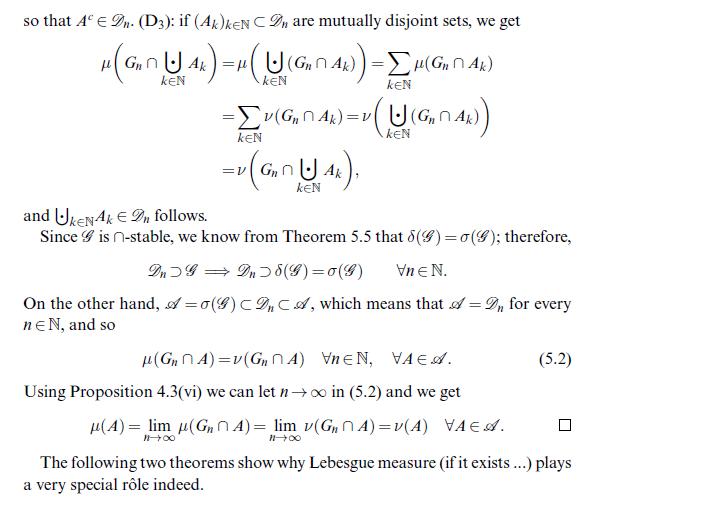
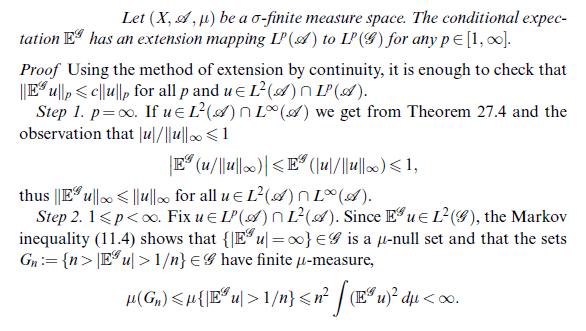
Show that Theorem 5.7 is still valid, if \(\left(G_{n}ight)_{n \in \mathbb{N}} \subset \mathscr{G}\) is not an increasing sequence but any countable family of sets such that\[\text { (1) } \bigcup_{n \in \mathbb{N}} G_{n}=X \quad \text { and } \quad \text { (2) } \quad
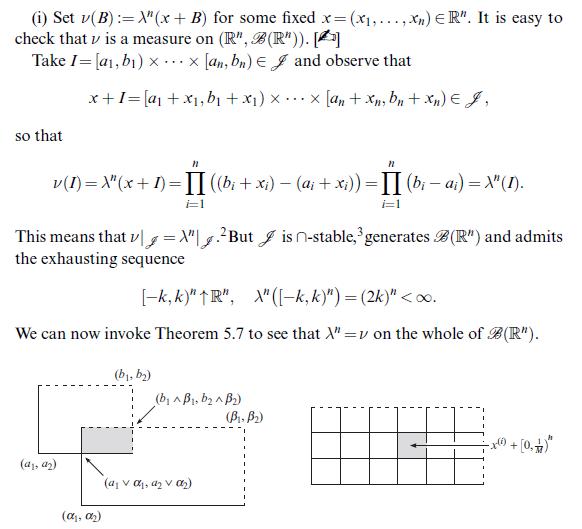
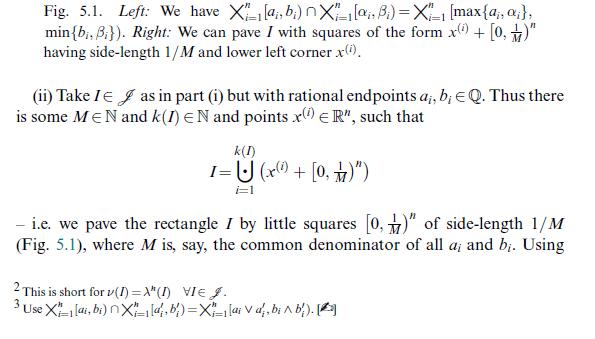
Show that the half-open intervals \(\mathscr{J}\) in \(\mathbb{R}^{n}\) are stable under finite intersections. [ check that \(\left.\mathrm{X}_{i=1}^{n}\left[a_{i}, b_{i}ight) \cap \mathrm{X}_{i=1}^{n}\left[a_{i}^{\prime}, b_{i}^{\prime}ight)=\mathrm{X}_{i=1}^{n}\left[a_{i} \vee a_{i}^{\prime},
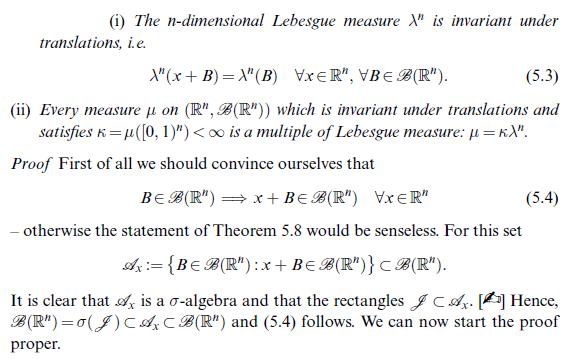
Dilations. Mimic the proof of Theorem 5.8 (i) and show that \(t \cdot B:=\{t b: b \in B\}\) is a Borel set for all \(B \in \mathscr{B}\left(\mathbb{R}^{n}ight)\) and \(t>0\). Moreover,\[\lambda^{n}(t \cdot B)=t^{n} \lambda^{n}(B) \quad \forall B \in \mathscr{B}\left(\mathbb{R}^{n}ight), \forall
Invariant measures. Let \((X, \mathscr{A}, \mu)\) be a finite measure space where \(\mathscr{A}=\sigma(\mathscr{G})\) for some \(\cap\)-stable generator \(\mathscr{G}\). Assume that \(\theta: X ightarrow X\) is a map such that \(\theta^{-1}(A) \in \mathscr{A}\) for all \(A \in \mathscr{A}\). Prove
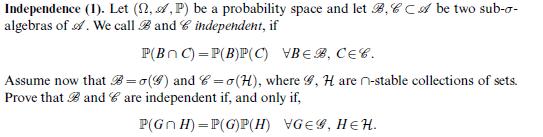
Independence (1). Let \((\Omega, \mathscr{A}, \mathbb{P})\) be a probability space and let \(\mathscr{B}, \mathscr{C} \subset \mathscr{A}\) be two sub- \(\sigma\) algebras of \(\mathscr{A}\). We call \(\mathscr{B}\) and \(\mathscr{C}\) independent, if\[\mathbb{P}(B \cap C)=\mathbb{P}(B)
Approximation of \(\sigma\)-algebras. Let \(\mathscr{G}\) be a Boolean algebra in \(X\), i.e. a family of sets such that \(X \in \mathscr{G}\) and \(\mathscr{G}\) is stable under the formation of finite unions, intersections and complements. Let \(\mathscr{A}=\sigma(\mathscr{G})\) and \(\mu\) be a
Let \(\mu^{*}\) be an outer measure on \(X\), and let \(A_{1}, A_{2}, \ldots\) be a sequence of mutually disjoint \(\mu^{*}\)-measurable sets, i.e. \(A_{i} \in \mathcal{A}^{*}, i \in \mathbb{N}\). Show that\[\mu^{*}\left(Q \cap \bigcup_{i} A_{i}ight)=\sum_{i=1}^{\infty} \mu^{*}\left(Q \cap
Consider on \(\mathbb{R}\) the family \(\Sigma\) of all Borel sets which are symmetric w.r.t. the origin. Show that \(\Sigma\) is a \(\sigma\)-algebra. Is it possible to extend a pre-measure \(\mu\) on \(\Sigma\) to a measure on \(\mathscr{B}(\mathbb{R})\) ? If so, is this extension unique?
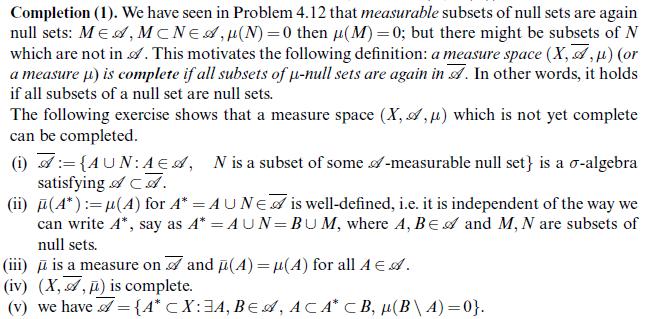
Completion (2). Recall from Problem 9.14 that a measure space \((X, \mathscr{A}, \mu)\) is complete if every subset of a \(\mu\)-null set is a \(\mu\)-null set (thus, in particular, measurable). Let \((X, \mathscr{A}, \mu)\)be a \(\sigma\)-finite measure space - i.e. there is an exhausting sequence
The steps below show that the family \(\epsilon_{\lambda}(t):=e^{-\lambda t}, \lambda, t>0\), is determining for \(([0, \infty), \mathscr{B}[0, \infty))\).(i) Weierstraß' approximation theorem shows that the polynomials on \([0,1]\) are uniformly dense in \(C[0,1]\), see Theorem 28.6 .(ii)
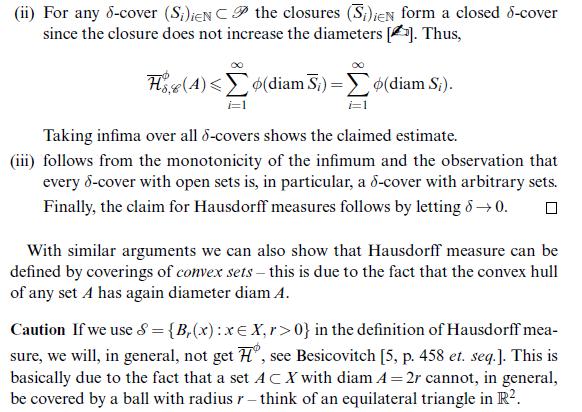
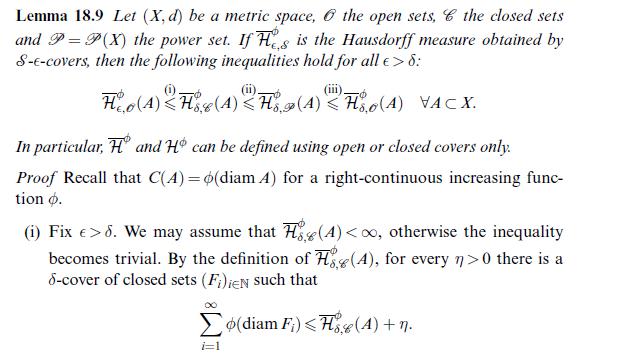
Show that we even get ' \(=\) ' in the estimate denoted by (ii) in Lemma 18.9.Data from lemma 18.9 Lemma 18.9 Let (X, d) be a metric space, the open sets, the closed sets and P = P(X) the power set. If He is the Hausdorff measure obtained by S-E-covers, then the following inequalities hold for all
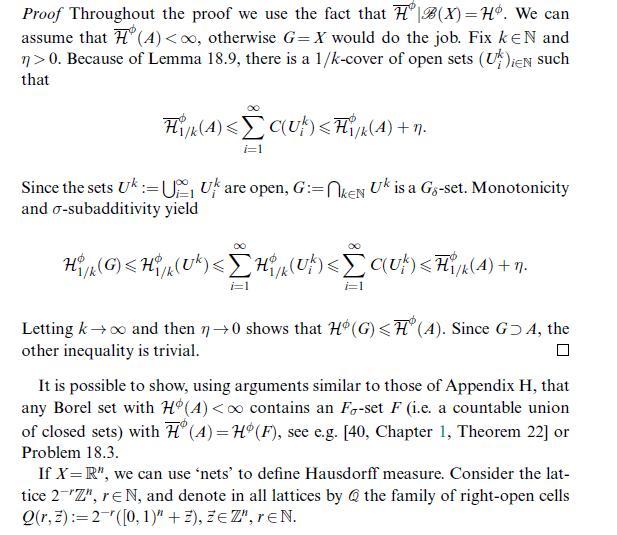
Let \(X=\mathbb{R}^{n}\) (or a separable metric space). Let \(B\) be a Borel set or, more generally, an \(\overline{\mathcal{H}}^{\phi}\)-measurable set, such that \(\mathcal{H}(B)[Instructions. Open sets in \(X\) are \(F_{\sigma}\)-sets. Thus, Corollary 18.10 gives a decreasing sequence \(U_{i}
Showing 300 - 400
of 423
1
2
3
4
5
Step by Step Answers

 Get 50% OFF
Claim Now
Get 50% OFF
Claim Now



![Cantor's ternary set. Let (X, )= ([0, 1], [0, 1] (R)), A=A [0,1], and set Co= [0, 1]. Remove the open middle](https://dsd5zvtm8ll6.cloudfront.net/images/question_images/1705/6/6/0/59265aa50b0074b21705660591454.jpg)


![Let (un)neN CM(A). Then 1 un is measurable and we have undu= |undu | n=] (including the possibility too =](https://dsd5zvtm8ll6.cloudfront.net/images/question_images/1705/7/2/4/19565ab4923ef7a51705724195415.jpg)
![(v) A={ACX: #A < #Nor #A < #N] is a o-algebra. Proof: Let us verify () (3). (): X = 0), which is certainly](https://dsd5zvtm8ll6.cloudfront.net/images/question_images/1705/5/7/9/94365a915a70af811705579942685.jpg)



![(Carathodory) Let SCP(X) be a semi-ring and u: 8 [0,00] a pre-measure, i.e. a set function with (1) (0)=0;](https://dsd5zvtm8ll6.cloudfront.net/images/question_images/1705/6/3/5/77665a9efc09ea331705635776402.jpg)

![Theorem 28.6 (Weierstra) Polynomials are dense in C[0,1] w.r.t. uniform convergence. Proof (S. N. Bernstein)](https://dsd5zvtm8ll6.cloudfront.net/images/question_images/1705/8/9/7/86265adef86c7d601705897860666.jpg)
![Consider the open [] sets U:= {xe X: d(x, Fi)](https://dsd5zvtm8ll6.cloudfront.net/images/question_images/1705/9/0/3/62165ae0605d8c8c1705903621569.jpg)