New Semester
Started
Get
50% OFF
Study Help!
--h --m --s
Claim Now
Question Answers
Textbooks
Find textbooks, questions and answers
Oops, something went wrong!
Change your search query and then try again
S
Books
FREE
Study Help
Expert Questions
Accounting
General Management
Mathematics
Finance
Organizational Behaviour
Law
Physics
Operating System
Management Leadership
Sociology
Programming
Marketing
Database
Computer Network
Economics
Textbooks Solutions
Accounting
Managerial Accounting
Management Leadership
Cost Accounting
Statistics
Business Law
Corporate Finance
Finance
Economics
Auditing
Tutors
Online Tutors
Find a Tutor
Hire a Tutor
Become a Tutor
AI Tutor
AI Study Planner
NEW
Sell Books
Search
Search
Sign In
Register
study help
business
measures integrals and martingales
Measures Integrals And Martingales 2nd Edition René L. Schilling - Solutions
Find \(\mathbb{1}_{[0,1]} * \mathbb{1}_{[0,1]}\) and \(\mathbb{1}_{[0,1]} * \mathbb{1}_{[0,1]} * \mathbb{1}_{[0,1]}\).
Show that \(\operatorname{supp}(u * w) \subset \overline{\operatorname{supp} u+\operatorname{supp} w},(A+B:=\{a+b: a \in A, b \in B\})\).
(Mellin convolution in the group \(((0, \infty), \cdot)\) ) Define on \(((0, \infty), \mathscr{B}(0, \infty))\) the measure \(\mu(d x)=x^{-1} d x\). The Mellin convolution of measurable \(u, w:(0, \infty) ightarrow \mathbb{R}\) is given by\[u \circledast w(x):=\int_{(0, \infty)} u\left(x
Let \((X, \mathscr{A}, \mu)\) be a measure space and \((Y, \mathscr{B})\) be a measurable space. Assume that \(T: A ightarrow B, A \in \mathscr{A}, B \in \mathscr{B}\), is an invertible measurable map. Show that\[\left.T(\mu)ight|_{B}=T\left(\left.\muight|_{A}ight)\]with the restrictions
Let \(\mu\) be a measure on \(\left(\mathbb{R}^{n}, \mathscr{B}\left(\mathbb{R}^{n}ight)ight)\) and \(x, y, z \in \mathbb{R}^{n}\). Find \(\delta_{x} \star \delta_{y}\) and \(\delta_{z} \star \mu\).
Let \(\mu, u\) be two \(\sigma\)-finite measures on \(\left(\mathbb{R}^{n}, \mathscr{B}\left(\mathbb{R}^{n}ight)ight.\) ). Show that \(\mu \star u\) has no atoms (see Problem 6.8) if \(\mu\) has no atoms.Data from problem 6.8Let \((X, \mathscr{A}, \mu)\) be a measure space such that all singletons
Let \(\mathbb{P}\) be a probability measure on \(\left(\mathbb{R}^{n}, \mathscr{B}\left(\mathbb{R}^{n}ight)ight)\) and denote by \(\mathbb{P}^{\star n}\) the \(n\)-fold convolution product \(\mathbb{P} \star \mathbb{P} \star \cdots \star \mathbb{P}\). If \(\int|\omega| \mathbb{P}(d \omega)
Let \(p: \mathbb{R} ightarrow \mathbb{R}\) be a polynomial and \(u \in C_{c}(\mathbb{R})\). Show that \(u \star p\) exists and is again a polynomial.
Let \(w: \mathbb{R} ightarrow \mathbb{R}\) be an increasing (and hence measurable, by Problem 8.21 ) and bounded function. Show that for every positive \(u \in \mathcal{L}^{1}\left(\lambda^{1}ight)\) the convolution \(u \star w\) is again increasing, bounded and continuous.Data from problem 8.21
Assume that \(u \in C_{c}\left(\mathbb{R}^{n}ight)\) and \(w \in C^{\infty}\left(\mathbb{R}^{n}ight)\). Show that \(u \star w\) exists, is of class \(C^{\infty}\) and satisfies\[\frac{\partial}{\partial x_{i}}(u \star w)=u \star\left(\frac{\partial}{\partial x_{i}} wight)\]
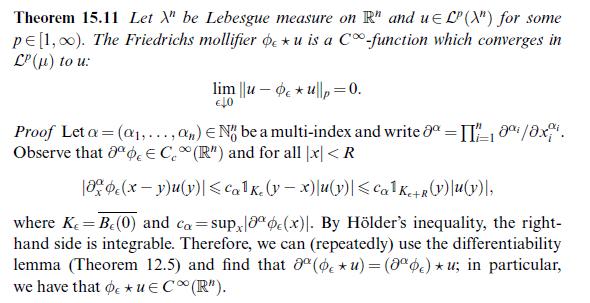
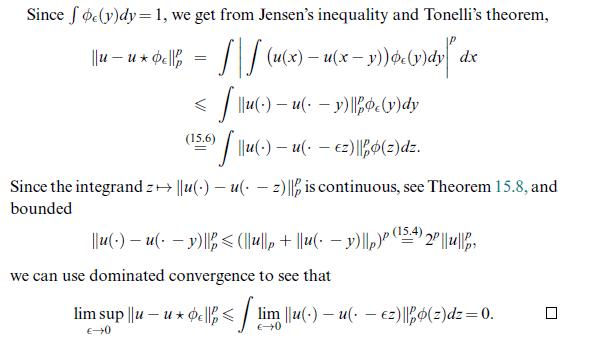
Modify the proof of Theorem 15.11 and show that \(C_{c}^{\infty}\left(\mathbb{R}^{n}ight)\) is uniformly dense in \(C_{c}\left(\mathbb{R}^{n}ight)\).Data from theorem 15.11 Theorem 15.11 Let X" be Lebesgue measure on R" and uELP (X") for some pe [1,00). The Friedrichs mollifier ou is a C-function
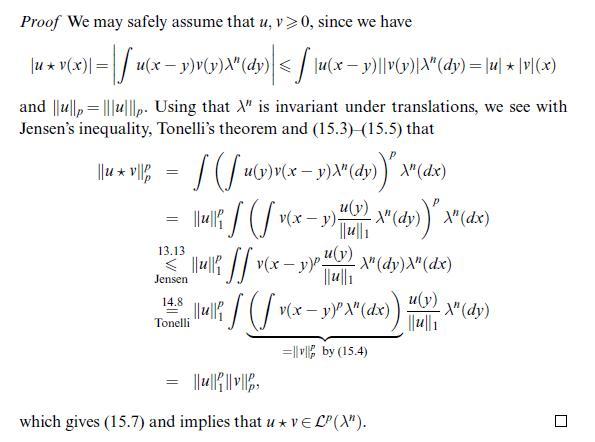
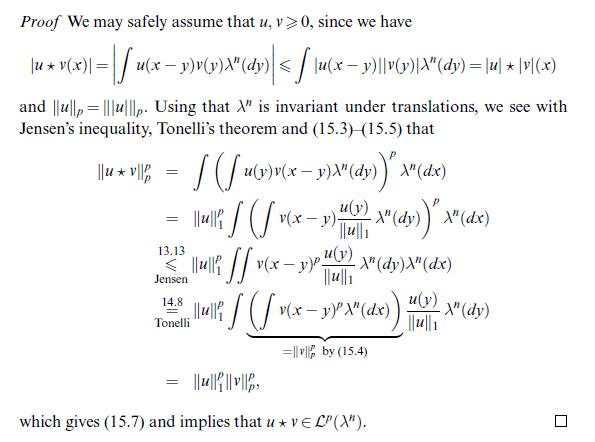
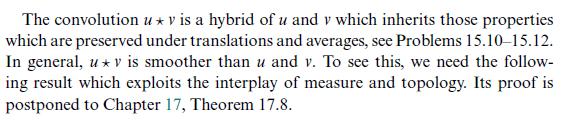
Young's inequality. Adapt the proof of Theorem 15.6 and show that\[\|u \star w\|_{r} \leqslant\|u\|_{p} \cdot\|w\|_{q}\]for all \(p, q, r \in[1, \infty), u \in \mathcal{L}^{p}\left(\lambda^{n}ight), w \in \mathcal{L}^{q}\left(\lambda^{n}ight)\) and \(r^{-1}+1=p^{-1}+q^{-1}\).Data from theorem 15.6
A general Young inequality. Generalize Young's inequality given in Problem 15.14 and show that\[\left\|f_{1} \star f_{2} \star \cdots \star f_{N}ight\|_{r} \leqslant \prod_{j=1}^{N}\left\|f_{j}ight\|_{p}, \quad p=\frac{N r}{(N-1) r+1}\]for all \(N \in \mathbb{N}, r \in[1, \infty)\) and \(f_{j} \in
Define \(\phi: \mathbb{R} ightarrow \mathbb{R}\) by \(\phi(x):=(1-\cos x) \mathbb{1}_{[0,2 \pi)}(x)\), let \(u(x):=1, v(x):=\phi^{\prime}(x)\) and \(w(x):=\int_{(-\infty, x)} \phi(t) d t\). Then(i) \(u \star v(x)=0\) for all \(x \in \mathbb{R}\);(ii) \(v \star w(x)=\phi \star \phi(x)>0\) for all
Let \(F, F_{1}, F_{2}, F_{3}, \ldots\) be \(F_{\sigma}\)-sets in \(\mathbb{R}^{n}\). Show that(i) \(F_{1} \cap F_{2} \cap \cdots \cap F_{N}\) is for every \(N \in \mathbb{N}\) an \(F_{\sigma}\)-set;(ii) \(\bigcup_{n \in \mathbb{N}} F_{n}\) is an \(F_{\sigma}\)-set;(iii) \(F^{c}\) and \(\bigcap_{n
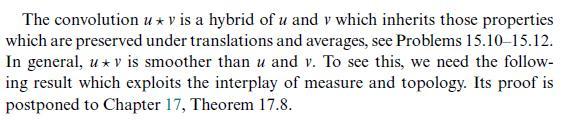
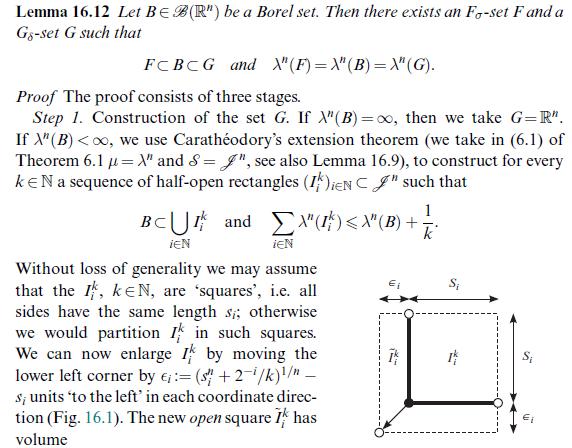
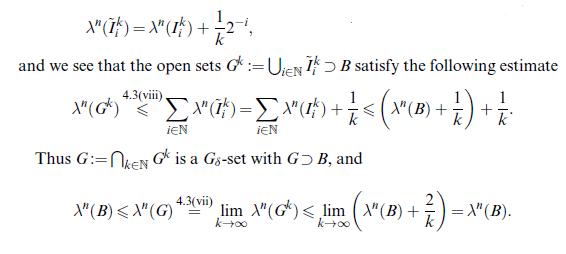
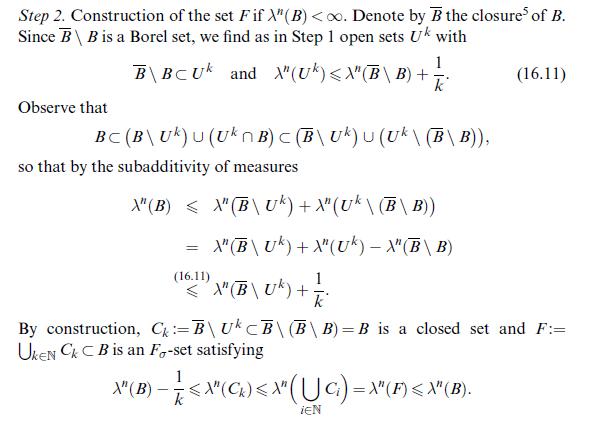
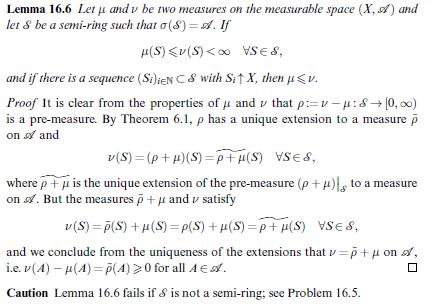
Prove the following corollary to Lemma 16.12 : Lebesgue measure \(\lambda^{n}\) on \(\mathbb{R}^{n}\) is outer regular, i.e.\[\lambda^{n}(B)=\inf \left\{\lambda^{n}(U): U \supset B, U \text { open }ight\} \quad \forall B \in \mathscr{B}\left(\mathbb{R}^{n}ight)\]and inner regular,
Completion (6). Combine Problems 16.2 and 11.6 to show that the completion \(\bar{\lambda}^{n}\) of \(n\)-dimensional Lebesgue measure is again inner and outer regular.Data from problem 16.2Prove the following corollary to Lemma 16.12: Lebesgue measure \(\lambda^{n}\) on \(\mathbb{R}^{n}\) is outer
Let \(C\) be Cantor's ternary set, see page 4 and Problem 7.12.(i) Show that \(C-C:=\{x-y: x, y \in C\}\) is the interval \([-1,1]\).(ii) Show that this proves that the result of Corollary 16.14 is the best possible.[ (i) Use the ternary expansion of \(x \in C\) from Problem 7.12 and show that
Consider the Borel \(\sigma\)-algebra \(\mathscr{B}[0, \infty)\) and write \(\lambda=\left.\lambda^{1}ight|_{[0, \infty)}\) for Lebesgue measure on the half-line \([0, \infty)\).(i) Show that \(\mathscr{G}:=\{[a, \infty): a \geqslant 0\}\) generates \(\mathscr{B}[0, \infty)\).(ii) Show that
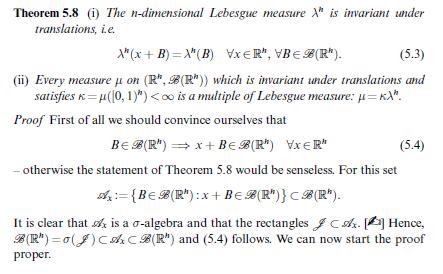
Use Jacobi's transformation formula to recover Theorem 5.8(i), Problem 5.9 and Theorem 7.10. In particular, for all integrable functions \(u: \mathbb{R}^{n} ightarrow[0, \infty)\)\[\begin{aligned}\int u(x+y) \lambda^{n}(d x) & =\int u(x) \lambda^{n}(d x) & & \forall y \in
Arc-length. Let \(f: \mathbb{R} ightarrow \mathbb{R}\) be a twice continuously differentiable function and denote by \(\Gamma_{f}:=\{(t, f(t)): t \in \mathbb{R}\}\) its graph. Define a function \(\Phi: \mathbb{R} ightarrow \mathbb{R}^{2}\) by \(\Phi(x):=(x, f(x))\). Then(i) \(\Phi: \mathbb{R}
Let \(\Phi: \mathbb{R}^{d} ightarrow M \subset \mathbb{R}^{n}, d \leqslant n\), be a \(C^{1}\)-diffeomorphism.(i) Show that \(\lambda_{M}:=\Phi\left(|\operatorname{det} D \Phi| \lambda^{d}ight)\) is a measure on M. Find a formula for \(\int_{M} u d \lambda_{M}\).(ii) Show that for a dilation
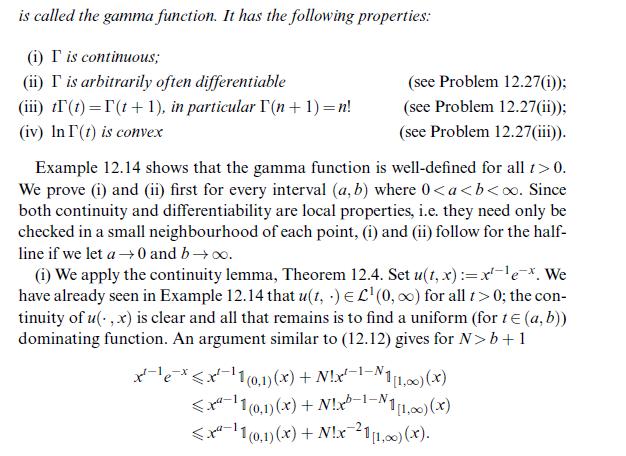
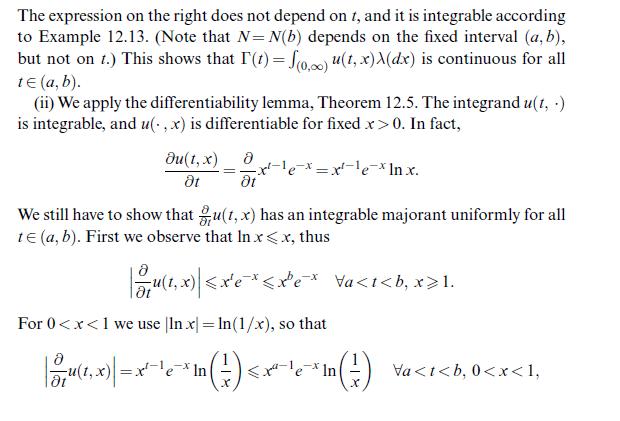
In Example 12.15 we introduced Euler's gamma function:\[\Gamma(t)=\int_{(0, \infty)} x^{t-1} e^{-x} \lambda^{1}(d x)\]Show that \(\Gamma\left(\frac{1}{2}ight)=\sqrt{\pi}\).Data from example 12.15 Example 12.15 (Euler's gamma function) The parameter-dependent integral ) := (0.00)*x^- e- x x (dx),
3D polar coordinates. Define \(\Phi:[0, \infty) \times[0,2 \pi) \times[-\pi / 2, \pi / 2) ightarrow \mathbb{R}^{3}\) by\[\Phi(r, \theta, \omega):=(r \cos \theta \cos \omega, r \sin \theta \cos \omega, r \sin \omega)\]Show that \(|\operatorname{det} D \Phi(r, \theta, \omega)|=r^{2} \cos \omega\) and
Euler's Inegrals. Euler's gamma and beta functions are the following parameterdependent integrals for \(x, y>0\) :\[\Gamma(x):=\int_{0}^{\infty} e^{-t} t^{x-1} d t \quad \text { and } \quad B(x, y):=\int_{0}^{1} t^{x-1}(1-t)^{y-1} d t\](i) Show that\[\Gamma(x) \Gamma(y)=4 \int_{(0, \infty)^{2}}
Compute for \(m, n \in \mathbb{N}\) the integral\[\int_{B_{1}(0)} x^{m} y^{n} d(x, y)\]
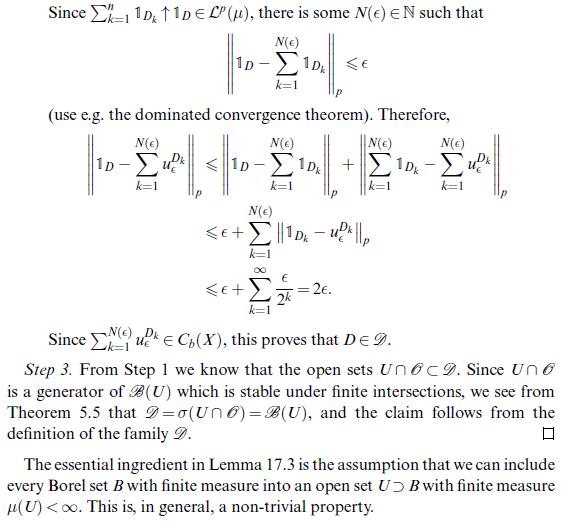
Let \((X, \mathscr{A}, \mu)\) be a measure space. Assume that \(\mathcal{D} \subset \mathcal{L}^{p}(\mu)\) is dense. If \(\mathcal{C} \subset \mathcal{D}\) is dense w.r.t. the norm \(\|\cdot\|_{p}\), then \(\mathcal{C} \subset \mathcal{L}^{p}(\mu)\) is dense.
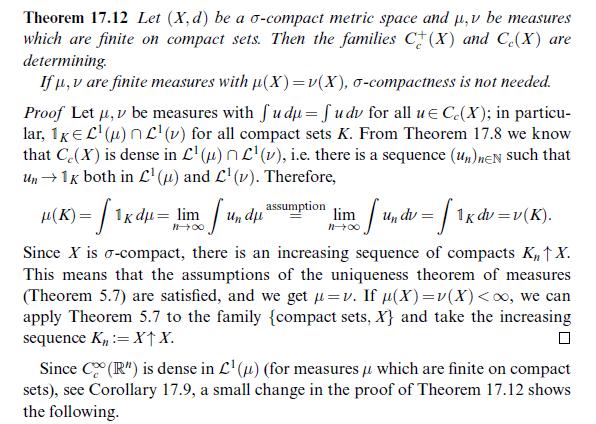
The following exercise provides an independent proof of Theorem 17.12 in \(\mathbb{R}^{n}\). Set \(d(x, A):=\inf _{a \in A}|x-a|\) and assume that all measures are finite on compact sets.(i) (Urysohn's lemma) Let \(K \subset \mathbb{R}^{n}\) be a compact set and \(U_{k}:=K+B_{1 / k}(0)\). Show that
Consider on \((\mathbb{R}, \mathscr{B}(\mathbb{R}), d x)\) the Lebesgue space \(\mathcal{L}^{p}(d x), \quad 1 \leqslant p
Denote by \(d x\) one-dimensional Lebesgue measure and let \(f \in \mathcal{L}^{1}(d x)\). Define the mean value\[M_{h} f(x):=\frac{1}{2 h} \int_{x-h}^{x+h} f(t) d t\]and show that(i) \(M_{h} f(x)\) is continuous and \(\left\|M_{h} fight\|_{1} \leqslant\|f\|_{1}\),(ii) \(\lim _{h ightarrow
Let \(\mu\) be an outer regular measure on \((X, d, \mathscr{B}(X)), 1 \leqslant p(i) Let \(A \in \mathscr{B}(X)\) such that \(f=\mathbb{1}_{A} \in \mathcal{L}^{p}(\mu)\). Show that for every \(\epsilon>0\) there is some \(\phi_{\epsilon} \in C_{\mathrm{Lip}}(X)\) such that
Let \((X, d)\) be a metric space which is separable (i.e. it contains a countable dense subset) and locally compact (i.e. every \(x \in X\) has an open neighbourhood \(U\) such that \(\bar{U}\) is compact); denote by \(\mathscr{O}\) the open sets of \(X\) and assume that \(\mu\) is a measure on
Lusin's theorem. The following steps furnish a proof of the following result.Theorem (Lusin). Let \(\mu\) be an outer regular measure on the space \((X, d, \mathscr{B}(X))\). For every \(f \in \mathcal{L}^{p}(\mu), 1 \leqslant p0\) there is some \(\phi_{\epsilon} \in \mathcal{L}^{p}(\mu) \cap
Consider Lebesgue measure \(\lambda\) on the space \(([a, b], \mathscr{B}[a, b])\) and assume there on that \(f \in \mathcal{L}^{1}([a, b], \lambda)\) satisfies \(\int_{a}^{b} x^{n} f(x) d x=0\) for all \(n=0,1,2, \ldots\). Show that \(\left.fight|_{[a, b]}=0\) is Lebesgue almost everywhere.[ use
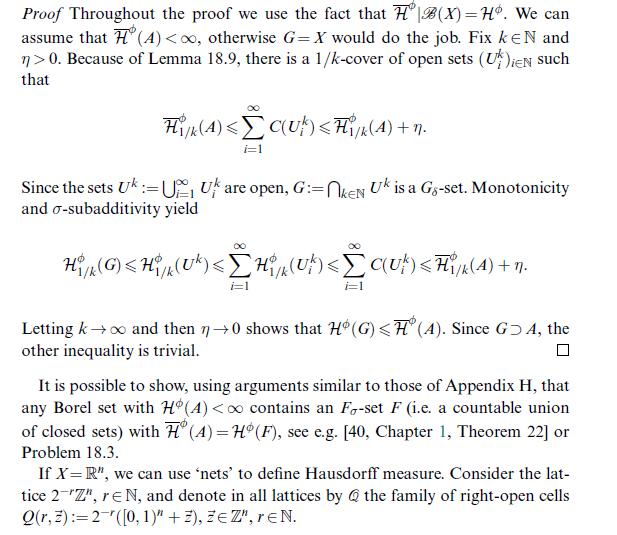
Show that the outer regularity from Corollary 18.10 coincides with the usual notion, i.e.\[\overline{\mathcal{H}}^{\phi}(A)=\inf \left\{\mathcal{H}^{\phi}(U): U \supset A, U \text { open }ight\},\]provided that there exists some open set \(U \supset A\) with finite Hausdorff measure. Use the
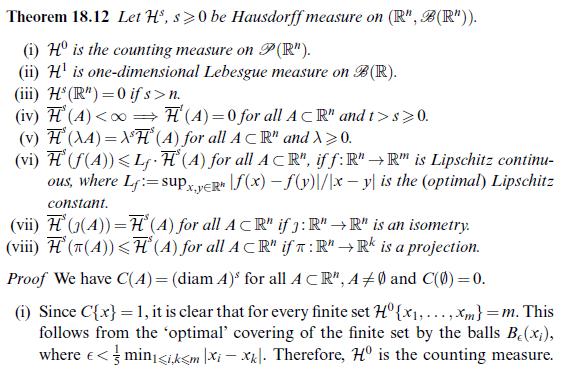
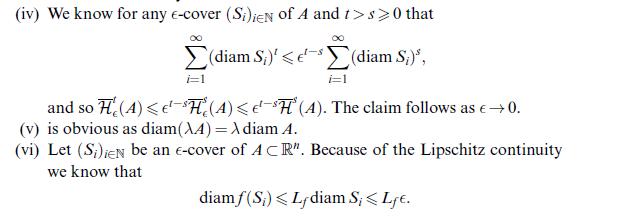
Finish the proof of Theorem 18.12 (i) and show that every set \(A \subset \mathbb{R}^{n}\) is indeed \(\overline{\mathcal{H}}^{0}\)-measurable.Data from theorem 18.12 Theorem 18.12 Let Hs, s20 be Hausdorff measure on (R", B(R")). (i) H is the counting measure on P(R"). (ii) H is one-dimensional
Let \((X, \mathscr{A}, \mu)\) be a \(\sigma\)-finite measure space and let \(u\) be a further measure. Show that \(u \leqslant \mu\) entails that \(u=f \mu\) for some (a.e. uniquely determined) density function \(f\) such that \(0 \leqslant f \leqslant 1\).
Let \(\mu, u\) be two \(\sigma\)-finite measures on \((X, \mathscr{A})\) which have the same null sets. Show that \(u=f \mu\) and \(\mu=g u\), where \(0
Give an example of a measure \(\mu\) and a density \(f\) such that \(f \mu\) is not \(\sigma\)-finite.
Let \((X, \mathscr{A}, \mu)\) be a \(\sigma\)-finite measure space and assume that \(u=f \mu\) for a positive measurable function \(f\).(i) Show that \(u\) is a finite measure if, and only if, \(f \in \mathcal{L}^{1}(\mu)\).(ii) Show that \(u\) is a \(\sigma\)-finite measure if, and only if,
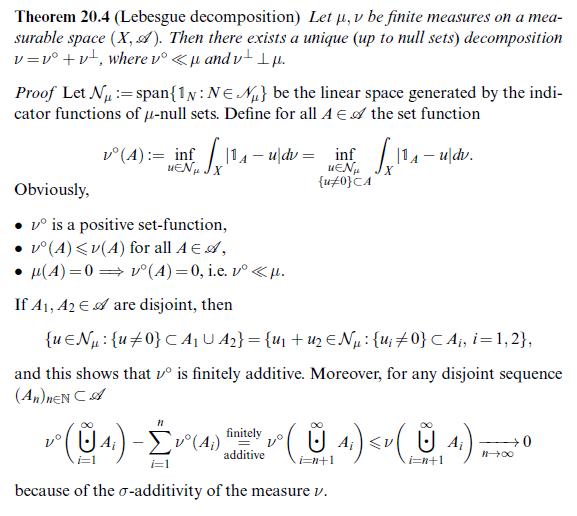
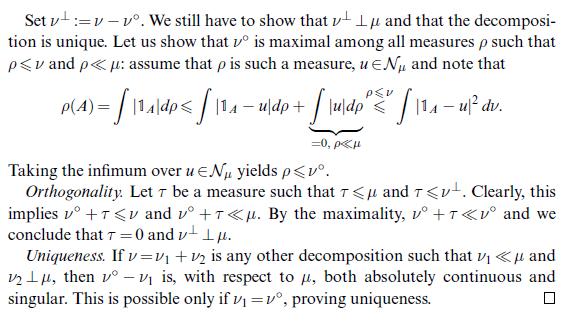
Two measures \(ho, \sigma\) defined on the same measurable space \((X, \mathscr{A})\) are singular, if there is a set \(N \in \mathscr{A}\) such that \(ho(N)=\sigma\left(N^{c}ight)=0\). If this is the case, we write \(ho \perp \sigma\). Steps (i)-(iv) below show the so-called Lebesgue decomposition
Bounded variation and absolute continuity. Let \(\lambda\) be one-dimensional Lebesgue measure.A function \(F:[a, b] ightarrow \mathbb{R}\) is said to beabsolutely continuous (AC) if for each \(\epsilon>0\) there is a \(\delta>0\) such that
Let \(\mu\) be Lebesgue measure on \([0,2]\) and \(u\) be Lebesgue measure on \([1,3]\). Find the Lebesgue decomposition of \(u\) with respect to \(\mu\).
Stielties measure (3). Let \((\mathbb{R}, \mathscr{B}(\mathbb{R}), \mu)\) be a finite measure space and denote by \(F\) the left-continuous distribution function of \(\mu\) as in Problem 6.1. Use Lebesgue's decomposition theorem (Theorem 20.4 ) to show that we can decompose \(F=F_{1}+F_{2}+F_{3}\)
The devil's staircase. Recall the construction of Cantor's ternary set from Problem 7.12. Denote by \(I_{n}^{1}, \ldots, I_{n}^{n}-1\) the intervals which make up \([0,1] \backslash C_{n}\) arranged in increasing order of their endpoints. We construct a sequence of functions \(F_{n}:[0,1]
The indicator function of a set \(A \subset X\) is defined by\[\mathbb{1}_{A}(x):= \begin{cases}1 & \text { if } x \in A \\ 0 & \text { if } x otin A\end{cases}\]Check that for \(A, B, A_{i} \subset X, i \in I\) (arbitrary index set) the following equalities hold:(i) \(\quad \mathbb{1}_{A \cap
Let \(A, B, C \subset X\) and denote by \(A \triangle B\) the symmetric difference as in Problem 2.2 . Show that(i)(ii) \(A \Delta(B \triangle C)=(A \triangle B) \triangle C\);(iii) \(\mathscr{P}(X)\) is a commutative ring (in the usual algebraists' sense) with 'addition' \(\triangle\) and
Let \(f: X ightarrow Y\) be a map, \(A \subset X\) and \(B \subset Y\). Show that, in general,\[f \circ f^{-1}(B) \varsubsetneqq B \text { and } f^{-1} \circ f(A) \supsetneq A \text {. }\]When does ' \(=\) ' hold in these relations? Provide an example showing that the above inclusions are strict.
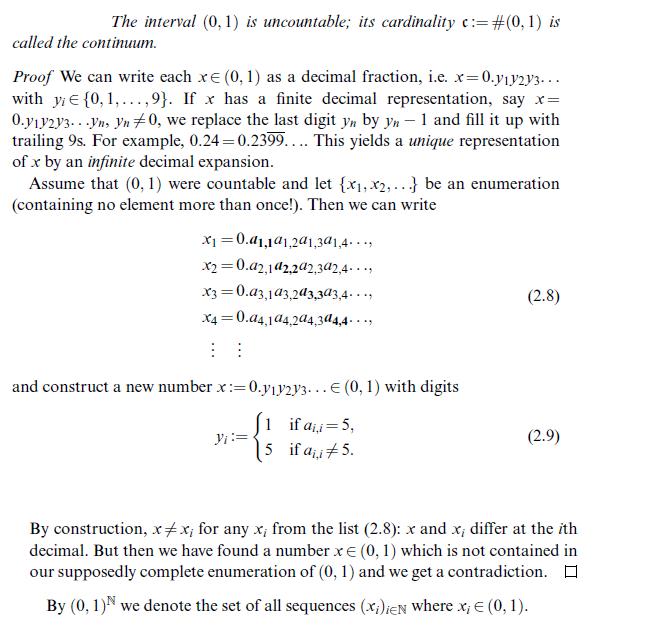
Show that \(\{0,1\}^{\mathbb{N}}=\{\) all infinite sequences consisting of 0 and 1\(\}\) is uncountable.
Show that the set \(\mathbb{R}\) is uncountable and that \(\#(0,1)=\# \mathbb{R}\).[find a bijection \(f:(0,1) ightarrow \mathbb{R}\).]
Adapt the proof of Theorem 2.8 to show that \(\#\{1,2\}^{\mathbb{N}} \leqslant \#(0,1) \leqslant \#\{0,1\}^{\mathbb{N}}\) and conclude that \(\#(0,1)=\#\{0,1\}^{\mathbb{N}}\).Remark. This is the reason for writing \(\mathfrak{c}=2^{\aleph_{0}}\).[ interpret \(\{0,1\}^{\mathbb{N}}\) as base- 2
Extend Problem 2.15 to deduce \(\#\{0,1,2, \ldots, n\}^{\mathbb{N}}=\#(0,1)\) for all \(n \in \mathbb{N}\).Data from problem 2.15Adapt the proof of Theorem 2.8 to show that \(\#\{1,2\}^{\mathbb{N}} \leqslant \#(0,1) \leqslant \#\{0,1\}^{\mathbb{N}}\) and conclude that
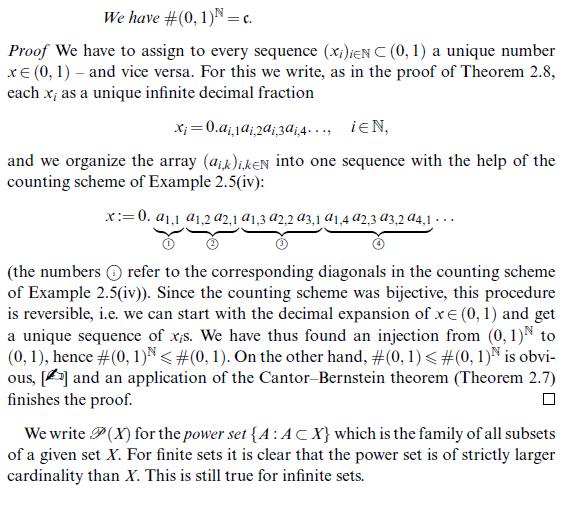
Mimic the proof of Theorem 2.9 to show that \(\#(0,1)^{2}=\mathfrak{c}\). Use the fact that \(\# \mathbb{R}=\#(0,1)\) to conclude that \(\# \mathbb{R}^{2}=\mathfrak{c}\).Data from theorem 2.9 We have #(0, 1) = c. Proof We have to assign to every sequence (xi)iEN C (0, 1) a unique number x = (0, 1)
Show that the set of all infinite sequences of natural numbers \(\mathbb{N}^{\mathbb{N}}\) has cardinality \(\mathfrak{c}\). [use that \(\#\{0,1\}^{\mathbb{N}}=\#\{1,2\}^{\mathbb{N}},\{1,2\}^{\mathbb{N}} \subset \mathbb{N}^{\mathbb{N}} \subset \mathbb{R}^{\mathbb{N}}\) and \(\#
Let \(A_{1}, A_{2}, \ldots, A_{N}\) be non-empty subsets of \(X\).(i) If the \(A_{n}\) are disjoint and \(\biguplus A_{n}=X\), then \(\# \sigma\left(A_{1}, A_{2}, \ldots, A_{N}ight)=2^{N}\).Remark. A set \(A\) in a \(\sigma\)-algebra \(\mathscr{A}\) is called an atom, if there is no proper subset
Find an example (e.g. in \(\mathbb{R}\) ) showing that \(\bigcap_{n \in \mathbb{N}} U_{n}\) need not be open even if all \(U_{n}\) are open sets.
Prove any one of the assertions made in Remark 3.9 .Data from remark 3.9 Let D be a dense subset of R, e.g. D=Q or D=R. The Borel sets of the real line R are also generated by any of the following systems: {(-, a): a D}, {(-,a]: aD}, {(a, ): aD}, {[a, ): a D}.
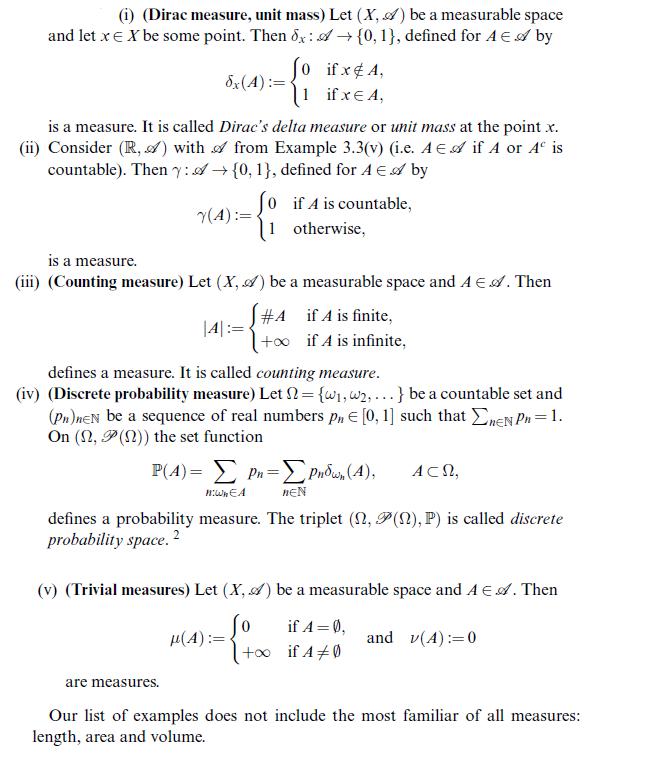
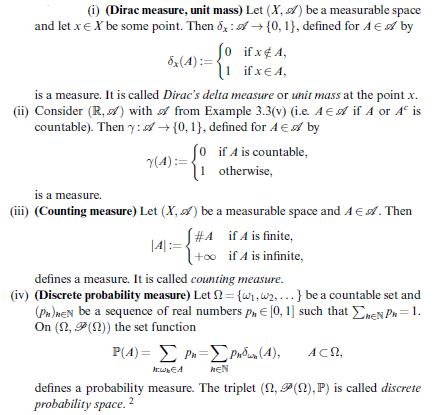
Check that the set functions defined in Example 4.5 are measures in the sense of Definition 4.1 .Data From example 4.5Data from definition 4.1 (i) (Dirac measure, unit mass) Let (X, A) be a measurable space and let x = X be some point. Then dx: {0, 1}, defined for AE by 5x (A):= is a measure. It
.Let \((X, \mathscr{A})\) be a measurable space.(i). Let \(\mu, u\) be two measures on \((X, \mathscr{A})\). Show that the set function \(ho(A):=a \mu(A)+\) \(b u(A), A \in \mathscr{A}\), for all \(a, b \geqslant 0\) is again a measure.(ii). Let \(\mu_{1}, \mu_{2}, \ldots\) be countably many
. Let \((X, \mathscr{A}, \mu)\) be a finite measure space and \(\left(A_{n}ight)_{n \in \mathbb{N}},\left(B_{n}ight)_{n \in \mathbb{N}} \subset \mathscr{A}\) such that \(A_{n} \supset B_{n}\) for all \(n \in \mathbb{N}\). Show that\[\mu\left(\bigcup_{n \in \mathbb{N}} A_{n}ight)-\mu\left(\bigcup_{n
Let \((X, \mathscr{A}, \mu)\) be a measure space, let \(\mathscr{F} \subset \mathscr{A}\) be a sub- \(\sigma\)-algebra and denote the collection of all \(\mu\)-null sets by \(\mathscr{N}=\{N \in \mathscr{A}: \mu(N)=0\}\). Then\[\sigma(\mathscr{F}, \mathscr{N})=\{F \Delta N: F \in \mathscr{F}, N \in
Let \(\overline{\mathscr{A}}\) denote the completion of \(\mathscr{A}\) as in Problem 4.15 and write\[\mathscr{N}:=\{N \subset X: \exists M \in \mathscr{A}, N \subset M, \mu(M)=0\}\]for the family of all subsets of \(\mathscr{A}\)-measurable null sets. Show
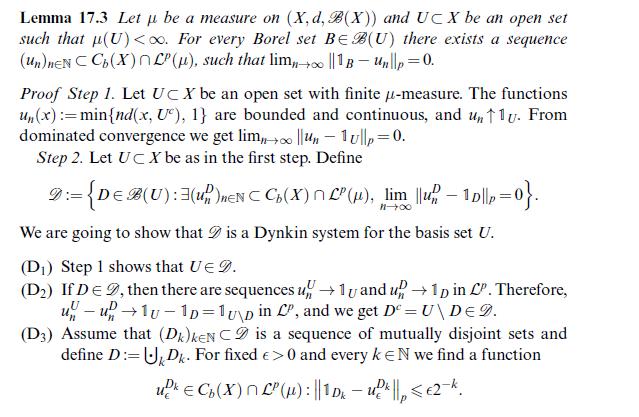
Regularity on Polish spaces. A Polish space XX is a complete metric space which has a countable dense subset D⊂XD⊂X.Let μμ be a finite measure on (X,B(X))(X,B(X)). Then μμ is regular in the sense
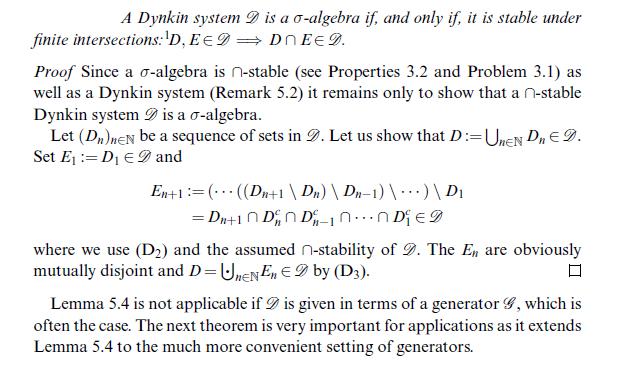
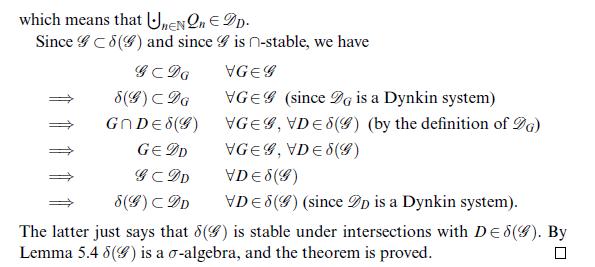
An alternative definition of Dynkin systems. A family \(\mathscr{F} \subset \mathscr{P}(X)\) is a Dynkin system if, and only if,Conclude that any Dynkin system is a monotone class in the sense of Problem 3.14 .Data from problem 3.14 Monotone classes (1). A family \(\mathscr{M} \subset
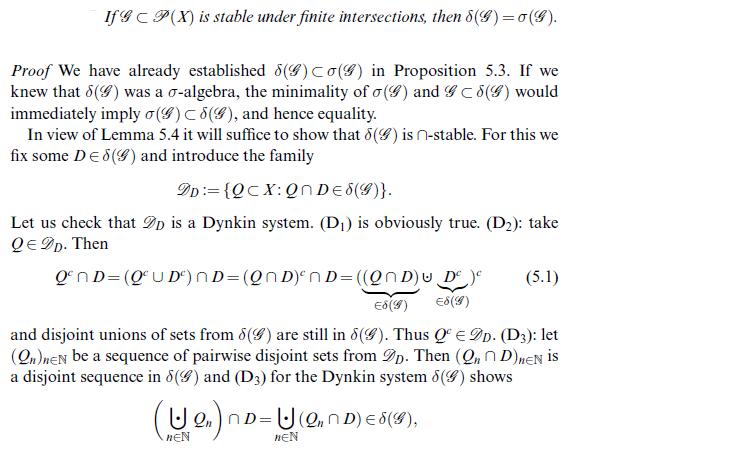
Monotone classes (2). Recall from Problem 3.14 that a monotone class \(\mathscr{M} \subset \mathscr{P}(X)\) is a family which contains \(X\) and is stable under countable unions of increasing sets and countable intersections of decreasing sets; denote by \(\mathfrak{m}(\mathscr{G})\) the smallest
(i) Show that non-void open sets in \(\mathbb{R}\) (resp. \(\mathbb{R}^{n}\) ) have always strictly positive Lebesgue measure.[let \(U\) be open. Find a small ball in \(U\) and inscribe a square.](ii) Does your answer to part (i) hold also for closed sets?
(i) Show that \(\lambda^{1}((a, b))=b-a\) for all \(a, b \in \mathbb{R}, a \leqslant b\).[ approximate \((a, b)\) by half-open intervals and use Proposition 4.3 (vi), (vii).](ii) Let \(H \subset \mathbb{R}^{2}\) be a hyperplane which is perpendicular to the \(x_{1}\)-direction (that is to say,
Let \(\lambda:=\left.\lambda^{1}ight|_{[0,1]}\) be Lebesgue measure on \(([0,1], \mathscr{B}[0,1])\). Show that for every \(\epsilon>0\) there is a dense open set \(U \subset[0,1]\) with \(\lambda(U) \leqslant \epsilon\).[take an enumeration \(\left(q_{i}ight)_{i \in \mathbb{N}}\) of \(\mathbb{Q}
Let \(\lambda=\lambda^{1}\) be Lebesgue measure on \((\mathbb{R}, \mathscr{B}(\mathbb{R}))\). Show that \(N \in \mathscr{B}(\mathbb{R})\) is a null set if, and only if, for every \(\epsilon>0\) there is an open set \(U_{\epsilon} \supset N\) such that \(\lambda\left(U_{\epsilon}ight)[
Borel-Cantelli lemma (1) - the direct half. Prove the following theorem.Theorem (Borel-Cantelli lemma). Let \((\Omega, \mathscr{A}, \mathbb{P})\) be a probability space. For every sequence \(\left(A_{i}ight)_{i \in \mathbb{N}} \subset \mathscr{A}\) we have\[\sum_{i=1}^{\infty}
Non-measurable sets (1). Let \(\mu\) be a measure on \(\mathscr{A}=\{\emptyset,[0,1),[1,2),[0,2)\}, X=[0,2)\), such that \(\mu([0,1))=\mu([1,2))=\frac{1}{2}\) and \(\mu([0,2))=1\). Denote by \(\mu^{*}\) and \(\mathscr{A}^{*}\) the outer measure and \(\sigma\)-algebra which appear in the proof of
Non-measurable sets (2). Consider on \(X=\mathbb{R}\) the \(\sigma\)-algebra \(\mathscr{A}:=\left\{A \subset \mathbb{R}: Aight.\) or \(A^{c}\) is countable \} from Example 3.3 (v) and the measure \(\gamma(A)\) from Example 4.5 (ii), which is 0 or 1 according to \(A\) or \(A^{c}\) being countable.
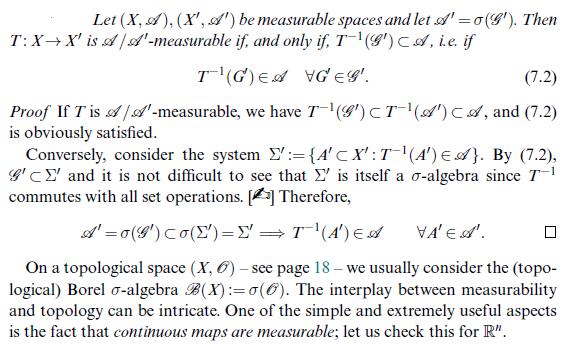
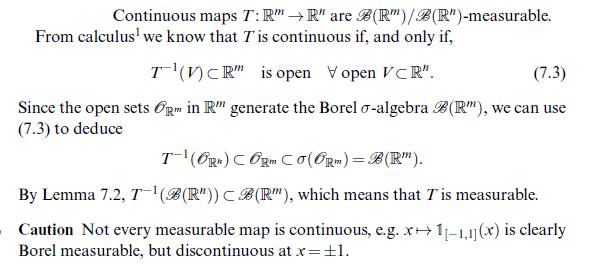
Use Lemma 7.2 to show that \(\tau_{x}: y \mapsto y-x, x, y \in \mathbb{R}^{n}\), is \(\mathscr{B}\left(\mathbb{R}^{n}ight) / \mathscr{B}\left(\mathbb{R}^{n}ight)\)-measurable.Data from lemma 7.2 Let (X, A), (X', A') be measurable spaces and let A'= o(9'). Then T:XX' is A/A -measurable if, and only
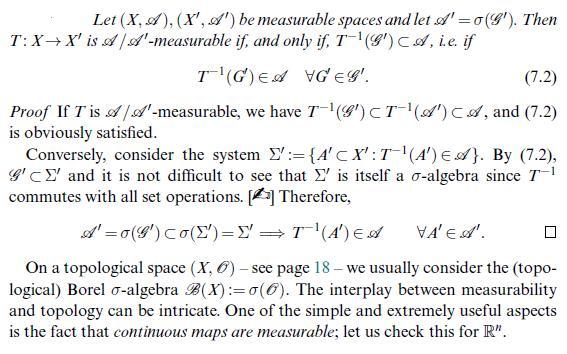
Show that \(\Sigma^{\prime}\) defined in the proof of Lemma 7.2 is a \(\sigma\)-algebra.Data from lemma 7.2 Let (X, A), (X', A') be measurable spaces and let A' = o(9'). Then T:XX' is A/A'-measurable if, and only if, T-(G) CA, i.e. if T(G)EA VG EG'. (7.2) Proof If T is A/A'-measurable, we have T-
Let \(X=\mathbb{Z}=\{0, \pm 1, \pm 2, \ldots\}\). Show that(i) \(\mathscr{A}:=\{A \subset \mathbb{Z} \mid \forall n>0: 2 n \in A \Longleftrightarrow 2 n+1 \in A\}\) is a \(\sigma\)-algebra;(ii) \(T: \mathbb{Z} ightarrow \mathbb{Z}, T(n):=n+2\) is \(\mathscr{A} / \mathscr{A}\)-measurable and
Let \(X\) be a set, let \(\left(X_{i}, \mathscr{A}_{i}ight), i \in I\), be arbitrarily many measurable spaces and let \(T_{i}: X ightarrow X_{i}\) be a family of maps.(i) Show that for every \(i \in I\) the smallest \(\sigma\)-algebra in \(X\) that makes \(T_{i}\) measurable is given by
Let \((X, \mathscr{A})\) and \(\left(X^{\prime}, \mathscr{A}^{\prime}ight)\) be measurable spaces and \(T: X ightarrow X^{\prime}\).(i) Show that \(\mathbb{1}_{T^{-1}\left(A^{\prime}ight)}(x)=\mathbb{1}_{A^{\prime}} \circ T(x) \quad \forall x \in X\).(ii) \(T\) is measurable if, and only if,
Let \(T: X ightarrow Y\) be any map. Show that \(T^{-1}(\sigma(\mathscr{G}))=\sigma\left(T^{-1}(\mathscr{G})ight)\) holds for arbitrary families \(\mathscr{G}\) of subsets of \(Y\).
Let \(X\) be a set, let \(\left(X_{i}, \mathscr{A}_{i}ight), i \in I\), be arbitrarily many measurable spaces and let \(T_{i}: X ightarrow X_{i}\) be a family of maps. Show that a map \(f\) from a measurable space \((F, \mathscr{F})\) to \(\left(X, \sigma\left(T_{i}: i \in Iight)ight)\) is
Use Problem 7.7 to show that a function \(f: \mathbb{R}^{n} ightarrow \mathbb{R}^{m}, x \mapsto\left(f_{1}(x), \ldots, f_{m}(x)ight)\) is measurable if, and only if, all coordinate maps \(f_{i}: \mathbb{R}^{n} ightarrow \mathbb{R}, i=1,2, \ldots, m\), are measurable.[ show that the coordinate
Let \(T:(X, \mathscr{A}) ightarrow\left(X^{\prime}, \mathscr{A}^{\prime}ight)\) be a measurable map. Under which circumstances is the family of sets \(T(\mathscr{A})\) a \(\sigma\)-algebra?
Use image measures to give a new proof of Problem 5.9 , i.e. show that\[\lambda^{n}(t \cdot B)=t^{n} \lambda^{n}(B) \quad \forall B \in \mathscr{B}\left(\mathbb{R}^{n}ight), \quad \forall t>0\]Data from problem 5.9 Dilations. Mimic the proof of Theorem 5.8(i) and show that \(t \cdot B:=\{t b: b \in
Let \((X, \mathscr{A})=(\mathbb{R}, \mathscr{B}(\mathbb{R}))\) and let \(\lambda\) be one-dimensional Lebesgue measure.(i) A point \(x\) with \(\mu\{x\}>0\) is an atom. Show that every measure \(\mu\) on \((\mathbb{R}, \mathscr{B}(\mathbb{R}))\) which has no atoms can be written as image measure of
Cantor's ternary set. Let \((X, \mathscr{A})=([0,1],[0,1] \cap \mathscr{B}(\mathbb{R})), \lambda=\left.\lambda^{1}ight|_{[0,1]}\), and set \(C_{0}=[0,1]\). Remove the open middle third of \(C_{0}\) to get \(C_{1}=J_{1}^{0} \cup J_{1}^{1}\). Remove the open middle thirds of \(J_{1}^{i}, i=0,1\), to
Let \(\mathcal{E}, \mathscr{F} \subset \mathscr{P}(X)\) be two families of subsets of \(X\). One usually uses the notation (as we do in this book)\[\mathcal{E} \cup \mathscr{F}=\{A: A \in \mathcal{E} \text { or } A \in \mathscr{F}\} \quad \text { and } \quad \mathcal{E} \cap \mathscr{F}=\{A: A \in
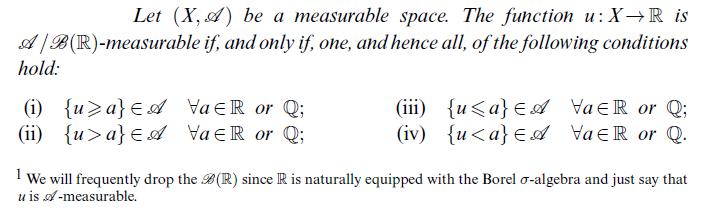
Show directly that condition (i) of Lemma 8.1 is equivalent to one of the conditions (ii), (iii) and (iv).Data from lemma 8.1 Let (X,A) be a measurable space. The function u: XR is A/B(R)-measurable if, and only if, one, and hence all, of the following conditions hold: (1) (ii) {u> a} VaR or Q;
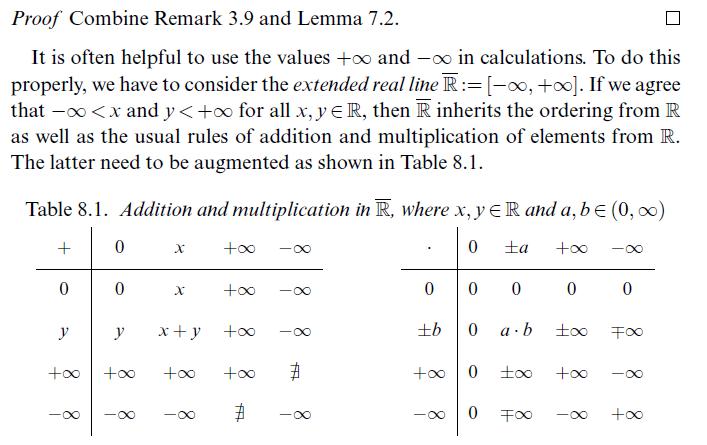
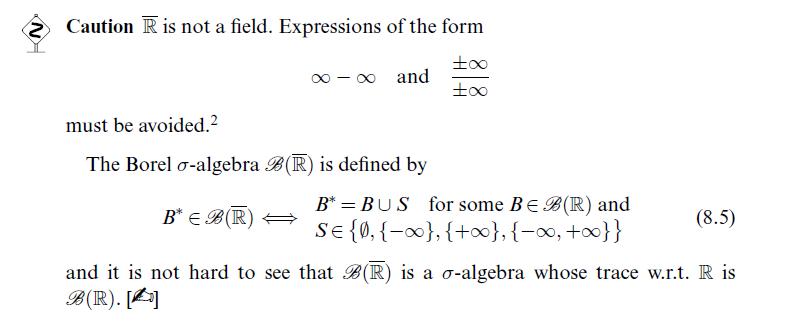
Verify that \(\mathscr{B}(\overline{\mathbb{R}})\) defined in (8.5) is a \(\sigma\)-algebra. Show that \(\mathscr{B}(\mathbb{R})=\mathbb{R} \cap \mathscr{B}(\overline{\mathbb{R}})\).Equation 8.5 B* E B(R) B* BUS for some BEB(R) and = SE {0, {-x}, {+0},{-0, +0}} (8.5)
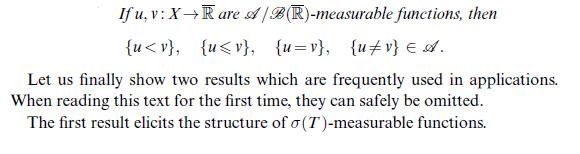
Let \((X, \mathscr{A})\) be a measurable space.(i) Let \(f, g: X ightarrow \mathbb{R}\) be measurable functions. Show that for every \(A \in \mathscr{A}\) the function \(h(x):=f(x)\), if \(x \in A\), and \(h(x):=g(x)\), if \(x otin A\), is measurable.(ii) Let \(\left(f_{n}ight)_{n \in \mathbb{N}}\)
Let \((X, \mathscr{A})\) be a measurable space and let \(\mathscr{B} \varsubsetneqq \mathscr{A}\) be a sub- \(\sigma\)-algebra. Show that \(\mathcal{M}(\mathscr{B}) \varsubsetneqq \mathcal{M}(\mathscr{A})\).
Show that \(f \in \mathcal{E}\) implies that \(f^{ \pm} \in \mathcal{E}\). Is the converse true?
Show that for every real-valued function \(u=u^{+}-u^{-}\)and \(|u|=u^{+}+u^{-}\).
Show that \(x \mapsto \max \{x, 0\}\) and \(x \mapsto \min \{x, 0\}\) are continuous, and by virtue of Problem 8.7 or Example 7.3 , measurable functions from \(\mathbb{R} ightarrow \mathbb{R}\). Conclude that on any measurable space \((X, \mathscr{A})\) positive and negative parts \(u^{ \pm}\)of a
Let \(\left(f_{i}ight)_{i \in I}\) be arbitrarily many maps \(f_{i}: X ightarrow \mathbb{R}\). Show that(i) \(\left\{\sup _{i} f_{i}>\lambdaight\}=\bigcup_{i}\left\{f_{i}>\lambdaight\}\);(iii) \(\left\{\sup _{i} f_{i} \geqslant \lambdaight\} \supset \bigcup_{i}\left\{f_{i} \geqslant
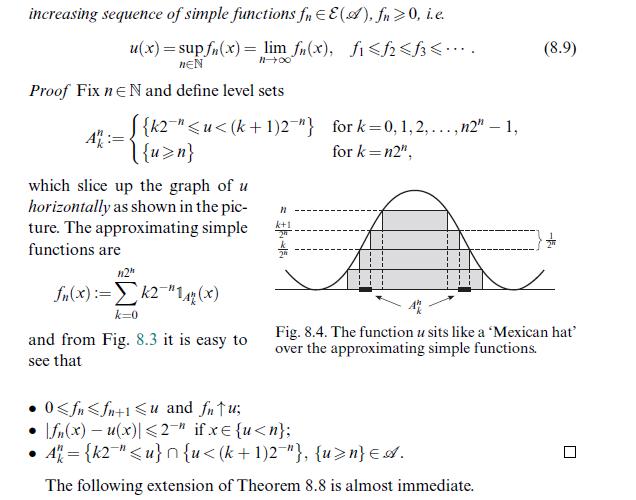
Check that the approximating sequence \(\left(f_{n}ight)_{n \in \mathbb{N}}\) for \(u\) in Theorem 8.8 consists of \(\sigma(u)\)-measurable functions.Data from theorem 8.8 (sombrero lemma) Let (X, A) be a measurable space. Every pos- itive A/B(R)-measurable function u: X [0,0] is the pointwise
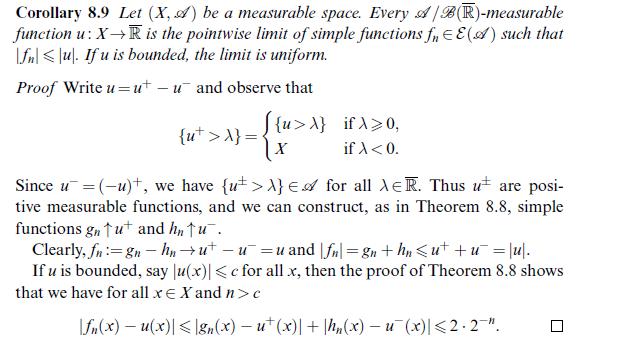
Complete the proofs of Corollaries 8.12 and 8.13.Data from corollaries 8.12Data from corollaries 8.13 A function u is A/B(R)-measurable if, and only if, the positive and negative parts ut are A/B(R)-measurable.
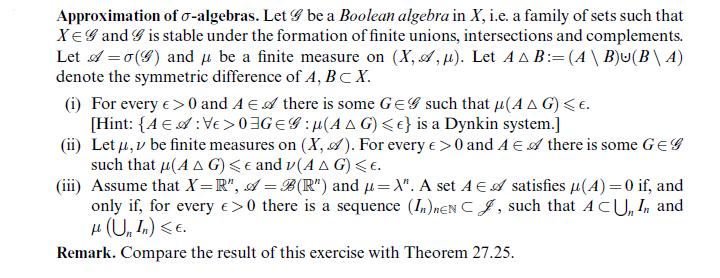
Let \((X, \mathscr{A}, \mu)\) be a \(\sigma\)-finite measure space and assume that \(\mathscr{A}\) is generated by a Boolean algebra \(\mathscr{G}\), i.e. a family of subsets of \(X\) which is stable under finite unions, intersections and complementation and contains \(\emptyset\). Show that every
Let \(u: \mathbb{R} ightarrow \mathbb{R}\) be differentiable. Explain why \(u\) and \(u^{\prime}=d u / d x\) are measurable.
Find \(\sigma(u)\), i.e. the \(\sigma\)-algebra generated by \(u\), for the following functions:\(f, g, h: \mathbb{R} ightarrow \mathbb{R}\),(i) \(f(x)=x\);(ii) \(g(x)=x^{2} ;\)(iii) \(h(x)=|x|\);\(F, G: \mathbb{R}^{2} ightarrow \mathbb{R}\),(iv) \(F(x, y)=x+y\)(v) \(G(x, y)=x^{2}+y^{2}\)[ under
Let \(\lambda\) be one-dimensional Lebesgue measure. Find \(\lambda \circ u^{-1}\), if \(u(x)=|x|\).
Let \(E \in \mathscr{B}(\mathbb{R}), Q: E ightarrow \mathbb{R}, Q(x)=x^{2}\), and \(\lambda_{E}:=\lambda(E \cap \cdot)\) (Lebesgue measure).(i) Show that \(Q\) is \(\mathscr{B}(E) / \mathscr{B}(\mathbb{R})\)-measurable.(ii) Find \(u \circ Q^{-1}\) for \(E=[0,1], u=\lambda_{E}\) and \(E=[-1,1],
Showing 200 - 300
of 423
1
2
3
4
5
Step by Step Answers

 Get 50% OFF
Claim Now
Get 50% OFF
Claim Now




![Corollary 16.14 Let :R" a (0,1]. If ad>n, then B(Rd), and the inequality Rd be an a-Hlder continuous map](https://dsd5zvtm8ll6.cloudfront.net/images/question_images/1705/7/5/3/91565abbd3bd30e61705753913560.jpg)


![Theorem 28.6 (Weierstra) Polynomials are dense in C[0, 1] w.r.t. uniform convergence. Proof (S. N. Bernstein)](https://dsd5zvtm8ll6.cloudfront.net/images/question_images/1705/8/9/7/92465adefc4982a11705897922446.jpg)

![It is a simple exercise to show that (R") are indeed the H-measurable sets. [] (ii) By Theorem 18.7 (R) C*.](https://dsd5zvtm8ll6.cloudfront.net/images/question_images/1705/9/0/3/88465ae070c078281705903883440.jpg)


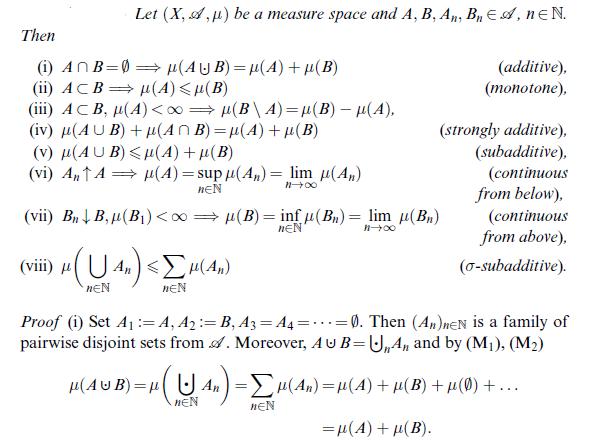
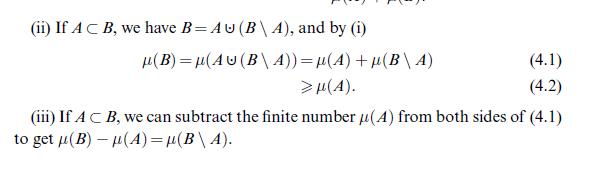
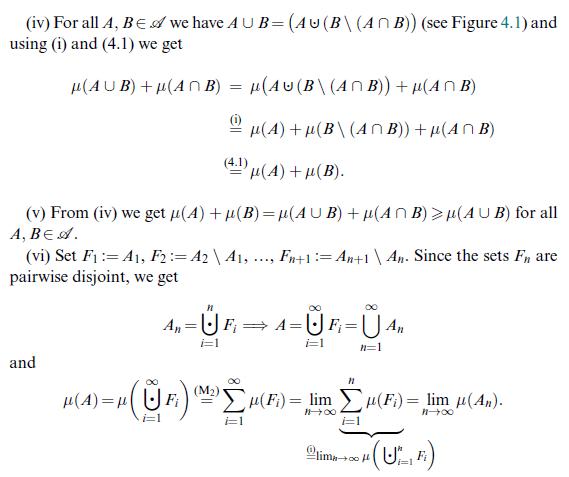
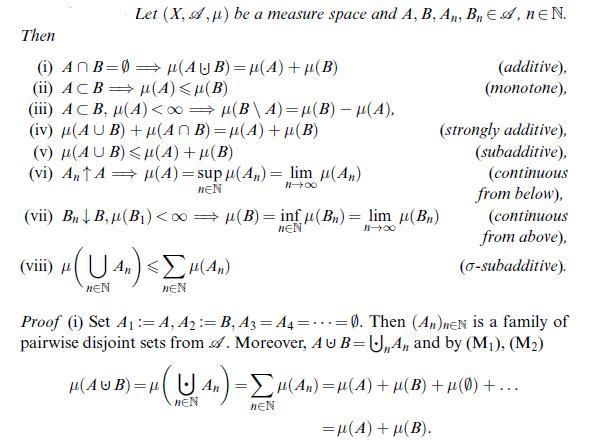
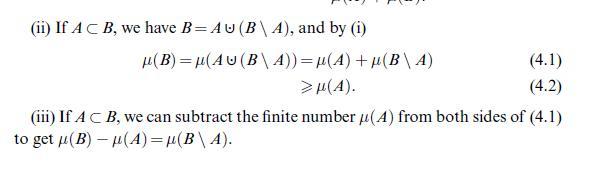
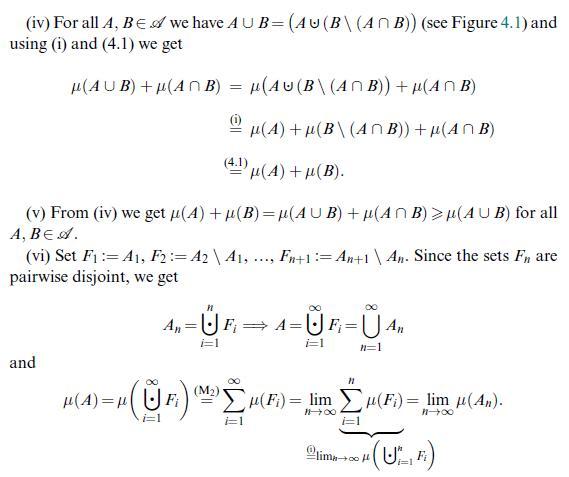
![A (positive) measure on X is a map : [0, ] satisfying A is a o-algebra in X, (0) = 0, (An) nEN CA pairwise](https://dsd5zvtm8ll6.cloudfront.net/images/question_images/1705/5/8/3/70965a9245d135e31705583708964.jpg)

![(Carathodory) Let SCP(X) be a semi-ring and u: S [0, ] a pre-measure, i.e. a set function with (i) (0)=0;](https://dsd5zvtm8ll6.cloudfront.net/images/question_images/1705/6/3/6/76765a9f39f8b5491705636767323.jpg)

![(Carathodory) Let 8C P(X) be a semi-ring and u: S [0, ] a pre-measure, i.e. a set function with (i) (0) = 0;](https://dsd5zvtm8ll6.cloudfront.net/images/question_images/1705/6/3/6/85265a9f3f4d614e1705636852299.jpg)

![(Carathodory) Let S P(X) be a semi-ring and u: S [0, ] a pre-measure, i.e. a set function with (i) (0) = 0;](https://dsd5zvtm8ll6.cloudfront.net/images/question_images/1705/6/3/6/88565a9f415b01bd1705636885415.jpg)


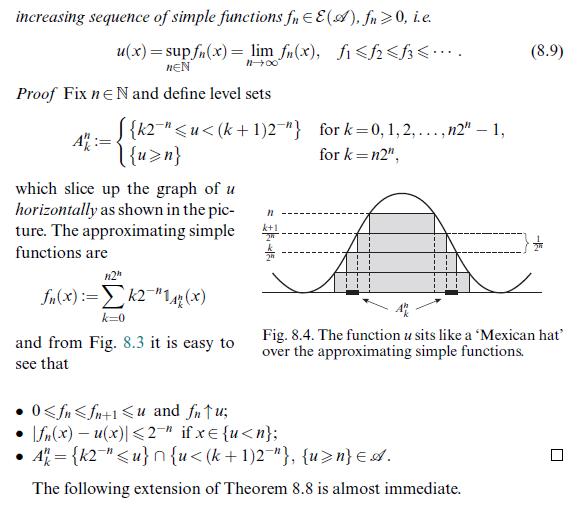
![(sombrero lemma) Let (X, A) be a measurable space. Every pos- itive A/B(R)-measurable function u: X [0,0] is](https://dsd5zvtm8ll6.cloudfront.net/images/question_images/1705/6/4/4/80565aa1305d55ef1705644805186.jpg)

![(sombrero lemma) Let (X, A) be a measurable space. Every pos- itive A/B(R)-measurable function u: X [0, ] is](https://dsd5zvtm8ll6.cloudfront.net/images/question_images/1705/6/4/5/18165aa147d9271c1705645181042.jpg)