New Semester
Started
Get
50% OFF
Study Help!
--h --m --s
Claim Now
Question Answers
Textbooks
Find textbooks, questions and answers
Oops, something went wrong!
Change your search query and then try again
S
Books
FREE
Study Help
Expert Questions
Accounting
General Management
Mathematics
Finance
Organizational Behaviour
Law
Physics
Operating System
Management Leadership
Sociology
Programming
Marketing
Database
Computer Network
Economics
Textbooks Solutions
Accounting
Managerial Accounting
Management Leadership
Cost Accounting
Statistics
Business Law
Corporate Finance
Finance
Economics
Auditing
Tutors
Online Tutors
Find a Tutor
Hire a Tutor
Become a Tutor
AI Tutor
AI Study Planner
NEW
Sell Books
Search
Search
Sign In
Register
study help
business
measures integrals and martingales
Measures Integrals And Martingales 2nd Edition René L. Schilling - Solutions
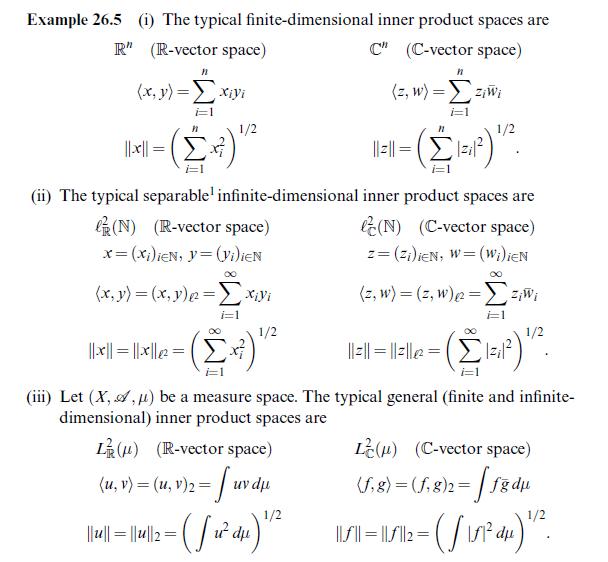
Show that the examples given in Example 26.5 are indeed inner product spaces.Data from example 26.5 Example 26.5 (1) The typical finite-dimensional R" (R-vector space) n (x, y) = xiyi i=1 1/2 Ball= (x) / ||x|| i=1 (ii) The typical separable infinite-dimensional (N) (R-vector space) x=(Xi)ieN,
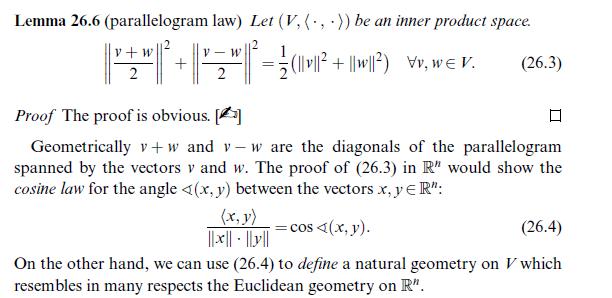
This exercise shows the following theorem.Theorem (Fréchet-von Neumann-Jordan). An inner product \(\langle\cdot, \cdotangle\) on the \(\mathbb{R}\)-vector space \(V\) derives from a norm if, and only if, the parallelogram identity (26.3) holds.(i) Necessity: prove Lemma 26.6 .Assume from now on
(Continuation of Problem 26.2 ) Assume now that \(W\) is a \(\mathbb{C}\)-vector space with norm \(\|\cdot\|\) satisfying the parallelogram identity (26.3) and let\[(v, w)_{\mathbb{R}}:=\frac{1}{4}\left(\|v+w\|^{2}-\|v-w\|^{2}ight)\]Then \((v, w)_{\mathbb{C}}:=(v, w)_{\mathbb{R}}+i(v, i
Does the norm \(\|\cdot\|_{1}\) on \(L^{1}\left([0,1], \mathscr{B}[0,1],\left.\lambda^{1}ight|_{[0,1]}ight)\) derive from an inner product?
Let \((V,\langle\cdot, \cdotangle)\) be a \(\mathbb{C}\)-inner product space, \(n \in \mathbb{N}\) and set \(\theta:=e^{2 \pi i / n}\).(i) Show that\[\frac{1}{n} \sum_{j=1}^{n} \theta^{j k}= \begin{cases}1 & \text { if } k=0 \\ 0 & \text { if } 1 \leqslant k \leqslant n-1\end{cases}\](ii) Use (i)
Let \(V\) be a real inner product space. Show that \(v \perp w\) if, and only if, Pythagoras' theorem \(\|v+w\|^{2}=\|v\|^{2}+\|w\|^{2}\) holds.
Show that every convergent sequence in \(\mathcal{H}\) is a Cauchy sequence.
Show that \(g \mapsto\langle g, hangle, h \in \mathcal{H}\), is continuous.
Show that \(\|(g, h)\|:=\left(\|g\|^{p}+\|h\|^{p}ight)^{1 / p}\) is for every \(p \geqslant 1\) a norm on \(\mathcal{H} \times \mathcal{H}\). For which values of \(p\) does \(\mathcal{H} \times \mathcal{H}\) become a Hilbert space?
Show that \((g, h) \mapsto\langle g, hangle\) and \((t, h) \mapsto t h\) are continuous on \(\mathcal{H} \times \mathcal{H}\), resp. \(\mathbb{R} \times \mathcal{H}\).
Show that a Hilbert space \(\mathcal{H}\) is separable if, and only if, \(\mathcal{H}\) contains a countable maximal orthonormal system.
Let \(w \in \mathcal{H}=L^{2}(X, \mathscr{A}, \mu)\) and show that \(M_{w}^{\perp}:=\left\{u \in L^{2}: \int u w d \mu=0ight\}^{\perp}\) is either \(\{0\}\) or a one-dimensional subspace of \(\mathcal{H}\).
Let \(\left(e_{n}ight)_{n \in \mathbb{N}} \subset \mathcal{H}\) be an orthonormal system.(i) Show that no subsequence of \(\left(e_{n}ight)_{n \in \mathbb{N}}\) converges. However, for every \(h \in \mathcal{H}\), \(\lim _{n ightarrow \infty}\left\langle e_{n}, hightangle=0\).[ show that it can't
Let \(\mathcal{H}\) be a real Hilbert space.(i) Show that\[\|h\|=\sup _{g eq 0} \frac{|\langle g, hangle|}{\|g\|}=\sup _{\|g\| \leqslant 1}|\langle g, hangle|=\sup _{\|g\|=1}|\langle g, hangle|\](ii) Can we replace in (i) \(|\langle\cdot, \cdotangle|\) by \(\langle\cdot, \cdotangle\) ?(iii) Is it
Show that the linear span of a sequence \(\left(e_{n}ight)_{n \in \mathbb{N}} \subset \mathcal{H}, \operatorname{span}\left\{e_{n}: e_{n} \in \mathcal{H}, n \in \mathbb{N}ight\}\), is a linear subspace of \(\mathcal{H}\).
A weak form of the uniform boundedness principle. Consider the real Hilbert space \(\ell^{2}=\ell_{\mathbb{R}}^{2}(\mathbb{N})\) and let \(a=\left(a_{n}ight)_{n \in \mathbb{N}}\) and \(b=\left(b_{n}ight)_{n \in \mathbb{N}}\) be two sequences of real numbers.(i) Assume that \(\sum_{n=1}^{\infty}
Let \(F, G \subset \mathcal{H}\) be linear subspaces. An operator \(P\) defined on \(G\) is called ( \(\mathbb{K}\)-)linear if \(P(\alpha f+\beta g)=\alpha P f+\beta P g\) holds for all \(\alpha, \beta \in \mathbb{K}\) and \(f, g \in G\).(i) Assume that \(F\) is closed and \(P: \mathcal{H}
Let \((X, \mathscr{A}, \mu)\) be a measure space and \(\left(A_{n}ight)_{n \in \mathbb{N}} \subset \mathscr{A}\) be mutually disjoint sets such that \(X=\biguplus_{n \in \mathbb{N}} A_{n}\). Set\[Y_{n}:=\left\{u \in L^{2}(\mu): \int_{A_{n}^{c}}|u|^{2} d \mu=0ight\}, \quad n \in \mathbb{N}\](i) Show
Let \((X, \mathscr{A}, \mu)\) be a measure space and assume that \(\left(A_{n}ight)_{n \in \mathbb{N}} \subset \mathscr{A}\) is a sequence of pairwise disjoint sets such that \(\bigcup_{n \in \mathbb{N}} A_{n}=X\) and \(0
Stieltjes measure (1).(i) Let \(\mu\) be a measure on \((\mathbb{R}, \mathscr{B}(\mathbb{R}))\) such that \(\mu[-n, n)0 \\ 0 & \text { if } x=0 \\ -\mu[x, 0) & \text { if } x
Let \((X, \mathscr{A}, \mu)\) be a finite measure space, \(\mathscr{B} \subset \mathscr{A}\) a Boolean algebra (i.e. \(X \in \mathscr{B}, \mathscr{B}\) is stable under the formation of finite unions, intersections and complements) and \(m: \mathscr{B} ightarrow[0, \infty)\) an additive set
Let \((X, \mathscr{A}, \mu)\) be a measure space such that all singletons \(\{x\} \in \mathscr{A}\). A point \(x\) is called an atom, if \(\mu\{x\}>0\). A measure is called non-atomic or diffuse, if there are no atoms.(i) Show that the one-dimensional Lebesgue measure \(\lambda^{1}\) is
A set \(A \subset \mathbb{R}^{n}\) is called bounded if it can be contained in a ball \(B_{r}(0) \supset A\) of finite radius \(r\). A set \(A \subset \mathbb{R}^{n}\) is called pathwise connected if we can go along a curve from any point \(a \in A\) to any other point \(a^{\prime} \in A\) without
Show that every continuous function \(u: \mathbb{R} ightarrow \mathbb{R}\) is \(\mathscr{B}(\mathbb{R}) / \mathscr{B}(\mathbb{R})\)-measurable.[ check that for continuous functions \(\{u>\alpha\}\) is an open set.]
Consider \((\mathbb{R}, \mathscr{B}(\mathbb{R}))\) and \(u: \mathbb{R} ightarrow \mathbb{R}\). Show that \(\{x\} \in \sigma(u)\) for all \(x \in \mathbb{R}\) if, and only if, \(u\) is injective.
Let \((\Omega, \mathscr{A})\) be a measurable space and \(\xi: \mathbb{R} \times \Omega ightarrow \mathbb{R}\) be a map such that \(\omega \mapsto \xi(t, \omega)\) is \(\mathscr{A} / \mathscr{B}(\mathbb{R})\)-measurable and \(t \mapsto \xi(t, \omega)\) is left- (or right-)continuous. Show that the
Let \((X, \mathscr{A}, \mu)\) be a measure space and \((X, \overline{\mathscr{A}}, \bar{\mu})\) its completion (see Problem 4.15 ). Show that a function \(\phi: X ightarrow \mathbb{R}\) is \(\overline{\mathscr{A}} / \mathscr{B}(\mathbb{R})\)-measurable if, and only if, there are \(\mathscr{A} /
Let \(u \in \mathcal{L}^{1}(0,1)\) be positive and monotone. Find the limit\[\lim _{n ightarrow \infty} \int_{0}^{1} u\left(t^{n}ight) d t\]
Let \(u \in \mathcal{L}^{1}(0,1)\). Find the limit\[\lim _{n ightarrow \infty} \int_{0}^{1} t^{n} f(t) d t\]
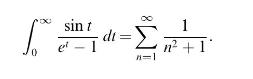
Show that: [Use the geometric series to express (e−t−1)−1(e−t−1)−1, observe that sint=Imeitsint=Imeit and use Problem 10.9 .]Data from problem 10.9 sin t el dt -; H=I 1 n? +1
Let \(u: \mathbb{R} ightarrow \mathbb{R}\) be a Borel measurable function and assume that \(x \mapsto e^{\lambda x} u(x)\) is integrable for each \(\lambda \in \mathbb{R}\). Show that for all \(z \in \mathbb{C}\)\[\int_{\mathbb{R}} e^{z x} u(x) d x=\sum_{n=0}^{\infty} \frac{z^{n}}{n !}
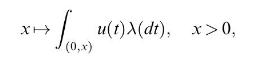
Let λλ be one-dimensional Lebesgue measure. Show that for every integrable function uu, the integral function or primitiveis continuous. What happens if we exchange λλ for a general measure μμ ? XH (0,x) u(t)X(dt), x>0,
Consider the functions(i) \(u(x)=\frac{1}{x}, \quad x \in[1, \infty)\);(ii) \(v(x)=\frac{1}{x^{2}}, \quad x \in[1, \infty)\);(iii) \(\quad w(x)=\frac{1}{\sqrt{x}}, \quad x \in(0,1]\)(iv) \(y(x)=\frac{1}{x}, \quad x \in(0,1]\)and check whether they are Lebesgue integrable in the regions given - what
Show that the function \(\mathbb{R} i x \mapsto \exp \left(-x^{\alpha}ight)\) is \(\lambda^{1}(d x)\)-integrable over the set \([0, \infty)\) for every \(\alpha>0\).[find integrable majorants \(u\) resp. \(w\) if \(0 \leqslant x \leqslant 1\) resp. \(1
Show that for every parameter α>0α>0 the functionx↦(sinxx)3e−αxx↦(sinxx)3e−αxis integrable over (0,∞)(0,∞) and that the integral is continuous as a function of the parameter. [ find piecewise integrable majorants like in Problem 12.18 ; use the continuity lemma.]Data from
Show that the function\[G: \mathbb{R} ightarrow \mathbb{R}, \quad G(x):=\int_{\mathbb{R} \backslash\{0\}} \frac{\sin (t x)}{t\left(1+t^{2}ight)} d t\]is differentiable and find \(G(0)\) and \(G^{\prime}(0)\). Use a limit argument, integration by parts for \(\int_{(-n, n)} \ldots d t\) and the
Denote by \(\lambda\) one-dimensional Lebesgue measure. Prove that(i) \(\int_{(1, \infty)} e^{-x} \ln (x) \lambda(d x)=\lim _{k ightarrow \infty} \int_{(1, k)}\left(1-\frac{x}{k}ight)^{k} \ln (x) \lambda(d x)\),(ii) \(\int_{(0,1)} e^{-x} \ln (x) \lambda(d x)=\lim _{k ightarrow \infty}
Denote by \(\lambda\) Lebesgue measure on \(\mathbb{R}\) and set\[F(t):=\int_{(0, \infty)} e^{-x} \frac{t}{t^{2}+x^{2}} \lambda(d x), \quad t>0\]Show that \(F(0+)=\lim _{t \downarrow 0} F(t)=\pi / 2\).Remark. This exercise shows that 'naive' interchange of integration and limit may lead to wrong
Let \(\mu\) be a measure on \((\mathbb{R}, \mathscr{B}(\mathbb{R})\) ), let \(u: \mathbb{R} ightarrow \mathbb{C}\) be a measurable function (see Problem 10.9 ) and denote by \(d x\) one-dimensional Lebesgue measure. Find conditions on \(\mu\) and \(u\) which guarantee that the so-called Fourier
Let \(\phi \in \mathcal{L}^{1}([0,1], d x)\) and define \(f(t):=\int_{[0,1]}|\phi(x)-t| d x\). Show that(i) \(f\) is continuous,(ii) \(f\) is differentiable at \(t \in \mathbb{R}\) if, and only if, \(\lambda\{\phi=t\}=0\).
Let f(t):=∫∞0x−2sin2xe−txdx,t⩾0f(t):=∫0∞x−2sin2xe−txdx,t⩾0.(i) Show that ff is continuous on [0,∞)[0,∞) and twice differentiable on (0,∞)(0,∞).(iii) Use (i) and (ii) to obtain a simple expression for ff. (ii) Find f" and work out the limits lim, f (t) and lim, f' (t).
Show that \(\int_{0}^{\infty} x^{n} e^{-x} d x=n\) ! for all \(n \in \mathbb{N}\).[ Show that \(\int_{0}^{\infty} e^{-x t} d x=1 / t, t>0\), and differentiate this identity.][ Show that \(\int_{0}^{\infty} e^{-x t} d x=1 / t, t>0\), and differentiate this identity.]
Euler's gamma function. Show that the function\[\Gamma(t):=\int_{(0, \infty)} e^{-x} x^{t-1} d x, \quad t>0\]has the following properties.(i) It is \(m\)-times differentiable with \(\Gamma^{(m)}(t)=\int_{(0, \infty)} e^{-x} x^{t-1}(\log x)^{m} d x\).[ take \(t \in(a, b)\) and use induction in
Denote by \(\lambda\) one-dimensional Lebesgue measure on the interval \((0,1)\).(i) Show that for all \(k \in \mathbb{N}_{0}\) one has\[\int_{(0,1)}(x \ln x)^{k} \lambda(d x)=(-1)^{k}\left(\frac{1}{k+1}ight)^{k+1} \Gamma(k+1) .\](ii) Use (i) to conclude that\[\int_{(0,1)} x^{-x} \lambda(d
Show that \(x \mapsto x^{n} f(u, x), f(u, x)=e^{u x} /\left(e^{x}+1ight), 0
Calculate the following limit:\[\lim _{n ightarrow \infty} \int_{0}^{1} \frac{1+n x^{2}}{\left(1+x^{2}ight)^{n}} d x\]
Moment generating function. Let \(X\) be a positive random variable on the probability space \((\Omega, \mathscr{A}, \mathbb{P})\). The function \(\phi_{X}(t):=\int e^{-t X} d \mathbb{P}\) is called moment generating function. Show that \(\phi_{X}\) is \(m\)-times differentiable at \(t=0+\) if the
Consider the functions \(u(x)=\mathbb{1}_{\mathbb{Q} \cap[0,1]}\) and \(v(x)=\mathbb{1}_{\left\{n^{-1}: n \in \mathbb{N}ight\}}(x)\). Prove or disprove the following statements.(i) The function \(u\) is 1 on the rationals and 0 otherwise. Thus \(u\) is continuous everywhere except for the set
Construct a sequence of functions \(\left(u_{n}ight)_{n \in \mathbb{N}}\) which are Riemann integrable but converge to a limit \(u_{n} ightarrow u\) which is not Riemann integrable.[ consider e.g. \(u_{n}=\mathbb{1}_{\left\{q_{1}, q_{2}, \ldots, q_{n}ight\}}\), where \(\left(q_{n}ight)_{n}\) is an
Assume that \(u:[0, \infty) ightarrow \mathbb{R}\) is positive and improperly Riemann integrable. Show that \(u\) is also Lebesgue integrable.
Fresnel integrals. Show that the following improper Riemann integrals exist:\[\int_{0}^{\infty} \sin x^{2} d x \text { and } \int_{0}^{\infty} \cos x^{2} d x\]Do they exist as Lebesgue integrals?Remark. The above integrals have the value \(\frac{1}{2} \sqrt{\frac{\pi}{2}}\). This can be proved by
Frullani's integral. Let f:(0,∞)→Rf:(0,∞)→R be a continuous function such that limx→0f(x)=mlimx→0f(x)=m and limx→∞f(x)=Mlimx→∞f(x)=M. Show that the two-sided improper Riemann
Let \((X, \mathscr{A}, \mu)\) be a finite measure space and let \(1 \leqslant q
Let \((X, \mathscr{A}, \mu)\) be a general measure space and \(1 \leqslant p \leqslant r \leqslant q \leqslant \infty\).Prove that \(\mathcal{L}^{p}(\mu) \cap \mathcal{L}^{q}(\mu) \subset \mathcal{L}^{r}(\mu)\) by establishing the inequality\[\|u\|_{r} \leqslant\|u\|_{p}^{\lambda}
Let \((X, \mathscr{A}, \mu)\) be a measure space and \(u, v \in \mathcal{L}^{p}(\mu)\).(i) Find conditions which guarantee that \(u v, u+v\) and \(\alpha u, \alpha \in \mathbb{R}\) are in \(\mathcal{L}^{p}(\mu)\).(ii) Show that \(\mathcal{L}^{1}(\mu)\) and \(\mathcal{L}^{2}(\mu)\) are, in general,
Let \(\Omega\) be a set and \(B, B^{c} \subset \Omega\) such that \(B\) and \(B^{c}\) are not empty.(i) Find all measurable functions \(u:(\Omega,\{\emptyset, \Omega\}) ightarrow(\mathbb{R}, \mathscr{A})\), if (a) \(\mathscr{A}:=\{\emptyset, \mathbb{R}\}\), (b) \(\mathscr{A}:=\)
Generalized Hölder inequality. Iterate Hölder's inequality to derive the following generalization:\[\int\left|u_{1} \cdot u_{2} \cdots u_{N}ight| d \mu \leqslant\left\|u_{1}ight\|_{p_{1}} \cdot\left\|u_{2}ight\|_{p_{2}} \cdots\|\| u_{N} \|_{p_{N}}\]for all \(p_{n} \in(1, \infty)\) such that
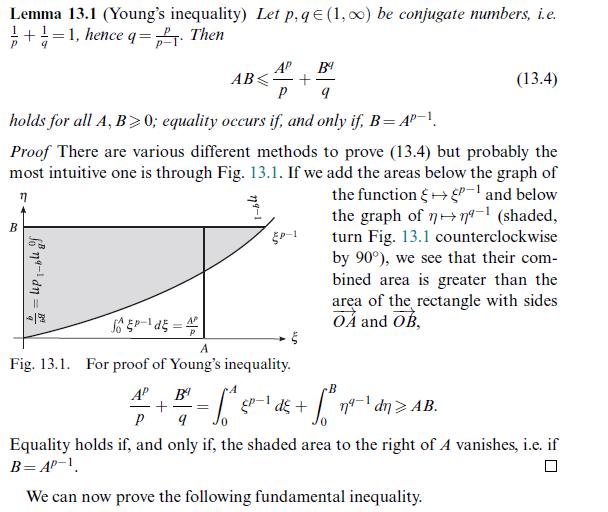
Young functions. Let \(\phi:[0, \infty) ightarrow[0, \infty)\) be a strictly increasing continuous function such that \(\phi(0)=0\) and \(\lim _{\xi ightarrow \infty} \phi(\xi)=\infty\). Denote by \(\psi(\eta):=\phi^{-1}(\eta)\) the inverse function. The functions\[\Phi(A):=\int_{[0, A)} \phi(\xi)
Let \(1 \leqslant p
Consider one-dimensional Lebesgue measure on \([0,1]\). Verify that the sequence \(u_{n}(x):=\) \(n 1_{(0,1 / n)}(x), n \in \mathbb{N}\), converges pointwise to the function \(u \equiv 0\), but that no subsequence of \(u_{n}\) converges in \(\mathcal{L}^{p}\)-sense for any \(p \geqslant 1\).
Let \(p, q \in[1, \infty]\) be conjugate, i.e. \(p^{-1}+q^{-1}=1\), and assume that \(\left(u_{k}ight)_{k \in \mathbb{N}} \subset \mathcal{L}^{p}\) and \(\left(w_{k}ight)_{k \in \mathbb{N}} \subset \mathcal{L}^{q}\) are sequences with limits \(u\) and \(w\) in \(\mathcal{L}^{p}\)-sense, resp.
Prove that \(\left(u_{n}ight)_{n \in \mathbb{N}} \subset \mathcal{L}^{2}(\mu)\) converges in \(\mathcal{L}^{2}\) if, and only if, \(\lim _{n, m ightarrow \infty} \int u_{n} u_{m} d \mu\) exists.[ verify and use the identity \(\|u-w\|_{2}^{2}=\|u\|_{2}^{2}+\|w\|_{2}^{2}-2 \int u w d \mu\).]
Let \((X, \mathscr{A}, \mu)\) be a finite measure space. Show that every measurable \(u \geqslant 0\) with \(\int \exp (h u(x)) \mu(d x)0\) is in \(\mathcal{L}^{p}(\mu)\) for every \(p \geqslant 1\).[check that \(|t|^{N} / N ! \leqslant e^{|t|}\) implies \(u \in \mathcal{L}^{N}, N \in \mathbb{N}\);
Let \(\lambda\) be Lebesgue measure in \((0, \infty)\) and \(p, q \geqslant 1\) arbitrary.(i) Show that \(u_{n}(x):=n^{\alpha}(x+n)^{-\beta}(\alpha \in \mathbb{R}, \beta>1)\) holds for every \(n \in \mathbb{N}\) in \(\mathcal{L}^{p}(\lambda)\).(ii) Show that \(v_{n}(x):=n^{\gamma} e^{-n x}(\gamma
Let \(u(x)=\left(x^{\alpha}+x^{\beta}ight)^{-1}, x, \alpha, \beta>0\). For which \(p \geqslant 1\) is \(u \in \mathcal{L}^{p}\left(\lambda^{1},(0, \infty)ight)\) ?
Consider the measure space \((\Omega=\{1,2, \ldots, n\}, \mathscr{P}(\Omega), \mu), n \geqslant 2\), where \(\mu\) is the counting measure. Show that \(\left(\sum_{i=1}^{n}\left|x_{i}ight|^{p}ight)^{1 / p}\) is a norm if \(p \in[1, \infty)\), but not for \(p \in(0,1)\). [ you can identify
Let \((X, \mathscr{A}, \mu)\) be a measure space. The space \(\mathcal{L}^{p}(\mu)\) is called separable if there exists a countable dense subset \(\mathscr{D}_{p} \subset \mathcal{L}^{p}(\mu)\). Show that \(\mathcal{L}^{p}(\mu)\), \(p \in(1, \infty)\), is separable if, and only if,
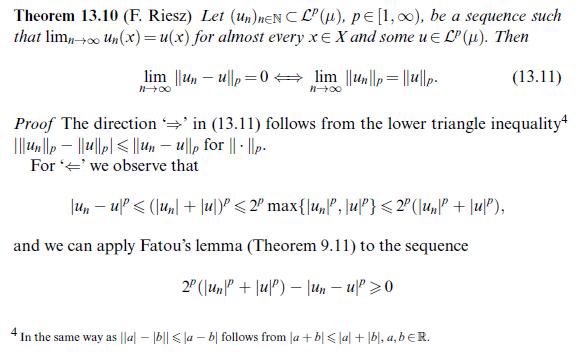
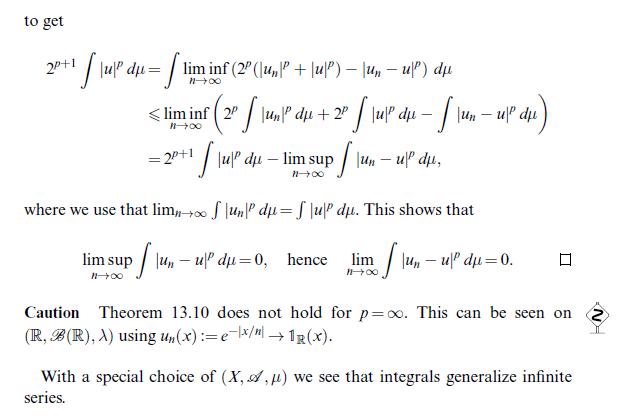
Let \(u_{n} \in \mathcal{L}^{p}, p \geqslant 1\), for all \(n \in \mathbb{N}\). What can you say about \(u\) and \(w\) if you know that \(\lim _{n ightarrow \infty} \int\left|u_{n}-uight|^{p} d \mu=0\) and \(\lim _{n ightarrow \infty} u_{n}(x)=w(x)\) for almost every \(x\) ?
Let \((X, \mathscr{A}, \mu)\) be a finite measure space and let \(u \in \mathcal{L}^{1}(\mu)\) be strictly positive with \(\int u d \mu=1\). Show that\[\int(\log u) d \mu \leqslant \mu(X) \log \left(\frac{1}{\mu(X)}ight)\]
Let \(u\) be a positive measurable function on \([0,1]\). Which of the following is larger:\[\int_{(0,1)} u(x) \log u(x) \lambda(d x) \quad \text { or } \quad \int_{(0,1)} u(s) \lambda(d s) \cdot \int_{(0,1)} \log u(t) \lambda(d t) ?\][ show that \(\log x \leqslant x \log x, x>0\), and assume first
Let \((X, \mathscr{A}, \mu)\) be a measure space and \(p \in(0,1)\). The conjugate index is given by \(q:=\) \(p /(p-1)
Let \((X, \mathscr{A}, \mu)\) be a finite measure space and \(u \in \mathcal{M}(\mathscr{A})\) be a bounded function with \(\|u\|_{\infty}>0\). Prove that for all \(n \in \mathbb{N}\)(i) \(M_{n}:=\int|u|^{n} d \mu \in(0, \infty)\);(ii) \(M_{n+1} M_{n-1} \geqslant M_{n}^{2}\);(iii) \(\mu(X)^{-1 /
Let \((X, \mathscr{A}, \mu)\) be a general measure space and let \(u \in \bigcap_{p \geqslant 1} \mathcal{L}^{p}(\mu)\). Then\[\lim _{p ightarrow \infty}\|u\|_{p}=\|u\|_{\infty}\]where \(\|u\|_{\infty}=\infty\) if \(u\) is unbounded.[start with
Let \((X, \mathscr{A}, \mu)\) be a probability space and assume that \(\|u\|_{q}0\). Show that \(\lim _{p ightarrow 0}\|u\|_{p}=\exp \left(\int \log |u| d \muight)\) (we set \(e^{-\infty}:=0\) ).
Let \((X, \mathscr{A}, \mu)\) be a measure space and \(1 \leqslant p
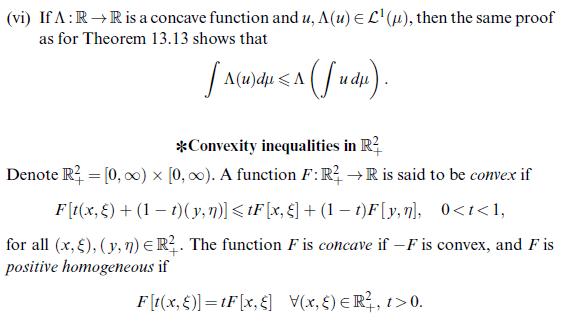
Variants of Jensen's inequality. Let \((X, \mathscr{A}, \mu)\) be a probability space.(i) Show Jensen's inequality for convex \(V: \mathbb{R} ightarrow \mathbb{R}\), see Example 13.14 (v).(ii) Show Jensen's inequality for concave \(\Lambda: \mathbb{R} ightarrow \mathbb{R}\), see Example 13.14
Use Jensen's inequality (Example 13.14 (i), (ii)) to derive Hölder's inequality and Minkowski's inequality. Use\[\Lambda(x)=x^{1 / q}, x \geqslant 0, \quad w=|f|^{p} \quad \text { and } \quad u=|g|^{q}|f|^{-p} \mathbb{1}_{\{f eq 0\}}\]for Hölder's inequality and\[\Lambda(x)=\left(x^{1 /
Let \((X, \mathscr{A}, \mu)\) be a finite measure space, \(1 \leqslant p
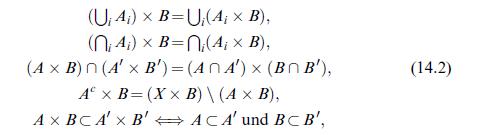
Prove the rules (14.2) for Cartesian products.Equation 14.2 (U4) x B=U(A B), (NA) x B=n(A B), (A x B) n (A' x B') = (ANA') x (BnB'), A x B= (X x B) \ (A x B), AXBCA' XB'ACA' und BCB', (14.2)
Let \((X, \mathscr{A}, \mu)\) and \((Y, \mathscr{B}, u)\) be two \(\sigma\)-finite measure spaces. Show that \(A \times N\), where \(A \in \mathscr{A}\) and \(N \in \mathscr{B}, u(N)=0\), is a \(\mu \times u\)-null set.
Let \(\left(X_{i}, \mathscr{A}_{i}, \mu_{i}ight), i=1,2\), be \(\sigma\)-finite measure spaces and \(f: X_{1} \times X_{2} ightarrow \mathbb{C}\) a measurable function. A function is negligible (w.r.t. the measure \(\mu\) ) if \(\int|f| d \mu=0\). Show that the following assertions are
Denote by \(\lambda\) Lebesgue measure on \((0, \infty)\). Prove that the following iterated integrals exist and that\[\int_{(0, \infty)} \int_{(0, \infty)} e^{-x y} \sin x \sin y \lambda(d x) \lambda(d y)=\int_{(0, \infty)} \int_{(0, \infty)} e^{-x y} \sin x \sin y \lambda(d y) \lambda(d x)
Denote by \(\lambda\) Lebesgue measure on \((0,1)\). Show that the following iterated integrals exist, but yield different values:\[\int_{(0,1)} \int_{(0,1)} \frac{x^{2}-y^{2}}{\left(x^{2}+y^{2}ight)^{2}} \lambda(d x) \lambda(d y) eq \int_{(0,1)} \int_{(0,1)}
Denote by \(\lambda\) Lebesgue measure on \((-1,1)\). Show that the iterated integrals exist and coincide,\[\int_{(-1,1)} \int_{(-1,1)} \frac{x y}{\left(x^{2}+y^{2}ight)^{2}} \lambda(d x) \lambda(d y)=\int_{(-1,1)} \int_{(-1,1)} \frac{x y}{\left(x^{2}+y^{2}ight)^{2}} \lambda(d y) \lambda(d x)\]but
Evaluate \(\int_{0}^{1} \int_{0}^{1} f(x, y) d x d y, \int_{0}^{1} \int_{0}^{1} f(x, y) d y d x\) and \(\int_{[0,1]^{2}}|f(x, y)| d(x, y)\) if(a) \(\left(x-\frac{1}{2}ight)^{-3} \mathbb{1}_{\left\{0
Consider the measure space \((\mathbb{R}, \mathscr{B}(\mathbb{R}))\) and denote by \(\zeta_{M}: \mathscr{B}(\mathbb{R}) ightarrow[0, \infty], M \subset \mathbb{R}\), \(\zeta_{M}(A):=\#(A \cap M)\) the counting measure.(i) Show that Lebesgue's measure \(\lambda\) and the counting measure
(i) Evaluate\[\int_{[0, \infty)^{2}} \frac{d x d y}{(1+y)\left(1+x^{2} yight)}\](ii) Use (i), in order to evaluate\[\int_{0}^{\infty} \frac{\ln x}{x^{2}-1} d x\](iii) Use a series representation in part (ii) to show that\[\sum_{n=0}^{\infty} \frac{1}{(2 n+1)^{2}}=\frac{\pi^{2}}{8}\]
Let \(\mu, u\) be \(\sigma\)-finite measures on \((\mathbb{R}, \mathscr{B}(\mathbb{R}))\). Show that(i) The set \(D:=\{x \in \mathbb{R}: \mu\{x\}>0\}\) is at most countable.(ii) The diagonal \(\Delta \subset \mathbb{R}^{2}\) has measure \(\mu \times u(\Delta)=\sum_{x \in D} \mu\{x\} u\{x\}\).
Let \(\mu(A):=\# A\) be the counting measure and \(\lambda\) be Lebesgue measure on the measurable space \(([0,1], \mathscr{B}[0,1])\). Denote by \(\Delta:=\left\{(x, y) \in[0,1]^{2}: x=yight\}\) the diagonal in \([0,1]^{2}\). Check that\[\int_{[0,1]} \int_{[0,1]} \mathbb{1}_{\Delta}(x, y)
(i) State Tonelli's and Fubini's theorems for spaces of sequences, i.e. for the measure space \((\mathbb{N}, \mathscr{P}(\mathbb{N}), \mu)\), where \(\mu:=\sum_{n \in \mathbb{N}} \delta_{n}\), and obtain criteria specifying when one can interchange two infinite summations.(ii) Using similar
Let \(u: \mathbb{R}^{2} ightarrow[0, \infty]\) be a measurable function. \(S[u]:=\{(x, y): 0 \leqslant y \leqslant u(x)\}\) is the set above the abscissa and below the graph \(\Gamma[u]:=\{(x, u(x)): x \in \mathbb{R}\}\).(i) Show that \(S[u] \in \mathscr{B}\left(\mathbb{R}^{2}ight)\).(ii) Is it
Let \((X, \mathscr{A}, \mu)\) be a \(\sigma\)-finite measure space and let \(u \in \mathcal{M}^{+}(\mathscr{A})\) be a \([0, \infty]\)-valued measurable function. Show that the set\[Y:=\{y \in \mathbb{R}: \mu\{x: u(x)=y\} eq 0\} \subset \mathbb{R}\]is countable.[ assume that \(u \in
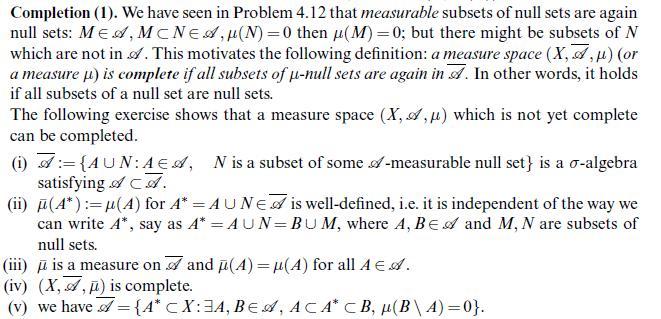
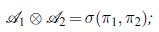
Completion (5). Let \((X, \mathscr{A}, \mu)\) and \((Y, \mathscr{B}, u)\) be any two measure spaces such that \(\mathscr{A} eq\) \(\mathscr{P}(X)\) and such that \(\mathscr{B}\) contains non-empty null sets.(i) Show that \(\mu \times u\) on \((X \times Y, \mathscr{A} \otimes \mathscr{B})\) is not
Let \(\mu\) be a bounded measure on the measure space \(([0, \infty), \mathscr{B}[0, \infty))\).(i) Show that \(A \in \mathscr{B}[0, \infty) \otimes \mathscr{P}(\mathbb{N})\) if, and only if, \(A=\bigcup_{n \in \mathbb{N}} B_{n} \times\{n\}\), where \(\left(B_{n}ight)_{n \in \mathbb{N}} \subset\)
Let \((\Omega, \mathscr{A}, \mathbb{P})\) be a probability space, i.e. a measure space such that \(\mathbb{P}(\Omega)=1\). Show that for a measurable function \(T: \Omega ightarrow[0, \infty)\) and every \(\lambda>0\) the following formula holds:\[\int e^{-\lambda T} d \mathbb{P}=1-\lambda
Stieltjes measure (2). Stieltjes integrals. This continues Problem 6.1. Let \(\mu\) and \(u\) be two measures on \((\mathbb{R}, \mathscr{B}(\mathbb{R}))\) such that \(\mu((-n, n]), u((-n, n])the associated right-continuous distribution functions (in Problem 6.1 we considered leftcontinuous
Rearrangements. Let \((X, \mathscr{A}, \mu)\) be a \(\sigma\)-finite measure space and let \(f \in \mathcal{L}^{p}(\mu)\) for some \(p \in[1, \infty)\). The distribution function of \(f\) is given by \(\mu_{f}(t)=\mu\{|f| \geqslant t\}\) and the decreasing rearrangement of \(f\) is the generalized
The differentiability lemma revisited. Let \((X, \mathscr{A}, \mu)\) be a \(\sigma\)-finite measure space and \(\phi\) : \(\mathbb{R} \times X ightarrow \mathbb{R}\) a mapping with the following properties.(i) \(\int_{X}|\phi(t, x)| \mu(d x)(ii) \(t \mapsto \phi(t, x)\) is differentiable for all
Let \((X, \mathscr{A}, \mu)\) be a measure space and let \(T: X ightarrow X\) be a bijective measurable map whose inverse \(T^{-1}: X ightarrow X\) is again measurable. Show that for every \(f \in \mathcal{M}^{+}(\mathscr{A})\) one has\[\int u d(T(f \mu))=\int u \circ T f d \mu=\int u f \circ
Let \(u \in \mathcal{L}^{1}\left(\mathbb{R}^{n}, \lambda^{n}ight)\) and \(\epsilon>0\). Show that \(\int u(\epsilon x) d x=\epsilon^{-n} \int u(y) d y\).
Showing 100 - 200
of 423
1
2
3
4
5
Step by Step Answers

 Get 50% OFF
Claim Now
Get 50% OFF
Claim Now






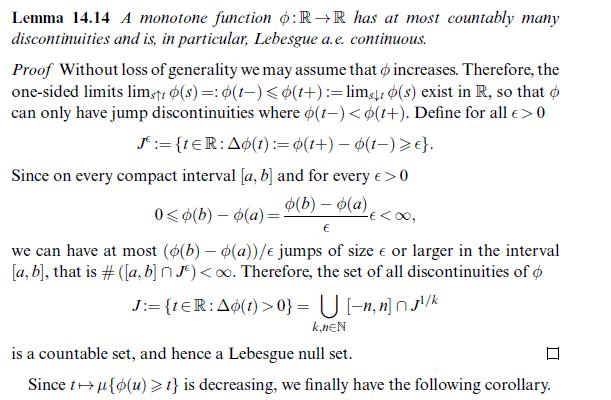
![Oc is generated by the balls in C.]](https://dsd5zvtm8ll6.cloudfront.net/images/question_images/1705/7/2/4/43465ab4a122460a1705724433392.jpg)


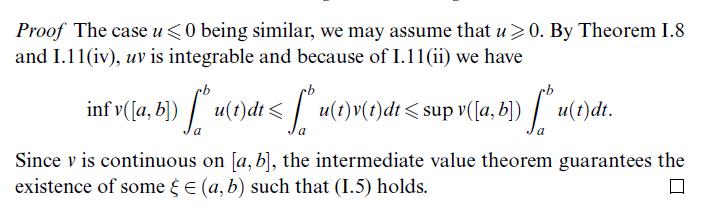
![(mean value theorem for integrals) Let u R[a, b] be either positive or negative and let ve C[a, b]. Then](https://dsd5zvtm8ll6.cloudfront.net/images/question_images/1705/7/2/5/11465ab4cba5fb8a1705725113837.jpg)






![if x > 0, if x = 0, -(x, 0], if x <0, (0, x], F(x):= 0, and G(x):= if x > 0, if x=0, -v(x, 0], if x <0, v(0,](https://dsd5zvtm8ll6.cloudfront.net/images/question_images/1705/7/3/9/38265ab847695cab1705739381868.jpg)
![o(F(b)) (F(a)) = ['(F(s-))dF(s) + [(F(s)) (F(s-)) 6'(F(s))AF(s)]. - a](https://dsd5zvtm8ll6.cloudfront.net/images/question_images/1705/7/3/9/47765ab84d5a1e491705739476905.jpg)