New Semester
Started
Get
50% OFF
Study Help!
--h --m --s
Claim Now
Question Answers
Textbooks
Find textbooks, questions and answers
Oops, something went wrong!
Change your search query and then try again
S
Books
FREE
Study Help
Expert Questions
Accounting
General Management
Mathematics
Finance
Organizational Behaviour
Law
Physics
Operating System
Management Leadership
Sociology
Programming
Marketing
Database
Computer Network
Economics
Textbooks Solutions
Accounting
Managerial Accounting
Management Leadership
Cost Accounting
Statistics
Business Law
Corporate Finance
Finance
Economics
Auditing
Tutors
Online Tutors
Find a Tutor
Hire a Tutor
Become a Tutor
AI Tutor
AI Study Planner
NEW
Sell Books
Search
Search
Sign In
Register
study help
business
measures integrals and martingales
Measures Integrals And Martingales 2nd Edition René L. Schilling - Solutions
For every \(B \subset \mathbb{R}^{n}\) one has \(\operatorname{dim}_{\mathcal{H}} B \leqslant n\). If \(B\) contains an open set or a set of strictly positive Lebesgue measure, then \(\operatorname{dim}_{\mathcal{H}} B=n\).
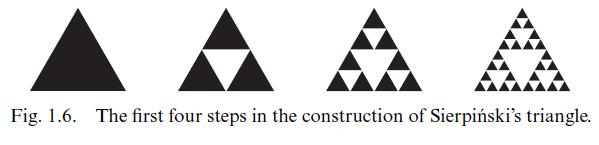
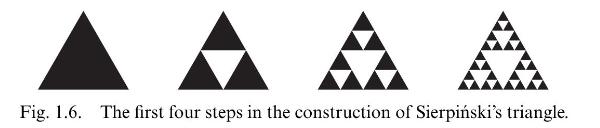
Consider the fractals introduced in Problems 1.4 and 1.5: the Koch snowflake and the Sierpiński triangle. Give a heuristic argument that the Hausdorff dimension of the Sierpiński triangle is \(\log 3 / \log 2\). What is the dimension of the Koch snowflake?Data from problem 1.4 Let \(K_{0}
Assume that \(\phi, \psi:[0, \infty) ightarrow[0, \infty)\) are admissible for the construction of Hausdorff measures and assume that \(\lim _{x ightarrow 0} \phi(x) / \psi(x)=0\). Show that \(\overline{\mathcal{H}}^{\psi}(A)
Calculate the Fourier transform of the following functions/measures on \(\mathbb{R}\) :(a) \(\mathbb{1}_{[-1,1]}(x)\),(b) \(\mathbb{1}_{[-1,1]} \star \mathbb{1}_{[-1,1]}(x)\),(c) \(e^{-x} \mathbb{1}_{[0, \infty)}(x)\),(d) \(e^{-|x|}\),(e) \(1 /\left(1+x^{2}ight)\),(f) \(\quad(1-|x|)
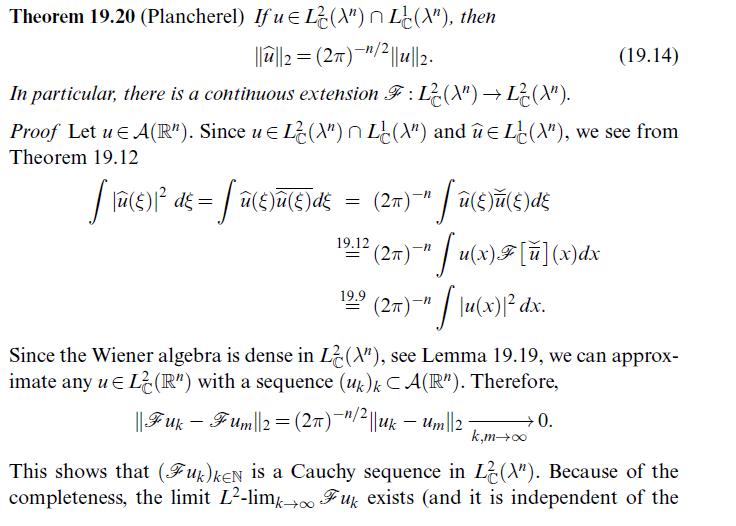
Extend Plancherel's theorem (Theorem 19.20 ) to show that\[\int \widehat{u}(\xi) \overline{\widehat{v}(\xi)} d \xi=(2 \pi)^{-n} \int u(x) \overline{v(x)} d x \quad \forall u, v \in L_{\mathbb{C}}^{2}\left(\lambda^{n}ight)\]Data from theorem 19.20 Theorem 19.20 (Plancherel) If u = L(X") L(X"), then
Let \(\mu\) be a finite measure on \(\left(\mathbb{R}^{n}, \mathscr{B}\left(\mathbb{R}^{n}ight)ight)\) and set \(\chi(\xi):=\widehat{\mu}(\xi)\). Show that \(\chi\) is real-valued if, and only if, \(\mu\) is symmetric w.r.t. the origin, i.e. \(\widetilde{\mu}(B):=\mu(-B)=\mu(B)\).
Let \(A \in \mathbb{R}^{n \times n}\) be a symmetric, positive definite matrix. Find the Fourier transform of the function \(e^{-\langle x, A xangle}\).
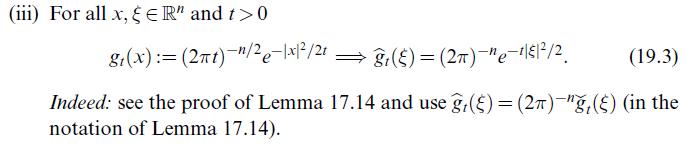
Assume that \(u \in L^{1}\left(\lambda^{1}ight) \cap L^{\infty}\left(\lambda^{1}ight)\) and \(\widehat{u} \geqslant 0\). Show that \(\widehat{u} \in L^{1}\left(\lambda^{1}ight)\). Extend the assertion to \(u \in L^{2}\left(\lambda^{1}ight)\)[estimate \(\int \widehat{u} \widehat{g}_{t} d \xi\),
Let \(\mu\) be a finite measure on \(\left(\mathbb{R}^{n}, \mathscr{B}\left(\mathbb{R}^{n}ight)ight)\). Prove P. Lévy's truncation inequality:\[\mu\left(\mathbb{R}^{n} \backslash[-2 R, 2 R]^{n}ight) \leqslant 2\left(\frac{R}{2}ight)^{n} \int_{[-1 / R, 1 /
Let \(\mu\) be a finite measure on \(\left(\mathbb{R}^{n}, \mathscr{B}\left(\mathbb{R}^{n}ight)ight)\) and denote by \(\phi(\xi):=\widehat{\mu}(\xi)\) the Fourier transform(i) \(\phi\) is positive semidefinite, i.e. for all \(m \in \mathbb{N}, \xi_{1}, \ldots, \xi_{m} \in \mathbb{R}^{n},
Let \(B \in \mathscr{B}(\mathbb{R})\). If \(\int_{B} e^{i x / n} d x=0\) for all \(n=1,2, \ldots\), then \(\lambda^{1}(B)=0\).
Assume that \(\mu\) is a finite measure on \((\mathbb{R}, \mathscr{B}(\mathbb{R})\) ). Show that(i) \(\exists \xi eq 0: \widehat{\mu}(\xi)=\widehat{\mu}(0) \Longleftrightarrow \exists \xi eq 0: \mu(\mathbb{R} \backslash(2 \pi / \xi) \mathbb{Z})=0\);(ii) \(\exists \xi_{1}, \xi_{2}, \xi_{1} / \xi_{2}
Where was \(\sigma\)-additivity used when calculating the length of the Cantor set?
Let \(K_{0} \subset \mathbb{R}^{2}\) be a line of length 1 . We get \(K_{1}\) by replacing the middle third of \(K_{0}\) by the sides of an equilateral triangle. By iterating this procedure we get the curves \(K_{0}, K_{1}, K_{2}, \ldots\) (see Fig. 1.5 ) which defines in the limit Koch's snowflake
Let \(S_{0} \subset \mathbb{R}^{2}\) be a solid equilateral triangle. We get \(S_{1}\) by removing the middle triangle whose vertices are the midpoints of the sides of \(S_{1}\). By repeating this procedure with the four triangles which make up \(S_{1}\) etc. we get \(S_{0}, S_{2}, S_{2}, \ldots\)
Let \(A, B, C \subset X\) be sets. Show that(i) \(A \backslash B=A \cap B^{c}\);(ii) \((A \backslash B) \backslash C=A \backslash(B \cup C)\);(iii) \(A \backslash(B \backslash C)=(A \backslash B) \cup(A \cap C)\);(iv) \(A \backslash(B \cap C)=(A \backslash B) \cup(A \backslash C)\);(v) \(A
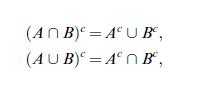
Prove de Morgan's identities (2.2) and (2.3).Equation 2.2Equation 2.3 (An B)=A U B, (AUB)=An B,
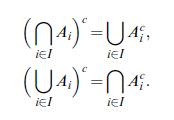
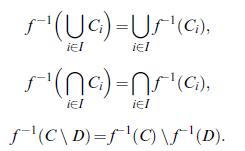
(i). Find examples showing that \(f(A \cap B) eq f(A) \cap f(B)\) and \(f(A \backslash B) eq f(A) \backslash f(B)\). In both relations one inclusion ' \(C\) ' or ' \(\supset\) ' is always true. Which one? (ii).Prove (2.6).Equation 2.6 S(UG)=US(c), El iEl f'(na)=n(a), EI El f'(C\D)=f(C) \ (D).
Let \(f\) and \(g\) be two injective maps. Show that \(f \circ g\), if it exists, is injective.
Consider on \(\left(\mathbb{R}^{n}, \mathcal{B}\left(\mathbb{R}^{n}ight)ight.\) ) the Dirac measure \(\delta_{x}\) for some fixed \(x \in \mathbb{R}^{n}\). Find the completion of \(\mathcal{B}\left(\mathbb{R}^{n}ight)\) with respect to \(\delta_{x}\).
Restriction. Let \((X, \mathscr{A}, \mu)\) be a measure space and let \(\mathscr{B} \subset \mathscr{A}\) be a sub- \(\sigma\)-algebra. Denote by \(u:=\left.\muight|_{\mathscr{B}}\) the restriction of \(\mu\) to \(\mathscr{B}\).(i) Show that \(u\) is again a measure.(ii) Assume that \(\mu\) is a
Show that a measure space \((X, \mathscr{A}, \mu)\) is \(\sigma\)-finite if, and only if, there exists a sequence of measurable sets \(\left(E_{n}ight)_{n \in \mathbb{N}} \subset \mathscr{A}\) such that \(\bigcup_{n \in \mathbb{N}} E_{n}=X\) and \(\mu\left(E_{n}ight)
Regularity. Let XX be a metric space and μμ be a finite measure on the Borel sets B=B(X)B=B(X) and denote the open sets by OO and the closed sets by FF. Define a family of
Showing 400 - 500
of 423
1
2
3
4
5
Step by Step Answers

 Get 50% OFF
Claim Now
Get 50% OFF
Claim Now



![approximating sequence [2]!) and defines an element Fu= L(X"); the identity (19.14) remains valid since the](https://dsd5zvtm8ll6.cloudfront.net/images/question_images/1705/9/0/5/58565ae0db1a07bd1705905580843.jpg)