New Semester
Started
Get
50% OFF
Study Help!
--h --m --s
Claim Now
Question Answers
Textbooks
Find textbooks, questions and answers
Oops, something went wrong!
Change your search query and then try again
S
Books
FREE
Study Help
Expert Questions
Accounting
General Management
Mathematics
Finance
Organizational Behaviour
Law
Physics
Operating System
Management Leadership
Sociology
Programming
Marketing
Database
Computer Network
Economics
Textbooks Solutions
Accounting
Managerial Accounting
Management Leadership
Cost Accounting
Statistics
Business Law
Corporate Finance
Finance
Economics
Auditing
Tutors
Online Tutors
Find a Tutor
Hire a Tutor
Become a Tutor
AI Tutor
AI Study Planner
NEW
Sell Books
Search
Search
Sign In
Register
study help
business
operations management 6th
Operations Management Providing Value In Goods And Services 3rd Edition Dilworth, James B - Solutions
10. How do you distinguish between planned orders and open orders?
11. Is capacity requirements planning important? Give some reasons for your response.
12. What are pegged requirements?
13. Distinguish between net change and regenerative MRP systems.
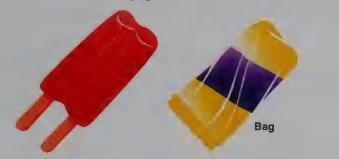
1. A Tongue Twister lollipop is shown below. Construct a structure tree for a bag of 20 fruit-flavored lollipops. Bag
2. Given the product structure you have just drawn for the Tongue Twister lollipop, determine the quantity of each component that must be purchased or produced if there is no inventory of any component at present and the company has scheduled production of 750 lollipops.
3. A Safe Rider bicycle headgear set consists of the following: box, warranty, instructions for use, helmet, extra pads for sizing, and reflective decals. The headgear assembly consists of the helmet and chin strap. The helmet consists of an inner and outer shell.The inner shell consists of a shell
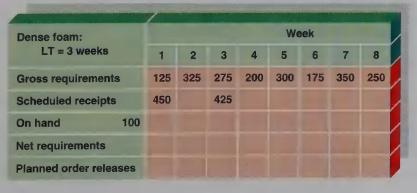
4. The gross requirements, on-hand inventory, and scheduled receipts for dense foam for the inner shell of the bicycle helmets described in problem 3 are indicated in thetime-phased inventory status record on the previous page. Its lead time is 3 weeks.Complete the inventory status records, showing
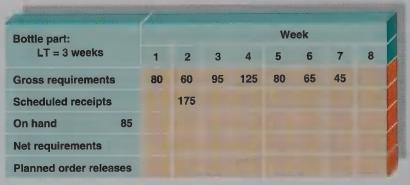
5. Safe Rider also manufactures the plastic water bottles that fit into metal brackets on bicycles so that cyclists can easily reach the bottles for a drink without stopping their pedaling. The current on-hand balance, the gross requirements, and the scheduled receipts for one of the bottle parts
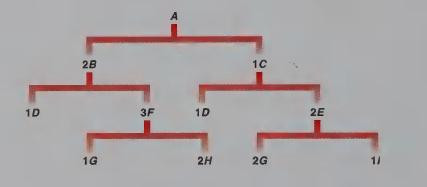
6. Given the product structure shown below, determine the quantity of each component that must be purchased or produced if there is no inventory of any component at present and the company has scheduled production of 75 units of product A. 1D 2B 1G 3F A 1D 1C 2H 2G 2E 1/
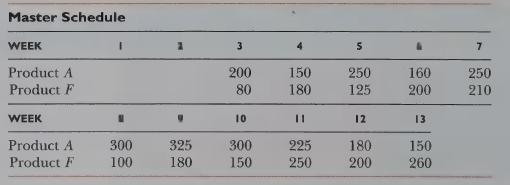
7. The product structure trees for products A and Fare shown on the facing page. Part of the master schedule showing when the company will complete production operations for quantities of these products is shown in the table below. Find the gross requirements for item B throughout the first 12
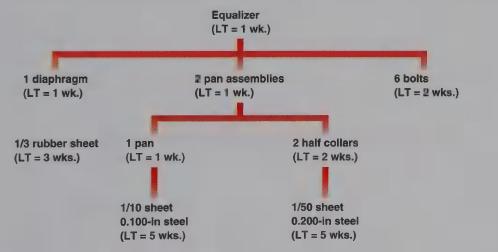
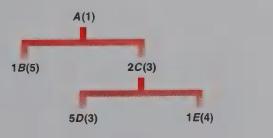
The Regular Regulator Company produces pressure regulators that are composed of two pan assemblies, a diaphragm, and six bolts. A pan assembly consists of a pan and two half collars. One sheet of rubber provides enough material for three diaphragms.One sheet of 0.100-in-thick steel is required for
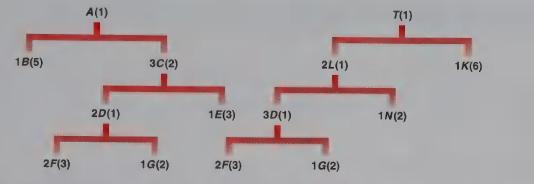
The lead time required to purchase or produce (from its immediately lower components)each component of the 16-mm equalizer is shown in parentheses below the component on the product structure tree that follows. How many components should be ordered, and when should they be ordered or started into
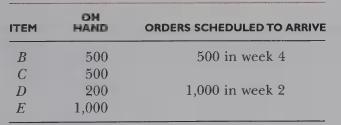
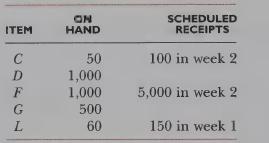
The Regular Regulator Company has on-hand inventory of some components for the equalizer shown in problem 9. The inventory levels and open orders for components of this equalizer are indicated on the next page. The master schedule shows only one production lot for 400 equalizers to be completed in
11. The product structure tree for a drafting table (part A) is shown below. The number of an item required to make one unit of the item above it is indicated in front of the item. The lead time required to purchase an item or to produce it from the component(s) at the next lower level is indicated
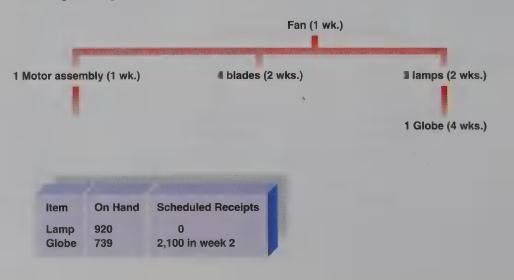
12. The product structure tree for a ceiling fan is shown below. The number of an item required to make one unit of the item above it is indicated in front of an item. The lead time required to purchase an item or to produce it from the component(s) at the next lower level is indicated in
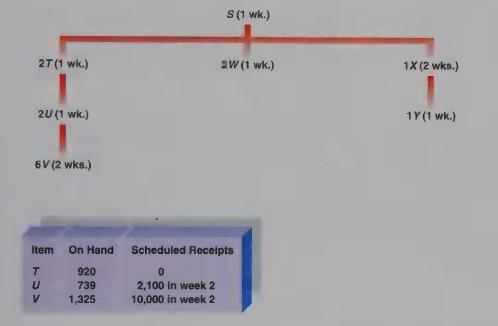
13. The product structure tree for a lawn sprinkler (part S) is shown below. The number of an item required to make one unit of the item above it is indicated in front of the letter representing an item. The lead time required to purchase an item or to produce it from the component(s) at the next
14. The structure of a product is shown in the tree diagram below, with the quantity required to make one unit of the higher-level item shown to the left of each item and the lead times in weeks indicated in parentheses. The company plans to complete production of 250 A’s in week 8, 300 in week
15. Refer to the product structures for products A and F presented in problem 7+ ine company has 500 units of B on hand, and 1,000 units are scheduled to be received in week 3. The master schedule shows that the company will complete the indicated quantities of end products during the scheduled
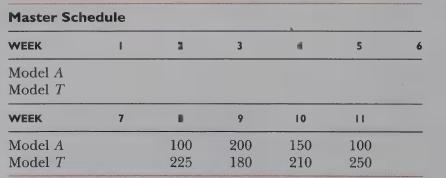
16. The Crime Stopper Alarm Company produces two models, A and TJ, for which the product structures are shown at the end of this problem. The quantity required to make one of the next-higher-level items is shown to the left of an item, and the lead time in weeks for each procurement or production
The net requirements for an item through a series of time periods are shown below.The setup cost for the item is $100 per order, and the holding cost is $0.25 per unit per period. Use the part-period algorithm to determine the orders into which these requirements should be batched. Period 1 N 3 4 5
Refer to the information in problem 17. Use the period order quantity technique to determine the size and timing of the planned order receipts.
Net requirements for item R557 during a series of time periods are shown below. The order cost for this item is $30 per order, and the holding cost is $0.10 per unit per period.Using the part-period algorithm, determine the timing and size of the orders that should be received. Period Requirement -
Refer to the information in problem 19. Use the period order quantity technique to determine the size and timing of the planned order receipts.
For the data provided in problem 19, calculate the mean weekly requirements, and round to the nearest integer. Use this number as a uniform weekly requirement, and use the order cost and holding cost that were given in problem 19.a. From the EOQ formula determine the optimal order size for the
Use a spreadsheet to set up the master production schedule for item A and the MRP inventory status records for all the dependent items. The needed data are given below.Bill of Materials Make a printout of the MRP inventory records for each of the following cases:a. The given master schedule and
1. Ikea is known worldwide as the innovative furniture designer and manufacturer that produces high-quality, contemporary modular furniture (assembly required) at low prices. Visit Ikea’s site at www.ikea.com to learn more about the dependent-demand — www.ikea.com items that are not only part
2. Woolrich has been a standard in the outdoor clothing manufacturing industry for many years. The company produces men’s and women’s clothing, as well as blankets and even a line called Babyrich. Visit the company’s Web site at www.woolrich.com and — www.woolrich.com click on a product
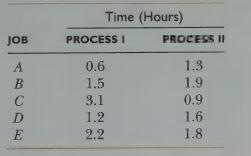
Five jobs are to be run—first on process I, then on process II. The jobs are listed in the following table with their time requirements on the two processes.(a) Sequence the jobs by Johnson’s method so that the total flow time and idle time will be minimized.(b) Show the sequence and durations
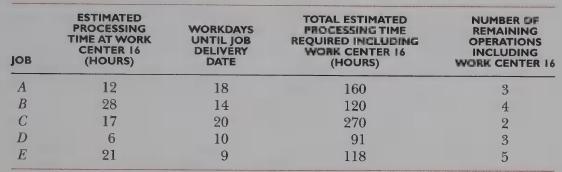
1. The jobs listed in the first column of the accompanying table are waiting at work center 16. The shop works 16 hours per day.a. Arrange the jobs in priority sequence according to the lowest average slack per operation given by equation 13.1.b. Arrange the jobs in sequence for work center 16
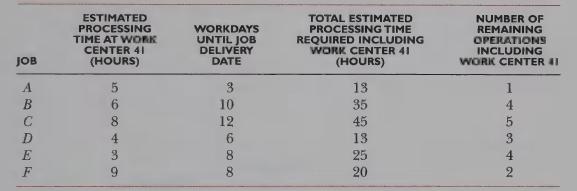
2. The jobs listed in the following table are waiting at work center 41. The shop works 8 hours per day.a. Arrange the jobs.in sequence for work center 41 according to the shortest-processing-time rule.b. Arrange the jobs according to the lowest average slack per operation (equation 13.1). JOB 1 4
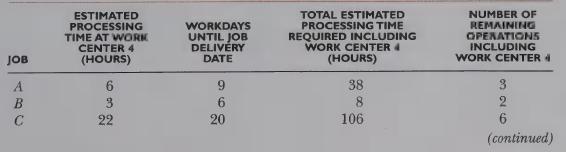
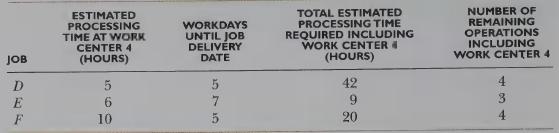
3. The jobs listed in the first column of the following table are waiting at work center 4.The shop normally works 8 hours a day.a. List the sequence in which the jobs would be done according to the shortestprocessing-time rule.b. In what order would the jobs be sequenced according to the lowest
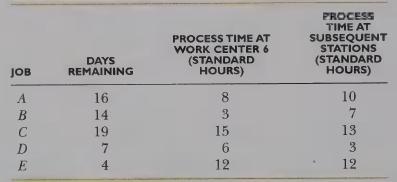
4. It is the start of work on Monday morning. The jobs listed below are the queue of work waiting to be done at work center 6, which is a single machine that is one of the bottlenecks in the shop. The shop normally works 8 hours a day. Sequence the jobs according to the critical ratio. If no more
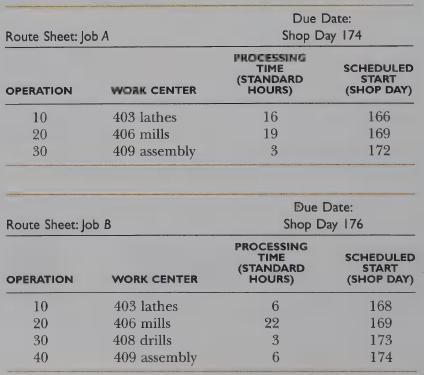
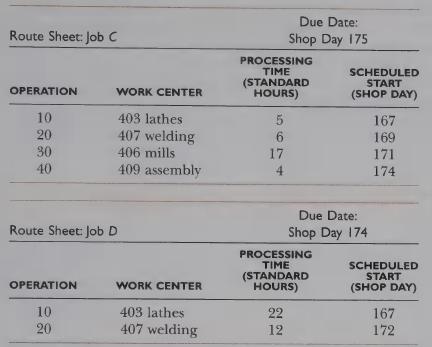
5. Work center 403 is the starting work center for four relatively simple jobs whose route sheets are shown in the following four tables.Sequence the jobs according to:a. The shortest processing time at the current work centerb. The shortest processing time at the next work centerc. The shortest
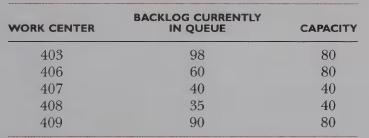
6. Today is shop day 167, and the backlogs already in queue at each of the work centers through which each of the jobs in problem 5 must flow are presented in the following table.a. Sequence the jobs from problem 5 in order of the scheduled start date at work center 403.b. Sequence these jobs in
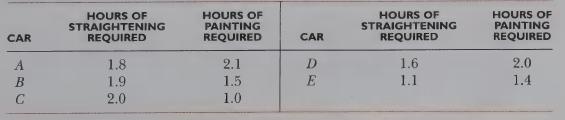
7. Sleek Auto Body Shop has five cars that must have fenders straightened and be repainted.Julie Stewart, the manager, must be present while the work is being done, although the person who straightens fenders can work independently of the painter.a. Sequence the cars so that Ms. Stewart’s workday
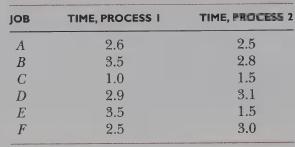
8. Six two-color printing jobs are to be run using two processes, all in the sequence of first process 1, then process 2. The table below indicates the duration (in hours) of each process.a. Sequence the jobs according to Johnson’s rule.b. Use a Gantt chart to show how long after the start of the
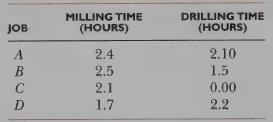
9. Morris Machine Shop has four jobs waiting to be run on the milling machine, and three of them must then go to the drill press for the next operation before they are completed. There is an operator for each machine. Times for the two processes are shown below.a. Sequence the jobs so that all will
Given below is the input part of an input/output control reporta. Compute the cumulative deviations in input.b. What is the minimum queue this work center could start with and not run out of work?c. How much capacity should the work center have on average to keep the average queue at this work
11. Given below is a partially completed input/ output control report for a certain work center.a. Compute the remainder of the table for the first 4 weeks.b. What problem appears to exist?c. What corrective actions can you suggest? Planned input 420 420 420 420 420 420 Actual input 400 450 440 465
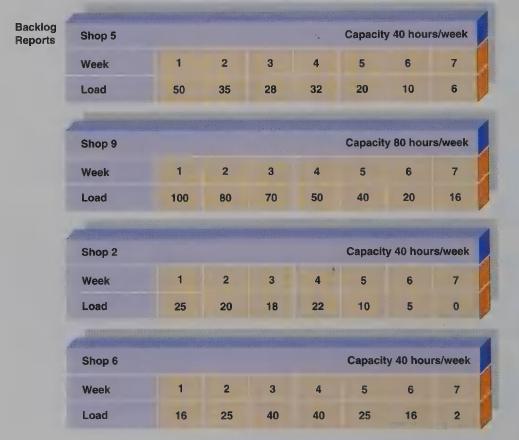
Congratulations, you own a job shop manufacturing company. Your company has been requested to quote on a simple assembly: a special-size metal door for McCall Enterprises. The door assembly consists of the door, the frame, two hinges, and a latch. The door must go to shop 5 for 1 hour and then to
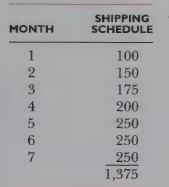
Dan Paramesh of Hugo Optical Equipment Company is developing a production plan for the assembly of special survey equipment for offshore oil exploration. The contract calls for the following shipping schedule:The first survey equipment was assembled in 755 standard hours. In the past, for similar
1. The company mentioned in the chapter with the discussion of the minimum feasible lot size has been working for continuous improvement. The setup time has been re- duced to 12 minutes to change from running one of the items considered earlier to running any of the others. Also the processing time
2. A company runs three items on the same machine. Demand and processing time for the three items are given in the following table. Setup time to change from pro- duction of any item to any other is 16 minutes. The machine is available for 420 minutes a day. The company wishes to start each day
3- Awesome Auto Parts runs three items on the same machine. The table below shows the demand and processing time for the three items. Setup time to change from production of any of the items to any other is 22 minutes. The machine is available for 450 minutes a day. Company managers want to start
4. A company runs four items on the same machine. Demand and processing time for the four items are given in the table below. Setup time to prepare the machine for production of each of the items is also given in the table. The machine is available for two shifts or 840 minutes a day. The company
13. Describe some situation in which TOC scheduling principles are applied or could be applied in a service operation.
12. Describe the DBR approach to scheduling and controlling production.
11. Describe the difference between the JIT and the TOC scheduling processes. What are the focus and primary goal of each?
10. In what ways does the role of purchasing change when a company shifts to JIT man- ufacturing?
9. What is jidoka? What messages about human resources management and the relative importance of output versus quality are conveyed by the use of jidoka?
8. Generally describe some setup reduction ideas that a manufacturing company might apply.
7. Single-minute exchange of dies (SMED) is a coveted goal of many JIT factories. Why are quick changeovers considered one of the pillars of JIT?
6. Why is preventive maintenance important in JIT production?
5. How do small lots contribute to high quality? To flexibility? To cost efficiency?
4. Compare the push and the pull methods of coordinating work at work stations.
3. Name the elements that work together to make JIT flow occur so effectively in repet- itive manufacturing.
2. What are the three major components of JIT manufacturing?
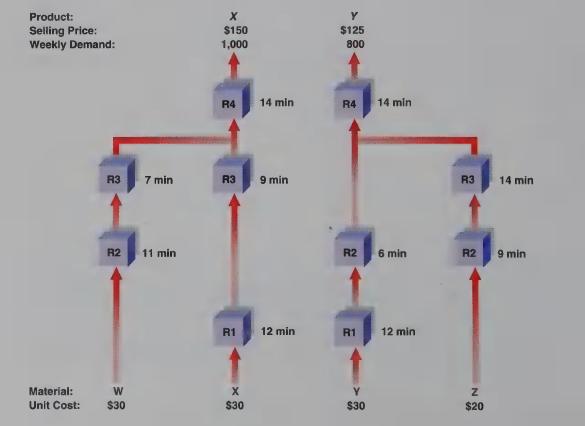
5. Shown on the next page is a flowchart that provides selling prices, demand, production times, and material cost information for two products a company produces. The company has worked to reduce setup times to such short times that they can be disregarded.The resources are available 900 minutes a
1. Briefly distinguish between JIT manufacturing and JIT flow.
3. Construction companies such as custom home builders are essentially make-to-order companies and must schedule their production in this manner. Leeside Construction Company, located on Cape Cod, a popular vacation spot in Massachusetts, is one such company. Leeside specializes in upscale homes,
2. Repetitive manufacturing is anything but dull. In fact, it can involve hectic scheduling for managers. Consider the Clarks footwear company, which has been producing shoes since 1825 and is perhaps best known for its Original Desert Boot. Visit the Clarks Web site at www.clarks.com, and click on
1. Information system linkages are vital for all types of production planning and control, including retail operations that link manufacturing with services. Williams-Sonoma is one such organization. Not only does Williams-Sonoma operate its own retail business, offering gourmet cooking products to
A landscaping contractor has received a contract to plant shrubs for a new subdivision in a nearby city. He intends to send one of his supervisors, who will employ a crew of workers in that city to perform the work.The subdivision contains 30 houses with basically similar landscape plans. She has
16. The Adams Company has just completed development of a new leaf blower. The first one required 47 minutes to produce, and it is estimated that the company will have a 95 percent improvement rate.a. Estimate the time required to produce the 1,000th, 2,000th, and 5,000th units.b. Estimate the
15. Talk To Me Communications Company produces communications systems for small businesses. The first of its new model TTMC-10 systems required 8.5 labor hours to complete. The company has experienced an 80 percent learning curve on its past models and expects this learning rate to apply to the new
14. Steadman Electronics is introducing a remote pager model. The company works at continuous improvement and has achieved a 90 percent improvement rate on similar small electronic devices, so a 90 percent improvement rate is expected with the new pager. It is estimated that initial production of
13. The Paper Chase Company recycles paper for packaging. Currently, the process requires 22 labor-hours per 8-ton batch to recover a certain amount of material. Because much of the labor time during processing is required for an operator to fill and empty water tanks, the company scheduler feels
12. The Silver Bullet Aircraft Company has just produced the first of its model R-80 airplanes, which required 36,500 direct labor-hours. The company has experienced a 90 percent learning curve for similar aircraft it has produced in the past. (Use Appendix II.)a. How long will the 10th airplane
7. Why is it necessary to continually replan priorities in a production system?
6.a. Discuss the objectives of input/output control.b. How can input and output be properly controlled and delivery performance still be mediocre?
5. What problems could result if a company’s dispatching rules were always to work on the item with the shortest processing time? To work on the item with the longest processing time?
6. Shown below is a flowchart that provides selling prices, demand, production times, and material cost information for two products a company produces. The company has worked to reduce setup times to such short times that they can be disregarded. The resources are available 7.5 hours per day for 5
4, What is dispatching? Describe a few rules of thumb (heuristics) that may be used in dispatching.
3. Why should production control bother to keep track of the amount of work that has been completed?
2. What is a backlog report?
1. Why is it difficult to select one criterion that will ensure optimum performance of a production system?
1. As you read in the chapter, Ocean Spray Cranberries has been able to reduce cycle times and lead times significantly by sharing cost information with suppliers. Access the Ocean Spray Web site at www.oceanspray.com, and click on “Corporate Information” —www.oceanspray.com to learn more
2. On its Web site, Pizza Hut claims that it uses “2.5 percent of all the milk (over 3.2 billion pounds) produced in the United States every year for cheese.” In addition, the company uses “more than 700 million pounds of pepperoni per year.” Thus, inventory of these and other items is a
3. Rollerblading has become so popular that the brand name for inline skates has now become a generic term. Visit the Web site for Rollerblade at www.rollerblade.com, and — www.rollerblade.com click on several categories, such as “Iechnology/Innovations” to find out more about the company’s
1. Discuss the difference between preventive and remedial maintenance. Give examples of each.
2. How might managing a maintenance operation incorporate some features of managing both a job shop and a make-to-stock operation at the same time?
3. What is predictive maintenance?
4. What are some of the advantages of a predictive maintenance program?
1. The Ecstasy Inn motel has 100 television sets in its rooms. The manager has an opportunity to sign a maintenance contract that calls for an annual payment of $12 per television set. The contract will provide preventive maintenance and adjustments to the sets at 6-month intervals. Currently the
Safeway Rentals has a fleet of 30 rental cars. It is in the process of reviewing its preventive maintenance program. The cost of performing preventive maintenance is $25 per car. The probability distribution for breakdown after a preventive maintenance is given in the following table.The average
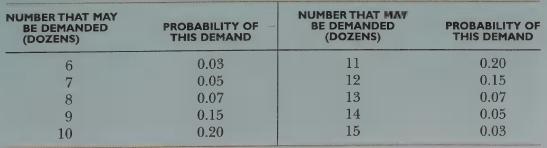
A style product must be ordered by a store . several months before. the season and can be purchased at $16.25 per unit. The retail price for the item will be $26.95 during the season. No “fill-in” stock can be ordered during the season if the store runs out of stock. Any excess stock left at
Assume the same cost and sales prices for the item in the previous problem, but assume that the probability distribution is stated a different way. It is estimated that the probability distribution of demands that may occur is expressed by a normal probability distribution with a mean p of 140 and
1.a. Should a company be concerned about its upstream suppliers other than its immediate suppliers?b. Why?
2. What are some of the challenges faced by companies that either cause them to want to work more closely with their suppliers or that make it more difficult to work more closely with them?
3. What are some of the changes that have taken place as companies have moved from traditional procurement approaches to the development of supplier-partnerships?
4. How can technology be applied to improve the speed and efficiency of the linkage between supplier-partner?
5. Why is it important that companies improve their internal operations in addition to improving the linkages with their suppliers?
6. Discuss some examples of single-period inventories.
7. What are some reasons companies hold inventories?
8. What is an inventory system?
9. Briefly describe four types of inventory systems for independent-demand items.
10. Why are inventories of dependent-demand items controlled differently from independent-demand items?
11. Why is the purchasing department often involved in value analysis?
12. What are some changes a company can make so it can operate with lower inventories?
Showing 1800 - 1900
of 5048
First
12
13
14
15
16
17
18
19
20
21
22
23
24
25
26
Last
Step by Step Answers

 Get 50% OFF
Claim Now
Get 50% OFF
Claim Now