New Semester Started
Get
50% OFF
Study Help!
--h --m --s
Claim Now
Question Answers
Textbooks
Find textbooks, questions and answers
Oops, something went wrong!
Change your search query and then try again
S
Books
FREE
Study Help
Expert Questions
Accounting
General Management
Mathematics
Finance
Organizational Behaviour
Law
Physics
Operating System
Management Leadership
Sociology
Programming
Marketing
Database
Computer Network
Economics
Textbooks Solutions
Accounting
Managerial Accounting
Management Leadership
Cost Accounting
Statistics
Business Law
Corporate Finance
Finance
Economics
Auditing
Tutors
Online Tutors
Find a Tutor
Hire a Tutor
Become a Tutor
AI Tutor
AI Study Planner
NEW
Sell Books
Search
Search
Sign In
Register
study help
business
pmp® exam practice test and study guide
PMP® Exam Practice Test And Study Guide 10th Edition Ginger Levin, J. LeRoy Ward - Solutions
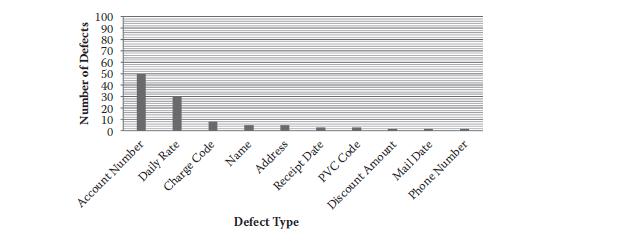
The below Pareto chart indicates defects in areas associated with billing a client for project services. Based on this Pareto analysis, which area, or areas, indicate the greatest opportunity for improvement?a. The account number, because if it is incorrect, the invoice may be sent to the wrong
Quality requirements of the project are recorded in—a. Process improvement planb. Quality management planc. Quality baselined. Quality metrics
One way to display the sequence of steps and the branching possibilities that exist for a process that transforms one or more inputs into one or more outputs is to use a process map or a—a. Checklistb. Flowchartc. Tree diagramd. Process decision program chart
Quality checklists are an output of Plan Quality Management. These checklists—a. Form the basis for quality control measurementsb. Are a tool and technique used in the quality auditsc. Incorporate the acceptance criteria included in the scope baselined. Contain product and project attributes
All but one of the following is objectives of a quality audit—a. Good practices being implemented are identifiedb. Gaps and shortcomings are identifiedc. Good practices can be introduced elsewhered. Root cause analysis has been performed as part of process analysis
Basic quality management as defined in the PMBOK® Guide is intended to be compatible with the International Organization for Standardization (ISO) quality standards. This means that, among other things, every project should—a. Describe how products should be producedb. State specifics for the
You work as a project manager in the largest hospital in the region. Studies have shown that patients have to wait for long periods before being treated. To assist in identifying the factors contributing to this problem, you and your team have decided to use which of the following techniques?a.
You are a project manager for residential construction. As a project manager, you must be especially concerned with building codes—particularly in the Plan Quality Management process. You must ensure that building codes are reflected in your project plans because—a. Standards and regulations
An often, but important, overlooked output of the Plan Quality Management process is the Process Improvement Plan. While its focus is on the steps to analyze project management and product development processes to identify activities to enhance their value, it also includes—a. An approach to
The control chart is a tool used primarily to help—a. Monitor process variation over timeb. Measure the degree of conformancec. Determine whether results conform to benefitsd. Determine whether results conform to requirements
Quality control measurements are captured—a. As specified in the Plan Quality Management processb. To prepare an operational definitionc. To prepare a control chartd. As an output to Perform Quality Assurance
Rework required, causes for rejection, and the need for process adjustment are examples of—a. Work performance data in Perform Quality Assuranceb. Work performance information in Control Qualityc. Items that are part of the process improvement pland. Items to cover at meetings used to prepare the
On-time performance, cost control, defect frequency, failure rates, availability, reliability, and test coverage are examples of—a. Incentives to vendors to make quality commitments to improve overall performanceb. Quality metrics as an input to Perform Quality Assurancec. Methods that usually
An often overlooked function of a quality audit is to—a. Confirm the implementation of approved change requestsb. Examine constraints experiencedc. Update training plansd. Establish quality metrics
Recently your company introduced a new set of “metal woods” to its established line of golfing equipment. As you work in quality assurance on this project, you decide to use a matrix diagram as it—a. Analyzes the product development cycle after product release to determine strengths and
You are managing a major international project, and your contract requires you to prepare both a project plan and a quality management plan. Your core team is preparing a project quality management plan. Your first step in developing this plan is to—a. Determine specific metrics to use in the
Your management has prescribed that a quality audit be conducted at the end of every phase in a project. This audit is part of the organization’s—a. Perform Quality Assurance processb. Control Quality processc. Quality improvement programd. Process adjustment program
Quality inspections also may be called—a. Control testsb. Walkthroughsc. Statistical samplingd. Checklists
Assume previous projects in the organization have overrun their budgets consistently and tend to require more contingency reserves than in the original budget. You are striving to avoid the need for additional contingency on your project and are doing so by—a. Involving more stakeholders in the
Projects tend to result in change, and people tend to resist change. Wanting to avoid resistance against the new manufacturing process that you are implementing, you—a. Prepare and follow a change management planb. Use force field analysisc. Involve all stakeholders using a nominal group
Using control charts is one way to monitor cost and schedule variances, volume, frequency of scope changes, and other results to determine if the project management processes are stable. Assume you are working on a project that implements a repetitive process because its result is used many times
Your quality assurance department recently performed a quality audit of your project and identified a number of findings and recommendations. One recommendation seems critical and should be implemented because it affects successful delivery of the product to your customer. Your next step should be
Assume your organization is a start-up company, and you are trying to explain the importance of project quality management to the management team, which has not worked in this area before. You make an analogy to archery in your presentation, because one of the managers is an expert in it. You tell
Project quality management was once thought to include only inspection or quality control. In recent years, the concept of project quality management has broadened. Which statement is NOT representative of the new definition of quality management?a. Quality is designed into the product or service,
Rank ordering of defects should be used to guide corrective action. This is the underlying principle behind—a. Trend analysisb. Inspectionsc. Control chartsd. Pareto diagrams
It is important to use statistical sampling during Plan Quality Management in order to—a. Help determine the cost of qualityb. Determine when attribute sampling versus variables sampling is more appropriatec. Set tolerances and control limitsd. Differentiate between special causes and random
In order to use approved change requests as an input to Control Quality, it is important to—a. Have a change management planb. Update the change logc. Implement recommendations from the CCBd. Verify their timely implementation
Your project scheduler has just started working with your project and has produced defect reports for the past two accounting cycles. If this continues, these defect reports could provide the potential for customer dissatisfaction and lost productivity that is due to rework. You discovered that the
Which of the following statements best describes attribute sampling versus variables sampling?a. Attribute sampling is concerned with prevention, whereas variables sampling is concerned with inspection.b. Attribute sampling is concerned with conformance, whereas variables sampling is concerned with
One area that often influences perceptions of quality is—a. Cultural concernsb. Information from the risk registerc. Organizational quality policiesd. Specific tolerances
Checksheets are one of the seven basic quality tools. Often overlooked is that the data about frequencies or consequences in checksheets—a. Can be used to formulate the problem for a cause-and-effect diagramb. Use statistical techniques to compute a “loss function” to determine the cost of
You are leading a research project that will require between 10 and 20 aerospace engineers. Some senior-level aerospace engineers are available. They are more productive than junior-level engineers, who cost less and who are available as well. You want to determine the optimal combination of
Often, one quality tool may lead to the development of another useful quality tool. An example is—a. Process decision point program chartsb. A roadmapc. Interrelationship diagraphsd. Force field analysis
Requirements documentation is useful in project quality management because it—a. Provides better product definition and product developmentb. Helps products to succeed in the marketplacec. Helps plan how quality control will be implemented on the projectd. Helps control the overall cost of quality
In quality management, the practice “rework” is—a. Acceptable under certain circumstancesb. An adjustment made that is based on quality control measurementsc. Action taken to bring a defective or nonconforming component into complianced. Not a concern if errors are detected early
Benchmarking is a technique used in—a. Inspectionsb. Root cause analysisc. Plan Quality Managementd. Control Quality
Quality is very important to your company. Each project has a quality statement that is consistent with the organization’s vision and mission. Both internal and external quality assurance are provided on all projects to—a. Ensure confidence that the project will satisfy relevant quality
The CPI on your project is 0.84. This means that you should—a. Place emphasis on improving the timeliness of the physical progressb. Reassess the life-cycle costs of your product, including the length of the life-cycle phasec. Recognize that your original estimates were fundamentally flawed, and
Assume that your actual costs are $800; your planned value is $1,200; and your earned value is $1,000. Based on these data, what can be determined regarding your schedule variance?a. At +$200, the situation is favorable as physical progress is being accomplished ahead of your plan.b. At −$200,
Assume it has become obvious on your project that the budget at completion is no longer viable. This means as the project manager, you should—a. Recommend to your managers that the project be terminatedb. Perform an analysis of the remaining tasks on the critical path and take corrective or
Assume you are using earned value on your project, and as of today, your cumulative CPI is below the baseline. This means—a. All future work will need to be performed immediately with the range of the TCPI.b. The ETC work will be performed at an efficiency rate that considers both the schedule
Assume that the project cost estimates have been prepared for each activity and the basis of these estimates has been determined. Now, as the project manager for your nutrition awareness program in your hospital, you are preparing your budget. Because you have estimates for more than 1,200 separate
As project manager, you identified a number of acceptable tolerances as part of your earned value management system. During execution, some “unacceptable” variances occurred. After each “unacceptable” variance occurred, a best practice is to—a. Update the budgetb. Prepare a revised cost
A revised cost baseline may be required in cost control when—a. CVs are severe, and a realistic measure of performance is neededb. Updated cost estimates are prepared and distributed to stakeholdersc. Corrective action must be taken to bring expected future performance in line with the project
Increased attention to return on investment (ROI) now requires you to re-estimate the costs for your project. When you looked at how costs were first estimated, you realized an order-of-magnitude estimate was prepared, which was never refined. Therefore, now you are estimating costs from the
Assume you have used reserve analysis as a tool and technique to Control Costs. However, during this project you have focused on continual risk identification and subsequent analysis of the identified risks. In fact you had a risk expert on your team. This means you may need to—a. Use management
One way to engage team members to improve estimate accuracy is to—a. Hold a focus groupb. Use vendor bid analysisc. Use a Delphi approachd. Involve industry groups
Overall cost estimates must be allocated to individual activities to establish the cost performance baseline. In an ideal situation, a project manager would prefer to prepare estimates—a. Before the budget is completeb. After the budget is approved by managementc. Using a parametric estimating
Performance review meetings are held to assess schedule activity and work packages over-running or under-running the budget and to determine any estimated funds needed to complete work in progress. Typically, if EV is being used, all but which of the following information is determined?a. Variance
Control accounts—a. Are charge accounts for personnel time managementb. Summarize project costs at level 2 of the WBSc. Identify and track management reservesd. Represent the basic level at which project performance is measured and reported
By reviewing cumulative cost curves, the project manager can monitor—a. EACb. PV, EV, and ACc. CVs and SVsd. CPI and SPI
Typically, the statement “no one likes to estimate, because they know their estimate will be proven incorrect” is true. However, you have been given the challenge of estimating the costs for your nuclear reactor project. A basic assumption that you need to make early in this process is—a. How
Which of the following calculations CANNOT be used to determine EAC?a. EAC = ETC-ACb. EAC = BAC/CPIc. EAC = AC + BAC—EVd. EAC = AC + (BAC-EV)/(CPI x SPI)
There are a number of different earned value management rules of performance measurement that can be established as part of the cost management plan. Which one of the following is NOT an example of such a rule?a. Code of accounts allocation provisionb. Formulas to determine the EACc. Earned value
Your project manager has requested that you provide him with a forecast of project costs for the next 12 months. He needs this information to determine if the budget should be increased or decreased on this major construction project. In addition to the usual information sources, which of the
It is expensive to lease office space in cities around the world. Office space can cost approximately USD $80 per square foot in Tampa, Florida. And it can cost approximately ¥50,000 per square meter in Tokyo. These “averages” can help a person to determine how much it will cost to lease
The approved, integrated scope-schedule-cost plan for project work is—a. Project budget baselineb. Performance measurement baselinec. Level-of-effort control accountsd. Expressed in the To Complete Performance Index
There are many useful EVM metrics, but the most critical is—a. CPIb. EACc. TCPId. VAC
Which of the following is a tool for analyzing a design, determining its functions, and assessing how to provide those functions’ cost effectively?a. Pareto diagramb. Value analysisc. Configuration managementd. Value engineering
Your approved cost baseline has changed because of a major scope change on your project. Your next step should be to—a. Estimate the magnitude of the scope changeb. Issue a change requestc. Document lessons learnedd. Execute the approved scope change
You receive a frantic phone call from your vice president who says she is going to meet with a prospective client in 15 minutes to discuss a large and complex project. She asks you how much the project will cost. You quickly think of some similar past projects, factor in a few unknowns, and give
If you want to calculate the ETC based on the assumption that work is proceeding as planned, the remaining work can be calculated by which of the following formulas?a. ETC = BAC − EVb. ETC = (BAC − EV)/CPIc. ETC = AC + EACd. ETC = EAC − AC
You have a number of costs to track and manage because your project is technically very complex. They include direct costs and indirect (overhead) costs. You have found that managing overhead costs is particularly difficult because they—a. Are handled on a project-by-project basisb. Represent
On your project, you need to assign costs to the time period in which they are incurred. To do this, you should—a. Identify the project components so that costs can be allocatedb. Use the project schedule as an input to determine budgetc. Prepare a detailed and accurate cost estimated. Prepare a
As of the fourth month on the Acme project, cumulative planned expenditures were $100,000. Actual expenditures totaled $120,000. How is the Acme project doing?a. It is ahead of schedule.b. It is in trouble because of a cost overrun.c. It will finish within the original budget.d. The information is
When you review cost performance data on your project, different responses will be required depending on the degree of variance or control thresholds from the baseline. For example, a variance of 10 percent might not require immediate action, whereas a variance of 100 percent will require
If operations on a work package were estimated to cost $1,500 and finish today but, instead, have cost $1,350 and are only two-thirds complete, the cost variance is—a. $150b. −$150c. −$350d. −$500
Management has grown weary of the many surprises, mostly negative, that occur on your projects. In an effort to provide stakeholders with an effective performance metric, you will use the to-complete performance index (TCPI). Its purpose is to—a. Determine the schedule and cost performance needed
You are responsible for preparing a cost estimate for a large World Bank project. You decide to prepare a bottom-up estimate because your estimate needs to be as accurate as possible. Your first step is to—a. Locate a computerized tool to assist in the processb. Use the cost estimate from a
If the cost variance is the same as the schedule variance and both numbers are greater than zero, then—a. The cost variance is due to the schedule varianceb. The variance is favorable to the projectc. The schedule variance can be easily correctedd. Labor rates have escalated since the project
You must consider direct costs, indirect costs, overhead costs, and general and administrative costs during cost estimating. Which of the following is NOT an example of a direct cost?a. Salary of the project managerb. Subcontractor expensesc. Materials used by the projectd. Electricity
All the following are outputs of the Estimate Costs process EXCEPT—a. Activity cost estimatesb. Basis of estimatesc. Documented constraintsd. Cost baseline
You have now prepared your cost management plan so now you are preparing your project’s cost estimate. You decided to use analogous estimating. Which of the following is NOT a characteristic of analogous estimating?a. Supports top-down estimatingb. Is a form of expert judgmentc. Has an accuracy
What is the EAC for this project, and what does it represent?a. $12,500; the revised estimate for total project cost(based on performance thus far)b. $10,000; the revised estimate for total project cost(based on performance thus far)c. $12,500; the original project budgetd. $10,000; the original
The CV for this project is—a. 300b. −$300c. 500d. −$500
What is the CPI for this project, and what does it tell us about cost performance thus far?a. 0.20; actual costs are exactly as plannedb. 0.80; actual costs have exceeded planned costsc. 0.80; actual costs are less than planned costsd. 1.25; actual costs have exceeded planned costs
According to earned value analysis, the SV and status of the project described above is—a. −$300; the project is ahead of scheduleb. +$8,000; the project is on schedulec. +$200; the project is ahead of scheduled. −$200; the project is behind schedule
The reason that the schedule performance index (SPI) is shown as a ratio is to—a. Enable a detailed analysis of the schedule regardless of the value of the schedule varianceb. Distinguish between critical path and noncritical path work packagesc. Provide the ability to show performance for a
To account for uncertainty in a schedule, reserve analysis may be used. All the following are examples of contingency reserves EXCEPT—a. Fixed number of work periodsb. Percent of the estimated activity durationc. Buffersd. Productivity metrics
You are managing a project to redesign a retail store layout to improve customer throughput and efficiency. Much project work must be done on site and will require the active participation of store employees who are life-long members of a powerful union with a reputation for labor unrest. One
Activity A has a pessimistic (P) estimate of 36 days, a most likely (ML) estimate of 21 days, and an optimistic (O) estimate of 6 days. What is the probability that activity A will be completed in 16 to 26 days?a. 55.70 percentb. 68.26 percentc. 95.46 percentd. 99.73 percent
You are managing a project that will use a virtual team with team members on three different continents. Your company is looking to use the virtual team to provide a lower cost product by using resources in countries that have a favorable exchange rate to that of your country. To assist in this
The risk register may need to be updated as an output of which following process?a. Define Activitiesb. Sequence Activitiesc. Estimate Activity Resourcesd. Control Schedule
You are managing a new technology project designed to improve the removal of hazardous waste from your city. You are in the planning phase of this project and have prepared your network diagram. Your next step is to—a. Describe any unusual sequencing in the networkb. State the number resources
All the following statements regarding critical chain method are true EXCEPT—a. It modifies the schedule to account for limited resourcesb. The first step is to use conservative estimates for activity durationsc. Duration buffers are added on the critical pathd. It focuses on managing buffer
Several types of float are found in project networks. Float that is used by a particular activity and does NOT affect the float in later activities is called—a. Extra floatb. Free floatc. Total floatd. Expected float
It is important to use the critical path analysis in Control Schedule because—a. It assists in reviewing scenarios to bring the schedule in line with the planb. It enables a consideration of the resource availability and the project timec. It examines project performance over timed. It can help
Which of the following is a key benefit of Control Schedule?a. It updates schedule progressb. It minimizes riskc. It reprioritizes remaining work as requiredd. It describes how the schedule will be managed and controlled
In project development, schedule information, such as who will perform the work, where the work will be performed, activity type, and WBS classification, are examples of—a. Activity attributesb. Constraintsc. Data in the WBS repositoryd. Refinements
Various tools and techniques are available to sequence activities, and several factors can help to determine which tool or technique to select. When a project manager decides to include sub-networks or a fragment network as part of his or her scheduling technique, what does this decision say about
A schedule performance index of less than 1.0 indicates that the—a. Project is running behind the monetary value of the work it planned to accomplishb. Earned value physically accomplished thus far is 100%c. Project has experienced a permanent loss of timed. Project may not be on schedule, but
When sequencing project activities in the schedule, all the following are true EXCEPT—a. There may be scheduled dates for specific milestonesb. Every activity is connected to at least one predecessor and at least one successorc. Lead or lag time may be requiredd. Necessary sequencing of events
Decomposition is a technique used for both WBS development and activity definition. Which following statement best describes the role decomposition plays in activity definition as compared to creating the WBS?a. Final output is described in terms of work packages in the WBSb. Final output is
You are remodeling your kitchen and decide to prepare a network diagram for this project. Your appliances must be purchased and available for installation by the time the cabinets are completed. In this example, these relationshipsare—a. Start-to-finishb. Finish-to-startc. Start-to-startd.
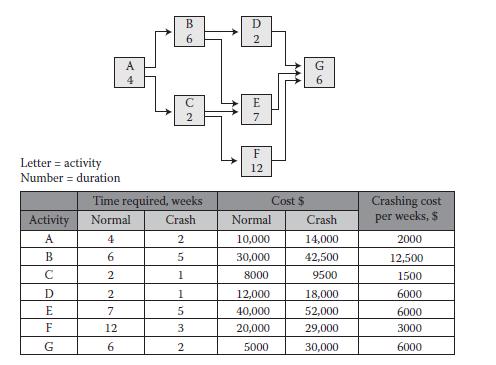
Review the following network diagram and table. Of the various activities, which ones would you crash and in what order?a. A, C, E, and Fb. A, B, D, and Fc. A, B, E, and Fd. C, A, F, and G A4 B D 6 G 6 F Letter = activity Number = duration 12 Time required, weeks Cost $ Activity Normal Crash Normal
Your project schedule was approved. Management has now mandated that the project be completed as soon as possible. However, you do not think it is possible given resource constraints. In order to convince your management of your need for additional resources, you decide to use—a. Resource
Working with your team to provide the basis for measuring and reporting schedule progress, you agree to use the—a. Schedule datab. Network diagramc. Project scheduled. Technical baseline
“I cannot test the software until I code the software.” This expression describes which of the following dependencies?a. Internalb. Rationalc. Preferentiald. Mandatory or hard
You can use various estimating approaches to determine activity durations. When you have a limited amount of information available about your project, especially when in the early phases, the best approach to use is—a. Bottom-up estimatingb. Analogous estimatingc. Reserve analysisd. Parametric
Activity A has a duration of three days and begins on the morning of Monday the 4th. The successor activity, B, has a finish-to-start relationship with A. The finish-to-start relationship has three days of lag, and activity B has a duration of four days. Sunday is a non-workday. Such data can help
Showing 5600 - 5700
of 5789
First
44
45
46
47
48
49
50
51
52
53
54
55
56
57
58
Step by Step Answers

 Get 50% OFF
Study Help!
Claim Now
Get 50% OFF
Study Help!
Claim Now