New Semester
Started
Get
50% OFF
Study Help!
--h --m --s
Claim Now
Question Answers
Textbooks
Find textbooks, questions and answers
Oops, something went wrong!
Change your search query and then try again
S
Books
FREE
Study Help
Expert Questions
Accounting
General Management
Mathematics
Finance
Organizational Behaviour
Law
Physics
Operating System
Management Leadership
Sociology
Programming
Marketing
Database
Computer Network
Economics
Textbooks Solutions
Accounting
Managerial Accounting
Management Leadership
Cost Accounting
Statistics
Business Law
Corporate Finance
Finance
Economics
Auditing
Tutors
Online Tutors
Find a Tutor
Hire a Tutor
Become a Tutor
AI Tutor
AI Study Planner
NEW
Sell Books
Search
Search
Sign In
Register
study help
engineering
chemical engineering
Advanced Transport Phenomena Analysis Modeling And Computations 1st Edition P. A. Ramachandran - Solutions
Knudsen diffusion is a phenomenon whereby transport takes place by gas-pore wall collisions rather than by gas-gas collisions. Knudsen diffusion is modeled using concepts similar to the kinetic theory of gases as \(D_{\mathrm{KA}}=\left(d_{\mathrm{p}} / 3\right) \bar{c}\), where \(\bar{c}\) means
Hindered diffusion is a phenomenon of diffusion of a solute in narrow liquid-filled pores when the size of the pores is comparable to the size of the diffusing molecule. The hindered diffusion is often modeled by introducing two correction factors, \(F_{1}\) and \(F_{2}\), which are defined as
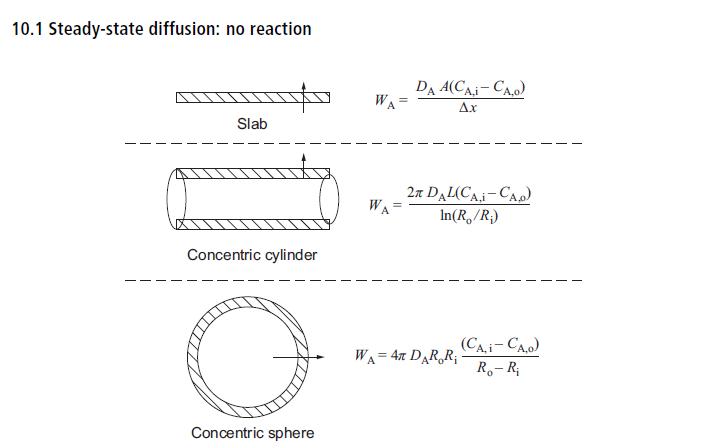
Verify that the concentration profile in a slab is linear, whereas that in a hollow cylinder is logarithmic, and for a spherical shell it is an inverse function of \(r\) for the three geometries in Fig. 10.1.Also verify the expressions for the numbers of moles transported across the system,
Derive an expression for the fall in the liquid level during evaporation using a quasi-steadystate approach. Show that\[\frac{d H}{d t}=\frac{M_{\mathrm{A}}}{ho_{\mathrm{L}}} N_{\mathrm{A}}\]where \(N_{\mathrm{A}}\) is the instantaneous rate of evaporation, i.e., based on the current height of the
Benzene is contained in an open beaker of height \(6 \mathrm{~cm}\) and filled to within \(0.5 \mathrm{~cm}\) of the top. The temperature is \(298 \mathrm{~K}\) and the total pressure is \(1 \mathrm{~atm}\). The vapor pressure of benzene is \(0.131 \mathrm{~atm}\) under these conditions, and the
For the above problem find the time for the benzene level to fall by \(2 \mathrm{~cm}\). The specific gravity of benzene is 0.874 .For this condition find the mole-fraction profile of benzene in the vapor phase and compare your answer with the linear approximation (which would be the prediction of
A liquid is contained in a tapered conical flask with a taper angle of \(30^{\circ}\). The radius in the flask for the liquid level at the bottom is \(7 \mathrm{~cm}\) and the vapor height above this is \(10 \mathrm{~cm}\).Find an expression for the rate of evaporation and the mole-fraction profile
Two bulbs are connected by a straight tube of diameter \(0.001 \mathrm{~m}\) and length \(0.15 \mathrm{~m}\). Initially one bulb contains nitrogen and the bulb at the other end contains hydrogen. The system is maintained at a temperature of \(298 \mathrm{~K}\) and a total pressure of \(1
Derive an expression for the case of mass transfer with second-order surface reaction based on a low-flux model. The resistance concept does not hold, unlike for a first-order reaction.
An example of a problem where there is severe counter-diffusion of the products is the deposition of \(\mathrm{SiO}_{2}\) from tetraethoxysilane (TEOS) on a solid substrate. The reaction is represented asNote that 6 moles have to counter-diffuse and hence this retards mass transfer unless the mole
9. At a certain point in a mass transfer equipment the bulk mole fractions are \(y_{\mathrm{A}}=0.04\) in the gas phase and \(x_{\mathrm{A}}=0.004\) in the liquid phase. The mass density of the liquid is nearly the same as water. The Henry's-law constant for A is reported as \(7.7 \times 10^{-4}
Consider the diffusion-reaction problem represented in the three geometries.Verify the analytical solutions shown in the text for the three geometries with the Dirichlet condition of \(c_{\mathrm{A}}=1\) at \(\xi=1\) and a symmetry condition (Neumann) at \(\xi=0\).Note that the solution for a
Consider the same problem with now a Robin condition at the surface:\[\left(\frac{d c_{\mathrm{A}}}{d \xi}\right)_{1}=B i\left[1-\left(c_{\mathrm{A}}\right)_{1}\right]\]Derive an expression for the effectiveness factor as a function of \(B i\) in addition to the \(\phi\) parameter. Do the analysis
Consider a second-order reaction in a catalyst in the form of a slab. Show that the differential equation can be expressed as\[\begin{equation*}\frac{d^{2} c_{\mathrm{A}}}{d \xi^{2}}=\phi^{2} c_{\mathrm{A}}^{2} \tag{10.91}\end{equation*}\]How is the \(\phi\) parameter defined for this case? Use the
The sulfur compounds present in petroleum fractions such as diesel can be removed by contact with a porous catalyst containing active metals such as Mo in the presence of hydrogen. If the catalyst is \(3 \mathrm{~mm}\) in radius and the concentration of sulfur in the liquid surrounding the catalyst
Gas absorption in an agitated tank with a first-order reaction.Oxygen is absorbed in a reducing solution, where it undergoes a first-order reaction with a rate constant of \(40 \mathrm{~s}^{-1}\). The conditions are such that the liquid-side mass transfer coefficient \(k_{\mathrm{L}}\) is equal to
Verify the expression for the critical Thiele modulus for the oxygen concentration to become zero at \(R_{0}\) in the tissue as a function of \(\kappa\), the ratio of the capillary diameter to the unit cell diameter of the tissue given in the text.Apply the model to the following data (from Truskey
The effective diffusion coefficient of \(\mathrm{H}_{2}\) in a mixture of \(\mathrm{H}_{2}\) and \(\mathrm{CO}\) in a porous catalyst was found to be \(0.036 \mathrm{~cm}^{2} / \mathrm{s}\) at a temperature of \(373 \mathrm{~K}\) and \(2 \mathrm{~atm}\) total pressure. The catalyst has a
Consider a porous catalyst with a series reaction represented as\[\mathrm{A} \rightarrow \mathrm{B} \rightarrow \mathrm{C}\]Write governing equations for A and B. Express them in dimensionless form. How many dimensionless groups are needed?Solve the equations for a case where the dimensionless
A spherical capsule has an outer membrane thickness with inner and outer radii \(r_{\mathrm{i}}\) and \(r_{\mathrm{o}}\), respectively. A solute is diffusing across this capsule. Consider the case where the diffusion coefficient is a function of concentration and can be represented in a general
A pool of liquid is \(10 \mathrm{~cm}\) deep, and a gas \(A\) dissolves and reacts in the liquid. The solubility of the gas is such that the interfacial concentration is equal to \(2 \mathrm{~mol} / \mathrm{m}^{3}\) in the liquid and the diffusivity of the dissolved gas is \(2 \times 10^{-9}
\(\mathrm{CO}_{2}\) is absorbed into a liquid under conditions such that the liquid-side mass transfer coefficient is \(2 \times 10^{-4} \mathrm{~m} / \mathrm{s}\). The diffusion coefficient of \(\mathrm{CO}_{2}\) in the liquid is \(2 \times 10^{-9} \mathrm{~m}^{2} / \mathrm{s}\). The interfacial
A porous catalyst is used for \(\mathrm{CO}\) oxidation, and the process is modeled as a first-order reaction with a rate constant of \(2 \times 10^{4} \mathrm{~s}^{-1}\). The effective diffusion coefficient for pore diffusion was estimated as \(4 \times 10^{-6} \mathrm{~m}^{2} / \mathrm{s}\). The
For the \(\mathrm{CO}_{2}\) absorption in \(\mathrm{NaOH}\) problem in the text, examine the effects of (i) changing the partial pressure of \(\mathrm{CO}_{2}\) and (ii) the concentration of the liquid-phase reactant. State the range of conditions under which the reaction is expected to take place
Extend the analysis of gas absorption with reaction to the case of absorption of two gases with a common liquid-phase reactant. A detailed study of this topic has been published in an award-winning paper by Ramachandran and Sharma (1971). Simulate numerically some illustrative examples from this
Condensation rates for a binary vapor mixture (adapted from Taylor and Krishna (1993)). Here we apply Eq. (10.22) to the condensation of a binary mixture of ethylene dichloride (A) and toluene (B) for the following conditions.Vapor-phase composition: \(y_{\mathrm{A} 0}=0.4\)Liquid-phase composition
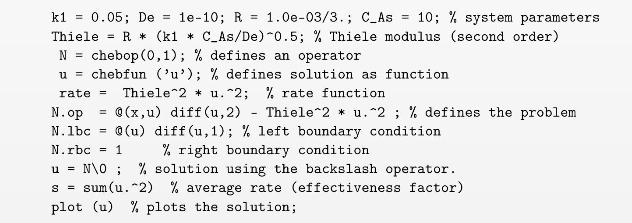
Code for pore diffusion with CHEBFUN is shown below. Note how compact the code is compared with BVP4C. The backslash operator is used as an overloaded operator here.Test the code which is applicable for diffusion with a second-order reaction in a porous catalyst. Then use the code to develop a
A membrane separator is \(3 \mathrm{~mm}\) in diameter, and the membrane permeability was estimated as \(2 \times 10^{-6} \mathrm{~m} / \mathrm{s}\). The solute being transported has a diffusivity of \(2 \times 10^{-9} \mathrm{~m}^{2} / \mathrm{s}\) in the liquid.Estimate the overall permeability.
Develop a simple backmixed model to evaluate the performance of a gas-separation system. Here a feed gas enters a high-pressure chamber with a mole fraction of A of \(x_{\mathrm{Af}}\) and leaves enriched with a mole fraction of \(x_{\mathrm{Ae}}\). The exit stream leaving the high-pressure chamber
Pervaporation: a case-study problem. Pervaporation refers to removal of the permeate as vapor and represents an intermediate case between purely gas transport and purely liquid transport in a membrane. The process is important in production of pure ethyl alcohol,which can otherwise be done only by
Find the acceleration of a fluid particle for the following velocity profiles:(a) \(v_{x}=A\left(1-y^{2}\right) ; v_{y}=0 ; v_{z}=0\)(b) \(v_{x}=A x ; v_{y}=-A y ; v_{z}=0\)(c) \(v_{r}=0 ; v_{\theta}=A r ; v_{z}=0\)(d) \(v_{r}=0 ; v_{\theta}=A / r ; v_{z}=0\)(e) \(v_{r}=0 ; v_{\theta}=0 ;
Derive an expression for \(D T / D t\) in Cartesian coordinates.Also show that the same relation holds for a vector; i.e.,\[\frac{D \boldsymbol{v}}{D t}=e_{x} \frac{D v_{x}}{D t}+e_{y} \frac{D v_{y}}{D t}+e_{z} \frac{D v_{z}}{D t}\]where \(D v_{z} / D t\) etc. have the same form as if they were
In cylindrical coordinates, the temperature field (a scalar field) can be expressed as\[T=T(r, \theta, z, t)\]Based on this, derive an expression for \(D T / D t\) in cylindrical coordinates.
In spherical coordinates, the temperature field can be expressed as\[T=T(r, \theta, \phi, t)\]Derive from this an expression for \(D T / D t\) in spherical coordinates.
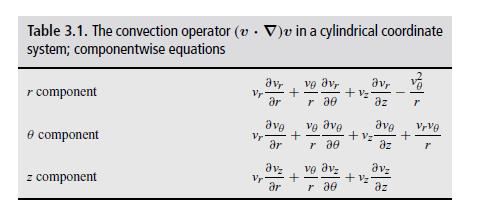
Derive an expression for \(D \boldsymbol{v} / D t\) in cylindrical coordinates.Define the nabla operator in cylindrical coordinates and let it be dotted with a vector. Expand and use the chain rule, taking care to differentiate some of the unit vectors. The components in Table 3.1 would be
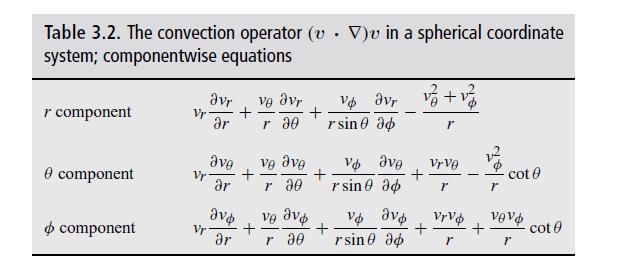
Derive an expression for \(D \boldsymbol{v} / D t\) in spherical coordinates. Follow the same procedure as for cylindrical coordinates. Some unit vectors have derivatives. The components in Table 3.2 would be obtained. Table 3.2. The convection operator (v system; componentwise equations . V) in a
Derive the expressions for the divergence of a vector in cylindrical and spherical coordinates. Thereby verify the results in the text.
Prove that \(abla \cdot(abla \times A)=0\); i.e., the divergence of the curl of a vector is zero. Use this result to prove that the vector potential of velocity satisfies the continuity equation.
Show that the necessary and sufficient condition for the flow to be irrotational is the existence of a scalar velocity potential.
Write the units for the (i) vorticity, (ii) circulation, (iii) velocity potential, and (iv) streamfunction.
By direct differentiation using Cartesian coordinates verify the following relations.(a) The divergence of the curl of any vector is zero.\[abla \cdot(abla \times \boldsymbol{A})=0\](b) The curl of the gradient of any scalar is zero\[abla \times(abla \phi)=0\]Use these properties in the Helmholtz
Show by direct differentiation that the divergence of the vorticity vector is zero.\[abla \cdot \boldsymbol{\omega}=0\]
Derive expressions for the components of the curl operator in cylindrical polar coordinates. Using these relations, find the vorticity field for the flow described by the followingvelocity field:\[v_{\theta}=A r+B / r\]where \(A\) and \(B\) are constants. This field is a general representation of
Show that for a 2D flow or plane confined to the \((x, y)\) plane only the \(z\)-component of the vorticity is non-zero. This component, \(\omega_{z}\), is simply abbreviated as \(\omega\) and treated like a scalar. Also verify by direct substitution that\[-\omega=abla^{2} \psi\]for 2D flow, where
Consider a 2D plane flow that is now represented in terms of the polar coordinates. The flow has then only \(v_{r}\) and \(v_{\theta}\) components and no \(v_{z}\) component. How is the streamfunction defined here? Show that the continuity equation (in polar coordinates) is automatically satisfied
Write out the components of the vorticity tensor, \(\tilde{W}\) in Cartesian coordinates. Show that the tensor is antisymmetric, i.e., \(W_{i j}=-W_{j i}\), and has only three distinct components.Show that the components of the vorticity tensor can be represented in terms of the components of the
Consider the simple shear flow described as \(v_{x}=\dot{\gamma} y\) and \(v_{y}=0\), where \(\dot{\gamma}\) is the rate of strain.Verify that the rate of strain has only shear components as shown in the text.Now consider a coordinate system that is rotated by an angle \(\theta\) to the \(x\)-axis.
Derive expressions for the gradient of velocity in cylindrical and spherical coordinates. Define the nabla operator in cylindrical/spherical coordinates and let it act on a vector. Use the chain rule, taking care to differentiate some of the unit vectors. Rearrange the results into a componentwise
Is \(\boldsymbol{n} \cdot \tilde{\tau}\) equal to \(\tilde{\tau} \cdot \boldsymbol{n}\) in general? When will they be the same?
Indicate the direction and the plane over which the following stress quantities act.Rectangular: \(\tau_{-x, x} ; \tau_{-y,-y} ; \tau_{z,-y}\).Polar: \(\tau_{-r, \theta} ; \tau_{\theta, \theta}\).Spherical: \(\tau_{-\phi, \theta} ; \tau_{-r,-\theta} ; \tau_{r, \phi}\).
A stress tensor in two dimensions has the following components at a given point: \(\tau_{x, x}=3\), \(\tau_{x, y}=2\), and \(\tau_{y, y}=2\). Find the stress vector on a plane that is inclined at an angle of \(60^{\circ}\) with the \(x\)-axis. The plane is located at the same point where the stress
The operator \(abla\) can be considered to be a vector operator.Here \(\tau\) is considered as a dyadic operator defined as\[\tau=\sum_{i} \sum_{j} e_{i} e_{j} \tau_{i j}\]With these definitions it is possible to write \(abla \cdot \tau\) in terms of the spatial differentiation on \(\tau\). The
The average ocean depth is \(2 \mathrm{~km}\). Compute the pressure at this point. Assume a constant density.The change in density of water with pressure is small, and can be represented using the bulk modulus \(K\) defined by the following equation:\[K=ho\left(\frac{\partial P}{\partial
Derive Eq. (4.13) for pressure variation in the atmosphere with elevation. Find the pressure at Shangri-La, which is about \(3000 \mathrm{~m}\) above the sea level. (In the Tibetan language Shangri-La means the Sun and Moon at heart.)The temperature variation with elevation is small, and is usually
Consider a lighter solid of density \(ho_{\mathrm{s}}\) floating on the surface of a liquid of density \(ho_{1}\). Derive an expression for the volume fraction for the solid submerged inside the liquid by using the vector calculus. The result will verify the Archimedes principle for floating solids.
Consider a circular viewing port on an aquarium. This window has a radius of \(R\), and the center of this port is at a depth \(d+R\) from the water surface. Find the force and the center of pressure by direct integration of the differential pressure force.
A process requires the delivery of drops of volume \(3.2 \times 10^{-8} \mathrm{~m}^{3}\). A liquid has a density of \(900 \mathrm{~kg} / \mathrm{m}^{3}\) and a surface tension of \(0.03 \mathrm{~N} / \mathrm{m}\). What size of capillary would you recommend to form these drops?In order to find the
Calculate the settling velocity of a spherical particle of diameter \(2.2 \mathrm{~cm}\) with a density of \(2620 \mathrm{~kg} / \mathrm{m}^{3}\) in a liquid of density of 1590 and a viscosity of 9.58 millipoise. What is the regime under which the particle is settling?
Consider the motion of the particle in the initial stages, i.e., before it reaches the terminal velocity. Include the acceleration terms in the momentum balance of the particle and derive the following equation for the velocity as a function of time:\[v(t)=v_{\mathrm{t}}\left[1-\exp \left(-\frac{9
Write the divergence of the dyad \(ho \boldsymbol{v} \boldsymbol{v}\) in index notation. Expand the derivatives using the chain rule.Write the continuity equation in index notation and use this in the expanded expression for the divergence of the above dyad. Simplify and show that the result is
Write the equation of motion in cylindrical coordinates using the various vector operations. Also write the equation of continuity. These equations together are the needed equations for the solution of flow problems posed in cylindrical coordinates.
Repeat for spherical coordinates.
Write the stress vs. rate-of-strain relations in cylindrical and spherical coordinates for Newtonian fluids.
Unidirectional flows in 2D Cartesian coordinates (also known as channel flows) are defined as systems with only one velocity component, say \(v_{x}\). How does the continuity simplify for such problems? Verify that \(v_{x}\) can be a function of \(y\) but not a function of \(x\). How does the
Unidirectional flows can also be posed as \(v_{x}\) as a function of \(y\) and \(z\). A flow in a square duct (away from the entrance region) is an example. How does the Navier-Stokes equation simplify for such problems?
Simplify the Navier-Stokes equation for flows in a circular pipe with only the axial velocity \(v_{z}\) as the non-vanishing component.
Determine the flow rate of water at \(25^{\circ} \mathrm{C}\) in a 3000 -m-long pipe of diameter \(20 \mathrm{~cm}\) under a pressure gradient of \(20 \mathrm{kPa}\). Assume a relative roughness parameter of \(2.3 \times 10^{-4}\). Use \(v=0.916 \times 10^{-6} \mathrm{~m}^{2} / \mathrm{s}\) for the
What form does the Colebrook-White equation take for a smooth pipe? Compare this with the Prandtl formula by plotting the values on the same graph.
Verify the steps leading to the vorticity-streamfunction formulation of the \(\mathrm{N}-\mathrm{S}\) equation for 2D flow.If the flow has no vorticity it is called irrotational flow. What form does this equation take for irrotational flow?
Derive the vorticity-velocity formulation of the \(\mathrm{N}-\mathrm{S}\) equation and discuss the advantages and disadvantages of using this formulation. Take the cross product of the NavierStokes equation and simplify the resulting equation using standard vector identities.
Show that the vorticity transport equation can also be written as\[\frac{D \omega}{D t}=v abla^{2} \omega+[\omega \cdot abla] \boldsymbol{v}\]How does it simplify for 2D flows? How does it simplify for slow flows?
Show all the steps leading to the pressure Poisson equation.
Derive the following form of the pressure Poisson equation shown in the book by Saffman (1993) on vortex dynamics:\[abla^{2} p=ho(\tilde{W}: \tilde{W}-\tilde{E}: \tilde{E})\]where \(\tilde{W}\) is the vorticity tensor and \(\tilde{E}\) is the rate-of-strain tensor. The symbol : indicates a double
Consider the case of channel flow where the top plate at \(y=H\) is moving at a velocity of \(U_{1}\) and the bottom plate at \(y=0\) is moving with a velocity of \(U_{0}\). We also impose a pressure gradient in the system. Show that the velocity profile is given byand that the volumetric flow rate
Consider the flow in a conduit whose cross-section has the shape of an equilateral triangle. State the differential equations and the associated boundary conditions.Show that the following expression satisfies the velocity profile in the \(x\)-direction (the flow
Consider the flow in a conduit whose cross-section has the shape of an ellipse. State the differential equations and the associated boundary conditions. Show that the following expression satisfies the velocity profile in the \(x\)-direction (the flow direction):\[\begin{equation*}v=\frac{G}{2 \mu}
The following solution is presented for fully developed flow in a square duct that has a half width of \(B\) in the \(y\)-and \(z\)-directions.\[v_{x}=\frac{G B^{2}}{4 \mu}\left(1-\frac{y^{2}}{B^{2}}\right)\left(1-\frac{z^{2}}{B^{2}}\right)\]The flow is in the \(x\)-direction. Is this solution
A simple model for a tornado is a central core of radius \(R\) rotating at an angular velocity of \(\Omega\) and an outer region. The flow is assumed to be tangential in both regions. Derive an expression for the tangential velocity and radial pressure distribution in the tornado. In particular,
Verify the expression (6.28) for torque for flow between two cylinders with the outer cylinder rotating. What would the corresponding result be if the inner cylinder were rotating? T = 4R ( (6.28) K
For flow in a square channel the shear stress is not a constant along the perimeter, unlike in a cylindrical channel. Obtain the stress distribution in a rectangular channel. At what point is the stress maximum?Derive an expression for the volumetric flow rate for a square channel. Compare it with
Show that the superposition of a radial velocity field and a torsional field results in a spiral flow.Sketch typical streamlines. Spiral flows are good prototypes for tornadoes.Explain why the pressure field cannot be superimposed. How would you compute the pressure field.
Find the point where the pressure is a maximum and find the value of this pressure.Calculate the tangential and normal stresses on the top plate.Calculate the tangential stress on the bottom plate. Explain why the tangential stress on the top plate is not the same as that on the bottom plate.
Consider the flow of water in a pipe of length \(2 \mathrm{~m}\) with an imposed pressure difference of \(1000 \mathrm{~Pa}\). Find the flow rate if (a) the pipe has a uniform cross-section of diameter \(2 \mathrm{~cm}\) and (b) the pipe is tapered with an inlet diameter of \(2 \mathrm{~cm}\) and
Two parallel disks of radius \(R\) are separated by a distance \(H\). The space between them is filled with an incompressible fluid. The top plate is moved towards the bottom at a constant velocity, causing the fluid to be squeezed out. Use the lubrication model and find an expression for the force
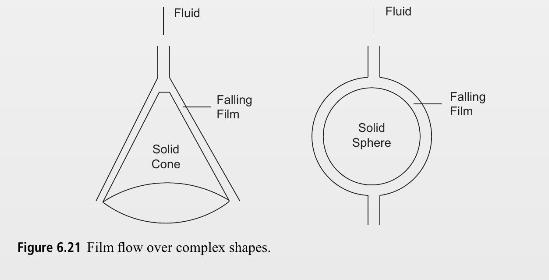
Consider the flow over a cone as shown in Fig. 6.21. Find the film thickness as a function of distance along the surface of the cone. Use the lubrication approximation. Repeat for the solid sphere in Fig. 6.21. Fluid Solid Cone Fluid Falling Film Solid Sphere Figure 6.21 Film flow over complex
A solution of \(13.5 \%\) by weight of polyisoprene has the following power-law parameters: \(\Lambda=5000 \mathrm{~Pa} \cdot \mathrm{s}^{n}\) and \(n=0.2\).Consider the flow of such a solution in a pipe of internal diameter \(1 \mathrm{~cm}\) and length \(100 \mathrm{~cm}\). Calculate and plot the
A power-law fluid has the following rheological constants: \(n=0.5\) and \(\Lambda=0.8 \mathrm{~Pa} \cdot \mathrm{s}^{n}\).It is pumped in a pipe of diameter \(2 \mathrm{~cm}\) and length \(5 \mathrm{~m}\). The pipe is changed to one of diameter \(4 \mathrm{~cm}\). What is the change in flow rate
A \(1-\mathrm{m}\) long pipe delivers a fluid with a power-law index of 0.5 at the rate of \(0.02 \mathrm{~m}^{3} / \mathrm{s}\). The pressure drop of the pipe across the system is \(3.5 \times 10^{4} \mathrm{~Pa}\).Now, if an additional parallel line of the same size is laid in parallel, what will
The model equation takes the following form for pipe flow:\[\begin{equation*}\sqrt{-\tau}=\sqrt{\tau_{0}}+s \sqrt{-\left(d v_{z} / d r\right)} \tag{6.93}\end{equation*}\]since both the shear stress, \(\tau\), and the strain rate \(\left(d v_{z} / d r\right)\) are negative here.Develop an equation
The three-constant Ellis model (Eq. (5.43)) can describe a wide range of experimental data for many fluids. The paper by Matsuhisa and Bird (1965) provides a detailed analysis of this case. the various flow geometries were also analyzed in this paper, and hence this makes an interesting case study.
Sketch the velocity profiles for the magnetohydrodynamic for the two cases of insulating and conducting walls, and compare the profiles.
Show that the steady-state exit concentration for a first-order reaction is \(1 /(1+D a)\). What is the corresponding expression if the reactor is modeled as a plug-flow reactor? Produce a comparison plot of the exit concentration for these two cases as a function of \(D a\). Show that if \(D a
Bolus injection is a very useful and important tool in pharmacokinetic analysis. Repeat the analysis for a bolus injection of a tracer that undergoes a first-order reaction. Sketch typical exit-concentration vs. time plots for various values of the rate constant (expressed as \(D a\) ). How is the
Consider a reactor modeled as \(N\) interconnected tanks in series. Derive an expression for the exit response for a bolus injection of a tracer.Show that the maximum value of the tracer concentration is given by the following expression:\[C_{\max }=\frac{N(N-1)^{N-1}}{(N-1) !} \exp [-(N-1)]\]and
Consider the system of IVP in the matrix form which is repeated here for convenience:\[\frac{d \boldsymbol{y}}{d t}=\tilde{A} \boldsymbol{y}+\boldsymbol{R}\]Eigenvalue representation is a useful and important concept in linear algebra. This exercise walks you through the key step in solving the IVP
Consider again the IVPs shown above.If \(R\) is time-varying, i.e., \(R(t)\), then show that the solution can be formally written in terms of the exponential matrix as\[\boldsymbol{y}=\exp (\tilde{A} t) \boldsymbol{y}_{0}+\int_{0}^{t} \exp [-\tilde{A}(\tau-t)] R(\tau) d \tau\]where \(\tau\) is the
Consider the series reaction scheme in a constant batch reactor:\[\mathrm{A} \xrightarrow{k_{1}} \mathrm{~B} \xrightarrow{k_{2}} \mathrm{C} \xrightarrow{k_{3}} \mathrm{D}\]Assuming all reactions are first order and irreversible, set up the governing equations in matrix form for \(\mathrm{A},
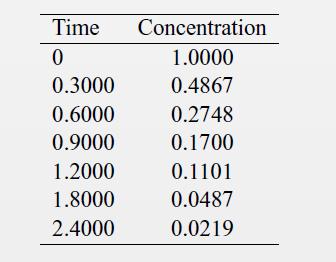
The following data were found in response to a drug injected as a pulse:How good is the fit to a one-compartment model? What is the time constant?How good is the fit to a two-compartment model? What are the time constants? To what degree of accuracy can you determine these, since the data are
CHEBFUN helps to make the MATLAB codes easier, and allows you to work with solutions as though they were analytic functions. You will find it very useful once you start using these. I will walk you through several examples in this book. This example is a starting point.What are CHEBFUNs? The answer
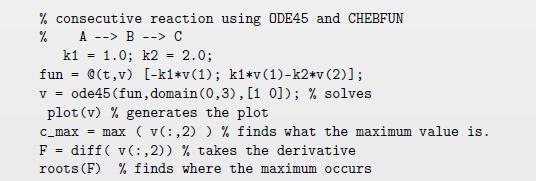
This code shows how CHEBFUN can be used with MATLAB ODE45 to give a "symbolic" look to your answer. The presence of the calling argument domain in the calling statement creates a Chebyshev polynomial for the results.Note that additional operations on the results such as finding the maximum values
Showing 1200 - 1300
of 1819
First
5
6
7
8
9
10
11
12
13
14
15
16
17
18
19
Step by Step Answers

 Get 50% OFF
Claim Now
Get 50% OFF
Claim Now