New Semester
Started
Get
50% OFF
Study Help!
--h --m --s
Claim Now
Question Answers
Textbooks
Find textbooks, questions and answers
Oops, something went wrong!
Change your search query and then try again
S
Books
FREE
Study Help
Expert Questions
Accounting
General Management
Mathematics
Finance
Organizational Behaviour
Law
Physics
Operating System
Management Leadership
Sociology
Programming
Marketing
Database
Computer Network
Economics
Textbooks Solutions
Accounting
Managerial Accounting
Management Leadership
Cost Accounting
Statistics
Business Law
Corporate Finance
Finance
Economics
Auditing
Tutors
Online Tutors
Find a Tutor
Hire a Tutor
Become a Tutor
AI Tutor
AI Study Planner
NEW
Sell Books
Search
Search
Sign In
Register
study help
engineering
chemical engineering
Advanced Transport Phenomena Analysis Modeling And Computations 1st Edition P. A. Ramachandran - Solutions
A gas bubble of diameter \(3 \mathrm{~mm}\) is rising in a pool of a liquid. What is the mass transfer coefficient if the diffusion coefficient is \(2 \times 10^{-5} \mathrm{~cm}^{2} / \mathrm{s}\) ?Note that the contact time is needed for finding the mass transfer coefficient. One way of
Consider again the periodic variation of temperature in a semi-infinite domain analyzed. Sketch or plot the temperature for three values of time. Show that a wave type of propagation of the temperature is observed. Find the distance between adjacent maxima in the temperature at any given instant of
In a flow distribution network that progresses from a large tube to many small tubes (e.g., a blood-vessel network), the frequency, density, and dynamic viscosity are (usually) the same throughout the network, but the tube radii change. Therefore the Womersley number is large in large vessels and
Transient heat conduction in citrus fruits is of concern to farmers in Florida and other farmers as well. They must develop strategies to prevent freezing during cold weather.The thermal diffusivity data are needed for this, and one way to find this information is to insert a thermocouple in the
Use the thermal-diffusivity value estimated from the above problem to find out whether any part of a fruit of diameter \(8 \mathrm{~cm}\) hanging in a tree will freeze if the ambient temperature suddenly drops to \(-6{ }^{\circ} \mathrm{C}\), from an initial temperature of \(15^{\circ}
A membrane of thickness \(L\) separates two solutions. Both solutions and the membrane have initially a zero concentration of a permeable solute. At time \(t=0\) and thereafter one side is maintained at a concentration of \(C_{\mathrm{A} 0}\) of this solute. Solve the concentration profile in the
For gas absorption with a semi-infinite region with reaction show that the following limiting values for the flux into the system can be derived starting from the detailed equation in the text:\[N_{\mathrm{A}, \mathrm{s}}=C_{\mathrm{A}, \mathrm{s}} \sqrt{\frac{D_{\mathrm{A}}}{\pi t}}(1+k t) \text {
Consider the above problem of gas absorption, but now for the limit for large values of \(k t\), and show that\[N_{\mathrm{A}, \mathrm{s}}=C_{\mathrm{A}, \mathrm{s}} \sqrt{D_{\mathrm{A}} k} \text { for } k t \gg 1\]The solution error is \(3 \%\) for \(k t=2.0\).Find the total quantity of gas
A gas stream with \(\mathrm{CO}_{2}\) at partial pressure \(1 \mathrm{~atm}\) is exposed to liquid in which it undergoes a first-order reaction for \(0.01 \mathrm{~s}\). The total amount of gas absorbed during this time was measured as \(1.5 \times 10^{-4} \mathrm{~mol} / \mathrm{m}^{2}\). Estimate
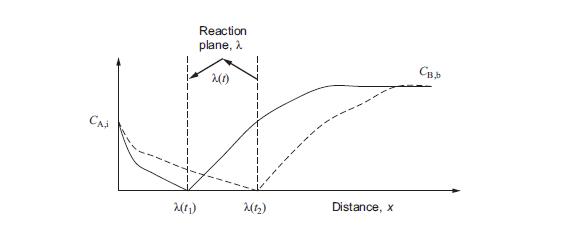
Extend the penetration model for two species reacting instantaneously. Assume that the solution on either side of the reaction front in Fig. 11.8 can be expressed in terms of error function which obviously satisfies the differential equation. Fit the boundary conditions for each side. Now use the
Complete the solution to transient channel flow with a pressure gradient using the separation of variables. Also solve the problem numerically using the PDEPE or other solvers and compare the results.
Assuming the pressure gradient to be zero. Set up the problem and state the boundary conditions. Verify that the boundary conditions lead to a non-homogeneity. Obtain the transient solution by separation of variables after subtraction of the steady-state solution.
Pipe flow with periodic pressure variation. Verify the result for the velocity profile in the complex domain. Write MATLAB code to find the real and imaginary parts. Use this code to plot the velocity profile for various values of \(W o\) as a function of position and time. Also derive an
The rheology of blood is nonNewtonian and is often represented by the Casson fluid model. Your project is to examine the blood flow with this model and examine the conditions under which the deviation from Newtonian fluid behavior may be expected. The mathematics is horrendous except for my
Consider the differential equation given by Eq. (12.2). Use a coordinate transformation \(\zeta=z^{*} P e^{a}\), where \(a\) is some index to be chosen suitably. Show that in the transformed equation there are no free parameters in the convection term and the radial conduction term if the index
Show that the differential equation for \(F\) given in the text can also be written as\[\begin{equation*}\xi \frac{d^{2} F}{d \xi^{2}}+\frac{d F}{d \xi}+\lambda^{2} \xi\left(1-\xi^{2}\right) F=0 \tag{12.44}\end{equation*}\]Show that this belongs to a class of Sturm-Liouville problem. Verify that
This exercise demonstrates how to find the eigenfunctions using CHEBFUN. The procedure is the same as that for the transient conduction prolbem. The first step is to declare \(\xi\) as a CHEBFUN and write Eq. (12.44) as a CHEBOP operator with an LHS and RHS such that the RHS is the term with
Show all the steps leading to (12.12) and verify that the Nusselt number has a value of 48/11 for this case. 7 8(5,5)=45+52. - (12.12) 4 24
Consider laminar flow between two parallel plates. The plates are electrically heated to give a uniform inward wall flux \(-q_{\mathrm{w}}\). Set a mesoscopic model to find the cup mixing average temperature in the system as a function of the flow direction. This will be needed for the temperature
Repeat the analysis if only one plate is exposed to the constant flux while the other plate is kept insulated. What is the value of the Nusselt number for this case?
Show all the steps leading to Eq. (12.15).Integrate once, using the substitution \(p=d \theta / d \eta\).Now integrate a second time to get the temperature distribution given by Eq. (12.16) in terms of the incomplete gamma function.Verify the expression for the Nusselt number given by (12.18).
Consider a liquid flowing down a vertical wall at a rate of \(1 \times 10^{-5} \mathrm{~m}^{2} / \mathrm{s}\) per meter unit width. Find the concentration at a height \(25 \mathrm{~cm}\) below the entrance for a dissolving wall such as a wall coated with benzoic acid as a function of perpendicular
A pipe of diameter \(2 \mathrm{~cm}\) with an oil flow rate of \(0.02 \mathrm{~kg} / \mathrm{s}\) heated by a wall temperature of \(400 \mathrm{~K}\). The inlet temperature is \(300 \mathrm{~K}\).Find and plot the radial temperature profile at a distance of \(5 \mathrm{~cm}\) from the entrance.Find
Consider the oil flowing in a pipe in Problem 10.The inlet temperature is \(300 \mathrm{~K}\) and the pipe is now heated electrically at a rate of \(76 \mathrm{~W} / \mathrm{m}^{2}\). Plot the wall temperature, the center temperature, and the bulk temperature as a function of position using the
Heat transfer in laminar flow with internal generation of heat is called the Brinkman problem. The additional dimensionless group needed here is the Brinkman number. Numerical solutions can be readily obtained using MATLAB functions or other numerical methods. Set up and solve the problem, for
Derive Eq. (12.34) leading to the exponential integral solution of the segregated flow model. CA,b(exit) = Da expint(Da/2) + (1 - Da/2)exp(-Da/2) (12.34)
Find the exit concentration and the conversion for a laminar-flow reactor under the following conditions using the segregated model: radius \(1 \mathrm{~cm}\), length \(500 \mathrm{~cm}\), mass flow rate \(0.1 \mathrm{~kg} / \mathrm{s}\), density \(1000 \mathrm{~kg} / \mathrm{m}^{3}\), and
Mass transfer can be enhanced by flow oscillation. Your goal in this study is to review the literature and, in particular, examine the following model problem, viz., mass transfer in pipe flow with a dissolving wall. Assume that the flow oscillation is caused by a sinusoidal variation of the inlet
Water is contained between two vertical plates with a gap width of \(2 \mathrm{~cm}\). The temperatures of the plates are 25 and \(75^{\circ} \mathrm{C}\). Find the velocity profile and plot the velocity profile as a function of distance. Also find the maximum velocity in the system.Use the
Consider again the problem of a highly viscous fluid contained between two parallel plates of gap width \(d\). The top plate is moving with a velocity of \(V\) and this generates heat in the system due to viscous dissipation.Develop an equation for the temperature distribution in the system if the
Owing to the non-homogeneous term in Eq. (13.24), direct separation of variables is not possible. A partial solution has to be found, and the problem has to be solved by the modified method of separation of variables. Develop this analytical model. Plot typical values of the temperature profiles
Reexamine the problem of laminar flow with heat generation. Now do the analysis for a constant heat flux at the walls. How should the dimensionless temperature \(\theta\) be defined here? How is the Brinkman problem defined for this case?Does the problem have an asymptotic solution for large
Extend the analysis to a power-law fluid. Compare the changes in the nature of the profile with varying power-law index. *- (). P (13.4)
The thermodynamic wet-bulb temperature is defined as the temperature at which water evaporates and brings the air to equilibrium conditions. Show that the thermodynamic wet-bulb temperature is the same as the wet-bulb temperature shown in the text, which is derived from transport considerations, if
At a point in a dryer benzene is evaporating from a solid. The air temperature is \(80^{\circ} \mathrm{C}\) and the pressure is \(1 \mathrm{~atm}\). The relative humidity of benzene in air is \(65 \%\). Find the wet-bulb temperature.
A wall subject to intense radiative and convective heating is to be protected by sweat cooling. For this purpose water is injected onto the surface through a porous stainless steel plate at a rate sufficient to keep it wetted and to keep the surface temperature at \(360 \mathrm{~K}\). Bone-dry air
Water is condensing on a surface at \(310 \mathrm{~K}\). The gas mixture has \(65 \%\) water vapor and is at a temperature of \(370 \mathrm{~K}\). The total pressure is \(1 \mathrm{~atm}\).Calculate the rate of condensation. Look for and use numerical values of physical properties from the web or
The condensation of a binary mixture A and B in the presence of an inert species \(C\) can be analyzed in the same manner. The liquid side has only \(\mathrm{A}\) and \(\mathrm{B}\), and hence the composition on the liquid side is calculated by the same set of equations.The composition on the vapor
Now consider the above problem for a case where a reaction between the condensing vapor A and the relatively non-condensing gas B can take place in the liquid according to\[\mathrm{A}+\mathrm{B} \rightarrow \mathrm{C}\]Model the system and study the effect of reaction on the condensation rate.
The effectiveness factors for a porous catalyst in the presence of significant temperature gradients can be larger than one. Explain why.Your goal is to generate such a plot of \(\eta\) as a function of \(\phi\) for the following set of parameters: \(\beta=1 / 3, \gamma=27, B i_{\mathrm{m}}=300\),
The time of oscillation \(t\) of a simple pendulum is expected to be a function of the mass of the pendulum, its length \(L\), and the gravitational constant. How many dimensionless groups can be formed? Show that the key dimensionless group is \(t \sqrt{g / L}\). Hence conclude that \(t\) should
The eminent British fluid dynamicist G. I. Taylor deduced the energy release \(E\) from the first atomic explosion simply by dimensional analysis. This was strictly classified information, but Taylor showed that those well versed in dimensional analysis have access to such confidential
In correlating the diameter of drops formed at the orifice, the viscosity is to be included as the core group rather than density as done in the text. Form groups with \(d_{0}, ho\), and \(\mu\) as the core groups and surface tension and drop diameter as the variables.
A vertical plate of height \(L\) at a temperature of \(T_{\mathrm{s}}\) is immersed in a fluid at a temperature of \(T_{\mathrm{a}}\). Local density variation due to temperature causes a flow, which causes an enhancement in the heat transfer rate.Note that the heat flux depends now on the following
It is required to find the cooking time of a large turkey. Experimental data are available for a small turkey of mass \(m_{\mathrm{s}}\), and the time is \(t_{\mathrm{s}}\). Suggest the cooking time, \(t_{\mathrm{L}}\), for a larger turkey of mass \(m_{\mathrm{L}}\) by dimensionless and scaling
Apply scaling analysis for gas absorption with first-order reaction based on the film model. Derive a relation for the depth of penetration of the gas for a fast reaction. Using this relation, verify the following model prediction:\[R_{\mathrm{A}}=C_{\mathrm{A}, \mathrm{s}} \sqrt{D_{\mathrm{A}}
Gas-absorption systems are usually modeled by assuming a film thickness and steady-state diffusion. In an attempt to modify this picture one can assume a finite film but allow for a transient diffusion in the film. This model is known as the film-penetration model. Perform a scaling analysis for
How does the power in an agitated vessel depend on the impeller speed and the impeller diameter in (a) the laminar regime and (b) the turbulent regime?
The mass transfer coefficient in agitated gas-liquid systems is often proportional to the power per unit volume of the reactor rather than the total power \(P\) dissipated in the system. On this basic derive a scaleup criterion for equal-mass transfer for a small and a large reactor.
For gas-liquid dispersions in agitated vessels, the gas flow rate \(Q_{\mathrm{G}}\) is also important. Show that an additional group, namely the flow number defined as \(Q_{\mathrm{G}} /\left(\Omega d_{\mathrm{I}}^{3}\right)\) is needed in order to correlate the data. Hence the power number is
The following data were obtained by Sharma and Danckwerts (1963) for \(\mathrm{CO}_{2}\) absorption in a laminar jet of solution in which the gas underwent a first-order reaction:Interpret the data on the basis of the scaling model. Exposure times 78.5 113 167 360 Total rate (mol/cm) 16.5 15.0 13.0
For turbulent flow of water in a pipe of diameter \(5 \mathrm{~cm}\) with \(R e=10^{5}\) estimate the magnitude of the length and velocity scales at which viscous dissipation becomes important.
An agitated tank has an impeller diameter of \(10 \mathrm{~cm}\) and operates at a speed of revolution of 10 r.p.s. The tank has a diameter of \(20 \mathrm{~cm}\) and is filled up to a height of \(20 \mathrm{~cm}\) with liquid. Find the following: (i) the power consumed assuming turbulent
Treating an oil spill by application of a chemical dispersant is a useful means for dispersion of oil. Knowledge of the droplet size formed as a function of the energy dissipation rate is useful to scale the laboratory data to oceanic applications. A dimensional and scaling analysis was done by our
Consider for illustration the diffusion-reaction problem given by\[\begin{equation*}\frac{d^{2} c}{d x^{2}}=M c^{2} \tag{14.54}\end{equation*}\]with the same boundary conditions as before.Use the expansion for \(c\) in terms of \(M\) as in Eq. (14.24) for small values of \(M\), which is a regular
Solve the problem of heat generation in a slab with a variable thermal conductivity. Show that the problem can be represented as\[\frac{d \theta}{d \xi}\left[(1+\beta \theta) \frac{d \theta}{d \xi}\right]=-1\]with the boundary condition of no flux at the center and convective heat loss at the
Solve the following problem:\[\frac{d^{2} c}{d x^{2}}-P e \frac{d c}{d x}=0\]Use the boundary conditions \(c(0)=1\) and \(c(1)=0\).Solve both for large Péclet number, \(P e\), where this is a singular perturbation problem, and for small \(P e\), where this is a regular perturbation problem.
Solve the following singular perturbation problem:\[\epsilon \frac{d^{2} c_{\mathrm{b}}}{d \xi^{2}}=\xi c_{\mathrm{b}}-1\]which arises in a model for a consecutive reaction in a liquid film (Deen, 2011). Here \(c_{\mathrm{b}}\) is the concentration variable, \(\xi\) is the distance variable, and
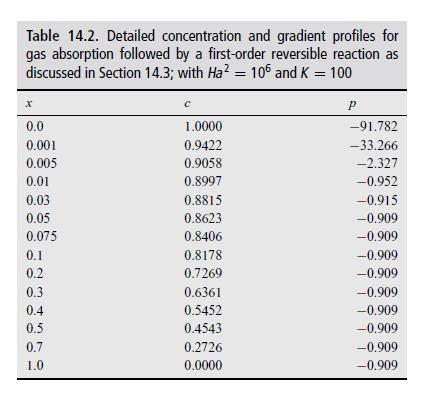
Your task is to obtain the solution by analytical and numerical methods and compare it with the perturbation solution.Verify the following analytical solution for the concentration distribution and the gradient at the gas-liquid
The problem was solved analytically using complex variables. The perturbation method is also suitable for this problem and provides additional physical insight into the solution.The model equation in dimensionless form is restated here for ease of reference:\[\begin{equation*}W o^{2} \frac{\partial
Consider again the radial flow between two parallel disks examined. The case of low Reynolds number was examined there, and a solution in which the non-linear terms were ignored was obtained. Here we wish to examine the role of inertia by performing a regular perturbation analysis. Expand \(v_{r}\)
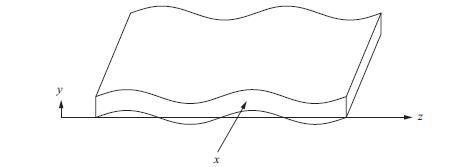
Complete the solutions for \(v_{1}\) in Example 14.4 for domain perturbation in the text. What are the boundary conditions for the \(v_{2}\) problem?Example 14.4:Consider flow in a rectangular channel. Let the walls be located at y = ±h, with y = 0 being the center of the walls. A pressure
The problem of potential flow past a circular object is a well-studied problem in fluid mechanics governed by the Laplace equation. We wish to study the flow around a circle which is slightly perturbed. The boundary is now described as \[r=R(1+\epsilon \cos \theta)\]The solution for the
Write out in detail all the terms for \(\tilde{\tau}: abla v\) in rectangular Cartesian coordinates.Now assume a Newtonian fluid; use the generalized version of Newton's law of viscosity for the stress tensor \(\tilde{\tau}\) and expand \(\tilde{\tau}: abla \boldsymbol{v}\). Thus derive the
Verify that the viscous dissipation term is always positive, indicating that this is an irreversible conversion into internal energy.
Comment and elaborate on the following statement from the BSL book: for viscoelastic fluids the term \(\tilde{\tau}: abla \boldsymbol{v}\) does not have to be positive since some energy may be stored as elastic energy.
For fully developed flow in a pipe the contributions to viscous dissipation are from \(\tau_{r z}\) and \(d v_{z} / d r\). What is the form of the viscous generation term for a fully developed laminar flow of a Newtonian fluid in a pipe? How does it vary with radial position?Calculate this for (a)
Verify the following thermodynamic relation:\[\begin{equation*}\left(\frac{\partial \hat{H}}{\partial P}\right)_{T}=\hat{V}-T\left(\frac{\partial \hat{V}}{\partial T}\right)_{P} \tag{7.48}\end{equation*}\]
How does the temperature equation simplify if there is no flow? Write this out in detail in all of the three coordinate systems.
Write in detail the expression for \((\boldsymbol{v} \cdot abla) T\) in cylindrical coordinates. Also write in detail the expression for the Laplacian, and thereby complete the temperature equation for cylindrical coordinates. What simplifications result for an axisymmetric case?
Write in detail the expression for \((\boldsymbol{v} \cdot abla) T\) in spherical coordinates. Also write in detail the expression for the Laplacian, and thereby complete the temperature equation for spherical coordinates. What simplifications result for an axisymmetric case, i.e., when the
A turkey is being roasted in a microwave oven. How would you calculate the internal heat generation term, \(\dot{Q}_{\mathrm{V}}\) ?
Derive equations for the temperature in a slab if the thermal conductivity (a) is constant, (b) varies linearly as \(k(T)=k_{0}+a\left(T-T_{0}\right)\), and (c) varies as a quadratic function \(k(T)=\) \(k_{0}+a\left(T-T_{0}\right)+b\left(T-T_{0}\right)^{2}\).State how the heat flow should be
Find the rate of heat flow in the radial direction through a spherical shell of inner radius \(r_{\mathrm{i}}\) and outer radius \(r_{\mathrm{o}}\) for the case where the thermal conductivity varies as a linear function of temperature,\[k=k_{0}(1+\beta T)\]The inside shell is at temperature
Show that a variable transformation known as the Kirchhoff transformation,\[F(T)=\int_{0}^{T} k(s) d s\]where \(s\) is a dummy variable, reduces the heat equation to \(abla^{2} F=0\) for the variable conductivity case.
Consider the case of linear heat generation with a linear variable-thermal conductivity.Express the governing equation in terms of dimensionless form. What are the number of dimensionless parameters needed to characterize the model?The numerical solution based on BVP4C introduced in Chapter 10
Consider heat conduction with generation in a slab and a sphere geometries. Derive the solution similar to Eq. (8.18) for slab and sphere cases.For all three cases (slab, cylinder, and sphere) find the heat flow from the surface to the fluid and show that the results satisfy an overall heat
For the linear generation, use the Robin condition at the surface rather than the Dirichlet condition used in the text. Derive an expression for the temperature profile, the maximum temperature, and the stability condition.
Verify the solutions in the text for the temperature distribution in a square slab with constant generation of heat. Generate illustrative contour plots for the temperature profiles.
Second-order elliptic equations of the Laplace and Poisson type can be solved by centraldifference-based finite-difference schemes. Thus, if we employ a square mesh, show that the temperature at a mesh point \((i, j)\) is given by the averge of the adjacent mesh values:\[T_{i,
The square problem can also be fitted using boundary collocation. For this we need functions that satisfy the Laplace equation in an exact manner. The solution can then be expanded in terms of these functions. Let us see whether we find suitable functions.Prove that the real and imaginary parts of
Show that, if purely Neumann conditions are imposed along the boundary, then the integral of the temperature gradient over the perimeter, \(\Gamma\),\[\int_{\Gamma} \frac{\partial T}{\partial n} d \Gamma=0\]has to be equal to zero in order to maintain a steady-state temperature profile inside the
State the governing equation and the dimensionless parameters needed to characterize the problem.Verify that the temperature profile is given by\[\theta=\theta_{\max } \frac{J_{0}(\zeta \sqrt{\beta})-J_{0}(\sqrt{\beta})}{1-J_{0}(\sqrt{\beta})}\]Show that it satisfies the differential equation and
Repeat the above problem for a spherical geometry. Find the temperature profile: What is the limit for explosion for this case? The answer is \(\sqrt{\beta}
Repeat the analysis for the above two problems if a Robin condition is applied at the surface.
A porous solid is in the shape of a hollow sphere and has temperatures of \(T_{\mathrm{i}}\) and \(T_{\mathrm{o}}\) at the radii of \(r_{\mathrm{i}}\) and \(r_{\mathrm{o}}\), respectively. Find an expression for the heat loss from the sphere.In order to reduce the heat loss, a gas is blown through
Apply the lumped model for cooling of a solid in the form of (i) a long slab and (ii) a long cylinder. Also apply the modified lumped model shown in the text, and show what correction is needed for the simple lumped model for an assumed quadratic variation in temperature of the solid.
Show that mole fractions can be converted to mass fractions by the use of the following equation:\[\begin{equation*}y_{i}=\left[\omega_{i} / M_{i}\right] \bar{M} \tag{9.57}\end{equation*}\]Derive an expression for \(d y_{i}\) as a funciton of \(d \omega_{i}\) values.
Show that mass fractions can be converted to mole fractions by the use of the following equation:\[\begin{equation*}\omega_{i}=\left[y_{i} M_{i}\right] / \bar{M} \tag{9.58}\end{equation*}\]Derive an expression for \(d \omega_{i}\) as a function of \(d y_{i}\) values.
At a point in a methane reforming furnace we have a gas of the composition \(10 \% \mathrm{CH}_{4}, 15 \%\) \(\mathrm{H}_{2}, 15 \% \mathrm{CO}\), and \(10 \% \mathrm{H}_{2} \mathrm{O}\) by moles.Find the mass fractions and the average molecular weight of the mixture.
The Henry's-law constants for \(\mathrm{O}_{2}\) and \(\mathrm{CO}_{2}\) are reported as \(760.2 \mathrm{l} \cdot \mathrm{atm} / \mathrm{mol}\) and \(29.41 \mathrm{l}\). \(\mathrm{atm} / \mathrm{mol}\).What is the form of Henry's law used? Convert to values for the other forms shown in the text.
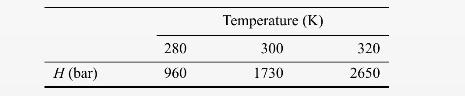
Solubility data for \(\mathrm{CO}_{2}\) are shown below as a function of temperature:Fit an equation of the type\[\ln H=A+B / T\]What is the physical significance of the parameter \(B\) ? 280 Temperature (K) 300 320 H (bar) 960 1730 2650
The Antoine constants for water are \(A=8.07131, B=1730.63\), and \(C=233.426\) in the units of \(\mathrm{mm} \mathrm{Hg}\) for pressure and \({ }^{\circ} \mathrm{C}\) for temperature.Convert this to a form where pressure is in \(\mathrm{Pa}\) and temperature is in \(\mathrm{K}\).Also rearrange the
Given the Antoine constants for a species, can you calculate the heat of vaporization of that species?
Is \(\boldsymbol{n}_{\mathrm{A}}\) equal to \(M_{\mathrm{A}} \boldsymbol{N}_{\mathrm{A}}\) ? Why?Is \(j_{\mathrm{A}}\) equal to \(M_{\mathrm{A}} \boldsymbol{J}_{\mathrm{A}}\) ? Why?
Show the validity of the following relations between the species velocities \(v_{\mathrm{A}}\) and \(v_{\mathrm{B}}\) referred to a stationary frame of
Show for a binary mixture the validity of the relation\[\boldsymbol{j}_{\mathrm{A}}=\frac{M_{\mathrm{A}} M_{\mathrm{B}}}{M} \boldsymbol{J}_{\mathrm{A}}\]
Show the validity of the following form of Fick's law:\[j_{\mathrm{A}}=-\frac{C^{2}}{ho} M_{\mathrm{A}} M_{\mathrm{B}} D_{\mathrm{AB}} abla x_{\mathrm{A}}\]where \(x_{\mathrm{A}}\) is the mole fraction.
Show the validity of the following equation based on Fick's law:\[\begin{equation*}abla x_{\mathrm{A}}=\frac{x_{\mathrm{A}} N_{\mathrm{B}}-x_{\mathrm{B}} N_{\mathrm{A}}}{C D_{\mathrm{AB}}} \tag{9.59}\end{equation*}\]Show that the following equation holds as well:\[\begin{equation*}abla
Velocity based on volume-fraction weighting. If the volume fraction \(\phi_{\mathrm{a}}\) is used as the weighting factor, one can define an average velocity \(\boldsymbol{v}^{\mathrm{V}}\) as\[\boldsymbol{v}^{\mathrm{V}}=\sum \phi_{v} \boldsymbol{v}_{i}\]Derive a form of Fick's law based on this
Showing 1100 - 1200
of 1819
First
5
6
7
8
9
10
11
12
13
14
15
16
17
18
19
Step by Step Answers

 Get 50% OFF
Claim Now
Get 50% OFF
Claim Now