New Semester
Started
Get
50% OFF
Study Help!
--h --m --s
Claim Now
Question Answers
Textbooks
Find textbooks, questions and answers
Oops, something went wrong!
Change your search query and then try again
S
Books
FREE
Study Help
Expert Questions
Accounting
General Management
Mathematics
Finance
Organizational Behaviour
Law
Physics
Operating System
Management Leadership
Sociology
Programming
Marketing
Database
Computer Network
Economics
Textbooks Solutions
Accounting
Managerial Accounting
Management Leadership
Cost Accounting
Statistics
Business Law
Corporate Finance
Finance
Economics
Auditing
Tutors
Online Tutors
Find a Tutor
Hire a Tutor
Become a Tutor
AI Tutor
AI Study Planner
NEW
Sell Books
Search
Search
Sign In
Register
study help
engineering
chemical engineering
Separation Process Engineering Includes Mass Transfer Analysis 5th Edition Phillip Wankat - Solutions
When might you use an intermediate condenser on a column? What are the possible advantages?
Explain with a McCabe-Thiele diagram how changing feed temperature (or equivalently, q) may help an existing column achieve the desired product specifications.
Equations (4-53) and (4-54) are mass balances on particular phases. When are these equations valid?Equation (4-53) Equation (4-54) L = L' + S
Several ways of adapting existing columns to new uses were listed. Generate new methods that might allow existing systems to meet product specifications that could not be met without modification. Note that you can postulate a complex existing column, such as one with an intermediate reboiler.
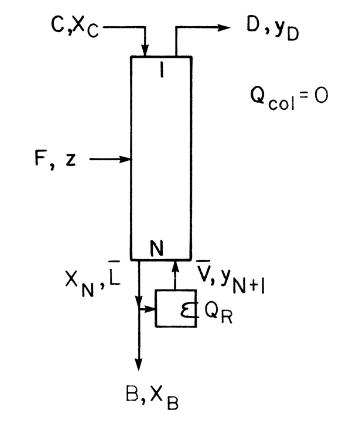
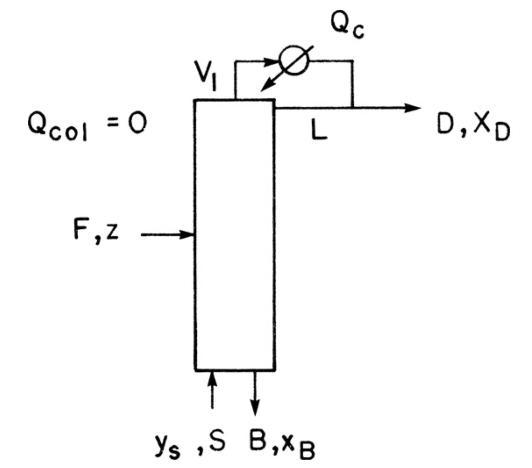
A distillation column separating ethanol from water is shown in the following figure. Pressure is \(1 \mathrm{~kg} / \mathrm{cm}_{2}\). Instead of having a condenser, a stream of pure, saturated liquid ethanol is added directly to the column to serve as the reflux. The feed to the column is \(40
A distillation column with a total condenser and a partial reboiler is separating \(200 \mathrm{kmol} / \mathrm{h}\) of a feed that is \(40 \mathrm{~mol} \% \mathrm{n}\)-pentane and \(60 \mathrm{~mol} \%\) n-hexane. The feed is a two-phase mixture that is \(20 \%\) liquid. Column pressure is \(1.5
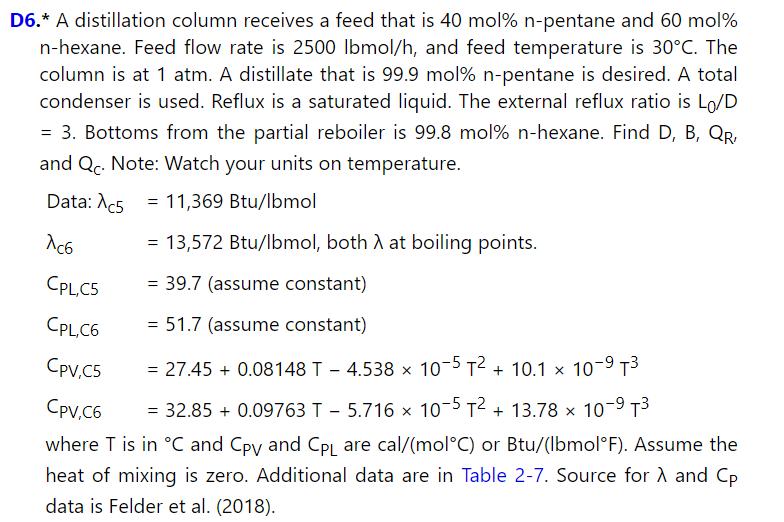
A distillation column receives a feed that is \(40 \mathrm{~mol} \% \mathrm{n}-\mathrm{pentane}\) and 60 \(\mathrm{mol} \% \mathrm{n}\)-hexane. Feed flow rate is \(2500 \mathrm{lbmol} / \mathrm{h}\), and feed temperature is \(30^{\circ} \mathrm{C}\). The column is at \(1 \mathrm{~atm}\). A
A continuous, steady-state distillation column is fed a mixture that is 70 \(\mathrm{mol} \% \mathrm{n}\)-pentane and \(30 \mathrm{~mol} \% \mathrm{n}\)-hexane. Feed rate is \(1000 \mathrm{kmol} / \mathrm{h}\). Feed is at \(35^{\circ} \mathrm{C}\). Column is at \(101.3 \mathrm{kPa}\). The vapor
A distillation column receives a feed that is \(40 \mathrm{~mol} \% \mathrm{n}-\mathrm{pentane}\) and 60 \(\mathrm{mol} \% \mathrm{n}\)-hexane. Feed flow rate is \(2500 \mathrm{lbmol} / \mathrm{h}\), and feed temperature is \(30^{\circ} \mathrm{C}\). The column is at \(1 \mathrm{~atm}\). A
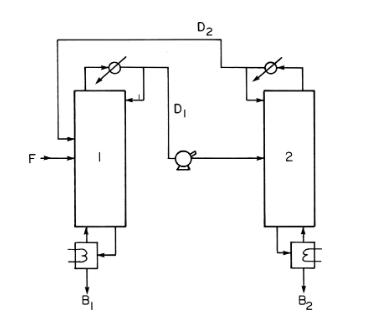
Some azeotropic systems can be separated by operating two coupled distillation columns at different pressures. The azeotrope concentration shifts enough that pure products can be recovered from the bottom of each column. This arrangement, shown in Figure 8-8, is used for the separation of water and
A distillation column is separating \(150 \mathrm{kmol} / \mathrm{h}\) of a saturated liquid mixture that is \(30 \mathrm{~mol} \%\) methanol and \(70 \mathrm{~mol} \%\) water. The column operates at 1.0 \(\mathrm{atm}\) pressure. Reflux ratio is 2.0 , and reflux is returned as a saturated liquid.
A distillation column with a partial condenser and a partial reboiler is separating methanol and water. Column pressure is \(1.0 \mathrm{~atm}\). We desire a bottoms product flow rate of \(120 \mathrm{kmol} / \mathrm{h}\) that is 0.0001 mole fraction methanol. Boilup ratio is 1.5 . Find \(Q_{R}\).
A distillation column receives a feed that is \(30 \mathrm{~mol} \% \mathrm{n}-\mathrm{pentane}\) and 70 \(\mathrm{mol} \% \mathrm{n}\)-hexane. Feed flow rate is \(3600 \mathrm{lbmol} / \mathrm{h}\), and feed temperature is \(67^{\circ} \mathrm{C}\). The column is at \(1 \mathrm{~atm}\). A
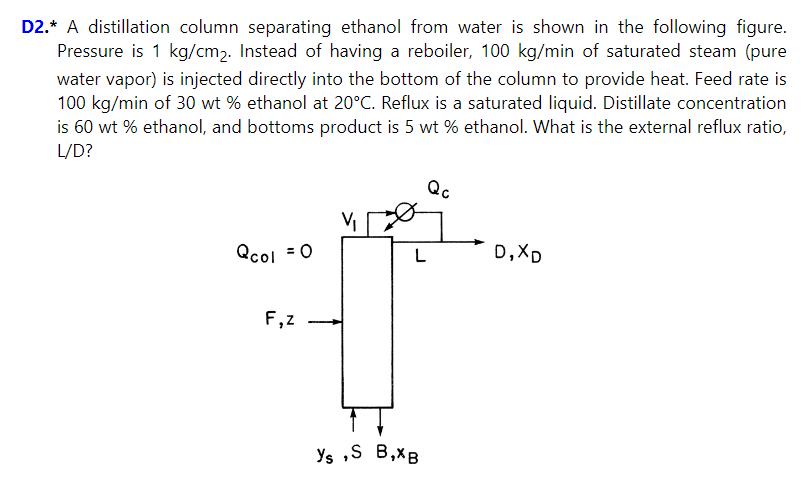
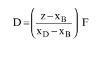
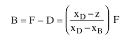
For the column shown in Problem 3.D2, derive equations for \(D, B, Q_{c}\), and L/D. D2.* A distillation column separating ethanol from water is shown in the following figure. Pressure is 1 kg/cm2. Instead of having a reboiler, 100 kg/min of saturated steam (pure water vapor) is injected directly
Show that for binary distillation in a column with a single feed, a total condenser, and a partial reboiler,\(\mathrm{FR}_{\text {MVC,dist }}=\frac{\mathrm{x}_{\mathrm{MVC}, \text { dist }}}{\mathrm{z}_{\mathrm{MVC}}}\left\lfloor\frac{\mathrm{z}_{\mathrm{MVC}}-\mathrm{x}_{\mathrm{MVC}, \text { bot
Show that Eqs. (3-3) and (3-4) are valid for a column with two feeds (e.g., shown in Figure 4-18) as long as we define \(\mathrm{F}_{\text {total }}=\mathrm{F}_{1}+\mathrm{F}_{2}\) and \(\mathrm{z}_{\text {total }}=\left(\mathrm{F}_{1} \mathrm{z}_{1}\right.\) \(\left.+\mathrm{F}_{2}
A partial condenser takes vapor leaving the top of a distillation column and condenses a portion of it. The vapor portion of mole fraction \(\mathrm{y}_{\mathrm{D}}\) is removed as the distillate product. The liquid portion of mole fraction \(\mathrm{x}_{0}\) is returned to the column as reflux.
Solve for \(\mathrm{Q}_{\mathrm{c}}\) and \(\mathrm{Q}_{\mathrm{R}}\) in Problem 3.D1 with a process simulator.a. Part a.b. Part b.Note: With Aspen Plus, use RADFRAC with an arbitrary (but large) number of stages and feed location \(=\mathrm{N} / 2\). Do calculation for \(\mathrm{D}\) by hand, and
Solve Problem 3.D6 using a process simulator to find \(Q_{c}\) and \(Q_{R}\). Do a hand calculation to find the value of \(\mathrm{D}\). Then arbitrarily set \(\mathrm{N}=40\) and \(\mathrm{N}_{\text {feed }}=20\) in the process simulator and do the simulation. D6.* A distillation column receives a
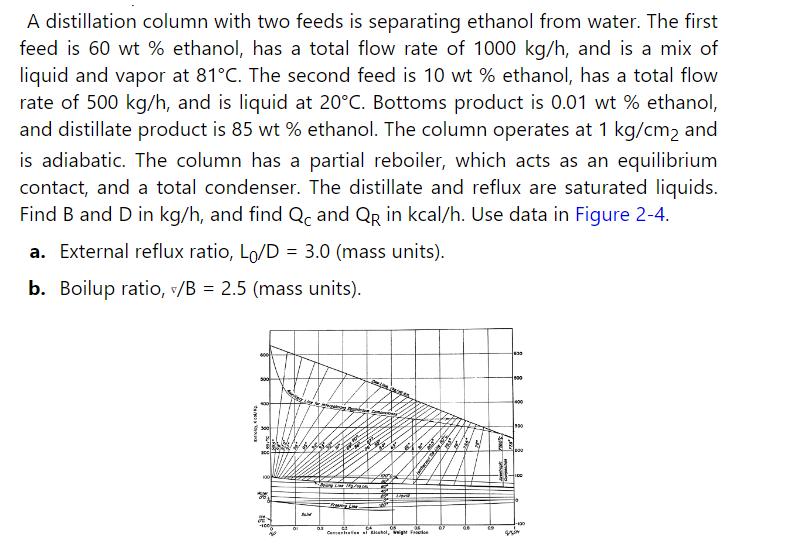
A distillation column with two feeds is separating ethanol from water. The first feed is \(60 \mathrm{wt} \%\) ethanol, has a total flow rate of \(1000 \mathrm{~kg} / \mathrm{h}\), and is a mix of liquid and vapor at \(81^{\circ} \mathrm{C}\). The second feed is \(10 \mathrm{wt} \%\) ethanol, has a
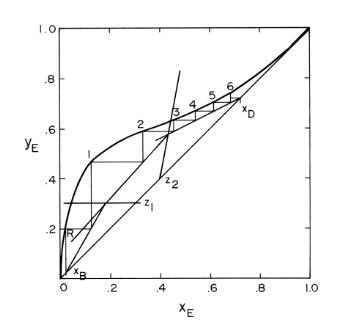
A distillation column separating ethanol from water is shown in the following figure. Pressure is \(1 \mathrm{~kg} / \mathrm{cm}_{2}\). Instead of having a reboiler, 100 \(\mathrm{kg} / \mathrm{min}\) of saturated steam (pure water vapor) is injected directly into the bottom of the column to
Explain how a distillation column works.
Without looking at the text, define the following:a. Isothermal distillationb. The four flow regimes in a staged distillation columnc. Reflux and reflux ratiod. Boilup and boilup ratioe. Rectifying (enriching) and stripping sectionsf. Simulation and design problems Check the text for definitions
Explain the reasons a constant pressure distillation column is preferable toa. An isothermal distillation system.b. A cascade of flash separators at constant temperature.c. A cascade of flash separators at constant pressure.
In a countercurrent distillation column at constant pressure, where is the temperature highest? Where is it lowest?
Develop your own key relations chart for this chapter. In one page or less, draw sketches, write equations, and include all key words useful for solving problems.
For a binary separation, is \(\mathrm{K}_{\mathrm{MVC}} \mathrm{V} / \mathrm{L}\) usually less than, equal to, or greater than 1.0? For a binary separation, is \(\mathrm{K}_{\mathrm{LVC}} \mathrm{V} / \mathrm{L}\) usually less than, equal to, or greater than \(1.0 ?\)
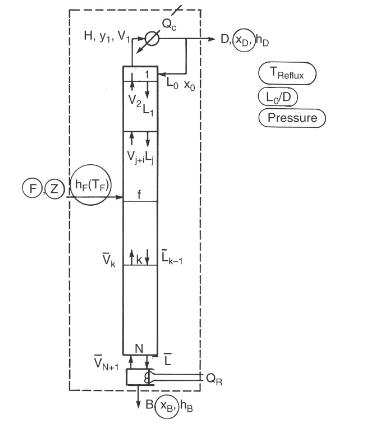
Specifications for a distillation column similar to Figure 3-8 cannot include all three flow rates F, D, and B. Why not? H. y. Vin -+-1 Qc F2 hp(TF) 1 V2L1 Vj+4 f Lo xo Vkk kk-1 VN+1 N B(Xehe D. XD D TReflux Lo/D Pressure
Is column pressure approximately constant \({ }^{*}\) for the following problems:a. Column operating at nominal pressure \(\mathrm{p}=1.0 \mathrm{~atm}\) with 10 traysb. Column operating at nominal pressure \(\mathrm{p}=1.0 \mathrm{~atm}\) with 30 traysc. Column operating at nominal pressure
In an abstract sense, is boilup a type of reflux?
Why is the assumption of constant column pressure often reasonable for columns at atmospheric pressure and above, but often not reasonable for vacuum columns?
A common misconception of new graduates is that reflux is usually a saturated liquid. In practice, if the reflux needs to be pumped, the reflux is always subcooled. Explain why. (Note: We will see in Section 4-12 that subcooling the reflux a few degrees has almost no effect on the column design.)
In the paragraph immediately before Example 3-1, the following sentence occurs: " \(\mathrm{Q}_{\mathrm{c}}\) is proportional to \((1+\mathrm{L} / \mathrm{D}) \mathrm{F}\), and \(\mathrm{Q}_{\mathrm{R}}\) is proportional to \(\mathrm{F}\) and linearly dependent on \((1+\mathrm{L} / \mathrm{D})\).
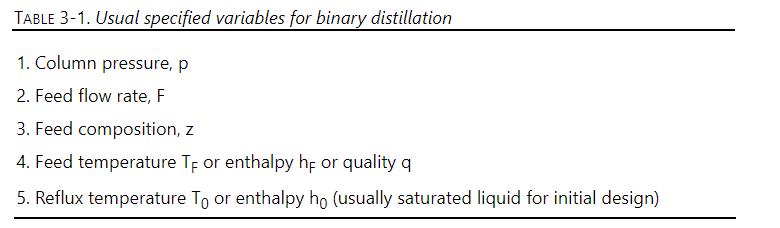
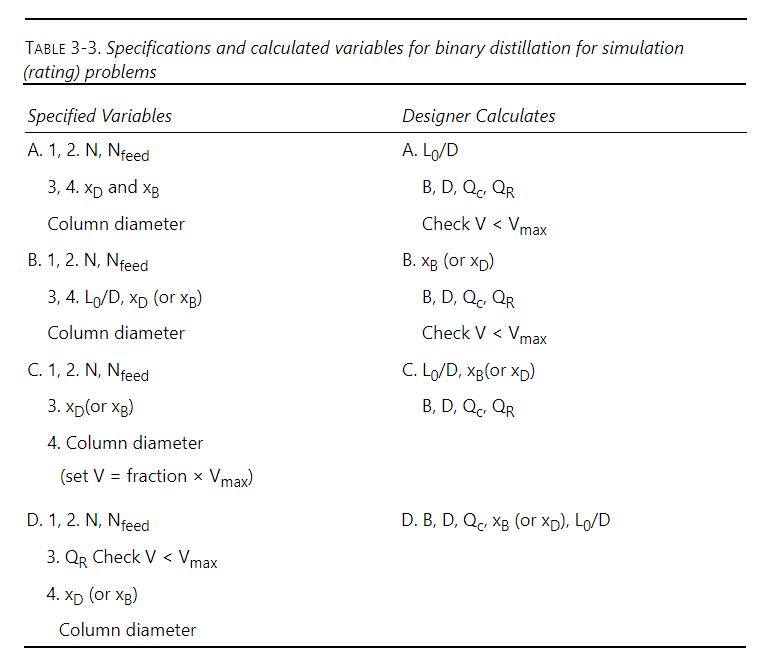
There are ways in which columns can be specified other than those listed in Tables 3-1 to 3-3.a. Develop alternative specifications for design problems.b. Develop alternative specifications for simulation problems. TABLE 3-1. Usual specified variables for binary distillation 1. Column pressure, p
We flash distill a mixture that is \(5.0 \mathrm{~mol} \%\) methane, \(12.3 \mathrm{~mol} \%\) ethane, 11.5 \(\mathrm{mol} \%\) n-butane, \(22.2 \mathrm{~mol} \%\) n-pentane, \(25.4 \mathrm{~mol} \mathrm{\%} \mathrm{n-hexane,} \mathrm{and} 23.6 \mathrm{~mol} \%\) n-heptane. Use Eq. (2-28) and a
We flash distill a mixture that is \(24.1 \mathrm{~mol} \%\) ethane, \(39.7 \mathrm{~mol} \% \mathrm{n}\)-hexane, and \(36.2 \mathrm{~mol} \% \mathrm{n}\)-heptane. If \(\mathrm{p}_{\text {drum }}=101.3 \mathrm{kPa}\) and \(\mathrm{T}_{\text {drum }}=65^{\circ} \mathrm{C}\), find \(\mathrm{V} /
We flash distill a mixture that is \(28.1 \mathrm{~mol} \%\) n-butane, \(42.8 \mathrm{~mol} \% \mathrm{n}\)-pentane, and \(29.1 \mathrm{~mol} \% \mathrm{n}\)-heptane. \(\mathrm{T}_{\text {drum }}=41^{\circ} \mathrm{C}\) and \((\mathrm{V} / \mathrm{F})_{\text {drum }}=0.35\). Find
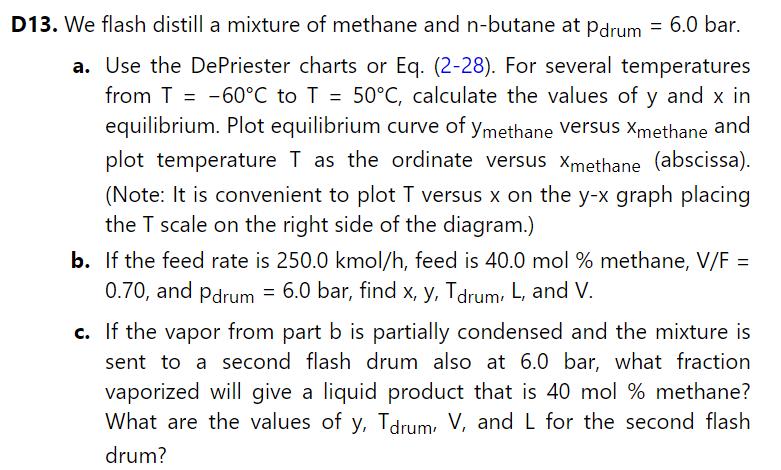
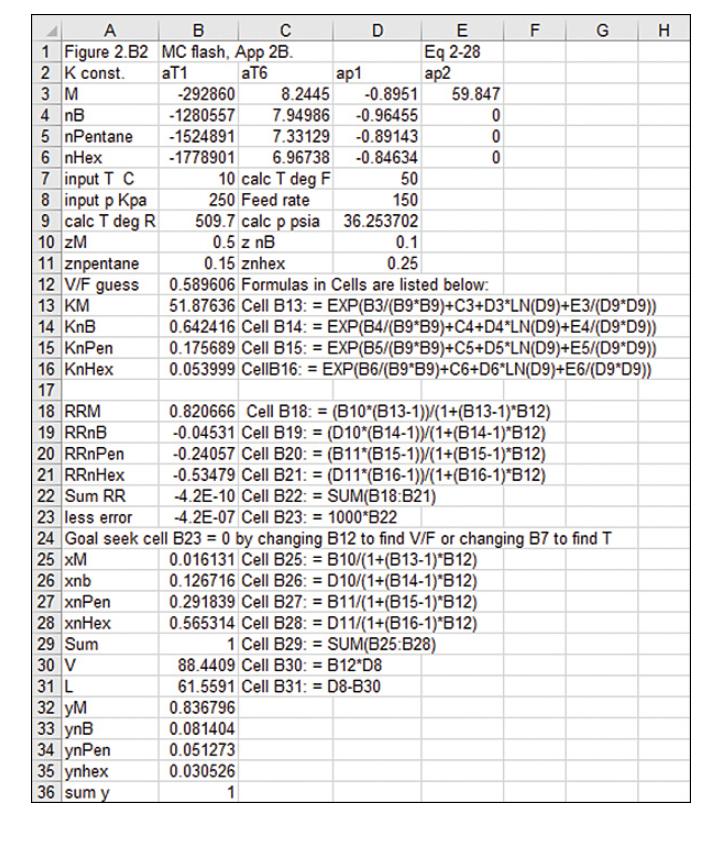
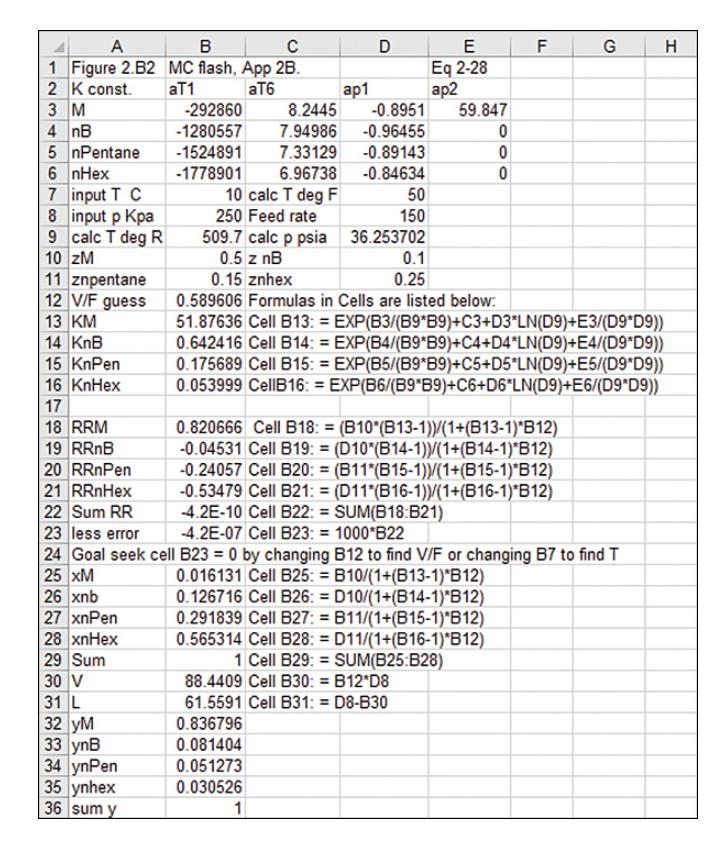
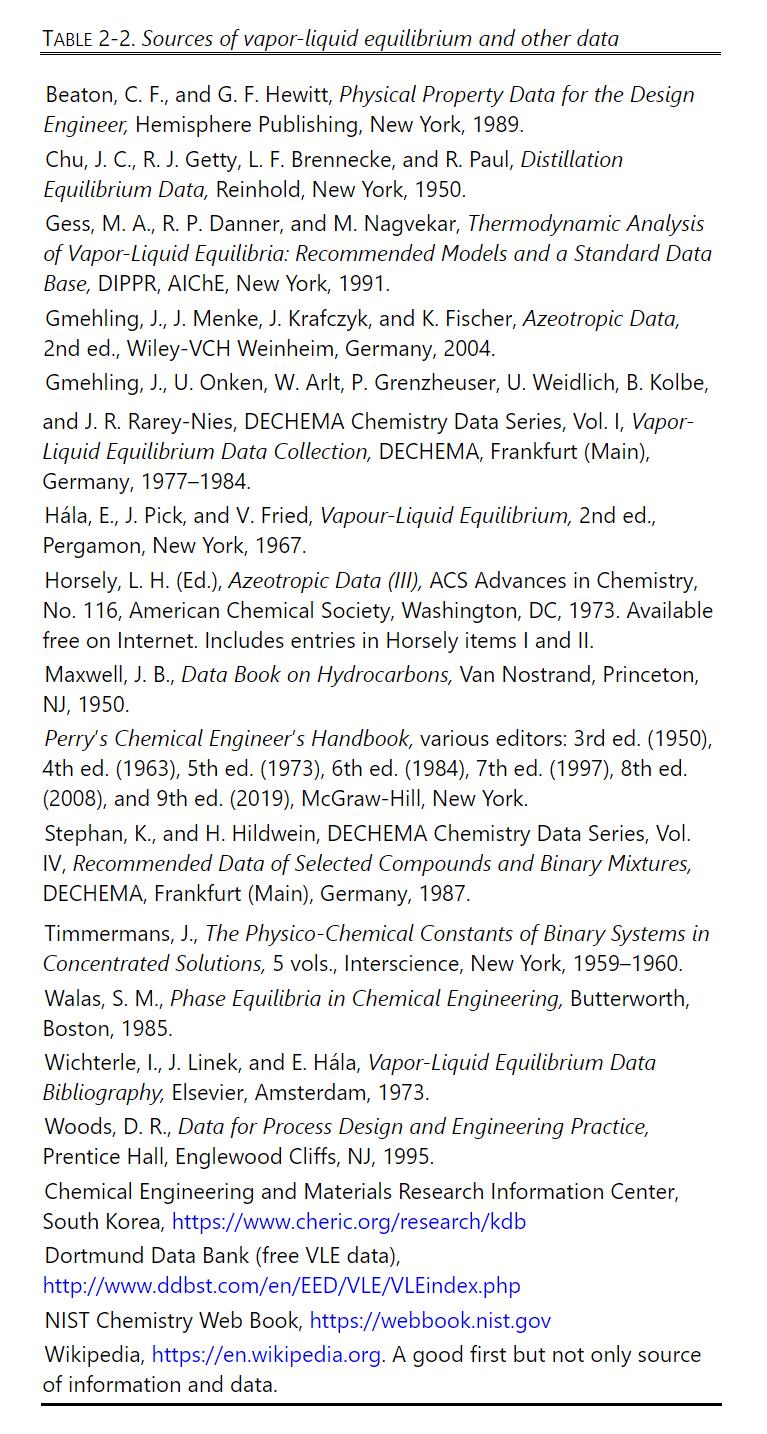
Develop a spreadsheet to solve problem 2.D13, parts b and c. Use Eq. (2-28). (Note: The easiest approach to solving this problem is to develop a spreadsheet similar to Figures 2-B2 and run the spreadsheet first for part b and next for part c.)Problem 2.D13Equation 2-28Figure 2-B2 D13. We flash
To explore what happens if a nonvolatile component is in the feed to a flash distillation, modify Figure 2-B2 to add \(37.5 \mathrm{kmol} / \mathrm{h}\) of a nonvolatile component to the feed.a. Keep drum temperature constant at \(10^{\circ} \mathrm{C}\) and determine a new V/F.b. Keep V/F constant
Benzene-toluene equilibrium is often approximated as \(\alpha_{\mathrm{BT}}=2.34\). Generate the \(\mathrm{y}-\mathrm{x}\) diagram for this relative volatility. Compare your results with data in the literature (see references in Table 2-2). Also, generate the equilibrium data using Raoult's law,
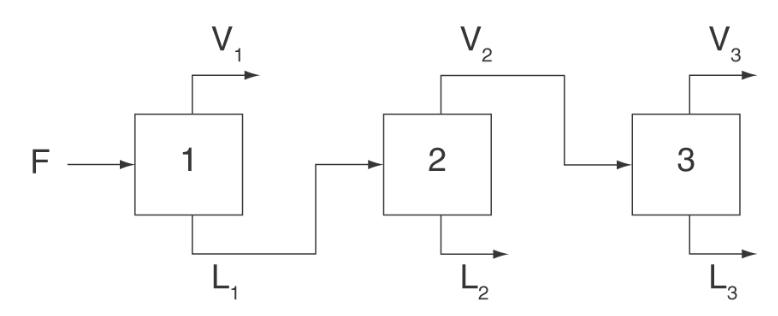
Ethylene glycol and water are flash distilled in a cascade of three drums connected as shown in the figure. All drums operate at 228 mm Hg. Feed is 40 mol% water. One-third of the feed is vaporized in the first drum, two-thirds of the feed to the second drum is vaporized, and one-half the feed to
Pure water at a flow rate of \(1500 \mathrm{~kg} /\) minute at \(\mathrm{p}=5000 \mathrm{kPa}\) and \(\mathrm{T}=500 \mathrm{~K}\) is sent to an adiabatic flash system operating at \(\mathrm{p}=100 \mathrm{kPa}\).a. Is this feed a liquid, a vapor, or a two-phase mixture?b. Find \(\mathrm{T}_{\text
Use the Peng-Robinson VLE correlation in Aspen Plus to solve Problem 2.D13, part \(\mathrm{b}\), except feed is a saturated liquid at 10.0 bar. Pressure is dropped to 6.0 bar in the flash drum. Report the values of \(\mathrm{x}\) and \(\mathrm{y}\) methane, \(\mathrm{T}_{\text {drum }}\), and
Two feeds containing methanol and water are sent to the same flash drum. Feed 1 is \(20 \mathrm{~mol} \%\) methanol, \(F_{1}=150 \mathrm{kmol} / \mathrm{h}\), and \((V / F)_{1}=0.4\). Feed 2 is \(30 \mathrm{~mol} \%\) methanol, \(\mathrm{F}_{2}=75 \mathrm{kmol} / \mathrm{h}\), and \((\mathrm{V} /
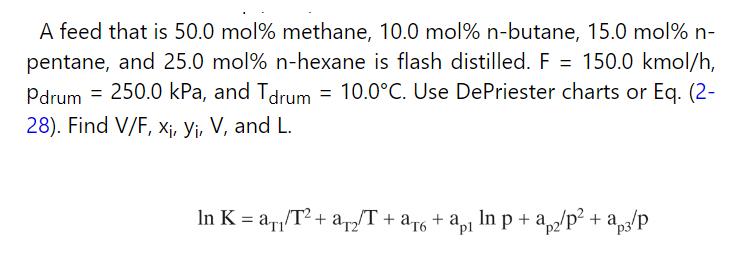
Use a process simulator to solve Problem 2.D16. Do "what if?" simulations to see what happens to V/F and product compositions as temperature and/or pressure vary.Problem 2.D16. A feed that is 50.0 mol% methane, 10.0 mol% n-butane, 15.0 mol% n- pentane, and 25.0 mol% n-hexane is flash distilled. F
One \(\mathrm{kmol} / \mathrm{s}\) of a feed containing \(20 \mathrm{~mol} \%\) furfural, \(75 \mathrm{~mol} \%\) water, and \(5 \mathrm{~mol} \%\) ethanol at \(105^{\circ} \mathrm{C}\) and 3.0 bar is fed to a three-phase flash drum. The drum is at 1 bar and operates with \(\mathrm{V} /
Use a process simulator to solve the following flash distillation problem. Feed is \(2 \mathrm{~mol} \%\) methane, \(30 \mathrm{~mol} \%\) n-butane, \(47 \mathrm{~mol} \% \mathrm{n}\)-pentane, and \(21 \mathrm{~mol} \% \mathrm{n}-\) hexane and is a liquid. The flash drum is at \(1.0
A vertical flash drum will be used to separate \(1000 \mathrm{kmol} / \mathrm{h}\) of a feed that is 10.0 \(\mathrm{mol} \%\) isopropanol and \(90.0 \mathrm{~mol} \%\) water. Feed is at 9.0 bar and \(75.0^{\circ} \mathrm{C}, \mathrm{V} / \mathrm{F}_{\text {drum }}\) \(=0.50\) and
A flash drum is to flash \(10,000 \mathrm{lbmol} / \mathrm{h}\) of a feed that is \(65 \mathrm{~mol} \% \mathrm{n}\)-hexane and \(35 \mathrm{~mol} \% \mathrm{n}-o c t a n e\) at \(1.0 \mathrm{~atm}\) pressure. \(\mathrm{V} / \mathrm{F}=0.4\).a. Find \(\mathrm{T}_{\text {drum }}\), liquid mole
A flash drum at \(1.0 \mathrm{~atm}\) is separating a feed consisting of methanol and water. If the feed rate is \(2000 \mathrm{~kg} / \mathrm{h}\) and the feed is \(45 \mathrm{wt} \%\) methanol, what are the values of \(\mathrm{L}(\mathrm{kg} / \mathrm{h}), \mathrm{V}(\mathrm{kg} / \mathrm{h}),
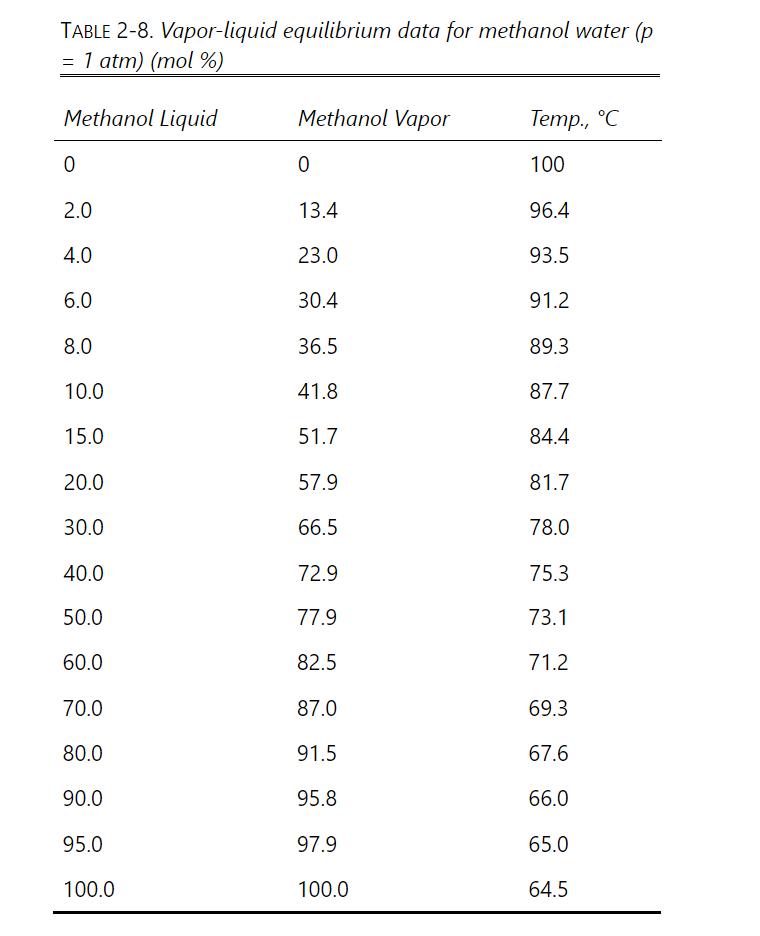
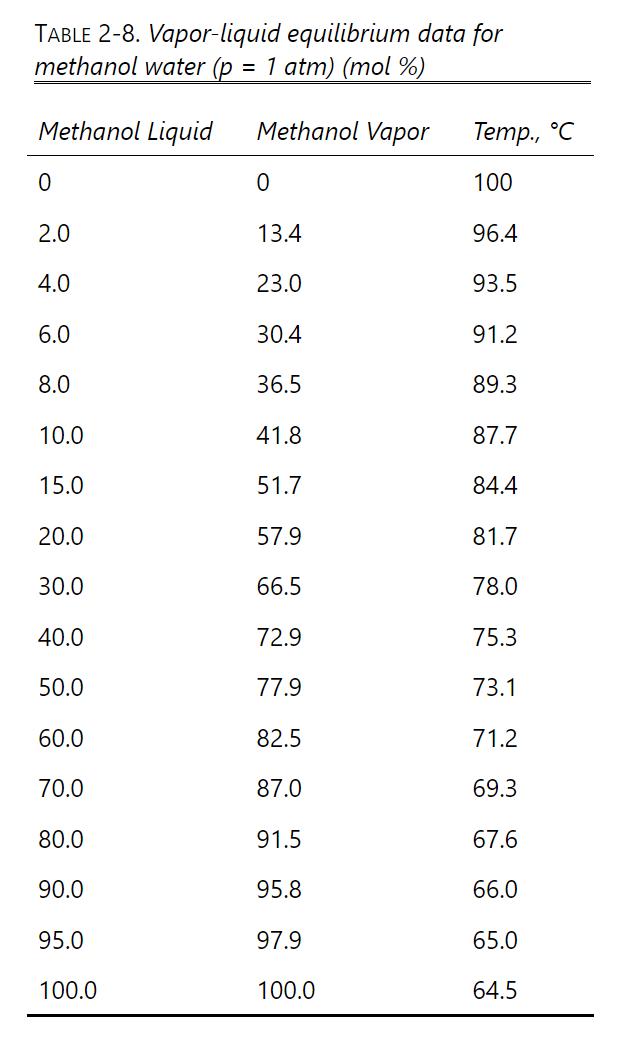
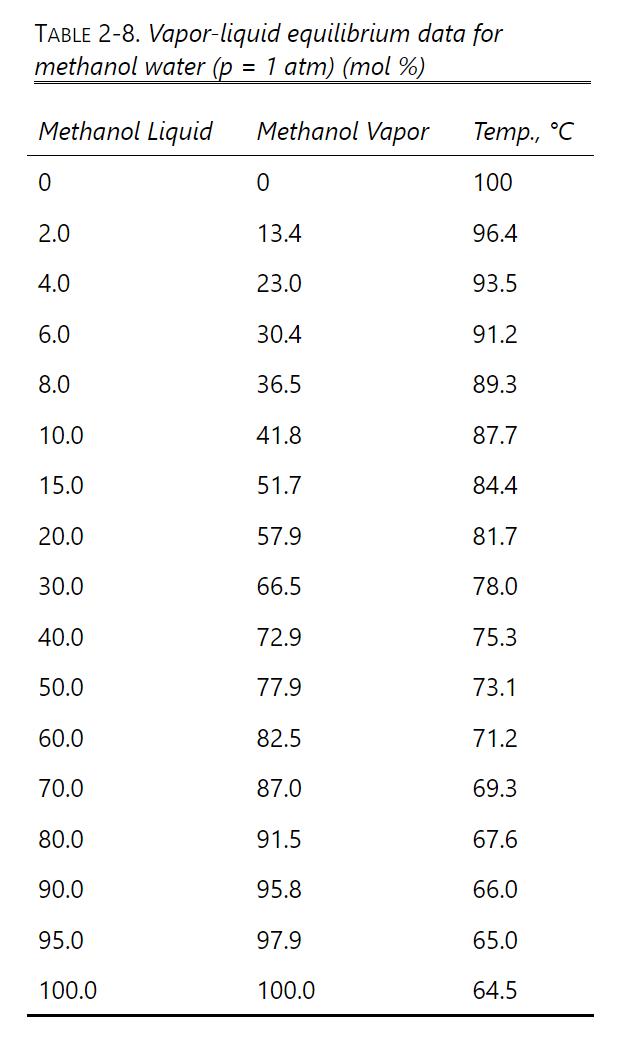
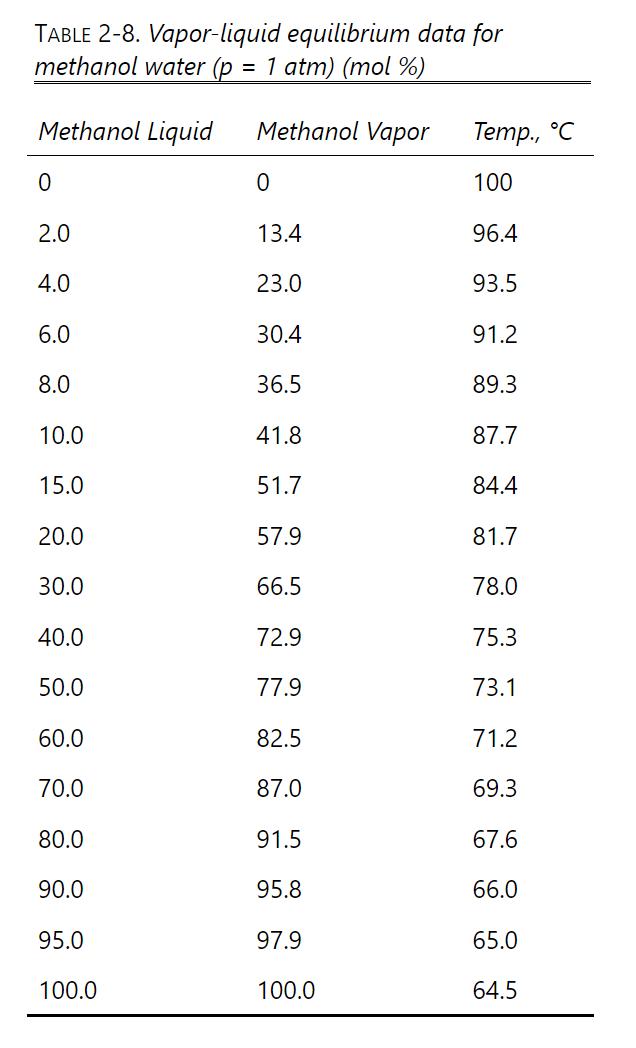
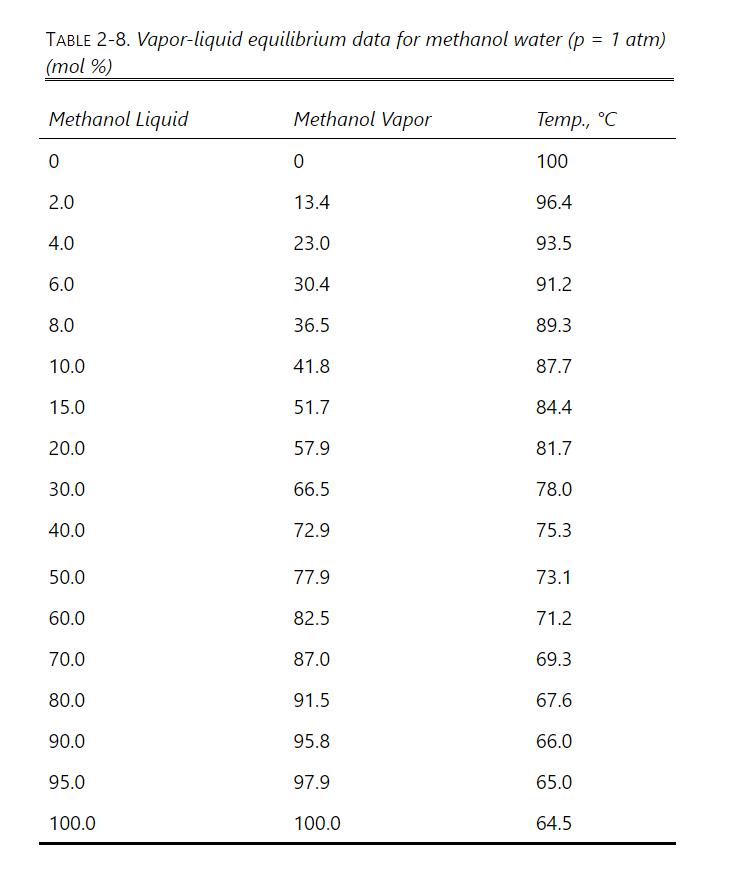
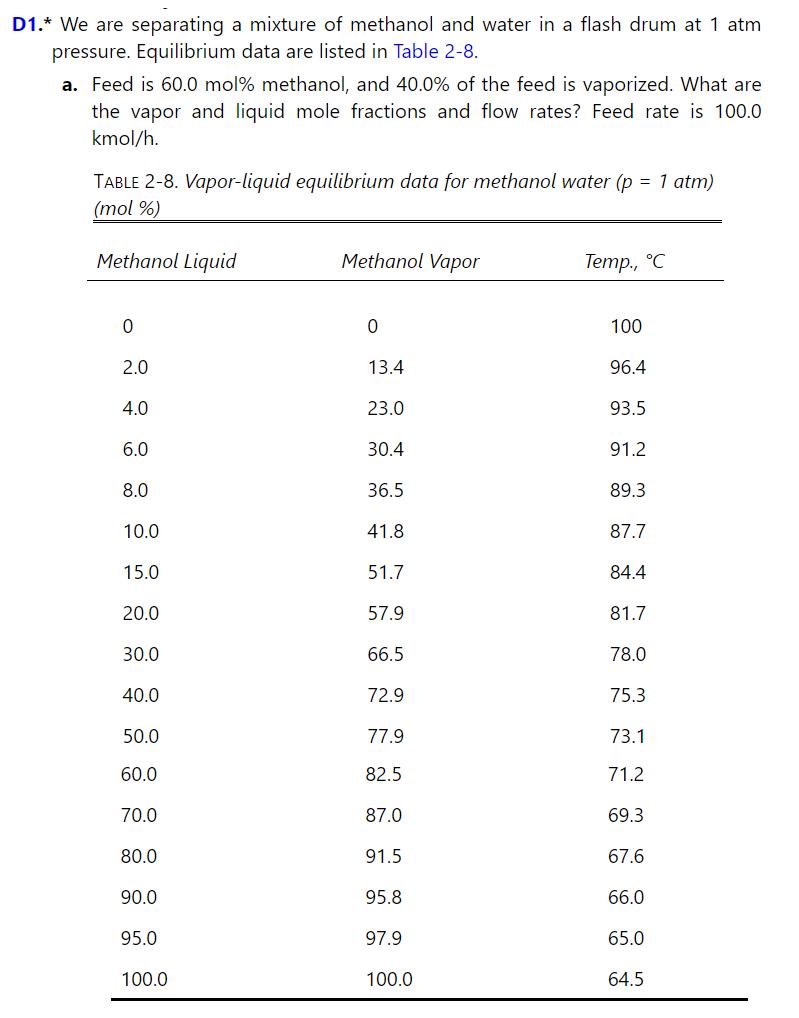
We are separating a mixture of methanol and water in a flash drum at 1 atm pressure. Equilibrium data are listed in Table 2-8.a. Feed is 60.0 mol% methanol, and 40.0% of the feed is vaporized. What are the vapor and liquid mole fractions and flow rates? Feed rate is 100.0 kmol/h.b. Repeat part a
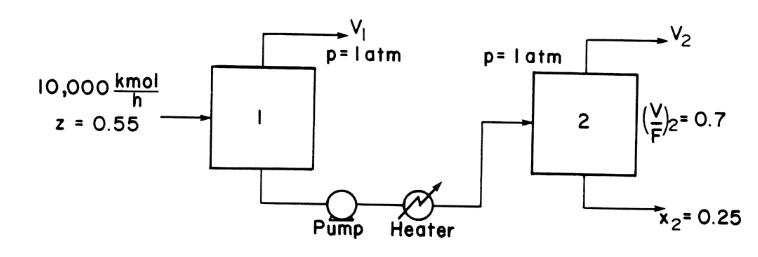
Two flash distillation chambers are hooked together as shown in the diagram. Both are at 1 atm pressure. The feed to the first drum is a binary mixture of methanol and water that is 55.0 mol% methanol. Feed flow rate is 10,000 kmol/h. The second flash drum operates with (V/F) 2 = 0.70 and the
Data for the equilibrium of water and n-butanol at 1.0 atmosphere are given in Table 8-5. Plot yw vs. xw. A feed of 100.0 kmol/h that is 20.0 mol% water is fed to flash chamber A, which is the first of two flash chambers. The vapor from flash chamber A is 40.0 mol% water. This vapor is then
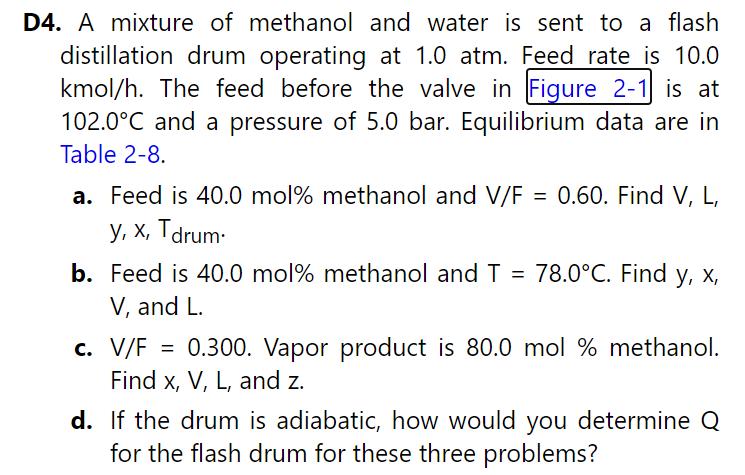
A mixture of methanol and water is sent to a flash distillation drum operating at 1.0 atm. Feed rate is 10.0 kmol/h. The feed before the valve in Figure 2-1 is at 102.0C and a pressure of 5.0 bar. Equilibrium data are in Table 2-8.Figure 2-1Table 2-8a. Feed is 40.0 mol% methanol and V/F = 0.60.
We have a feed that is a binary mixture of methanol and water (55.0 mol% methanol) that is sent to a system of two flash drums hooked together. The vapor from the first drum is cooled, which partially condenses the vapor, and then is fed to the second flash drum. Both drums operate at a pressure of
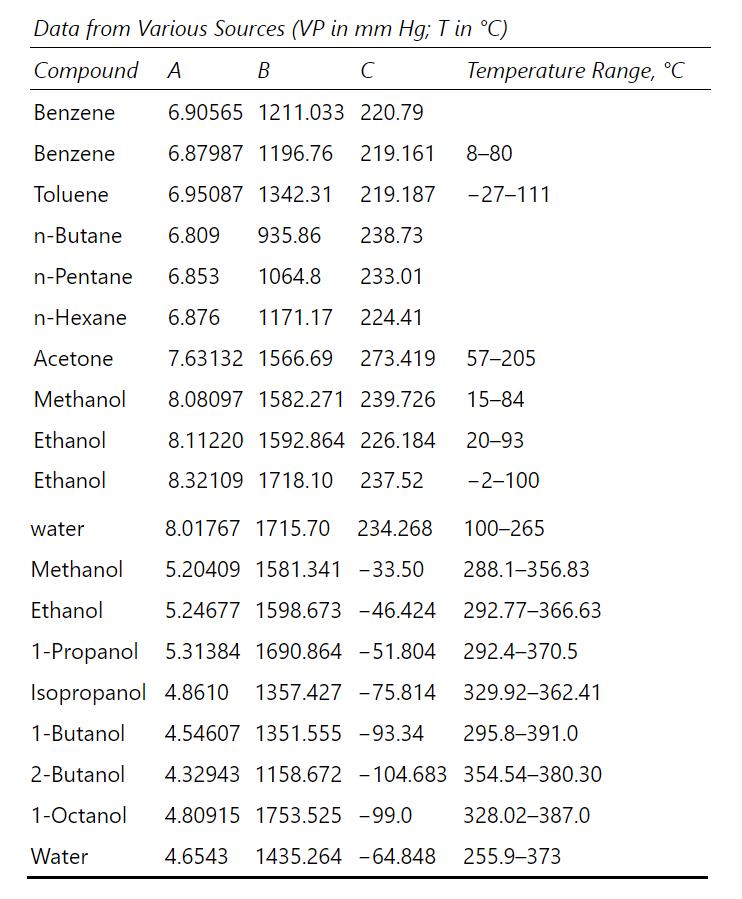
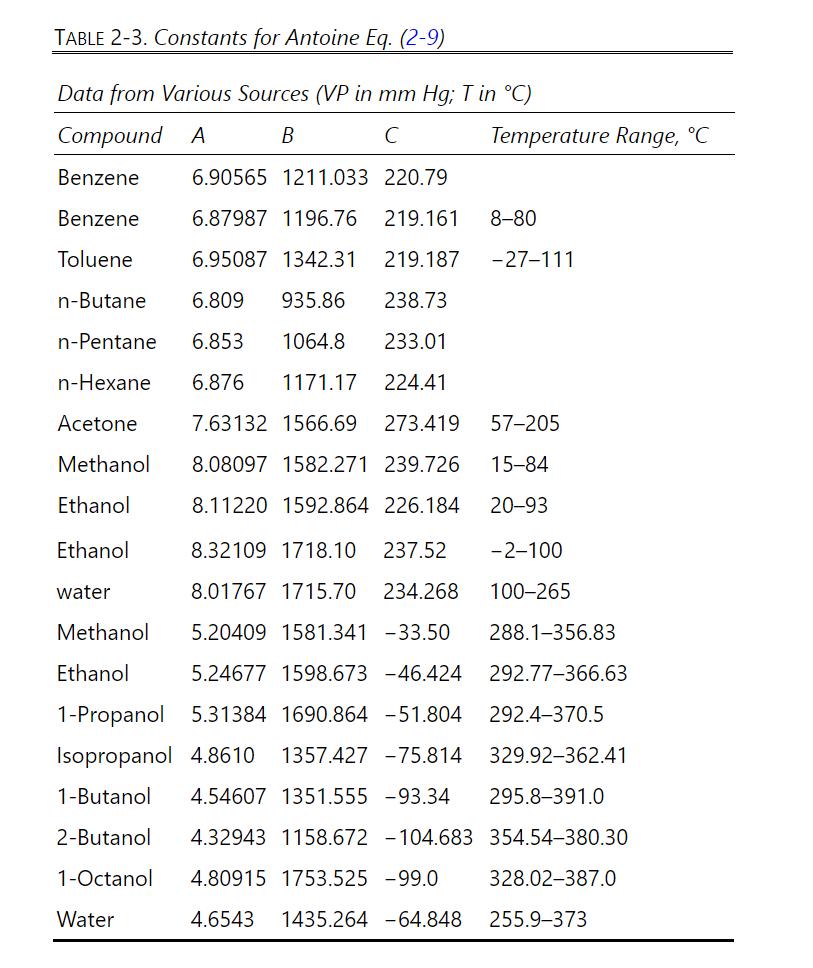
Antoine constants for 1-octanol and 1-propanol are listed in Table 2- 3.a. At 1.50 atm and 100.0C, what is vapor pressure of 1-octanol in mm Hg?b. Assuming Raoult's law is valid, what is the K value of 1-octanol at 1.50 atm and 100.0C?c. An alternate source for Antoine constants gives A = 6.8379, B
Your plant feeds 100.0 kmol/h of a mixture that is 46.0 mol% ethanol and 54.0 mol% water to a flash drum. Your boss thinks that results will be better with two flash drums (same configuration as in problem 2.D2) with V1 = 30.0 kmol/h and V2 = 30.0 kmol/h.Data From problem 2.D2D2.* Two flash
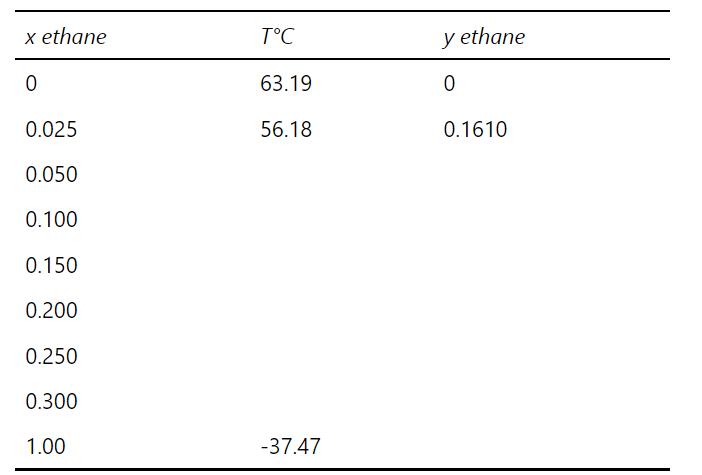
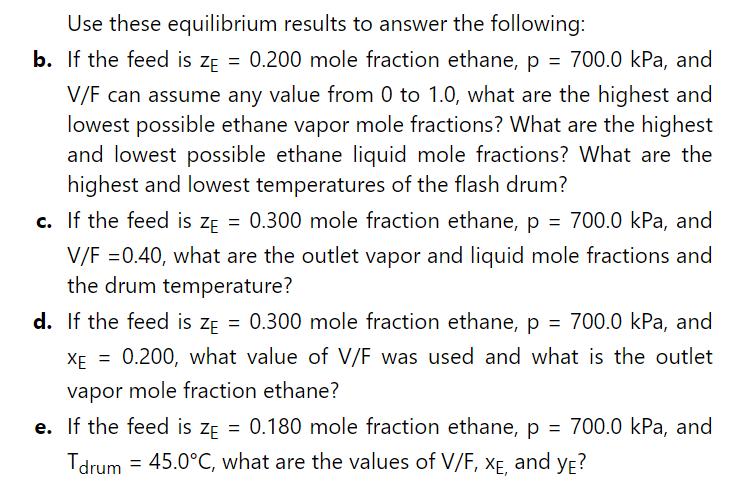
A flash drum at 700.0 kPa is separating binary mixtures of ethane and n-butane.a. The following equilibrium results were generated using correct units in Eq. (2-28) and then converting temperature to C. Complete the table and use the results to answer the questions that follow.Eq (2-28)Use these
We wish to flash distill an ethanol-water mixture that is \(30.0 \mathrm{wt} \%\) ethanol and has a feed flow of \(1000 \mathrm{~kg} / \mathrm{h}\). Feed is at \(200.0^{\circ} \mathrm{C}\). The flash drum operates at a pressure of \(1.0 \mathrm{~kg} / \mathrm{cm}_{2}\). Find \(\mathrm{T}_{\text
We have a mixture that is \(35.0 \mathrm{~mol} \% \mathrm{n}\)-butane with unknown amounts of propane and n-hexane. We are able to operate a flash drum at \(400.0 \mathrm{kPa}\) and \(70.0^{\circ} \mathrm{C}\) with (\mathrm{x}_{\mathrm{C6}}=0.700\). Find the mole fraction of \(n\)-hexane in the
An equilibrium mixture of ethylene and propylene is at \(2500 \mathrm{kPa}\) and \(25.0^{\circ} \mathrm{C}\). Find the vapor and liquid mole fractions of ethylene. Use DePriester charts or Eq. (2-28). This is not a guess-and-check problem.Equations (2-28) In K = a/T2+ a2 T + + pl In p + ap2/p +
Find the diameter and length of a horizontal flash drum for Problem 2.D1c if a hold-up time of 1.0 hours is specified.Problem 2.D1cc. If the feed is \(30.0 \mathrm{~mol} \%\) methanol and we desire a liquid product that is \(20.0 \mathrm{~mol} \%\) methanol, what V/F must be used? For a feed rate
We flash distill a mixture of methane and n-butane at \(\mathrm{p}_{\text {drum }}=6.0\) bar.a. Use the DePriester charts or Eq. (2-28). For several temperatures from \(\mathrm{T}=\) \(-60^{\circ} \mathrm{C}\) to \(\mathrm{T}=50^{\circ} \mathrm{C}\), calculate the values of \(\mathrm{y}\) and
A ternary mixture of methanol, n-propanol, and n-butanol is flash distilled at a pressure of \(0.74 \mathrm{~atm}\). The feed is \(36 \mathrm{~mol} \%\) methanol, \(42 \mathrm{~mol} \% \mathrm{n}\)-propanol, and the remainder n-butanol. The relative volatility of methanol with respect to \(n-\)
We have a flash drum separating \(50.0 \mathrm{kmol} / \mathrm{h}\) of a mixture of ethane, isobutane, = and n-butane. The ratio of isobutane to n-butane is held constant at 0.80 (that is, Zic4/ZnC4 0.80). The mole fractions of all three components in the feed can change. If the flash drum operates
A feed that is \(50.0 \mathrm{~mol} \%\) methane, \(10.0 \mathrm{~mol} \% \mathrm{n}\)-butane, \(15.0 \mathrm{~mol} \% \mathrm{n}\)-pentane, and \(25.0 \mathrm{~mol} \% \mathrm{n}\)-hexane is flash distilled. \(\mathrm{F}=150.0 \mathrm{kmol} / \mathrm{h}, \mathrm{p}_{\text {drum }}=250.0
Two feeds containing ethanol and water at \(1.0 \mathrm{~atm}\) are fed simultaneously to the same flash drum. Feed 1 is \(10.0 \mathrm{~mol} \%\) ethanol, \(\mathrm{F}_{1}=150.0 \mathrm{kmol} / \mathrm{h}\), and \((\mathrm{V} / \mathrm{F})_{1}=\) 0.40 . Feed 2 is \(30.0 \mathrm{~mol} \%\) ethanol,
\(10 \mathrm{kmol} / \mathrm{h}\) of a feed that is \(10.0 \mathrm{~mol} \%\) propane, \(30.0 \mathrm{~mol} \% \mathrm{n}\)-butane, and 60.0 \(\mathrm{mol} \% \mathrm{n}\)-hexane is flash distilled at a drum pressure of \(200 \mathrm{kPa}\). We desire a liquid that is \(85.0 \mathrm{~mol} \%
A flash drum operating at \(300 \mathrm{kPa}\) is separating \(1000.0 \mathrm{kmol} / \mathrm{h}\) of a mixture that is \(40.0 \mathrm{~mol} \%\) isobutane, \(25.0 \% \mathrm{n}\)-pentane, and \(35.0 \% \mathrm{n}\)-hexane. We wish a \(90.0 \%\) recovery of \(n\)-hexane in the liquid. Find
\(200 \mathrm{kmol} / \mathrm{h}\) of a feed that is \(10.0 \mathrm{~mol} \%\) ethanol and \(90.0 \mathrm{~mol} \%\) water is separated in a pair of flash drums. The vapor from drum 1 is partially condensed and fed to drum \(2\left(F_{2}=V_{1}\right)\). If \(y_{2}=0.450\) and \(V_{2} /
We wish to flash distill a feed that is \(55.0 \mathrm{~mol} \%\) ethane and \(45.0 \mathrm{~mol} \% \mathrm{n}-\) pentane. \(\mathrm{p}_{\text {drum }}=700 \mathrm{kPa}\) and \(\mathrm{T}_{\text {drum }}=30.0^{\circ} \mathrm{C}\). Feed flow rate is \(100,000 \mathrm{~kg} / \mathrm{h}\).a. Find
\(50 \mathrm{kmol} / \mathrm{h}\) of a vapor feed that is \(70 \mathrm{~mol} \%\) methanol and \(30 \mathrm{~mol} \%\) water is partially condensed in a heat exchanger and then fed to a flash drum operating at a pressure of \(1.0 \mathrm{~atm} .20 \mathrm{kmol} / \mathrm{h}\) of liquid product is
You specified a 5.5 -foot diameter, 22.0 -foot long drum with a mesh demister for Example 2-4. This drum was built. Later, your boss informed you that a minor [the boss' word] mistake had been made in the specifications given to you. The flow rate of the liquid feed to be flashed is \(1500
We plan to separate a mixture of propane and n-hexane at 300 kPa.a. Using the data in the DePriester charts, plot ypropane VS. Xp Xpropane for this mixture at 300 kPa. Xpropane and T vs.b. If the feed is 30.0 mol% propane, and V/F = 0.40, what are the liquid and vapor mole fractions and the drum
Two feeds containing ethanol and water at \(1.0 \mathrm{~atm}\) are fed simultaneously to the same flash drum. Feed 1 is \(20.0 \mathrm{~mol} \%\) ethanol, \(\mathrm{F}_{1}=150.0 \mathrm{kmol} / \mathrm{h}\), and \((\mathrm{V} / \mathrm{F})_{1}=\)0.40. Feed 2 is \(30.0 \mathrm{~mol} \%\) ethanol,
Use Eq. (2-11) to create a table comparing the y values for methanol for methanol-water VLE at \(1.0 \mathrm{~atm}\) versus y values from Table 2-8 (in problem 2.D1) for all the \(x\) values in Table 2-8. Comment on how good the fit is.Eq(2-11)Table 2-8Problem 2.D1 y= -+bx(1-x) 1+(a-1)x
Antoine constants for vapor pressure for \(\mathrm{n}\)-pentane and \(\mathrm{n}\)-hexane are listed in Table 2-3.a. Predict the vapor pressure at \(0.0^{\circ} \mathrm{C}\) for pure \(\mathrm{n}\)-pentane.b. Predict the boiling point of pure \(\mathrm{n}\)-pentane at \(3.0 \mathrm{~atm}\)
Repeat Example 2-4, but with \(\mathrm{F}=3000 \mathrm{lbmol} / \mathrm{h}\), and use a horizontal flash drum with holding time \(=55 \mathrm{~min}\) and surge time \(=85 \mathrm{~min}\). Calculate \(\mathrm{D}, \mathrm{h}\), and \(\mathrm{h} / \mathrm{D}\).Example 2-4A vertical flash drum is to
Design a horizontal flash drum to separate \(15,000 \mathrm{~kg} / \mathrm{h}\) of a feed with the following mass fractions: methane 0.21 , propane 0.39 , n-butane 0.24 , i-butane 0.11 , and n-pentane 0.05 . The feed is at \(0.0^{\circ} \mathrm{C}\) and a pressure just high enough that it is all
A flash drum is separating \(n\)-butane and \(n\)-pentane with \(T_{\text {drum }}=20.0^{\circ} \mathrm{C}\) and \(p_{\text {drum }}\) \(=101.3 \mathrm{kPa}\). The feed is \(50.0 \mathrm{wt} \% \mathrm{n}\)-butane and \(50.0 \mathrm{wt} \% \mathrm{n}\)-pentane. Use the Rachford-Rice equation to
A feed of \(100.0 \mathrm{kmol} / \mathrm{h}\) that is \(60.0 \mathrm{~mol} \%\) methanol, and \(40.0 \mathrm{~mol} \%\) water is sent to a system of three flash drums operating at 1.0 atmosphere. The feed is sent to drum A with \((\mathrm{V} / \mathrm{F})_{\mathrm{A}}=0.666\). After partial
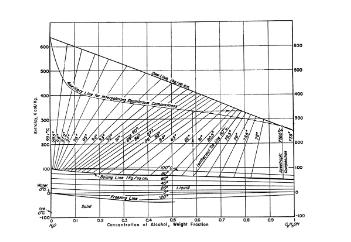
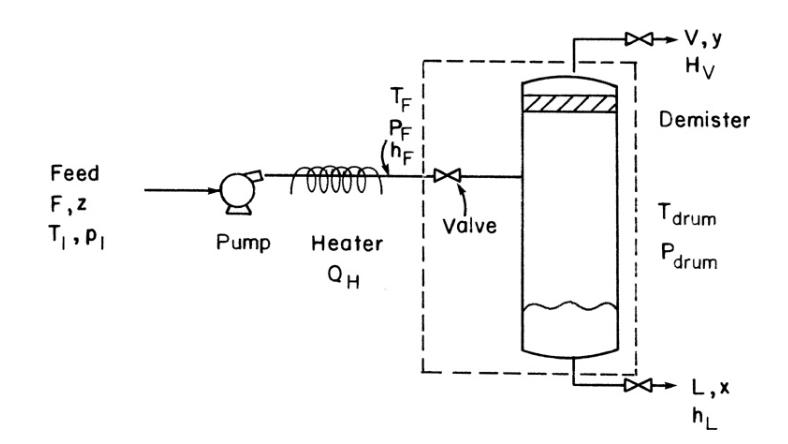
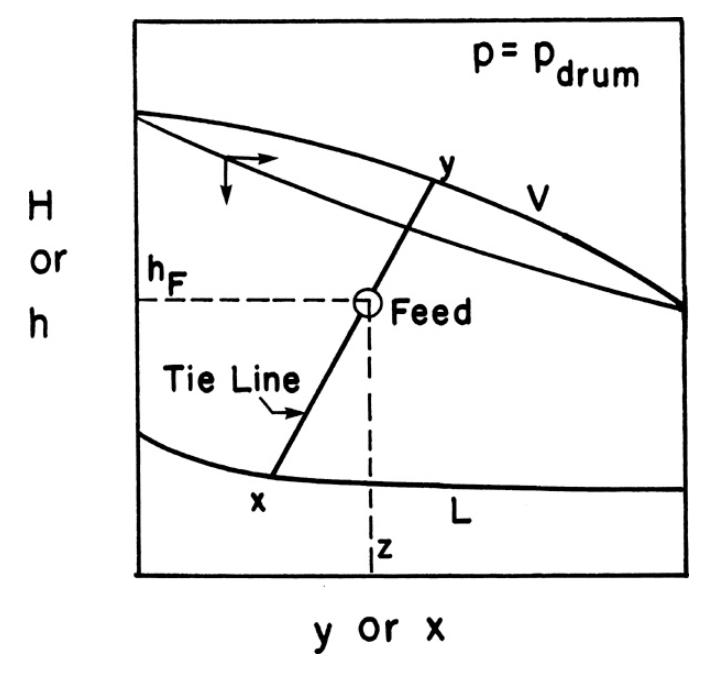
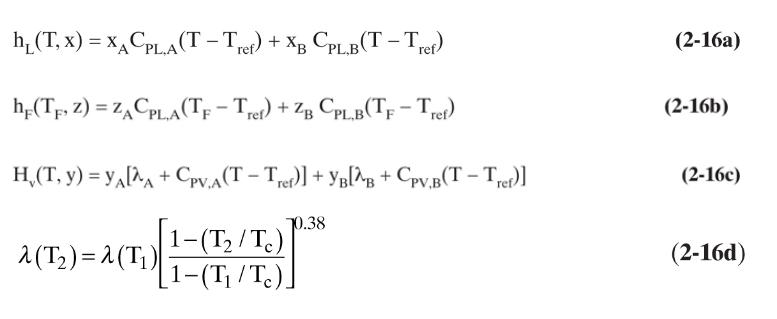
In Figure 2-9, the feed plots as a two-phase mixture, whereas it is a liquid before introduction to the flash chamber. Explain why. Why can’t the feed location be plotted directly from known values of TF and z? In other words, why does hF have to be calculated separately from an equation such as
Can weight units be used in the flash calculations instead of molar units?
Flash distillation is usually operated adiabatically. Where does the energy to vaporize part of the feed come from?
In the flash distillation of salt water, the salt is totally nonvolatile (this is the equilibrium statement). Show a McCabe-Thiele diagram for feed water containing 3.5 wt % salt. Be sure to plot weight fraction of more volatile component.
Develop your own key relations chart for this chapter. That is, on one page summarize everything you would want to know to solve problems in flash distillation. Include sketches, equations, and key words.
In a flash drum separating a multicomponent mixture, raising the pressure willa. increase the drum diameter and increase the relative volatilities.b. increase the drum diameter and cause no change to the relative volatilities.b. increase the drum diameter and cause no change to the relative
a. What would Figure 2-2 look like if we plotted y2 vs. X2 (i.e., plot less volatile component mole fractions)?b. What would Figure 2-3 look like if we plotted T vs. X2 or y2 (less volatile component)?c. What would Figure 2-4 look like if we plotted H or h vs. y2 or x2 (less volatile component)?
a. At 100.0°C and a pressure of 200.0 kPa, what is the K value of n-hexane?b. As the pressure increases, does the K value (a) increase, (b) decrease, or (c) stay constant?c. Within a homologous series such as light hydrocarbons, as the molecular weight increases, does the K value (at constant
Use the DePriester chart:What is the K value of propane at 240.0 kPa and 25.0°C?What is the normal boiling point of n-pentane?What is the boiling point of n-pentane at p = 600.0 kPa?
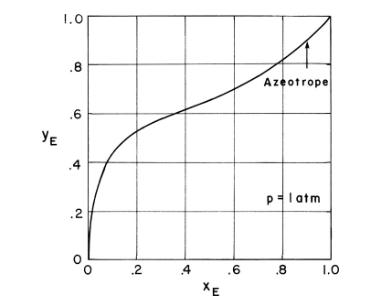
Use the vapor-liquid equilibrium data at 1.0 atm. for methanol-water (Table 2-8 in Problem 2.D1) for the following:If the methanol vapor mole fraction is 0.600, what is the methanol liquid mole fraction?Is there an azeotrope in the methanol-water system at a pressure of 1.0 atmospheres?If water
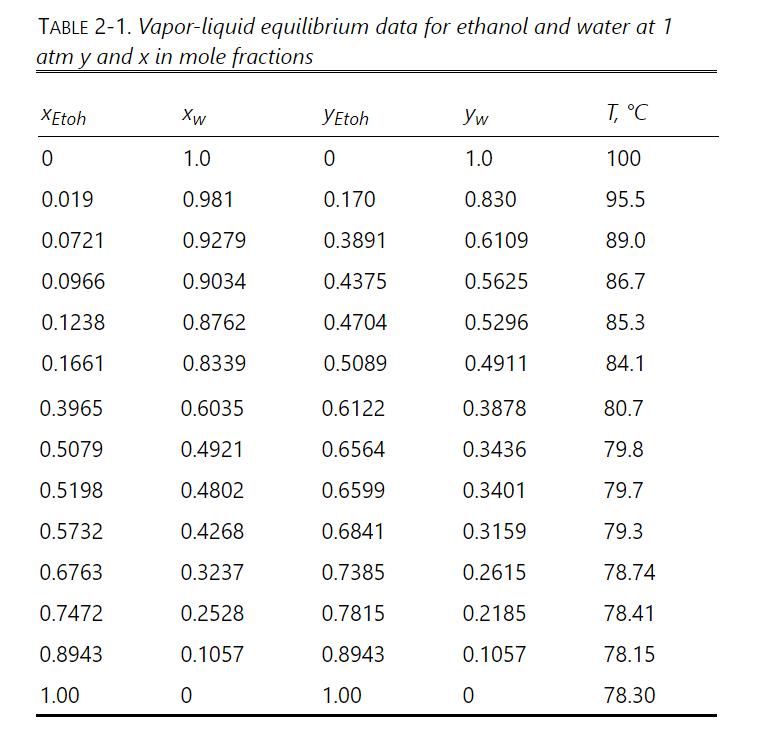
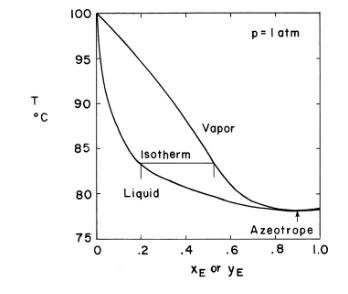
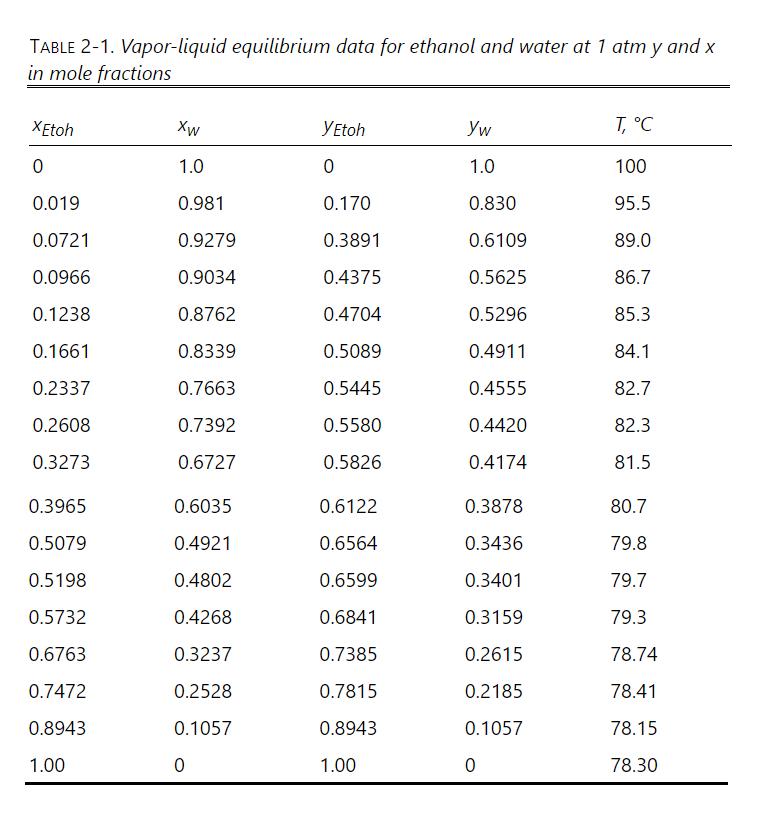
An open glass of an alcoholic beverage that is 15.0 mol% ethanol and 85.0 mol% water has been sitting on the table for a long time and is at 1.0 atm pressure and 25.0°C. The temperature and mole fractions are not even close to values in Table 2-1. Explain why not. TABLE 2-1. Vapor-liquid
Why is there a difference between degrees of freedom for equilibrium and degrees of freedom for complete design? Example: binary flash. Gibbs phase rule, F = C − P + 2 =2; entire design F = 6.
Part E of Example 2-3 determines the differences between Aspen Plus and Example 2-3 results. Explain how the % difference in V is about 4.5 times as the % difference in L yet the numerical differences between V (Aspen Plus value V − Example 2-3 value V) and L (Aspen Plus value L − Example 2.3
Figure 2-4 is at a pressure of 1.0 kg/cm2 (actually kgf/cm2), which was formerly a fairly common pressure unit. What is the pressure in bar and in atm? 100 400 O 05 100
Think of all the ways a binary flash distillation problem can be specified. For example, we have usually specified F, z, Tdrum, Pdrum in addition to T and p. If T and p are constant, what other combinations of variables can be used? (I have over 20.) Then consider how you would solve the resulting
An existing flash drum is available. The vertical drum has a demister and is 4 ft in diameter and 12 ft tall. The feed is 30 mol% methanol and 70.0 mol% water. A vapor product that is 58 mol% methanol is desired. We have a feed rate of 25,000 lbmol/h. Operation is at 1 atm pressure. Since this feed
Determine the effect of pressure on the temperature, separation, and diameter of a flash drum.
Analytically solve the Rachford-Rice equation for V/F for a binary system.
Assume that vapor pressure can be calculated from the Antoine equation and that Raoult's law can be used to calculate K values. For a binary flash system, derive an analytical expression for the drum pressure if drum temperature and V/F are given.
Showing 800 - 900
of 1819
First
2
3
4
5
6
7
8
9
10
11
12
13
14
15
16
Last
Step by Step Answers

 Get 50% OFF
Claim Now
Get 50% OFF
Claim Now